We've seen plenty of poker games interrupted by gunfights on Western pulp covers, of course, but as far as I recall, this is the first one I've run across where the same thing happens during a game of pool. This cover is by H.W. Scott, who did nearly all the covers for WESTERN STORY during this particular era. As usual, there are plenty of good authors inside including Harry Sinclair Drago, Cliff Farrell, Hugh B. Cave, Frank Richardson Pierce writing as Seth Ranger, James B. Hendryx, Lloyd Eric Reeve, and Russell A. Bankson. I don't own this issue, but it looks like a good one.
Saturday, September 20, 2025
Saturday Morning Western Pulp: Street & Smith's Western Story, August 9, 1941
We've seen plenty of poker games interrupted by gunfights on Western pulp covers, of course, but as far as I recall, this is the first one I've run across where the same thing happens during a game of pool. This cover is by H.W. Scott, who did nearly all the covers for WESTERN STORY during this particular era. As usual, there are plenty of good authors inside including Harry Sinclair Drago, Cliff Farrell, Hugh B. Cave, Frank Richardson Pierce writing as Seth Ranger, James B. Hendryx, Lloyd Eric Reeve, and Russell A. Bankson. I don't own this issue, but it looks like a good one.
Sunday, September 07, 2025
Sunday Morning Bonus Pulp: Terror Tales, July 1935
Nobody could accuse TERROR TALES, or any of the other Weird Menace pulps, for that matter, of being subtle and restrained. That's certainly true of this cover by John Howitt, which is one of the more lurid that I recall. The lineup of authors inside this issue is pretty much an all-star one for this genre: Hugh B. Cave, Wyatt Blassingame, Wayne Rogers, Paul Ernst, Nat Schachner, and James A. Goldthwaite writing as Francis James. All those guys wrote other things, too, of course, but they were prolific and well-regarded contributors to the Weird Menace pulps.
Sunday, December 31, 2023
Sunday Morning Bonus Pulp: Far East Adventure Stories, September 1931
That's a very effective, evocative cover by Don Hewitt on this issue of FAR EAST ADVENTURE STORIES. I certainly would have picked that one up off the newsstand back in 1931, and the authors inside probably would have prompted me to slap down a couple of dimes if I had them: H. Bedford-Jones (with part of a John Solomon story), two stories by Hugh B. Cave (one under his pseudonym Geoffrey Vace), a yarn by Bob du Soe, and stories by forgotten pulpsters Chester L. Saxby, Sgt. Herbert E. Smith, A.L. De Burgh, and T.S. Southwick. De Burgh has only two credits in the FMI, Southwick only one, and that always makes me suspect the names are pseudonyms for better known authors, but who knows? All I know is that this looks like a very enjoyable pulp, and it's the final one of the year in this series. But I'll be back next week in a new year, if all goes according to plan.
Sunday, December 17, 2023
Sunday Morning Bonus Pulp: Detective Fiction Weekly, January 13, 1940
I've mentioned before that the first actual pulp I ever owned was an issue of DETECTIVE FICTION WEEKLY, so I've always had a soft spot for that magazine despite reading very little from it. This issue from 1940 sports a good cover by Emmett Watson and a very solid line-up of authors including Cleve F. Adams with two stories, a novelette and an installment from a Rex McBride serial called "Homicide: Honolulu Bound". If this serial was published as a novel under some other title, maybe one of you out there can provide that information. Also on hand are Brett Halliday (Davis Dresser) with an installment in the Mike Shayne serial "Death Rides a Winner" (if I've read this, I don't remember it), Hugh B. Cave, John St. John (who was really Richard Sale) and a forgotten pulpster named John Randolph Phillips. Like ARGOSY, DETECTIVE FICTION WEEKLY is a frustrating pulp for people who just want to read the stories because of all the serials, but there's no doubt that a lot of great yarns were published in its pages.
Sunday, December 10, 2023
Sunday Morning Bonus Pulp: Adventure, November 1943
This is a pulp that I own and read recently. The cover is by Maurice Bower, an artist I’m not familiar with who did quite a few covers for ADVENTURE during this period. It’s an okay cover, not one of my favorites by any means, but it promises excitement inside and that’s what it was supposed to do.
The first thing I noticed about this issue is that it has a story by Georges
Surdez in it. Surdez is always good. But when I opened it up, the story by him
is actually the first installment of a two-part serial set in World War II.
Boo! I don’t own the issue with the second part, and it doesn’t appear to be
online, so I wound up skipping this one. I also skipped the final installment
of “The Fleet in the Forest”, a five-part historical serial about the War of
1812 by Carl D. Lane. It was published as a novel. Maybe I’ll read it one of
these days, as I find the War of 1812 interesting.
The next thing I noticed is that there are three non-Western short stories by
authors best remembered for their Westerns. “Collision Hazard” by L.L. Foreman
is one of several stories in this issue set during World War II. It’s a tale of
naval action centered around a tugboat, not the usual vessel you’d think of in
a story like this. But it’s an excellent yarn, very tense and well-written.
Foreman was one of the best Western pulpsters and he demonstrates his skill
here, too. “Message to Manakas” is by Hal G. Evarts Jr. (son of the early Western
novelist Hal G. Evarts Sr.) and is another World War II yarn about a soldier of
Greek descent being infiltrated into Crete to deliver a message to the leader
of the Greek underground. It’s well-written but maybe not quite as exciting as
it should have been. “Break-Through” by Robert E. Mahaffey, one of the regulars
in various Popular Publications Western pulps, is a short-short about a couple
of GIs driving a truck in North Africa. It has a twist ending that I didn’t see
coming, and that makes it effective.
“Gray Is For Apple” is another short story set during the war, a nice little
yarn about an Australian soldier in the New Guinea campaign who’s a fantastic
marksman despite a handicap he has to overcome. The author, Christian Folkard, was
an Australian journalist and war correspondent who published only three stories
in the pulps, in 1943 and ’44. This is the first of that trio, and it’s a good
one.
The novelette “One Little Slip” is a Northern by H.S.M. Kemp, who wrote plenty
of them for various pulps. It’s a cleverly plotted tale in which a Mountie
solves a murder. I liked it quite a bit.
The other novelette in this issue is “Red Justice” by William Du Bois. It’s
part of a series about an army officer named Captain John Carter (Really? That’s
the name you want to use?) who battles the Seminole Indians during the 1830s.
There’s a lot of back-story from the other entries in the series, I didn’t care
for the protagonist, and the writing never resonated with me. I read it, but I
didn’t care for it.
There’s also an article by Hugh B. Cave about PT boats that’s actually an
excerpt from his non-fiction book on the subject LONG WERE THE NIGHTS. Cave’s
work is always worth reading, and I’ve been interested in PT boats ever since
being a fan of McHALE’S NAVY in its original run 60 years ago, so I read and
enjoyed this article even though I usually skip the non-fiction content in
fiction magazines.
So this issue of ADVENTURE is a really mixed bag. None of the stories are
outstanding, but the ones by Foreman, Evarts, Mahaffey, Folkard, and Kemp are
all okay, entertaining yarns without being all that special. Don’t rush to your
shelves for this one, but if it’s handy you might find it worth reading.
One more note: in the back of this issue and others of the era is a column
called “Lost Trails”, where readers can write in, in hopes of reconnecting with
friends or relatives they’ve lost track of. Most of these notes are fairly
bland, if vaguely poignant, but one in this issue caught my eye: “Louis Sixt,
probably known as Bob Six, last heard of Gananoque, Ont., and Vancouver, B.C.
Age about 26, height 4’ 10”, weight 135 lbs., gray eyes, back-brushed straight
brown hair. Scrapper, gambler, seafaring man. Anyone having knowledge of his
whereabouts please write his brother Paul Sixt c/o Adventure.” What a
great description! And now I want to write a series of pulp yarns about a
scrappy little guy named Bob Six knocking around and having adventures all over
the world. I’ll probably never do it, of course, but it’s fun to think about. Just
out of curiosity, I tried to look up Louis Sixt and his brother Paul, but I
couldn’t find out anything about them. Maybe one of their descendants will read
this and email me one of these days. Stranger things have happened, as the
saying goes.
Sunday, October 01, 2023
Sunday Morning Bonus Pulp: Detective Fiction Weekly, April 20, 1940
An issue of DETECTIVE FICTION WEEKLY was the first actual pulp I ever owned, so I've always had a fondness for the magazine. This issue has a nice cover by Emmett Watson, who provided excellent covers for many Munsey pulps, and there's a strong line-up of authors inside: Donald Barr Chidsey (with a Morton and McGarvey story), Hugh B. Cave, D.L. Champion, G.T. Fleming-Roberts, Walter Ripperger (who was a very prolific author of detective and adventure yarns for various Munsey pulps but almost completely forgotten now, probably because apparently he never wrote any novels), and a couple of authors unknown to me, Lois Ames and B.B. Fowler. Like ARGOSY, DETECTIVE FICTION WEEKLY is a frustrating title for collectors because it ran a lot of serials, but there's plenty of good stuff in those pages anyway.
Sunday, January 22, 2023
Sunday Morning Bonus Pulp: Spicy-Adventure Stories, February 1938
H.J. Ward provides another typically lurid cover on this issue of SPICY-ADVENTURE STORIES. Inside are some of the usual Spicy authors: Robert Leslie Bellem (as Jerome Severs Perry), E. Hoffmann Price, Hugh B. Cave (an Eel story as Justin Case), Edwin Truett Long (as Dale Boyd and Charles Daw), and two authors not known to be house-names, Ross Flynn and Wyreck Brent. However, both guys published only a few stories and only in various Spicy pulps, so I wouldn't put too much faith in those being their real names.
Sunday, July 24, 2022
Sunday Morning Bonus Pulp: Detective Fiction Weekly, July 20, 1940
Foreign Legion covers showed up frequently on ARGOSY and ADVENTURE, but I don't recall seeing any on DETECTIVE FICTION WEEKLY until I came across this issue on the Fictionmags Index. I don't know who did the cover, but I think it's a pretty good one. It illustrates a story by Robert Carse, who did plenty of good Foreign Legion stories for ARGOSY. Since ARGOSY and DETECTIVE FICTION WEEKLY were both published by the Frank A. Munsey Company, it's possible Carse wrote this, sent it to ARGOSY, and somebody at Munsey decided to run it in DETECTIVE FICTION WEEKLY because of its title. Not that it matters, but I find speculation like that interesting. Also on hand in this issue are Hugh B. Cave, Lawrence Treat, David Goodis, Edward S. Aarons (writing as Edward Ronns), and Edwin Truett Long (writing as Edwin Truett). That's a really nice group of authors, and for a change, no serials! (Serials being the bane of a collector's existence, of course, and Munsey ran a ton of them.)
Sunday, August 22, 2021
Sunday Morning Bonus Pulp: Dime Detective, June 1936
With the exception of BLACK MASK in the Twenties, I'm not sure there was ever a better detective pulp than DIME DETECTIVE in the Thirties. And DIME DETECTIVE runs BLACK MASK a pretty close second! With Walter Baumhofer as the regular cover artist, you know the magazine was going to look great. This issue has a pretty typical line-up of authors inside: a Cardigan story by Frederick Nebel, a Needle Mike story by William E. Barrett, a Carter Cole story by Frederick C. Davis, a Kip Lacey story by Robert Sidney Bowen, and a stand-alone yarn by Hugh B. Cave. You might find a better bunch of writers than that in some other detective pulp, but not often.
Friday, March 26, 2021
Forgotten Books: Magazines I Remember - Hugh B. Cave
I consider myself fortunate to have traded a few emails with Hugh B. Cave before he passed away. Like nearly all of the old pros I’ve met or corresponded with, he was a true gentleman and always a pleasure to hear from. A legendary pulp writer who had a long, prolific career in their pages, Cave was unusual in that he moved on to other things and continued writing successfully all the way into this century.
His memoir, MAGAZINES I REMEMBER: SOME PULPS, THEIR EDITORS, AND WHAT IT WAS
LIKE TO WRITE FOR THEM, published by Tattered Pages Press in 1994, touches on
all phases of his career, not just the pulps, despite its subtitle. Most of it
is drawn from a decades-long correspondence between Cave and fellow writer Carl
Jacobi. The letters from the Thirties, full of news about stories they had
written, sales they had made, and the changing landscape of magazines, editors,
and agents, is a fascinating look into the pulp industry. Cave was prolific,
though never a million-words-a-year man like Arthur J. Burks, and when he
writes about how it was to make your living that way, you know he knows what
he’s talking about.
But equally interesting are the sections about writing dozens of stories for
the high-paying slick magazines, non-fiction books about World War II and about
Jamaica (where Cave lived and operated a coffee plantation for a number of
years), and finally his later career when he wrote many horror, fantasy, and
dark suspense stories for various small press magazines and anthologies, along
with a number of horror novels for Avon, Dell, and Tor. And that doesn’t even
include the horror novels he wrote for Leisure after this memoir was published.
Several times in his letters, Jacobi mentions that he doesn’t understand why
Cave was still writing so much for markets that paid only a fraction of what he
had earned from the slicks.
Cave’s answer is simple: He’s a writer. So he writes. And he writes for the
markets that are available to him. It’s that attitude that makes me admire Cave
and causes me to be glad that I knew him, if only briefly.
Jacobi, on the other hand, in his later years comes across as a man very much
out of his time who tries to adjust to change but can’t quite do it. I’ve read
very little of Jacobi’s work over the years, but after reading Cave’s memoir,
I’m more interested in him and his career. I have a copy of LOST IN THE
RENTHARPIAN HILLS: SPANNING THE DECADES WITH CARL JACOBI, a
biography/bibliography by R. Dixon Smith, and I may read it in the near future,
along with a couple of collections of Jacobi’s stories I also own. But more
about that later. For now, let me give a very high recommendation to MAGAZINES
I REMEMBER. I’ve been meaning to read this one for years, and I’m glad I
finally got around to it.
Sunday, January 24, 2021
Sunday Morning Bonus Pulp: Spicy Mystery Stories, January 1936
This cover by H.L. Parkhurst is pretty lurid and bizarre even by Spicy pulp standards . . . but it sure catches the eye, doesn't it? Inside are stories by the usual top-notch suspects: two by Robert Leslie Bellem (as himself and as by Jerome Severs Perry), two by Edwin Truett Long (as Cary Moran and Mort Lansing), two by E. Hoffmann Price (as himself and as by Hamlin Daly), Hugh B. Cave (as Justin Case), Colby Quinn, and Charles A. Baker Jr., who may or may not have been real. It's pretty easy to see why most of the Spicy pulps were sold under the counter back in 1936, no matter how tame they may seem today.
Sunday, December 13, 2020
Sunday Morning Bonus Pulp: Spicy-Adventure Stories, January 1937
A lurid but eye-catching cover by H.J. Ward on this issue of SPICY-ADVENTURE STORIES. This one has a particularly good line-up of authors inside: Robert E. Howard (writing as Sam Walser) with one of his Wild Bill Clanton stories, Robert Leslie Bellem (of course) as both himself and Ellery W. Calder, Hugh B. Cave as Justin Case, Victor Rousseau as Lew Merrill, Edwin Truett Long as Clint Morgan, and a couple of authors writing under (apparently) their real names, Alan Anderson and Carson West. I love all the Spicy pulps, although they're best in small doses. I can read two or three stories in a row and still find them very enjoyable.
Sunday, November 08, 2020
Sunday Morning Bonus Pulp: Spicy Mystery Stories, April 1942
The usual good cover by H.J. Ward on this issue of SPICY MYSTERY STORIES, the Spicy line's sort-of-Weird-Menace pulp. Inside are stories by the usual group of authors under the usual mix of pseudonyms and house-names: Robert Leslie Bellem (at least twice), Hugh B. Cave (as Justin Case), Laurence Donovan, Edwin Truett Long, Colby Quinn, and more. I really like the Spicy pulps, as most of you know. I find them consistently entertaining, although formulaic enough that I have to space them out some.
Sunday, June 21, 2020
Sunday Morning Bonus Pulp: Popular Detective, March 1936
Now there's a thoroughly bizarre cover for you. I'm not sure what's going on here, but I am certain there are some good authors in this issue of POPULAR DETECTIVE, including Hugh B. Cave, Steve Fisher, Edmond Hamilton, Barry Perowne, Emile C. Tepperman, Frederick C. Painton, and George A. McDonald. If I'd had an extra dime and nickel in my pocket back in 1936, I might've had to buy this one just to try to figure out the cover.
Sunday, November 03, 2019
Sunday Morning Bonus Pulp: Strange Detective Mysteries, May 1941
This issue of STRANGE DETECTIVE MYSTERIES has a good cover, but the real attraction is the line-up of authors: Day Keene, Hugh B. Cave, Norvell Page, Emile C. Tepperman, and Wayne Rogers. That's a powerhouse bunch of pulpsters!
Sunday, June 30, 2019
Sunday Morning Bonus Pulp: Dime Mystery Magazine, June 1934
A Norman Saunders cover yesterday, a Walter Baumhofer cover today. That's an all-star weekend as far as cover artists go. And some all-star authors in this issue of DIME MYSTERY MAGAZINE, too, including Hugh B. Cave, Wyatt Blassingame, William B. Rainey (who was also Wyatt Blassingame), Arthur Leo Zagat, G.T. Fleming-Roberts, and John H. Knox. I love lurid but eye-catching covers like this. Where else but on a Weird Menace pulp are you going to find a hunchback with an eyepatch?
Sunday, February 25, 2018
Sunday Morning Bonus Pulp: Dime Detective, April 1, 1935
What a great cover by Walter Baumhofer on this issue of DIME DETECTIVE. Inside are stories by some of the top pulpsters: T.T. Flynn, Hugh B. Cave, Cornell Woolrich, John K. Butler, and Edward Parrish Ware. DIME DETECTIVE deserves its reputation as one of the very best pulps.
Sunday, June 11, 2017
Sunday Morning Bonus Pulp: Thrilling Adventures, January 1936
This isn't a great machine gun cover, but it's a good one. And the authors in this issue of THRILLING ADVENTURES are mighty good: Hugh B. Cave, Leslie T. White, George Fielding Eliot, Oscar Schisgall, Gunnison Steele (Bennie Gardner), and house-name Jackson Cole.
Sunday, February 26, 2017
Sunday Morning Bonus Pulp: The Magic Carpet Magazine, July 1933
THE MAGIC CARPET MAGAZINE and its predecessor, ORIENTAL STORIES, didn't last very long--15 issues total--but they sure published some great stuff while they were around. The July 1933 issue of THE MAGIC CARPET MAGAZINE features a cover by J. Allen St. John and stories by H. Bedford-Jones, Robert E. Howard, E. Hoffmann Price, Geoffrey Vace (who was actually Hugh Cave's brother Geoffrey . . . or sometimes Hugh Cave . . . or sometimes both of them--I don't know who actually wrote this particular story), Clark Ashton Smith, and Warren Hastings Miller. What a fantastic bunch of authors! I've read the Bedford-Jones story in a Black Dog Books chapbook reprint, as well as the REH story, but none of the others. I'll bet they're all good, though.
Sunday, February 12, 2017
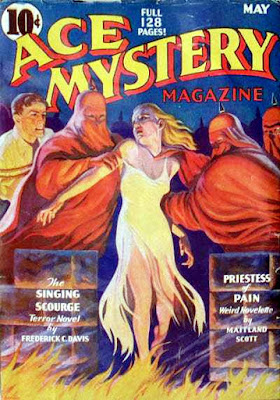
Sunday Morning Bonus Pulp: Ace Mystery, May 1936
It gets off to a strong start with the novella "The Singing Scourge" by Frederick C. Davis. This one involves a beautiful young heiress (is there any other kind?) who’s driven into a killing frenzy by a strange, high-pitched song that comes out of nowhere and that only she can hear. Her fiancĂ© takes on the role of two-fisted detective to find out what’s going on. Most of the action takes place in an isolated mansion and there are a number of sinister characters lurking around, so you’d expect the goings-on to be suitably creepy, and they are. Davis was an excellent writer no matter what the genre. He tells a pretty standard story here but does it very well.
Laurence Hammond’s story concerns an heiress as well. "Death's Heiress", in fact, as the title tells us. She’s a beautiful redhead from Boston who inherits a fortune from her crazy old uncle in New Orleans. But when she arrives she winds up being trapped in an old plantation house with her uncle’s lawyer, Edmond LaRue. (And if you think a lawyer named Edmond LaRue is going to turn out to be bad news...well, you’ve read a pulp story or two in your time, haven’t you?) Despite having a pretty good idea what’s going to happen, Hammond’s writing is atmospheric enough that I enjoyed this story. I haven’t encountered Hammond’s work before, but I’d read more by him.
I don't know anything about Ben George, either, but his story "Cat-Man" is more like something you'd find in WEIRD TALES, rather than a Weird Menace pulp. It's about an artist who has become rich and famous by painting portraits of cats that belong to wealthy members of high society. But when he crosses a Crazy Old Cat Lady (to borrow a term from THE SIMPSONS), he finds himself cursed and believes he's turning into a cat. This is an okay story for the most part, but it's cursed, too—with a really lame ending.
Maitland Scott is better remembered as R.T.M. Scott, the author of the first two novels about The Spider, which were packaged together and reprinted by Berkley Books in the Sixties. I remember buying those and reading them nearly fifty years ago. I recall that I liked them, but that’s about it. Unfortunately, Scott’s novelette in this issue, “Priestess of Pain”, isn’t very good. The protagonist is a would-be writer whose childhood sweetheart marries a friend of his, then apparently dies in a car wreck, then comes back to life as one of the minions of an evil occultist who practically twirls his mustache. The writing is too florid even for a Weird Menace pulp (and that’s saying a lot), and there are some continuity glitches that make me think this might have been rewritten from an earlier, unsold manuscript.
Steve Fisher is the author of some well-regarded hardboiled crime novels, one of which, NO HOUSE LIMIT, was reprinted by Hard Case Crime. His story "Satan's Faceless Henchmen" in this issue is also a crime yarn, although a much more lurid one. It's the tale of a resurrection racket in which a gang of evil monks steals freshly dead corpses and brings them back to life in return for a payment of a quarter of a million dollars. The explanation behind all this is less than convincing, but the pace is fast and the action scenes are good.
"Wolf Vengeance" by Rex Grahame is a backwoods tale about the rivalry between two half-brothers over the beautiful girl they both love. One of the brothers was practically raised by wolves and has a strange affinity with them, and when he disappears it sets a chain of violent events in motion. The twists in this yarn are pretty obvious, but it's well-written, with a nice sense of its swampy locale.
John H. Knox was one of the leading authors of Weird Menace stories, but his contribution to this issue, "The Corpse Queen's Lovers", is a supernatural yarn more like what you'd find in WEIRD TALES. It concerns an archeological expedition in search of artifacts from an ancient religion in the New Mexico hills, and that Southwestern setting gives this story a nice distinction. Naturally enough, what the expedition finds is dangerously evil, and Knox tells the story in smooth, well-written prose.
Paul Ernst is best remembered as the author of the pulp novels featuring The Avenger, but he also wrote a lot of weird fiction and straight mystery tales. "Nightmare House" mixes the two genres effectively. It has some Weird Menace trappings—an eccentric scientist and a gorilla—but it's basically a detective yarn with a beat cop (who would have been played by Ward Bond if this had ever been filmed) serving as the protagonist. A minor but entertaining story.
Hugh B. Cave was one of the pulps' best and most prolific writers, turning out top-notch work in numerous genres for many different magazines. His novelette in this issue, "The Horde of Silent Men", concerns a group of businessmen who are meeting mysterious deaths one by one, until only the son and daughter of two of the men (who had died earlier of natural causes) are left and are threatened by the same doom that claimed the others. Though it's plenty creepy in places, this is really more of a mystery yarn, and the solution is fairly interesting. It's not in the top rank of Cave's work, but it's certainly enjoyable.
As is this entire issue. There are a couple of weak stories, but the ones by Davis and Knox are excellent and the others are well-written. Plus it has a good cover by Howard Sherman. For a hybrid of Weird Menace and mystery pulp, ACE MYSTERY is pretty darned good, based on this issue, and I wouldn't hesitate to read another.