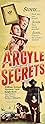
A reporter finds a WWII book listing traitors and profiteers. After he's killed in hospital, his assistant must evade police and criminals seeking the book for blackmail.A reporter finds a WWII book listing traitors and profiteers. After he's killed in hospital, his assistant must evade police and criminals seeking the book for blackmail.A reporter finds a WWII book listing traitors and profiteers. After he's killed in hospital, his assistant must evade police and criminals seeking the book for blackmail.
Ralph Brooks
- Reporter
- (uncredited)
Sayre Dearing
- Reporter
- (uncredited)
Herbert Rawlinson
- Dr. Van Selbin
- (uncredited)
- Director
- Writer
- All cast & crew
- Production, box office & more at IMDbPro
6.3608
1
2
3
4
5
6
7
8
9
10
Featured reviews
great start
D. C. insider and investigative reporter Allen Pierce has returned to town, but immediately ends up in the hospital. He tells junior reporter Harry Mitchell (William Gargan) about "The Argyle Album". After leaving the room, Harry returns to find him dead. Harry wants a head start on the story and convinces the photographer to delay reporting the death. By the time the doctor arrives, there is a knife stuck in Allen's body, and the photographer has been stabbed to death. Harry goes on the run and searches for the album without knowing what it is.
I really love the premise. It becomes not much more than a McGuffin hunt. I would like more paranoia and more kinetic action. This movie needs some car chases and a few foot chases. I like some of the villains, but they could be more compelling. The ending is a little anti-climatic. I would have expected a victim of the blackmail come hunting for it. This has a great start, but the movie isn't able to elevate above its B-movie nature.
Short and to the point.
Everyone wants the argyle papers that have the names of nazi sympathizers on them and could be used as blackmail. A reporter searches them out and gets caught up in a web of betrayals.
This is basically just a redo of the Maltese Falcon on a low budget with no names. It's not bad at all and is entertainingly brief. It's just by the book and uninteresting. What was the deal with everyone calling the lead youngster and new kid when he's clearly 50 years old?
Guy goes to look for the papers, gets captured, hears exposition, escapes, rinse repeat. Kind of bleh when you get right down to it, but it's nice to see that it's stayed alive after disappearing for so long.
This is basically just a redo of the Maltese Falcon on a low budget with no names. It's not bad at all and is entertainingly brief. It's just by the book and uninteresting. What was the deal with everyone calling the lead youngster and new kid when he's clearly 50 years old?
Guy goes to look for the papers, gets captured, hears exposition, escapes, rinse repeat. Kind of bleh when you get right down to it, but it's nice to see that it's stayed alive after disappearing for so long.
It's not The Maltese Falcon, and Gargan is no Bogart, but...
The Babel of foreign and regional accents in The Argyle Secrets seems too exotic overdone until you learn that Cy Endfield directed this short, cheap thriller from his own radio play. There, probably no more than four actors took the many and generic parts, distinguishing them with funny voices. Movies can't get away with that, so a roster of character players several of them familiar from 50s television was rounded up to fill out the cast. Since the stars are William Gargan (a couple of seasons as Martin Kane, Private Eye) and Marjorie Lord (Make Room For Daddy), with Barbara Billingsley (Leave It To Beaver) visible to those who don't blink, viewers should know better than to expect The Big Sleep.
Actually, The Maltese Falcon is the better template, of which The Argyle Secrets resembles a fifth-generation knockoff. The object in demand is a book called The Argyle Album, a detailed list of war profiteers that's being used for blackmail. A famous investigative columnist, in hospital, tells his younger colleague Gargan about it shortly before he expires, either of poison or a scalpel plunged into his pajamas. In tracking down the album, Gargan meets up with and fends off a motley of grotesques, including femme fatale Lord.
By no stretch of hyperbole can it be called good it's coarse and jumpy but now and again it shows flashes of talent (Endfield, two years later, would direct the much better The Underworld Story). There are some neat shots of the waterfront at night (the city's unspecified, but Boston comes to mind) and a tense and well-photographed sequence where an acetylene torch burns through a metal gate behind which Gargan has locked himself for safety.
Alas, Gargan is foisted off as an energetic young turk of the fourth estate, even though at the time he was 42 and looked at least 10 years older. He had started in movies in 1917, chalking up a more than respectable list of credits, but what charisma he may have once displayed had long since dissipated. Sad that the Indian Summer of his career would be spent in those lesser mediums of radio and newfangled TV. But he earns praise for spending the last years of his life, following a laryngectomy, working for the American Cancer Society.
Actually, The Maltese Falcon is the better template, of which The Argyle Secrets resembles a fifth-generation knockoff. The object in demand is a book called The Argyle Album, a detailed list of war profiteers that's being used for blackmail. A famous investigative columnist, in hospital, tells his younger colleague Gargan about it shortly before he expires, either of poison or a scalpel plunged into his pajamas. In tracking down the album, Gargan meets up with and fends off a motley of grotesques, including femme fatale Lord.
By no stretch of hyperbole can it be called good it's coarse and jumpy but now and again it shows flashes of talent (Endfield, two years later, would direct the much better The Underworld Story). There are some neat shots of the waterfront at night (the city's unspecified, but Boston comes to mind) and a tense and well-photographed sequence where an acetylene torch burns through a metal gate behind which Gargan has locked himself for safety.
Alas, Gargan is foisted off as an energetic young turk of the fourth estate, even though at the time he was 42 and looked at least 10 years older. He had started in movies in 1917, chalking up a more than respectable list of credits, but what charisma he may have once displayed had long since dissipated. Sad that the Indian Summer of his career would be spent in those lesser mediums of radio and newfangled TV. But he earns praise for spending the last years of his life, following a laryngectomy, working for the American Cancer Society.
Rare Maltese Falconish yarn
Very rare low-budget film from director Endfield (Zulu) plays like a not-bad student film version of The Maltese Falcon-- the supporting performances aren't always convincing but there are nice touches of visual imagination and good pacing.
argyle secrets
If, like Ben Mankewiecz the other night, I were to extol the tragic, shamefully HUAC truncated career of writer/director Cy Enfield, this agressively ordinary murder/espionage mystery with way too much dull narration and a rather flat acting job by lead William Gargan would not be my first choice as evidence. Think I'd go with either "Zulu" or "Hell Drivers" instead. Still, it's always nice to see the future June Cleaver get clocked and Enfield brings the thing in at under seventy minutes, which is almost always a plus in these kinds of el cheapo Saturday matinee type deals. C plus.
Did you know
- TriviaThe opening narrator says, "The Teapot Dome Scandal was going to be a church club misunderstanding compared to this." The Teapot Dome Scandal (1921-1923) was a bribery scandal involving the administration of US President Warren G. Harding. Secretary of the Interior Albert B. Fall had leased Navy petroleum reserves at Teapot Dome in Wyoming and California to private oil companies at low rates without competitive bidding. Before the Watergate scandal (1972-1974), Teapot Dome was regarded as the "greatest and most sensational scandal in the history of American politics."
- GoofsWhen Mitchell is in Scanlon's room, his action of reaching into his pocket and sitting on the bed is repeated from one shot to another.
- Quotes
Scanlon: Mitchell! What is it? You know where the album is. Tell me, Mitchell. Tell me!
Harry Mitchell: Why should I tell you? That's like the coach of Notre Dame giving the signals to the coach of Michigan.
Details
- Release date
- Country of origin
- Language
- Also known as
- Ronda da Morte
- Filming locations
- Hollywood Knickerbocker Hotel - 1714 N. Ivar Avenue, Hollywood, Los Angeles, California, USA(Knickerbocker Hotel exteriors, a real world location)
- Production company
- See more company credits at IMDbPro
Box office
- Budget
- $125,000 (estimated)
- Runtime
- 1h 4m(64 min)
- Color
- Aspect ratio
- 1.37 : 1
Contribute to this page
Suggest an edit or add missing content