

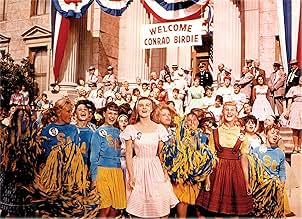
A rock singer travels to a small Ohio town to make his "farewell" television performance and kiss his biggest fan before he is drafted.A rock singer travels to a small Ohio town to make his "farewell" television performance and kiss his biggest fan before he is drafted.A rock singer travels to a small Ohio town to make his "farewell" television performance and kiss his biggest fan before he is drafted.
- Director
- Writers
- Stars
- Nominated for 2 Oscars
- 7 nominations total




- Director
- Writers
- All cast & crew
- Production, box office & more at IMDbPro
6.610K
1
2
3
4
5
6
7
8
9
10
Featured reviews
A time and a place that we thought would not end
This musical, for those of us who were of the age then, represents a time and a place we thought would not end. Entering our early teens in suburbia, begat of young war veterans, the biggest issues in our lives were those reflected in this film; who pinned who and the adulation of our musical icons. The whole world was Sweet Apple and "someday we would find out this was what life was all about" as Kim sings to a befuddled Hugo. Even nerds could fall in love. And an equal force in our weekly lives was the Sunday ritual of The Ed Sullivan Show. This is a beautiful homage to that world that would end seven months later in Dallas and bring with it the counter culture, riots and Viet Nam. Hard to put on a happy face... But you will with this score. More fifties and Bosa Nova then the hip sixties it is toe tapping and gets under your skin. Worth repeat viewings. And as always "I gotta be sincere..if you feel it in here.." and I still do.
A Lot of Livin' to do.
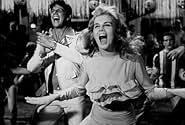
With the gift of a DVD by a good friend, I have now viewed BBB for the first time in over 20 years. And the comments here astound me: so many people coming to a message board to complain on a film that isn't a stage show. Or a book. Or an editorial. Different media sometimes (not always, to be sure) necessitate a change or alteration in a story adaptation. Yes, Rosie's ethnicity is down pedaled in the film (mainly because Chita Riviera wasn't in it), but they don't eliminate it entirely by the inclusion of a hideous black wig on Janet Leigh. I didn't miss Albert not being an English teacher as opposed to a chemist at all; it doesn't change the essence of his still-henpecked-by-his-mother character. On a different matter, I'm a little surprised to learn that Dick Van Dyke apparently had a bruised ego because of the strong emergence of co-star Ann-Margret in the film (his name still comes before hers, f'heaven's sakes!), but what can you do? The film is a fun, bright, pseudo-satire of the generation gap, teens, Elvis, and most of all, Ed Sullivan!! The finer numbers include the A-M introduction in "How Lovely to be a Woman" followed by the insane ensemble piece "Sincere-" which contains one of the funniest closing camera pans ever used in a film. "Kids" is also fine, but "Put on a Happy Face" is hampered by the limited dancing ability of Janet Leigh- through no fault of her own, mind you, but an obvious hole in what should have been a boy-girl dance duet (which they try to hide with excessive trick camera effects). The film's standout number, IMO, is "A Lot of Livin' to Do-" a nightclub extravaganza sung by THREE different leads advancing two different plots of the story at once. With stellar direction by George Sidney and inventive choreography by Onna White, it first appears as a conventional girl-swooning solo for the title character, but quickly shifts to the cat-and-mouse antics of torn lovers A-M and Bobby Rydell, who lead the entire club in a kind of challenge dance. And while it isn't her first film, this is the scene (for me, anyway) which shows A-M's breakout performance, dancing in a bare midriff and pair of hot-pink capris- and she blows the roof off the place. No surprise that the next year she was cast opposite Elvis himself. Check it out, and try not to break into dance yourself, I dare you!!
The Changes Were Necessary
I am usually in the corner of those who complain about how Hollywood generally altered many classic Broadway stage musicals into something radically different when they were made into movies. Most of the time, the changes were ridiculous and weakened the property dramatically.
"Bye Bye Birdie" though, is the rare exception where the changes made to get it to the big screen were absolutely necessary. And nothing demonstrates this more than the fact that the faithful 1995 TV version is a lumbering, slow-moving mess that manages to demonstrate perfectly how what plays great on the stage does not always translate effectively to the film medium.
By contrast, the 1963 film version decided to make itself a bright, colorful film extravaganza that played to the strengths of the film medium. And the results in my opinion, worked wonderfully.
To a stage fan like "citybuilder" who rips the changes from the play, he needs to stop and think of how the structure of the stage version, which has the Sullivan show moment and the punching of Conrad as an Act I finale, would never have worked on film. It simply makes more cinematic sense to move that to the end. And the whole big deal over Rose's ethnicity, which was really done to showcase the talent of Broadway lead Chita Rivera, would have been a distraction as well because spotlighting Albert's mother as a racist would have gone against the whole tone of the movie (and truth be told "Spanish Rose" is not that great a song). Likewise, it's better to have Albert sing "Put On A Happy Face" to Rose rather than a nameless Conrad Birdie fan we never see again.
Dick Van Dyke and Paul Lynde offer the right amount of gravitas from the Broadway cast, Janet Leigh in her black wig gets to show off her dancing talent which she seldom got a chance to do (her singing is admittedly a bit thin, but she gets by), and of course Ann-Margret totally elevates the role of Kim McAfee into a star vehicle, and who can blame them for doing this? Her rendition of the title song written for the film is enough to leave one gasping for air, yet she still manages to be convincing as the wide-eyed teenager just the same.
Ultimately, stage fans can be satisfied that they got the version they prefer done on film (though it should be noted that the 95 version is not a pure rendition of the 1960 stage script, but rather the 1991 touring revival), but movie fans got the better end of things with this version in 1963. It will never be among the great movie musicals, but it is two solid hours of colorful early 60s fun.
"Bye Bye Birdie" though, is the rare exception where the changes made to get it to the big screen were absolutely necessary. And nothing demonstrates this more than the fact that the faithful 1995 TV version is a lumbering, slow-moving mess that manages to demonstrate perfectly how what plays great on the stage does not always translate effectively to the film medium.
By contrast, the 1963 film version decided to make itself a bright, colorful film extravaganza that played to the strengths of the film medium. And the results in my opinion, worked wonderfully.
To a stage fan like "citybuilder" who rips the changes from the play, he needs to stop and think of how the structure of the stage version, which has the Sullivan show moment and the punching of Conrad as an Act I finale, would never have worked on film. It simply makes more cinematic sense to move that to the end. And the whole big deal over Rose's ethnicity, which was really done to showcase the talent of Broadway lead Chita Rivera, would have been a distraction as well because spotlighting Albert's mother as a racist would have gone against the whole tone of the movie (and truth be told "Spanish Rose" is not that great a song). Likewise, it's better to have Albert sing "Put On A Happy Face" to Rose rather than a nameless Conrad Birdie fan we never see again.
Dick Van Dyke and Paul Lynde offer the right amount of gravitas from the Broadway cast, Janet Leigh in her black wig gets to show off her dancing talent which she seldom got a chance to do (her singing is admittedly a bit thin, but she gets by), and of course Ann-Margret totally elevates the role of Kim McAfee into a star vehicle, and who can blame them for doing this? Her rendition of the title song written for the film is enough to leave one gasping for air, yet she still manages to be convincing as the wide-eyed teenager just the same.
Ultimately, stage fans can be satisfied that they got the version they prefer done on film (though it should be noted that the 95 version is not a pure rendition of the 1960 stage script, but rather the 1991 touring revival), but movie fans got the better end of things with this version in 1963. It will never be among the great movie musicals, but it is two solid hours of colorful early 60s fun.
Spreading Sunshine All Over The Place
Bye Bye Birdie which ran a most respectable 607 performances on Broadway was the second musical by the team of Charles Strouse and Lee Adams. And though they've been responsible for such additional Broadway hits as Applause, Golden Boy, All American, not one other of their shows has ever been adapted to the screen.
Though Bye Bye Birdie contains a number of hit songs still performed frequently today, it's never been revived. Interesting in that Grease which was a satire of that pre-Beatles era of rock and roll is performed all the time. You'd think the real article would occasionally be revived.
The only ones who make the transition from Broadway to Hollywood from the cast are Dick Van Dyke and Paul Lynde. Probably because respectively they are so identified with the songs Put On A Happy Face and Kids that no one would see the film if they weren't in it.
Based on the great pop culture uproar when Elvis Presley got drafted, Bye Bye Birdie is about a contest thought up by production assistant Janet Leigh to the Ed Sullivan Show to help her struggling songwriter boyfriend Dick Van Dyke. He writes a song One Last Kiss and Janet puts the idea to Sullivan to have Conrad Birdie {Jesse Pearson) sing it on the show to a special Conrad Birdie fan selected at random and bestow one last kiss before Uncle Sam takes him.
The lucky girl is Ann-Margret of Sweet Apple, Ohio and wouldn't you know that she'd come from a town like that. The teen virgin roles Sandra Dee didn't get are the ones Ann-Margret got and unlike Dee, that girl could sing and dance. Her boyfriend is Bobby Rydell who was at the height of his teen idol popularity as well and they do make an attractive and charming couple.
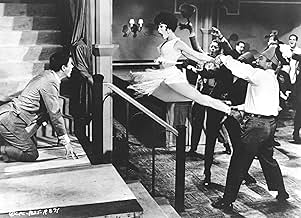
The dynamic of the triangle of Birdie, boyfriend, and fan is a very big change from the Broadway show. Realize that Bobby Rydell's part was played on Broadway by Michael J. Pollard and you KNOW it has to be different. Rydell, Pearson, and Ann-Margret sing and dance A Lot of Living To Do.
Janet Leigh is not thought of as a musical performer, but she did acquit herself well, though she would never have classified herself in Chita Rivera's echelon as a dancer. Leigh was in Howard Hughes's earlier attempt at RKO for a big musical in Two Tickets to Broadway and she did well there as she does here.
To say Bye Bye Birdie is from a more innocent time is to belabor the obvious. But if Grease can be continually revived, why can't Bye Bye Birdie?
Though Bye Bye Birdie contains a number of hit songs still performed frequently today, it's never been revived. Interesting in that Grease which was a satire of that pre-Beatles era of rock and roll is performed all the time. You'd think the real article would occasionally be revived.
The only ones who make the transition from Broadway to Hollywood from the cast are Dick Van Dyke and Paul Lynde. Probably because respectively they are so identified with the songs Put On A Happy Face and Kids that no one would see the film if they weren't in it.
Based on the great pop culture uproar when Elvis Presley got drafted, Bye Bye Birdie is about a contest thought up by production assistant Janet Leigh to the Ed Sullivan Show to help her struggling songwriter boyfriend Dick Van Dyke. He writes a song One Last Kiss and Janet puts the idea to Sullivan to have Conrad Birdie {Jesse Pearson) sing it on the show to a special Conrad Birdie fan selected at random and bestow one last kiss before Uncle Sam takes him.
The lucky girl is Ann-Margret of Sweet Apple, Ohio and wouldn't you know that she'd come from a town like that. The teen virgin roles Sandra Dee didn't get are the ones Ann-Margret got and unlike Dee, that girl could sing and dance. Her boyfriend is Bobby Rydell who was at the height of his teen idol popularity as well and they do make an attractive and charming couple.
The dynamic of the triangle of Birdie, boyfriend, and fan is a very big change from the Broadway show. Realize that Bobby Rydell's part was played on Broadway by Michael J. Pollard and you KNOW it has to be different. Rydell, Pearson, and Ann-Margret sing and dance A Lot of Living To Do.
Janet Leigh is not thought of as a musical performer, but she did acquit herself well, though she would never have classified herself in Chita Rivera's echelon as a dancer. Leigh was in Howard Hughes's earlier attempt at RKO for a big musical in Two Tickets to Broadway and she did well there as she does here.
To say Bye Bye Birdie is from a more innocent time is to belabor the obvious. But if Grease can be continually revived, why can't Bye Bye Birdie?
Hollywood makes a Broadway classic its own
The vitriol below from fans of the Broadway original is absurd. Yes, this is not a filmed version of the stage play - GET OVER IT! What we have is a funny, smart, classic film musical that gets virtually everything right. Dick Van Dyke reprises his Broadway role while at the peak of his career, Paul Lynde gives his best film performance, Maureen Stapleton milks her part for all it's worth, and Ann-Margret is simply astounding! The only casting error is Janet Leigh - but they needed a name, since everyone else in the cast was unknown at the time. While Leigh gives a solid performance, songs had to be cut since she could sing only with difficulty. But this is a minor flaw - everything else about this film is spot on, as demonstrated by the sad effort to redo it for TV in 1995. It captures the era perfectly - of course, it's dated: it's about America in the early 60s! If it wasn't dated, it wouldn't work! So if you haven't seen it, get it - I just watched in in NYC's Bryant Park with thousands of jaded New Yorkers, and it won over that audience completely. Enjoy!


Did you know
- TriviaIronically, Bobby Rydell, who plays the timid Hugo Peabody, was himself a national teen idol before and after the film's production. In fact, in contrast to the original stage musical where Michael J. Pollard played the role, the part of Hugo was expanded significantly in the film to accommodate his teen celebrity.
- GoofsAfter Rosie pulls the McAfee family out of the audience at The Ed Sullivan Show (1948), two different shots of the Russian conductor show the McAfees still sitting in the audience.
- Quotes
Rose DeLeon: I must be the prized dope of all-time... thinking I could pry you away from your mama's ever-lovin' tentacles.
- Crazy creditsThere is no "The End" credit or cast list at the end of the film. Ann-Margret simply sings an on-screen reprise of the song "Bye Bye Birdie" at the end, and then says " 'Bye, now!".
- ConnectionsEdited into Histoire(s) du cinéma: Seul le cinéma (1994)
- SoundtracksBye Bye Birdie
Music by Charles Strouse
Lyrics by Lee Adams
Performed by Ann-Margret before the title credits, with Johnny Green and the Columbia Studio Orchestra and Chorus
Reprised by Ann-Margret in the finale
- How long is Bye Bye Birdie?Powered by Alexa
Details
- Release date
- Country of origin
- Languages
- Also known as
- Adiós, ídolo mío
- Filming locations
- Production company
- See more company credits at IMDbPro
Box office
- Gross worldwide
- $94
- Runtime
- 1h 52m(112 min)
- Color
- Aspect ratio
- 2.35 : 1
Contribute to this page
Suggest an edit or add missing content