Hallelujah
- 1h 49m
IMDb RATING
6.7/10
2.2K
YOUR RATING


A sharecropper decides to become a preacher after falling for a vamp from the city.A sharecropper decides to become a preacher after falling for a vamp from the city.A sharecropper decides to become a preacher after falling for a vamp from the city.
- Nominated for 1 Oscar
- 3 wins & 1 nomination total


Matthew 'Stymie' Beard
- Child
- (uncredited)
Evelyn Pope Burwell
- Singer
- (uncredited)
Eddie Conners
- Singer
- (uncredited)
William Allen Garrison
- Heavy
- (uncredited)
Eva Jessye
- Singer
- (uncredited)

Sam McDaniel
- Adam
- (uncredited)

Clarence Muse
- Church Member
- (uncredited)
6.72.1K
1
2
3
4
5
6
7
8
9
10
Featured reviews
An Uneven Film, But It Should Be Seen
"Hallelujah" is a very interesting film. For that reason alone, it should be seen. It has an all-black cast and it was released in 1929, just as sound was first being used in films.
However, it is a very uneven production. We should give it some slack because of when it was produced, but not to mention its deficiencies would be dishonest. The acting, the lighting, the sound--all are uneven. Sometimes it is distracting, sometimes not.
Zeke (Daniel L. Haynes) is the central character. He lives with his large family, growing cotton. When the crop is harvested, he and his brother have it processed and baled. They deliver it to the riverboat and sell it on the dock. There in the city, with the money burning a hole in his pocket, he is introduced to some unscrupulous characters. He is naïve and obviously unaware of some basic rules of life and film: Never shoot with another man's dice. Never take a knife to a gunfight. And never, never go for a woman who gives her attentions to the highest bidder.
The story is filled with clichés and stereotypes, and it frequently drags. It has its compelling moments, like a chase through a swamp. But what bothers me most is the overly-dramatic acting. This is partly due to the fact that many of the scenes were couched in religious fervor. There are revival scenes, baptism scenes, scenes of general praying. In fact, the entire film is presented as a religious parable. Often when the characters speak, it is as if they are preaching. This interferes with the authenticity of the action, making some characters seem more caricatures than real people.
"Hallelujah" is a musical. Songs accent almost every scene. Most of them are gospel/spirituals. But the two best songs were written by Irving Berlin ("At The End of the Road" and "Swanee Shuffle").
However, it is a very uneven production. We should give it some slack because of when it was produced, but not to mention its deficiencies would be dishonest. The acting, the lighting, the sound--all are uneven. Sometimes it is distracting, sometimes not.
Zeke (Daniel L. Haynes) is the central character. He lives with his large family, growing cotton. When the crop is harvested, he and his brother have it processed and baled. They deliver it to the riverboat and sell it on the dock. There in the city, with the money burning a hole in his pocket, he is introduced to some unscrupulous characters. He is naïve and obviously unaware of some basic rules of life and film: Never shoot with another man's dice. Never take a knife to a gunfight. And never, never go for a woman who gives her attentions to the highest bidder.
The story is filled with clichés and stereotypes, and it frequently drags. It has its compelling moments, like a chase through a swamp. But what bothers me most is the overly-dramatic acting. This is partly due to the fact that many of the scenes were couched in religious fervor. There are revival scenes, baptism scenes, scenes of general praying. In fact, the entire film is presented as a religious parable. Often when the characters speak, it is as if they are preaching. This interferes with the authenticity of the action, making some characters seem more caricatures than real people.
"Hallelujah" is a musical. Songs accent almost every scene. Most of them are gospel/spirituals. But the two best songs were written by Irving Berlin ("At The End of the Road" and "Swanee Shuffle").
Interesting Historical Document, But Not Very Entertaining
"Hallelujah!" is fascinating from a film history perspective. King Vidor created the first Hollywood film with an all-black cast, and depicted in almost documentary fashion what life was like for poor blacks living in America's deep South. Alas, any interest the film held for me was purely academic -- as a film, it's otherwise rather boring.
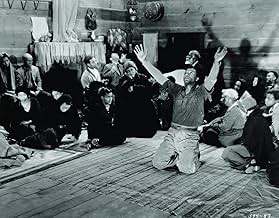
The nominal plot focuses on Zeke, who lives with his large family and helps with their cotton-picking business. We watch him struggle with the demons that plague mortal man -- like gambling and horniness -- give into them, repent, give into them again, repent, and so on, until he comes back at the end to the family who loves him. Indeed, family and religion are the two dominant pillars around which these poor folk anchor themselves, much as they are in any culture. Much of the film consists of long scenes depicting a sermon, a baptism, a local dance. There are countless scenes of characters lifting their hands to heaven, praying to Jesus to guide them. It's all rather dramatically inert, and the film is too long. If you are religious yourself, I imagine these scenes might have a certain power to them. I found all of the weeping and wailing tiresome after a while.
Credit must go to Vidor, though, for even bothering to make this film at a time when much of America didn't care all that much about the black people. The movie is a memento of the role film can play in leading cultural progress.
Grade: C+
The nominal plot focuses on Zeke, who lives with his large family and helps with their cotton-picking business. We watch him struggle with the demons that plague mortal man -- like gambling and horniness -- give into them, repent, give into them again, repent, and so on, until he comes back at the end to the family who loves him. Indeed, family and religion are the two dominant pillars around which these poor folk anchor themselves, much as they are in any culture. Much of the film consists of long scenes depicting a sermon, a baptism, a local dance. There are countless scenes of characters lifting their hands to heaven, praying to Jesus to guide them. It's all rather dramatically inert, and the film is too long. If you are religious yourself, I imagine these scenes might have a certain power to them. I found all of the weeping and wailing tiresome after a while.
Credit must go to Vidor, though, for even bothering to make this film at a time when much of America didn't care all that much about the black people. The movie is a memento of the role film can play in leading cultural progress.
Grade: C+
A great movie from a great director.
It's important to realize this was only the first year of sound pictures. Seen in that light, HALLELUJAH! has a remarkable fluidity, and a freedom from the tyranny of the sound camera that is little short of astonishing. (See "Singin' in the Rain" for a realistic depiction of this problem.) The acting is on a high level, if somewhat dated. King Vidor did an admirable job in depicting his characters' life condition, and was deservedly nominated as Best Director of 1929/30.
Way ahead of it's time. A work of genius.
In 1929, MGM began the process of converting to sound. They were almost the "latecomers" of sound conversion compared to their competitors over at the Warners lot; Warners' Vitaphone was pretty much in full swing by 1929 after having experimented with orchestral sound on film in 1926 in "The Better 'Ole" and "Don Juan" and then with actual voice embedment on film in "The Jazz Singer" the following year.
Even for such a major film studio like MGM, the cost was almost prohibitive, so Louis B. Mayer was skeptical about financing a major film epic featuring an all black cast. In the first half of the 20th Century, the major film studios catered mostly to white audiences, so a project of this nature was almost unheard of. Director, King Vidor was personally convinced that this film would be a success at the box office that he offered to match MGM dollar for dollar in producing this film. That said, the executives at MGM agreed, reluctantly, to take on this project.
I was totally surprised by the candidness of the material. From the way the major studios depicted black people as individuals of little or no importance, usually portraying them in a very negative way, I was at first skeptical. I expected more singing, dancing and stereotyping. Little did I know what a surprise I was in for! MGM could not have done a better job at portraying individuals with such humanistic qualities. As with most backdrops featuring blacks, it takes place in the cotton fields of the South; the motion picture industry failed miserably to depict black urban or middle class life until decades later.
Amazingly, most, if not all, of these actors were untested individuals on the screen or stage. Vidor's direction, along with these actors' willingness to succeed on the screen, created a work of art for the cinema. A huge box office success, "Hallelujah" was an oasis in an otherwise all-white world of big business cinema. It is a shame that the movie moguls at the time did not take further advantage of the acting talents of minorities.
Leonard Maltin could not have put it more succinctly when he said about Hallelujah: "King Vidor's early talkie triumph, a stylized view of black life focusing on a Southern cotton-picker who becomes a preacher but retains all-too-human weaknesses." Definitely a home run! A must see!
Even for such a major film studio like MGM, the cost was almost prohibitive, so Louis B. Mayer was skeptical about financing a major film epic featuring an all black cast. In the first half of the 20th Century, the major film studios catered mostly to white audiences, so a project of this nature was almost unheard of. Director, King Vidor was personally convinced that this film would be a success at the box office that he offered to match MGM dollar for dollar in producing this film. That said, the executives at MGM agreed, reluctantly, to take on this project.
I was totally surprised by the candidness of the material. From the way the major studios depicted black people as individuals of little or no importance, usually portraying them in a very negative way, I was at first skeptical. I expected more singing, dancing and stereotyping. Little did I know what a surprise I was in for! MGM could not have done a better job at portraying individuals with such humanistic qualities. As with most backdrops featuring blacks, it takes place in the cotton fields of the South; the motion picture industry failed miserably to depict black urban or middle class life until decades later.
Amazingly, most, if not all, of these actors were untested individuals on the screen or stage. Vidor's direction, along with these actors' willingness to succeed on the screen, created a work of art for the cinema. A huge box office success, "Hallelujah" was an oasis in an otherwise all-white world of big business cinema. It is a shame that the movie moguls at the time did not take further advantage of the acting talents of minorities.
Leonard Maltin could not have put it more succinctly when he said about Hallelujah: "King Vidor's early talkie triumph, a stylized view of black life focusing on a Southern cotton-picker who becomes a preacher but retains all-too-human weaknesses." Definitely a home run! A must see!
Nina Mae McKinney- The First Black Movie Star
Nina Mae McKinney portrayed Chick in this movie. The untrained, natural singing, dancing, acting talent stole everyone's heart who saw this movie, even till this day she's still winning hearts. A great actress, after this movie people named her "The Black Garbo" and "The Dark Clara Bow". Being the first black actress, she had to represent her race well, and show that Blacks could act, and show Hollywood that Blacks could hold their own on the silver screen. Norma Shearer, John Gilbert, Irving Thalberg, and King Vidor was breath-taken by her acting, and after her you saw many white actresses copying her style, the hands on the hips and facial expressions. This movie isn't stereotypical at all, its about Black Life in the South, the music and styles of the time. Nina Mae was promised many more movies, but never did anything else, but singing apperances, shorts, and maid apperances. But she did get to show her acting in the independent black movies. If you ever get to see them, you won't be sorry. People say this movie was ahead of its time, maybe so, But Nina was lucky she got to show all her talents, singing, dancing, comedy, and acting. Even Blacks don't get to show all of that today. People say that Lena Horne opened the doors, thats false, Nina Mae McKinney did, representing the Black race well, and showing that we could act, open the doors for Blacks in the future in Hollywood.


Did you know
- TriviaAlthough this film is frequently touted as the first black-cast film produced in Hollywood, it is actually predated by the more obscure Hearts in Dixie (1929).
- GoofsWhen Zeke confronts Chick and Hot Shot and strong-arms them in front of the crowd, the shadow of the microphone falls across Hot Shot as he is pushed to the background of the scene and tries to regain his composure. The shadow of the boom is also visible falling across the extras behind him.
- Alternate versionsMGM also issued this movie in a silent version, with Marian Ainslee writing the titles.
- SoundtracksSometimes I Feel Like a Motherless Child
(uncredited)
Traditional Spiritual
Sung offscreen during the opening credits
- How long is Hallelujah?Powered by Alexa
Details
- Runtime
- 1h 49m(109 min)
- Color
- Aspect ratio
- 1.20 : 1
Contribute to this page
Suggest an edit or add missing content