

An unruly class of gifted and charming teenage boys are taught by two eccentric and innovative teachers, as their headmaster pushes for them all to get accepted into Oxford or Cambridge.An unruly class of gifted and charming teenage boys are taught by two eccentric and innovative teachers, as their headmaster pushes for them all to get accepted into Oxford or Cambridge.An unruly class of gifted and charming teenage boys are taught by two eccentric and innovative teachers, as their headmaster pushes for them all to get accepted into Oxford or Cambridge.
- Nominated for 2 BAFTA Awards
- 2 wins & 15 nominations total

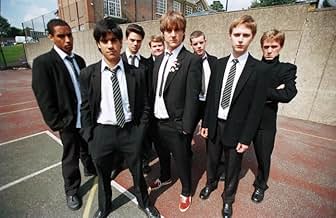
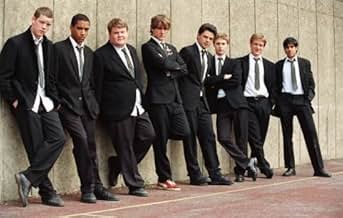
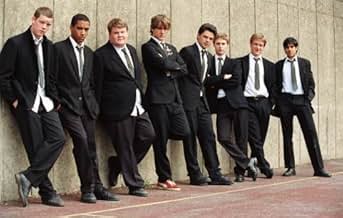
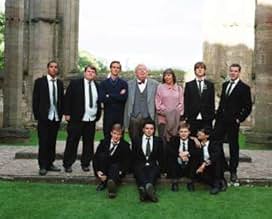


- Director
- Writer
- All cast & crew
- Production, box office & more at IMDbPro
Featured reviews
the best film i've seen on growing up
Gays and straights should see "The History Boys" to learn about love and tolerance.
I saw "The History Boys" yesterday at The Fine Arts - Popular Center in San Juan, Puerto Rico. It is excellent. If you have a closed or narrow, rigid mind, don't go. In order not to be offended by the language, you need to be a Metro Man or a Metro Woman. It is downright blunt at times. The blunt language is not to be shocking or porno, but to be brutally honest and upfront about important perceptions concerning love and tolerance.
I had a little trouble getting into the movie in the very beginning scenes. Too much was going on all at once. However, as soon as it involved the teenage boys having a one-on-one "educational" discussion with the out-of-the-closet gay teacher, the movie grabbed me and kept me until the very end.
There is one powerful scene where the teacher discusses a poem with a gay student. This gay student is also Jewish but his gayness is what makes him different. There is an outstandingly handsome black student who is accepted in the school without conditions. A Moslem who is accepted as the black student is. A young, newly hired teacher is in the closet and does not know it. This new teacher can be completely honest with his teaching history but not with his own life. There are many very British types who are the complete opposite of American homophobes. There was no spiritually sick prejudice of diversity among these eight teenagers. They got along beautifully with each other. They had a wonderful respect for each person's uniqueness.
Gays and straights should see "The History Boys." It is not a gay movie per se. It is more a movie about being a loving and caring human being. It is about being true to one's self. I hope the day will come when more people in Puerto Rico and the states, especially the anti-gay bigots and religious zealots, will have the tolerant perceptions of these eight teenage boys in Yorkshire, England, in 1983.
Witty observation on the English education system
But the social, political and cultural milieu of the era is kept in the background (it's much less evocative than THIS IS ENGLAND, made the same year and also set in 1983). This is as much a fantasy of education as DEAD POET'S SOCIETY. These are classes full of the expectational, bright and articulate. Bennett never really finds the authentic voice of the 18-year olds - they speak the words of older, wiser men. But the performances - Richard Griffiths, Stephen Campbell Moore and Frances De La Tour as the teachers tutoring them in various ways towards university and, amongst other a pre-stardom Domonic Cooper and James Corden as the students - are uniformly excellent. The dialogue is witty in its observations on the education system and the purpose of education. Bennett's own adaptation wisely drops the two flashes forward which opened the play's first and second acts (Campbell Moore's character as a TV historian in the present day).
beautiful
Where We Go To School Does Not Determine What We Will Become
The other reason is because the story is one beyond social judgment. Perhaps this is purposeful because being written, produced, directed, and acted by English people, class-consciousness is surely existent among them. But that's what I love so much about this film. The audience, in order to understand and enjoy it, must release themselves from the scrutiny of general culture over many, mostly sexual, aspects of life. The film is not about homosexuality, but homosexual goings-on exist prevalently in the story. It's also treated very nonchalantly, and many straight boys are free of any personal sexual burdens that would inhibit them from partaking. The very talked-about homosexual element of the film exists as the most direct example and also the core of the basis of the story, which is the pressure of society's judgmental and devastatingly interfering nature with many things that, if one were truly understanding, would not judge or interfere with. This extends to greater and more complex idealism in the script, such as the philosophy and meaning of education, the satisfactory or unsatisfactory pursuit and outcome of success, the importance of art and poetry, and the point of studying history.
I believe that The History Boys is an extremely important movie, and the fact that it lasted for a single week at a small theater here in Cincinnati is despicable and glaringly, stupidly contradictory to its message.


Did you know
- TriviaThe cast for this movie are the same cast who appeared in the original play at the National Theatre in London, England.
- GoofsLockwood was killed in action with the York and Lancaster Regiment. They were disbanded in 1968.
- Quotes
Hector: The best moments in reading are when you come across something - a thought, a feeling, a way of looking at things - that you'd thought special, particular to you. And here it is, set down by someone else, a person you've never met, maybe even someone long dead. And it's as if a hand has come out, and taken yours.
- Crazy creditsAt the beginning of the film, the title - "The History Boys" - is taken letter by letter from random parts of an essay on the dissolution of the monasteries, a common history topic, which the History Boys themselves write later on in the film.
- SoundtracksL'Accordéoniste
Music by Michel Emer
Lyrics by Michel Emer
© 1945 S.E.M.I., France / Peer Music (U.K.), Ltd., London
Performed by Samuel Barnett & Jamie Parker
- How long is The History Boys?Powered by Alexa
Details
- Release date
- Countries of origin
- Official site
- Language
- Also known as
- Любителі історії
- Filming locations
- Claremount Road, Claremount, Halifax, West Yorkshire, England, UK(Scripps' church, Hector's motorcycle rides)
- Production companies
- See more company credits at IMDbPro
Box office
- Budget
- £2,000,000 (estimated)
- Gross US & Canada
- $2,706,659
- Opening weekend US & Canada
- $100,803
- Nov 26, 2006
- Gross worldwide
- $13,407,101
- Runtime
- 1h 49m(109 min)
- Color
- Sound mix
- Aspect ratio
- 1.85 : 1