What was the 80s and why was it such a golden age for weird sci-fi and head trips? Was it thanks to the dawn of MTV and
Night Flight and their power to amuse stoned kids back late from the punk shows on weekends?
Repo Man, Return of the Living Dead, and
Night of the Creeps in theaters;
Liquid Sky and
Street Trash were at
(shhh) inner-city theaters; drive-in
and the video rental places co-existed comfortably.., for the moment.
Conan, the Terminator, and
Robocop made such big money that art house wonders like
Brazil and
Blue Velvet could be seen and occupy hallowed places in the press.
Also, it was the height of Nancy-fueled anti-drug hysteria, and so--just as, during Prohibition, imbibing booze had become a symbol of American freedom and defiance of knee-jerk puritanism, so now there togetherness and patriotism to be found in smoking weed during the 80s (when you could go to jail for years just for having a joint in your pocket). Today weed is mostly legal and so innocuous its users are unnoticed. But back then, getting high and going to the midnight movie was a rite of dangerous passage. And going home to watch
Night Flight and weird rented movies was simply the norm. And as a result, thrived a momentary nation of the strange. We were a decade away from the ecstasy-and-blue recovery roller coaster of the Prozac 90s. We had to invent micro-tripping just to get by - so we liked it weird. As ye shall see, brave wanderer:
1. SOCIETY
(1989) Briam Yuzna
***1/2 / Amazon Image - A
For sheer over-the-top surreal class-commentary, nothing really beats Brian Yuzna's SOCIETY which has one of the best WTF denouements in cinema history. I'm going through great pains to not spoil any of it, let's just say that in best surrealist form it taps into the Freudian Id impulse and the anxiety that one is shut out of a massive 80s upper crust orgy--that even your parents are in on some licentious surreal group sex cult secret. It's this very real feeling that underwrote the Satanic panic of the 80s (and continues today in things like Pizza-gate, Q-Anon, and the conspiracies of David Icke -[
here]), so it makes sense this came out in the "me" decade, a time when Reagan was in office and 'yuppies' were gobbling up everything, their little IZOD collars turned up and Ray-bans on in slavish imitation of their god, Tom Cruise. Not for nothing, then, does
Society star the euphonious Cruise-clone Billy Warlock as a privileged lad who enjoys the finer things thanks to his adopted family, yet is ever reminded of just how much better a slightly richer contingent at his elite school has it. He begins to realize something is going on when his older sister's paranoid ex-boyfriend-cum-stalker plays him tapes he secretly made of the sister's private conversations with their father re: her debutante 'coming out' party. It sounds, in this weird conversation, like she's going be offered up to some evil reptilian throng as a sexual offering, forced to sleep with everyone in the cult, including her parents and local officials--and that she's looking forward to it. But that can't be--can it?
To amp the paranoia we're never quite sure, til it's too late, if we're just reading into it. Billy is paranoid, but the truth is far crazier. Along his journey, he picks up a hot mess girlfriend (Devin DeVasquez) and--in the weirdest element--her "mother" (Pamela Matheson), a bizarre hair-eating nutcase that seems to have wandered in from a John Waters casting lagoon, and seems younger than her daughter, starts hanging around with them, regularly trying to eat Billy's hair.
Yuzna produced those early Stuart Gordon gems From Beyond and Re-Animator so clearly knew how to hire and use the best effects teams. The gooey weirdness would be CGI today but here it's all latex analogy--the weirdest coolest mess since Carpenter's The Thing. Too bad that, like The Thing itself, so few people saw it in theaters --did it even get a release? Either way, what a blast! It goes everywhere Eyes Wide Shut does in about 1/3 of the time, and then a whole, whole WHOLE lot farther. Along the way it lays down full bushels of insight on the nature of desire, social-climbing, consumer culture, the parasitical nature of the rich, and what's known today as FOMO - or the feeling a massive beautiful people orgy is going on whenever you're not around. Kurbick really should have gone out more, or at least watched some horror movies --Society would have maybe saved his film from its fatal inertia.
And even today, some still believe there's a secret basement where gorgeous women abandon themselves to hairy ugly men at the clang of
Get Out teacup rattle or an
Eyes Wide Shut Rammstein-style synth/chant dirge. How that 'missing the orgy' feeling ties in with priapism and paranoia could be a full semester course (see
here for full syllabus), but
Society says it all in 99 minutes and without bitter aftertaste.
3. LIQUID SKY
(1982) Dir. Slava Sukerman
***1/2 / Amazon Image - A+
We're deep in the height of the artsy early-80s downtown NYC New-Wave scene, back when it was cool, underground, emaciated and addicted to an array of pills and powders. A small alien saucer lands on the roof above the balcony apartment of trendy new wave icon Margaret (Anne Carlisle) and her drug-dealing lesbian roommate Adrian, played by Paula E. (Alice in
Alice Sweet Alice) Shepherd. Across the way in a parallel story is Susan Doukas as Sylvia, mother of Jimmy (also Carlisle) a strung-out sneering male model struggling to pay for a high-end cocaine addiction. A German scientist is lured up to lonely Sylvia's apartment for dinner but really he wants to spy on the saucer across the street. What is it up to? It's zapping anyone nearby at the moment of sexual climax, using the orgone (?) energy for, presumably, rocket fuel or their own form of drug.
There's oodles of great stuff, style, and disaffect, but the ultimate in weird 'scenes' has got to be Anna Carlisle going down on the male version of herself while a bunch of fashionistas hanging out (while using her gorgeous roof balcony apartment for a photo shoot) jeer in a very punk aggro manner that would be scary if it were done by a bunch of straight dudes, but done by coked-up gay aesthetes it's just kind of punk. As Walter Sobchak might put it, there's nothing to worry about --they're nihilists.
In the end it's Margaret's zonked renouncement of sexual pleasure in favor of drugs and mind expansion is what saves her while all her lovers are zapped. She doesn't say no to sex, even with her old teacher/mentor who drops up (a different time to be alive in NYC, oh me brothers). Then the aliens zap the life essence out of these lovers in the moment of orgasm and--until Anna complains--leaves their corpses piling up in the apartment. If you're not totally down with this film by the time Adrian starts an impromptu smack-shivery poetry slam while playing one of the corpses's bald head like a conga, then well, you may as well leave the city and move in with your brother out in Phoenix, know what I'm talking about? Me, I belong to this film, I love all its little moments, like Sylvia's a hilarious brunch with her sneezy, coke-withdrawal-wracked son. Now that the image is so lustrous, the sun streaming in through the window makes his suffering so beautiful and uniquely NYC I got a 90s strung-out flashback chill just watching him/her -- been there, bro! Not for coke or heroin, but for alcohol. They are actually similar in that (as I learned in. CASAC school) two withdrawals they have to medicate you for in detoxes, i..e. quitting cold turkey can be fatal! So if you've ever tried to hide how hungover and strung out you are while eating brunch with your mom, you'll really relate.
Clearly, this is the female east coast parallel to
Repo Man. Was it an influence on Alex Cox? And like that one-off masterpiece, it's a film to be revisited, again and again - especially now that it's been so lovingly remastered. It probably never looked this good even in its initial NYC run. The shrill pre-programmed Casio synth music mat make the raucous punk on
Repo Man's soundtrack seem like Mozart by comparison, but it works. (
see full review)
7. BRAZIL
(1985) Dir. Terry Gilliam
**** / Amazon Image - A-
Time was this was the bee's-knees, a universally praised cult hit, and it's kinda forgotten today due to being kinda dated. Though one of the most gamely dark and savage satires of modern bureaucracy in the history of cinema, here in the paperless 21st century its big anti-bureaucracy messages can seem rather labored. The whole Orwellian hodge podge and endless ducts and malfunctions feel so yesterday since the entirety of the film's vast "Dept. of Information Retrieval" would be replaced by a handful of geeks on laptops. Still, as the missing link between Kafka (a rather heavy debt is owed) and--alas--one of those whimsical too-obvious Danny Kaye 'daydreaming office drone thinks he's a swashbuckler' odysseys, the level of detail and imagination is stunning. Since it's all before CGI and so beautifully remastered in HD, we can really savor the level of obsessive termite craftsmanship (the clouds in the fantasy flying sequences alone are worth the price of admission).
Terry Gilliam's trouble as a director has always been that--like Ridley Scott--he can never trust the story to work on its own so his films gush over with detail and interesting things while the mythic root is lost like a child in a Black Friday opening door crush of overworked imagery. Here, since that crush is what it's all about, the overkill actually works perfectly, turning it all into a ballet of post-futuristic 30s decor crumbling under the weight of add-on tech (temporary things installed to fix problems with the fixes to other problems, etc). Still, Jonathan Pryce's flustered Walter Mitty-everyman schtick starts to get wearisome during his prolonged panicky run-for-it with the girl of his dreams. With her short hair and trucker's job she'd be instantly pegged as a lesbian today, making her initial resistance all the more glaring. It never even occurs to Pryce to ask if she likes him.
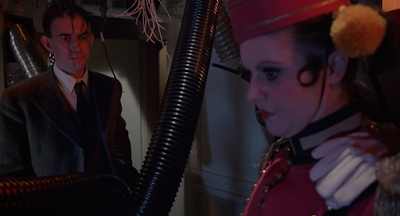
That's the cool thing about Gilliam's vision - though a knee-jerk leftist reading is the most obvious--i.e. that Pryce is a hapless hero in a coiled universe strangled by evil bureaucrats-- a closer reading shows that the dystopia is the fantasy as much as the clouds. Reality chokes itself on its own exhaust so millions can relax in air conditioned privacy and dream of angels, or watch
The Cocoanuts in their own bathtub while smoking a joint. Hey, I relate, I don't have a bathroom TV but I've smoked weed to Paramount Marx Brothers movies on air-conditioned couches far and wide. Realizing the extent to which my first world consumption habits butterfly tsunamis out to mass poverty in the third world doesn't help me change my habits. Trying to change them now would be like throwing a pale of water on a forest fire. It might make me feel less guilty, but it won't even slow the blaze--and I don't like being hot.
Regardless of whether you think Pryce's character is a hero or just a trust fund Marxist floundering in the deep end, it all gorgeously done, with an extended wordless chase set piece finale that finally fishtails into pure fantasy that references everything from
American in Paris to
The Red Shoes and (of course)
Potemkin under a dazzlingly expansive Michael Kamen score
. And what a cast of first-class Brits! Ian Holm has never been funnier as Pryce's nervous wreck boss; Michael Palin is a chilling blast as Pryce's nonchalant torturer college friend and--marvelous as ever--Bob Hoskins is a miracle as a sinister blue collar duct worker. And cuz ya gotta have an American, there's Robert De Niro as a combination Groucho Marx and Che Guevara, zip-lining in and out of windows and balconies along the tall apartment complexes to make bootleg duct repairs without the proper forms. If Gilliam never made another movie after this, he'd be remembered as one of the masters of surrealism and dark comedy. But dystopia has a habit of dragging on...
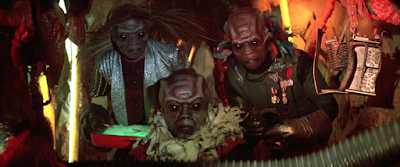
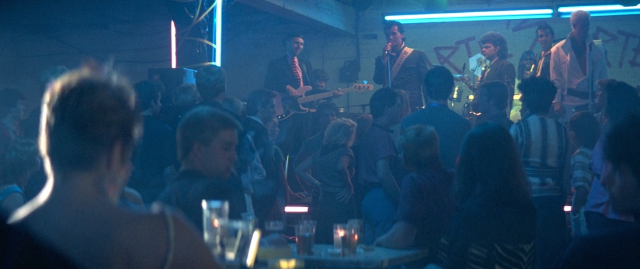

6. THE ADVENTURES OF BUCKAROO BANZAI
(1984) Dir. W.D. Richter
*** / Amazon Image - A+
The problem with this film was that it kind of positioned itself a shoe-in for cult status, and that's not how cults are made. Cult films are born of legitimately weird outsider types trying to make a normal film, not a normal person trying trying to make a weird outsider film. BUT just because the motives are baffling and the weird hybrid Captain Midnight-brain surgeon-mad scientist-Formula 5 racer-rock band frontman thing is just a little Too Much Johnson, it doesn't mean the cast, effects crew, and too many moments to count in the script, aren't worthy of Sub-Genius-style lionization. Let the lamp affix its beam! Even if one can't simply whip up a franchise out of thin air (Lucas, never forget, used carefully imported mythic ingredients, plumbing Joseph Campbell as well as Alex Raymond), "No matter where you go / there you are" became an instant classic line.
And what a cast: Peter Weller and Ellen Barkin have never been more beautiful (the way Ellen Barkin opens her mouth for a kiss is so carnal and raw it collapses time and space as we know it), and it's clear they vibe on each other's energy. Jeff Goldblum is saddled with a ridiculous cowboy get-up that's just not working for him, but he's great as usual, and so is John Lithgow as Big Booty or Dr. Lizardo (top), and on and on it goes with way too much fan club stuff ("I'm Buckaroo club, Genus chapter!" like anyone watching was old enough to remember
Captain Midnight decoder rings)- did they really expect such fan clubs would start?
One thing too - this is one dense film - packed with mythos and character running which way and that. You can see it over and over agin and are still noticing little details. Around the tenth viewing, it starts to really work except for, it never quite does. Great end theme though. Too bad there weren't ten sequels! Weller - you are or were a gawd!
7. MEET THE HOLLOWHEADS
(1988) Dir. Thomas R. Burdman
*** / Amazon Image - C
A chamber piece that plays like some off-off family sitcom from an alternate reality (we never see a window or an outside - are they all in some gigantic multi-generational cross-galaxy spaceship? Did I miss that part?). No moment of the typical domestic bliss-ticked early-60s-late-80s sitcom is missed in director Thomas Burdman's (and co-writer Lia Morton)'s keen eye for absurdist surreal digression. The doofus grandpa needs force feeding with a giant syringe; the half-dog half-human 'pet' needs de-lousing (the boys shoot the bugs off him with a slingshot); the boss (Richard Portnow) comes over for dinner and dad (John Glover) is planing to ask for an overdue promotion; wife (Nancy Mette) hopes dinner goes just right! The cute daughter (Juliette Lewis!) is getting ready to go out on a date with some new wave glorkenspruling doofus; the tentacled one-eyed watcher in the foyer (security system?) makes sure no lurkers walk past unnoticed. It's all played letter straight, such as it is, and the weirdness never stops.
It's very tube-oriented; everything is round and comes out of tubes that connects to a vast system, one that is cleaned out chimney sweep-style by men covered in pipe cleaner tubules who speak so abstractly they need subtitles (the same font Spheeris uses in
The Decline of Western Civilization!). Lewis does her
Lolita thing in due earnest here, clearing the way for her iconic stretch of films as a jailbait thumbsucker from the early 90s (
Husbands and Wives, Cape Fear, Kalifornia). Just look at her in the top center picture! She's almost a different girl and who's that on her left? It's Bobcat Goldthwait --pre-screechy voice -- as one of the weird cops who carry her home.
Come over for an evening with the
Hollowheads, and stare agog at a universe that might have been. If the 80s was really that kind to weirdness, this would be on muhfuggin' Criterion!
I confess, I was only able to finish
Meet the Hollowheads over several 20 minute viewings, as I found it too weird to endure for longer, especially in such bad quality (it's about akin to what you'd find on youtube, duped from some old first run VHS scored at a close-out) though as soon as I finished it, I started it right up again, so what's that tell you? And it's no dis - I watch Godard movies the same way and I love him. If you love crazy Godard too (for the comedy) and if you like the friendly day-glo genuine insanity of
Pee-Wee's Playhouse, the industrial Kafka savagery of
Brazil, and post-industrial ennui and alienation of
Eraserhead, then this is your film. Just watch it from far enough away you don't get any on you. And though the image is bad it's all worth it for the wacky climax which finds the lecherous Portnow running amok, killed more times than Rasputin, the kids coming home wasted after hacking into a forbidden drug tube (the title I'd give it were I in charge:
Forbidden Drug Tube-Tap) and the wasted son almost giving the whole show away by thinking the bruised near-dead boss is a monster. What a family. What a film! What set decoration. Would it was clearer, image-wise as that deep red in the round living room alone is to dye for. Stick with it and it you may never get it off. Maybe you won't even want to.
8. NIGHT OF THE COMET
(1984) Writer/dir. Thom Eberhardt
*** / Amazon Image - A
With a weird cult-ready veneer that's quintessential 80s, this sci-fi/cult/horror/comedy tics a lot of boxes but does 'em all right. The heroine survives the comet night apocalypse because she was shacked up in the El Rey theater's projection room in a sleeping bag with cult douche Michael Bowen, for god's sake - and rather than work her usher job she eats Twizzlers and rules the Galaga high score in the lobby, saved from being fired by her beauty. Writer/director Robert Thom was one of those almost-iconic auteurs who made too few films to have a following, aside from weirdos like me who love both this and his
Sole Survivor (also 1984, though much less widely known - seek it out immediately!) - I remember I saw
Night on the big screen in the suburbs during its initial release--by myself, while skipping a high school--so you you know I'm the right guy to defend it. And if you love Mary Woronov and any movie where the teenage heroine warns a guy trying to kill her that she's "been trained" and doesn't want to hurt him (and means it, and does) then you'll love this film which now looks better than ever thanks to a great Shout Factory dusting and color-depth-asizing.
The dazzlingly-haired Catherine Mary Stewart and Kelli Maroney star as the cool sisters Regina and Samantha--capably rescuing children and mowing down punk mall cops thanks to their CIA op father teaching them home defense before departing for Nicaragua. Woronov's fellow Eating Raoul star, Robert Beltran is a truck driver who answers the girls' survivor call (they set up base at the local LA radio station). Woronov heads an underground lab looking for a cure to the slow decay that hits those who survived the initial mystery dusting of the comet. God, zombies were so much cooler back then. What happened?
One thing may turn some folks off if they watch in the wrong context: this is the film with the quintessential first shopping montage set to Cyndi Lauper's "Girls Just Want to Have Fun." Echoing
Dawn of the Dead as much as foreshadowing
Day with its underground scientist think tank bunker, it's not the film's fault that trying-on-clothes montage set to that song have become inescapably and inseparably cliche. We might wish for a world in which it was cliche instead to have super cool, capable girls like Regina and Samantha as our stars of horror and science fiction films, but they're still rare in any genre. (see also Anita Skinner in Thom's
Sole Survivor for another cool Hawksian, this one even quoting
To Have and Have Not -here)
9. PHENOMENA
(1985) Dir. Dario Argento
*** 1/2/ Amazon Image - B
When the plot of this was first described to my roommate and I by his girlfriend back around 1994, we knew the movie we needed to see after a drug-addled weekend. The description was so weird we doubted it even existed. This being long before the advent if Wiki and imdb, we could only trudge video store-ward and scope out the Argento titles, and nothing even remotely insect-concerned appeared. Years later, when I finally did get to see
Phenomena it was the uncut version presented by Anchor Bay (as opposed to the American butcher job,
Creepers) and in widescreen on DVD (as opposed to murky VHS) so it was even better than she made out. I was never so happy. Why am I telling you this? Because to relay the actual plot of it is like giving away the trick ending of
Psycho if it was all trick endings. While Argento certainly references everything from (the previous year's hit)
Firestarter as well as
Carrie, (Jennifer Connolly loves insects and they swarm at her telepathic command) it also goes in all sorts of zig-zaggy directions. I'm not a big fan of Argento's insistence (continued in
Opera and other late 80s films) of using heavy metal to underscore the murders, ghoubh. Time has been as kind of Morricone and Goblin as it's been unkind to Iron Maiden, in my opinion. At any rate, the rest of the score is the perfectly accentuated flanger-drenched guitar music of Claudio Simonetti, evoking the film's windy foot-of-the-Alps setting with a palpable unearthly chill.
What I most love about it though is the weird midnight bond that forms between young Connelly, a wheelchair-bound entymologist played by Donald Pleasance, and his helper chimp, Inga. The dubbing is excellent and a real weird unique mood holds between them, as the ever present chilling wind keeps rolling down and up the Alps creating a totally unique mood in the Argento canon. There's also Daria Nicolodi as a nerdy teacher and Daria Di Lazzaro as the sexy-bitchy headmistress. The last 1/3 is a never-ending cascade of shocks and twists guaranteed to keep any jaw glued to the floor, and in the midst of it all, sweet innocent Jennifer Connelly finds herself swimming in lakes covered by burning fuel and calling insects and drowning in pits of maggot-filled decomposing bodies, and almost decapitated, all in great style. You may be warned, but there's no way you can be prepared...
1. BLUE VELVET
(1986) Dir. David Lynch
**** / Amazon Image - A
I'll confess it took me a long way to come around to this movie: I found its violent thuggery disturbing and without a cathartic resolution. After a few decades of repeat viewings, and absorbing deep tissue analyses of the film by Todd McGowan and Zizek, I was able to unravel my private relationship to its Freudian subconscious Oedipal separation trauma, so I could let go of my ambivalence. Turns out the purple and blue velvet apartment where Kyle McLachlan spies through the closet blinds isn't merely his anger/anxiety over a woman being hurt, but a primal scene as understood through the mind of a child who mistrusts the animal grunts of sex and seethes with resentment over the dad's power to shut him out of the bedroom at a whim. So, turns out, the problem was
mine, not Lynch's! I myself was Frank (Dennis Hopper) as much as Kyle - and I didn't want to be either one. I had to make peace with my inner monster. I tried, and am trying, and sometimes I love this film and sometimes not. I prefer actually
Lost Highway, perhaps because it isn't as good. I'm not really connected to it, and that's just fine.
Laura Dern co-stars, at her dreamy-but-chipper best; the beautiful Dean Stockwell as a kind of dream world pimp lip syncing Roy Orbison (see
CinemArchetype 18: The Aesthete) while Kyle tries not come off like a frightened kid who visits his drug dealer on the
wrong night and ends up a veritable hostage in an all-night road trip binge. An initiation into a darker realm of life beneath the grass line of sunny Lumberton, these scary people eventually guide him into becoming a mature man through their loving abuse (like in
Sonny Boy, with which it would make a fine double feature!).

Lynch's subsequent works would all point back to this key moment, some improving on it (
Mulholland Dr.) some not so much (
Wild at Heart). But
Blue Velvet is Lynch's first great 'cracking it wide open' while still staying in a recognizable (small town
noir) genre format. It's his "Demoiselles d'avignon," his Pollock's 1947 drip stick moment. No matter how many times you see it, it's never the same movie, but it's always, always disturbing. It's the dark nightmare of childhood brought into the light like a screaming, still-alive, tar pit mastodon.
TOO WEIRD EVEN FOR ME:
These are definitely cult/surreal and look great on Prime but --me--personally - I couldn't stand them. I hate them And I'll give you my reasons why, in case your mileage varies. One critic's bias should never lose a film's chance at the right viewer.
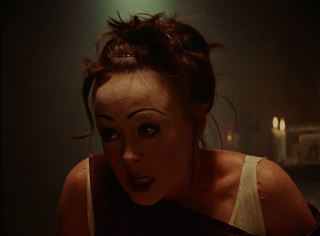
 SPIRITS OF THE AIR, GREMLINS OF THE CLOUDS
(1989) Dir. Alex Proyas
*1/2 / Amazon Image - A
In and around a cloistered shack in the middle of a nowhere post-apocalyptic outback, two wildly overacting eccentrics--one a wheelchair-bound aviation enthusiast, one a Gothic virgin introvert--help a monosyllabic punk rocker type escape the empty desert plain via a homemade airplane. Though the scenery is lovely, the actors are grotesque and do little to allay the monotony. The film seems to last forever as nothing happens, but not in a cool Jarmusch way but in an overwrought hammy Aussie way - the worst of both worlds. It needs either a genuinely macabre element (ala Burton's
Beetlejuice), savage gallows satire (ala Gilliam's
Tideland) or deadpan zest for living (ala Kusturica's
Arizona Dream). This has none of the three! NONE! I hate it the way I hate those stale nightmares I used to have when suffering from a bad flu. The deep aqua-blue tint of the wide open sky and the burnished gold sand indicate gorgeous cinematography and color-grading; the Tangerine Dream soundscapes keep it all at a dreamy windswept beguilement; Melissa Davis hams it up like a kind of Helena Bonham Carter gone butoh missionary, but it's not enough to make it worth enduring the spittle-flecked hamming of Michael Lake, usually filmed for maximum grotesque close-ups (his teeth need work). Director Proyas went on to make
The Crow and
Dark City, so he has his fans. The rest of us might survive if we view it as a prequel origin story for Bruce Spence's pilot character in
The Road Warrior. Nonetheless watching it is too much like that feeling of being trapped in the middle of nowhere I used to have as a child in the suburbs. God, being forced to hang out with these three people the rest of my life seems far worse than any death by dehydration.

THE FORBIDDEN ZONE
(1980) Dir. Richard Elfman
* / Amazon Image - B
Though zany and strangely familiar to any one who's watched old Betty Boop cartoons while macro-tripping, the ceaseless toilet humor of Elfman's little miracle gets very old fast, in fact before it starts. There's so much shit imagery and septic tanks I wonder how mired in infantile poop obsession can any alleged adult be? Further, Oingo Boingo is one irritatingly uncool band. Clearly a lot of effort went into this film and Herve is amazing (those dewey eyes....sigh), but everyone else -- good lord. I felt sick to my sacrum for weeks after only ten minutes of viewing. God blind me to the sights herein.
 The plot involves a mysterious amulet given by a mysterious old lady somewhere in the Valley of the Kings, to a little girl who's visiting Egypt with her parents. Dad (Christopher Connelly) is an Egyptologist investigating a strange tomb; mom writes or photographs for Time or Life (at least there are exteriors shot at the building). At night, back in NYC, the jewel opens up a stargate between some lost Pharaoh tomb and the little girl and her brother's bedroom in (this leads to lots of sand on their bedroom). The dad meanwhile was temporarily blinded back in Egypt by the gem's twin embedded in a wall in a secret part of a tomb. It shoots him with blue lasers when he looked at it too long in a mysterious cave/tomb wall carving. As his eyesight slowly returns, a psychic tosses the family a note from a window that lets them know they're not out of the woods: the amulet is a gateway to evil that gets off on possessing children and trapping their souls within its sinister facets. Anyone who gets in its way, including a taxidermist, a louche family friend, and the psychic herself--all wind up either attacked by stuffed birds, real cats, or dropped through an interdimensional doorway that dumps them in Egypt and leaves lots of sand on the carpet after it closes again.