Showing posts with label Doug Wildey. Show all posts

Monday, March 23, 2026

Journey Into Strange Tales Issue 168: Atlas/Marvel Horror & Science Fiction Comics!


The Marvel/Atlas 
Horror Comics
Part 153
August 1957 Part II
by Peter Enfantino
and Jack Seabrook


Mystery Tales #54
Cover by Fred Kida

"The Last Lap" (a: Reed Crandall) 
"Prisoners of the Valley of Fear!" (a: Jay Scott Pike) 1/2
"Death of a Gambling Man!" (a: Frank Bolle) 
"Can of Soup!" (a: Robert Q. Sale) 
"Nobody!" (a: George Klein) 1/2
"The Labyrinth!" (a: Sid Check) 

Race car driver Rex Bilbo will do anything to win and that includes cutting his competitors off at the final lap. This is how Rex wins. Then along comes "The Kid," the fastest racer anyone's ever seen. Rex knows he can't beat the newbie, so he loosens the young man's tires; next day, on "The Last Lap," The Kid hits the wall and... bloooey!

The other racers know what Rex has done but can't prove it. But they'll get him, they promise. One night, when Rex is working on his GTO, The Kid rises from the grave (still wearing his speed racer outfit) and heads for the track. Next thing we see is Rex's new auto, with real human skin upholstery, Rex's eyeballs as headlights, and a tank full of blood. Alas, that's not what happens, but in the early pages it sure seems like we're going to get the first honest-to-gosh EC-style revenge tale in years and the cherry on top is the Reed Crandall art. The CCA wouldn't have okayed my scenario, but the sappy (and inane) climax we're given is safe enough for the 8-year-olds. No nightmares here.

Planes flying through Austria are disappearing from sonar without a trace. Government agent Alfonse Grumet suspects foul play, so he commandeers a dirigible to fly the same path in hopes the truth will unravel. Sure enough, the blimp reaches the same area as the missing planes and is stopped in mid-air by a huge net. The net brings the vehicle to a landing and Grumet and crew are taken prisoner by a group of bald ruffians. Grumet is taken to the wizard of this Valley of Fear, disgraced Professor Kalendru, whose theories of... something... drew waves of laughter from his colleagues.

As his revenge, Kalendru traveled to this deserted valley and created a city of miracles. Kalendru orders his mute slaves to take the dirigible to a populated city and kidnap hundreds of people in order to build Kalendru's army of slaves. But Grumet has an ace up his sleeve and puts the kibosh on the evil emperor's plot. Everything about "Prisoners of the Valley of Fear!" smells like an old cinema serial, with hidden cities, beast-men, and an explosive finale. The elements it's lacking are a good script and excitement. We're never really clued in to what Kalendru's goal is; he builds a "paradise" to get even for all the slights aimed at him through the years. Heck of a revenge.

Larry Hall worked for Matt Trevor, one of the biggest crooks in the city. Trevor is opening a new casino and his biggest enemy is the mayor, whose daughter happens to be in love with Larry. Get all that? Well, when Trevor gets wind of the secret affair, he uses the mayor's daughter as a pawn in his war with her father. Luckily, Larry stumbles on a secret room at the new casino filled with chemicals and stuff. He uses the potions to make the casino disappear, thus preventing any harm to his one true love. Larry has made the ultimate sacrifice. "Death of a Gambling Man!" (hey, spoiler alert!) is cheesy Wessler pulp junk that's good for a couple of chuckles when it changes direction in the final page, but little else.

Starving, a hobo steals a "Can of Soup!" from a truck, unaware that this "soup" is actually nitroglycerine. It's evident right from the get-go what the mystery can is, but what's not clear is why Stan okayed the truly awful Robert Q. Sale art. Yeccch! In the equally brainless "Nobody!," a flight filled to the brim with stinkin' Commies lands in Moscow to find an empty city. Panicked, they jump back onboard and head to the next Red city they can find. Same thing. "Nobody!" In the end, it's all a case of brain manipulation by a stinkin' Commie scientist. They see only what he wants them to see. But the joke's on Ivan when he tries to end the hold on his comrades' brains and the machine goes kaput. So does the plane. 

"The Labyrinth!," the final story in Mystery Tales #54, helps the title go out on a high note (or at least a higher note than the four stories that preceded it). A race of underground men try to make it to the surface world but can't seem to work their way through a maze of tunnels. Turns out the poor chaps are stuck in a subway tunnel. Some nice throwback penciling (meaning it looks like the penciling was done in the 1940s) by Sid Check and a fairly decent twist ending. Quality-wise, the 54-issue run of Mystery Tales was middle of the pack, neither better nor worse than its sister pubs. Two stories from pre-code MT made my Top 50 list: George Tuska's "Marion's Murderer" (from #14) and Bill Benulis's "The Little Monster" (from #15).-Peter


Mystic #61
Cover by Bill Everett

"Someday It Will Open" (a: Richard Doxsee) 
"The Thirteenth Floor!" (a: Bernard Baily & Gene Fawcette (?)) 
"Mister Backwards!" (a: Frank Bolle) 
"Too Dangerous to Live" (a: Carl Burgos (?)) 
"The Strange Sea!" (a: Alfonso Greene) 
"The Face in the Mirror!" (a: Joe Orlando) 1/2

Professor Klauser returns from the jungles of South America with a souvenir, an odd, stone-like object he dubs a "thought pod." Kaluser is convinced that if he concentrates on something hard enough, that thought will materialize from out of the pod. His colleagues all think he's daft, but Klauser sits in his chair staring at the pod, certain that "Someday It Will Open." And it does. It just doesn't produce anything interesting, unfortunately. Not even the Doxsee art can elevate this one above the basement floor.

Brand is convinced the partying people on "The Thirteenth Floor!" are wearing priceless jewels and he's intent on robbing them. His friends tell him he's nuts since the hotel has no 13th floor, but he's convinced it isn't a mirage. When one of the hotel employees tells him that the hotel used to have a 13th floor but it was destroyed by a fire and never rebuilt, it gives him an idea. He sets a fire and watches as all the "shadow people" run into the elevator. He heads for their jewelry but fate has other ideas. What a dumb story! How can an entire floor of a hotel building be destroyed and removed without affecting the floors above and below? 

Ralph Paval buys a wonderful hourglass at an auction house and quickly learns it has the remarkable power of turning back time. All Ralph has to do is turn the hourglass over and... ta-da!... it's the past. Of course, since Ralph is living in the Atlas Universe, the first thing he does is rob a bank. Then he turns the hourglass over several times and it's ten years before. Ralph takes the money he made from the robbery and invests it in a sure thing in the stock market. Ralph's not as smart as thinks, though, as evidenced by the G-Men who come to arrest him for counterfeiting. The dope used 1957 currency in 1947! You'd think that would be the end of "Mister Backwards!" but, as with Mr. Brand in the previous story, Ralph finds fate has a way of evening things up for time travelers. I thought this one was semi-clever, but my only question would be, if Ralph is going back in time, why does he get to keep the dough he robbed in 1957, a heist he hasn't even committed yet? Am I thinking too much?
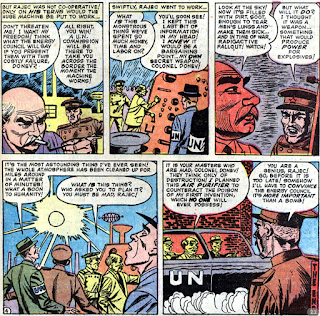
Really smart genius Professor Rajec is forced by the stinkin' Commies to build the perfect weapon, an explosive device they plan to use on the enemy. The Reds test three ounces of Rajec's formula and it destroys a square mile of land, but it also gives Rajec a bad case of amnesia; he can't remember the formula. After interrogating and torturing him for weeks, the Commies leave him be, hoping his brain will come around. At last, Rajec tells his bosses he's okay and ready to build another, bigger gizmo. But Rajec has a better idea and a better device to build: an air purifier that will suck up all the radioactivity caused by his first bomb. When last we see the professor, he's driving away with a U.N. escort, and the Commie colonel who once led his interrogation is giving him a thumbs-up. Bar none, "Too Dangerous to Live" contains the fastest (and funniest) transformation from bloodthirsty sadist to peacenik ever portrayed in a funny book strip. 

In the three-page, "The Strange Sea!," Jeff Marlowe yearns to be a seafaring lad like his ancestors, so he signs up to be a sailor. On his maiden voyage, he's swept overboard by a giant wave but, luckily, he's saved... by his great-grandfather. I know just how Jeff feels, swirling around in a whirlpool of bad comic stories. The finale, the last story ever to appear in Mystic, stars a pair of thieves, one of whom has become something of an animal, brutalizing everyone he comes in contact with. "The Face in the Mirror!" has yet another predictable, inane twist ending and uninspired Joe Orlando art. Four Mystic stories placed in my Pre-Code Top 50 list: Sol Brodsky's "The Devil Birds" (from #4, which landed smack dab in the number one spot), Mort Lawrence's "Help Wanted" (from #19), "The Living and the Dead" (from #26), and Russ Heath's "Who Walks with a Zombie" (from #27).-Peter


Mystical Tales #8
Cover by Fred Kida

"Stone Walls Can't Stop Him!" (a: Doug Wildey) 
"The Dream People!" (a: Ruben Moreira) 1/2
"The Lair of the Thunder Lizard!" (a: Bernie Krigstein) 1/2
"The Sleeping Man" (a: Robert Q. Sale) 1/2
"Try-Out!" (a: Sid Check) 
"The Island of No Return" (a: Sam Kweskin) 

A convicted killer named Carl Brent walks right through the bars of his prison cell as if they were not there! Even "Stone Walls Can't Stop Him!" and he walks through one of those as well on his way to freedom. Roy Anders, the prison guard, doesn't tell anyone because he thinks he'd be ridiculed. He goes home and his wife encourages him to consult his "scrapbook case histories of all the men who have been executed on Death Row." (Roy is clearly a little off.)
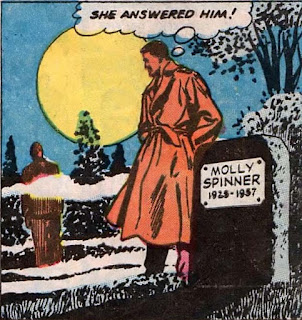
Reading about Brent, Roy recalls that the criminal seemed to have a heart, never taking all the cash when he robbed a store and begging for forgiveness from a young woman he mistakenly shot during a holdup. When the woman, whose name was Molly Spinner, died, Carl was sentenced to death. Roy has an idea and drives to the cemetery, where he observes Carl kneeling on Molly's grave, asking her to forgive him. Roy hears her voice granting forgiveness and the guard drives back to the prison, where he learns that Brent was found dead of a heart attack on the floor of his cell, a contented smile on his face.

Doug Wildey does a decent job with this rather mournful story and I enjoyed it. The final twist, such as it is, comes from the surprise on the face of the guard on duty when Roy tells him he knows Carl died with a smile. Not much of a twist, but a pretty good story.

After dreaming of standing before an audience, a playwright named Baker is convinced his new play will be a hit. "The Dream People!" can't be wrong! Instead, his play is rejected and one written by his roommate, Philips, is accepted. Baker lies to Philips and takes his place, taking credit for the work and watching the rehearsals. Philips catches on and threatens to go to the cops, so Baker kills him just as the police burst in. He is tried and convicted and finally realizes that the audience he dreamed of was the members of the jury. Once again, Ruben Moreira works hard with a run of the mill idea.

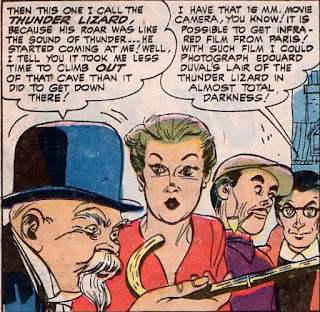
Old Edouard Duval likes to spin yarns about seeing dinosaurs in a nearby cave, describing it as if it were "The Lair of the Thunder Lizard!" Young Jacques Rambeau doesn't believe it and enlists two friends to explore the caves with him to show that the old man is making up stories. The trio descend into the cave and photograph what lies in the darkness, certain it's nothing. To Rambeau's surprise, when the film is developed, it shows the thunder lizard! Duval volunteers to visit the cave and Rambeau agrees to film the outing; the old man shoots into the darkness and the film records the death of the creature. The cave is sealed off and Duval is a hero! Days later, Rambeau finds a small lizard that crawled into his camera and looked big in the pictures. He doesn't have the heart to burst the old man's bubble. Leave it to Krigstein to wring some emotion out of a weak story by Wessler. The artists gets the feeling of the French folk right and Rambeau's kind decision at the end seems genuine.
In the year 1457, Wolfgang Roebling invents a machine but when he shows it to the authorities they throw him out, insisting that it's evil. On his deathbed, Roebling entrusts the machine to his faithful servant, Karl Rieger, who promises not to give up until the world recognizes Roebling's genius. In a secret cellar room, Rieger sleeps for a century and awakens to show the machine to a man in Italy, who calls it a work of darkness. "The Sleeping Man" nods off in the catacombs for another century, wakes up, and tries his luck in Paris, where he is nearly killed when one of the king's ministers doesn't react well to the invention.

He sleeps for another hundred years in a cave in the Pyrenees, but when he wakes up, the king's secretary tries to steal the machine and Karl runs off to another extended nap in a tower castle. He gets the same reception in England in 1857. Finally, it's 1957 (surprise!) and Karl stows away on a ship to America. He arrives, but the perpetual motion machine Roebling invented 500 years before is scoffed at. Karl finds an underground spot to doze off and the robot hopes that, in a hundred years, the machine will be accepted. I kind of liked this story, not for the hideous art by Sale but rather for the plucky robot who keeps thinking that, if he just tries again in 100 years, people will accept his inventor's gizmo. I did not know he was a robot till the last panel, so I guess Wessler got me this time.
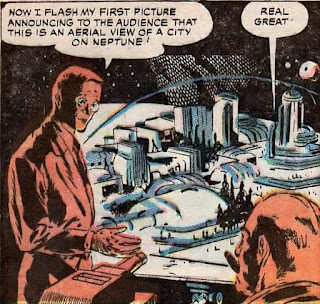
A booking agent named Stanton yawns through a presentation by a man named Lund, who narrates a travelogue to Neptune, the Earth's core, and the moon while showing images from a projector on a screen. He then suggests a talk on telepathy and ESP, but Stanton is unmoved. After the "Try-Out!" fails and Lund exits the office, Stanton is shocked to discover that Lund accidentally left the projector behind and there's no film in it! Sid Check's regular panels with people talking are smooth and the panels where he depicts the wonders presented by Lund are impressive, but they're not enough to make the story interesting.

Bruce Marner bullies everyone in Merville, a small town on the coast of Canada, and has one thing on his mind when he sees Hover Island, where there's a safe filled with gold coins in a long-abandoned bank. Marner commandeers a boat and heads out to "The Island of No Return," but when he gets the gold and tries to navigate his way back to the mainland, he discovers that the boat keeps ending up back at the island. Sam Kweskin's art on this forgettable story is a hair better than that of Robert Q. Sale on "The Sleeping Man," but the narrative is much less interesting.

So ends the short run of Mystical Tales, which never rose above the level of ho-hum. My highest-rated story was "Someone Behind Me!" by Reed Crandall, in #3.-Jack

Next Week...
Watch Helplessly as Matt Fox
Tries to Save Atlas From
the Deadly Implosion!

Monday, March 9, 2026

Journey Into Strange Tales Issue 166: Atlas/Marvel Horror & Science Fiction Comics!


The Marvel/Atlas 
Horror Comics
Part 151
July 1957
by Peter Enfantino
and Jack Seabrook


Adventure into Mystery #8
Cover by John Severin

"The Man Who Couldn't Be Killed!" (a: Jim Infantino) 
(r: Strange Tales #176) 
"The Voice from Nowhere" (a: George Woodbridge) 
"Effigy!" (a: Angelo Torres) 
(r: Vault of Evil #16)
"We the Jury" (a: Ruben Moreira) 1/2
"The Night of March 5th" (a: Robert Q. Sale) 
"Mister Mason's Strange Problem" (a: Dick Giordano) 

Convicted murderer Henri Berney is sentenced to hang on Monday on Devil's Island but he has a card up his sleeve. Using a tunnel he's dug over a long period of time, Henri escapes into the jungle and forces a medicine man to hand over a potion that automatically erases all Mondays from Henri's life. In his mind, he's become "The Man Who Couldn't Be Killed!" Bad mistake, that, as the warden points out in the final panel, since Henri was born on a Monday. Amusing fluff with some spare and gritty work by Jim Infantino (Carmine's little brother). 

David Warner, a retiring entertainer, loses his will to live when he inadvertently switches suitcases with another passenger, and gone are all his show-biz mementos. Meanwhile, aboard another plane, the man who has become the benefactor of Warner's souvenirs experiences some deadly weather in the skies. Luckily, "The Voice from Nowhere" guides the plane to a safe landing. Later, when the man returns the luggage to Warner, we learn the suitcase contained Warner's ventriloquist dummy. Most of the story is sappy but that twist is clever and the Woodbridge art is easy on the eye.

Painter Guy Mason has been obsessed with his "arch-nemesis," Fred Waters for decades. Fred always had to beat Guy to the punch on everything, including the girl. Yep, that's right, Waters stole Mason's girl right from under him. So a high-falutin' psychiatrist tells Guy he should paint a portrait of Fred Waters and then destroy it, thus ending any rivalry between the two. 

Guy's buddy thinks he's a nut but encourages him anyway so, once the painting is done (complete with Fred holding a gun, since Guy wants their last meeting to be on an even keel), the buddy steps out of the studio while the artist gets ready to riddle the canvas with bullets. But Guy has a big surprise waiting for him. "Effigy!" ranks as the best story of the month because it's a witty little tale with a couple of very effective twists and the Torres art is gorgeous. Look sideways at a few of the panels and you'd swear it was mid-'60s Ditko.

The bland, three-page "We the Jury" (about a man on trial for murder who wishes he could see into the jury room and then gets his wish) marks the debut of Ruben Moreira, an artist who will only hang around in the Atlas SF/H Universe for just under a year, contributing six times before heading off to the then-greener pastures at DC. "The Night of March 5th" thoughtfully combines two of the three most overused plot devices in 1957 Atlas titles: stinkin' Commies and time travel. A foreign agent is tasked with stealing a top-secret mystery-box from the gizmo's inventor and becomes curious about its capabilities. He pushes a button and it teleports him one year into the future. There he sees a newspaper headline touting his handler's arrest for murder. I think we all know where this one is going.

Last up, "Mister Mason's Strange Problem" takes care of the third most microwaved plot device of 1957, the guy who is suddenly unknown to all around him. Mister Mason assaults a fakir in India and incurs his wrath. This was the second of only four contributions Dick Giordano made to the Atlas books. His work is solid if unspectacular. That word could be applied to the short life of Adventure Into Mystery, which was canned with this issue. Of the 48 stories contained within its 8 issues, only four were awarded three stars.-Peter


Strange Tales #59
Cover by Fred Kida

"Help! Help!" (a: Gene Colan) 
"When the World Went Mad!" (a: Bernie Krigstein)  
"What Waits in the Dungeon?" (a: George Woodridge)  
"Trapped in the Burning Sands" (a: Doug Wildey) 1/2
"The Fearful Fate of Mr. Foster" (a: Dan Loprino) 
"The Death Mask!" (a: Jim Mooney) 1/2

A man sits in a movie theater, starving and paralyzed because, years before, in the war, he was hit with shrapnel and now that hunk of steel sits in his back, waiting to kill him. Luckily, a painting team moves in and notices the man sitting in his seat, long after the movie ends, and they call the medics. The end. There's absolutely nothing strange about "Help! Help!" other than the fact that Stan decided to place it in Strange Tales rather than Mainstream Ho-Hum Tales. The moral, I guess, that we learn from this guy's ordeal is that you should let your wife know when you're going to the flicks.

The FBI is investigating a strange series of disappearances--up, up, up in a puff of smoke go a two-story home, a lighthouse, and even a bridge. What the heck is going on? The clues lead to the lab of Professor Haughton, a crazed Atlas genius who has created a "solvent" that can make big stuff vanish. As the nutty Haughton explains to his captive Federal pursuer, he could use this formula for the betterment of mankind but, nope, he's going to rule the world. Thank goodness for that lab assistant with a conscience! "When the World Went Mad!" is a grind, a total waste of time, and not even Bernie could work up enough enthusiasm to help us through.

Skilled thief Fillipo gets word that a vast fortune awaits he who is brave enough to break into the Villa Cenedella and make his way downstairs. But "What Waits in the Dungeon?" It's a little hazy as to how our protagonist meets his horrific end (it all happens off-panel) but the whole affair is more interesting than the first two entries this issue and the atmospheric Woodridge art is nifty.

At the end of World War II, Hans Loring buries the booty he stole while on his march across Africa, unaware his buddy Luther is watching. Luther shoots the man and leaves him for dead, noting where the treasure has been buried and planning to revisit this part of the desert when the dust settles. But Luther must be a lousy shot because Hans survives the ambush (not knowing who shot him) and the men are shipped home.

Fifteen years later, the two are reunited in an African village and Hans suggests they share the fortune since they were always such good mates. Luther happily agrees and the men set out across the desert, with Luther planning his friend's murder every chance he gets. Once they reach their destination, they discover they've run out of food and water. Hans opts to look at the bright side; he's been dead all these years and only wanted to lure his murderer out into the desert for his revenge. Yes, it's predictable but done the correct way (as pulpmeister Wessler does here) and adorned with sharp Wildey graphics. "Trapped in the Burning Sands" doesn't get bogged down in details (why does Luther wait fifteen long years to go back for the treasure and, if he needs that treasure map Hans drew years ago, how was he going to find the spot on his own?) and that's a good thing.

Billionaire Amon Foster is tired of being old and ugly; he wants to be strong and vibrant again. So he pays a shady character to get what he wants and, soon after, Foster is flying to a remote cabin and discussing his future with a bearded character who warns him that if he drinks this potion, he'll receive exactly what he wants, but there is a catch. Amon poo-poos any side effects and drinks the beverage down. And he gets just what he wanted. The plot device of the three-page "The Fearful Fate of Mr. Foster" has been done literally to death but this variant comes with a genuinely clever twist.

In "The Death Mask!," ex-actor Orrie Lait has mastered his new job, the big heist. Lait has used his expertise as a makeup man to disguise himself as other master criminals in the city, thereby throwing the cops off his scent. But, as happens with these genius ex-actor/criminals, Lait does one job too many and is undone by... a ghost! The Mooney art is not bad and the script is good for a few laughs but the ending reveal (Lait can't remove his latest makeup job when the cops come calling) makes little sense.-Peter


Uncanny Tales #55
Cover by Bill Everett 

"A Suit of Clothes!" (a: George Roussos) 
"Trapped in the Room of Mystery!" (a: Angelo Torres) 
"Which One is Real?" (a: Syd Shores) 
"The Nick of Time" (a: John Giunta(?) & Sid Greene(?)) 
"Impossible?" (a: Bob Bean) 1/2
"Lost in the Mad Maze!" (a: Frank Bolle) 1/2

Con man Ed Tallis never paid a penny for something he could steal. So, in the Bahamas and needing a new suit, he visits a tailor who promises that he can make Ed "A Suit of Clothes!," one suit that can change into anything Ed desires. The crook thinks the tailor is a loon but goes along with the joke since he'll be paying the guy with a rubber check, anyway.

The suit is complete and Ed stands before a mirror, admiring the lean cut, when the tailor tells the suit to change to a tuxedo. Wham-O, it's a tuxedo. Several more tests ensue but Ed is convinced and writes his tailor a check. But deceit runs both ways in the Atlas Universe and Ed will soon regret having cheated the brilliant suit-maker. The penultimate issue of Uncanny Tales does not get off to a memorable start; the twist is a variant on a plot device we just read in "The Death Mask!"

While out hunting, Albert Cotter becomes caught in a blizzard and takes refuge in a well-furnished shack. Convinced that the sanctuary has been placed there by the forest service to aid such wayward hunters, Albert helps himself to the comfortable bed and, after waking from his nap, eats the food in the fridge. But, oddly and suddenly, everything seems to float in the shack, and Albert panics. Opening the door, he sees the storm has subsided and makes his way home. Hours later, two scientists enter the shack (which is actually some kind of test module) to find its contents disheveled and theorize that aliens from another world must have visited. That final panel declaration in "Trapped in the Room of Mystery!" makes no sense to me. Why would the nattily-dressed eggheads jump to such a conclusion? Still, Angelo Torres seems to shrug off the sub-par script and lets it rip with yet another fine graphic display.

In the abysmal "Which One is Real?," two crooks evade the police with a device one of them made that can project ultra-realistic images. So what we get is four pages of cops shouting "Holy cow, a mountain just appeared in the middle of the road!" and not much else. I love how even the degenerate criminals in the Atlas Universe are geniuses! Equally lame is "The Nick of Time," wherein Cornelius Jones, late for a date with the gorgeous Ada, hits upon the perfect excuse: he'll adjust the arms of the town's clock back one hour and blame his tardiness on the mechanical malfunction. Alas, the dope didn't realize he was setting the clock (and therefore the entire town) back a whole year! Ada slaps his face when he lays one on her full, sensuous lips, cuz he's only known her six months! Two co-workers stop him in the town square to tell him all about a new promotion that Corny witnessed months before! This craziness has to stop! And after four pages it does.

Our stinkin' Commie story for the issue is "Impossible?," about a top secret meeting of the good guys that is interrupted by an invasion of the bad guys. The day is saved when the toys on a war diorama defend the free world from Communism and kill the Reds dead. In the finale, "Lost in the Mad Maze!," George and Eddie have heard tell of a secret pharaoh's chamber, a room filled with priceless gems and gold goblets fit for a king. Eddie is the brains and he's been given the directions to get halfway into the chamber. George is the brawn and all he wants is wealth. When the boys break into the pyramid, they discover a room full of diamonds and George wants to grab as much as possible and hit the highway; Eddie argues that the real treasure awaits within the secret chamber and they should go on. 

George gives in and they push on into uncharted territory, but Eddie does not trust his partner, so he drops diamonds on the ground to mark the way back with an eye to killing George later on and keeping the treasure to himself. They arrive at the secret chamber and it's as advertised, with both men planning their futures in a matter of seconds. Eddie pulls a gun and explains he doesn't trust George, so he's going to put a bullet in him and then follow the trail of diamonds back to civilization. That's when George confesses he thought Eddie was accidentally dropping diamonds and so he would pick them up, not wanting to waste a single one! That final panel, one that elicited an out-loud guffaw from this here half-asleep comic reader, was worth all the eye ache I endured from Frank Bolle's mediocre doodlings.-Peter


World of Mystery #7
Cover by Fred Kida (?) and Carl Burgos (?)

"Pick a Door...!" (a: Paul Reinman) 
"The Night I Lost My Body!" (a: Marvin Stein) 1/2
"Obey... Or Die!" (a: Sam Kweskin) 
"Last Seen Entering the Fog!" (a: Al Eadah) 
"The Raving Beauty!" (a: Christopher Rule) 1/2
"The Man Who Wasn't Afraid!" (a: John Forte) 1/2

A 75-year-old man named Lon Fremont finds himself in a cave where a hooded figure tells him to "Pick a Door...!" The doors are labeled Guilt, Conscience, Remorse, and Punishment. One by one, Lon goes through the doors, until he emerges a young man on a street corner. Lon was about to help rob a jewelry store but his journey has convinced him to give up his life of crime. Paul Reinman's art has deteriorated to the point where it is painful to look at, especially in light of what he was capable of only a few years before. The story is one we've seen before, where a person at a crossroads experiences a mysterious event that makes him go straight.

Sims is hiding from the police and avoiding a life sentence, so he answers a scientist's advertisement looking for a volunteer who is willing to let his brain be transferred into another body. The experiment is a success and, when Sims awakens in his new body, he attempts to smash the machine so that he'll never go back. The scientist stops Sims and it's a good thing, too, because Sims looks in a mirror and sees that his brain now inhabits the body of an ape! Marvin Stein's art on "The Night I Lost My Body!" is marginally better than that of Paul Reinman on this issue's first story but, again, the narrative is trite.

Luke Dawson discovers that he accidentally invented a transmitter that makes people comply with his orders when he gives them. He tells people to put themselves in harm's way, then "Obey...Or Die!" The way to avoid death is to pay Luke large sums of cash. When the police start to chase Luke he takes a taxi out of town and climbs the side of a mountain, unaware that his voice will echo back at him across a ravine and compel him to leap to his death. A few more of these poorly written, poorly drawn comic stories may have me considering leaping off the edge of a cliff!

A small-time London crook named Bertie Hodgkins runs from the police and ends up on a lonely heath, where he sees a man press a knob on a box that emits fog. When the fog is gone, the man has vanished! Bertie sees another man with a similar box, tackles him, grabs the box, and turns the knob. The crook was "Last Seen Entering the Fog!" When it dissipates, Bertie finds himself at what he thinks is the men's hideout. He offers to share his skills but they reveal that they are from another dimension. They use the fog to travel between worlds and decide to turn Bertie over to the London authorities as a show of good faith. I don't recall seeing the name Al Eedah before in these comics, but if this story is any indication of his work, I hope we don't see him again.

Gordon Brent has a problem: his wife has always thought of herself as "The Raving Beauty!" but doesn't like seeing signs of age in the mirror, so she's told George he must find her a perfect glass that only shows her as she wants to see herself. The proprietor of an old curio shop sells George just the thing and, before you know it, Marsha is trapped in the mirror forever, always beautiful and less able to nag her hubby. I gave this one an extra half star because Christopher Rule draws a pretty Marsha and because I only had to suffer through three pages of it.

A group of explorers in the African jungle find an abandoned city guarded by natives who have a limited vocabulary. They tell of a treasure but warn that it is guarded by a monkey god. Kessler, "The Man Who Wasn't Afraid!," goes it alone after his colleagues depart; he shoots his way into the cave where the treasure is hidden, removes giant rubies from the eyes of an idol, and is shocked to discover that the monkey god is really a giant ape! So ends a dreadful issue of World of Mystery. I guess we should assume that Kessler will be torn to shreds by the ape. If only the same fate had befallen this issue!-Jack


World of Suspense #8
Cover by Richard Doxsee

"Prisoner of the Ghost Ship" (a: Richard Doxsee) 1/2
"Dead End" (a: Howard O'Donnell) 1/2
"The Amazing Bardini!" (a: Emil Gershwin) 1/2
"Forbidden!" (a: Ed Winiarski) 
"The Very Old Man" (a: Sol Brodsky (?)) 
"The Secret Room" (a: John Forte) 

Martin has boarded a ship called the Fortune, looking for a legendary spot in the Pacific Ocean where the past meets the future. The captain and crew decide to get rid of Martin and take the fortune in cash he has sitting in his cabin, so the captain abandons Martin on a derelict ship, whose crew's bodies are below decks, having died of hunger or thirst. After a few days Martin is rescued and tells his rescuers that he found the legendary spot: the derelict ship was the Fortune in the future and its dead crew were the ones who left him to die. It's not a good sign when they can't even come up with an original cover, is it? This issue's cover is a partially-recolored page three of this story. "Prisoner of the Ghost Ship" makes little sense and Doxsee was uninspired.

What's so special about the new sports car stolen by Jed Havel and Arnie Farrel? It runs great and looks cool, but when they run out of gas in Death Valley and their extra tanks of fuel don't help, they discover it's the first vehicle to run on water, something in very short supply! "Dead End" is poorly drawn but the ending surprised me, so I added a half star to what's essentially a one-star story.

Mike Gregg is a criminal mastermind who reads about a hypnotist named the Great Bardini in the paper and comes up with a new angle to cash in. He talks Bardini into becoming a prize fighter and the hypnotist wins every bout by entrancing his opponents. Eventually, he's set up to fight the champ, and Gregg tells him to throw the bout so Mike can win big. Mike watches the fight on TV and is thrilled when Bardini appears to lose, but when the crook goes to collect his winnings, he learns to his dismay that Bardini actually won. The real hypnotist was his wife, who hypnotized Gregg into thinking her hubby lost!

I'm not sure why the story is titled "The Amazing Bardini" when every reference to the hypnotist calls him (or her) "The Great Bardini," but never mind--this is the umpteenth Atlas tale where Carl Wessler comes up with a convoluted plot that leads to a disappointing payoff. Have we seen Emil Gershwin in an Atlas comic before? He did some good Golden Age work and was George Gershwin's cousin.

After climbing a mountain trail all day, Matt Taylor sees a sign on a house that reads, "Forbidden!" He ventures on to a town below the trail, where the residents express no knowledge of or interest in the sign or the house. Matt is undeterred and enters, where a scientist explains that the townsfolk are all robots. Suddenly, the robots burst in and surge toward Matt, who finds himself back on the trail, where he sees the sign and town all over again. Good lord, not another story that ends with the same events about to take place. Poor Ed Winiarski was stuck with  this dud, and his art reflects his lack of enthusiasm.

"The Very Old Man" is Abner Peters, who is fired one day by J.J. Bascombe, the head of Bascombe Enterprise Inc. J.J. lies and tells Abner that his fondest dream would be to convert the factory into a home for the aged. Abner quickly discovers that he can make wishes come true just by concentrating really hard, and when a cynical Bascombe visits him right before he dies, the scientist makes one more wish come true and the factory is changed into an old folks home. The GCD suggests that this may have been drawn by Sol Brodsky, and it does look like his work in spots, but it also looks like the last gasp of a writer and company that had utterly run out of ideas. Who would want to read about a factory turning into a nursing home? How does this fit in a comic called World of Suspense?

People in the neighborhood begin to notice that things are looking up for unassuming baker Thad Tyrone. A new suit, a new car, stacks of cash to deposit at the bank--what's going on? A hood named Ollie Nash investigates and, in "The Secret Room" at the back of the bakery, he finds a giant mass with tentacles that close around him! In the morning, the cops find a dead Ollie in the middle of a giant lump of Thad's new quick-rising dough. It's telling that this dopey story easily wins best of issue, despite less than stellar work by John Forte. At least the three panels of Ollie being attacked by a tentacled mass in the dark are entertaining.

This is the last issue of World of Mystery, which appeared (almost) bi-monthly from April 1956 to July 1957. Of all the stories, only one earned three stars: "When Walks the Scarecrow" from issue #2. Not a great record.-Jack

Next Week...
Bernie Helps Usher Out the
Long-Running Marvel Tales!

Monday, March 2, 2026

Journey Into Strange Tales Issue 165: Atlas/Marvel Science Fiction & Horror Comics!


The Marvel/Atlas 
Horror Comics
Part 150
June 1957 Part II
by Peter Enfantino
and Jack Seabrook


Mystical Tales #7
Cover by Bill Everett

"The Secret of the Haunted Picture" (a: Angelo Torres) 
(r: Beware 7)
"Hide and Shriek" (a: John Forte) 1/2
(r: Journey Into Mystery #12)
"The Living  Shadows!" (a: Doug Wildey) 
"It Happened in the Attic!" (a: Frank Bolle) 
(r: Marvel Chillers #1)
"Too Smart to Live!" (a: Ed Winiarski) 
"The Man Who Can't Be Stopped" (a: Joe Orlando) 

Artist Nelson Arne is in a bit of a slump... well, maybe the word "slump" doesn't apply. Nelson doesn't have a career at all, thanks to his unimaginative doodles and some prickly critics. Then one night, while feeling sorry for himself, Nelson meets a man in the park who promises he can grant the artist fame and fortune for one year if he then hands over his soul.

Nelson scoffs and tells the man to go away (important detail that). The next day, two delivery men arrive at Arne's door and drop off a pane of glass meant to replace one that had broken in his apartment. Nelson looks long into the glass and a nightmarish scene appears. Overtaken by the horrid image, he begins to copy it on his canvas. The result is a masterpiece that immediately sells for a really big price. Sure enough, Nelson Arne the artist has arrived. After one year of success, the bill comes due. There's a twist in the climax of "The Secret of the Haunted Picture" that is simultaneously effective and ridiculous. This could be the first "bargain with the devil" story since the code came along (even though Satan is never named); odd too since Arne never agrees to the pact. 

In "Hide and Shriek," George Karus loves a good practical joke, as long as it's being played on someone else. At one of his ritzy parties, the wealthy Karus stages a couple of particularly annoying acts of "humor" on his guests, leaving them fuming. To make amends, he announces there will be a treasure hunt and the winner will take home fifty grand. But, while the hunt is on, his guests all disappear and in their place stands Khala, Voodoo Headman of the African Veldt! Years before, George had played what he considered to be one of his best jokes on Khala, but the native found it somewhat less funny. Now, Khala tells George he must play this new kind of game, find the guests by the stroke of midnight, or face the consequences. Poor George has never been on the receiving end of these games and he's not finding this very funny.

Howard and his friends find an old map to a buried treasure, but the dang thing has no landmarks other than a tree and some rocks. How will they find out where this incredible sum is buried? Well, naturally, they decide to visit a swami and contact the spirit of the dead man who wrote the map! When the mapmaker, Lloyd Barton, materializes, he brings with him his beautiful fiance, Alice, and the two promise to lead the men to the treasure. Are Lloyd and Alice really spirits or con artists running a game? Well, at the climax of "The Living Shadows!," you certainly find out. It's a wordy and dopey tale, one that would have fit more comfortably in the pages of an Atlas romance title, but it's fairly entertaining. The Wildey art, however, is very 1940s and fits well with the story's World War II setting.

Roger has always been a selfish man but when his best friend invents a time machine, Roger does the unforgivable. Believing he can go back one hundred years and talk his great-grandfather into better investments (and thereby establish a larger inheritance for himself!), the scalawag steals the device and heads back in time. These time travel novices never end up better than before their trip and Roger, the lunk-headed protagonist of the three-page "It Happened in the Attic!," is no exception. 

Running from the law, Mike Morse falls off a cliff and finds himself trapped in a steep ravine. Luckily, a hiker comes along and offers to help the wanted man; unluckily, the new guy meets the same fate as Mike and very soon there are two trapped rats. The newcomer seems to have a case of amnesia and, quicker than you can say "I know I'm trapped in an Ed Winiarski strip where all the characters look alike anyway," Mike has convinced his would-be rescuer that he's the fleeing felon. Pretty brilliant scheme until the new guy starts thinking like a criminal. "Too Smart to Live!" has utterly atrocious graphics (Winiarski has a problem with human anatomy here as the arms of our characters seem to change shape and size every other panel) but I was surprised by the clever twist. Could be I'm that guy just searching the penny jar for a dime.

Professor Thornton has invented a gizmo that enables his mind to be a receiver of other thoughts. Yep, he can read minds! So, naturally, the brilliant and really smart genius decides to use his tool to rule mankind. Alas, poor Thornton didn't bank on the fact that the machine allows him to read billions of minds at the same time. The result is brain overload. "The Man Who Can't Be Stopped" is a strange title for a story about a deviant egghead who's stopped in the first couple of pages. The artwork is average; this one won't be found in any Best of Joe Orlando collections.-Peter


Spellbound #34
Cover by Carl Burgos

"In the Room of Darkness" 
(a: Al Williamson & Ralph Mayo) 1/2
"The Man Who Was Twice" (a: Richard Doxsee) 1/2
"The Missing Nail!" (a: George Roussos) 
"The Silent Shriek" (a: Robert Q. Sale) 
"The Mysterious Cargo" (a: Frank Bolle) 
"The Crooks Who Couldn't Be Caught!" (a: John Forte) 

Swami Ram is helping rich Mrs. Peters contact her dead husband, Walter, through his mystical powers and doing a pretty good job, according to the old woman. That is, until the sage delivers a note supposedly written by the deceased, not knowing Walt couldn't write! The twist for "In the Room of Darkness" is pretty silly stuff (yeah, I know, it's all pretty silly stuff), considering the woman is buying the fact that her dead husband is actually contacting her but not quite buying the fact that St. Peter might have given Walter a lesson or two in penmanship before sending him through Heaven's turnstiles. GCD claims this one is penciled and inked by the great Williamson and Mayo, and those guys are so much more knowledgeable than I, but if it's Al & Ralph it's not their finest hour.

While the other wives boast of their husbands' virility, paychecks, and bravery, Joyce Haywood can only remain mum. Her husband Henry is a timid, sexless, half-man and she's so ashamed of him that she pays brilliant and really smart inventor Bernard Baldwin a small fortune to create a robotic twin of Henry to prove her friends wrong. While the real Henry is off on a business trip, the women invite Joyce and "Henry" along on a boating excursion and a fierce storm hits, tossing the women off the catamaran. Rather than hide under the picnic basket, "Henry" dives overboard and saves the girls from a watery doom, becoming the talk of the town for his bravery. Henry comes home from his trip and professes surprise that the women are bragging about his masculinity just as the doorbell rings. (To no one's) surprise, it's Professor Bernard here to deliver Robo-Henry with apologies for his lateness. You mean... brave Henry was the real Henry? Well, there's one more twist that makes "The Man Who Was Twice" much cleverer than its lame title. And then there's the tame GGA from Doxsee, who makes it worth the look as well.

A brilliant but forgetful chemist takes his horse in to be shod but forgets the incredible serum he created (to send man back to ancient times) on the back seat of the carriage. Not bothering to wonder if the substance is toxic or not, the blacksmith downs the potion and is sent twirling back to the time of King Richard III. King Dick is just as unhappy about his horse throwing a shoe and takes his wrath out on the hapless blacksmith. "The Missing Nail!" has a moronic script that's good for a few laughs but the whole thing seems like a mini-history review, complete with bad textbook illustrations.

When brilliant but meek inventor John Kent brings his new bug-killer gizmo to Mr. Carpenter to manufacture, the businessman is not impressed. That is, not until Kent warns the entrepreneur that if the machine's high frequency is turned way up, it could kill a human. Coincidentally, Carpenter is looking for a way to murder a business associate and get away with it! "The Silent Shriek" is just as mind-numbing as the previous tale and not much better to look at. 

In the three-page "The Mysterious Cargo," the world one hundred years in the future has witnessed severe climate change due to atomic testing and the temperature has increased dramatically. Within a specially refrigerated vehicle, two men race against time to deliver a precious item to a faraway museum. The item in question is a surprise but more surprising is how accurately the (uncredited) scripter predicted our current ecosystem's problems. Last up is "The Crooks Who Couldn't Be Caught!," wherein small-time crook Al Jenkins hits the big time when he starts dating a gorgeous telepath who doesn't seem to catch on when Al keeps asking her to read the minds of jewelry store owners as they're opening their safes. But the joke's on Al: the babe-a-licious blonde is really a stinkin' Commie sent to enlist an oaf to help her steal top secret blueprints from the defense department! 

And so closes the final issue of Spellbound after a long and bumpy run, the first victim of the apocalyptic "Atlas Implosion of 1957" (a good history lesson on the Implosion can be found here). Though there wasn't much to shout about in the eleven post-code issues (with Bill Benulis's "Eye Over the City" back in #24 being the only obvious standout), the pre-code version could be counted on for some solid thrills and chills. Two of the stories featured in those first 23 non-CCA issues made my "50 Best Atlas Stories" list: Bill Everett's "Horror Story" (from #2) and Tony DiPreta's "The City" (#18). -Peter


Strange Stories of Suspense #15
Cover by Carl Burgos

"Doomsday!" (a: George Woodbridge) 1/2
"The Liquid of Life!" (a: Richard Doxsee) 
"The Man Who Forgot" (a: Sam Kweskin) 
"The Sinister Suit" (a: Bernie Krigstein) 
"I Went Inside the Hidden World!" (a: William Weltman) 
"The Terrible Timepiece!" (a: Paul Reinman) 

When Tanya the gypsy looks into her crystal ball and says what she sees, you'd better listen! She announces that a stranger fleeing like a fox will arrive at their camp and, sure enough, a crook on the run named Foxy Bertram turns up. The gypsies take him in and Tanya tells him that a falling, glowing rock will play a great role in his life. He discovers a gold nugget and convinces the gypsies to leave the area by telling them that a meteor is hurtling through space and will soon crash on the campsite. After they leave, Foxy stakes his claim and encounters "Doomsday!" when his prediction comes true and the meteor lands right where he's kneeling.

Who would have thought that would happen? George Woodbridge's art on this one is average and the reader can't say they're surprised by the ending, since Tanya spelled it all out for us.

Ralph Porter puts on his diving suit and descends to the ocean floor to plunder a sunken galleon's gold. While avoiding hungry tiger sharks, he sees people swimming under water with no breathing apparatus and follows them, finding an ancient Spanish civilization that features the Fountain of Youth. Ralph assumes that these folk are the same as those who were on the sunken galleon--they drink "The Liquid of Life!" and never age. The governor is not interested in Ralph's plan to bring machinery down to bottle the stuff and throws him in  jail. That night, Ralph escapes, grabs a sample of the special water, and returns to the surface, where the others on his ship scoff at his claims. Ralph drinks the water and suddenly begins gasping for breath--he now has gills and must be tossed back into the water to survive.

Leave it to Carl Wessler to present us with such a dizzying series of twists and turns that lead to a clunker of a finale. At least we have four pages of Richard Doxsee's artwork to enjoy; he has quickly joined the top tier of Atlas artists in 1957.

The first man to test a new time machine is disappointed to land on a deserted island, not knowing the date or where he is. As time passes and he struggles to survive, he becomes "The Man Who Forgot," unable to recall anything but his own name. He spies a ship and hopes to be rescued. At the same time, the inventor of the time machine realizes that the man will never return and crosses his name off the list of those willing to try it; the name is Robinson Crusoe. Hoo boy, this barely has enough to fill three badly drawn pages! In this month's Spellbound we had an appearance by Richard III and now we get this. The well is running dry.

At the 10th Street Rescue Mission, a bum named Danny puts on a fancy suit that had belonged to John Fletcher, a millionaire who disappeared last week and whom the police are still looking for. Danny takes a nap on a park bench and awakens to find himself in Fletcher's bedroom, where the butler tells him that the car is waiting. The chauffer takes off and Danny finds himself locked inside the car and left to drown when the driver leaps out just before the car sinks in a lake. Danny wakes up, back on the park bench and still clad in "The Sinister Suit"; he leads the cops to the lake, where they find Fletcher dead in his car, clutching a note that implicates the chauffeur.

When I see that Ed Winiarski or Robert Sale has drawn a story in an Atlas comic, my expectations are low and I am rarely disappointed. But when I see that the artist is Bernie Krigstein I expect more than we get in this tepid mystery-fantasy It looks like he, like the rest of the Atlas crew, is playing out the string until the big implosion.

A pair of scientists invent a microscope that shows them a microscopic world and that would allow someone to shrink to tiny size and visit the world for an hour before returning unharmed. The janitor overhears the men talking and, when they're gone, looks through the microscope and sees a giant diamond! He enters the machine, shrinks, visits the tiny world, steals the diamond, and returns to normal size, but when he reaches into his pocket he realizes that the diamond stayed microscopic.

Once again, I saw that one coming a mile away. William Weltman's art reminds me a bit of the work of Steve Ditko in certain panels, but overall it's nothing special.

A petty thief named Konrad Brugy robs an old man and drops his pocket watch as he runs from the police. Returning to look for it, he finds that it was crushed beneath their boots. Konrad visits a pawnbroker and buys a replacement that doubles as a very special stopwatch--when he presses the button, everything around him begins to defy gravity. Like every other Atlas protagonist, Konrad sees this as a way to make money and takes it to a series of important people, demanding ten million dollars for it. He finds a buyer in Colonel Ivan Gorovsky, whose government is about to drop a bomb on Konrad's Soviet-bloc republic. Konrad joins the colonel in a bomber plane, assuring him that the stopwatch will keep the plane in the air if it's hit by enemy fire. Sure enough, this comes to pass, but when the bomb is dropped it floats upward due to the anti-gravity field and blows up the plane.

"The Terrible Timepiece!" is yet another Wessler story with so many twists and turns needed to set up the conclusion that it is a chore to plod through, even at a mere four pages. Poor Paul Reinman wasn't doing his best work by the point in his career. All in all, a poor issue.-Jack


Strange Tales of the Unusual #10
Cover by John Severin

"Menace of the Unseen Man" (a: Richard Doxsee) 1/2
"The Man Who Said 'No'" (a: Angelo Torres) 
(r: Journey Into Mystery 16)
"Don't Answer the Phone!" (a: Gray Morrow) 1/2
(r: Uncanny Tales #9)
"Mass Murder" (a: Robert Q. Sale) 
(r: Vault of Evil #18)
"The Threat!" (a: Paul Reinman (?) & John Tartaglione (?)) 
"The Nightmare Men" (a: Mac L. Pakula)
(r: Uncanny Tales #9) 1/2

A hobo named Barney Lowry is given two hours to get out of Haysville, but when he eats some berries from a tree just outside of town and becomes invisible, Barney heads right back into the sleepy borough. His invisibility wears off and he is jailed, but a few more berries allow the "Menace of the Unseen Man" to begin as Barney escapes from his cell, robs a jewelry store, steals a police car, and heads into the countryside. Eventually, Barney gets tired and lies down for a nap in a new building under construction; too bad for him it's the new jail and he wakes up back in a cell and visible!

I know we've seen this ending before. Doxsee's art is passable but the story is so tired that there's not much he can do with it.

Jonathan Bascombe is a cruel, rich man who enjoys watching ants climb up the side of a mound of sand and knocking them back down just before they reach the top. A scientist named Max visits and asks Bascombe for money to finish a cellular project, but the wealthy man enjoys barking "no." The next night, Jonathan drives to Max's house to torture him some more but finds no one home. He reads the scientist's journal and learns that he can't complete his serum without a dynamo. Just then, a handy bolt of lightning comes through the window and hits a beaker of serum.

Bascombe blacks out and awakens to find himself at the bottom of a mound that he starts to climb. Just as he nears the top, a giant finger knocks him off. We see that the finger belongs to a little boy who enjoys torturing ants just as Jonathan does; Max the scientist walks by and thinks of his cellular shrinkage serum that just needed a dynamo to activate it electrically. He blames himself and thinks that Bascombe, "The Man Who Said 'No,'" would never have given up.

Angelo Torres makes this obvious story bearable with some nice graphics, but the events are far-fetched and predictable. It's odd that Max ends up respecting Jonathan for being so strong; it's supposed to be ironic, since Bascombe ends up at the base of the mound, but it doesn't really work.

Hal Terrance is a successful businessman until he begins to be tortured by phone calls from Lydia. At a meeting, on a dinner date, in the middle of the night--she keeps calling and it's driving him crazy. Finally, he goes to the police station and confesses to her murder. The phone rings and the detective tells the caller that Hal has just confessed--Lydia replies that no more calls are needed and hangs up.

"Don't Answer the Phone!" is a moody, spooky mystery that works due to the evocative artwork by Gray Morrow. It gradually becomes apparent that the caller is a dead woman, but until Hal's confession, it's not clear what he did. The conclusion is satisfying.

Harrison from the Defense Department lands secretly by parachute on a remote atoll, where he is met by Dr. Peter Farnum, who announces that Operation Nullify is an unqualified success. Farnum and his team have created an atmospheric dust that will protect the nation from atomic bombs. Six months ago, after realizing that there were two methods that needed to be tested and only enough geniuses to work on one, an inventor named Barnaby used a machine to create duplicates of the scientists. The images, or duplicate scientists, went to the Pacific to work, while the real ones worked in the Arctic. Now that the problem has been solved, Farnum uses a ray to dissolve them. Harrison is shocked and accuses Farnum of "Mass Murder"; the scientist is tried in a courtroom, where the prosecutor argues that the images had the power to save mankind and thus the right to live.

For a change, an Atlas story is thought-provoking! In today's world, with A.I. on the rise and 3-D printing creating lifelike duplicates, the question posed by this story could soon be a timely one--how close do the duplicates have to come to having human characteristics before they deserve human rights? The story is so intriguing that even Robert Sale's art is bearable. The only slight glitch is that the images would have dissolved on their own anyway had Harrison not sped up the process. I like that the end is left ambiguous--the story ends before the jury returns a verdict.

Disappointed by his inheritance from his father, Lester Harlow reads his grandfather's diary and comes up with a moneymaking scheme. It seems that the old man had built a machine that brought people over from another dimension and they still live in town. The machine is still running in the attic, so Lester invites the inter-dimensional visitors to his house and issues "The Threat!" Pay him $25K each or he'll shut off the machine and they'll return to their old dimension! The three couples think Lester is nuts, so he turns a dial on the machine and vanishes! Poor Lester did not read far enough into the diary to learn that his father married one of the people from the other dimension, making Lester himself a visitor subject to return.

The GCD suggests that Paul Reinman penciled this three-pager and that John Tartaglione inked it. The pencils definitely look like Reinman's chicken-scratch, circa 1957, while some of the characters' faces do have that Tartaglione look and seem more finished, especially in the last couple of panels. Whatever the case, Wessler's script is terrible! Only he would have a character discover a machine that brings people over from another dimension and immediately have that character's thoughts turn to blackmail.

A tyrant is feared, but every night he is visited in his dreams by "The Nightmare Men," whom he fears are coming to take him away. The only man who can help him is Dr. Peter Rostov, whose brother the tyrant sent to a concentration camp. Rostov agrees to help and that night the tyrant sleeps soundly. The next morning, he is gone! Did the nightmare men finally take him away? Unaware of what has happened, Rostov laments his cowardice in aiding the tyrant.

The lack of an ending doesn't make a weak story worth reading. Mac Pakula draws a few decent panels but that's about it.-Jack

Next Week...
The Implosion Continues to Scorch Earth.
Help Us Bid Fond Farewell to Three More Titles!