Showing posts with label John Romita. Show all posts

Monday, February 2, 2026

Journey Into Strange Tales Issue 161: Atlas/Marvel Science Fiction & Horror Comics!


The Marvel/Atlas 
Horror Comics
Part 146
May 1957 Part I
by Peter Enfantino
and Jack Seabrook


Adventure into Mystery #7
Cover by Bill Everett

"The Invisible Doom!" (a: Gene Colan) 1/2
"The Watcher!" (a: Marvin Stein) 
"One Hour till Doomsday!" (a: Robert Q. Sale) 
"Beware... the Brimm!" (a: Angelo Torres) 
"Mission... Murder!" (a: Howard O' Donnell) 
"Trapped in the Room of Darkness" (a: Syd Shores) 1/2

Brilliant scientist Professor Jason has created a formula that will enable its user to become absolutely invisible (except to himself, that is). Jason has had successful attempts on rats and seems assured that humans will follow suit. That's where Jason's grotesque, hunchbacked assistant Phil comes in. Phil sees dollar signs in the act of becoming invisible and forces Jason to give him the juice.

Jason goes out and steals a million dollars from a bank (for some undisclosed reason, everything that Phil touches becomes invisible so he's able to walk out of the bank vault without anyone the wiser) and then comes back to the lab demanding an antidote. Jason is brilliant so he's able to trick the dope into taking a knockout drug. The police arrive shortly thereafter. The Colan work in "The Invisible Doom!" is good but the script is day-old fish. We're never told what it is that this ding-dong Phil does in the lab. Sweep up dead rats? Mix highly-combustible solutions? Run algebraic problems with the boss? 

Andrew Morris, "a rather colorless man," in his own words "a nobody," invents a portal where he can transport part of his body to save his fellow human beings. He scoops passengers out of a crashing auto, grabs a baby who's climbed out on a ledge, and commits various other selfless acts. But suddenly Andrew's portal opens up onto a distant planet and the startled genius realizes that the portal might be two-way and the people on the faraway world are very aggressive. A fun little bit of dopiness starring one of the most unlikely Atlas protagonists: a brilliant genius who uses his invention to save people rather than knock over liquor stores! It's got the cliched climax but otherwise "The Watcher!" is an entertaining distraction.

In the dopey "One Hour till Doomsday!," hardened criminal Biff Malden holds an old couple hostage on their farm until the woman begins cackling about the end of the world and Biff can't take it anymore. He runs out of the house and down the road but suddenly everything turns black! The old woman was right! Well, no, once the cops arrive we discover it's just an eclipse. -Groan-

Australian cowboy Rick Mallory is out searching for lost sheep one day when he comes across a cute little creature hiding in the brush. Not recognizing it from the approximately one million species to be found in the Outback, Rick grabs the thing and heads back to the ranch. There, the natives become restless, claiming the nipper is the fabled Brimm.. an evil being that brings chaos to anyone around it. Rick scoffs but then his bad luck begins. Could this little gremlin really be a miniature demon? "Beware... the Brimm!" is a fabulous little fantasy, so much more entertaining and clever than anything else I tripped over this time out. The Torres art is right on the level (style-wise) of Frazetta and Williamson, and the Brimm has a Wally Wood-ian look to it. 

In the discardable three-page "Mission... Murder!," foreign agents (read that as stinkin' Commies) are sent in to destroy a mechanical brain that the good guys have invented. It doesn't go well. How to make a three-pager seem like thirty. In the finale, hardened criminal Oliver Deane is given a chance at parole if he'll participate in an experiment that will wipe out crime as we know it: the Jordan Chamber!

Deane enters the chamber and does indeed exit a changed man, with not one bad bone in his body. But that's because, unbeknownst to Deane and anyone else involved in the test, his bad side has exited his body and been given form as an exact clone of Oliver! The twin goes on a rampage of violence, including knocking over candy stores and Hobby Lobbies and smashing parking meters. Only the "real" Oliver Deane can clear up this mess and get back to Barbara, his one true love. There's a Hallmark Movie of the Week schmaltziness to the climax of "Trapped in the Room of Darkness," but there's also a bit of imagination used, so I have to give extra credit where it's due, especially when the scripter is our favorite target, pulpmeister Wessler.-Peter


Astonishing #61
Cover by Bill Everett

"Midnight in the Wax Museum!" (a: Richard Doxsee)
(r: Fear #20) 
"Mystery in Mid-Air" (a: John Forte) 
"The Frightful Film!" (a: Gray Morrow) 1/2
"The Floating Man" (a: Joe Orlando) 
"The Too Late Show" (a: Ed Winiarski) 
"The Creeping Threat!" (a: John Romita) 1/2

Tough guy Kenyon accepts a bet to stay the night in the "haunted" wax museum where a criminal named Anders went missing. Everything goes fine until the wax dummy of the bad guy comes to life and threatens bodily harm. As Anders's gun is about to go off, Kenyon awakens to a crowd of cops all laughing at him. Turns out Kenyon had a tussle with nothing but a wax dummy since Anders was arrested the previous night across town. "Midnight in the Wax Museum!" would be completely dismissible were it not for the classy Doxsee art; very Reed Crandall-ish in spots.

The Great Alfredo is in love with two objects: his lovely wife and his marvelous trapeze. One day, while high above the circus floor, waiting for an available swing and wondering why his wife has never said anything about her past in all their years of marriage, Alfredo swears he will put on the show of a lifetime. He shall swing faster than any other trapeze-ster. And that he does! In fact, Alfredo swings so fast he lands in another dimension! Luckily, rather than become Alfredo Sauce, our hero lands safely and is escorted out of the tent by some rather strangely-garbed gentlemen. He's taken to the leader of Trapeze-World and promised that his daughter will make a good wife.

"My wife! She's still waiting for me to land!," exclaims the befuddled performer. With that, he turns tail, runs back into the tent, and climbs to the highest swing. His engine at Mach-10, Alfredo swings right back into our world and into the arms of his mysterious wife, who admits she's that gorgeous chick back in Trapeze-World! No wonder she's never come clean about her early days. She was a swinger. (drum beat) I gotta say that "Mystery in Mid-Air" made me laugh almost as hard as that time Jack swore Bill Shatner was a great actor. None of this four-page delight makes sense, but who cares? Just savor it.

Photographer Eli Payne runs out of plates for his camera box so he digs out some old stock created by his father, also a photographer. Turns out these plates can change a person's face with just a little monkey business on the photo. The proof is when Eli makes himself twenty years younger with some retouching. Eli suddenly realizes he can become the richest man in America if he uses the new process to blackmail vain millionaires. But, as we've seen with so many of these Atlas mad-genius-get-rich-quick schemes, Eli is in for a rude awakening. "The Frightful Film!" is Wessler back to doing what he does best... pumping out sub-par microwaved scripts low on ingenuity and high on groans. Normally, I'd give anything sporting a Gray Morrow art job two stars, but even Morrow looks tired here.

In a stinkin' Commie compound, U.N. prisoners are given little to eat and made to slave for backbreaking hours on end. Danny wants to get home to see his newborn son and the only way out he can see is Rupa Sidi, an Indian prisoner who has perfected the "rope trick." Danny is convinced that Rupa can elevate Danny over the barbed wire and from there he can make his way home to his family. I'm not spoiling anything when I tell you that, by the climax of "The Floating Man," Danny will be changing diapers and his wife will be bitching about the broken air conditioning. I'll say this though (for the 100th time), that Orlando guy sure knew his way around a pencil. 

Old penny-pincher Jason Bond buys a cheap television set at a rummage sale and sits in wonder at channels that aren't listed in the TV Guide. You're not going to believe this but everything he watches on the set comes true the next day. Apartment fires. Train crashes. The mini-skirt. So Jason decides he's going to get even richer on this wonderful miracle. He bets on the stock market and makes enough to buy the Empire State Building. That night, he watches in horror on his TV set as he's killed by a falling brick from the building. Jason Bond swears he'll now turn this miracle into a good tool for mankind if given the chance. In heaven, the angels who rigged Bond's TV have a laugh and head for the next penny-pincher on their list. For a three-pager, "The Too Late Show" is not all that bad. It's got a hilarious final shot and some scratchy Winiarski art perfect for the subject. I don't see Win doing cheesecake art.

Leading professor in ant science Dr. Paul Marsden believes he can communicate with the little bugs and that they are even more intelligent than man. So he does what any other brilliant mind would do: he sets up a communicator between himself and a trio of ants he's weeded out of dozens of test subjects. These three are all strictly A (for Ant) students. Soon the ants are requesting human history lectures and studies in science. Marsden spends the better part of a decade reading the little critters every book on science he can find and then the exhausted egghead takes a nap. That's when the ants make their move.

There's nothing particularly original to "The Creeping Threat!" but, like "Mystery in Mid-Air," it generated several out-loud laughs from this jaded comics consumer. Marsden supplies the little buggers with materials they request and darned if the trio doesn't build a mini-laboratory and make plans of world conquest. The climactic panels, where Marsden takes his insect friends out to lunch at a nearby cafe and a well-meaning waitress squishes the bugs is comic book gold. The devastated scientist, unaware how close he came to destroying the world, can only sob and make "dumb waitress" jokes. These are the moments I live for when cracking open Atlas funny books. This was John Romita's 33rd and final appearance in the Atlas SF/Horror titles, but Spider-Man fans know he'll be back in a big way.-Peter


Journey Into Mystery #46
Cover by Carl Burgos

"The Middle of the Night!" (a: John Forte) 
"Voodoo!" (a: Robert Q. Sale) 1/2
"The Red Doom!" (a: Bernard Baily) 1/2
"The Desert Rat!" (a: Bernie Krigstein) 
"The Betrayer!" (a: Manny Stallman) 
"Nightmare!" (a: Angelo Torres) 

A mysterious stranger visits Alfred Mott in "The Middle of the Night!" He asks Mott to repair a pocket watch before midnight the next evening and offers to pay twice the going rate. Mott greedily accepts and stays up late working on the watch. Testing it to see if it's fixed, he pushes the hour hand backwards and realizes that he's traveled to the day before! He turns the hands back a week and travels back in time seven days.

Determined to cash in on the handheld time machine, Alfred winds the watch back to the year 1575, where he plans to steal jewels from the King of  France! He scales the castle wall and surprises the king in his bedroom, only to be arrested. To his dismay, Alfred can't find his watch to return to the present because watches haven't been invented yet!

John Forte's art is competent but don't think too much about this story. How in the world does Alfred wind the watch back a week, not to mention almost 400 years? That's a lot of times around the dial! The last panel is funny--Alfred is in his cell yelling about his missing watch and a guard is outside making the "he's crazy" sign with his finger by the side of his head.

Sergeant Lane doesn't believe that Mario really can practice "Voodoo!" and Mario threatens to make a doll of Lane. Mario is using his dolls to blackmail superstitious locals, so Lane gives Mario a few of his own hairs and challenges him to make a doll of the sergeant. Lane's partner, Sergeant Brice, isn't sure what to believe. Lane canvasses the neighborhood and finally finds someone who will testify that Mario has been blackmailing him. Lane and Brice visit Mario to confront him, but Mario shows Lane a new voodoo doll that he's made in Lane's image. Mario drops it out the window, threatening Lane that he'll die, but instead Mario falls out the window to his death. Brice reveals that he switched the hairs on the doll so they were Mario's rather than Lane's.

Stories involving voodoo are always welcome, but Robert Sales's art continues to disappoint me. His characters are just plain ugly and his panel designs are flat.

Jean Lacoste collects the largest jewels in the world. When he's told that he doesn't possess the biggest ruby, known as "The Red Doom!," he vows that he'll have it under glass within a month. Jean flies to India and goes into the jungle, where the locals fear the ruby's evil power. Jean enters a shrine and takes the huge jewel, but when he tries to leave the jungle he finds himself trapped in a large glass cube. His vow came true--he has the ruby under glass!

Cue the "wah-wah" horns for the dopey, cornball ending to this story. Where did the big glass cube come from? What's its purpose? Who knows? Certainly not the writer. Baily's art makes it clear that he didn't think much of this tale.

Why does an old hermit whom the newspapers call "The Desert Rat!" refuse to move out of his condemned shack in the desert to let a road project pass through the property? A reporter named Phil is determined to get the answer. Pretending to be a sick, lost, bewildered traveler, Phil is taken in by Josef Kruge, the hermit, who confesses that he hates the shack in which he lives. Kruge explains that he was once known as Josef the Great, a strongman who performed before crowds. When he began to get weak with age, he sought a way to regain his strength and found Abu Shah, a strongman who traveled with a sheik's caravan.

Kruge discovered that Shah's strength came from a liquid he drank every night, so Kruge grabbed the bag and took a drink. Shah told him that he'd be doomed to live in the desert from then on. Kruge's strength returned and he again performed before adoring crowds, but he was forced to flee to Death Valley and remain there. One night he had reached his hand out of his dressing room tent to see if it was raining and it was, but his hand rusted because he had become a man of iron!

Bernie Krigstein turns in another superb performance on this tale, which creates a mystery and carries the reader along until the final panel, where the secret is revealed. He's able to tell so much more story with his technique of multiple, skinny panels, and at this point his work is the closest thing in Atlas comics to something from the days of EC Comics, even if he was not one of their original stable of great artists.

Igor is a Communist in New York City who can't seem to convince red-blooded Americans of the validity of his cause. "The Betrayer!" keeps being told that the patriots will listen to him when the torch on the Statue of Liberty stops burning. Igor gets the bright idea to blow up the torch, but when he climbs all the way up one night with a satchel of dynamite he suddenly falls over the side to his death. A doctor examines him and concludes that he wasn't killed by the fall but rather from third degree burns, "as if he were burned by a big flame."

It's comforting to see that Atlas Comics were still keeping up their anti-Communist fervor in terrible stories like this one as late as 1957. The rest of the country was emerging from the national nightmare brought on by HUAC, but Stan Lee and co. were determined to show their pre-teen readers that the Red Menace was still alive and well in the U.S. Three pages are wasted here and Manny Stallman's art shows how little he cared about the story.

Just after midnight, an entire town disgorges itself from the Earth and floats off into space! It must be a "Nightmare!" Only three men are awake and aware of what's happening. One is Mayor George Bascombe, who just withdrew the town's welfare fund from the bank and plans to clear out in the morning. Another is Frank Lefferts, the banker, who plans to foreclose on the farm of a sweet young couple tomorrow. The third man is an old farmer, Joseph Brooks, who plans to kill his wife's fiance the next day due to an old family feud. As the city floats off into space, the trio reconsider their cruel plans and suddenly the town reverses courses and settles back down on Earth.

The story is an old one and the conceit of the town flying off into space is bizarre, but Angelo Torres ignored the trite theme and drew some very nice pages, making this a comfortable way to end the issue.-Jack

Next Week...
A Rare Stop in the
Atlas Post-Code Universe
for Dick Giordano!

Monday, September 29, 2025

Journey Into Strange Tales Issue 147: Atlas/Marvel Science Fiction & Horror Comics!


The Marvel/Atlas 
Horror Comics
Part 132
January 1957 Part I
by Peter Enfantino
and Jack Seabrook


Adventure Into Mystery #5
Cover by Bill Everett

"The People Who Weren't" (a: Bill Everett) 
(r: Weird Wonder Tales #9)
"Change Your Face, Sir?" (a: Joe Orlando) ★1/2
"The Death Sentence" (a: George Roussos) 
"Foster Was Afraid!" (a: Werner Roth) 
"The Unseen!" (a: Sol Brodsky) 
(r: Vault of Evil #2)
"No Place to Hide!" (a: John Forte) 
(r: Vault of Evil #18)

Explorer Evan Moore comes across a beautiful desert village, lorded over by the gracious King Hanim. The King offers kindness, food, and drink (as well as his gorgeous daughter, Princess Nara), but it's the huge chest of gems that catches the adventurer's eye. With the help of Nara's handmaiden, Inez, Moore grabs the jewels and the two head off for a life of luxury and love. Unfortunately, the guards give chase and the pair are forced to split, promising to meet up outside the city. Once in the clear, Moore turns to discover the paradise was a mirage. His gems turn to sand and he mourns the life he might have made with the gorgeous mirage, Inez. Not too far away, Inez thinks exactly the same thing about mirage Evan!

We don't get very many stories illustrated by the great Bill Everett anymore, so I'll grab hold of anything and be happy, but I thought pulpmeister Carl Wessler did a really good job capping what might have been just another "explorer turns thief and gets his in the end" fantasy; I didn't see the final panel twist coming. "The People Who Weren't" might just be one of the most generic titles in the post-code Atlas era. 

In a "small Central European nation," its dictator rules with an iron fist and no conscience, but the rebels are gaining confidence and power. When he orders the five men leading the opposition to be rounded up and executed, Professor Norov uses his incredible machine to change their faces and they lead the army that marches on the palace. The dictator orders Norov to change his face and that of his aide or else the inventor's family will be put to death. With no other option, Norov performs the operation but, as we discover from the final panel, the doc has a bit of a funny bone, even while staring down death. Some decent art and that unexpected finale make "Change Your Face, Sir?" an enjoyable yarn, one that tones down the preach and accents the science fiction.

Seth Beech is on trial for his life, accused of murdering kindly old Dr. Malkin while guiding him through the mountains and caves of Kentucky. If convicted, Beech will receive "The Death Sentence." But Beech argues on the stand that he didn't kill the professor--the egghead slipped and fell in a cavern after the pair had made an incredible discovery: a Martian communicator! The jury finds Beech guilty, laughing at his story, and the condemned man is taken out of the courtroom. That's when the spaceships land!

Mopey Bill Foster walks through the streets of his city, convinced there's no such thing as happiness. He stops in at a tavern and strikes up a conversation with a kindly "fat man" and confides everything: he's just not a happy guy and, when it comes down to it, is anyone? Is there a place where one can go to find a bit of sunshine? The stranger insists there is such a place and it's called Arcady; if Mopey Bill would follow him, he'll take him there. Foster agrees and is led to a cave; in that cave is a metal room, and in that metal room is a group of people looking just as miserable as Bill.

"This must be the place!," exclaims Bill. Without really knowing why, Bill suddenly gets cold feet, believing the fat man was lying, and flees the cave. He heads back to the tavern where (surprise, surprise, surprise!) the bartender tells him there was no fat man. Bill exits the bar, realizing he'll have to look for happiness deep down in the recesses of his soul. For it's only there that man can find... the truth! Just about as sappy as a Cowsills tune, "Foster Was Afraid!" is a patchwork of several Atlas fantasy tropes: the aliens, the kindly scientist, the kindly hick, and, especially, the bathetic message fade-out. We're never told why Foster is feeling depressed, but I sure wanted to reach into the panel and, rather than offer my hand in support, slap the guy a few times and tell him to snap out of it. Of course, the man's deep melancholia may come from the fact that he's drawn so lazily by Werner Roth.

In the three-pager, "The Unseen!," Mason has a hard time convincing his townsfolk he witnessed the crash of a UFO in the woods. After a search party turns up nothing, the villagers mock Mason and send him on his way. Sitting at home, he tries to ponder what it all means as his dog (who's been possessed by the invisible alien) smiles and gives a wink to the audience. 

Eager to please the woman he loves, simple-minded thief Ernst steals the King's crown and informs Berta he has to make tracks as he's got "No Place to Hide!"--the royal guardsman saw his face. They agree to meet up at a later date and Ernst flees, taking refuge in the home of an old man who informs his guest that he has three bottles sitting on his fireplace. A drink from bottle #1 will send Ernst 100 years into the future; #2 will send him back into the past; and #3 will give him eternal life. Ernst tries to buy the "future" bottle from his host but the man is unwilling, so the ungracious thief grabs a bottle and takes a swig. Unfortunately, it sends him into the past! Calamity ensues. There are a couple more twists to "No Place to Hide!" but the story gets way too complicated by the climax. The panel where the old man explains he just happens to have these magical bottles sitting up on his shelf is hilarious and almost makes wading through the rest worth it.-Peter


Astonishing #57
Cover by Bill Everett & Carl Burgos

"Inside the Furnace!" (a: Robert Q. Sale) 
(r: Crypt of Shadows #17)
"The Black Boxes!" (a: Dick Ayers) 
"The Unknown Ones!" (a: Al Williamson & Roy Krenkel) ★1/2
"They Lurk in the Cave!" (a: Werner Roth) ★1/2
(r: Crypt of Shadows #17)
"He Can't Lose!" (a: Vic Carrabotta) 
"The Strange Power of Mr. Dunn!" (a: John Romita) ★1/2
(r: Tomb of Darkness #14)

Astonishing #57 opens with two complete and utter disasters. The first, "Inside the Furnace!," stars an old miser who socks away fifty grand in a black bag beneath his basement floor and, while counting his money one day, discovers a doorway to another time and place. There he finds a young man holding a bag containing fifty grand and decides to steal the satchel. Even as he races from the scene of the crime, he scratches his head and tries to remember where he's seen the victim before (hmmm... fifty thousand in a black bag...). The police are on to him, so he has to burn the money in a furnace and then race back to his present-day basement, where he discovers his own dough is now reduced to ashes. "I knew I recognized that guy! He was me in the past!" Though Robert Sale's splash is nicely reminiscent of the pre-code days, the rest is a scratchy mess.

Which is exactly the state in which we find "The Black Boxes!," about Dr. Entrick, a scientist who's trying to invent a rocket that can bring down enemy ICBMs but just can't get the tech right. Suddenly, little black boxes appear in the sky all over the world, objects that destroy flying weapons from any country. Without means to destroy the rest of the world, the Russkies have to settle for (BORING!) peace with their adversaries. Our final panel has kindly Dr. Emrick pondering what those magical boxes could be and realizing he'll probably never know. I guess a mystical conclusion is better than a dopey explanation, but the rest of this preachy is somnambulant and horribly rendered. 

After his gal unceremoniously dumps him, Space Captain Ken Hastings is royally pissed and volunteers to lead a group of ships to conquer Mars (Earth has become too crowded). There he finds that the War Planet is actually filled with humble, loving souls who resemble Earthlings. Hastings falls in love with the Princess of Mars but her Pop refuses to allow the two to marry, so Princess Muhna renounces her claim to the whole princess thing and accompanies Ken back to Earth. "The Unknown Ones!" is cheesy but charming, and if you have to run a Buck Rogers rip-off, then Al Williamson is your man. You can try but you can't resist.

His name is Jim Dana, but he doesn't fool me. This miserable, whiny excuse for a male acts and talks just like Mopey Bill Foster, carrying on how he's the world's biggest failure and kicking rocks into the water. Then, while fishing, Mopey Jim witnesses a tall, half-nekkid man entering a cave and follows. Turns out the big guy is a Galactic League cop sent to Earth to capture the "Outlaws of Sirius II," who are about to conquer our planet. With Mopey Jim's help, the bandits are defeated and the Earth is saved! See, Mopey Jim, you're not a complete failure. Sure, you got no job, no girl, the mortgage is due, your dad just drank himself to death, the Yankees lost the World Series...

In the not-too-distant future, wars will no longer exist... but there will be... the International Games! Yep, it's not Rollerball but something much more boring. The East and West each send an athlete to compete in various sports; whoever wins the competition becomes the BMOC. But, of course, the stinkin' commies cheat and send a robot! "He Can't Lose!," but with this ultra-preachy script and stiff, amateurish art, we sure can! Last up this time out is "The Strange Power of Mr. Dunn!," a routine science fiction yarn about the titular scientist who hits rock bottom and is taken in by a carnival owner. When the carny is held up, Mr. Dunn drinks a potion and grows to twenty feet, nabbing the criminals and saving the carnival in the process. Mr. Dunn stays on as an attraction until he can figure out an antidote for his freakish growth. Meh plot and weak Romita. An issue to be skipped.-Peter


Journey Into Mystery #42
Cover by Bill Everett

"Farley's Other Face!" (a: John Forte) 
"Life Sentence!" (a: Robert Q. Sale) 
"The Curse of Ojiir!" (a: Pete Morisi) ★1/2
"Humans... Keep Out!" (a: George Roussos & John Giunta) 
"The Savages" (a: Angelo Torres) 
"The Disappearing Man!" (a: Gray Morrow) 1/2

Ted Farley is a creep! He cons pretty Gladys Murray into falling in love with him and he convinces an old recluse named Barney Rupert into thinking he can trust the young couple. What Ted really wants is the thousand bucks Rupert keeps tucked under the cushion of his easy chair and, once Ted discovers the money's location, he grabs it and runs off, leaving Barney and Gladys disappointed.

A week later, a private eye tracks Ted to his furnished room and Ted does what any self-respecting crook in a Carl Wessler yarn would do--he pays a shady plastic surgeon to create "Farley's Other Face!" Once the bandages come off, Ted looks a bit stockier and no one recognizes him. This becomes a problem after he sees a personal ad suggesting that Rupert may have left him money in his will. Ted visits the detective agency and confirms that he's owed $47K, but the detective won't accept that he is who he says he is. Ted offers the surgeon ten grand to back him up, but the man says no dice. Even Gladys doesn't recognize him any longer! Poor Ted's bad deeds mean he can't cash in.

John Forte's art usually falls on the "pretty good" end of the scale for me, and this story is no exception. The biggest problem is that Ted doesn't look all that different post facial surgery, so everyone's insistence that he can't be Ted is hard to accept.

Leo Sampson has served twenty years of a "Life Sentence!" for a robbery that was his fourth offense. A man named Murdoch visits him in prison and offers to sell him two pills in exchange for details of where he hid the $10K he stole. The pills will take Leo back twenty years, making him young again and resetting his life to a day before he went to the slammer. Leo tells Murdoch where the money is hidden, swallows the pills, and finds himself back on the night of the robbery. He commits it again and discovers that you can't change the past.

The ending is no surprise, and neither is the mediocre quality of Sale's art. I know Peter thinks he drew horror comics well, but he doesn't seem to have the same skill with crime stories.

Two men steal the legendary Luxor Diamond from the forehead of a statute called the Ojiir Idol in a Hindu temple and suddenly find that everything is spinning. Replacing the diamond cures their disorientation, but when they exit the temple, the pair discover that they've suffered "The Curse of Ojiir!" and suddenly turned into old men. Pete Morisi does a decent job with this throwaway three-pager, but when things started spinning and changing colors, I wished Steve Ditko were at the drawing board. He really knew how to draw a spaced-out environment!

Men are living on the moon under a giant glass dome that keeps oxygen inside. The creatures outside the dome have a motto: "Humans...Keep Out!" They show their displeasure with the dome dwellers by throwing boulders at the top that create big holes that require patches. Those inside the dome plan to leave the moon, but Lewis insists on knowing why those outside the dome have such a bad attitude toward those inside the dome. Bender explains that the creatures outside the dome are humans who were trained to live without oxygen so they could colonize the moon.

This story demonstrates the sad fact that Jack Oleck could write stories just as meandering and meaningless as Carl Wessler. Add scratchy, ugly drawings by George Roussos and John Giunta and the result is a tale better left in the dustbin of history.

How did modern man evolve so quickly from "The Savages" of prehistoric times? Well, see, there were these people in a spaceship from another planet and their spaceship crashed on Earth amidst the dinosaurs and woolly mammoths...yep, it's "In Search of Ancient Astronauts" time here at Atlas once again. Thank goodness Angelo Torres was selected to draw this story because his panels are gorgeous. So nice, in fact, that they make the story much more interesting than it has any right to be.

When fight promoter Fritz Luder discovers a fighter named Lon Novi who packs a wallop and can disappear and reappear at will, he thinks he's found a gold mine. Fritz uses his wife Edna's charms to seduce Lon into becoming a fighter and Lon explains that his disappearing trick comes from the fact that he's from the planet Venus. In the end, Lon refuses to throw a fight and flies off to Venus with Edna, after she falls in love with him and they get married. Poor Fritz is left alone without cash, a fighter, or a woman.

I must admit that I was not expecting this issue to conclude with eight pages by Angelo Torres and Gray Morrow! Morrow's art is excellent but not quite as strong as that of Torres. The story has the usual overly complicated Wesslerian plot, but I'd be happy to see more early work from Gray Morrow.-Jack


Journey Into Unknown Worlds #53
Cover by Bill Everett

"Lost... One World" (a: Bob Powell) 
(r: Worlds Unknown #4)
"The Invisible Thieves!" (a: Reed Crandall) 
"The Victim!" (a: John Forte) ★1/2
"A Voice from Nowhere!" (a: Ed Winiarski) 1/2
"When We Awake!" (a: Robert Q. Sale) 
"When the Eggs Hatch!" (a: Tony DiPreta) 1/2
(r: Creatures on the Loose #25)

A young man named James Blaine is shocked to find himself in a place that looks like the future! He rushes to his home, only to find the neighborhood run down and falling apart. Instead of his Mom, a cranky old woman answers the door and says she's been renting the dump for a decade. Shaken, James returns to the room where he first found himself in the future and finds notes about someone building a time machine and looking for a human guinea pig. He starts smashing things and a woman arrives with the police. To no reader's surprise, it turns out that Blaine was staying there as an old man a day ago and used his time machine to make himself young again, which isn't the worst result.

Bob Powell's attractive art is the only good thing about this mess of a story, which riffs for the umpteenth time on the time machine theme. At this point in our Atlas journey, I think we've seen just about every variation.

While trying to create a new insecticide, Dr. Howard Downer accidentally creates a spray that makes his two fellow scientists disappear! It wears off after a few hours. Crooks read about the stuff in the paper and steal it, leading Downer and the cops to dread the exploits of "The Invisible Thieves!" The hoods rob a bank and disappear, but their escape plans are foiled by cops who also use the invisible spray and join them on their flight.

Reed Crandall had it pretty easy with this one since there are several panels where people are invisible and he didn't have to draw them! His art continues to be solid, but the story is lightweight.

Policemen witness Luke Mundy shoving another man off a bridge into swift current and are certain the man could not have survived. They interrogate Luke and learn that "The Victim!" was Morton Ruggles, who Luke proudly admits has been helping him test various inventions. Morton had to swim two miles back to shore when Luke's flying submarine was a flop, the jet-powered racing car crashed and Morton broke his leg, and don't even ask about the missile. When Morton was pushed off the bridge, he was testing a new parachute. The cops find Morton's body in the river and bring him to the station house, where everyone sees that he's just a robot.

Was anyone surprised that Morton was a robot? I wasn't. The disastrous tests of Luke's experiments are funny but his confident demeanor at the police station guaranteed the denouement.

After a cataclysm destroys all but one colony on a planet, there are only thirty people left, and twenty-nine of them don't like it when Martin takes more than his share of food. His punishment is that he is banished to the switchboard, where he must place telephone calls to every number in a stack of phone directories in the off chance someone will answer. After a woman's voice answers a call to a colony 200 miles away, Martin sets out on foot to meet her. He arrives to discover that what he heard was a recorded message on an answering machine!
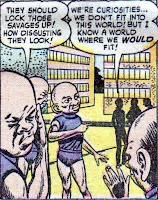
I'm not sure if I've given a story a half star before, but I awarded that dubious distinction to "A Voice from Nowhere!," which is confusing, pointless, and badly drawn. It's not clear exactly what Martin did to rile up the other colonists at the start (I think it had to do with food) or why telephone lines would still work after a cataclysm. Worst of all is the punishment of having to sit and dial numbers all day. Oh, and Martin manages to walk 200 miles alone in a suit and dress shoes. Ed Winiarski phoned this one in, which was appropriate.

In 2156, scientists decide to send a nuclear-powered spaceship, traveling at the speed of light and carrying astronauts in suspended animation, to travel to the next solar system in search of life. After a thousand years, the sleepers awake and arrive at a planet populated by humans who have found peace and tranquility. The astronauts take note, get back on the ship, and return to suspended animation for the journey home. Another thousand years later, they land on Earth, only to be jailed by humans who have evolved into angry little bald men who treat them like savages. They escape prison and hop back onto the ship for another thousand-year trip to the planet with the nice people.

It just gets worse and worse! At least "When We Awake!" looks better than the story that preceded it, though Sale is hardly on the level of Crandall.

Bob Fry is out fishing one day when a sudden storm comes up and he seeks shelter in a cave. He finds a glass jar with notes inside that were written a few years ago by Dr. Amos Milton, a scientist who disappeared while collecting samples from a meteor. Milton found a large egg and, when it hatched, out came a big green creature that looked kind of like a T Rex. Milton assumed the creatures were aliens bent on conquering Earth! As Fry reads the notes, he sees a nest of huge eggs, and one is hatching! He runs out of the cave, determined to alert the authorities and set off a great Easter egg hunt!

What a dumb ending! People are going to return to the cave to destroy the alien creatures and eggs and Bob thinks of it as an Easter egg hunt? Good thing they didn't waste good art on this story. "When the Eggs Hatch!" concludes a disappointing issue, where three poor stories illustrated by three decent artists gave way to three examples of dreck.-Jack
Next Week...
Kane and Anderson
Continue to Deliver!

Monday, September 15, 2025

Journey Into Strange Tales Issue 146: Atlas/Marvel Science Fiction and Horror Comics!


The Marvel/Atlas 
Horror Comics
Part 131
December 1956 Part IV
by Peter Enfantino
and Jack Seabrook


Uncanny Tales #50
Cover by Bill Everett

"Look Behind You!" (a: Joe Orlando) ★1/2
"Inside the Room of Shadows" (a: Ed Winiarski) 
"A Man Destroyed!" (a: Angelo Torres) 
"The Escape of Johnny York" (a: Herb Familton) 
"Valley of No Return!" (a: Bob Powell) 
"It Happened to Henry" (a: Robert Q. Sale) 

Brilliant scientist Louis Stark has invented a television screen that allows him to drop in on important events and people of the past. Unlike the usual brilliant scientist, Louis doesn't use his new toy as a tool to rob banks or rule third world countries; Louis just wants to make the world a more peaceful place to live.

To that end, the egghead drops in on well-known 18th-Century dictator, Vincent di Varni, just before he reaches power. With the aid of his gizmo, Louis is able to sway di Varni from making the decisions he made that set him down a wrong path in life. Unfortunately, Louis discovers that di Varni is his ancestor and slowly, but surely, the changes he's made affect the man's lineage. In a panic, the professor attempts to manipulate the machine in order to erase his changes but fate intervenes. "Look Behind You!" is not a bad little science fiction tale; sure, it's very predictable, but it's a nice change of pace to see someone with a big brain who doesn't want to use his assets to rule mankind.
Penny-pinching miser Mr. Bascombe just can't seem to get happy; he's miserable about everything, convinced the world is out to cheat him. The maid spends too much money on butter; the butler stole his cigars; Dish Network raised their rates 35.6%. The list goes on and on. Then one day, while on a walk, Bascombe is compelled to enter a dark doorway. "Inside the Room of Shadows," he is greeted by an old, bearded man who claims that Bascombe's true happiness is attainable if he simply enters a doorway within the house. The old codger quickly talks himself out of it, for fear the stranger is trying to take advantage of him. Convinced he has been hypnotized by his thieving butler (!), Bascombe races home to fire the man, only to learn he gave the dedicated servant the axe the night before. Atlas strips where cold-hearted bastards have a complete 180-degree turn within two panels never cease to cause eye-rolling in this funny book veteran.

In the year 2056, crime has essentially been eliminated, thanks to the "Criminal Selector" machine, which predicts a crime is about to be committed and gives law enforcement the right to arrest the guilty parties before the act takes place. But mob boss Victor Sharkey discovers a way to manipulate the gizmo to his advantage. In the end, we discover that the entire drama is a television show being telecast in 1956. A worried housewife asks her husband if he thinks such a "mechanization age" will come to be and her husband laughs and assures her machines will never become that widespread, all while the couple are surrounded by a plethora of modern electric kitchen devices. 

Yep, the concept of a government-supported initiative to arrest criminals before they break the law sounds verrrrry familiar. PK Dick's "Minority Report" had popped up in Fantastic Universe at the beginning of 1956, which certainly gave Carl Wessler more than enough time to "borrow" some elements from the SF short story. But thievery aside, "A Man Destroyed!" is a decent read with some great Torres work. I swear at times I would not be able to tell Angelo's pencils from those of Al Williamson.

Carl Wessler returns with his script for the nonsensical "The Escape of Johnny York," in which the titular POW drinks some herbal tea provided by a cellmate and escapes prison to visit his dying wife. Predictably, the tea not only transports Johnny to his wife's bedside, but also magically cures her ills. Maudlin hogwash. In the three-page "Valley of No Return!," Burt almost shoots a white eagle but is convinced to leave the bird alone by fellow hunter, Greg. Later, when they become lost, the eagle leads them out of the lost valley safe and sound. The last-panel reveal is immensely predictable.

Perhaps the worst was saved for last. Henry is a bully and his latest target is fellow accountant, Porter. After a particularly vicious prank, Porter tells Henry the world would be better off without him. Sure enough, from then on no one sees or hears Henry. What's going on? Who knows? The last panel of "It Happened to Henry" literally reveals that the writer had no idea either. So let's just ignore this one.-Peter


World of Mystery #4
Cover by Carl Burgos

"The Things in the Window" (a: Werner Roth) 
"The Forbidden Land" (a: Paul Reinman) ★1/2
"Let the Creature Beware!" (a" Bob Powell) 
"The Dreadful Dream" (a: Manny Stallman) 
"The Man with Yellow Eyes" (a: Dick Ayers) 
"What Happened in the Basement?" (a: Mac L. Pakula) ★1/2

Cal buys a deserted house on the edge of town, a well-tended home that has a bad reputation and a hint of... evil! This would normally send Cal running the other way because everyone in the Atlas Universe knows... Cal is a coward! He knows it, has become used to the sensation, almost revels in it. When the real estate salesman lets Cal know that a woman who lived in the house vanished off the face of the earth, the knees of our timid hero shake a bit because, you know... Cal is a coward!

Seeing the new residence as something of a challenge, Cal moves in and, in a cowardly fashion, continuously looks out the front window to make sure no one will bother him. Then, later that night, Cal notices that one of the windows has been blacked out. Cal shivers! Cal quakes! But soon he feels he can't take the mystery anymore and climbs through the darkened sill to find himself in another dimension. There, in the distance, is a beautiful woman held captive by weird shapes. Can Cal dispose of his cowardice and save the woman from a fate worse than death? This being the 1956 Atlas Universe, you can bet on it. About as harmless as a Saturday morning cartoon, "The Things in the Window" just shambles and stumbles to its inevitable, happy ending, saved only by some tasty art by Werner Roth. The other-dimensional voyage is very Ditko-esque and a few panels of cowardly Cal look like Roth was assisted by Johnny Craig. The speed bump is the reminder, in every other panel, that Cal has a problem being brave.

A trio of reporters from World View Magazine arrive in Peru to sniff out the legend of "The Forbidden Land." The three men push their way through, ignoring Incan pleas, and find themselves inside the ancient temple, ready to witness rites never seen by white men. Unfortunately for the three stooges, they soon find out that they are to be the human sacrifices at the ritual. They manage to escape and return to New York but, once their pictures are developed, they discover the secret Incan ritual will remain secret. Back in the early 1950s, at least one of the men would have gunned down a score of Incans and the trio would have been skinned alive.

In the heavy-handed preachy, "Let the Creature Beware!," Judd Kerr stirs up hate in small towns, pointing out residents who may be a bit "different" than their neighbors and dropping hints these "creatures" might be from another world. Once the town is in a stir, Kerr asks for donations so that he can pursue the situation in a "legal" way by hiring a lawyer. Cash in hand, Kerr races out of town. Then he gets to Abbyville and turns the town's attention to an odd old man who lives on the edge of town. Too late, Judd discovers this is the last stop on his hate tour. Some good Bob Powell work can't transform "Creature" into anything other than a mild distraction with a very unsubtle message. Powell seems to hint in his last panel that Kerr might be Hitler.

Frank Beech is involved in a terrible, serious, life-threatening, and really scary train wreck. He dies but then wakes up and relives everything he'd seen in his dream--the damn toys left on the staircase by his rotten little brat, his wife's attempts to make him breakfast despite the fact that she has no cooking skills to speak of, and the innocuous dialogue he engages in with people at the train station. Sure enough, his train crashes and he awakens to the same thing over again. When his wife hands him his mushy pancakes and tells him to hurry up, he'll be late for work, he informs her he's taking the day off. No, I mean it, that's really the end of "The Dreadful Dream"! I had roughly the same feeling as Frank since this plot has been on a loop since 1948.

"The Man with Yellow Eyes" is G.I. Lee Forrest, who fights with the American Tank Corps in Africa. "Yellow Eyes," as he's affectionately known to his comrades, fights with a bestiality akin to a jungle cat. A fellow G.I. saves the life of "Yellow Eyes" and the two men become friends, with the giant brute claiming that no matter how, no matter where, he'll return the favor. "Yellow Eyes" confides in his new friend that he was an orphan, found in a zoo near the wild cat cages, and Africa seems like home to him. A few months later, Forrest is given a discharge, but he stays in Africa and his savior loses track. 

Once the war ends, our narrator also decides to stay in Africa and attempt a search for "Yellow Eyes." One day, while out in the jungle, a lion leaps but is stopped (mid-air!) from chowing down on our hero by a mysterious whistle. The lion runs off with a man and we come to learn exactly where "Yellow Eyes" has made his home. Right off the bat, I gotta admit that a Tarzan rip-off with Dick Ayers art would usually get a one-star rating from me sight unseen, but "Yellow Eyes" has a real kooky atmosphere that must be experienced to be believed. A couple chuckles translate to a couple stars any day!

John Winters is a would-be inventor who actually doesn't work on anything in his basement. He simply goes down there to see if his family cares enough about him to head down the stairs now and then to check up on him despite his warnings to never ever ever bother him. Confused yet? Keep up. John gets zapped by lightning in his basement and is transported into the future, where he's tried and convicted as a spy. The judge listens to John's fantastic story and then tells the convicted man that his only hope is that his family will come to his rescue. Magically, John is zapped back into the present, where wife Ethel and forty-something, useless, sycophantic son, Melvin, grill him as to where he went. After he tells his utterly ludicrous tale, his wife reminds him that she couldn't check up on him because she was making him his birthday cake like any loving wife would. Holy crap, what connived rubbish this be! So, the answer to the question, "What Happened in the Basement?" is a very resounding, "Nothing!"-Peter


World of Suspense #5
Cover by Carl Burgos

"While Simon Slept...!" (a: Bill Everett) ★1/2
"By the Dark of the Moon" (a: John Giunta) ★1/2
"Menace Below!" (a: John Romita) 
"The Men in Glass!" (a: Don Heck) ★1/2
"The Lead-Lined Box!" (a: Chuck Miller) 
"The Brain Trap!" (a: George Roussos) 

Simon Miller is an inventor who shows up at the police station with a wild story. He claims to have invented a matter duplicator in his basement. He mistakenly left the machine on and dozed off on the floor under its ray. "While Simon Slept...!" an exact duplicate of him was created, and he met his mirror image upstairs! Simon brings a policeman home to show him the man, but the duplicate claims to be Simon's twin brother. The cop chases the duplicate into the cellar and, when the machine is switched on, a duplicate policeman is created. Now the cop believes Simon's story!

It's not often that I wish an Atlas story were longer, but this one, nicely drawn by Bill Everett, would have benefited from more pages. The story is interesting but ends abruptly. Is there a way to get rid of the duplicates, or would that be murder? Are they good or evil? More pages drawn by Everett would be welcome.

A strange creature haunts the outskirts of Grenhorst! Local farmers believe that it's one of the town's residents who doesn't realize that "By the Dark of the Moon," he changes into the green-skinned descendant of space creatures who landed nearby 200 years ago. Over time, they took on human characteristics that only disappeared under the full moon. One of the townsfolk, Luther Krohler, decides to take revenge on Charles Reuse, a town father, for marrying the woman Luther loved. Luther creates fake movies that show the green-skinned creatures landing and eventually demonstrates that Freda Reuse was one of them. But just as the townspeople are about to grab Charles, the full moon rises, and it's revealed that the real descendent of the creatures is Luther. The next day, he apologizes to everyone for his behavior.

I do not want to read more pages of this story! It's too complicated and not worth the effort it takes to unravel. The art, by John Giunta, reminds me of the type of art I used to see in children's books or issues of Classics Illustrated.

Two men from a foreign country (Russia?) are given a tour of a U.S. Naval station, but they are not allowed to inspect the dock. Karlin, one of the foreigners, deduces that there must be some important secret under the water by the dock, so he waits for a dark, calm night, dons scuba gear, and dives down to inspect. He sees a large metal ball that has studs all around it and he swims toward it. Unfortunately for Karlin, he has discovered a new anti-frogman device that will explode at the slightest touch!

I've always liked John Romita's art, and he does a nice job with what are essentially four pages of people talking to each other. Fortunately, there are some underwater panels that allow him to draw some shadowy scenes. The story ends on a note of suspense, with Karlin about to whack the ball with a wrench and a Naval officer explaining what will happen if he connects, unaware that there's about to be a big boom right off the dock.

Joe is a recent immigrant to the U.S. who is working as a waiter at a banquet where the president is going to speak. Suddenly the lights go out! When they come back on, an alien named Zarki and several of his cohorts have appeared in the room. Zarki announces that they have been sent to colonize Earth and resistance is futile! The aliens have glass helmets around their heads and Zarki demands that the people in the room cooperate and give him information. Everyone refuses but Joe, who volunteers to cooperate, drawing jeers from the patriots around him. Joe asks if he can display his skills as an opera singer and, when Zarki agrees, Joe breaks into a loud version of "The Star-Spangled Banner." The Americans in the room are horrified until Joe hits a high note that shatters the aliens' glass helmets! Now everyone realizes that the immigrant waiter saved the day.

"The Men in Glass" is corny as heck, but artist Don Heck knocks it out of the park and his dynamic depictions not only make it bearable but also prefigure the work he would do in a few years on The Avengers and other Marvel comics of the '60s.

Professor Hugo Steiner believes that babies are born with the memories of mankind's collective history already implanted on their brains and he plans to prove it with his new Memory Visualizer! His assistant Hans brings him a newborn in "The Lead-Lined Box!" and Hugo zaps the box with a ray from his gizmo, but what he sees as the newborn's memories show that its immediate ancestors were mute slaves, dependent on others and thrown scraps and bones for food. Hugo is so upset by what he sees that he destroys the machine, unaware that his kindly assistant couldn't bear to put a human baby in the box, so he put a puppy dog in there instead!

I like Chuck Miller's art on this three-pager, and I did not see the twist ending coming in advance, so it was worth a read. I had a feeling that there was something going on with the newborn in the box, but the uncredited writer did a decent job of  suggesting that it was a human baby until we were told otherwise.

Harry Hoyt is a chemist who accidentally invents a cure for baldness and decides that he needs a partner to develop his new product into one that he can sell worldwide. His wife warns him that his partner might take advantage of Harry's good nature. Harry puts an ad in the paper and Earle Bolton responds. Earle is impressed by the invention and signs on as partner, but Harry suddenly finds himself able to read Earle's thoughts and discovers that Earle plans to kill him and take all the money for himself. Harry avoids Earle's clumsy attempt to brain him with a wooden stool, calls the police, and burns his formula.

An unexpectedly enjoyable issue of World of Suspense ends with a dud in "The Brain Trap!;" George Roussos's illustrations are as pedestrian as the script. Both Peter and I are working on a time machine to return to 1956 and question Harry about his miracle cure for baldness.-Jack

Next Week...
With-it, Hip, New Writer Mike Friedrich
Decides That What the World Needs Now Is a Hip, With-It
Reboot of the Very First Batman Adventure For the
Dark Knight's 30th Anniversary. Do the Boys Agree?