Repository navigation
[css-inline] Arabic drop-caps #2399
Description
@behnam provided the necessary info in #698 (comment) to define shaping behavior, so we should spec it.
@behnam provided the necessary info in #698 (comment) to define shaping behavior, so we should spec it.
Activity
[css-inline] maintain arabic shaping across initial-letter boundaries…
fantasai commentedon Dec 6, 2018
In #698 (comment) @jfkthame wrote:
r12a commentedon Dec 12, 2018
Do we have a source which we believe is reliable that does show enlarged initial letters using joining forms? @behnam, @shervinafshar, @khaledhosny, @sahafshar, @ntounsi, @mostafa, any ideas?
shervinafshar commentedon Dec 12, 2018
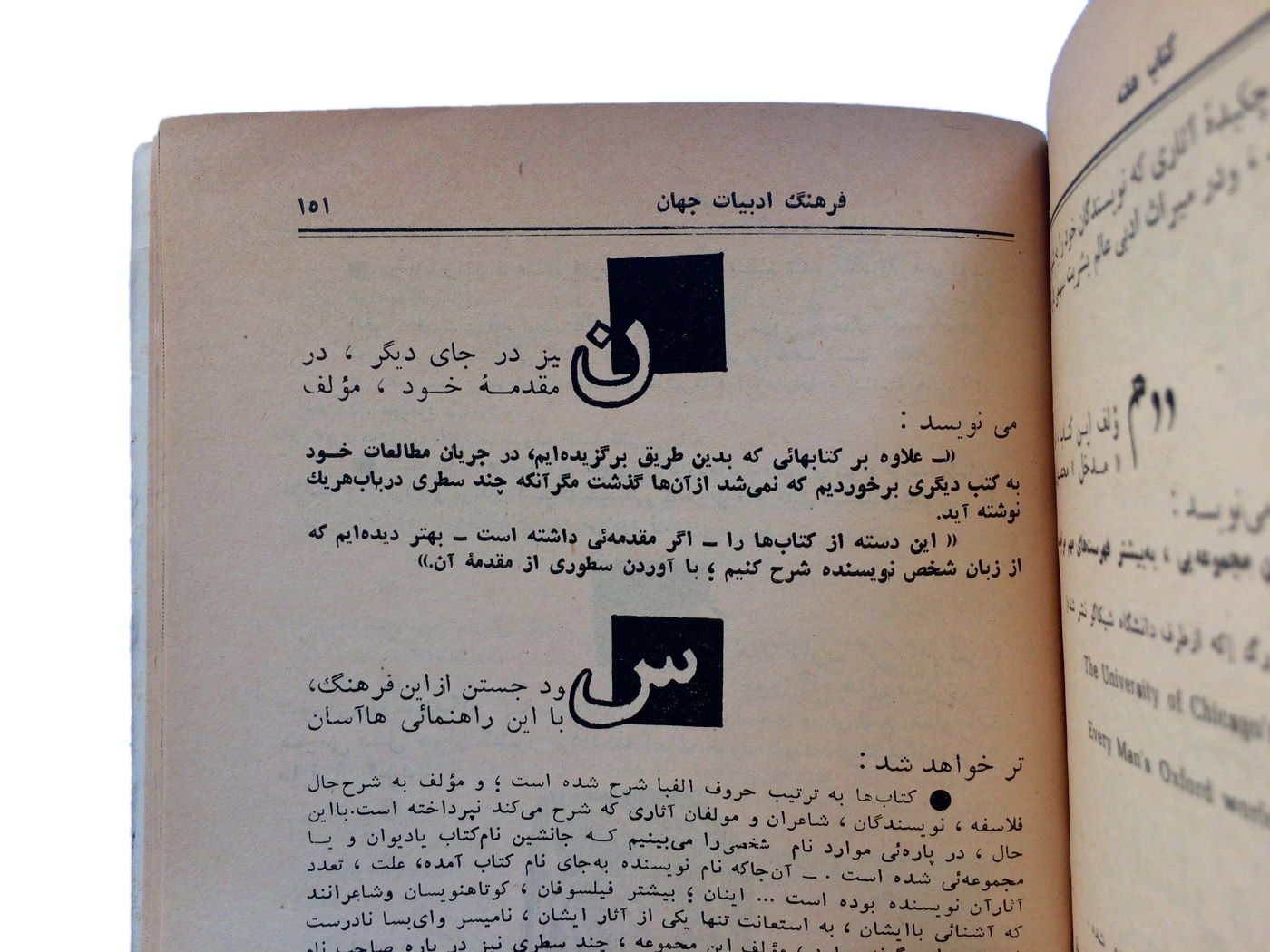
@r12a, this topic has been bouncing around for a bit now. My personal take is that since this is a novelty of a typographical practice in Arabic script text, there is no reliable source. However, the research shows that (a) most cases of drop-caps in Arabic script texts are not using joining forms; (b) through my research on the matter, I believe that there is also some precedence for the drop-caps in Arabic script text to use of joining forms. This requires further investigation, but I reproduce the case that I'm referring to as a rare precedence.
What follows is from the volume Compendium of Latin Translations of Persian Astronomical Tables, selected portions of Zīj-i Sultānī translated into Latin and published by Oxford University Press in 1655.
Further pointers:
– my thread on Persian Computing
– Liam Quin's blogpost has a section with his findings, points to the thread above
sahafshar commentedon Dec 12, 2018
r12a commentedon Aug 23, 2019
I wonder whether the answer here is to assume that by default arabic versals are not joining forms, but allow authors to turn them into joining forms using ZWJ if desired??
In that case, would we need a special rule to say that ZWJ is kept with the preceding letter when using
::first-letterselection?(Btw, @sahafshar your image didn't seem to make it into the thread.)
r12a commentedon Jan 23, 2020
Fwiw (perhaps not much) if you open this test in Safari (which is the only major browser i know of that supports initial-letter behaviour) you'll see that when selecting the first letter of a word where i had inserted ZWJ after the initial letter, ::first-letter automatically picked up the ZWJ and rendered the enlarged initial as a joining form.
If there is no ZWJ (see this test) then the initial letter is unjoined, but the 2nd letter in the word is joined.
svgeesus commentedon Jan 24, 2020
@faceless2 a nice drop cap testcase for you
fantasai commentedon May 28, 2020
I'm inclined to spec the behavior @r12a describes in #2399 (comment) Happy to do something different if there's some clear consensus as to what's correct, though. :)
jfkthame commentedon May 28, 2020
@r12a When you say "but the 2nd letter in the word is joined", do you mean it takes a right-joining (medial or final) form, as if it were joined to the initial letter? Or just that it is joined to what follows it?
(As far as I can see when testing here, it takes an initial form; i.e. it does not shape as though joined to the initial letter.)
fantasai commentedon May 28, 2020
Got an iOS screenshot I got from my friend... so it does look like Safari is breaking the connection on both sides.
That said, using the correct connecting form between the second part of the word and the initial letter seems to me would be more readable than actually breaking this connection. Similar concept to how Latin drop-caps kern in the rest of the first word into the drop-cap, to help maintain a clearer connection between the first letter and the rest of its word.
I also understand that using isolated form for a drop-cap just looks a lot better; that's probably why it's more common per @shervinafshar and @sahafshar’s comments.
So basically we have three options here:
I think the third option is actually the best one. Curious to hear what native users of the writing system think.
Here's a mockup of all three options, for reference:

sahafshar commentedon May 28, 2020
I agree @fantasai, the third option makes most sense to me. Sorry @r12a you're right, I forgot the reference picture in my original response on the thread. I've attached it here. As you can see, it also follows the same logic as the split model.
[css-inline-3] Update rules for Arabic drop-cap handling per discussi…
fantasai commentedon May 28, 2020
Tentatively updated the editor's draft with text for this behavior given @sahafshar’s confirmation. I'll wait on more feedback before closing the issue, though.
faceless2 commentedon May 29, 2020
This change isn't script-specific? Seems reasonable. Given how hard it was finding examples for arabic etc. I'm pretty sure we'd be basing a decision on a sample size of zero for N'Ko.
fantasai commentedon Jun 5, 2020
@faceless2 I think in the absence of conclusive information to the contrary, it should apply to all scripts. :) The principles that make it the most sensible option (see #2399 (comment)) are generally-applicable.
[css-inline-3] Clarify the shaping effect of initial letter a bit more.