Showing posts with label Roger Corman. Show all posts

Wednesday, 10 November 2021

Dementia 13 (1963)


"Coppola's Gothic Giallo Finally Gets A Decent Transfer"


Yes that's right. After existing in various dubious public domain versions on DVD for many years, Francis Ford Coppola's Roger Corman-produced horror picture (otherwise known as THE HAUNTED AND THE HUNTED here in the UK) is coming out on Blu-ray as part of the Vestron Collector's Series.


While out rowing (at night, in the dark), the husband of Louise Haloran (Luana Anders) dies of a heart attack, seriously threatening her chances of sharing in any fortune he may inherit. So she pretends he's still alive and travels to the ancient Irish family homestead to take part in the Haloran's annual ceremony to remember the death of their youngest daughter, Kathleen, who drowned when she was little. Unfortunately this year's occasion is marked by the presence of an axe-wielding maniac keen to bump off the family members while also possibly being one of them.


With a feeling of corner-cutting typical of its producer, DEMENTIA 13 nevertheless has plenty of gothic atmosphere, some decently gory axe murders, and a couple of memorable underwater sequences. With its twists and turns it's easy to see where the directors of 1970s gialli may have got some of their ideas from.

Ronald Stein's music score is a classic, all creepy harpsichord that walks the fine line between horror and black humour. Patrick Magee turns up as the local doctor and William Campbell - Star Trek's Squire of Gothos himself - is one of the suspects. The whole thing clocks in at an economical 69 minutes and is something of a black and white low budget delight from start to finish.


And it's even more of a delight in Vestron's special edition which boasts a nice clean print with good grain and minimal picture noise even during the darkest sequences. Extras consist of a Coppola introduction. It's only a minute long but don't worry because he's on hand to provide a detailed commentary track as well. In fact it's surprising how much he can remember about a film made so long ago but as he says himself, this was a very special film for him. Finally, you also get the 'DEMENTIA 13 Test' Prologue, which is six minutes of a 'specialist' who has allegedly designed a test to make sure the viewer doesn't go out and murder people after viewing this film, presumably even in this first-rate Blu-ray presentation. Good stuff, Vestron.


Francis Ford Coppola's DEMENTIA 13 is out on Blu-ray as part of the Vestron Collector's Series from Lionsgate on Monday 15th November 2021


Saturday, 2 May 2020

The Man With the X-Ray Eyes (1963)


Mad science leads to cosmic horror (well, a decent-sized hint of it anyway) as Second Sight releases Roger Corman's classic science fiction picture as a limited edition Blu-ray with a host of extras.


The researches of Dr James Xavier (Ray Milland) has led to him creating a serum 'X' that allows the eye to see through objects to what lies beneath. He's tried it out on monkeys and when it comes to human tests he decides to use himself as a subject. Initially he finds he can read documents covered by other papers, then at a party he finds he can see through everyone's clothes. 


Soon he can see further, diagnosing a child's heart condition and performing surgery for it against the clinical decision of his superior (John Hoyt). A threat of malpractice, plus an incident where he accidentally pushes a colleague out of a window, leads to Xavier going on the run & becoming a carnival sideshow attraction. But for him, the worst is yet to come.


A neat bit of 'meddling in things man must leave alone' is given a cosmic edge to it (and some great dialogue ) by a screenplay co-written by Ray Russell (Sardonicus and a number of very fine short stories) and Robert Dillon (PRIME CUT). The idea that Milland's Xavier is being tormented by what he can see at the edges of the universe has its roots in Lovecraft, but Roger Corman's no-nonsense direction keeps it all very sober until that final, classic, scene which I will leave you to discover for yourselves if you haven't already.


Second Sight's Blu-ray includes two commentary tracks, one from Corman and another fact-packed one from Tim Lucas. There's also a Corman interview and another with Kat Ellinger, as well as Joe Dante talking about the film and Mick Garris providing commentary on a Trailers From Hell segment devoted to it.


The disc comes in a sturdy slipcase with new Graham Humphreys art. The case also includes a double sided poster (UK quad art on one side, the new art on the other), plus a book with new writing on the film from Allan Bryce and Jon Towlson. 

Roger Corman's THE MAN WITH THE X-RAY EYES is out on limited edition Blu-ray from Second Sight on 
Monday 4th May 2020

Sunday, 29 May 2016

Blood Bath (1966)


“A box set of four films...sort of”

Sort of indeed. Fans of the wild and crazy world of 1960s exploitation cinema are likely to be the main / only audience for this latest smartly-presented Arrow double-disc Blu-ray release, which gives you four black and white films (OPERATION TITIAN, PORTRAIT IN TERROR, BLOOD BATH and TRACK OF THE VAMPIRE) spread over two discs. The peculiar ‘gimmick’ if you like, is that each of these films has footage common to all of them, as well as footage specific to each individual one, resulting in four movies different enough to warrant separate presentations, while not being sufficiently different to warrant individual releases.


Does that make sense? If not there’s one of Arrow’s splendid ‘visual essays’ to explain it all, narrated by the extremely knowledgeable Tim Lucas and based on a series of articles from his excellent Video Watchdog magazine. Most of these essays on Arrow releases last about twenty minutes. Lucas’ piece runs for over eighty, which give you an idea of how much explaining needs to be done.


So I’m not going to even try. What I am going to suggest is that if you’re a horror fan you tuck into this set by starting off with the title film BLOOD BATH (on Disc 2), directed by Jack Hill and Stephanie Rothman (and some other people who don’t get credited). BLOOD BATH stars William Campbell as an artist who also happens to be a vampire haunted by the spirit of a girl his ancestor had burned. I think. The film doesn’t make a lot of (if any) sense but it does feature some stunningly atmospheric shots - including at least one splendidly weird bit on a beach that’s reminiscent of a similar shot in Rothman’s subsequent THE VELVET VAMPIRE (1971) - some scenes with ‘beat artists’ (including Sid Haig) that are immensely entertaining, and a weird climax of crumbly wax-covered corpses that’s worth the price of admission. Fans of Ronald Stein’s horror film scores (like me) will have fun spotting cuts from THE HAUNTED PALACE, PREMATURE BURIAL and others on the ‘library’ soundtrack. BLOOD BATH only runs for 61 minutes but if you like this sort of thing it’s well worth your time.


The other film on Disc 2 is TRACK OF THE VAMPIRE, which is kind of the TV version of BLOOD BATH. Some of the teasy nudity and bits of bloodiness have been cut but a lot of extra footage has been added which makes it the longer of the two films here, even if it’s not the more interesting. Disc two also has the extras, including talking head pieces with director Jack Hill and actor Sid Haig (is he wearing a hospital bracelet?) and the previously mentioned piece by Tim Lucas.


Disc 1 has OPERATION TITIAN, which is the film that started it all off. I mention it down here because it’s not terribly interesting, except to show you where a lot of BLOOD BATH’s footage originated. It’s a fairly anaemic crime thriller about picture smuggling with William Campbell and Patrick Magee (criminally not in BLOOD BATH except for a blink-and-you’ll-miss him bit right at the end). OPERATION TITIAN was recut and rescored to create PORTRAIT IN TERROR, which actually does move better and has an ending that’s hysterical enough to make it worth a watch. 


You also get a stills gallery, a fold-out poster, a reversible sleeve and a booklet with new writing on the film. I said above that Arrow’s BLOOD BATH package is really only for people who are going to be fascinated (as I was and still am) by how these four films came to be. That’s not to do it down, however. This is a fine and carefully put together package that archives for posterity a remarkable, and remarkably complex, slice of exploitation obscurity. Arrow absolutely deserve some sort of award for this one. 

BLOOD BATH and its three friends are out on Blu-ray in an Arrow box set on Monday 30th May 2016

Tuesday, 9 December 2014

Six Gothic Tales (1960 - 1964)


Christmas has come (slightly) early for fans of Roger Corman’s Edgar Allan Poe adaptations in the form of this gorgeous box set that contains six of the movies he made that starred Vincent Price. We’re missing MASQUE OF THE RED DEATH (because Arrow don’t have the rights to that one) and THE PREMATURE BURIAL (presumably because it starred Ray Milland instead) but otherwise the gang’s all here - a splendid smorgasbord of crumbling castles, eerie matte paintings, Daniel Haller’s elegantly creepy production design, Floyd Crosby’s smooth, economical camera setups, music that varies from adequate to absolutely marvellous, and of course the unsurpassed and unsurpassable Vincent Price, without whose central performance to anchor these pictures they would be simply be elegant exercises in low budget gothic. With him, however, they are so much more.
As I’ve said above, Arrow’s box set gives us six films, all on Blu-ray. Two of these have been released previously in separate standard and steelbook editions. The transfers and extras here are all the same so if you want to read what I thought of THE FALL OF THE HOUSE OF USHER and PIT AND THE PENDULUM then click on the titles and you’ll be whisked away to my reviews. Remember to come back here when you’ve finished, however, so we can talk about the others. 
All done? Ok. Let’s start with

TALES OF TERROR (1962)
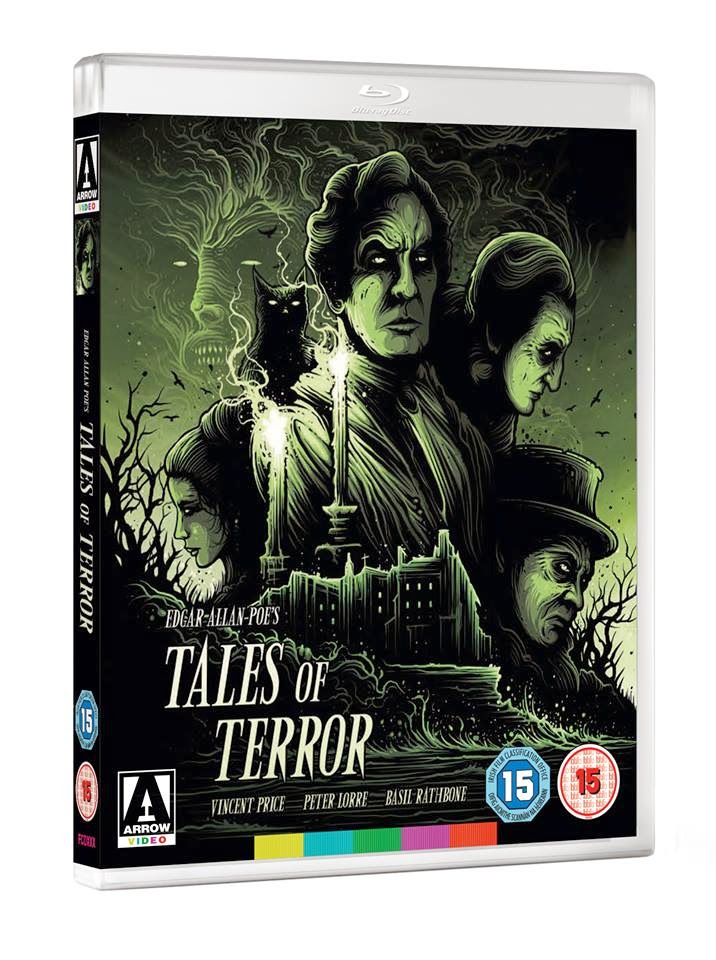

        Before Amicus resurrected the DEAD OF NIGHT-style anthology film (several short stories plus a framework), Roger Corman put together three Poe shorts without a linking sequence under the above title. We open with Morella, which is a bit like an entire Corman Poe film condensed into twenty minutes. Vincent Price is still mourning the passing of long-dead wife Morella in his crumbling castle when his daughter Lenora (Maggie Pearce) calls on him. Morella died in childbirth and, perhaps understandably, wants to be reborn in her daughter's body. It all ends predictably in flames, but this is one of the very best bits of Poe Corman ever made, and it’s a shame it’s not longer. Everyone seems to like the second story, The Black Cat, even though it’s actually The Cask of Amontillado with a cat in it and played for laughs. I have to say it’s the one I always skip over, but Peter Lorre and Vincent Price do have a whale of a time as rival drinkers. The Facts in the Case of M Valdemar finishes the film with Price, kept alive at the moment of death by hypnotist Basil Rathbone, liquifying all over him when Rathbone’s control fails. 
       Arrow’s transfer carries over a few scratches but otherwise is pristine and clean. Extras include a quite charming featurette by Anne Billson on cats in horror films, an hour long documentary on Roger Corman, Kim Newman talking about Poe, a short film of The Black Cat from 1993, a trailer and a reversible sleeve.

THE RAVEN (1963)


        Using Poe’s poem as a springboard, THE RAVEN immediately turns into a comedy in which magicians Vincent Price and Boris Karloff wage war while Peter Lorre watches from the wings (sorry). Hazel Court is there to egg them on. Arrow gives us another excellent transfer, and the extras here include a 1984 documentary on Peter Lorre (Harun Farocki’s The Double Face), a featurette on Richard Matheson, the short film The Trick (from the director of The Black Cat short), the promotional record that was released at the time (featuring voices of the actors, including Lorre reading the poem), a trailer, still and poster galleries, and another reversible sleeve.

THE HAUNTED PALACE  (1963)


       Quite often this is my favourite of the “Poe” pictures, even if it is adapted from an H P Lovecraft story. And what a fine adaptation it is. Corman’s Arkham is suitably decaying and filled with the mutated results of experiments from the palace on the hill, as well as plenty of suspicious locals with a terrible secret and monsters of their own in the attic. Possibly Vincent Price’s finest acting moment in the entire cycle occurs when he transforms from innocent Charles Dexter Ward into his evil ancestor Joseph Curwen. Sets and photography are as top notch as usual, but where THE HAUNTED PALACE goes one better is in having Ronald Stein do the music. Les Baxter is the composer most commonly associated with these films and I’ve always found his music passable, if not exactly inspiring. Stein’s score for HAUNTED PALACE, however, is a masterpiece, with the opening titles a waltz of sheer gothic perfection. 
Arrow’s transfer is, like the other films in this set, most likely the best this film is ever going to look. For extras we get a superbly chatty commentary track from David Del Valle and Derek Botelho. Kim Newman talks about H P Lovecraft in cinema, there’s an interview with Roger Corman, still and poster galleries, a trailer, and a reversible sleeve.

THE TOMB OF LIGEIA (1964)


        The last of the Corman Poes and pretty much the least. Whether it’s the slight script, Elizabeth Shepherd’s aristocratic air of disbelief that she’s even in one of these, or the opportunity for location shooting that seems to have so overwhelmed Corman that many of the set-ups distract massively from what is actually going on, TOMB OF LIGEIA really isn’t the best by a long way. Still, it's fun to see British character actors like Frank Thornton, Richard Vernon and PSYCHOMANIA’s Denis Gilmore in one of these but otherwise it’s a pretty lame affair.
It looks lovely here, though, and the extras we get this time include two commentaries (by Corman and Elizabeth Shepherd), and a set of new interviews with composer Kenneth V Jones, co-writer Paul Mayersberg, 1st AD David Tringham and camera assistant Bob Jordan. Most of these run for around ten minutes each except for the Mayersberg which last for about half an hour. 


       As well as the six films (and the lovely box they come in) you also get a 200 page book with writing on the Poe cycle as well as three comic books published to tie in with TALES OF TERROR, THE RAVEN and TOMB OF LIGEIA. Arrow will be releasing the Blu-rays separately for those of us who already have USHER and PIT. If you haven’t, however, then grab this set now - it’s a beautifully presented example of 1960s gothic cinema at its best. 

Arrow Films released SIX GOTHIC TALES as a Region B Blu-ray set on 8th December 2014

Thursday, 29 May 2014

Pit and the Pendulum (1961)


        Arrow Films continues its series of lovely Blu-ray and steelbook releases of classic Vincent Price films with arguably the most famous of them all (even my parents can remember watching this one on its initial release). Made in the wake of the success of FALL OF THE HOUSE OF USHER, Roger Corman’s second adaptation of an Edgar Allan Poe story is a triumph of inspired matte paintings, clever writing on Richard Matheson’s part, a spooky and creative Les Baxter score, but above and beyond all that a terrific central performance by Vincent Price. 


In the kind of fifteenth century Spanish castle that could only exist painted on glass and projected above a California beach, Vincent Price is slowly going mad. Bad enough that as a child he witnessed his mother and her lover killed by his insane Inquisitor father, now his wife (Barbara Steele) has died, but he can hear her playing the harpsichord late at night. Discovering that Barbara was entombed alive doesn’t help his fragile mental state, which takes a turn for the worse as the film reaches its climax. Insane aristocratic Vincent Price and a handy torture dungeon equipped with fully functioning swinging pendulum that he’s been keeping oiled even when he was presumably a little bit more sane is going to spell trouble for anyone, not least those who have been plotting against him.


While it’s not as good as some of the later Poe pictures (especially MASQUE OF THE RED DEATH which remains my favourite) the last twenty minutes of PIT AND THE PENDULUM  is a gothic triumph, managing to combine Price at his most lip-smackingly evil, a massive torture device, and Barbara Steele, barefoot, beautiful and distressed, being locked up in an iron maiden. Forever. It was rare for a film of this period to end on quite such a shocking note, but Roger Corman knew that if you’ve got the imploring eyes of a poor imprisoned Barbara Steele to make use of, you really can’t fade out on anything else. 


The first hour or so of the film does suffer a bit in being simply preparation for the big reveal at the climax, but on the whole it’s not bad, with the usual sumptuous sets and photography. But it’s the pendulum that made such an impression on sixties audiences, and with good reason - despite numerous attempts, the final twenty minutes of this film has yet to be matched in its use of this macabre mechanical murder device.
Arrow’s Blu-ray transfer is pretty good, but there is some print damage and quite a few scratches, most noticeably in the scene where Price looks on in horror as a bloody hand emerges from a coffin. Extras include two commentary tracks - one by producer-director Roger Corman that’s been ported over from the previous DVD release, and a new fact-filled track by Tim Lucas. There’s a new 45-minute making of documentary that includes interviews with Corman, Victoria Price, Brian Yuzna and Barbara Steele, who also touches on her experiences with directors Riccardo Freda and Mario Bava. 


Also included, and previously unavailable in the UK, is the Vincent Price TV special AN EVENING OF EDGAR ALLAN POE. This consists of Price in costume and amid appropriate sets telling four Poe tales - The Tell-Tale Heart, The Sphinx, The Cask of Amontillado, and The Pit and the Pendulum. There’s also an isolated music and effects track, a trailer, and a collector’s booklet written by Jonathan Rigby. Depending on which you prefer there’s either the lovely steelbook or the standard edition to choose from, both of which have splendid cover art. 

Arrow Films released Roger Corman's PIT AND THE PENDULUM on Blu-ray in steelbook and standard editions on the 19th May 2014

Friday, 6 September 2013

The Fall of the House of Usher (1960)


      As I’ve mentioned previously on here (in my review of Mario Bava’s BLACK SUNDAY) Hammer Films really did do something wonderful for gothic cinema when they breathed new life into the horror film genre in the late 1950s. They didn’t just change the face of horror, they encouraged others to carry on changing it, adding their own peculiar quirks and styles. Soon film-makers from all over the world were trying to get in on an act that had proved so fabulously lucrative that for the exploitation market to ignore it would have been foolhardy at the very least.


It can only have been the prospect of vast amounts of money that convinced Sam Arkoff and Jim Nicholson of AIP to fund Roger Corman’s lavish colour version of Edgar Allan Poe’s FALL OF THE HOUSE OF USHER. That, and of course, Roger being a very, very good salesman. Now, 53 years later, all we can say is thank goodness he was a very good film-maker as well, something that could hardly have been suggested by previous movies like THE WASP WOMAN & IT CONQUERED THE WORLD. And now we have Arrow’s quite stunning Blu-ray restoration to show just how gorgeous a film FALL OF THE HOUSE OF USHER is.
In a rotting manor house live the dying Madeleine Usher (Myrna Fahey) and her brother Roderick (Vincent Price) a man who suffers from a unique exquisiteness of the senses, such that loud noises and bright colours are ‘agony’. One wonders, then, why he tends to wander around in a scarlet dressing gown all day. At least he doesn’t play too many high notes on his lute.
Into this atmosphere of death and decay comes Philip Winthrop (Mark Damon) sporting the brylcreemed ducktail hairstyle of the sixties (1960s rather than 1860s). His ride through a blackened forest at the beginning is superbly atmospheric, and a prime example of Corman taking advantage of whatever might be to hand (in this case, a recent nearby forest fire). Mark wants to marry Myrna, but Vincent is unhappy about it to say the least. He tells Mark that the Usher bloodline is cursed and that extending it will only prolong the agony. It all ends with bloodstained, post-cataleptic Madeleine clawing her way out of the tomb and strangling her brother while the whole house goes up in flames (actually a nearby barn due for demolition - well done again, Roger). 
FALL OF THE HOUSE OF USHER is a cracking film for many reasons. Floyd Crosby’s photography and Daniel Haller’s production design give the movie a look that is different from, but no less lush than, the Hammer films of the time. With the exception of Price, the acting isn’t especially memorable, although it’s only by the end that you realise there are only four people in this. As well as hiring a good crew, Corman also performed a masterstroke in getting a proper writer (Richard Matheson) to put together a screenplay which made the actual Poe story its third act - something Matheson would do again for the following year’s PIT AND THE PENDULUM. As well as doing all of this, Corman acquits himself well as a director, his most startling addition to the world of the 1960s gothic being the weird dream sequence. I don’t doubt this was probably done out of necessity to help fill up the running time, but nevertheless it’s a superbly scary little vignette and you can tell Corman’s heart was totally in that bit too.
Arrow’s Blu-ray treatment of Roger Corman’s first Poe movie is just lovely. The fine detail of the lush furnishings (and even Mark Damon’s hair, if you’re so inclined) can now be more greatly appreciated, and the richness of the colours make the television screen glow.
There are a number of extras. First off is a Roger Corman commentary track that’s been ported over from the previous region 1 DVD release (although I don’t think it’s been previously available in the UK). There’s a lovely featurette in which Joe Dante talks about his relationship with Corman, and how little kids in the 1960s didn’t seem to mind sitting through endless scenes of people in frock coats and hoop skirts to get to the horror bits. Jonathan Rigby talks for over half an hour - and very well indeed, too - about the Corman cycle of Poe films and USHER in particular. Mr Rigby obviously knows a great deal about the subject and it’s always a pleasure to listen to him.
Fragments of the House of Usher is an interestingly-narrated piece by critic and film-maker David Cairns that compares Corman’s film to the original Poe story, and there’s an archival French interview with Vincent Price, fresh from making THE GREAT MOUSE DETECTIVE, that’s a pleasure to watch.
As usual, Arrow have gone the extra mile with packaging materials (the steelbook is a thing of beauty). The so-called standard packaging has a new cover by Graham Humphreys, a man whose artwork could never be described as standard. There’s also a booklet with new writing on the movie by Tim Lucas, adding up to a quite unmissable set that’s deserving of the attention of anyone with an interest in gothic cinema.