Napoleonic, WSS & ECW wargaming, with a load of old Hooptedoodle on this & that


Showing posts with label Nostalgia. Show all posts

Wednesday, 1 April 2026

Hooptedoodle #495 - Joseph Spence Revisited

I still own a lot of CDs, which I am told is very 1990s. I don't care - they are mine, and I love them (most of them), and I can play them whenever I like, in super quality, without asking anyone, without leaving my personal details all over the web and without watching someone's bleeping adverts.

Recently I've been making an effort to tidy things up a bit, get rid of stuff I don't want any more, spot old discs which are starting to degrade (and rescue them if possible, if it's worth it), and do some serious-quality rips that I can play in the car. I've had some interesting reunions with a number of voices from my past.

 
Joseph Spence
(1910-1984)

During this latest period of avoiding the news I spend a lot of time listening to Finzi, Ravel, Fauré and odd-bods like George Butterworth and John Jeffreys, so it was a bit of a culture shock to meet up again with Joseph Spence.

Joseph was a pipe-smoking stonemason in the Bahamas, who had a fearsome local reputation as a guitarist and entertainer. Word sneaked out in the late 1950s, when he was visited by collectors and the Folkways people and was recorded in his home. He became something of a celebrity, was recorded again, more professionally, and was booked for a tour in New York and Boston in 1964. This didn't go wonderfully well. His family were very religious, and did not approve of drinking or songs about inappropriate behaviour. Thus he was allowed to travel to the US only on the understanding that he was accompanied by two women members of his family, who monitored his behaviour very carefully, and appeared on stage with him, singing hymns. 

This is why you have probably never heard of Joseph, in the same context as you have probably heard of Blind Gary Davis, Mississippi John Hurt, Rosetta Tharp and others from those days. However, the fact remains that Joseph was a self-taught phenomenon - wildly gifted and completely unfiltered. His guitar playing is remarkable (he was a noted inspiration to Ry Cooder, Tommy Emmanuel and all sorts of people), and he sort-of sings along (deedle deedle), coughs and mutters his way through performances. Most importantly, his music is happy - it is very difficult not to smile at his work.

After the failure of the Newport Foundation tour, Joseph returned to live in peace in the Bahamas, and disappeared almost completely, though I am sure that he was still the life and soul of the spontaneous building-site parties, and that his sisters still disapproved of the rum. 

And I'm sure he wasn't a bit bothered.


Sunday, 8 March 2026

It Was Such a Long Time Ago, and It Wasn't Even True

Mention of the late Clive Smithers came up in an email exchange this week with a friend, who remembered that around this time of year Clive would have been burning the midnight oil, researching and perfecting one of the celebrated April Fool pranks he used to post on his blog. 

I was involved in the skulduggery surrounding a couple of them, my favourite of which was the JRR Tolkien Hoax of 2010. All right, I confess I took a minor role in the construction of the plot, but I was responsible for this photo, which spread far and wide among the online fora of the gullible; the picture is a rather crude assemblage of bits from here and there, the medium was PhotoShop, but the idea was solidly Clive's.  

 
"Peter Young playing the game, in the garden of 
20 Northmoor Road, September 1939"

This July will be the 5th anniversary of Clive's passing, which is certainly worth a respectful nod when it comes around. I realise that these have been a hectic few years, but my friend and I were both surprised that it was only 5 years, and we agreed that Clive would have been less than impressed with most of what has happened since.

His family planned to preserve his blogs, and as far as I know they are all still online. 

Friday, 25 July 2025

Hooptedoodle #485 - a Rare Touch of Class - Cleo Laine

 A respectful note from me for the passing of Dame Cleo, who has died at the age of 97. Here's a little dalliance with Shakespeare; my favourite track from what was one of my very favourite albums when I was a student (and subsequently, in fact).


Wednesday, 7 May 2025

Hooptedoodle #480 - Something to Do with Having Your Cake


 I've always been fascinated by how memory works. Part of this has been reinforced recently by living through my mother's mental decline, and also by my occasional sifting through the big box of old photos I rescued when we sold her house. 

The photos themselves can become a little misleading, since sometimes I can remember seeing a photo before, and am no longer sure whether I can remember the actual event depicted. This may also have something to do with having a strong impression that my early childhood was all in monochrome!

How far back can we really remember? They say that between ages 2½ and 3½ is when we start to put together coherent memories - it probably depends on how spectacular one's early years were. I have some photos here of a weekend I spent with my parents at the seaside at Borth-y-Gest during the Summer when I was 2. There are pictures of me playing with my toys, and I can remember some of these toys from having known them in my later childhood, but I don't remember being there. I don't even remember that my dad almost drowned us all by taking us out in a rowing boat when there was a gale warning, which must have been fairly memorable. 

I am sure there must be bits of real memories in the early mixture, but the first definite event I can remember and put a date on was shortly after my 3rd birthday. I went to stay for a few days at my Uncle Ernie's house, across the river in the Wirral, because my mother was in hospital giving birth to my sister, and unfortunately (always having been a klutz) I fell off the swing in Ernie's garden and broke my left leg. I can't remember the swing or any of the trauma, but I have very vivid memories of two days spent in Birkenhead General Hospital; I remember the strangely-coloured lights they had on at night in the ward, and I remember very clearly playing in my cot with a Dinky Toys refuse truck which Ernie brought me by way of apology.

Just like this one, in fact:


 Dinky Toys model no. 25

I also have pretty clear memories of travelling with my mother by bus back to the hospital however-many weeks later to get my plaster cast removed. 

One thing that doesn't necessarily attach itself to old remembered images is how I felt about what was going on. However, during the recent annual festival of Gorging on Chocolate which has replaced the religious themes of Easter, I was reminded of The Incident of the Easter Chick Cake, and this may be a very early sample of my feelings about events.

This must have been my 4th Easter, so I would be 3-and-a-bit. My mother came in with some groceries, and she handed me a small paper bag, which contained a simple little novelty cake she had bought at the baker's. It was a very plain likeness of a small Easter Chick, not much bigger than a real live one, I guess, made of two balls of sponge cake, covered with yellow icing, with currants for eyes and a little beak of folded orange marzipan. It must have been pretty crude, really, but I loved it, and no-one had ever bought me a cake before. I spent some of the afternoon staring at it, being its friend; at teatime it was served up on a little plate, and I ate it.

I was heart-broken. Inconsolable. It hadn't been all that wonderful to eat, and I now knew for a fact that I would much rather have kept the cake as a friend. My mother was actually quite worried, and the following day she quietly went out and brought me another little bag. Yes - that's right; she had gone back to Mr Osborne the Baker (in South Street) and they had one Chick Cake left. I can still just about remember how wildly happy I was - all of a sudden life contained the possibility that something you had lost could be replaced. I had maybe never thought of that before. It probably ruined me for life, in fact...

This time, I decided, I was going to keep my cake safe, forever - you may have some concerns that this might not have gone very well. What actually happened was that the replacement cake was served up on the same plate, at teatime on the day of its arrival, and I happily scoffed it without hesitation and without any subsequent qualms. It seems that, once I had explored and enjoyed the personal tragedy of having eaten and lost the first one, I was ready to move on to more orthodox gluttony. I have never looked back. 


I find this interesting. We must put together a whole life-set of values and feelings based on personal experiences; I'm sure mine started a long time before the cake, but this is the first one I can identify.

And you know what? Both the Chick Cake and the Dinky refuse truck are remembered in full colour. Hmmm. 

Thursday, 17 April 2025

Hooptedoodle #477 - Årstid and the Acer - a week for time travel

 No garden progress this week, since it has been raining steadily (which is, of course, perfect for new plants). I've been doing Other Things, an underrated pastime in my opinion; as ever, Nature likes to chip in with the odd minor accident or inconvenient coincidence, but it's all part of the Great Plan.

Årstid

I really don't wish to know how this is pronounced. One small event which could have been a big nuisance is that the bedside lamp in the attic room has packed up. Broken switch. Needs to be replaced, and the first obvious issue here is that it must be 25 years old. I realise these little domestic mishaps are sent to test our faith, so I don't take it personally.

I had a look online to see what is available, and felt a familiar sinking of the heart as I was confronted by the riches of endless, bewildering choice. I find much of this choice is not what I'm looking for, since, stupidly, I have no interest in a lamp which is rechargeable, or has a USB socket for charging my devices, or is dimmable, or is touch sensitive, or can be spoken to, or switched on while I'm still on the train, via my phone, or is light sensitive. What I do want is something very like the old one, which takes big, screw-in bulbs, is tall enough and has a big enough shade to light up the room yet not be scorched by the big LED bulbs I use. I want it to have a simple pull-switch, which I can operate without upsetting everything when I wake up - in the dark, for goodness sake. Cheap and simple would be good characteristics.

My wife, who is extremely good at this stuff, found that what we currently have is an old IKEA design called Årstid. She also found - wonder of wonders - that IKEA still sell it, and it is very cheap. Here it is:


With a bit of luck I should have a new one up and working by tonight. My ability to read in bed is depending on this, so it is not a trifling matter. One great thing about this big old-fashioned model is that modern LED bulbs will create an astonishing amount of illumination without offending the current or heat limits of the old 40w-rated design. 

The Acer

Tonight I am hosting a Zoom wargame to test a modified version of my Corporal John rules. This version is deliberately designed to facilitate remote gaming, and also to cope with games involving more than two players. I mention this (briefly) to remind myself that this is supposed to be a wargaming blog, but will say no more for the moment, other than to take this opportunity to thank Jon Freitag and the Jolly Broom Man for their generosity, patience and wisdom in helping me with a couple of the proposed changes in the rules. Gentlemen, I am in your debt.

Part of the changes requires some thorough testing of dice systems for combat, and, as often happens nowadays, I found myself lamenting that I no longer have access to my old QBASIC facility on the PC, which made it very simple to run extended series of simulations, varying the conditions and the numbers of dice. Stochastic testing for idiots, which I used to find enjoyable and useful. Same thread as the broken lamp story; the world has moved on. It is probably possible to install a virtual environment to simulate DOS on my iMac or my current Windows laptop, but - while such a project would have been very stimulating some years ago - I find the very idea of attempting it now brings a great weariness. To be honest, I would rather have a cup of something and get on with my book.

The laptop screams at me, every time I switch it on, that I had better upgrade to Windows 11 or I shall be excommunicated. A few key programs (that's "apps", sorry) will not run if the machine is not connected to the Internet, since the software has to check online that my licences are up to date. Sapristi. 

I find that in some ways I miss laptops which I had in the past, which were less user-friendly but actually let you use the machine in useful ways by getting behind the Eternal User Interface (EUI) without going on a nightschool course first.

And then, out of nowhere, I remembered that, somewhere in the bottom of the Junk Trunk in the attic, there is a little Acer Aspire One which I bought in about 2009 - specifically so that I could keep in touch while on holiday. It has a 10inch screen, runs Windows XP, and will allow me to duck behind all that front end and run in old-fashioned DOS. The QBASIC editor should be there, along with my old testing suites, not to mention various bits of the old Elan game I wrote to manage solo Napoleonic miniatures games (last time I played Elan was with Clive Smithers, about 15 years ago, and he was impressed enough to take a copy of the software, though he never installed it. Life is a bit like that). 


I still have my QBASIC textbook - if this works, I could get a little useful fun and keep a few neurons firing.  

Because the Acer will not be able to connect to the Internet (since we have changed our modem/router/hub at least 3 times since it was last switched on), I can't think of any reason why DOS and Windows XP shouldn't still work. If they are not supported into the future, well I couldn't care less. I have found the machine - it looks OK, and is charging up now. I suspect the wireless mouse may have died, but I have a few suitable museum-piece mice with wires which will do the job. 

That should keep me entertained for an hour or two tomorrow.

In the meantime, today's priority task is to set up the table and the cameras for the Zoom test game.

Busy, busy.

Monday, 31 March 2025

Hooptedoodle #476 - Macdonald Road Library (Leith Walk, Edinburgh)

 I read recently that the public library in Macdonald Road was 120 years old last year - I confess that I was rather surprised to learn that it is still open; Leith is well out of my usual stomping ground these days, and public libraries are not doing too well, I fear, since Google has made it unfashionable to actually know anything.

Why mention it, then?

Well, back in the early 1970s I had a fleeting acquaintance with the old place - bear with me, and I shall attempt to explain in a pleasantly businesslike manner...

 
Appropriate monochrome photo of the library in 1930 - note the tram cars in Leith Walk. For some reason, my memories of Edinburgh in the early 1970s seem to be monochrome as well - maybe it was that sort of place
 
 
I think that military and wargaming books were indexed under code U - not that I wasted my study time with such matters, of course

Back in those days I was working as an actuarial trainee with a big (old) insurance company in Edinburgh, and part of the deal was that I got two half-day study periods a week during the winter (90 minutes each, in fact), which I had to take in the designated study room, in the attic above Accounts, which was filthy and unheated, and my recollection is that most of the students chain-smoked. Grim.

One winter my department moved. This sort of thing didn't happen often at the time, but the company's group pensions business was expanding quickly, and some of the pensions departments were relocated to a new building, in Leith, a good distance from the main offices in George Street. If the mention of a new building sounds promising, it must be borne in mind that the building in question had been built as an investment, but the proposed new occupant (Scottish Gas, I think) disliked it so much that they ducked the contract, so my employer cut their losses by using it themselves; it was probably good enough for us peasants in Pensions, anyway.

I now had an additional snag in that my twice a week study periods would be on the other end of a 30-minute journey each way. I made the mistake of asking the Personnel people if some other arrangement might be possible, and contempt was served up from a great height. If I chose not to use the facilities which were so generously offered, then that was my problem, etc etc.

As it happened, my boss was a nice old guy, and I agreed with him informally that I could absent myself on Tuesday mornings, and spend 3 hours in Macdonald Road library, which was only a few minutes away.

This worked well. The library was large, and very quiet indeed, and my 3 hour visits were much better for serious studying than the filth-hole up in George Street. I was surprised how deserted the place was - there were 3, sometimes 4, pensioners who came in to keep warm in the cold weather, otherwise there was very little happening. Maybe it was crowded in the evenings.

One of the pensioners was always very busy, scribbling away - the others seemed to sleep most of the time.

Eventually I struck up a nodding-terms relationship with the librarian in charge - Miss Gilhooley, who was a rather timid-looking young lady - pale, with red hair - and sometimes she would offer to make an extra cup of tea for me. This was kindness of a sort that actuarial trainees were not used to.

It turned out that Miss Gilhooley lived somewhere on the South Side, as did I, and on one occasion she sat next to me on the morning bus into the city. I learned a little of daily goings-on at Macdonald Road. It seems that the pensioner who did all the writing was a Mr Duguid [I have no idea how or why I remember this stuff], and what he liked to do was to bring in a ballpoint pen, and fill in all the letters o, e, a, b, d, p, q (etc) in the library's public copy of the Scotsman newspaper - he also liked to draw spectacles on the photographs of people in the news. I am pleased to add that as far as I know he didn't do anything worse than this, but what he did was relentless - he worked at it for most of the day. Miss Gilhooley used a cunning plan, and would lay out an old newspaper for Mr Duguid's use, but this didn't work, since one of his companions could read (Mr Duguid could not), and tipped hm off that it was not today's edition. Mr Duguid refused (quite correctly) to waste his effort destroying an out-of-date newspaper, so a Plan B came into use. Miss Gilhooley did a very brave, unofficial thing, and ordered a special second copy of the Scotsman for Mr Duguid. This seemed to be working, though the auditors would no doubt find out eventually.

Miss Gilhooley's worst experience had been a morning when another elderly chap came in, but he was wearing a Rangers FC scarf. This caused an actual punch-up with the regulars - Macdonald Road is right in Hibernians territory - and Miss Gilhooley had not witnessed hooliganism of this sort before or since. The only casualty was the maintenance man, who was struck with a fire extinguisher - or claimed he had been.

As I recall, my visits to the library only lasted for one winter. I can't remember why, but I know that you didn't get study time if you had to resit an exam failure, so maybe there is a clue in there somewhere.

Lovely city, Edinburgh, but I have a strong memory of it being a cold, grey, unfriendly place for a young man far from home! And there is some lingering whiff of the Council's disinfectant...

Monday, 18 November 2024

Hooptedoodle #471 - Whatever happened to...?

 This follows a lighthearted conversation with a friend, in which we were lamenting things from our past which, somehow or other, seem to have slipped into ancient history when we weren't paying attention.

For example, what happened to:

 
Comfortable shoes...

 
Proper, cheap, French vin ordinaire...
 
 
Google+...
 
I'd be interested to get some suggestions for other things which we might miss in wistful moments - the sillier the better, of course.

Monday, 14 October 2024

Hooptedoodle #469 - Hitler's Motorbikes, and Their Part in My Upbringing

 The title, of course, is a joke. This is just going to be the usual self-indulgent stuff about me, me, me, but let's sustain the pretence for a minute, and start with the motorbikes.


Most of you will recognise this as the iconic Zündapp KS750 sidecar unit, of which the Wehrmacht bought some 18,000 during WW2.  Zündapp were the most successful German maker of motorcycles; it is less well known that they were also the sponsors of the experimental Porsche 12 of 1931, which was one of the forerunners of Hitler's People's Car. The Zündapp effort was very advanced, having a flat-5 watercooled engine, and it may have been dropped on the grounds of cost. Here's a postwar reconstruction of the Porsche 12, which never made it into production; I understand that there were 3 running prototypes, of which the last was destroyed in a bombing raid on Stuttgart in 1945.


After the war, Zündapp moved their operation to Munich, and production was restricted to small, 2-stroke engined motorcycles. They produced a range of what became known as "mo-peds", and also introduced the excellent Bella scooter, which in the 1960s should by rights have been a very serious challenger to the Vespa and the Lambretta - maybe it was too ugly?


 Changes in regulations and international trading agreements meant that Germany's protected motor cycle industry was suddenly thrown open to competition from Japan, and Zündapp eventually went bankrupt.

Right, back to my own history.

My family moved to a more suburban district of Liverpool when I was 10, and my dad got a better job, at English Electric, in Aintree. This was too far to cycle, and he detested public transport, which he always considered to be primarily an uncomfortable way to spread infection. So he bought himself a 50cc moped - a Zündapp, in fact - for his commute. This would do something amazing like 150mpg on 2-stroke fuel. The build quality was exceptional, and the device was very strong (and heavy, of course). Officially it would do 35mph, but my dad fitted his with steel leg guards, and with a mighty perspex windscreen, which had a clear apron hanging down to the leg guards, so it had the aerodynamic properties of a garden shed. He also fitted it with an improvised pillion seat. With me on the back, 25mph was about the limit, and up anything like a significant slope I would often have to get off and jog up the hill behind him. It was not a huge amount of fun, as I recall.

Since I have given the general impression that this was no kind of sophisticated or comfortable means of transport, it makes obvious sense that the first serious run my dad took me on with his noisy, stinking, wheezing moped should be a 3-day jaunt to the Lake District "and beyond" (which I think meant "whatever we can manage"). I spent a lot of this trip jogging up steep hills, as you might imagine, thinking silent, dark thoughts. We went on the old A6 road over Shap Fell; we got as far as the Scottish border (just about); neither of us had been to Scotland before, so never mind the physical torture and the driving rain. Then we came back via the Pennines (he wanted to take a photo of the waterfall, High Force, near Middleton in Teesdale, with his ridiculous little Ensign box camera), cut back into the Lakes for our second night, and dawdled our way home the following day. How we survived, and why no-one ever murdered him, remain topics of wonder to this day.

During that trip, apart from my first sight of Scotland, I recall that we also spent a night's bed and breakfast upstairs in a pub in Stainton, Penrith - I had never been in a pub before!

This all comes to mind now because I recently rescued some of my mother's old family photo albums from her care home, and I now have some evidence. Here am I, with the moped, on the shore at Coniston Water, in the Lake District, on that very trip. Note short trousers, school socks and non-aerodynamic hairstyle.


And here, just to prove we got there, is the ritual photo of Gretna Green. I think that the wretch in the plastic mac in the middle is me.


A year or so later the Zündapp was replaced by a Lambretta scooter (by this time we are getting into the age of crash helmets), but serious upgrades to the transport situation waited until I had gone away to university, after which my mum and dad owned motor cars, and started going on nice continental holidays. [I've always wondered about that...].

It was interesting for me (if not for you) to find these old snapshots, which I haven't seen for 60 years at least. I should keep them handy, in case I am ever guilty of thinking that life gets a little tough some days.


Tonight I propose to work on touching up my growing collection of gabions. I may also paint some chevaux de frises. I have some excellent CDs of the Danish String Quartet playing folk music to keep me entertained, of which I may say more on another occasion.

***** Late Edit *****

I mentioned the Danish String Quartet briefly above - here's one of my favourite tracks from the painting session - the DSQ reinforced with a couple of friends:


*********************


Friday, 20 September 2024

Hooptedoodle #468 - Another Nostalgia Trip - Football Safari

 Last week I visited Liverpool, with one of my sons. Although it is my home town, it had been six years since my previous trip there.

 
Tourist-style photo (not mine)

We had a very loose agenda; my son was keen to have a look around the dock area, and visit the football grounds; there were a few personal memories I wished to see again, I hoped to meet up with my last surviving relative in the area, and also - following my recent wargame based on the ECW siege there - I was keen to have a walk around some of the relevant sites from the 17th Century.

Let's start off with something of a spoiler: the weather was dreadful - torrential rain with very few pauses. We had to modify our plans quite a bit; we enjoyed some excellent (but very wet) walks, had some terrific evening meals (including a jovial dinner with the aforementioned relative!) and quite a few beers [I had a couple of pints of an ale called Titanic, which, as you might expect, went down very well]. Some of the proposed walks were shelved because we didn't fancy another trek through the monsoon, so the ECW sites were left in peace until another occasion (though we did look around the area that used to be the Pool, the inlet which served as a port in 1644 - subsequently replaced by Hanover Street, Paradise Street, Whitechapel). Eventually we ended the trip and returned home earlier than planned, partly because I had run out of dry walking gear!


On our drive home, the rain stopped somewhere near Wigan (maybe 40 miles from Liverpool river front), and it was a lovely sunny day all the way back to Edinburgh. Yes, quite.

One other result of the weather was that I took hardly any photos. Never mind. Where necessary, I shall borrow someone else's.

On the first full day there, we initially abandoned a hefty hike up the hills to see the Liverpool and Everton football grounds, but then - mostly because we couldn't think of anything else to do on such a wet day, and because we knew we could always give up if things got too bad - we did it anyway. We walked from the Pier Head, downstream (North) into a disused area of the old docks, and had a look at where Everton FC are building their new stadium, at Bramley Moore Dock. It should be ready for the start of the 2025/26 season, so it is to be hoped they will still be in the Premier League when this happens. How the economics will stack up if the home games are in the next league down, against teams like Plymouth and Bristol City (no offence), and the TV companies are not interested, remains to be seen. On the other hand, the fans may come pouring in if they actually start winning some games. We wish them well.

 
Bramley Moore Stadium, nearing completion


This part of the walk took us past some historic Port of Liverpool landmarks such as the old Stanley Tobacco Warehouse, which I knew of but had never seen close-up before. The Tobacco Warehouse was (maybe still is?) the biggest brick-built warehouse in the world. The fact that it is still standing, despite the best efforts of time and the Luftwaffe, is entirely due to the fact that it was built to be fireproof - which means bricks, masonry, and vaulted ceilings supported on cast iron pillars, no timber - and when the Mersey Docks and Harbour Board specified "fireproof" they were not messing about. More recently, the continued survival of so many of these old buildings is because no-one fancied the expense of trying to demolish the beggars, and there is now a big demand for them to be converted into riverside apartments, at fancy prices. My dad would have been astounded. 

 
Stanley Tobacco Warehouse, built in 1900 and still unmovable - you can buy a posh flat here if you fancy one

After we had a look at the Bramley Moore development, we cut inland, up Boundary Street and the hills leading up to Everton. Not much tradition left here; Everton was once the site of some of the worst slums in Europe, and there is a lot of modern housing up there now - much of it very attractive.

We got to Anfield (Liverpool's stadium), dripped dry for a while, had some lunch, and on a whim, because we found there were spaces on the afternoon session, paid for the official tour, which was a significant first for me, and a marvellous experience - recommended, even if you are not an LFC fan.


Son No.2 on the Anfield tour, enjoying a short break from the downpour

Subsequently, we walked through Stanley Park (which is lovely - a big surprise) to Everton's current ground at Goodison Park, which is looking very shabby these days - hardly surprising, since they will be moving out next Summer. As a schoolboy, I often went to Goodison (Everton were my number 2 team), and it was always an eye-opener. They were the big team locally (this is the 1960s), played in the old First Division (Liverpool were exiled to the Second for years), and benefited greatly from the ownership of the Moores family, who also owned Littlewoods Pools and the retail stores. Thus Everton had expensive players (many of them Scots, in fact), their ground was bigger, safer, better floodlit, more businesslike. I can also remember the ground being smartened up and made to line up with international regulations in preparation for the 1966 World Cup, and they were selected as one of the official venues for that competition. [In 1966 I saw Brazil vs Portugal (Brazil lost, and Pele was kicked off the park after about 20 minutes), and Brazil vs Hungary (Brazil lost again, and Pele was still injured)]

Time has not been kind to Goodison Park. The new stadium looks marvellous, so I hope Everton thrive there.

 
Interesting aerial shot of the old Goodison Park stadium, looking over towards the new site next to the river

We didn't attempt to enter Goodison - we were too tired and wet, so from this point we took the bus back into Liverpool city centre, and started to search out enough dry clothes to go out for dinner.

Sunday, 4 August 2024

Hooptedoodle #467 - The Massacre of Murrayfield, 24th November 1951

 Another affectionate, though pointless, tale, prompted by an email exchange with a former work colleague this week.

The tale is one of sporting disaster; I have watched a few Rugby Union matches in my time, though I was never a fan - two of my older sons played rugby at school, so I had some partisan involvement for a while, but never a devout follower.

For one thing, I never fully understood the rules (not helped by constant change in that department), and I was alienated by the old militant amateurism of the sport. I knew two lads who were banned for life in their teens, because it was revealed they had had trials with (though never been paid by) professional soccer clubs, and I knew one who was banned because he had once taken part in the professional sprint race at Powderhall. Unforgiving. In those days, even a brief exposure to playing "the Other Code" - Rugby League rules - at school in the North of England, perhaps - could bring the sporting equivalent of a Papal Bull.

It all seems very odd nowadays, but the tradition was primarily one of being recognisably a gentleman - which had a lot to do with having attended the right schools, rather than necessarily being any good. Though, of course, if you were good as well that had its advantages.

The subject of my email discussion this week was a famous calamity for Scottish rugby. The South African Springboks visited the UK for a very successful tour in 1951, which included defeating the Scottish national team 44-0 at Murrayfield, a catastrophe which ultimately changed the history of the sport here, and remained a record margin of victory for a full international "Test" until 1986. [The effect was not dissimilar to the occasion when Ferenc Puskas and his soccer-playing chums from Hungary visited Wembley and humiliated England two years later. Shock. Horror.]

As it happens, I later met two of that losing Scottish rugby team. One was Oliver Turnbull, uncle of my first wife, who won his only two international caps at the advanced age of 32, both in 1951. Oliver was a great club player and local celebrity in the Scottish Borders; he captained a very good Kelso team. He was well past his playing days when I met him, and was a successful farmer near St Boswells.

This is the best picture I could find. Scotland team to play France in 1951 - Oliver Turnbull is in the middle of the front row, winning his first Scottish cap

 The other was at one time my boss in Edinburgh, Ian Thomson, a great character who in addition to his seven international rugby caps also had a successful career (amateur, of course) as a cricketer. Ian was surprisingly small for a sportsman, but he was a full-back of great speed and strength, and also a place-kicker of legendary repute - "a siege-gun left boot". I never saw him play - all before my time; he was some 11 years younger than Oliver.

On office nights out, Ian could be coaxed into telling us stories of his sporting days. He said that he didn't get as many international caps as he would have hoped, since he had a great rivalry with another contemporary full-back, Neil Cameron; Ian said he made a career out of being "the second best full-back in Scotland", but he also maintained that he owed a lot to having been the travelling reserve for the Springboks game. In those days, the reserve did not play unless one of the first XV was taken ill before the game - there was no concept of bringing on substitutes.

 
Ian Thomson, Heriots and Scotland, on the occasion of his first international, against Wales

After the Murrayfield debacle on 24th November, only five of that Scottish team ever played again for their country; Ian reckoned that he got a run in the team largely because he hadn't been on the field against the 'Boks. He had a nice, self-deprecating sense of humour anyway, so I am sure that he was selected on merit, but his theory is interesting.

My favourite recollection of his account of the 44-0 hammering is that he was sharing a room with Oliver at the team's hotel (which I think may have been the Caledonian, at the West End of Princes Street). The evening before the game, there was a bit of a session going on in the hotel bar, and Ian excused himself and went to bed. At about 2:30 am, according to Ian, he was woken by Oliver returning to the room, "well-refreshed and roaring". Oliver grabbed him by the shoulders and shook him violently, in his bed, yelling, "WE'RE GOING TO BLOODY MURDER THE BASTARDS, IAN - BLOODY MURDER THEM...".

And the rest, as they say, is history. Just Ian's affectionate story, of course, but it gives an interesting insight into the levels of athletic dedication these gentlemen brought to the honour of representing their country. I almost mentioned professionalism, but that would have been very inappropriate.


There is a legend of a disgruntled Scottish fan saying after the game, "We were lucky to get nil..."

Wee Ian died in 2014, aged 84. Uncle Oliver died in 2009, aged 89. Mighty characters, both of them.

Wednesday, 10 July 2024

Hooptedoodle #465 - Much to See on the 253

 After some rather hectic weeks of trying to plug holes in dykes, I am pleased to be able to say that I have managed to get my mother safely relocated from a local residential care home (which our County Council has suddenly decided to close - they didn't ask my mother, by the way) to a very satisfactory nursing facility in Berwick-upon-Tweed. The move finally took place on 28th June, and it all seems to be working out rather well.

Berwick-upon-Tweed (which I shall subsequently refer to as just "Berwick") is the famous old frontier town, which at various times in the past has been in England and/or Scotland. It is about 45 minutes drive from where I live, so not an impossible journey by any means, but over the last few weeks I have made quite a few trips down there to get things sorted out. Today I had to make another visit to sign contracts and set up payment details and so, partly for a little variety and partly to take advantage of the free travel pass available for Very Old People like me, I travelled by bus.

 
My bus, in far more pleasant weather than I saw today

The bus journey takes almost exactly twice as long as driving there, but I decided to make it a day out, and took my camera along. Surely, I hear you thinking, the old fool isn't going to give us an illustrated narrative of his free day out on the bus? Well, yes - in fact that is the plan, though it may be even less promising than you fear - the weather was so awful that I didn't get to take any useful photos, so I shall use a few borrowed from elsewhere.

This now stops being a tale about me and my bus pass, or even about my mum, and becomes a little potted history of part of the A1 - the Great North Road.

The A1 is the official main route which connects Edinburgh and London, the capital cities of Scotland and England. The London Road from Edinburgh has evolved almost beyond recognition over the years, as you would expect. Back in the days of stagecoaches, roads connected villages to local market towns, some of which were large enough to offer stabling services for horses and hospitality, and the run to London consisted of an extended join-the-dots puzzle.

As time passed, many of the towns were bypassed, new expressways were built across-country to get traffic away from town centres and speed things up, and a lot of places were left high and dry. It surprises even me, but I am old enough to recall when the A1 used to include the main streets of a few villages which are well off the beaten track now.

I have always been interested in this stuff; in a village about 6 miles from where I live, there is a fine old stone bridge - single track - which was a toll bridge on the London Road into the age of the motor vehicle. It was bypassed in 1927 by the new link road which later became the A1, and that new road was itself bypassed when a brand-new, motorway-standard A1 section was opened in about 2002. This is all progress in all sorts of ways, and the little stone bridge is now just an old curiosity in a quiet backwater town.

 
I boarded the bus at East Linton, which is about half-way between Haddington and Dunbar

My trip was on the No. 253 bus, run by Borders Buses, which travels from Edinburgh to Berwick, and it goes all over the place (which is really the whole point, both for my trip and for the existence of the bus route in the first instance). The reason it takes twice as long as a trip by car is not because the buses are very slow, it is because the service supports some isolated communities in rural Eastern Scotland which otherwise might struggle to survive at all. This is an oft-forgotten aspect of public transport. I just about remember the Doctor Beeching years, when railways which did not make a profit were culled wholesale, and stations were closed in their hundreds, which was hard luck for those people who were stupid enough to live in the wrong parts of the country. Mrs Thatcher's later privatisation of local transport services complicated things further (as countless visitors to rural bits of the UK will testify).

 So today's run to Berwick included many loops off the A1, to visit (as far as I can remember) East Linton, Dunbar,  Innerwick, Thurston, Crowhill, Oldhamstocks, Cockburnspath, Grantshouse, Reston, Ayton, Eyemouth and Burnmouth. I saw a few places I have never seen before, and some I haven't seen for a long while. Some of them used to be on the A1 in living memory (well, mine, anyway), some are just outliers. They are not all trivial; the river crossing at East Linton was of military importance right back to ancient times; the castle at Innerwick was one of the lairs from which the Moss Troopers tormented the English army after the Battle of Dunbar; Dunbar itself and Eyemouth were important fishing ports until comparatively recent times. 

I emphasise that these are not my pictures, just things I borrowed from the Internet to add some body to my little story.

 
The 253 well off the beaten track, in Eyemouth town centre
 
 
Ayton High Street, a very long time ago
 
 
Burnmouth Harbour
 
 
The Mercat Cross at Cockburnspath, founded by James IV
 
 
Dunbar High Street
 
 
The old bridge over the (Scottish) Tyne at East Linton, once part of the London Road, with the old Toll House on the right
 
 
What remains of Innerwick Castle
 
 
Nearly 60 years after Dr Beeching closed the last one, they have a new railway station at Reston. Here you see a typical resident waiting to get on board [this last bit is a joke, by the way]
 
 
Reston - has both a railway station and a post box...


Wednesday, 12 June 2024

Hooptedoodle #463 - Bonne Nuit à la Yé-yé Girl

 Memory of long ago - a gentler age?


I heard this morning of the death, at age 80, of Françoise Hardy, who was never a great singer, certainly wasn't much of an actress, but had a breathless, fragile quality which caused me some (respectful) stirrings in my teens.

This is naive, but charming, I think. Seems like yesterday.


 Thank you, Françoise.


Thursday, 2 May 2024

Hooptedoodle #461 - Another Man Done Gorn

 While I'm on a run of avoiding "me-too" tributes, here's a recollection of a childhood hero of mine, who passed away this week.

Points in its favour?

(1) It was composed by Henry Mancini, which is class by any standards

(2) It helped to enliven what would otherwise have been the most creepy period of American pop music on record [see what I did there?]

Tuesday, 9 April 2024

Hooptedoodle #459 - Peter Higgs

 I have something of an aversion to the standard "me too" notices which are published on social media when a significant public figure dies; just a personal preference, but I shall break with my traditions and publish a very short note to commemorate the passing of Peter Higgs. Yes, THE Peter Higgs, the man after whom they named the Higgs boson.


I have a  fondness for (popular) science, and have pretended to have some basic grasp of particle physics for some years now, but I am, at best, an imposter. A magazine reader.

Higgs was my first Mathematical Physics lecturer at Edinburgh University, long ago in another century. He was already deeply involved in his theoretical work on sub-atomic particles at that time, though no such topics ever came near us humble first-year students. I remember him as by far the best of the teaching staff in that department (which was swallowed by the Physics Dept some years later), but I have to say the competition was not great as far as imparting knowledge and enthusiasm were concerned. I also saw him often enough during my lunchtime visits to the Edinburgh Bookshop for the next 20 years or so of civilian life to be on what might be described as "nodding terms", though he had no idea who I was. I'm sure he was on nodding terms with most of the customers there, but I remember him as an affable, kindly old fellow.

 
Tait Institute
 
He died, at his home in Edinburgh yesterday, aged 94. He is, and will continue to be celebrated as, one of the greats of British Physics, no doubt at all. The old headquarters of the Mathematical Physics Dept, the Tait Institute, at No.1 Roxburgh Street, is mostly just a plaque on an old wall now, but Higgs followed some stellar figures as Professor there; notably PG Tait himself and (spectacularly) Max Born, who held the position from 1936 (when he escaped from Nazi Germany) until his retirement in 1953. My personal recollection of the old place is of freezing cold, occasionally hung-over, Monday tutorials at 8am in the depth of Winter.

My mention of Prof Higgs this evening is because he was one of the few distinguished academics that I might have recognised, and he remains one of the very few aspects of my involvement at the University that I view with anything approaching pride.

Please, if you are interested, have a look at the Wikipedia entry for him.

Tuesday, 20 February 2024

Hooptedoodle #457: A Stuffed Lion in Yorkshire


 A tale from long ago, prompted because I was discussing it with my wife recently, and I had some difficulty believing that it actually happened.

In the late 1970s, I was busily collecting information about the Napoleonic Portuguese army (as one does). I chanced upon some excellent contacts - in particular the very supportive curator at the Lisbon Museum, and a splendid old chap named Herbert, of São Paulo, who became my penfriend, and who had almost unlimited access to the old colonial archives in Brasilia, thanks to his son, Norbert, who worked there. Altogether, I stockpiled some great material on uniforms and flags, including some sumptuous watercolours by Old Herbert, who was a splendid artist; for a while I shared information and sources with Terry Wise (another splendid and generous chap), and he published some things for Osprey, sometimes working with Otto Von Pivka.

The name dropping stops at this point. For reasons I can't really remember now, I wrote a booklet on Portuguese uniforms for the Napoleonic Association. I gained nothing from the experience, apart from an invitation to their Annual Dinner in 1980, which was held at the Dower House Hotel, in Knaresborough. I drove down from Edinburgh (in my Mk.III Cortina - the worst car I ever had...) with my first wife and our 3 sons, the youngest of whom must have been 4 years old, now I come to think of it.

 
The Dower House Hotel (now the Knaresborough Inn, I believe)

The Dower House was a bit pricey for our family budget in those days, so we stayed just one night. I recall that the manager at the Dower House was a perfect doppelganger for Basil Fawlty. The dinner was loud and boozy, and the sound of axes grinding was very distinct. The re-enactment section despised the wargame section, and the main mission for the entire Association seemed to be to mock, and otherwise irritate, the deities of the wargaming establishment of the day.

To be honest, the dinner was not very memorable - I was, in any case, a total outsider, since I wasn't even a member of the wargaming section. My most vivid recollection of the night, beyond the forced laughter and the cigar smoke, was of Tim Pickles in the full - and I mean very full - dress uniform of an officer of Napoleon's Guard Chasseurs à Cheval, including sword, pelisse and fantastic plumed colpack. A spectacular production, and the quality was faultless. I recall that I and another drunken guest studied Tim's magnificent uniform in some detail, and the gold lace piping on his breeches gave rise to a fleeting joke about the Order of the Golden Haemorrhoid, which was promptly awarded to all and sundry, with copious toasts.

My wife and the kids had nothing to do with the dinner, and had very sensibly gone out on the Saturday. I promised that on the Sunday we should have a look around Knaresborough before the drive back up north.

It was suggested that we might visit the zoo. Not many people know that there was a zoo in Knaresborough; as far as I can deduce, not many people knew about it at the time, either. If you can be bothered, I recommend that you check it out in Wikipedia, which will reveal that its short history was so odd that I am confident that the story would not be believed if I told it here. 

We arrived at the zoo at about 10:30am on Sunday, and found the entrance booth closed. It said "please ring" on the door, so that is what we did. A rather harrassed-looking lady appeared, quite friendly, and she said:

"He's not here at present, he's busy somewhere. Just come in and look around - if he is here when you leave you can pay him then."

Fair enough, we went in and it was, to be sure, a small and very dilapidated zoo. The layout was confusing. There were small reptiles, and some rat-like things. There may have been a monkey. There was a lion and, in the same enclosure, there was also a stuffed lion - apparently a former resident. It seems that the previous owner had studied taxidermy as a hobby, which maybe explains why it was stuffed, but not why it was still on display. I would rather not think what psychological damage this could potentially do to the live one.

There were a few further weirdnesses about the place, but our visit was cut short. At one point, my youngest son laughed loudly at the antics of one of the small animals, and a furious lady with a clip-board appeared, and said we would have to leave at once, quietly. For a moment I thought we had finally met the Enjoyment Police, but in fact the zoo was in use that day as a set for a TV crew. There were cameras, masses of young ladies with tight sweaters and clipboards, director-type people and hangers-on, and there were even a few actors. It seems that Knaresborough was doubling for the day as Prague Zoo, for a very short scene from a contemporary British TV drama series (which, predictably, I had never heard of, though my wife at that time knew all about it). [A friend, all these years later, suggests that the scene might have been for The Sandbaggers, which was a Yorkshire TV series from this period, but I can't find sufficient clues to form an opinion!]

We were duly escorted from the premises. Since the entrance kiosk was still closed, we did not disturb the owner, or our budget, any further. [If you do look at Wiki, you may learn that the owner was also a little strange.] 


Apart from the Twilight Zone zoo, Knaresborough was a fine little town, and I am reminded now that I always promised myself a return visit, but never got around to it. We didn't have a lot of time that day, since we had to get on with our journey, to see if the Cortina could make it all the way to Scotland without boiling or forgetting how to charge its battery.

 
Passengers travel at their own risk...

I subsequently left the Napoleonic Association to get on with their squabbles. I met and liked a few of the guys who did the uniform booklets (well-intentioned amateurs, just like me). Howard Giles and Rob Mantle were very pleasant fellows, as was Peter Hofschroer (whom I'm not allowed to mention these days).

My remaining, abiding memory of the trip is that stuffed lion, pretending to be alive. There are official denials that it ever existed; I am here to tell you, my friends, that I saw it.


Tuesday, 19 September 2023

Hooptedoodle #446 - Onus and the Telephone Box

 Another worthless tale from my distant youth - this one at least has the slight compensations of a whiff of crime and some vintage technology.

Despite my efforts to unsubscribe, I still receive issues of a newsletter for ex-pupils of my old grammar school in Liverpool. This month's edition informs me that a former classmate of mine, Ray Burden, has passed away. That's OK - he obviously had a long and full life, and I haven't met him or thought about him for something like 60 years, so I can only send mental best wishes to his friends and family, whoever they may be.

Ray was a very large boy for his age, which made him a natural to get involved in the school's rugby-playing activities when he was 15 or so - his main attribute on the rugby field was that he might usefully fall on one of the opposition in a moment of stress; certainly he was unlikely to catch anyone in open play. He was known universally as "Onus", since our first-year Latin primer made it clear (in about chapter 2) that this was the Latin word for a burden, and therefore he obviously had to be called this, since we were all desperate to grasp any excuse to avoid the embarrassment of addressing each other by our given first names. A boys' school, it goes without saying.

In passing, I have some faint concerns about that first year Latin book, which was full of translation exercises involving the daughters of the gods hastening to the woods to meet the sailors. No matter.

In our second year, Onus suddenly approached me to ask if I would be interested in helping him with a new hobby, which was finding out the special engineers' codes which would enable anyone who had them to make free local calls from any public call-box in Liverpool.

 
Classic 1950s UK phone-box

I'd better insert a brief explanation of the technology of the day. In those days the public telephones were attached to large black boxes. If you wished to make a call via the operator (which might be a long-distance call, meaning outside Liverpool area) then you dialled "100", the operator would tell you the cost of the call, and you would place coins to this value in the appropriate slots on the black box. The operator would hear the coins going in, different value coins making a different noise (in fact anyone within about 50 metres outside the phone-box could probably have heard this) and would connect the call. If it was answered, you pressed Button A (which required a fair amount of strength) and the money fell through into a strong box at the bottom) and you could then speak to the recipient. If the call was not answered you pressed the equally mighty Button B, which, with a bit of luck, would return your coins into a little tray. All of this was big, clunky, mechanical stuff vaguely reminiscent of Steam Punk now. Lots of girders and grease.
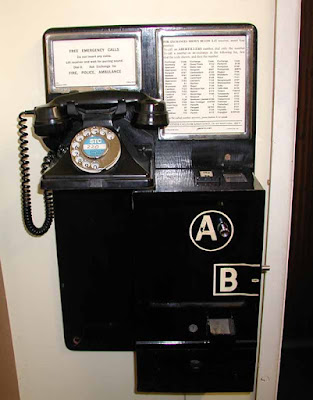
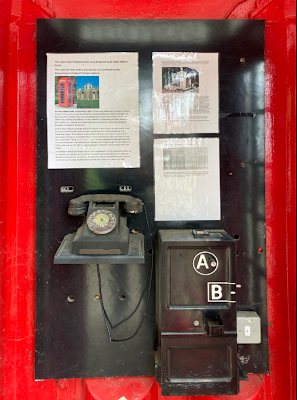

OK - I'm sure this was the same throughout the UK at the time. Our telephones were connected to a local exchange - our number at home was LAR 1125, attached to Lark Lane exchange, in Aigburth. Other exchanges were CHIldwall, WAVertree, ALLerton, STOneycroft and a pile more. If you wished to call a local number from a Liverpool phone-box, you placed 4d (that's 4 old pennies, 4 x 1/240 of a Pound) in the slot, dialled the number and then pressed either Button A or B depending on whether it was answered or not. The recipient could not hear you unless you pressed Button A.

If this seems of very minor interest, I have to explain that Onus's new hobby stemmed from the fact that he had got hold of a brief instruction note, normally issued to GPO telephone engineers, which allowed them to make free calls. To put this into perspective, 4d was not a great deal of money, even for 12-year-olds, and none of us had anyone to call anyway, but it was something we were not supposed to know, and that was enough to get Onus fired up.

The phone-boxes had to cope with free emergency calls (999) and free operator calls (100), so the mechanism allowed the digits 1, 9 and zero to be dialled without charge, but as soon as the call number involved any other digit then the call could not be connected without money being paid. What Onus had found out was that the engineers used a system whereby they could tap in any digits which were not 1, 9 or zero on the receiver rest - and when I say "tap" I mean bang them in, quickly and evenly - thus "three" would be entered as "bang-bang-bang", etc. This took some skill, and I imagine telephone engineers would be likely to suffer from RSI.

There was a secret three digit code which should be tapped in (let us say it was 147), followed by a 2-digit number for the target exchange, followed by the phone number. Throughout this, free digits could be dialled, but other digits had to be tapped. The normal 3-letter exchange codes didn't work in this system, so Onus had set about collecting the details of the 2-digit exchanges.

So for a few weeks he and I would spend a lot of our lunch-hour in a very quiet phone-box in Green Lane, Childwall, about half a mile from school, banging the living daylights out of the receiver rest. Onus would do the banging and the talking, I would be in charge of writing down the results in his homework jotter and providing moral support. It goes without saying that we would have been promptly expelled from school if we had been caught doing this.

Onus would call up a number - let us say he dialled and tapped "147-14-2001". If the phone was answered, he would ask to speak to Mr Barrington (an unusual name was advisable, after some early flukes when he asked for "John", and the recipient said, "Speaking" - panic stations).

When it transpired that Mr Barrington did not live there, Onus would say, "I'm very sorry, I must have the wrong number - is that Garston 2001?"

and the recipient might say, "No - this is Aintree 2001."

And we would have scored a new code, 14 = Aintree, which I would write in the jotter.

Onus found out that if he varied the 147 code, we could get further afield, and we started to collect exchange codes for far-off, exotic places such as Colwyn Bay, Ashton-in-Makerfield, Burscough, some of which may have been as much as 20 miles away. We were giddy with excitement, though there was nothing practical we could possibly have used this knowledge for.

One wet lunchtime, about 3 weeks into this strange research project, our bangings were interrupted by the door of the phone-box being yanked open, and a police constable in full uniform - plant-pot helmet and everything - demanded to know what we were doing. I think Onus may have wet himself - he certainly didn't say anything. From some dark corner of self-preservation, I came up with, "We're trying to get his money back out of the phone...".

 
'Ello, 'ello?

The policeman reached in and pressed Button B, and, by some freak chance, 4 pence dropped into the tray. "Come on, lads - if you don't mind, I have to make an urgent call."

We ran back to school, pale and shaking. About halfway back, Onus announced that we had left his homework jotter behind in the phone-box, and it contained not only our recorded results for the exchange codes, but also his address (right down to which bit of the galaxy he lived in, and his phone number) and which class he was in, at which school. He was convinced that we were now doomed. 

I ran back to the phone-box, to find the policeman emerging. He had the homework jotter in his hand.

"Did you lads leave this? Here you are - you'd better be more careful, or you won't know what homework to do!"

I took it and ran all the way. Onus and I never mentioned the subject again. Since we were never sent to prison or expelled, I assume that the policeman had not spent any time watching us rattling out numbers on the receiver rest. In fact Onus and I were never such close friends thereafter. He eventually did biology and chemistry, while I did mathematics and physics, so we saw less and less of each other. I believe he became a science teacher and moved to Derbyshire - I only know this from reading his obit in the newsletter.

 
Newfangled STD phone - 1960s

Within a very short time after this adventure, maybe a year, the entire UK telephone system was upgraded to the new STD (Subscriber Trunk Dialling) system, which involved a complete nation-wide technology change and was, as far as I know, incapable of being cheated. I have never thought about hacking phone-boxes since then until this very morning.  

Honest, Your Honour.