Redartz: Comics, obviously, are a visual medium. Composed of images, in combination with text; both elements working together to produce that unique art form we all know and love. And many of us have, on our bookshelves, collected volumes of comic stories: whether a gigantic Omnibus, or a small digest format. Graphic novels, Masterworks, TPB's, there are many formats and many names. All of these showcase the complete union of word and picture that is the comics medium.
For consideration today, however, I'm concentrating only on the artistic side of comics. "Just the pictures", if you will. In the space of a couple months, I've added two such books to my humble library.
First off, "The DC Comics Art of Brian Bolland".
This gorgeous volume came courtesy of a huge discount sale at a local outlet store. The book is brimming full of rich reproductions of Bolland's fine penwork, represented mainly by the covers for which he is best known. The breadth of his career is covered, from the early 80's to the 2000's. What I found particularly interesting are his discussions about the technical aspects of drawing, and his 'behind the scenes' tales involving his DC comics work. Here are a couple examples of what lie within the pages...
A wonderful collection of Bolland's artwork, and a great book I'd recommend to any art aficionado.
My second book was acquired most recently: "DC Comics' Comic Art Colouring".
As opposed to the Brian Bolland volume, this book is 'just for fun'. You probably are familiar with the current popularity of 'adult coloring books'. Even my mother loves to exercise her creative side with them. Well, once I saw this at a Half Price Books store, I couldn't resist it. The whole book is comprised of black-and-white reproductions of various DC comic covers, panels, pages, and even some actual page swipes from vintage childrens' coloring books. Some great covers are featured, and also some rather pedestrian ones. My only minor gripe with this book is the overwhelming focus on Superman and Batman. Probably 90 percent of the book depicts one or both of them. There are, though, JLA appearances, Green Lantern, Atom, and others. I'd have thought they'd give Wonder Woman more print here, she doesn't get a single page to herself.
Anyway, what could be a better relaxation pastime (and, for an artist, a good skills sharpener) than doing a bit of coloring? With that said, here are a couple shots from the book, including my first attempt at a page. Incidentally, I changed the color scheme on that Justice League cover; the original purple robot and dark green background didn't work for me...
So there you have two different examples of art in comics, have you more? Again, there are many great books out there on the subject; here's a few more to kindle your thoughts.
Redartz: One of the 'little' pleasures of my youth was a series of small books, combining text with panel illustrations on a facing page. Featuring a wide array of familiar characters placed into novel-length adventures, and priced at a level my allowance would cover: yes, Big Little Books!
 BLB's actually first appeared in 1932, published by Whitman (the same company who provided them for our perusal in the 60's and 70's). In those days the books were filled with tales of Slam Bradley, Mickey Mouse, The Gumps, The Shadow, and many other stars of film, radio and the pulps.
In our era, of course, they added in many favorites from television: Flipper, Lassie, Daktari, Frankenstein Jr., and many many more. I had quite a few of these thick tomes, stacked alongside my beloved comics. Some of those I recall most fondly: Popeye ("Ghost Ship to Treasure Island"), Bugs Bunny ("Double Trouble on Diamond Island"), and Donald Duck ("The Fabulous Diamond Fountain") . I know, we see a pattern of sorts here- they all seemed to combine the lure of treasure and some element of menace; a pairing hard to resist for any kid.
One I recall especially well: Woody Woodpecker ("The Meteor Menace"). Indeed, this is one I've managed to reacquire in recent years, and got a kick out of reading it again. Here you see the opening page, showing the standard format of text on the right, illustrations on the left. No credits were given for the creators, unfortunately (The Fantastic Four BLB has art that greatly resembles Kirby, but I don't think it actually was). The story itself is full of gimmicks, tricks, gadgets, and mysteries (Woody's nephew Knothead even has a secret spy kit that proves integral to the plot). At 250 pages, it makes for a pretty long tale, albeit a quick one to read (after all, you only get about a paragraph on a page).

Those old BLB's from the 30's to the 50's were all in 'hardback' form (actually a sort of cardboard cover). The late 60's versions also had a stiff cover, although the spines didn't hold up very well. The later books from the 70's were soft paper covers, and basically reprinted many of the previous decade's offerings. Hard or soft cover, the Big Little Books offered a lot of reading enjoyment for the price of a couple of comics. And they were easier to fit in a backpack or suitcase or camp bag, and less likely than a comic to end up crinkled to unreadability. Now here's a few to jog your memories. Which ones did you have?


 Redartz: Hello again, folks! Like you, I've spent many years reading innumerable books, magazines, and comic books. In the case of comics, my younger years were spent with newsprint adventures of Spider-Man, Batman, Archie, and many others. But during those years, I never really thought of comics as more than (very enjoyable, and at times very literate) entertainment. In 1978, however, something quite new got my attention: that something was a 'graphic novel'. Not a collection of comic books or strips, but a single ,self-contained 'novel' of comic art and story. Comics icon Will Eisner, in that year, released a book called "A Contract With God"; representing a fundamental shift in the way comics art could be viewed.
A brief digression: what I'm referring to today are graphic novels created initially in that specific format, as opposed to those comprised of the collected contents of previously-published material. No disrespect to those, of course. Among them are some of the greatest comic novels ever published: Maus, Batman: The Dark Knight Returns, Watchmen, Bone, and so on...
Redartz: Hello again, folks! Like you, I've spent many years reading innumerable books, magazines, and comic books. In the case of comics, my younger years were spent with newsprint adventures of Spider-Man, Batman, Archie, and many others. But during those years, I never really thought of comics as more than (very enjoyable, and at times very literate) entertainment. In 1978, however, something quite new got my attention: that something was a 'graphic novel'. Not a collection of comic books or strips, but a single ,self-contained 'novel' of comic art and story. Comics icon Will Eisner, in that year, released a book called "A Contract With God"; representing a fundamental shift in the way comics art could be viewed.
A brief digression: what I'm referring to today are graphic novels created initially in that specific format, as opposed to those comprised of the collected contents of previously-published material. No disrespect to those, of course. Among them are some of the greatest comic novels ever published: Maus, Batman: The Dark Knight Returns, Watchmen, Bone, and so on...
So having read, and loved, Eisner's "Spirit" stories, I decided to give this new storytelling venture of his a look. It turned out to be a good decision; the book was phenomenal. A powerful, at times painful, at times hilarious, set of tales; blending Eisner's masterful storytelling with his ground-breaking artwork. As a reader, I was gobsmacked: here were all the familiar elements of comic books, put to a serious, adult format. Eisner had long discussed the concept of comics as art, and here was that concept in concrete form (indeed, Eisner preferred the term "sequential art" to "comics").
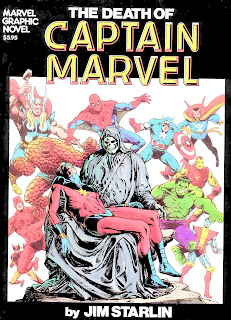

In subsequent years, I grabbed up many other 'graphic novels', including Marvel's first entry into the field: Jim Starlin's "Death of Captain Marvel". And though the subject matter was superheroic, the
story itself was much deeper. Again, the 'graphic novel' format allowed for an expansion of theme, and the opportunity for creators such as Starlin to explore some meatier fare than standard four color comics generally allowed. Not tied into the continuity of monthly comics, a graphic novel could present powerful stand-alone stories with familiar characters (X-Men: God Loves, Man Kills) or material from totally divergent genre (say, DC's Science Fiction Graphic Novels). The graphic novel format has , over the last three decades, expanded the potential audience for comics art and has included biographies, humor stories, horror, history, and any genre you could name. Looking over my bookshelf, I am certain that Eisner was right; comics can be as potent, and effective, as any other medium for artistic and social expression.
Which brings us to the discussion for today: when did you discover the Graphic Novel? What was your first; your favorite? Do you agree with Eisner regarding the creative potential of the medium? If not, what is your assessment of comics as graphic novels? Pull your best ones 'off the bookshelf' and tell us about them...
 |
| Comix- A History of Comic Books in America, by Les Daniels; graphics by Mad Peck Studios |
Redartz: Good day, everyone! Anyone for a history lesson? I always am, especially when it's comics history. Which brings us to today's topic: learning about comics and the creators behind them.
Shortly after I first got hooked by the comic bug, early in 1974, I found this book on sale in the 'cutout's section of a Walden Books (remember them?). I'd never heard of the author, and was at the time unaware of the alternative comics referred to by the title's term 'comix'. Nonetheless, a quick browse through the book convinced me to buy it. Imagine, a book ABOUT comics, illustrated with the actual comics! Yes, there had been other histories; Steranko had his "History of Comics". There was Jules Feiffer's "The Great Comic Book Heroes". But overall, there weren't that many books yet about the medium of comics, or the wide variety of subjects found therein. So, long story short, "Comix" became my first comics history lesson.
And it was a rich lesson indeed. Published in 1971, early in our illustrious Bronze Age, "Comix" reached waaaay back to Richard Outcault and his "Yellow Kid", and followed up with a fascinating tour of comics throughout the 20th. Century. Writer Daniels gives the prose a bit of a countercultural feel (certainly to be expected, given the pop cultural background of the late 60's/early 70's). Yet it also reads as an engaging , entertaining overview of comics history; filled with fascinating anecdotes. Consider some of the chapter headings: "The Birth of the Comic Book". "Dumb Animals". "The E.C. Revolution". "The Comics Code Controversy". "Mighty Marvel". "Underground Comics". Yes, Daniels touched all the bases here. And it was pure manna for this comics-starved kid.
 |
| An example of a 40's "Crime" comic |
 |
| Jack Cole. Amazing composition... |
This book was my first exposure to EC Comics, to Golden age comics, to crime comics, to underground comics. So many genres I'd never dreamed of. Here, for the first time, I was introduced to some of the towering figures behind some of the stories I'd enjoyed: Will Eisner, Carl Barks, Harvey Kurtzman, Basil Wolverton. Further on, Daniels revealed to me the work of later creators such as Trina Robbins, Robert Crumb, and Gilbert Shelton. The story of the Comics Code Authority, and Fredrick Wertham? All that was in there as well. Oh, so much to absorb...
And it was easy to swallow this informative medicine: Daniels sweetened it with a generous dose of actual comics. Not only individual panels and pages, but many entire stories; color and black/white! He included some excellent examples, well chosen to give the reader a dose of the very best comics have to offer. We find Jim Steranko's entire story "At the Stroke of Midnight"from Tower of Shadows #1 (only complaint; wish this had been a color selection).
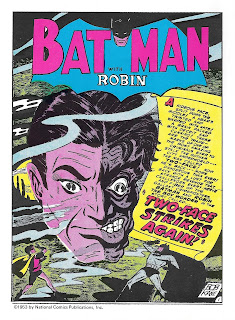
 "A Visit With the Fantastic Four" by Lee and Kirby. From EC- "A Little Stranger" by Graham Ingles. A complete Barks Uncle Scrooge story. An early Two-Face story from Batman. Several great horror tales from Warren publishing. A "Mad" story by Wally Wood. An EC war story by Kurtzman. A Jack Cole Plastic Man story. And much, much more. Truly, it was an embarassment of comic riches. I devoured every page.
Les Daniels, through this book, lit the spark of interest for the vast wonders of comics past and present. He showed me how much more there was besides superheros and funny animals. Daniels put the works of the masters before me, identified them, and through them fired a fascination that continues to this very day. For this, I owe him immensely. Les Daniels, years later, produced a fine book about Marvel Comics; if memory serves Doug and Karen once discussed that tome over at the BAB. As much as his first book affected me, his later one is something I also need to add to my library.
 |
| Two DC 'funny animals'; Fox and Crow |
 |
| A cool EC house ad |
 |
| A last word from Robert Crumb... |
Before reading this book, I loved Spider-man and the Fantastic Four; Batman and Superman. After reading it, I loved Comics. So now I ask you; was there any book about comics that roused your interest? Where did you first learn of the early names and faces of the medium? How did you discover the early tales of our heroes, and their predecessors? Tell us all about your 'history texts'...
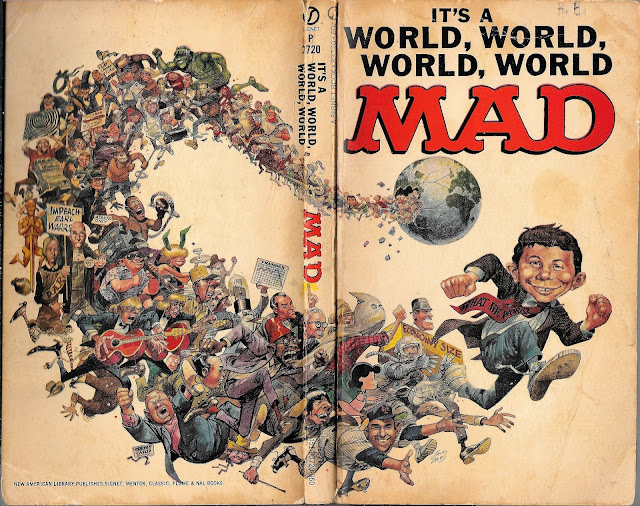 |
| A Jack Davis cover for the ages. Mindboggling. How many can you identify? |
Redartz: Ah, it is indeed. Hi folks! Previously in "Off the Bookshelf", we have discussed paperback collections of Peanuts and Calvin & Hobbes. There was another popular series of paperback reprints in our beloved Bronze age, often found on drug store and supermarket racks alongside those old Peanuts books. "Mad"; originally a comic book published by E.C. Comics and later a full-size magazine, has been an iconic part of popular culture for decades. Beginning in 1954, many of the humorous features from those publications were presented in collected book form.Originally reprinting material from the comic books, they soon carried the wacky, iconoclastic bombast from the magazines.
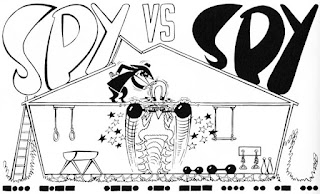
And what incredible talent was represented here. Creators such as Don Martin, Antonio Prohias (Spy vs. Spy), Sergio Aragones, Jack Davis, Al Feldstein, Paul Coker Jr., Dave Berg and many others gained popular followings among the Mad readers, and found their work spotlighted in the paperbacks.
Berg 's "Lighter Side of..." strips were among my favorites, finding innumerable foibles in modern society to puncture. Another of my faves were the tales of avian espionage that Prohias provided (I always rooted for the black spy). Those cartoons, the movie parodies, the political satires, the Madison Avenue jibes- all filled those pocket-size tomes with edgy fun (perhaps not edgy now, but back then it was). You could often find a couple of these books stashed among my comics on a family trip, or piled among the detritus in my school locker. They were a great bargain; you don't find that many laughs per page in many other books. And I loved the covers- frequently painted by Mad Magazine ace Norman Mingo, they found countless ways to beat us over the head with Alfred E. Neuman.

I give Mad a lot of credit for starting me off on the right (some would say wrong) foot. Long before I discovered Dr. Demento or Saturday Night Live, those Mad paperbacks showed me our culture in a slightly subversive, twisted mirror, and my head (thankfully) would never be the same.