Showing posts with label Will Eisner. Show all posts

Saturday, September 1, 2018

Two Questions: Who's on Your Mount Rushmore?


Martinex1: Today we have two questions based on a poll I posted recently on twitter.  Here is the poll and the results.


Because twitter had limitations regarding the number of choices and options, let me pose the question to you a little differently:


QUESTION 1: Who is on your comic book artist Mount Rushmore?  Name four artists that you think should be on the monument.  It is open to any artists from any genre of comics.  Tell us why you chose your selections.   Here are some options (this list is definitely not all inclusive):


Jack Kirby, Jose Luis Garcia-Lopez, John Byrne, Wally Wood, John Buscema, Frank Miller, Steve Ditko, John Romita Sr., Joe Kubert, Neal Adams, Will Eisner, Jim Steranko, Gil Kane, George Perez, Gene Colan, Jim Starlin, Bill Sienkiewicz, Marie Severin, Mort Drucker, Joe Shuster, Carmine Infantino, Todd McFarlane, Bill Everett, Sal Buscema, Paul Smith, Don Heck, George Tuska, Michael Golden, Carl Barks, Mike Ploog, Jim Aparo, Amanda Connor, Bill Finger, Frank Frazetta, Moebius, Fiona Staples, Walt Simonson, Bob Bolling, Stan Goldberg, Harry Lucey, Ramona Fradon, Bob Montana, Dan DeCarlo, Frank Robbins, Nick Cardy, Bernie Wrightson, etc.

QUESTION 2: Who is on your comic book writer Mount Rushmore?  Name four writers that you would honor in this way.  Again, it can be a writer from any genre of comic book, and again tell us why you made the choice you did.  Consider anybody that has written comics including but not limited to:

Stan Lee, Bob Haney, Chris Claremont, Al Feldstein, Grant Morrison, Jim Shooter, Edmond Hamilton, Art Spiegelman, Doug Moench, Roger Stern, Mark Waid, Otto Binder, Jack Kirby, Bill Mantlo, Roy Thomas, Frank Miller, John Byrne, Ann Nocenti, Bill Mantlo, Alan Moore, Gardner Fox, Joe Gill, J,M, DeMatteis, Gail Simone, Gaiman, Peter David, Denny O'Neil, Jim Starlin, Mark Gruenwald, Kurt Busiek, Kelly Sue DeConnick, Jeph Loeb, Don McGregor, Marv Wolfman, Len Wein, etc.


Cheers all!


c


Saturday, August 18, 2018

Adventures in Comics: Comics and "The Big Picture"


Redartz: Good day, everyone! Hope you'll forgive me for some verbal wandering today. Usually in these  "Adventures in Comics" installments, we discuss fairly specific activities or events related to our favorite hobby. Today, though, I'd like to look at the 'big picture'. That is, comics in general. Have they had an impact on our lives, our attitudes, our goals? How have they affected our journey down this long road we call Life?

Let me start by saying I don't mean to trivialize anything about life itself, our decisions, the highs and lows we all face as human beings. Indeed, life has enough challenge each day to sober up even the most cheerful of Pollyannas. And regarding the things that affect our lives, there are many factors far more influential than any hobby or pastime (our families and friends, to begin with).

That said, I feel no apologies needed for my love of comics. Most every person who ever lived has had something they enjoy doing to relax, to escape for a bit, or just to help them 'feel themselves again'. Comics have been my 'thing' for most of my life now. I've loved them from the start. 

I started reading pretty young, in fact I recall reading the newspaper at age 5 (specific memories of reading about the "Palm Sunday Tornadoes" of 1965).  Book reading followed soon after, and already I was noticing the pictures in those books. And when an older neighbor introduced 7 year old Redartz to this thing called a 'comic book', well, the die was cast. Already  an enthusiastic book reader, now there were these fascinating magazines with cool artwork to enjoy along with the textual material.

 An aside, historical type- I recall reading Dr. Frederick Wertham's book "Seduction of the Innocent". One passage was rather denigrating to comics as a medium, referring snidely to 'pictures with words in balloons'. The inference was that reading comics was lower, or less intellectually challenging, than reading an actual book. I couldn't disagree more. Comics as a medium combine the best elements of both literary and visual arts. And subject matter varies as widely as it does in any other creative format: film, books, or whatever. That's one of the things I find most rewarding about comics; there's something for any mood or interest. How can you not love a hobby which gives you light fun with Archie, dramatic adventures with Spider-man, crazy satire with MAD, chills with any of the horror books? Or if you're looking for something a bit deeper, Maus is as powerful a tale as any film or novel you'll ever find. Looking for adult material- there's the undergrounds. Will Eisner was right, comics (or as he preferred, 'sequential art') is perfectly valid as an art form, high or low.

Anyway, once I started reading comics, I never stopped. Sure, the material changed; Casper to Superman to Spider-man to Archie and then to full scale collecting. And adulthood added a whole range of graphic novels to the mix. But through it all, the appeal of comics remained consistent. And that's not all. Comics led me to explore other areas, as well. Initially, when I started college, my goal was to become a comics artist. Of course I soon learned that my figure drawing was insufficient, but on the other hand discovered a whole new world of fine art and photography. Reading various graphic novels inspired more curiosity about history and other cultures. New friends and new experiences followed, all stemming from the  welcoming atmosphere of art school and the company of like-minded folks ( and numerous comics fans). And to push this all even further, I met my wife at a party with one of my art-school buddies. So I used to tease my sons with "You know, if it wasn't for comic books...". At any rate,  I found it funny. The point is:  comics, in general, enhanced my life in various ways and pointed me in directions I might otherwise have bypassed.

So, to sum things up, comics have been a pretty big part of my life; and a beneficial one at that. Comics have provided entertainment, education, inspiration,  diversion, and indirectly a career. They have given me wonderful stories such as "'Bone" and "Y-The Last Man". " The Avengers/Defenders War" and  "Days of Future  Past". "A Contract With God" and "Sugar and Spike". Enemy Ace and Little Lulu. Batman and Forbush Man. And so on, and so on, and so on. You get the idea, there's no limit to the wonders that I've read, and to the ones that await. It gives you something to look forward to; whether rereading an old favorite or discovering some new comic creation. So Dr. Wertham, if you're out there listening, I'll continue to take my words with pictures and balloons; thank you.

Saturday, March 3, 2018

Off the Bookshelf: Considering "Graphic Novels"


Redartz:  Hello again, folks! Like you, I've spent many years reading innumerable books, magazines, and comic books. In the case of comics, my younger years were spent with newsprint adventures of Spider-Man,  Batman, Archie, and many others. But during those years, I never really thought of comics as more than (very enjoyable, and at times very literate) entertainment. In 1978, however, something quite new got my attention: that something was a 'graphic novel'.   Not a collection of comic books or strips, but a single ,self-contained 'novel' of comic art and story.  Comics icon Will Eisner, in that year, released a book called "A Contract With God"; representing a fundamental shift in the way comics art could be viewed.

A brief digression: what I'm referring to today are graphic novels created initially in that specific format, as opposed to those comprised of the collected contents of previously-published material. No disrespect to those, of course. Among them are some of the greatest comic novels ever published: Maus, Batman: The Dark Knight Returns, Watchmen, Bone, and so on...

So having read, and loved, Eisner's "Spirit" stories, I decided to give this new storytelling venture of his a look. It turned out to be a good decision; the book was phenomenal. A powerful, at times painful, at times hilarious, set of tales; blending Eisner's masterful storytelling with his ground-breaking artwork. As a reader, I was gobsmacked: here were all the familiar elements of comic books, put to a serious, adult format. Eisner had long discussed the concept of comics as art, and here was that concept in concrete form (indeed, Eisner preferred the term "sequential art" to "comics"). 


In subsequent years, I grabbed up many other 'graphic novels', including Marvel's first entry into the field: Jim Starlin's "Death of Captain Marvel". And though the subject matter was superheroic, the
 story itself was much deeper. Again, the 'graphic novel' format allowed for an expansion of theme, and the opportunity for creators such as Starlin to explore some meatier fare than standard four color comics generally allowed. Not tied into the continuity of monthly comics, a graphic novel could present powerful stand-alone stories with familiar characters (X-Men: God Loves, Man Kills) or material from totally divergent genre (say, DC's Science Fiction Graphic Novels). The graphic novel format has , over the last three decades, expanded the potential audience for comics art and has included biographies, humor stories, horror, history, and any genre you could name. Looking over my bookshelf, I am certain that Eisner was right; comics can be as potent, and effective, as any other medium for artistic and social expression.


Which brings us to the discussion for today: when did you discover the Graphic Novel? What was your first; your favorite? Do you agree with Eisner regarding the creative potential of the medium? If not, what is your assessment of comics as graphic novels? Pull your best ones 'off the bookshelf' and tell us about them...

Sunday, August 27, 2017

Sunday Rerun: When The Spirit Moves You!


Martinex1: Today we have another Sunday Rerun for you, as we harken back to June 27, 2015 from the great and legendary Bronze Age Babies site, when Redartz blogged about Will Eisner and The Spirit.  I thought this was definitely worth a second look, so enjoy...

Redartz:  Hey, thanks partner!  Glad you pulled this one up. It was a great pleasure working this one up for Doug and Karen back at the good 'ol BAB. And it had a lot of special meaning for me, huge Eisner fan that I am. So it's  only appropriate that we run it now, this year: the 100th. Anniversary of Will Eisner's birth. Which , by the way, is amazing; Jack Kirby's hundredth anniversary too. What a mammoth pair; two absolute cornerstones of the art of comic books (or sequential art, as Will would say). Hope you all find it interesting...


The Spirit (Warren Magazine) #3 (August 1974)(cover by Eisner with colors by Rich Corben)
Art and story by Will Eisner

Redartz: Greetings everyone! Recently, during several different conversations, several folks have recalled Warren's Spirit magazine . It seems like a fine time to give this deserving title some attention, so: today we will look at a book that absolutely knocked me out when I first bought it lo, those many years ago. Upon re-reading it for this review, for the first time in years, I found it even better than I remembered. So, with no further delay, let's have a look.

To begin with, this magazine was loaded with goodies. It featured 8 individual stories, with the dates of original publication included in some cases (don't know why this wasn't the case with all; some stories simply noted “Copyright 1974 Will Eisner”). The stories included: “Black Alley”, “Fox at Bay”, “Surgery”, “Foul Play”, “Paraffin”, “The Embezzler”, “The Last Hand” and “Lonesome Cool”. All the stories are presented in beautiful black-and-white with gray wash, except for “Paraffin”; which was reprinted in full color. This was the standard for this magazine: mostly b/w with a color story each issue . Additionally, there was a two-page letter column and a one-page feature: “Will Eisner Interviews the Spirit” (more about which will follow shortly). All the stories in this magazine are enjoyable; but in the interests of brevity we will look at one: “Fox at Bay” (by the way, my apologies for the scans; the gray tone seemed to create patterns upon scanning which were frustratingly resistant to correction).


At this point, I would note that much and more has been written about Will Eisner; and by folks far better qualified than I. However, I must note a few observations about Eisner's work in general:

First, his artwork is peerless. Eisner's drawings read like stills from a classic film. His use of shadows, his dramatic composition and unusual perspectives literally pull you from panel to panel. His pen linework is stunning, and he virtually defines expressive characterization. Each face, each figure just bleeds emotion. Then there is his lettering, and his famous penchant for incorporating the logo in so many different ways into the splash pages of his stories. It is with good reason that Will Eisner is considered a giant in the history of  comic art.

Second, his writing cannot be underestimated. As noted above, each story here was powerful, Eisner blends high drama, comedy, and an almost EC-ish (does that sound right?) bit of horror. Some stories are  light hearted and gentle; some quite humorous, some stories can be quite violent; Denny Colt ( our hero, the Spirit) seems to be constantly getting his head bashed in. Our chosen story falls into the latter category.
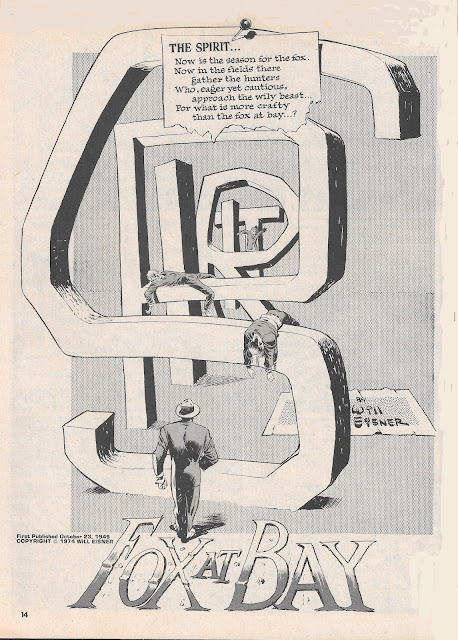

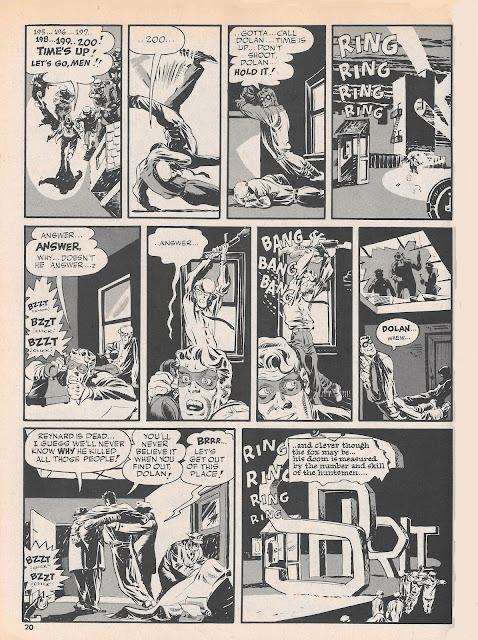
“Fox at Bay” opens with one of those  logo plays for which Eisner is known. We follow the Spirit past watchful police, past a trail of sprawled bodies on the ground, The text tells us that the Fox, Reynard, has already left numerous victims and awaits in his lofty hideaway. The Spirit enters a phone booth and proceeds to dial (yes, this certainly sets our timeframe) Reynard's number. We see Reynard himself busy ignoring the ringing phone as he types away at his typewriter (another remnant of yesteryear). It seems Reynard, portrayed through his dialogue as a man of some intelligence, is performing an experiment of sorts: having established himself as a multiple killer, he wants to gauge his reactions (as a perfectly sane man- his words, not mine) to being pursued and cornered by the law. Upon reading this, I found him eerily relevant today, considering the heartbreaking deeds committed by some elements in the news recently. 
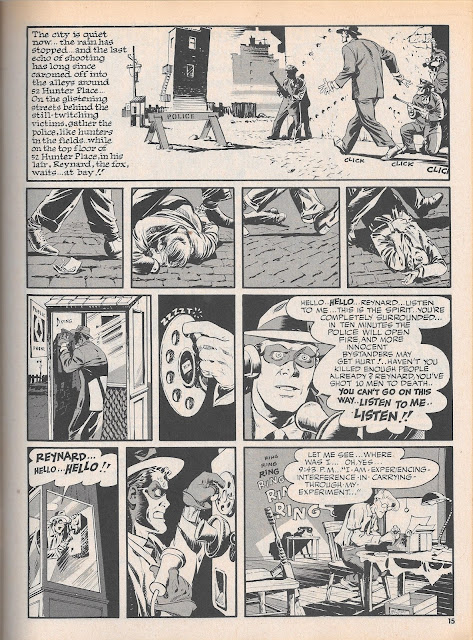
At this point, Commissioner Dolan (the Spirit's friend and foil on the Central City Police ) calls up to Reynard to surrender. Reynard answers with a burst from his machine gun, then answers the phone. He requests the Spirit stop calling, as he is becoming a distraction from the experiment. Reynard then inventories his supplies, while below Commissioner Dolan is ready to fire the tear gas. The Spirit convinces Dolan to give him a count of 200 to stop the Fox on his own, and so the countdown begins.
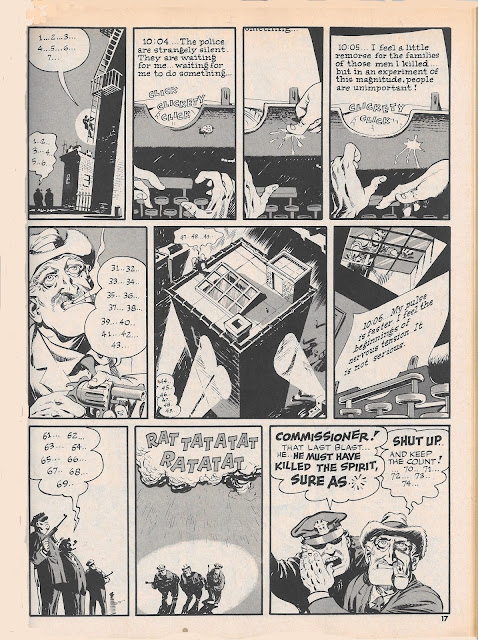

Eisner builds the suspense as he switches the viewpoint back and forth between the Spirit (working his way to the skylight above the Fox) and Dolan; both keeping up the count. We get a peek into Reynard's head as we see his typed page, describing slight regret for the families of his victims (but not much, they were all part of the experiment, after all). Reynard notes that the police have been quiet, and decides to draw their fire by shooting off a few rounds. This results an officer being hit, and said officer's distraught comrade shoots back. Unfortunately, his shots hit the Spirit (still lurking above the skylight) . The panel showing the Spirit's pain as the bullets hit his legs is almost excruciating in itself. He then falls through the skylight and ends up on the floor, right in front of the Fox!
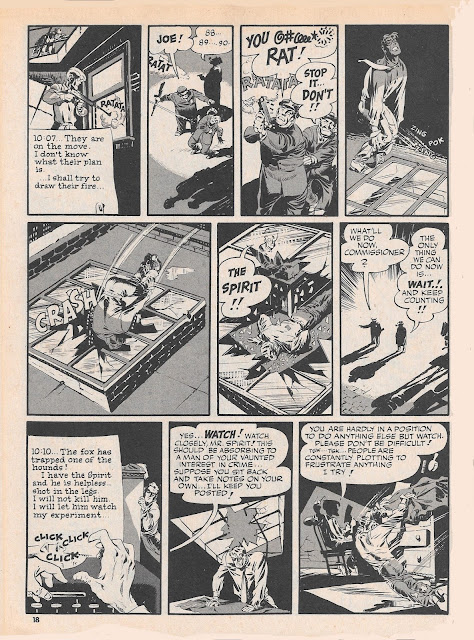

Below, Dolan and his officers see no option as yet other than to keep up the count. Upstairs, the Fox considers the Spirit to be helpless with his leg wounds, and offers to let the Spirit 'sit back and watch'. The Spirit is having none of that, however. He tries to convince Reynard of the futility of his situation, while struggling to gain his feet. Reynard's reply is a swift whack to the head with the butt of his rifle. Two panels later the Spirit has gotten hold of Reynard's typewriter and hurls it at his captor, all the while keeping the count in his head ( can this guy take a beating, or what!?).
            
Having lost his typewriter, Reynard decides to make his final journal entries by hand, and then to kill both the Spirit and himself. However, our relentless hero has dragged himself across the floor and secreted himself behind Reynard's chair, which he then upends; spilling the Fox to the floor (just as the count reaches 200, of course). Thinking he has the situation settled, the Spirit tries in vain to reach Dolan by phone to prevent a rush of police fire. As he begs for an answer to his call, the still-treacherous Fox has regained his feet, and his weapon. Just as Reynard raises his rifle to bludgeon the oblivious Spirit,  a rain of bullets from the broken skylight ends the Fox's threat once and for all. Dolan has arrived, and helps the wounded Spirit from the Fox's lair. The final panel shows them passing beside the same “Spirit” logo that was used in the initial page, as the phone in the booth keeps ringing, ringing...

After finishing this story, I was struck by the level of intensity , and by the Spirit's ability to take a licking (and a few bullets, a head clubbing, etc). Denny Colt reminds me of Batman in this regard, as he lacks superpowers or invulnerability. Actually, the Spirit doesn't even have Batman's level of training or weaponry. Denny Colt is just a guy, a very resilient, tough guy who keeps on smiling despite his current circumstance. Incidentally, there was a wonderful one-shot several years ago published by DC, featuring these two : Batman/the Spirit. Presented by Jeph Loeb and Darwyn Cooke, this book offers loads of good reading, and a fun tour through both heroes' rogues galleries.
             
All through this story, Eisner's artistic skills are evidenced. For example, the second story page; note the dramatic lighting on the wall both highlighting the bullet holes and obscuring the police officer's face. Note any of the faces in the story, where with even but a few lines Eisner captures the character's emotions effectively. Then there is the beautiful composition displayed in the 6th. Panes of page 18: the Spirit is framed visually by the shards of the broken skylight through which he just fell. Almost lost the edge is the thin face of the Fox, also framed but obscured by the intact glass. If one is inclined to choose a comic to leaf through just to admire the drawing, an Eisner book is a perfect choice.

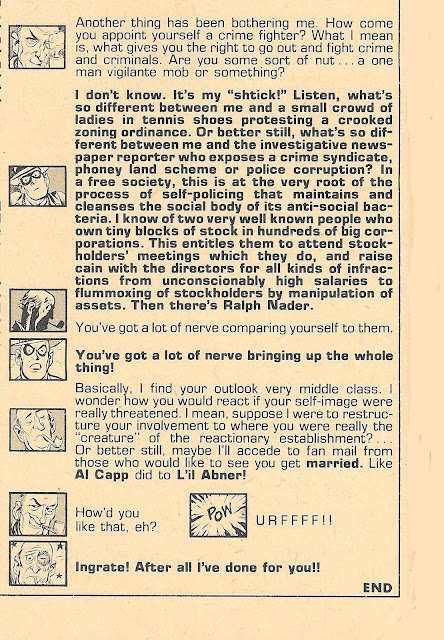
Finally, there is the Eisner/Spirit interview. The author questions his creation about crimefighting, his relevance to contemporary society, and his attitudes about women (even going so far as to bait the Spirit about the possibility of having him married). The entire interview is handled with cleverness and humor, and is accompanied by small face shots of the two speakers. Eisner casts his keen eye upon himself here, and the results are both thought-and smile-provoking.

These Warren editions of the Spirit were a great introduction to Will Eisner's work. The larger size allowed the artwork to be more easily admired, and the color sections with their higher quality stock were a big plus. Collecting this series led me to explore some of Eisner's other work; including his graphic novel “A Contract With God”. I even found one of his issues of P.M.; a maintenance periodical he did for the army (featuring a lot of his Eisner wit, among the drawings). I also was led to hold a great respect for a man who remains, always, a comics legend.

Saturday, December 10, 2016

Panel Discussion: What Makes the Best Christmas Covers


Redartz:  Good day, one and all! Here we are, almost halfway through December, so it seems the time is right to look at some holiday decorations, comics style. After all, we can't all fit together in my car for a ride to see the light displays..

So, today we will check out some festive covers. Now, the insides may not have anything to do with the cover content- we are only talking visuals today, not the stories. And, we may venture a bit earlier (and later) than our Bronze Age parameters would normally allow, but after all, 'tis the season'.

Christmas covers could be a genre all to themselves. It would be difficult to find many titles over the years that, at some point, had not featured at least one holiday-themed cover. From the Golden Age to today's books, holiday covers are one thing that has remained a constant throughout comics history. And as they are so plentiful, we will not even attempt a comprehensive review of them. Rather, I'll present a few of my favorites, with a few comments:

Sugar and Spike 25: The great Sheldon Mayer devoted the covers to his beloved "Sugar and Spike" to holidays very frequently. This one perfectly captures the charm and innocence of Christmas for tots, which of course we all once were.
Amazing Spider-Man 166: What says 'festive' more than  Stegron, the Lizard and Spidey framed by holly boughs? And, it's Romita. Nuff' said.
Marvel Two-in-One 8: Just emblematic of Bronze Age lunacy- the skull cycle roaring down on the denizens of ancient Judea. 


Batman 239: Neal Adams gives us a visual gift here, full of sentimentality and melodrama. We even get Batman with a beard. All that's missing is Jimmy Stewart.
Archie: A company and a character with an extensive list of holiday cover. Indeed, each year there were several specific Christmas books published. And the covers were bright, joyful and celebratory; I always loved the traditional style typeface they used for "Christmas", and the frequent use of decorative  borders. Look at the colors on the "Betty and Veronica" cover- like a newsprint candy cane...


The Spirit 12: Even though the cover was assembled from panels taken from the interior stories, it still shows Will Eisner at his masterful best. Nobody could tell a story through pictures better, holiday or otherwise.
Donald Duck: Carl Barks is another master at illustration and storytelling. Here his Donald (and nephews) joyfully show the spirit of the season. There are as many striking Disney holiday covers as there are Archie; perhaps more. 


Hot Wheels 6: Adams again, with an incredibly dramatic black background, effectively highlighting the Poinsettia Red logo and sleigh. Yes, it's rather odd to see Santa barrelling down on an injured skier. Great composition, though...
Marvel Treasury Special 1974: A personal sentimental fave. It looked like, and was, an ideal Christmas gift from Marvel to their readers. 
Superman, vol.2, 165: Absolutely love this cover. Ed McGuinness and Cam Smith imagine a wonderful nod to Lois, Clark and the JLA. Also love the somewhat Bruce Timm rendering style. Oh,and I want those ornaments. 


Batman 309: Jim Aparo give us Bats in wintry peril, framed in holly and bells. I'm a sucker for decorative edging.
Richie Rich 8: Here you go, Edo! From the red -and-green logo to the jeweled tree, this is a holiday cover defined. Simple, brightly colored, festive, and lightly humorous. Wonderful.
 Christmas With the Super-Heroes 1: Ah, now we get John Byrne's take on the season. And it's a good one. Fabulous wraparound cover; the boots on the mantle are a witty touch. Nice attention to each character's personality here, check out Batman analyzing his gift.


Well, I'm certainly in the spirit now. These covers were, and are, a part of the whole holiday experience for me. Their design, coloration, sentiment, and humor highlight some of the most memorable facets of the holidays, and are the elements that make these covers tree-toppers in my opinion.  Now let's consider what it takes to make a favorite holiday cover from your viewpoint- surely there must be more than the inclusion of Old St. Nicholas somewhere...what are your favorites, and why?


You Might Also Like --

Here are some related posts: