Directors: Severin Fiala & Veronika Franz (segment)
Release date: 2018
Contains spoilers
The Field Guide to Evil is an anthology film that was produced by Tim League & Ant Timpson who also produced
the ABCs of Death. This, however, is a very different beast – it concentrates on folklore from various countries. I found this film uploaded to YouTube.
There is one segment I am going to concentrate on but there are three segments that have a link into vampire folklore through the creature used (and the fact that they are included in Theresa Bane’s
Encyclopedia of Vampire Mythology, which I will quote when looking at each segment). The primary segment is
The Sinful Women of Höllfall (also listed as
Die Trude on IMDb and directed by Fiala & Franz, as mentioned above) and this does have a folkloric vampire feel/aspect. The other two segments I’ll touch on actually feel a lot less vampiric (if at all) and the use of the folklore is different to that described by Bane. Those segments are
What Ever Happened to Panagas the Pagan? directed by Yannis Veslemes and
A Nocturnal Breath directed by Katrin Gebbe.
 |
| being crushed |
The Sinful Women of Höllfall is Austrian and begins with an intertitle that says, “
Once upon a time in Austria, when life and love were still a sin, myths tell about monsters brought to human bedsides at nighttime. Monsters born from guilt and fear, sent to deprive us of our life’s breath.” It is in film that we discover that the monster is identified as a trude and Bane lists this as a variant of both the alp and the drude (both of which have their own entries in the encyclopedia, whilst the trude does not). One of the things I did like about this was the concept in the segment that the vampire was a manifestation of guilt.
 |
| bashing herself with a rock |
It begins with a young woman, Kathi (Marlene Hauser), undertaking chores – beginning with milking the goat and then taking clothes to the river to wash them. On the way to the river she sees Valerie (Luzia Oppermann) and watches from a distance as the other woman bashes herself in the face with a rock, causing her nose to bleed, which she then cleans with her linens. At the river, with her mother (Birgit Minichmayr), Kathi sees Valerie approach and start to wash her clothes. As there is blood in her undergarments Kathi’s mother declares that Valerie isn’t with child.
 |
| a kiss |
Valerie and Kathi meet and start to gingerly kiss each other but are caught by Kathi’s mother, who drags her to a woodland shrine to pray her sins away, having told her that if she sins the trude will be summoned. Something wakes her in the night but she cannot tell what it is and in the morning she has started her period. However, she does meet Valerie again and we discover that Valerie is pregnant, presumably out of wedlock hence hiding the fact, and the two girls take their relationship further. But when Kathi returns to her home the goat has died and she tries to clean her sin away and pray for forgiveness. However that night there is an invisible presence in her room, crushing the breath from her, which eventually reveals itself as a monstrous creature (Karin Pauer).
 |
| the trude |
Bane says about the alp, “
it sits upon the victim’s chest and compresses the air out of their lungs so that they cannot scream. Then the alp will drink blood…” In this we get no blood drinking but the Trude is shown as a female figure, her face ripped into a huge maw. Bane also suggests that a woman can call an alp to her (and it will be a gentle lover) in this case Kathi does summon it, whilst holding a knife, by masturbating. There is a slight aspect of the Electra complex to this also – though there is no male figure seen within the film.
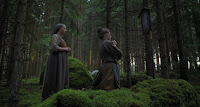 |
| pray the sin away |
The segment is particularly dreamlike in construction, with little dialogue, perhaps apropos as the alp is said to bring vivid dreams and nightmares. Indeed, it had a feel of the
VVitch, in atmosphere at least. Whilst it did not contain blood drinking there was a (menstrual) blood motif and the actions of the trude (crushing the breath out) was consistent with the myth as relayed by Bane. It also used the vampire as an analogy – manifesting Kathi’s guilt for what she had been told was a sin. The other two segments I want to mention were not as obviously vampiric.
 |
| mingling amongst humans |
The intertitle at the start of
What Ever Happened to Panagas the Pagan? states, “
Kallikantzaros are the lowliest of devil’s children. They brood underground all year until Christmas day when they visit empty houses and play tricks on people. In parts of Greece where pagan customs are still alive the kallikantzaros dare to mingle among the drunk, beast-like humans.” Bane has it listed as a vampire type who is created by being conceived on the Day of the Annunciation and born on Christmas Day (or during the Feast of Saturnalia) and describes it has having “
black skin, fangs, horns, hooves, a tail, talons, or any combination of animal parts.”
 |
| goblin blood |
In this the creature is a goblin (Vasilis Kamitsis) who tries to join the pagan revelry by wearing a sack over its head but is discovered by the drunken men who take it off (and call a priest) in order to pierce its wrists and drink its blood – for the narcotic effect. So blood drinking is involved but reversed almost and the creature is neither human nor displays any vampiric tendencies itself.
 |
| lying lifeless |
The final segment returns to Germanic folklore and uses the drude (which I mentioned earlier as an entry in Bane that lists the trude as a variant). The segment is entitled
A Nocturnal Breath and the intertitle tells us “
A drude is a Bavarian malevolent spirit that leaves the body of the possessed to haunt and spread disease. The person lies there lifeless until the spirit returns. If the drude is killed, the person remains dead.” Conversely Bane suggests it is “
A vampiric witch well versed in the black arts… Almost always a woman…” Her modus operandi is to find a victim and “
inflict horrible nightmares and terrible visions upon” them.
 |
| drude goes back into her body |
What we actually get is a brother (Thomas Schubert) and sister (Lili Epply) on a farm and she is possessed by a drude. She collapses at night and the creature emerges from her mouth in the form of a mouse that then spreads disease to their livestock, which develop buboes and die. The brother is at a loss of what to do as he cannot kill the drude as it will kill the catatonic sister. There is an indication that damage done to the drude will appear on her body (we see a welt on her neck after it is briefly caught by a dog). However, whilst some vampires are associated with spreading disease, the creature does little in the way of the vampiric in this segment.
 |
| Kathi prays for forgiveness |
I mentioned the further two segments as they used folklore that some associate with vampires, even if they are not vampiric films, but the film as a whole is worthwhile. That said its long (two hour running time) and the dreamlike quality of some of the segments (as well as their languid pacing leading to a slow burn) might put some off. When I score anthologies I am scoring for the vampire section alone and I am balancing that I liked its more languid pace and minimalist approach to narrative, against the fact that many will find it a tad too slow. I think it deserves
6 out of 10 and could make an interesting feature, if handled correctly, that oscillates between the folk horror of the
VVitch and the psycho-sexual fairy-tale that is
Valerie and her Week of Wonders.
The imdb page is
here.
On Demand @ Amazon US