Showing posts with label david trampier. Show all posts

Monday, June 25, 2012

DnD Spells: Shape Change


Shape Change is a ninth level Magic-User spell that evokes remembrances of that wonderful wizard's duel in the Disney film, The Sword In The Stone. 

Like the Magic-User spell, Gate, it's a shame this spell is reserved for high-level Magic-Users, as it would be fun to play out a wizard duel at low to mid-levels.


Thursday, June 21, 2012

David Trampier's Gamma World Cover


Sure, I like the Erol Otus Gamma World art well enough, but I still prefer the David Trampier Gamma World Cover.

Thursday, June 14, 2012

DnD Spells: Gate


"Jagreen Lern has succeeded in making a sizable breach in the Law-constructed barrier which has hitherto kept the creatures of Chaos from wholly ruling our planet.  He is forever widening this breach as his power increases.  This explains how he could summon such a mighty assembly of Hell's nobility where, in the past, it was hard to bring even one of the Dukes of Hell to our plane."

-- Michael Moorcock, "Stormbringer"

Few of the DnD campaigns that I participated in ever reached the player character levels necessary to access ninth level magic-user spells.  One of those spells, Gate, permits the magic-user to open a gate to another plane and entreat a powerful entity to come to the caster's aid.

I've always wanted to include scrolls with spells like this, as treasure.  To have a powerful one-shot item that the players could use, in this case, to gate in a powerful entity, would be handy for those occasions where the party is overmatched and otherwise needs some deus-ex-machina intervention by the DM to survive.

The problem is that a lower-level magic user are more apt to write the spell into their spell-book (for use when they reach the necessary level) as keep the scroll as a one-use item, thus defeating the point of scrolls as one-shot magic items.

Monday, May 28, 2012

Absolutely Enchanting


Sometimes the artwork attached to an ADnD spell description is just ever so slightly incongruous.  The Dave Trampier illustration attached to the spell, Enchant An Item, is one of those situations. 

While it's true that the illustration shows an item being crafted -- one of several steps involved in making a magic item -- it would make more sense for the illustration to show the spellcaster interacting with the item, and somehow imbuing the item with the desired dweomer, rather than a weaponsmith busy with his more mundane tasks.

The last two paragraphs of this spell description fall on the next-following page in the ADnD Players Handbook, and I think it is easy to forget that the process of enchanting items came with some unpleasant risks, chief among them the chance of losing a point of constitution while casting Permanency on an enchanted item.

Does the same circumstance threaten magic-users in 3E and 4E?  I suspect, like many other game design features inherent in early versions of DnD, all of the advantages have been transferred into subsequent rule sets, while the risks have been discarded as "not fun" for the players.

Tuesday, May 22, 2012

Leomund And Named Magic User Spells


Unlike Larodrm the Leaper, Leomund is well-known for his magic user spells.  Two of Leomund's more useful non-combat spells appear in the 1st edition ADnD Players Handbook published in 1978:  Leomund's Tiny Hut and Leomund's Secret Chest.

The above illustration, by David Trampier, accompanies that later spell.


It's intriguing to consider the number of spells appearing in the Players Handbook, named after one of the magic user characters participating in the earliest Dungeons and Dragons campaigns.  Tenser, Nystul, Leomund, Rary, Bigby, Mordenkainen, Otiluke, Drawmij, Serten, Sustarre and Otto all have spells appearing in the Players Handbook. 

What is more telling is that there is not a single Illusionist spell named after its creator.  It could be argued that unlike Magic Users, the Illusionist class was not an organic ougrowth of actual game-play, thus explaining the lack of character named spells.

At any rate, Larodrm has a long way to go to have any of his spells recognized in a treatise on famous spell-casters and their invented spells.

Thursday, April 19, 2012

DnD Spell Cards


Over the last two years, I've seen several putative variations of DnD spell cards. 

My interest in spell cards is quite simple: i've been tinkering with the idea of a card-based Dungeons and Dragons accessory, where all of your game resources are in card form, and can be swapped in and out of a three-panelled sleeved booklet, as you aquire and spend resources. 

Those card-based resources would include, treasure, magic items, spells, equipment, relationships, and other trackable items.

In addition to  the home-brew spell cards featured by several old and new-school bloggers, Wizards created a card-based accessory for 4th Edition, tied into their AEDU system, by issuing decks of powers cards.  I really loathed those cards, for a couple of reasons: one, they lacked artwork; two, the 4E powers themselves were too mechanical; and three, WOTC ignored all the other in-game resources.

On the other hand, Paizo published decks of item and treasure cards, featuring lush illustrations, but the related game mechanics were absent from the cards, as were resources like spells.

One of the things I loved about the ADnD Players Handbook was the inclusion of artwork  accompanying the spell descriptions.  Case in point is the spell, below, Dancing Lights. 


Although uncredited, I believe this spell features a Dave Trampier ilustration. It would be lovely to have the above artwork in color, though the black and white version is perfectly serviceable. 

Yes, the spell description is probably sufficiently clear that an accompanying illustration is unnecessarily decadent, but having an illustrated set of resource cards like this would be a dream come true for this old-schooler.

Monday, April 16, 2012

Save Or Die, Suckers!


The much-maligned "Save Or Die" mechanic could use a facelift.  In old-school Dungeons and Dragons, your saving throws are disassociated from your character attributes, instead connected to your class.  This results in extra record-keeping, as at the time of character creation you must consult a special saving throw table and record your saving throws, and then reference that table each time you level, to see if your saving throw scores have changed.  It seems to me that if saving throws are tied to classes, and each class has a prime attribute, that it would be much simpler to connect the saving throws to attributes instead.

I'm sure the idea of connecting saving throws to character attributes is not a new one.  Here is an optional saving throw system, which I found in an old binder of mine.  I can't take credit for this system, as I don't recall developing it.

SAVING THROWS

Your saving throw versus a particular threat is based on the attribute related to that threat (see below), modified by your level.  In order to pass a saving throw, roll either a d20 or 3d6 (whichever is the agreed-upon method) and subtract your level.  If your dice roll, modified by the subtraction of your level, is LESS than your attribute, you pass the saving throw.

Strength: save versus paralysis and constriction

Dexterity: save versus breath weapons, gaze attacks and traps

Constitution:  save versus disease, energy drain and poison

Intelligence:  save versus magic and illusion

Wisdom:  save versus demon/devil/divine magic, confusion, polymorph/pertrification

Charisma:  save versus death attacks, charm and fear

Monday, April 9, 2012

Dungeon Module D2: Shrine of the Kuo-Toa


It's easy to find examples of "bad" Dungeons and Dragons artwork.  One has only to look at the D-series of modules to find it.  Of course, when I say bad, with quotations, I don't really mean bad.  Primitive, yes.  Amateurish?  Fine.  But it is also entirely appropriate, in keeping with the requirements for Dungeons and Dragons art, as separate from Fantasy Art.

Incidentally, some people, big fans of Elmore, Easley and Parkinson, uncritically consider fantasy art (particularly by those three artists) and DnD art to be the same thing.  I will return to why they are not in a separate post.

Having reached the end of module D1, Descent into the Depths of the Earth, and avoided or defeated the troglodytes, bugbears, trolls, dark elves, and assorted other adversaries that dwell in a large subterranean cavern, the party pushes on towards the fabled city of the Drow.  The party continues to encounter Drow patrols and merchant caravans, along with quintessential DnD monsters like the Rust Monster pictured above.


Several other new (for 1977) monsters appeared in Shrine of the Kuo-Toa.  The above Umber Hulk makes his first appearance here in this DnD module.


Above we discover a trio of Ropers, one being put to the torch while another Roper pulls a hapless party-member to his doom.  It's interesting to view these illustrations, and in so doing compare them to the artwork that will come in the mid-80's and beyond.  It's typical of these early illustrations that the party's survival is often in doubt.

Other than some standard subterranean corridors, we are provided with very few encounter areas in D2.  One such encounter area is a river crossing, populated by a single insane Kuo-Toa ferryman.  It is possible that this will be the first of several encounters with this Lovecraftian adversary, prior to reaching the Shrine.

It should be obvious that the above artwork is by Trampier, even without his signature appearing upside down at the top of the illustration.  It features Tramp's not-atypical conceit of framing the illustration from the persective of the monster, rather than that of the adventuring party.  It catches the action at the precise moment of decision and danger, for the madness of the insane Kuo-Toa will be revealed in the manner in which the party reacts to his hail.

Another secondary encounter area features deep gnome miners, foes of the Kuo-Toa, whose reaction and sympathetic gestures towards the party may affect the success of their visit to the Shrine.  The deep gnomes have been scouting the Shrine of the Kuo-Toa, and have had several military encounters with these fish-men.  The deep gnomes are potentially powerful allies, if the party reacts to them in a fashion appropriate to their motivations.
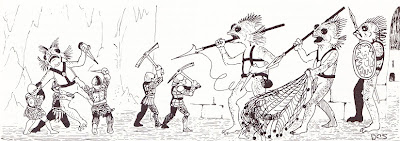
Finally, we reach the Shrine of the Kuo-Toa.  Like the central subterranean cavern adventure location in D1, there is no requirement that the Shrine be cleared of foes.  In fact, you could, potentially, bypass this encounter location without participating in a single combat.  That is because there is significant underworld traffic through this area, including the traffic of drow patrols and merchant caravans.  Although the Drow and the Kuo-Toa hate each other, they have come to an uneasy accommodation, with rare breaches of that truce.  Other underworld denizens travel to and past the Shrine, so it is not unusual to find over-worlders in the vicinity.
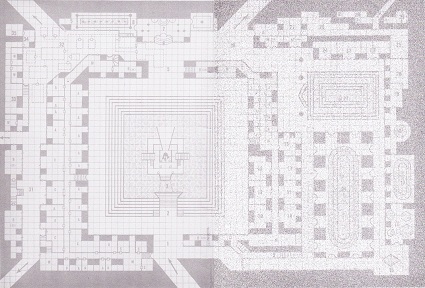
However, there are clues to be gathered at the Shrine, regarding the intentions of the dark elves, and opportunities for other intelligence-gathering and preparation for what lies beyond, not to mention ample treasure and combat for those who wish to partake in those activities.  A smart party will take advantage of their friendship with the deep gnomes, or use subterfuge and cleverness to gain information and treasure here.


Thursday, March 29, 2012

Dungeon Module D1: Descent Into the Depths of the Earth


This post really needs to be subtitled "A Megadungeon Template."  I say that because the Drow module series is the best example I can find of a TSR-published adventure that provides the sort of megadungeon I would want to run.  

The D-series of modules are comprised of D1, D2 (Shrine of the Kuo-toa) and D3 (Vault of the Drow). That series of modules provides a variety of location-based adventures, while simultaneously giving the Dungeon Master a wealth of un-developed locations for future use.


Each hex of the above map represents one mile, and only the dark grey sliver, extending from the top-left to the bottom-right of the map, is developed in the D-series.  The rest of the map, including the sunless sea in the top-right corner, is left for the Dungeon Master to develop.

The D-series starts where the G-series (Against the Giants) left off.  Having defeated the Hill, Frost and Fire Giants, the players discover that all three giant races are being manipulated by the Drow, a race of evil subterranean elves. 


The characters come into possession of a map, and using a rope-bridge and crane, the party crosses a river of lava in search of the lost city of the dark elves.  As they make their descent towards the dark elf stronghold they encounter giant slugs and other enormous subterranean creatures.


There are three major encounter areas in D1, Descent Into the Depths of the Earth.  The first is a Drow checkpoint, staffed by two separate Drow patrols.


The second encounter is a Mind Flayer outpost, representing an incursion into the realm of the Drow.


Finally, the party reaches a massive underground cavern, populated by Bugbears, Troglodytes, and Trolls, along with Drow, Purple Worms, a Lich, Gargoyles, and sundry other potential adversaries and allies.


Other than the first Drow outpost, there is no absolute requirement that the characters must participate in any of the encounters in this module.  Nor must they defeat the Drow or any of the other denizens.  In fact, there is an opportunity to win the trust of the dark elves by eliminating the Mind Flayer outpost.  The players will likely encounter at least one drow caravan while plumbing the depths, and those encounters also provide opportunities for role-playing and negotiation.


Even the Lich, who occupies a side cavern within the major encounter site of this module, can be easily avoided:  don't enter his lair to begin with.


I really like the form of adventure that the D-series represents.  While it provides a destination-based adventure path, there is no particular requirement that the players pursue a specific goal as they seek that destination, nor does the module presume that every denizen encountered must be defeated.  In addition, the module offers side passages that the DM can flesh out, to create a completely novel adventure.  And then there is that tantalizing sunless sea, lurking up in the top-right corner of the map.

I like that there is a boundedness to the D-series of modules, while offering significant agency to the DM and the players.  That, to me, is the hallmark of a good adventure product.


Sunday, March 11, 2012

Ken Kelly's Conan


As I read through my Appendix N collection, I can't help but note the fabulous covers on the Berkley Robert E. Howard collection. 

Ken Kelly, the cover illustrator for that series, has a style reminiscent of Franzetta.  I'm drawn to his covers for another reason though.  All of his illustrations are wrap-around covers, thus explaining the positioning of the hero, and the action, in the bottom right corner.  These wrap-around cover remind me of another one, that being the David Trampier wrap-around cover for the Advanced Dungeons and Dragons Players Handbook.

Not all of these Ken Kelly covers are of Conan, of course.  Black Vulmea, El Borak, Almuric and several others are represented as well.


Sunday, March 4, 2012

Jim Roslof And The DSG


I was recently pointed to the blog of Bruce Heard, which got me to thinking about the 1986 ADnD Dungeoneer's Survival Guide and the art of Jim Roslof.

Jim Roslof illustrated about a quarter of the 33-odd illustrations in the DSG.  In my mind, his art offerings provided the real snap to this late 1st Edition ADnD guidebook.


It's not surprising that the Drow should make an appearance in the illustrations of the DSG, considering that they are most famous of the underdark menaces.


The risk of becoming lost while dungeon-delving was an important feature of old-school DnD.  Mapping is one of those activities that is eschewed by players of recent versions of DnD, as it is not "fun."

I'm ambivalent towards the inclusion of skills in DnD.  I understand the benefits, as it regularizes and legitimizes certain in-game activites.  My issue with climbing, blacksmithing and other skills is that it resulted in dice taking the place of description.  Once skills had associated proficiency levels, players picked up the dice rather than engaging in dialogue with the DM.


There are a lot of later DnD players that grew up with the art of Elmore, Easley and Parkinson.  Those three artists introduced a more posed and heroic style to the art of DnD.  The early DnD artists, like Roslof, seemed to understand the sensibilities and gaming styles of the first generation of gamers.  In particular, that the game was about the mundane activities, like lowering the party into the dungeon.  Roslof and others were still able to include a feeling of risk and danger in those illustrations.

Roslof was not the only artist involved in the DSG.  Jeff Easley, Doug Chaffee, Greg Harper and David Sutherland also provided illustrations. 

While I really like Easley's black and white art, when did DnD become about hot, scantily clad wenches? 


Doug Chafee's artwork in the DSG, like the mushroom infested cavern, above, focussed equally on the adventurer's and the underworld environments.


Greg Harper displays a much heavier hand when it comes to his illustrations.  I do like this piece, above, of a party fleeing from some demon-spawn.  Still, the adventurers are more heroic than the ones we see in the artwork of old-school artists like Trampier, Otus or Holloway.


This uncredited David Sutherland piece is reminiscent of the aventuring tableaus found in the ADnD Dungeon Masters Guide appendices.  It seems by 1986, DCS had been relegated to cartography and diagrams, and was no longer the go-to guy for depicting adventurers in historical armor.