Thanks to Turner Classic Movies (TCM), I've discovered two little black-and-white British films from the middle of last century that should be on everyone's holiday viewing list. Just like the next classic cinema fan I love
The Bishop's Wife, The Shop Around the Corner, A Christmas Carol, Meet Me In St. Louis, etc. etc., but this year I was itching to discover films I hadn't seen, and of course, TCM obliged.
The Holly and The Ivy (1952)
 What it is:
 The film was adapted from a play of the same name by English playwright Wynyard Browne, adapted for the screen by
Anatole De Grunwald, who also produced the picture, and directed by
George More O'Ferrall. It's set in 1948 England, in a small fictionalized town called Wyndenham, whose local parish is presided over by its hard-working but aging widowed parson played by renowed British actor of stage and screen,
Ralph Richardson. On Christmas Eve his grown children and other family members dispersed around the country congregate at the family parsonage, bringing both literal and figurative baggage and brewing conflicts. Both past and present struggles threaten to ruin the family Christmas unless communication barriers are broken down and important understandings and compromises arrived at.
Why I loved it
 |
Dutiful daughter Jenny (Celia Johnson) enjoys a sweet
moment with Dad (Ralph Richardson) with boyfriend David
(John Gregson) in the background. |
As in all movies I love, the film eloquently captures a past time and place, and helps the viewer understand, if not completely empathize with, the social mores and struggles of the film's characters. This film is relevant today, first, where faith in a higher power (often seen in the older generation) struggles against the non-faith or ambivalence of other parts of society (often younger generations). Second, I found the broader generational dynamics and other issues presented with more candor than is usually seen in films of this time. These include alcoholism, consumerism, dementia, pregnancy out of wedlock, and other secrets, which in this family are kept and then revealed when least expected.
Despite the dark tone of much of the movie, the characters shine with humanity and love for one another, and there are genuinely humorous moments. And when you start the film knowing it's a Christmas movie, you know you will be left with a positive feeling at the end.
 |
Denholm Elliott, John Gregson, and Celia Johnson enjoy a
Christmas homecoming |
The performances are wonderful. In addition to Ralph Richardson, you have
Margaret Leighton as 'rebel' younger daughter Margaret Gregory,
Celia Johnson as responsible older daughter Jenny Gregory, and
Denholm Elliott as happy-go-lucky son Michael Gregory. Two elderly and somewhat eccentric aunts are played by
Margaret Halston and
Maureen Delaney, both of whom assayed these characters in the stage version of the story. The lovely soundtrack prominently featured the upbeat English carol The Holly and the Ivy, with occasional minor chords thrown in. My only issue with the film was the conclusion was a bit too tidy and rushed...as up until that point the script was leisurely paced, with characters circling around and confronting each other delicately. But, if you are an Anglophile and film fan, you must see this one.
 |
Celia Johnson (l) and Margaret Leighton have a sisterly
heart-to-heart whilst doing the washing up |
Where you can find it: Those who subscribe to a cable service with TCM can access the film on the
WatchTCM streaming app until December 31. It's also streaming on
Kanopy for subscribers of that service. It's available on
DVD and Blu-Ray from Kino Lorber, on which author and TCM friend Jeremy Arnold does an audio commentary track - I hope to add this to my collection at some point.
 |
Ralph Richardson, Maureen Delany, and Margaret Leighton hope
for a happy Christmas |
Cash on Demand (1962)
What it is: Don't let the rather ridiculous and pedestrian title of this little gem keep you from checking it out. As TCM host
Eddie Muller pointed out in his intro to the film, on the surface it's a heist film, but only slightly below the surface it's a modern Christmas-time redemption tale with echoes from Victorian England and Dickens' famous story of a mean old miser and the various ghosts who help him see the error of his ways. (
Cash on Demand has no ghosts and no supernatural elements, though.) The film was made at Hammer Film Productions, better known for campy horror pictures during this time, and was expectionally directed by
Quentin Lawrence.
 |
From his seat, gentleman robber Gore-Hepburn (André Morell)
menaces Fordyce and Pierson (Peter Cushing and Richard Vernon). |
Cash on Demand originated from a British TV drama episode called The Gold Inside, also directed by Lawrence. The film brings the great
Peter Cushing (a Hammer horror regular) and
André Morell to the roles of the miser and robber respectively. Cushing's character Fordyce, branch manager of a small town bank and boss from hell, berates his employees for tiny infractions and coolly admits he has no interest in them as humans. He is pretty hard on his downtrodden right hand man, chief clerk Pierson, played by
Richard Vernon.
 |
| The great Peter Cushing ponders how to save his bank |
Yet when Fordyce is sequestered in his private office the staff all do the best they can to enjoy their work environment; on December 23rd when this story takes place, they eagerly anticipate their staff holiday party. Then 'Colonel' Gore-Hepburn comes in, posing as a senior insurance inspector on a surprise visit; he deceives everyone with his imperious manner and sets in motion an ingenious plot to rob the bank of
£90,000. This involves an extended confrontation between the two men in which Fordyce's composure slowly crumbles. A few plot twists later the film concludes in a tidy manner, this time totally appropriate to the narrative.
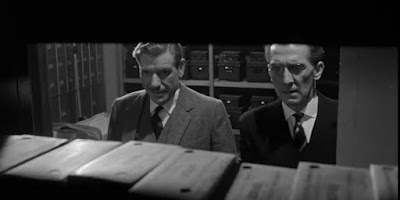 |
| The expressions say it all here when the loot appears. |
Why I loved it
At about 80 minutes, the film's efficient script unfolds in real time. It doesn't hide its 'Christmas movie' origins as from the very beginning several touches demonstrate that the action revolves around the holiday. And it's a blast to compare it to A Christmas Carol, with Fordyce as a clear Scrooge, and head clerk Pierson a clear Bob Cratchit stand in. The character of Gore-Hepburn is certainly not benevolent like most of the ghosts, but he does do one good turn at a key moment that makes you wonder about his motives. Yet for much of the film you can forget about Christmas as you get sucked into the suspense as step by step the robber executes his plan to make off with a small fortune. And in another element of suspense you wonder if and when the rest of the staff will realize what's happening quietly under their noses.
 |
Great faces here by Norman Bird, Edith Sharpe and Lois Daine,
as the robbery is revealed to the staff |
In its short running time all actors are at the top of their games, especially Cushing and Morell. The latter is alternately warm, then a snarling bully. Lawrence captures the action in a combination of wide shots and intense close-ups where the full variety of actors' facial expressions is on display. All in all it's a fantastic piece of entertainment that doesn't require a huge investment of time - invite the family to gather round and make this one part of your holiday party this or any year.
Where you can find it: If you don't have TCM, this one is up on YouTube at the moment--see below. It's also available on DVD both on its own and as part of a Sony collection of Hammer films.