For the second time in three years, on a muggy August weekend I made a road trip to Rome, New York to attend the very unique classic film festival known as '
Capitolfest', after the Capitol Theater, the old movie palace downtown playing host to the event. The festival's tag line is "a vacation, not a marathon!" Well, with just two and a half days to watch over two dozen movies, and with assorted special presentations mixed in, if that doesn't meet the criteria for a marathon, I'm not sure I share the same working definition of the word. That said, here in Rome the experience was relaxed, and lacked major downsides of bigger festivals, such as rushing from one theater to another, standing in lines, fighting to secure a seat in smaller venues, and choosing between eating and seeing a film. Here, it was also a great pleasure to spend many hours exploring film history in the presence of other classic film enthusiasts and in such an historic place.
  |
| The Capitol Theatre on W. Dominick St.. in Rome, NY |
This was the 14th annual edition of the film festival, and it is one of the most unique around, because it concentrates on hard-to-find films from the silent and early talking era. (This is NOT a greatest hits parade of classic film.) Yet, festival organizers, led by Art Pierce, theatre Executive Director, and Assistant Manager Jack Theakston, look at the critical reviews of the time and ensure they are generally positive before choosing a film to screen at Capitolfest. The films are often coming off restoration projects by the George Eastman House & Museum or the Library of Congress, and many haven't been seen since their original run in the 1920s or 30s. The festival also includes special presentations highlighting developments in film history. Tremendously affordable, a weekend pass (Friday, Saturday, Sunday) will put you out exactly $60.
 |
| Interior view of the Capitol Theatre, from www.romecapitol.com |
About half the films screened are from the silent era, and accompanying them live on their original restored theater organ, were musicians Dr. Philip C. Carli, Avery Tunningley, and Bernie Anderson. And in the 'can it GET any better?' category, the 'featured star' this year was
Gary Cooper, who was at his most smoldering and attractive early in his career.
 |
| Young Gary Cooper -- it may not get any better than this, folks. |
The FilmsAs a relative newbie to film history appreciation, I really enjoyed the special presentations of the
Dawn of Technicolor, by James Layton, and a sampling of
Edison Kinetoscope shorts (with recorded soundtracks) from 1913, presented by George Willeman, .... these proving that color film didn't just emerge in the late thirties, or that sound films didn't just magically appear in 1927. Film history is much more complicated, with trials, errors, hard work, and more trials. I also wonder what the stars of those 1913 shorts would think if they knew, 103 years later, that live audiences would re-discover their work.
I'm proud to say I saw every film presented at the festival (!) While I can't claim I was completely awake for every last minute of them, I was there. The late film on Friday evening was the sci-fi-adventure-comedy mash-up
JUST IMAGINE (1930), which could have garnered the award for oddest film possibly ever made in the 1930s. With it's look at what life might be like in the (gasp) 1980s (!) we all had fun with this one wondering what the heck was going on and I'm sure festival organizers did too.
 |
| The cast of JUST IMAGINE. Yeah, most of us didn't quite get this one, either. |
My favorite films were, in no particular order:
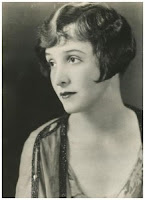 |
| Beautiful Florence Vidor |
DOOMSDAY (Rowland Lee, 1928) opened the festival on Friday at 11:30 AM. A silent love triangle set in England with Cooper as the lower class rival for
Florence Vidor's hand. While she loves him she balks at the hard farm work she'd be required to do. Complications ensue. Despite the somewhat anti-feminist themes in the film, I enjoyed it because it was my first exposure to Florence Vidor, and she was a fascinating, strong actress who was a good match for Cooper. Her career was launched thanks to her husband, director
King Vidor, who cast her in many of the films he produced in the era. She eventually divorced him, and retired from films at the end of the silent era. She also later married violinist Jascha Heifetz.
WOLF SONG (Victor Fleming 1929): This was the concluding film of the festival, a silent Western melodrama directed by Victor Fleming with a script written by John Farrow. Cooper plays a rugged 'mountain man' who in his travels meets and falls in love with beautiful Mexican ingénue
Lupe Velez. The struggle to maintain their relationship in face of Cooper's character's reluctance to be tied down creates the primary drama. This one had terrific acting by the leads, and solid support comes from
Louis Wolheim as his sidekick. What distinguished this film for me was the emotional resonance and the final payoff, when Cooper had to literally crawl on his knees back to his love to gain her forgiveness. It was working on this film that Cooper and Velez started a romantic relationship that lasted a few years. Their chemistry in the film oozes from the screen.
 DUDE RANCH
 (Frank Tuttle, 1931)-- This was a farce in which enterprising business owners run a fake 'Dude Ranch' as a tourist attraction. The trouble? Not enough going on threatens business. So they hire a family of traveling circus performers to impersonate cowboys to liven things up with horses, gunfights and the like. This showcases the comic skill of
Jack Oakie who was in his element here with his double takes and 'aw shucks' charm-oozing persona.
Eugene Pallette is also tremendously entertaining with and also despite his totally un-PC act as a Native American. Great example of verbal and physical comedy at a breakneck pace. I'd love to see this movie discussed in TCM's Slapstick course!
 |
| Cast of THE POOR RICH (IMDb) |
THE POOR RICH (Edward Sedgwick, 1934): Another rousing comedy with some of the best character actors to grace the screen in the 1930s, or any era. The cast is composed of
Edna May Oliver,
Edward Everett Horton,
Andy Devine,
Thelma Todd,
Una O'Connor,
Leila Hyams and
Grant Mitchell. All contribute in what is a master class of comic timing, both verbal and physical. The plot concerns a brother and sister (Oliver and Horton), late of the landed upper class but now completely destitute, who return to their family home in ruins, and attempt to try to rebuild while keeping up the ruse of their class for important and class-conscious visitors. My only complaint with this one was Thelma Todd has too little to do and didn't get to showcase her natural ebullience as a comedienne.
Honorable Mention:
THE TEXAN, also with Cooper, and the short silent drama starring
Norma Talmadge called
UNDER THE DAISIES.
The Extras
A huge 'dealers room' in a neighboring space provided much browsing pleasure. Original film stills and magazines in great shape, hundreds of books on film at low prices, and DVDs galore, added to the vintage feel of the festival, and I must say I enhanced my collection just a bit :
Making the festival for me was the opportunity to get to know some new film friends, some of whom I met at the Turner Classic Film Festival, and others only online. They inspire me with their passion, knowledge, and ability to express their love for film across multiple online platforms.
A few blogged about their experience, and @classicmoviehub and @citizenscreen created a video log:
Check out these other first-person accounts from film friends:
Raquel Strecher's account
I'm already looking forward to Capitolfest 2017 in August 2017! The featured star will be
Fay Wray.