Search This Blog

Showing posts with label Dan Duryea. Show all posts

Tuesday, August 16, 2016

An Oscar for Ethel: NONE BUT THE LONELY HEART Film Review

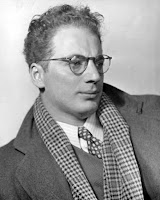
It is an unusual film in many ways: the directorial debut of author and playwright Clifford Odets (and only one of two for him), an unusual dramatic role for Cary Grant, and the return to Hollywood of stage queen Ethel Barrymore after a twelve-year hiatus.  The film, of course, is NONE BUT THE LONELY HEART (1944). In celebration of Ethel's 137th birthday, I'm pleased to present this post as part of the 2nd Annual Barrymore Trilogy Blogathon, hosted by Crystal of The Good Old Days of Classic Hollywood.
Ethel is someone that I will admit to putting on a pedestal.  Whenever I'm having a bad day, or need to calm my nervousness and take a risk, I think of her.  That's because my mother told me that, when  she was young, her father encouraged her to 'do her best Ethel Barrymore' in face of trying circumstances.  That stuck with me.  For my grandfather's generation, there was probably no other actress who so embodied excellence in the art of acting.  For those who haven't seen any of her films, I can attest--she was the real thing.
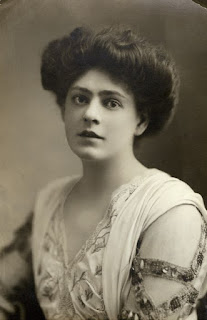
Young Ethel Barrymore
Clifford Odets
I eagerly approached NONE BUT THE LONELY HEART precisely because it was Ms. Barrymore's only Oscar.  I found it often moving, with complex, well-drawn characters, if not wholly satisfying.  The filmmakers went to great lengths to ensure Barrymore would star.  In fact, David Hempstead, producer at RKO Pictures, bought the rights to the novel by Richard Llewellyn, and offered the role of 'Ma Mott' to Barrymore, who turned it down, thinking the novel wouldn't make a good film.  She was reluctant also because her previous film, RASPUTIN & THE EMPRESS, was not a happy experience, despite starring along with both brothers, Lionel & John.  When Clifford Odets was given the job to adapt the novel for the screen, Barrymore softened.  The problem then was her commitment to a touring production of the stage play The Corn is Green during the time filming would commence.  So RKO simply paid the play's producer to take a six-week hiatus.

Barrymore felt comfortable with Odets as director, because of his stage credentials and his deference to her.  Despite its studio production, the film was set in 1930s London, in the working class East End. As widow "Ma" Mott, Barrymore owns a junk shop and barely gets by, no thanks to her vagabond and often AWOL son, Ernie Mott, played by Grant.  Ernie can't seem to stay long enough to take charge of the shop, and there is an uncomfortable truce between mother and son.  Having recently returned from a jaunt to who knows where, this time Ernie is facing for the first time some very unpleasant consequences of leaving again -- Ma is now dying of cancer, and he falls in love with beautiful Ada, as a vulnerable young woman trying to make up for some bad decisions but not quite succeeding.  Things get even more complicated when both Ma and Ernie separately get mixed up with the criminal element.  We wonder if anyone in the film will have a happy ending.
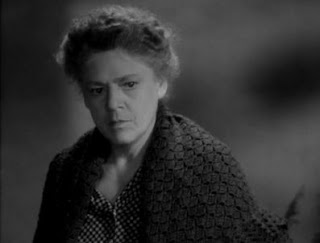
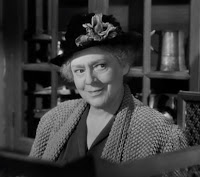
Barrymore as 'Ma Mott' has not had an easy life.  
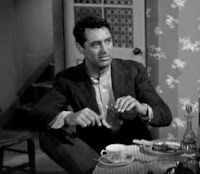
Grant in an early scene
I've read some commentary claiming that Grant didn't fit the part of a young cockney wastrel, or that he was too old (at just over 40) for the part.  In fact, in Richard Schickel's biography of Grant, the author quotes Grant as feeling that way himself, although he loved playing the role.  For me, he was perfect; the years wore on him well, convincing us he really had thrown away half of his life and it was beginning to catch up to him psychologically. There was never any doubt that underneath his obvious immaturity and indecision he was a good guy--when he first appears on the scene all the neighbors are truly thrilled to see him.  Grant used his (natural) cockney accent to good effect, and was quite subtle and powerful in the more emotional scenes.  Ultimately if he didn't realize the full impact of the character, as Schickel suggests, due to holding back a bit too much, he was believable as a flawed hero.
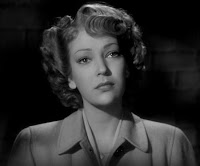
Luminous June Duprez in NONE BUT THE LONELY HEART
The cast of supporting actors was also mostly very good - Barry Fitzgerald as the crusty aging fellow who lost a son in WWI; June Duprez, the English-born actress as Ada, lovely, vulnerable, but tough.  Jane Wyatt was a bit too angelic in her self-sacrificing love for Grant. I was disappointed that normally supremely interesting and reliable Dan Duryea had a throwaway part as a shopkeeper and had a cringe-worthy accent in the few lines he uttered.
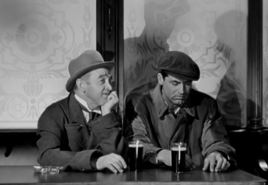
Barry Fitzgerald and Grant have a pint together
With the Salvation Army hat
Barrymore's screen presence was a good match for Grant.  Her accent, at least to my ear, was just right, and considering her acting chops and experience, not surprising.  Having been away from the screen so long she apparently was very nervous, nailing rehearsals but losing confidence during actual filming.  She regained the confidence she needed when in secret, Odets starting filming the rehearsals and playing them back to her to show her how good she was.  She relished disappearing into the role, and wearing a 75 cent hat from the Salvation Army that Odets trampled on to make it all the more 'lived in.'  The final scene in which Barrymore and Grant appear together was so convincing that I couldn't hold back the tears.
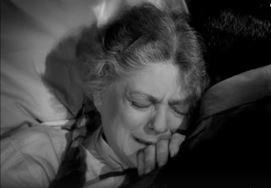
A heart-rending scene with Grant
What didn't completely work for me was the journey into film noir territory in the second half of the film with the gangsters, car chases and dimly lit scenes, when the film seemed to be going along quite well as a character-driven melodrama.  The film also got quite 'preachy' about values associated with wartime sacrifice and morality, with the clouds of WWII ominously and quite obviously appearing near the end.  More liberal editing and shorter overall run time would have been welcome.

The film received good reviews, and the normally snarky Bosley Crowther of the New York Times was effusive with his praise: "The poignant and wistful story of the Cockney wanderer, Ernie Mott, and his sad and wonderful mother and their ever-hungry search for some sort of spiritual fulfillment has been rendered in this film with all of the beauty and feeling that one could hopefully expect.".(NY Times, 11/18/1944). The film eventually lost money -- it was apparently too much of a downer for mass audiences -- but won Barrymore her Oscar, which stunned her.  When asked if she thought it was fair for her to have won when others had gone to Hollywood earlier and toiled longer there, she paused, and then replied, "Perhaps they shouldn't have gone."  Her success prompted her to move to Hollywood and devote many more years to the medium--and we are the better for it.
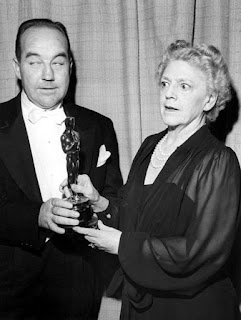
Barrymore with her Oscar and Broderick Crawford (1945)
References:
James Kotsilibas-Davis, The Barrymores: The Royal Family in Hollywood, 1981, Crown Publishers.
Richard Schickel, Cary Grant--A Celebration, 1999, Applause Books.

Sunday, March 20, 2016

In praise of ... Howard Da Silva, character actor extraordinaire

I mentioned in my introductory post how discovering a great new classic film can feel like waking up to Santa's bounty on Christmas morning.  Great films, charismatic stars, and talented directors all create this effect, but it doesn't end there.  I've found pleasure in getting to know terrific character actors who show up over and over in films during specific time periods, or at a particular studio.  One of these is Howard Da Silva (1909-1986) who has astonished me by the versatility of the roles he played, all with exceptional skill. This plain man of average build bounced back from a major career set-back as one of many movie people black-listed by the House Unamerican Committee (HUAC) during the Communist witch hunt era.  What he lacked in movie star glamour, he made up for in spot-on characterizations, deep commitment to his roles, and a wonderful deep resonant voice.

Da Silva was born Howard Silverblatt in the U.S. to Russian Jewish immigrant parents.  When he became an actor he changed his surname to Da Silva, a very common Portuguese name, yet oddly he had no connection with Portugal. His chosen name had the benefit of being distinctive and memorable, in any case.  He launched his acting career on the stage, progressing to significant parts on Broadway, including musical theater.  His film career began in the 40s; in that decade alone he had parts in 38 different movies, mostly as heavies.  He was blacklisted in 1951 after refusing to testify in front of HUAC as to his political activities or those of anyone else he knew. Apparently keeping his lips zipped was somewhat uncharacteristic of Da Silva. Fellow actor Robert Taylor, whose words got him that visit to HUAC in the first place, supposedly said "He seems to always have something to say at the wrong time."  The blacklisting resulted in a hiatus from movies, but Da Silva eventually found work on television and on the stage once again. [For more on the blacklisting in Hollywood check out the current series from www.youmustrememberthispodcast.com] He returned to film in the 1960s and gained memorable parts through the early 1980s.  One has the sense that this was a man who was devoted to, and devoted himself completely to, his craft of acting.

Here are the films that exposed me to Da Silva and made me an admirer.  I realize this just skims the surface of his work, and I look forward to enjoying more of his performances.

THE LOST WEEKEND (1945)
An acting showcase for Ray Milland in the role of an alcoholic struggling through an epic bender, this film allows Da Silva to shine in the small part of a sympathetic paternal bartender in a joint Milland's character frequents.  Da Silva has little screen time but dissolves into his role, demonstrating good chemistry with Milland.
Da Silva (right) attempts to talk Ray Milland out of one for the road.

Da Silva (right) confronts Hugh Beamont and William Bendix
 in his character's usual suave but unyielding manner.
THE BLUE DAHLIA (1946)
In this classic noir penned by Raymond Chandler, Da Silva plays Alan Ladd's rival in love twice over (!) -- as Ladd's estranged wife's lover, and the husband of Veronica Lake (whew!).  As character Eddie Harwood, he is also a sophisticated baddie who cuts an elegant figure as the sly owner of the nightclub of the film's title.  He is smooth as silk while narrowly escaping blackmailers, thugs,scorned women, and Ladd's righteous anger.
THEY LIVE BY NIGHT (1948)In this film, Nicholas Ray's directorial debut, Da Silva inhabits a character quite different than his cool, dapper Eddie Harwood.  Here he is blustering, one-eyed thug "Chickamaw", who is the driving force behind Farley Granger's life of bank robbery, and can never get his emotions or impulses in check.  We feel threatened by him but also drawn to him as his character is never completely black.  We sense that ultimately, he is a once-decent guy who fell victim to his own bad decisions years ago.  Check out the scene in the video link below.


BORDER INCIDENT (1949)
Ricardo Montalban has top billing in this strong docu-noir about a racket smuggling illegal Mexican farm workers across the border.  Da Silva shows up about 30 minutes into the film, but once again portrays the heavy, this time the menacing head of the smuggling operation.  He's never sympathetic here, and his face and voice dominate the screen when he's setting up Montalban's character for a fall.

TWO YEARS BEFORE THE MAST (1946)
Da Silva as Captain Thompson explains wistfully to owner
Stewart (Ray Collins) that he doesn't have to use his sword as
a commercial boat captain.
In this Alan Ladd Paramount film, based on the memoir from Richard Henry Dana, Jr., Da Silva plays the tyrant captain of the sailing ship 'Pilgrim' in the late 18th century.  He insists on all manner of economy to deliver under budget for the ship's owner, who happens to be Ladd's father.  After deprivations, the crew finally mutinies and Da Silva must confront this ultimate test.  Pulling some characterization from his Eddie Harwood role, he stands strong and straight, unyielding to those who would get the better of him.  It's Ladd's film, but Da Silva is the one to watch when he's on screen.

Da Silva efficient about the business of a burial at sea, with
Bendix and Ladd looking sullenly on.

THE UNDERWORLD STORY (1950)
I admit to watching this because of Herbert Marshall.  Dan Duryea is the main character and for once, he's the protagonist, albeit a bit oily.  Once again, Da Silva portrays a gangster, this time at odds with the press, represented by Duryea and his love interest, Gale Storm.

1776 (1972)
For something a bit different, I submit this historical musical comedy-drama as perhaps the film that latter-day audiences may best know Da Silva.  He portrays the pompous, humorous, witty, and ultimately courageous patriot Benjamin Franklin, a role which he owned on Broadway for many years.  And, Da Silva can sing and dance!  He is at home in Franklin's skin, and astonishes when he switches from his 'congenial know-it-all' to dead serious in an instant.  It's a testament to Da Silva that he comes up against but never crosses the line into caricature.  It's written that Da Silva was a bit difficult to work with during 1776's run on Broadway, and director Peter Hunt did not want to work with him in the film; he got the part once he promised to "behave," and, apparently he did!  If you've not seen this film, you can watch the clip below to get a sense for it -- here, Ken Howard, Da Silva, and William Daniels (as Thomas Jefferson, Franklin, and John Adams) tunefully debate what bird (!) should represent the nascent U.S. of A.


Radio -- CBS Mystery Theater
With his great voice, Da Silva made quite a number of radio shows, including a regular appearance on CBS Mystery Theater.  Check this one out from 1976 -- Da Silva uses the full range of voice to create the conflicted policeman Harry in the drama 'The Smoking Pistol 565.'

[THE LOST WEEKEND is showing on TCM on April 9 at 8PM EDT].
Drop me a line mentioning other Da Silva films you'd recommend!