Who doesn't love a charismatic villain? The best villains are those who not only steal all the scenes they are in, but make you root for them by exposing their humanity, vulnerability, or sheer likeability. In one of my favorite examples,
Douglas Fairbanks Jr. had a tremendous turn as devilish, dashing 'Rupert of Hentzau' in
The Prisoner of Zenda (1937). (By the way, this movie is terrific beyond just Fairbanks, Jr., so check it out if you haven't already seen it.)
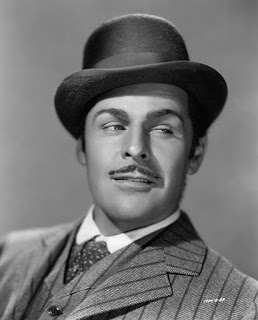 |
Brian Donlevy, publicity photo from
Destry Rides Again. (IMDb.com) |
I'd seen character actor
Brian Donlevy (1901-1972) in a few films from the 1940s before he really registered on my radar, but that all changed when I watched
Destry Rides Again (1939). I wrote about this western, starring James Stewart,
here, and had commented on how Donlevy really killed it. It turns out that playing deeply flawed characters, protagonists or antagonists, was Donlevy's specialty. Some were straight out villains that were unlikeable but still charismatic (
Beau Geste, 1939), villains that were just unlikeable and not particularly charismatic (
The Virginian, 1946), misguided tough guys with hearts of gold (McGinty in
The Great McGinty, 1940
), or corrupt politicians with a sense of humor (
The Glass Key, 1942). But his career also saw him assaying strong upstanding guys--two that I enjoyed were: in
Two Years Before the Mast (1946),
he supported leading man Alan Ladd as the real-life writer who ultimately exposes the poor working conditions aboard sailing vessels in early 19th century; in
Kiss of Death (1947)
he plays the straight and sympathetic D.A. to Victor Mature's reforming ex-con. If nothing else, his range was wide and he was reliable, and sometimes breathtaking.
Late last year, his first full-length biography, titled
Brian Donlevy, the Good Bad Guy, was published by McFarland Books, and does justice to this often overlooked actor's life and career. The author, Derek Sculthorpe, who also wrote the recent bio of Van Heflin that I reviewed
here, answered some of my questions about his work, and I intersperse them throughout this post.
Sculthorpe's objective in writing about Donlevy was to "provide a comprehensive and human assessment of his life and career." As with the Heflin book, it's thoroughly researched. The primary focus is on the detailed output of Donlevy's career, and because Sculthorpe watched every available film and television show, he is able to draw detailed insights about his work. It really is a great reference for those interested in film history, as Sculthorpe provides the background of each film's production, a short description, an analysis, and citations from press of the time.
Despite this heavy film focus, Sculthorpe intersperses chronologically those specifics of Donlevy's personal life that he uncovered during his research so that we get a sense of who this man was. For example, with his study of military records, Sculthorpe was able to debunk some of the more colorful stories of Donlevy's service before and during WWI which were fed to the press during Donlevy's early acting career, and which are still part of the lead bio on
IMDb.com.
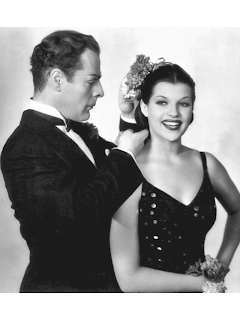 |
Donlevy with starlet Rita Cansino, soon to become
mega-star Rita Hayworth, in Human Cargo (1936)
(Photo from: Brian Donlevy, the Good Bad Guy,
McFarland Books 2016)
|
Q. How long did it take you to research and write your book on Donlevy?
Sculthorpe: "It took several months to research. It’s an incredibly time-consuming process. The thing is that once you start writing you begin to find more things. Obviously by the end you have so much. It took about eight months to write. This is so much less than it took for Heflin of course which was about two years or so in total. I learnt so much writing the first one which meant that I knew what to expect this time."
We learn that, in many ways, Donlevy had a career typical of many Hollywood actors of his generation, working until just a couple of years before he succumbed to cancer in 1972 at the age of 71. While he had no real formal acting training, he scored successes in film, the Broadway stage, radio and television. He had a private life that wasn't without its bumps and bruises, and battled alcoholism. He struggled with being typecast as a 'heavy', but often made the best of those roles, and relished those in which he played against type.
Q. What film of Donlevy's that is less well-known would you recommend people watch because of Donlevy's presence?
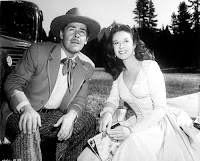 |
Brian Donlevy and Susan Hayward on
the set of Canyon Passage (IMDb.com) |
Sculthorpe: "It’s hard to name just one. I would say
Canyon Passage, which was an interesting role. Among the less well-known ones I especially liked
36 Hours to Kill (1936) in which he showed a lightness of touch; he was romantic and jaunty.
The Remarkable Andrew (1942) (where Donlevy played the ghost of President Andrew Jackson) because he worked well with (William) Holden and it was something different. Incidentally, in one of his early shorts,
Ireno (1932) he had a tiny uncredited role as a drunk which was well-observed I thought. It is very short but is now available on YouTube:"
Donlevy first gained star status with his Oscar-nominated turn as the villain in
Beau Geste. But his career reached its apex in the 1940s, where he was under contract with Paramount, and where he made most of the hit films I cited as those catching my attention. Later, as his career ebbed, he worked for various other studios, such as Republic, and ventured into television. His hit show
Dangerous Assignment in the 1950s was based on the radio show of the same name, that Donlevy himself conceived and wrote. In it, he's a debonair but tough U.S. special agent dealing with all kinds of cases of intrigue and adventure. Interestingly to me, he married the widow of
Bela Lugosi late in life, after having divorced two wives, and Sculthorpe was in touch with stepson Bela Lugosi Jr., for insights about Donlevy. One gets the sense that Donlevy had a restless energy all his life that propelled him to success, but also perhaps never allowed him contentment with his choices. He dabbled in writing poetry and fiction, and investments in mining concerns.
Q.
In reading the book, it struck me that Donlevy’s life and career had parallels to those of Van Heflin, the subject of your earlier book (e.g. talents underused, character actor vs. lead, challenges in personal life such as difficult relationships with children, drinking, etc). Any thoughts about what made them similar, and perhaps more importantly, what was different about the two?
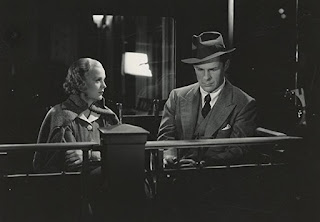 |
| Donlevy with Gloria Stuart in 36 Hours to Kill (IMDb.com) |
Sculthorpe: "I think Heflin was a far more intense actor; for him acting was a real craft and he put a great deal into his roles, especially on stage. Those parts were physically and emotionally draining. For Donlevy, it was more of a job I would say, a means to an end. Both were a similar generation, both loners and, as you say, had a drinking problem. As to drinking, it is a common theme, and others such as William Holden and Robert Ryan were comparable. I think that generation were encouraged to keep emotion inside. Conversely, I think this made them better actors. Both sought adventure in their early lives, but the crucial difference was that Donlevy wanted to be part of something (the army), whereas Heflin just wanted to escape and do his own thing. Overall, I would say Heflin turned down a great many more roles than Donlevy. Their attitude to television was revealing; Heflin saw it as diminishing the art of acting in some way. Donlevy was practical and enjoyed one of his greatest successes with a TV series."
Q.
If you could play casting director…is there any film role that Donlevy would have been absolutely the best choice for (past or present) that may have showcased his talents better?
Sculthorpe: "I would like to have seen him as Frank Elgin in
The Country Girl, (1954) which he only ever did on stage in his “straw hat” days. I know Bing Crosby did it well but Donlevy was said to be unexpectedly good in that role so that would have been interesting."
Q. What is your next project?
Sculthorpe: "
My next book is about Claire Trevor, it should be out at the beginning of next year." The subjects I have chosen have not been the most obvious ones, or the easiest to write about. I just feel that the big stars - Marilyn, Cary Grant, Bette Davis et al. have been written about a lot. What more can be said about them? A vast number never made it to their level, but nonetheless have a story to tell. It is heartening to see that there have recently been books about Lloyd Nolan, Richard Jaeckel, Dan Duryea and other less feted people for instance."
Sculthorpe added that he would be interested to know which subjects my blog readers would like to see books written about -- feel free to add your thoughts in the comments section.
This post is my entry in the
2017 "What a Character" Blogathon, hosted by Aurora of
Once Upon a Screen, Kellee of
Outspoken & Freckled, and Paula of
Paula's Cinema Club. Check out all the posts to satisfy your curiosity about actors you've probably seen but may not know their names. All these actors deserve to have their stories told for what they gave us on the silver screen.