If the idea of a small mystery involving Lamming Napoleonics ranges, Charles Grant's book Napoleonic Wargaming, Peter Gilder and the Wargames Holiday Centre piques your curiosity, you might like to take a look at my latest two posts on the Old Metal Detector blog here and here.
Showing posts with label Charles Grant. Show all posts
Showing posts with label Charles Grant. Show all posts
Tuesday, 12 May 2020
Small mystery about Lamming Napoleonics....
If the idea of a small mystery involving Lamming Napoleonics ranges, Charles Grant's book Napoleonic Wargaming, Peter Gilder and the Wargames Holiday Centre piques your curiosity, you might like to take a look at my latest two posts on the Old Metal Detector blog here and here.
Sunday, 2 February 2014
Something Old School - Grant on Minden
The Wargamers Yearbook 1966/7 contains this lengthy (ish) article by Charles Grant on a refight of Minden, which should be of interest to devotees of The War Game/Charge way of doing things.
I haven't been able to check but I think the "Visitor" will have been Brigadier Peter Young and his"local chief of staff" the young CS Grant.


I've always felt that, due to the sources I have available for Vintage Wargaming, Charles Grant is under represented on this blog and I'm glad to have the opportunity to redress the balance a little.
I haven't been able to check but I think the "Visitor" will have been Brigadier Peter Young and his"local chief of staff" the young CS Grant.
I've always felt that, due to the sources I have available for Vintage Wargaming, Charles Grant is under represented on this blog and I'm glad to have the opportunity to redress the balance a little.
Tuesday, 12 June 2012
The Combat at Pigeon's Ranch by Chares Grant
This version of this article is from Wargamer's Newsletter #77 August 1968, athough it is reprinted from an earlier Wargamer's Newsletter. I don't have this earlier version so I don't know in which issue it first appeared.
It is of particular interest as it relates to Charles Grant's earlier American Civil War gaming, which as I understand it predated the SYW set up represented by The War Game.
Thursday, 5 August 2010
Tribute to Charles Grant, 1979
In the Editorial to Wargamers Newsletter #208 of July 1979 Don Featherstone wrote this announcement and tribute to Charles Grant.
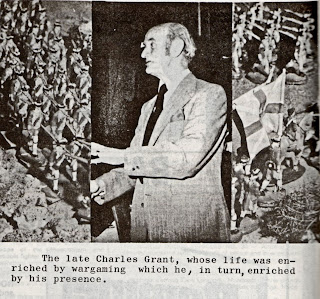
It is with the greatest regret and sorrow that I report the death of an old friend and veteran wargamer Charles Grant. Apparently it occurred recently and was very sudden but I have no details. Charles was perhaps the most experienced wargamer around, being in the hobby long before I ever became aware of wargaming and his contributions to it, both practical and literary, played a major part in the great advance to its present status. At various stages in my early acquaintance with wargaming, I had stimulating meetings and wargames with Charles, although in recent years we have not seen much of each other. This knowledgeable and experienced senior statesman of our hobby will be sadly missed and there are many of us who will remember him fondly for years to come.
D.F.F.
It is with the greatest regret and sorrow that I report the death of an old friend and veteran wargamer Charles Grant. Apparently it occurred recently and was very sudden but I have no details. Charles was perhaps the most experienced wargamer around, being in the hobby long before I ever became aware of wargaming and his contributions to it, both practical and literary, played a major part in the great advance to its present status. At various stages in my early acquaintance with wargaming, I had stimulating meetings and wargames with Charles, although in recent years we have not seen much of each other. This knowledgeable and experienced senior statesman of our hobby will be sadly missed and there are many of us who will remember him fondly for years to come.
D.F.F.
Sunday, 1 August 2010
Charles Grant on Battles - Large and Small
When idly flicking through the labels on the right hand side of this blog, I was a little shocked to see how few posts there were related to Charles Grant. As a step towards remedying this, here is a short piece he wrote for the Wargamer's Annual 1965, Don Featherstone's follow-up to his Wargamer's Yearbook 1964. As this won't be widely available elsewhere I thought it would be good to post it here.
Incidentally, it has reminded me of my long standing quandary over DF's use of the Wargamer's apostrophe (as in the Wargamer's Newsletter or Wargamer's Annual). Had it been Wargamers' this would suggest it was intended for or belonged to more than one wargamer; as it is it suggests a single wargamer. Is this the Don himself, sharing his thoughts with others where he is the eponymous wargamer? If so surely this is the spiritual ancestor of every wargames blog. Or is it intended to be the newsletter of every wargamer - "the wargamer"? I just don't know, and short of asking him (and I really don't want to bother him with this) I don't think I ever really will - but interesting to speculate...


Incidentally, it has reminded me of my long standing quandary over DF's use of the Wargamer's apostrophe (as in the Wargamer's Newsletter or Wargamer's Annual). Had it been Wargamers' this would suggest it was intended for or belonged to more than one wargamer; as it is it suggests a single wargamer. Is this the Don himself, sharing his thoughts with others where he is the eponymous wargamer? If so surely this is the spiritual ancestor of every wargames blog. Or is it intended to be the newsletter of every wargamer - "the wargamer"? I just don't know, and short of asking him (and I really don't want to bother him with this) I don't think I ever really will - but interesting to speculate...
Monday, 7 December 2009
Original review of Charles Grant's "The War Game", from Wargamer's Newsletter # 116, November 1971
THE WAR GAME by Charles Grant (10" x 7½”: 191 pages; 25 photographs; 28 maps and diagrams. Published by A. and C. Black £3.00).
I had read and enjoyed most of the contents of this book when originally published in "Tradition" magazine and now this most lavish and pleasingly presented book makes re-reading it a pleasure. My enjoyment was increased because I have actually fought with Charles Grant using the figures depicted in the beautiful photographs in the book and on the same battlefield. In that connection I am very impressed with the manner in which Charles Grant remains satisfied and loyal to his rules because those given in the book are exactly the same as we used on pleasant if argumentative Saturday afternoons and Sunday mornings some eight to ten years ago. I say this with some feeling because my own rules are constantly being changed or amended as some new situation arises that causes dissatisfaction.
It is a most pleasingly presented book presumably aimed at the beginner whom it takes in carefully explained steps through the mechanics of fighting that neglected but fascinating and colourful warfare of the mid-l8th century. Charles backs his theories with historical illustrations and, whilst there is nothing particularly new or original in the book, it admirably does what it sets out to do - to arouse interest in a pleasing period of warfare without once straying from the fact that it is an enjoyable game that is being described and not a highly technical and intense simulation of real warfare. It may be because the wargaming careers of Charles Grant and Brigadier Peter Young have been blended together for so many years and because both fight in the same period, but "THE WAR Game" most strikingly resembles "CHARGE!" by Brigadier Peter Young and Lieutenant-Colonel J.P. Lawford in that both are exactly the same size books, both beautifully presented with gorgeous and stimulating coloured jackets, the interior lay-out, style and standard of photographs and method of presentation is remarkably similar.
The principal difference lies in the style of writing where Charles lacks the whimsicality of the Brigadier and occasionally I found irritating his over-wordy, slightly old-fashioned style of putting words together as though they were directed at youngsters. However, this may be carping because after all Charles Grant's credentials for writing such a book arise from him being an experienced veteran wargamer and not a writer.
All-in-all, this is a most pleasing contribution to the ever growing literature of wargaming and, speaking with some experience, may I say that I think that Charles's publishers have done him proud!
I had read and enjoyed most of the contents of this book when originally published in "Tradition" magazine and now this most lavish and pleasingly presented book makes re-reading it a pleasure. My enjoyment was increased because I have actually fought with Charles Grant using the figures depicted in the beautiful photographs in the book and on the same battlefield. In that connection I am very impressed with the manner in which Charles Grant remains satisfied and loyal to his rules because those given in the book are exactly the same as we used on pleasant if argumentative Saturday afternoons and Sunday mornings some eight to ten years ago. I say this with some feeling because my own rules are constantly being changed or amended as some new situation arises that causes dissatisfaction.
It is a most pleasingly presented book presumably aimed at the beginner whom it takes in carefully explained steps through the mechanics of fighting that neglected but fascinating and colourful warfare of the mid-l8th century. Charles backs his theories with historical illustrations and, whilst there is nothing particularly new or original in the book, it admirably does what it sets out to do - to arouse interest in a pleasing period of warfare without once straying from the fact that it is an enjoyable game that is being described and not a highly technical and intense simulation of real warfare. It may be because the wargaming careers of Charles Grant and Brigadier Peter Young have been blended together for so many years and because both fight in the same period, but "THE WAR Game" most strikingly resembles "CHARGE!" by Brigadier Peter Young and Lieutenant-Colonel J.P. Lawford in that both are exactly the same size books, both beautifully presented with gorgeous and stimulating coloured jackets, the interior lay-out, style and standard of photographs and method of presentation is remarkably similar.
The principal difference lies in the style of writing where Charles lacks the whimsicality of the Brigadier and occasionally I found irritating his over-wordy, slightly old-fashioned style of putting words together as though they were directed at youngsters. However, this may be carping because after all Charles Grant's credentials for writing such a book arise from him being an experienced veteran wargamer and not a writer.
All-in-all, this is a most pleasing contribution to the ever growing literature of wargaming and, speaking with some experience, may I say that I think that Charles's publishers have done him proud!
Wednesday, 17 June 2009
Original review of Charles Grant's "The War Game", On Parade from Military Modelling December 1971
On Parade
A review of new books for modellers
The War Game by Charles Grant. 10 in. x 7- in., 190 pp, 25 photos, 35 diagrams. Published by A. & C. Black Ltd. £3.00.
It is possible to quarrel with the title of this book, on the ground that it might be considered more applicable to a general guide to wargaming than to a monograph on 18th century warfare. But this might well be a good thing, if it should wean some young modernists from their grim preoccupation with our present-day instruments of indiscriminate mass-murder to an appreciation of the most 'civilised' age of warfare, which interfered as little as possible with the civilian population, when both sides were composed of professionals anxious to observe humane rules, and even the private soldier when captured was not left to rot in a prison-camp 'for the duration', but could look forward to an early exchange.
Such conditions are of course ideal for wargaming, and we have the additional bonus of concentrated, orderly battles, a really active cavalry, and attractive uniforms. It is small wonder that many years ago Mr. Grant chose this period for intensive study, the results of which are here set down having first appeared in a preliminary form in that very 'glossy' periodical Tradition'. The rules that he evolved are constantly referred to; indeed, they are so likely to intrigue the reader that it seems a pity they are not included as a (very substantial) appendix. That they play well and are in character with the period is widely agreed. If a limitation might be indicated here, it concerns their detailed nature, which adds great realism to the normal-sized engagement between friends, but is less well suited to those gigantic set-piece affairs arranged as Convention spectaculars. For these, of course, the Grant Rules were never designed.
For details: Chapter IV's eminently sensible remarks on cavalry are commended to all readers, especially those enthusiasts whose horseflesh is apparently equipped with internal-combustion engines. One point I missed here was the proviso, which I presume still exists in the Grant Rules, for a six-move interval after a charge to allow for rallying, reforming, and breathing horses. The devastating effect of the knee-to-knee charge of heavy cavalry is mentioned; it would be effective against infantry and light cavalry of the Continental type, who would be sure to flinch from the impact, but cavalry v cavalry engagements are not touched upon. Here it may be pointed out no decision could be expected from a mutual knee-to-knee charge, the horses, being sensible animals, would be bound to pull up nose to nose, leaving their riders with nothing to do but wave their swords and make fierce faces, Chinese-style. In fact, cavalry confident of their swordsmanship would open their ranks to let their opponents ride in, and settle the affair blade to blade. (As I remember, this is covered in the Rules, and might well be mentioned here.) Another point, though an elementary one, is often overlooked, namely that cavalry cannot retire in order; quadrupeds cannot'about-turn' as do bipeds. Hence for every retirement there must be a reforming.
As to musketry (Chapter V) the only criticism I would make is that though the author indicates that the firing for a move may represent one volley or the total of several, according to the time comprehended in one move, the instructions for the two sides' firing are consecutive (i.e. B's casualties are removed before he fires). Very good, if the volume of fire is calculated to represent a single volley, not so, if B has to endure, say, two to five minutes' fire before the survivors may return a shot! Mr. Grant says. 'The firing-first procedure merely accounts for one side firing more quickly than the other'. But unless such an advantage has been agreed upon and compensated for at the start of the game, why should they? And with some time-intervals and rates of fire I have known, B could be blown to ribbons! Surely, if more than one volley is concerned, it is fairer if B fires back before his casualties are removed?
Artillery effects are well taken care of by three devices: the Roundshot Measuring Stick which gives the successive falls of ricocheting shot, the Howitzer Shell-burst Circle, and the Canister Cone. Should one desire to reduce the lethal effect of the first, or be playing on a narrow table, it is always possible to agree on a heavy overnight rain!
Morale is based to the greatest extent on control by officers - very characteristic of the period - combined with losses, and there is a useful chapter on organisation, historically based. Buildings, together with their attack and defence (including bombardment) are dealt with, and there is a very practical discussion on terrain construction, and the effect of dead ground. Engineers and river transport are not forgotten, and there is enough about map-strategy and campaigns at least to start the novice off on this refinement.
No less than three specimen battles are described in most illuminating detail. The photographs (some of them full-page), the work of Kent Photos of King Street, Dover, are about the clearest in detail I have seen, considering that they are not printed on art paper. Mr. Grant's learning is everywhere apparent, yet never oppressive, worn lightly as it is, and his enthusiasm is infectious. The price is perhaps on the high side, even for these days, but the book is handsomely turned out, and should be a wel¬come Christmas present to the younger enthusiast, while his elder will find much both to entertain and to consider carefully.
A review of new books for modellers
The War Game by Charles Grant. 10 in. x 7- in., 190 pp, 25 photos, 35 diagrams. Published by A. & C. Black Ltd. £3.00.
It is possible to quarrel with the title of this book, on the ground that it might be considered more applicable to a general guide to wargaming than to a monograph on 18th century warfare. But this might well be a good thing, if it should wean some young modernists from their grim preoccupation with our present-day instruments of indiscriminate mass-murder to an appreciation of the most 'civilised' age of warfare, which interfered as little as possible with the civilian population, when both sides were composed of professionals anxious to observe humane rules, and even the private soldier when captured was not left to rot in a prison-camp 'for the duration', but could look forward to an early exchange.
Such conditions are of course ideal for wargaming, and we have the additional bonus of concentrated, orderly battles, a really active cavalry, and attractive uniforms. It is small wonder that many years ago Mr. Grant chose this period for intensive study, the results of which are here set down having first appeared in a preliminary form in that very 'glossy' periodical Tradition'. The rules that he evolved are constantly referred to; indeed, they are so likely to intrigue the reader that it seems a pity they are not included as a (very substantial) appendix. That they play well and are in character with the period is widely agreed. If a limitation might be indicated here, it concerns their detailed nature, which adds great realism to the normal-sized engagement between friends, but is less well suited to those gigantic set-piece affairs arranged as Convention spectaculars. For these, of course, the Grant Rules were never designed.
For details: Chapter IV's eminently sensible remarks on cavalry are commended to all readers, especially those enthusiasts whose horseflesh is apparently equipped with internal-combustion engines. One point I missed here was the proviso, which I presume still exists in the Grant Rules, for a six-move interval after a charge to allow for rallying, reforming, and breathing horses. The devastating effect of the knee-to-knee charge of heavy cavalry is mentioned; it would be effective against infantry and light cavalry of the Continental type, who would be sure to flinch from the impact, but cavalry v cavalry engagements are not touched upon. Here it may be pointed out no decision could be expected from a mutual knee-to-knee charge, the horses, being sensible animals, would be bound to pull up nose to nose, leaving their riders with nothing to do but wave their swords and make fierce faces, Chinese-style. In fact, cavalry confident of their swordsmanship would open their ranks to let their opponents ride in, and settle the affair blade to blade. (As I remember, this is covered in the Rules, and might well be mentioned here.) Another point, though an elementary one, is often overlooked, namely that cavalry cannot retire in order; quadrupeds cannot'about-turn' as do bipeds. Hence for every retirement there must be a reforming.
As to musketry (Chapter V) the only criticism I would make is that though the author indicates that the firing for a move may represent one volley or the total of several, according to the time comprehended in one move, the instructions for the two sides' firing are consecutive (i.e. B's casualties are removed before he fires). Very good, if the volume of fire is calculated to represent a single volley, not so, if B has to endure, say, two to five minutes' fire before the survivors may return a shot! Mr. Grant says. 'The firing-first procedure merely accounts for one side firing more quickly than the other'. But unless such an advantage has been agreed upon and compensated for at the start of the game, why should they? And with some time-intervals and rates of fire I have known, B could be blown to ribbons! Surely, if more than one volley is concerned, it is fairer if B fires back before his casualties are removed?
Artillery effects are well taken care of by three devices: the Roundshot Measuring Stick which gives the successive falls of ricocheting shot, the Howitzer Shell-burst Circle, and the Canister Cone. Should one desire to reduce the lethal effect of the first, or be playing on a narrow table, it is always possible to agree on a heavy overnight rain!
Morale is based to the greatest extent on control by officers - very characteristic of the period - combined with losses, and there is a useful chapter on organisation, historically based. Buildings, together with their attack and defence (including bombardment) are dealt with, and there is a very practical discussion on terrain construction, and the effect of dead ground. Engineers and river transport are not forgotten, and there is enough about map-strategy and campaigns at least to start the novice off on this refinement.
No less than three specimen battles are described in most illuminating detail. The photographs (some of them full-page), the work of Kent Photos of King Street, Dover, are about the clearest in detail I have seen, considering that they are not printed on art paper. Mr. Grant's learning is everywhere apparent, yet never oppressive, worn lightly as it is, and his enthusiasm is infectious. The price is perhaps on the high side, even for these days, but the book is handsomely turned out, and should be a wel¬come Christmas present to the younger enthusiast, while his elder will find much both to entertain and to consider carefully.
Thursday, 16 April 2009
The Dover Amendments
Harry Pearson writes:
The Dover Coven
The Dover Amendments were designed by Charles Grant and “The Dover Coven” to use in conjunction with WRG 3rd Edition. Charles Grant mentions them frequently in his writing, notably in The Ancient Wargame and Ancient Battles for Wargamers, but I am not sure if they were ever published.
The Coven was a large, loose body of likeminded gamers from the Dover area who met at Grant’s house on Sundays. The photo shows (l-r) Rob Waldren, Charles Grant, Chris Spriggett, Peter Sheppard, Ray McGarry (on chair), Andrew Green and Ian Osborn. Other members included Alan Stoneman, David Matthews, Chris Longhurst, Martin Dice, Gregory Perry, Alan Bennett, Alan Angus, Derek Casey, Mark Smith, Nigel Andrews, Stanley and Martin Medrow, Andrew Mummery and Barry Martin. Charles Grant junior does not seem to have been much involved in the ancient games.


The Dover Coven
The Dover Amendments were designed by Charles Grant and “The Dover Coven” to use in conjunction with WRG 3rd Edition. Charles Grant mentions them frequently in his writing, notably in The Ancient Wargame and Ancient Battles for Wargamers, but I am not sure if they were ever published.
The Coven was a large, loose body of likeminded gamers from the Dover area who met at Grant’s house on Sundays. The photo shows (l-r) Rob Waldren, Charles Grant, Chris Spriggett, Peter Sheppard, Ray McGarry (on chair), Andrew Green and Ian Osborn. Other members included Alan Stoneman, David Matthews, Chris Longhurst, Martin Dice, Gregory Perry, Alan Bennett, Alan Angus, Derek Casey, Mark Smith, Nigel Andrews, Stanley and Martin Medrow, Andrew Mummery and Barry Martin. Charles Grant junior does not seem to have been much involved in the ancient games.
Subscribe to:
Posts (Atom)