Showing posts with label French Invasion. Show all posts
Showing posts with label French Invasion. Show all posts
Saturday, 16 February 2013
Sunday, 13 January 2013
French Invasion of England in 1810, Part 5, by Harold Gerry
After a bit of a hiatus here is the first post of 2013. The blog has managed to slip past 300 followers and needs another 2,500 or so page views to hit the 250,000 mark.
Slightly more formal employment is restricting my time and energy for blogging but I am hoping to get back to regular posts soon. With a view to tidying up some unfinished business, here is Part 5 of Harold Gerry's series on the the French Invasion of England in 2010, from Wargamer's Newsletter #103 from October 1970.


Slightly more formal employment is restricting my time and energy for blogging but I am hoping to get back to regular posts soon. With a view to tidying up some unfinished business, here is Part 5 of Harold Gerry's series on the the French Invasion of England in 2010, from Wargamer's Newsletter #103 from October 1970.
Wednesday, 23 December 2009
The French Invasion of England in 1810, Part 4, by Harold Gerry
(A campaign game played by the Mid-Herts Group; for strategic rules see June "Newsletter").
The West Country, May 9th-14th. At Taunton, on the afternoon of the 9th, the French had just begun to take possession of the captured town when their cavalry, scouting along the Bristol road, reported a new English force entrenched just across the River Tone, blocking the road effectively. There was consternation in the French camp. The militia army driven south¬wards out of Taunton, although shaken, would recover its spirits within a day or two unless it could be relentlessly pursued. But the main English army in the West was also one day's march from Taunton, but to the westward, so such pursuit was out of the question.
The new force discovered was one of the reserve armies composed of militia, which one of the English commanders from another area had sent down into the West Country to render what assistance it could, and somehow the two commanders locally had not been informed. So the Taunton general had fought and lost his battle without realising that this second English force (about 4 regiments) was only about 2 hours' march away. (The player originally dealing with the West Country had had to hand over, for business reasons, to temporary assistants at this stage of the campaign, and a most realistic "fog of war" descended on all this area as a result).
At length the French decided that a trap was closing in on them, and marched north-west along the road to the Bristol Channel. The main English army tried to cut them off by marching over secondary roads, but, having force-marched the day before as well, had at length to give up and call a day's rest.
The French thus escaped, but the British profited from the halt to re-group. Some units went back towards Salisbury, as London was still anxious about Portsmouth, which area was not too strongly guarded. A force of about 16,000 of all arms (1 figure = about 50 men) hurried after the French, who were now covering a temporary base at Minehead.
Unknown to the British, the local French commander had just sent word to Paris that he was retiring on Launceston and Falmouth (both now fortified) and that there was now no hope of breaking through up to the Severn Valley to raise the Midlands as originally planned. The British were still obsessed with the possible danger to the Plymouth base (the initial French landings at Falmouth and Lyme Regis were intended to confirm the British in this fear, to draw the British westwards whilst the main French thrusts went into the Midlands from West and East).
So in fact the Western stage of the campaign was now almost over. Nothing further of significance would take place. The French used any available shipping to ferry troops over to Wales, which they had suddenly realised must have been very denuded of troops in order to reinforce the fighting in Somerset. But the British, naturally, knew nothing of all this as yet, and could not withdraw too many units from the West Country in case the next major landing of French reinforcements was to take place near Plymouth. The base must be held at all costs.
To cover their embarkation, the French with about 8,000 men, stood to fight along the line of the small river and woods at Dunster, in North Somerset. Nearly two hours of daylight were left. (It was established by dice throw that the English forces had overtaken the French, and further dice fixed the number of game-moves possible before dark).
The French units were mostly concealed from view, (and therefore not laid down on the wargame table), the terrain being very broken, with many woods. The English commander was forced to attack "blind", and this possibly led him to direct his thrusts mainly at the area between village and sea, where he could at least expect no very complicated surprises. He could have attacked more recklessly had he known that about a quarter of the French army were at Minehead bay embarking on shipping to cross to Wales to re-open the campaign there. The French at Dunster were outnumbered nearly 2 to 1.
The English left was intended merely to contain any French opposite them. In the centre, four militia regiments moved directly on the bridge and village, with instructions to attack repeatedly and regardless of losses, whilst all the cavalry and the best regular infantry tried to envelop the French line from the sea side. The militia ran into the expected skirmishers' fire from the woods on the East bank, but one unit sufficed to deal with this, whilst the others advanced determinedly. But each regiment as it approached into grape range and long musket range lost over a quarter of its strength to the concentrated fire from the houses and barricades opposite. The attack came to a stop, two of the regiments routing. But the defenders realised their luck would not hold much longer. A rifle militia regiment had just cleared the hedged field area downstream, and was moving up the river to engage the batteries and muskets from the more advantageous rifle range (12" as compared with 6" for muskets).
On the English right, the flanking force had just crossed the small river, in some disorder, when they were charged at a nicely judged moment by a cuirassier regiment. The leading English cavalry unit routed, and carried with it the second, which was in the river. "Never mind, the Guards will stop the rot", opined the C. in C., that unit being next to have its morale tested. To his disgust they broke also, and the entire column of seven regiments was pushed back from the river, due to the narrow frontage. (The Guards threw four morale dice, needing a 5 or 6 on one at least; they threw 4, 2, 2, 1). By the time the unshaken rear units could move up to the river, it was too late to re-mount the attack.
Then the somewhat incompetent English commander found he had scored a partial success after all, but with the part of his force of which he had expected nothing. His left wing had simply plodded forward warily to the river, their cannon preventing the French guns opposite from doing the same execution which had happened at Dunster town. The French, afraid of losing the batteries which had been their main battle-winning asset so far in the campaign, limbered up and escaped out of range, and English light companies supported by an infantry brigade in line took the hills where the main road south to Exeter left the Dunster area. Unknown to anyone on the English side, this was to have been the French route back to their smaller supporting forces in Devon and Cornwall. So when they retired next morning, before dawn, the French had to take the long route through Minehead and Barnstaple.
The English Western army followed slowly, to within a few miles of Launceston, disposing a screen of troops about the north and east sides of the town by the even¬ing of the 14th. At about this time bad news from Wales began to arrive, and some of the Welsh militia regiments were marched off to the Bristol Channel to reinforce tie small forces in South Wales, where the next decisive part of the campaign was going to take place.
TO BE CONTINUED
I regret the map accompanying this article of the Battle of Dunster is so faint I can not reproduce it here.
This article appeared in Wargamer's Newsletter #102, in September 1970.
The West Country, May 9th-14th. At Taunton, on the afternoon of the 9th, the French had just begun to take possession of the captured town when their cavalry, scouting along the Bristol road, reported a new English force entrenched just across the River Tone, blocking the road effectively. There was consternation in the French camp. The militia army driven south¬wards out of Taunton, although shaken, would recover its spirits within a day or two unless it could be relentlessly pursued. But the main English army in the West was also one day's march from Taunton, but to the westward, so such pursuit was out of the question.
The new force discovered was one of the reserve armies composed of militia, which one of the English commanders from another area had sent down into the West Country to render what assistance it could, and somehow the two commanders locally had not been informed. So the Taunton general had fought and lost his battle without realising that this second English force (about 4 regiments) was only about 2 hours' march away. (The player originally dealing with the West Country had had to hand over, for business reasons, to temporary assistants at this stage of the campaign, and a most realistic "fog of war" descended on all this area as a result).
At length the French decided that a trap was closing in on them, and marched north-west along the road to the Bristol Channel. The main English army tried to cut them off by marching over secondary roads, but, having force-marched the day before as well, had at length to give up and call a day's rest.
The French thus escaped, but the British profited from the halt to re-group. Some units went back towards Salisbury, as London was still anxious about Portsmouth, which area was not too strongly guarded. A force of about 16,000 of all arms (1 figure = about 50 men) hurried after the French, who were now covering a temporary base at Minehead.
Unknown to the British, the local French commander had just sent word to Paris that he was retiring on Launceston and Falmouth (both now fortified) and that there was now no hope of breaking through up to the Severn Valley to raise the Midlands as originally planned. The British were still obsessed with the possible danger to the Plymouth base (the initial French landings at Falmouth and Lyme Regis were intended to confirm the British in this fear, to draw the British westwards whilst the main French thrusts went into the Midlands from West and East).
So in fact the Western stage of the campaign was now almost over. Nothing further of significance would take place. The French used any available shipping to ferry troops over to Wales, which they had suddenly realised must have been very denuded of troops in order to reinforce the fighting in Somerset. But the British, naturally, knew nothing of all this as yet, and could not withdraw too many units from the West Country in case the next major landing of French reinforcements was to take place near Plymouth. The base must be held at all costs.
To cover their embarkation, the French with about 8,000 men, stood to fight along the line of the small river and woods at Dunster, in North Somerset. Nearly two hours of daylight were left. (It was established by dice throw that the English forces had overtaken the French, and further dice fixed the number of game-moves possible before dark).
The French units were mostly concealed from view, (and therefore not laid down on the wargame table), the terrain being very broken, with many woods. The English commander was forced to attack "blind", and this possibly led him to direct his thrusts mainly at the area between village and sea, where he could at least expect no very complicated surprises. He could have attacked more recklessly had he known that about a quarter of the French army were at Minehead bay embarking on shipping to cross to Wales to re-open the campaign there. The French at Dunster were outnumbered nearly 2 to 1.
The English left was intended merely to contain any French opposite them. In the centre, four militia regiments moved directly on the bridge and village, with instructions to attack repeatedly and regardless of losses, whilst all the cavalry and the best regular infantry tried to envelop the French line from the sea side. The militia ran into the expected skirmishers' fire from the woods on the East bank, but one unit sufficed to deal with this, whilst the others advanced determinedly. But each regiment as it approached into grape range and long musket range lost over a quarter of its strength to the concentrated fire from the houses and barricades opposite. The attack came to a stop, two of the regiments routing. But the defenders realised their luck would not hold much longer. A rifle militia regiment had just cleared the hedged field area downstream, and was moving up the river to engage the batteries and muskets from the more advantageous rifle range (12" as compared with 6" for muskets).
On the English right, the flanking force had just crossed the small river, in some disorder, when they were charged at a nicely judged moment by a cuirassier regiment. The leading English cavalry unit routed, and carried with it the second, which was in the river. "Never mind, the Guards will stop the rot", opined the C. in C., that unit being next to have its morale tested. To his disgust they broke also, and the entire column of seven regiments was pushed back from the river, due to the narrow frontage. (The Guards threw four morale dice, needing a 5 or 6 on one at least; they threw 4, 2, 2, 1). By the time the unshaken rear units could move up to the river, it was too late to re-mount the attack.
Then the somewhat incompetent English commander found he had scored a partial success after all, but with the part of his force of which he had expected nothing. His left wing had simply plodded forward warily to the river, their cannon preventing the French guns opposite from doing the same execution which had happened at Dunster town. The French, afraid of losing the batteries which had been their main battle-winning asset so far in the campaign, limbered up and escaped out of range, and English light companies supported by an infantry brigade in line took the hills where the main road south to Exeter left the Dunster area. Unknown to anyone on the English side, this was to have been the French route back to their smaller supporting forces in Devon and Cornwall. So when they retired next morning, before dawn, the French had to take the long route through Minehead and Barnstaple.
The English Western army followed slowly, to within a few miles of Launceston, disposing a screen of troops about the north and east sides of the town by the even¬ing of the 14th. At about this time bad news from Wales began to arrive, and some of the Welsh militia regiments were marched off to the Bristol Channel to reinforce tie small forces in South Wales, where the next decisive part of the campaign was going to take place.
TO BE CONTINUED
I regret the map accompanying this article of the Battle of Dunster is so faint I can not reproduce it here.
This article appeared in Wargamer's Newsletter #102, in September 1970.
Sunday, 19 July 2009
The French Invasion of 1810, by Harold Gerry, part 3
(A campaign game played by the Mid-Herts Group; for strategic rules see part1. Basic numerical representation - one figure = 40 men, one gun = a battery of 6).
General situation prior to the East Coast landings
French strategy during the first ten days or so of the campaign was based on the natural assumption that the English would concentrate most of their forces (about 26,000 regular infantry, 4,800 cavalry, 90 guns) in the London area, or within easy reach. In fact the English had decided to divide their regulars into four small equal armies: one in the South-West, one near Portsmouth, one near London, one in reserve near Reading, and to employ a strategy of immediate counter-attack on all landings. In this way it was hoped to keep the French well away from the key naval bases, and prevent them from building up overwhelming strength in any one region.
The French, with far more regulars available, about 34,000 Line, 4,800 Young Guard and 6,000 cavalry, but limited in shipping, consequently found it difficult to obtain any foothold at first. They landed in small scattered groups which were easily dealt with. Their general plan, to create multiple diversions in the West and Wales and then land in East Anglia with the elite troops, largely failed at first, as the English had massed their militia regiments (one per county) within two or three days of the first May 1st landings into small local reserve armies of about four regiments each. These, appearing unexpectedly from directions different from the English regular armies, bewildered the French strategists as to the English strategic intentions.
For a long time, the French were seldom able to hold an area long enough to raise regiments of Republican sympathisers. It needed about 48 hours in undisputed control of the greater part of a county to muster and equip one such unit.
French Landing on the East Coast, May 10th and 12th.
The second stage of the French invasion began on the 10th with four ships landing a regiment of infantry (960 men) with supporting cavalry and field guns, at Lowestoft. The British reacted at first by sending a reserve army of regulars from Cambridge towards the invasion, and a mixed militia-regular army started out from London, hoping to meet the invaders or any others before Ipswich.
The Lowestoft landing was in fact only a bait, as on the morning of May 12th 4,800 Young Guard supported by 1,600 heavy cavalry and some guns and Line infantry landed at Harwich, and proceeded to march on Colchester next day. The Cambridge army was slightly delayed in reacting, owing to starting for Lowestoft, but the London army, coming leisurely up the main road, had plenty of time to change its plan, swung right at Colchester, and deployed to check the Young Guard until the Cambridge force could come down to assist.
The French, about 5,700 infantry with 1,600 cavalry, deployed just East of where a brook crossed the Harwich-Colchester road near Little Bentley. The ground was featureless apart from a slight ridge on either side of the brook. Here the French were attacked by the London army of about 7,000 regulars and 6,000 militia!
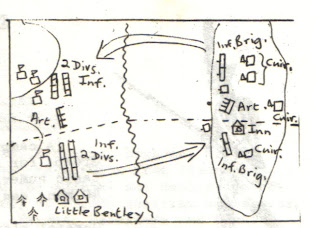
Gambling on the militia not standing up to determined bayonet charges, (Militia throw 2 dice for morale when charged, need 5 or 6, choosing highest dice thrown. Line throw 3 dice, Elite troops 4. 1 dice deducted for disorder per 2%> loss, etc.), the French planned to hold the road area with half the army, sending the other half to attack the English left strongly. Unfortunately the English had most of their regular rifles on this wing, and much energy and manpower had to be expended on simply destroying that one unit. The French advanced half a mile, the English masses falling back as the militia failed to stand when charged by the French cavalry. The English brought over a regiment of Guard infantry to stop the rot, and the French just hadn't the numbers to extend further. They began to withdraw across the brook towards 1.30 p.m. after 1½ hours fighting (8 moves) with the satisfaction of having outshot the English Guard into routing temporarily, and swinging a cuirassier regiment left to ride down an English Line infantry unit near the Inn which had already been gutted by musketry from the Inn defenders. The English right wing had made good progress towards the French ridge, but then had most of their first line of militia regiments flattened and broken by the superior musketry of the French regulars. (For firing, throw one average dice per 9 front rank regulars or 12 militia or other second-grade troops). The second line retired to the Little Bentley position to await the Cambridge army, having the satisfaction of halting the French advance on Colchester and London. The French, with only one infantry regiment still in good fighting trim, withdrew to Harwich to join with the Lowestoft column now crossing the estuary in small craft(evening of 13th).
Almost a third of the French were casualties after this bloodbath, whilst of the English only 8,100 out of the 13,000 were still with the colours at nightfall.
Battle of Harwich, May 14th.
The next morning the English, reinforced by the Cambridge army to nearly 16,000 strong, attacked at dawn to avoid excessive casualties in the approach to the French lines over the very open isthmus - open apart from a few sandpits affording slight cover.
The French, amounting to about 9,000 but of which 2,000 were cavalry, had planned to tempt the English into an attack on the south-east sector, whereupon the French right wing would have swung round and tried to drive the English towards the sea coast.
But due to subordinates' mistakes, the two Young Guard brigades were stationed nearer the centre than the plan had intended, and this confused French reactions when the English surprised them by instead attacking in great force along the estuary shore, straight for Harwich, with a subsidiary thrust at the centre. The massed French field guns for half an hour cut down masses of the leading English assault line, but it was obvious that the English were going to break through at the estuary unless something were done quickly to bring French infantry over from the seacoast side. The situation was serious, as the English had cleverly kept ¾ mile gap clear between their two wings, and 36 cannon were firing with deadly accuracy down this lane.
The French ordered their own infantry to abandon the redoubt and the whole sea-coast sector, and to march at full speed towards the French grand battery, one regiment going straight along the beach to Harwich. To cover this move, the French Hussars and two regiments of cuirassiers were thrown-in against the smaller English assault force. The Hussars routed and practically wiped out some heavy dragoons before being cut down or captured by three light cavalry units, one cuirassier regiment caught a Guard infantry unit in disorder just after an infantry melee and routed them with loss. The remaining cuirassier unit broke two English line infantry units and although it was in the end also swamped by English reserves, the English advance had been held up just long enough to allow a good deal o£ the French infantry to disengage.
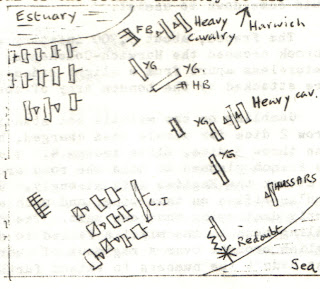
The English main attack had meanwhile reached the French gun line, which succeeded in beating off only the first two waves, having to limber up to avoid being overrun by the 3rd and 4th English lines. On this sector the French used infantry to gain time, the 1st Voltigeurs having a whole battalion engulfed and captured in the process. The English brought up two heavy dragoon regiments and decided the day. They rushed the French horse batteries, which broke, and one went on to hit a fresh Young ;Guard regiment just arrived in disorder after a hurried march from the seacoast side. This did not break, but was too disordered to stop the cavalry, (units in disorder have only half the normal melee points value. So in this case 24 Young Guard at 1¼ points each = 30 points, fought 10 heavy dragoons at 5 points each = 50 points), and was driven back.
Covered by counter-charges by the cuirassier brigade supporting the guns, the French poured back in disorder to Harwich. The two horse batteries could not be recovered, and the 16th Line could not get back to the town through the throng of hostile cavalry and light infantry, bringing the total of prisoners taken by the English to 640 cavalry and 1,440 infantry.
Three cuirassier regiments and two Young Guard regiments still in a good fighting state took up position in the outskirts, and, together with the guns which had been rescued from the pursuing English, checked pursuit for a short time. The English guns were far to the rear.
At first the general in charge thought of digging in to try and hold Harwich, as a base near London, but further orders came in by frigate during the day with fuller information as to just how heavily he was outnumbered by the English armies defending London from the North, and ordering him to embark and abandon the port. The last companies of tirailleurs left the docks in the late afternoon, under fire from the converging English riflemen.
So the English, at the cost of not much more than 1,500 killed, had achieved a decisive victory, leaving their London army free to return to base. The French had been lucky in saving any of their army, against such odds.
General situation prior to the East Coast landings
French strategy during the first ten days or so of the campaign was based on the natural assumption that the English would concentrate most of their forces (about 26,000 regular infantry, 4,800 cavalry, 90 guns) in the London area, or within easy reach. In fact the English had decided to divide their regulars into four small equal armies: one in the South-West, one near Portsmouth, one near London, one in reserve near Reading, and to employ a strategy of immediate counter-attack on all landings. In this way it was hoped to keep the French well away from the key naval bases, and prevent them from building up overwhelming strength in any one region.
The French, with far more regulars available, about 34,000 Line, 4,800 Young Guard and 6,000 cavalry, but limited in shipping, consequently found it difficult to obtain any foothold at first. They landed in small scattered groups which were easily dealt with. Their general plan, to create multiple diversions in the West and Wales and then land in East Anglia with the elite troops, largely failed at first, as the English had massed their militia regiments (one per county) within two or three days of the first May 1st landings into small local reserve armies of about four regiments each. These, appearing unexpectedly from directions different from the English regular armies, bewildered the French strategists as to the English strategic intentions.
For a long time, the French were seldom able to hold an area long enough to raise regiments of Republican sympathisers. It needed about 48 hours in undisputed control of the greater part of a county to muster and equip one such unit.
French Landing on the East Coast, May 10th and 12th.
The second stage of the French invasion began on the 10th with four ships landing a regiment of infantry (960 men) with supporting cavalry and field guns, at Lowestoft. The British reacted at first by sending a reserve army of regulars from Cambridge towards the invasion, and a mixed militia-regular army started out from London, hoping to meet the invaders or any others before Ipswich.
The Lowestoft landing was in fact only a bait, as on the morning of May 12th 4,800 Young Guard supported by 1,600 heavy cavalry and some guns and Line infantry landed at Harwich, and proceeded to march on Colchester next day. The Cambridge army was slightly delayed in reacting, owing to starting for Lowestoft, but the London army, coming leisurely up the main road, had plenty of time to change its plan, swung right at Colchester, and deployed to check the Young Guard until the Cambridge force could come down to assist.
The French, about 5,700 infantry with 1,600 cavalry, deployed just East of where a brook crossed the Harwich-Colchester road near Little Bentley. The ground was featureless apart from a slight ridge on either side of the brook. Here the French were attacked by the London army of about 7,000 regulars and 6,000 militia!
Gambling on the militia not standing up to determined bayonet charges, (Militia throw 2 dice for morale when charged, need 5 or 6, choosing highest dice thrown. Line throw 3 dice, Elite troops 4. 1 dice deducted for disorder per 2%> loss, etc.), the French planned to hold the road area with half the army, sending the other half to attack the English left strongly. Unfortunately the English had most of their regular rifles on this wing, and much energy and manpower had to be expended on simply destroying that one unit. The French advanced half a mile, the English masses falling back as the militia failed to stand when charged by the French cavalry. The English brought over a regiment of Guard infantry to stop the rot, and the French just hadn't the numbers to extend further. They began to withdraw across the brook towards 1.30 p.m. after 1½ hours fighting (8 moves) with the satisfaction of having outshot the English Guard into routing temporarily, and swinging a cuirassier regiment left to ride down an English Line infantry unit near the Inn which had already been gutted by musketry from the Inn defenders. The English right wing had made good progress towards the French ridge, but then had most of their first line of militia regiments flattened and broken by the superior musketry of the French regulars. (For firing, throw one average dice per 9 front rank regulars or 12 militia or other second-grade troops). The second line retired to the Little Bentley position to await the Cambridge army, having the satisfaction of halting the French advance on Colchester and London. The French, with only one infantry regiment still in good fighting trim, withdrew to Harwich to join with the Lowestoft column now crossing the estuary in small craft(evening of 13th).
Almost a third of the French were casualties after this bloodbath, whilst of the English only 8,100 out of the 13,000 were still with the colours at nightfall.
Battle of Harwich, May 14th.
The next morning the English, reinforced by the Cambridge army to nearly 16,000 strong, attacked at dawn to avoid excessive casualties in the approach to the French lines over the very open isthmus - open apart from a few sandpits affording slight cover.
The French, amounting to about 9,000 but of which 2,000 were cavalry, had planned to tempt the English into an attack on the south-east sector, whereupon the French right wing would have swung round and tried to drive the English towards the sea coast.
But due to subordinates' mistakes, the two Young Guard brigades were stationed nearer the centre than the plan had intended, and this confused French reactions when the English surprised them by instead attacking in great force along the estuary shore, straight for Harwich, with a subsidiary thrust at the centre. The massed French field guns for half an hour cut down masses of the leading English assault line, but it was obvious that the English were going to break through at the estuary unless something were done quickly to bring French infantry over from the seacoast side. The situation was serious, as the English had cleverly kept ¾ mile gap clear between their two wings, and 36 cannon were firing with deadly accuracy down this lane.
The French ordered their own infantry to abandon the redoubt and the whole sea-coast sector, and to march at full speed towards the French grand battery, one regiment going straight along the beach to Harwich. To cover this move, the French Hussars and two regiments of cuirassiers were thrown-in against the smaller English assault force. The Hussars routed and practically wiped out some heavy dragoons before being cut down or captured by three light cavalry units, one cuirassier regiment caught a Guard infantry unit in disorder just after an infantry melee and routed them with loss. The remaining cuirassier unit broke two English line infantry units and although it was in the end also swamped by English reserves, the English advance had been held up just long enough to allow a good deal o£ the French infantry to disengage.
The English main attack had meanwhile reached the French gun line, which succeeded in beating off only the first two waves, having to limber up to avoid being overrun by the 3rd and 4th English lines. On this sector the French used infantry to gain time, the 1st Voltigeurs having a whole battalion engulfed and captured in the process. The English brought up two heavy dragoon regiments and decided the day. They rushed the French horse batteries, which broke, and one went on to hit a fresh Young ;Guard regiment just arrived in disorder after a hurried march from the seacoast side. This did not break, but was too disordered to stop the cavalry, (units in disorder have only half the normal melee points value. So in this case 24 Young Guard at 1¼ points each = 30 points, fought 10 heavy dragoons at 5 points each = 50 points), and was driven back.
Covered by counter-charges by the cuirassier brigade supporting the guns, the French poured back in disorder to Harwich. The two horse batteries could not be recovered, and the 16th Line could not get back to the town through the throng of hostile cavalry and light infantry, bringing the total of prisoners taken by the English to 640 cavalry and 1,440 infantry.
Three cuirassier regiments and two Young Guard regiments still in a good fighting state took up position in the outskirts, and, together with the guns which had been rescued from the pursuing English, checked pursuit for a short time. The English guns were far to the rear.
At first the general in charge thought of digging in to try and hold Harwich, as a base near London, but further orders came in by frigate during the day with fuller information as to just how heavily he was outnumbered by the English armies defending London from the North, and ordering him to embark and abandon the port. The last companies of tirailleurs left the docks in the late afternoon, under fire from the converging English riflemen.
So the English, at the cost of not much more than 1,500 killed, had achieved a decisive victory, leaving their London army free to return to base. The French had been lucky in saving any of their army, against such odds.
Monday, 25 May 2009
New Posts
After a decent interval, I have posted up the second parts of three series: Neil Cogswell's Bombar Succession, Don Houghton's At the Colonel's Table, and Harold Gerry's French Invasion of 1810. For general interest I have added a brief profile of Terry Wise and an account of Joe Morschauser's visit to Southampton in 1964.
The French Invasion of 1810, by Harold Gerry, part 2
At Exeter, then in the afternoon of May 4th, the French deployed just to the east of the town, about 6,400 men with their 4 batteries massed centrally; the weaker of their light cavalry regiments guarding the minor bridge over the river about a mile to the north (this regiment played no part in the battle and is not included in the above numbers). The bridge and some houses were mined in readiness. Here the French were vigorously attacked at about 6.30 p.m. by just over 8,000 British with 3 batteries, under one of the divisional commanders General J.Cruickshank, in the absence of Major-General Popkess on other business.

The French were relying on the fairly open ground near the town to cause heavy losses to the British with gunfire. The four batteries had a clear field of fire from the ridge on the town edge. The British decided to move in wide arcs round the French flanks, so that the French could not decisively deal with both attacks at once, and to link the two attacks only with a squadron of heavy cavalry and a Guards regiment in the centre. They kept their inferior batteries screened behind their left wing attack until they got within range of the French big guns.
The French guns concentrated in the meantime on this left wing infantry, causing over 400 casualties, mainly among militia. Then the British guns began firing on the French guns, and the two largely cancelled each other out until nearly dusk.
When the British left got close enough, the French right attacked, cavalry circling round along the road. A much-battered militia unit actually beat off a cuirassier attack, but the light infantry broke when charged by Saxon light dragoons, and the rout carried away another militia unit. The dragoons cut down large numbers of fugitives, and only halted at nightfall. Meanwhile the cuirassiers recovered, and this time routed both the battered militia infantry which had been their first target, and then a line regiment. So the French had carried all before them on this wing, except along the river, where a British Line infantry regiment broke first the French Light infantry and then their supporting Line. The southern half of the town was jammed with French fugitives just as darkness came down.
The British right wing attack meanwhile had circled cautiously well away from the grand battery, leaving their attack almost too late in fact. The infantry went in first, but were immediately charged by one French infantry regiment and routed. So, about ten minutes from nightfall, it seemed that the French had won a notable victory all round. Then came sudden disaster. The British desperately flung in both Household cavalry regiments in a last attempt. The French infantry stood the charge, but were borne down in the melee by the weight of the heavies, and routed back into Exeter. Supporting companies in the houses discouraged British pursuit to some extent, but Guards infantry were now in the outskirts. Calling his own cavalry back from pursuit, Ney brought his rearguard over the bridge and abandoned the main part of the town, blowing the bridge behind him.
So the Exeter area remained disputed, although the British had at least the satisfaction of clearing the east side of the river. The French had the satisfaction of inflicting 1,200 casualties on the British for the loss of 480. The British began probing for a way round the Exeter area.
Relief of Plymouth and fall of Taunton (May 5th-9th).
Before dawn on 5th May, the main bulk of the English (Exeter) western army marched round the flank of the French to get on to the west bank of the Exe, leaving two militia regiments and artillery as a screen in the city and along the river. They advanced half-way across Devon during the 5th and 6th, sending a strong flying column ahead which met and chased back (into Launceston), a French force of about 2 regiments which was marching to reinforce the Exeter French. The single regiment of French watching Plymouth hastily draw back over the Tamar, and the flying column dropped a further regiment into Plymouth to strengthen the garrison, itself returning to Exeter, where the western army re-assembled on the 8th, to find that on the 7th the French had cautiously pushed across the river and driven the 2 militia rearguard units back along the Taunton road. On the 9th the English marched 24 miles to Wellington, and halted there about 4 p.m. when they heard that an hour earlier the French had driven the garrison from Taunton in a brisk action.
A force of 3 South Midlands militia infantry and 1 cavalry regiment had force-marched from Bristol to join the militia retreating from Exeter. The town was just over half-fortified, quite open along the river. The French laid down a heavy artillery barrage on the isolated westernmost redoubt and went straight into the attack.

The light redoubt guns began to lose crewmen quickly, the English withdrew them to the bridge and held up the French beyond the river for half an hour. Three English regiments had crossed the river originally to try and beat the detached French before they could be helped from the main force, but came back and through the town at about 2 p.m. (action started at 1 p.m.) when it became obvious that the main French attack was going to succeed, and that the extreme French right wing was not only the weak part of the French army but lay on the best line of retreat for the militia, towards Lyme Regis and Dorchester. So whilst the Somerset militia (already battered at Exeter on the 4th), held the defences between the Wellington and Lyme roads, all the rest of the garrison sallied out through the Lyme and Bristol exits and attacked the French right. The leading regiment ran into a storm of roundshot from horse batteries and suffered from light infantry harassing, and broke, but the remainder swept down in column, routed the French horse guns and a light infantry battalion off the field, and made the Devon republican battalion run. Luck ran with the English militia, and just deserted the French in this last part of the action. So the English escaped south to the Hatch Beauchamp Woods, and the French occupied Taunton.
The militia lost 960 casualties, the French 360, out of about 4,800 and 7,000 strengths respectively.
The French were relying on the fairly open ground near the town to cause heavy losses to the British with gunfire. The four batteries had a clear field of fire from the ridge on the town edge. The British decided to move in wide arcs round the French flanks, so that the French could not decisively deal with both attacks at once, and to link the two attacks only with a squadron of heavy cavalry and a Guards regiment in the centre. They kept their inferior batteries screened behind their left wing attack until they got within range of the French big guns.
The French guns concentrated in the meantime on this left wing infantry, causing over 400 casualties, mainly among militia. Then the British guns began firing on the French guns, and the two largely cancelled each other out until nearly dusk.
When the British left got close enough, the French right attacked, cavalry circling round along the road. A much-battered militia unit actually beat off a cuirassier attack, but the light infantry broke when charged by Saxon light dragoons, and the rout carried away another militia unit. The dragoons cut down large numbers of fugitives, and only halted at nightfall. Meanwhile the cuirassiers recovered, and this time routed both the battered militia infantry which had been their first target, and then a line regiment. So the French had carried all before them on this wing, except along the river, where a British Line infantry regiment broke first the French Light infantry and then their supporting Line. The southern half of the town was jammed with French fugitives just as darkness came down.
The British right wing attack meanwhile had circled cautiously well away from the grand battery, leaving their attack almost too late in fact. The infantry went in first, but were immediately charged by one French infantry regiment and routed. So, about ten minutes from nightfall, it seemed that the French had won a notable victory all round. Then came sudden disaster. The British desperately flung in both Household cavalry regiments in a last attempt. The French infantry stood the charge, but were borne down in the melee by the weight of the heavies, and routed back into Exeter. Supporting companies in the houses discouraged British pursuit to some extent, but Guards infantry were now in the outskirts. Calling his own cavalry back from pursuit, Ney brought his rearguard over the bridge and abandoned the main part of the town, blowing the bridge behind him.
So the Exeter area remained disputed, although the British had at least the satisfaction of clearing the east side of the river. The French had the satisfaction of inflicting 1,200 casualties on the British for the loss of 480. The British began probing for a way round the Exeter area.
Relief of Plymouth and fall of Taunton (May 5th-9th).
Before dawn on 5th May, the main bulk of the English (Exeter) western army marched round the flank of the French to get on to the west bank of the Exe, leaving two militia regiments and artillery as a screen in the city and along the river. They advanced half-way across Devon during the 5th and 6th, sending a strong flying column ahead which met and chased back (into Launceston), a French force of about 2 regiments which was marching to reinforce the Exeter French. The single regiment of French watching Plymouth hastily draw back over the Tamar, and the flying column dropped a further regiment into Plymouth to strengthen the garrison, itself returning to Exeter, where the western army re-assembled on the 8th, to find that on the 7th the French had cautiously pushed across the river and driven the 2 militia rearguard units back along the Taunton road. On the 9th the English marched 24 miles to Wellington, and halted there about 4 p.m. when they heard that an hour earlier the French had driven the garrison from Taunton in a brisk action.
A force of 3 South Midlands militia infantry and 1 cavalry regiment had force-marched from Bristol to join the militia retreating from Exeter. The town was just over half-fortified, quite open along the river. The French laid down a heavy artillery barrage on the isolated westernmost redoubt and went straight into the attack.
The light redoubt guns began to lose crewmen quickly, the English withdrew them to the bridge and held up the French beyond the river for half an hour. Three English regiments had crossed the river originally to try and beat the detached French before they could be helped from the main force, but came back and through the town at about 2 p.m. (action started at 1 p.m.) when it became obvious that the main French attack was going to succeed, and that the extreme French right wing was not only the weak part of the French army but lay on the best line of retreat for the militia, towards Lyme Regis and Dorchester. So whilst the Somerset militia (already battered at Exeter on the 4th), held the defences between the Wellington and Lyme roads, all the rest of the garrison sallied out through the Lyme and Bristol exits and attacked the French right. The leading regiment ran into a storm of roundshot from horse batteries and suffered from light infantry harassing, and broke, but the remainder swept down in column, routed the French horse guns and a light infantry battalion off the field, and made the Devon republican battalion run. Luck ran with the English militia, and just deserted the French in this last part of the action. So the English escaped south to the Hatch Beauchamp Woods, and the French occupied Taunton.
The militia lost 960 casualties, the French 360, out of about 4,800 and 7,000 strengths respectively.
Wednesday, 8 April 2009
The French Invasion of 1810, by Harold Gerry, part 1: Wargamer's Newsletter #99 June 1970
Heavily damaged in an unparalleled hurricane, the English Channel Fleet (greatly reduced in numbers) has entered Plymouth, Portsmouth and Chatham to refit. This will take about 4 weeks.
The French, using what forces they have available on the coast, have decided to carry out an improvised invasion, with the general idea of doing as much damage as possible and, if luck favours them, of forcing England to sue for peace.
Caught unprepared, the French are severely limited as regards transports. They have no idea where the British forces are deployed as a result of the new situation. On the other hand, they will have the initial advantage of having better-trained troops.
French objectives:
a. to capture at least one portion of the Fleet or destroy its dockyard.
b. take London (in which case Government must sue for peace, ceding Kent, Surrey and Sussex to France to be set up as a Southern Confederation Republic).
c. to clear the maximum number of counties of their defending troops, to allow Republican sympathisers to come forward, form volunteer regiments, and set up puppet government centres.
English objectives:
1. to defeat invasion forces.
2. to save the refitting fleet.
3. to hold London
(From earlier attempts at campaigns, it seemed that a vital aim should be to spread the objectives, so that neither side could win unrealistically by simply mass¬ing everything in one area (ignoring everywhere else) and having one huge Leipzig-type battle. Hence the idea of having the English fleet split up and the bait held out to the French in the form of raising Republican regiments. We then built in re¬wards for resting units, and penalties for charging about too far and too continually - a common fault in wargaming campaigns.
The French will have 20 transports initially operating from Brest, 5 in Boulogne and 5 in Dunkirk. Each transport holds 12 infantry figures (480 men) OR 5 cavalry OR 2 field batteries OR 1 siege battery.
The first landings will be assumed to occur on May 1st, 1810, thereafter ship movements will be calculated as 60 miles a day with one day lost either loading or unloading. Beach landings are not possible. Landings must be at recognised harbours, likewise embarkations. French cannot land in the Thames estuary between Harwich and Whitstable exclusive (because of shoals).
Forces available will be those owned at beginning of campaign by the players. In addition, both sides are assumed to be well supplied with engineers except in yeomanry-only armies, and each side will have 2 siege batteries (not replaceable) positions of which and movements of which will have to be specified initially. Also any corps of more than 200 figures of all arms will be assumed to have basic bridging.
1 figure = 40 men. Regulars initially - French 1,000+; British 750+.
Naval warfare will be disregarded for the four-week period. At the end of this, if the English have two fleets ready in undamaged dockyards (the 3 dockyards are fortified and cannot be taken by direct assault) rules will be agreed regarding poss¬ible actions at sea taking into account the weather, etc. It is assumed that the available French fleet is sufficient to defeat one section only of the English
Suggested Movement Procedure: (12-hr, day).
Movement 3 miles per hour on roads (only roads marked red existed in 1810), half-speed across country. Siege trains 2 miles per hour.
For each county they occupy (territory behind their front line, at least ⅔ of way across country) the French can also raise one regiment of Republican Volunteers. 2 dice, 1½ points.
The English can have one yeomanry regiment (infantry or cavalry) per county. These will require over a day to assemble and equip, SO can only start out on the morning of the second day of the campaign.
Losses.
After any battle, three-quarters of the casualties return to colours next morning.
One quarter of losers casualties are prisoners, and permanently lost, if the winner outnumbers loser more than 5 to 3 in cavalry points.
Apart from prisoners, all casualties are replaced automatically if a unit is rested for 2 weeks in camp or billets.
Movement in excess of an average of 18 miles a day will require 1 halt day after every 3.
Any unit moving for more than 8 hours in any one day will drop to ⅔ speed if in action in the next 24 hours.
Magazines and Communications.
British will be based OD magazines (for powder and shot etc., food being no problem in S. England) at Colchester, Bedford, Maidstone, Aldershot, Salisbury, Taunton, Plymouth, Gloucester. Armies can operate up to 50 miles from a magazine, so the loss of any of these will mean the withdrawal of the army based thereon from the area affected.
The French will be based on their initial captured bases, and will establish magazines as they move inland, each to cover a forward area of about 50 miles.
Raids against communications (bridges etc.,) can be disregarded, although players who are ahead of schedule on their main battles and have to wait until actions are fought in other parts of the country can blow-up actions against outposts, crossroads into table battles on almost a man-for-man basis. The only parts of lines of communication which will have to have a. specific garrison allotted (besides magazines of course) are pontoon bridges over very wide rivers such as the Thames below Oxford or the Severn below Worcester.
News
As both sides will be supplied with news from informers, players should notify their opponent in advance of the forces likely to be acting against him in that area. To represent layman's exaggeration, he may exaggerate +25% or under-estimate by up to -25% if he wishes.
Fortifications and sieges
Localities can be fortified with a redoubt every ½ mile plus linking entrenchments at the following rate: 1 day per 250 yard frontage.
To avoid siege complications, it can be assumed that a garrison in fortifications can hold off up to twice its strength in attackers indefinitely. Both sides can be assumed to have a supply of light cannon (for defensive use in redoubts etc) which need not be deducted from the army's artillery numbers. Garrison should be at least 1 man per 2 yds of frontage.
Siege battery can destroy 1 redoubt and 100yds trench/glacis at each side in 3 days. The fortified town is then summoned. Defender can elect to march away with honours of war to own territory. If he does not, attacks on breach can be represented by each side throwing 1 dice per infantry battalion or cavalry regiment or field/siege battery. Side with highest total on all dice wins. Attackers losing throw twice in succession raise the siege. Defenders losing once are made prisoner.
Fortifications can be destroyed at the sane rate as they are built.
The initial stage of the French invasion of Britain was not at all the British expected it to be. Instead of one, or maybe two massive landings, the French landed four very small forces and only one medium-sized army, the latter at Lyme Regis. Three forces landed along the Welsh coast of the Bristol Channel , and it is convenient to discuss these first, as their activities were over on day 5.
A Dragoon regiment was split to land half at Pembroke harbour and half at Swansea with the aim of sweeping quickly through the nearest counties and raising rebel regi¬ments. At Pembroke the Dragoons, on emerging from the harbour area in the afternoon when they had partly rested their horses after the sea crossing, ran into the local militia cavalry regiment, which had been ordered to muster at that very town A sharp fight followed for half an hour, the better French training carrying all before it at first, but in the end succumbing to sheer numbers. 120 unwounded men out of 200 managed to regain their ships, to return to France.
The Swansea ½ regiment of French swept inland but had similar bad luck, their line of march taking them into the scouting area of a militia force assembling at Llandovery, and the militia set off in pursuit as the French fled towards Monmouth to try and rejoin the main landing under Marshal Augereau, due to reach Monmouth about that time. So the Dragoons were unable to halt and raise the local Republicans effectively. Glamorgan rebels did begin to muster, but these were overwhelmed by the pursuing militia without a fight, and sent to prison camps at St. Kilda.
However, the Swansea French did succeed in reaching Monmouth, and with these 200 cavalry and his own 960 infantry and two batteries Augereau took up a good position just north of Monmouth in the afternoon of May 5th to try and hold off an army of 800 cavalry (militia) and 2,880 militia infantry which were reported advancing down from Ross on Wye. For unwittingly, the Paris staff had sent Augereau exactly in the direction of the most effective militia concentration in the West Midlands, which was complete by May 4th just as Augereau was approaching.
The French batteries and infantry deployed on the end of a steep ridge which ex¬tended roughly West-East to about ¾ mile from the river Wye, the cavalry in reserve. The English infantry had to advance over open country at first, and the batteries in half an hour had killed or wounded 280 men, with no loss to the French, as the militia had no cannon. But Augereau then began to be apprehensive about a turning moving further along the ridge by the English cavalry, and swung one battery and much of his infantry to face these. So just at the point when they might have been deluged with grape, the militia were able to climb the slopes with quite tolerable losses. The militia cavalry swung round behind the French, and Augereau decided the ridge was untenable. The French fought well, but the militia infantry, wisely keeping at long range, used their indifferent musketry to steady effect. The French cavalry were routed towards Monmouth by the militia cavalry, but the batteries beat off the latter before losing half their gunners to the militia infantry. One French battalion struggled back into Monmouth, the remaining gunners abandoning their guns as the English swept in behind them. English cavalry blocked the South end of the streets, infantry came in from the North, and French resistance came to an end. Augereau escaped with some officers and got away from the coast in a fishing boat, but all his army was captured or killed. The main action lasted 1½ hours.Two standards and two batteries fell into the hands of the English.
In Cornwall, a French force of about 1,800 men of all arms landed at Falmouth, and moved across Cornwall unhindered, raised a Republican regiment at Launceston on May 5th, and moved onwards towards Tavistock on May 6th, joined by the half-regiment of cavalry which had managed to escape from Pembroke some days earlier. Launceston was set up as a magazine for further penetration into Devon, and fortification begun. A messenger got through from Ney's force retiring from Taunton to Exeter, to say they were hoping to hold Exeter long enough to allow the Falmouth force to do what they wished in Devon.
This possible stroke of luck for the Falmouth force had come about as follows: a main force of 4,800 infantry, 1,300 cavalry and 24 guns under Marshal Ney had land¬ed at Lyme Regis at dawn on the 1st May, and pushed inland rapidly next day, to find their way to Taunton blocked (about 4 miles from that town), by an English army of about the same size although including both Guard and militia units, in an awkward position at Hatch Beauchamp where some woods straddled the road. In Ney's absence owing to illness (brought on by squabbling with his Saxon corps commander von Munchausen), on the morning of May 3rd von Munchausen led his force in a flanking march against the extreme right of the English position. The English hastily brought their centre and left through and behind the woods, but in the meanwhile lost a third of their batteries under skillfully concentrated counter-battery fire from the Saxon guns. Now outgunned by 2 to 1, the English decided to draw back about ¾ mile and await the arrival of a flying column sent from Salisbury to assist the Taunton force, and which was already within 5 miles. Casualties amounted to about 800 each, including 200 dead. On the arrival of this force in his rear, von Munchausen led his troops across to the main Taunton-Exeter road through Wellington, where they halted until dawn on May 4th. The English pursuit did not overtake them on May 4th either, and the French/ Saxons reached the eastern edge of Exeter in the late afternoon.
(It should be interposed here that this French force was originally intended to march north from Taunton and link up with a landing at Avonmouth which took place on May 3rd. Of course this proved impossible owing to the way in which the French were heavily outnumbered in the Taunton area, and the Avonmouth force, unsupported, failed to establish any permanent bridge head. The day after they landed, some militia regiments were due to march through Bristol on their way South, and these pushed the one French regiment back into Avonmouth and then with great determination broke through the French entrenchments round the village, taking about 800 casualties. The French kept back much of their force in the streets for counter-attacks instead of manning the trenches fully, and the militia were able to outshoot the units in the trenches and make them break. One battalion of the French barricaded themselves in the docks and held out until dawn on May 7th when, no ships appearing from France, they embarked on some of the local vessels and made their way down the coast to Falmouth after vainly trying to contact French units in Wales. They reached Falmouth on May 10th. Losses (killed only) 120 men out of the 960).
The further instalments of this series will appear here in due course.
Those interested in campaign systems for the Napoleonic period may be interested in following Paul Leniston's Napoleonic Wargaming blog.
The French, using what forces they have available on the coast, have decided to carry out an improvised invasion, with the general idea of doing as much damage as possible and, if luck favours them, of forcing England to sue for peace.
Caught unprepared, the French are severely limited as regards transports. They have no idea where the British forces are deployed as a result of the new situation. On the other hand, they will have the initial advantage of having better-trained troops.
French objectives:
a. to capture at least one portion of the Fleet or destroy its dockyard.
b. take London (in which case Government must sue for peace, ceding Kent, Surrey and Sussex to France to be set up as a Southern Confederation Republic).
c. to clear the maximum number of counties of their defending troops, to allow Republican sympathisers to come forward, form volunteer regiments, and set up puppet government centres.
English objectives:
1. to defeat invasion forces.
2. to save the refitting fleet.
3. to hold London
(From earlier attempts at campaigns, it seemed that a vital aim should be to spread the objectives, so that neither side could win unrealistically by simply mass¬ing everything in one area (ignoring everywhere else) and having one huge Leipzig-type battle. Hence the idea of having the English fleet split up and the bait held out to the French in the form of raising Republican regiments. We then built in re¬wards for resting units, and penalties for charging about too far and too continually - a common fault in wargaming campaigns.
The French will have 20 transports initially operating from Brest, 5 in Boulogne and 5 in Dunkirk. Each transport holds 12 infantry figures (480 men) OR 5 cavalry OR 2 field batteries OR 1 siege battery.
The first landings will be assumed to occur on May 1st, 1810, thereafter ship movements will be calculated as 60 miles a day with one day lost either loading or unloading. Beach landings are not possible. Landings must be at recognised harbours, likewise embarkations. French cannot land in the Thames estuary between Harwich and Whitstable exclusive (because of shoals).
Forces available will be those owned at beginning of campaign by the players. In addition, both sides are assumed to be well supplied with engineers except in yeomanry-only armies, and each side will have 2 siege batteries (not replaceable) positions of which and movements of which will have to be specified initially. Also any corps of more than 200 figures of all arms will be assumed to have basic bridging.
1 figure = 40 men. Regulars initially - French 1,000+; British 750+.
Naval warfare will be disregarded for the four-week period. At the end of this, if the English have two fleets ready in undamaged dockyards (the 3 dockyards are fortified and cannot be taken by direct assault) rules will be agreed regarding poss¬ible actions at sea taking into account the weather, etc. It is assumed that the available French fleet is sufficient to defeat one section only of the English
Suggested Movement Procedure: (12-hr, day).
Movement 3 miles per hour on roads (only roads marked red existed in 1810), half-speed across country. Siege trains 2 miles per hour.
For each county they occupy (territory behind their front line, at least ⅔ of way across country) the French can also raise one regiment of Republican Volunteers. 2 dice, 1½ points.
The English can have one yeomanry regiment (infantry or cavalry) per county. These will require over a day to assemble and equip, SO can only start out on the morning of the second day of the campaign.
Losses.
After any battle, three-quarters of the casualties return to colours next morning.
One quarter of losers casualties are prisoners, and permanently lost, if the winner outnumbers loser more than 5 to 3 in cavalry points.
Apart from prisoners, all casualties are replaced automatically if a unit is rested for 2 weeks in camp or billets.
Movement in excess of an average of 18 miles a day will require 1 halt day after every 3.
Any unit moving for more than 8 hours in any one day will drop to ⅔ speed if in action in the next 24 hours.
Magazines and Communications.
British will be based OD magazines (for powder and shot etc., food being no problem in S. England) at Colchester, Bedford, Maidstone, Aldershot, Salisbury, Taunton, Plymouth, Gloucester. Armies can operate up to 50 miles from a magazine, so the loss of any of these will mean the withdrawal of the army based thereon from the area affected.
The French will be based on their initial captured bases, and will establish magazines as they move inland, each to cover a forward area of about 50 miles.
Raids against communications (bridges etc.,) can be disregarded, although players who are ahead of schedule on their main battles and have to wait until actions are fought in other parts of the country can blow-up actions against outposts, crossroads into table battles on almost a man-for-man basis. The only parts of lines of communication which will have to have a. specific garrison allotted (besides magazines of course) are pontoon bridges over very wide rivers such as the Thames below Oxford or the Severn below Worcester.
News
As both sides will be supplied with news from informers, players should notify their opponent in advance of the forces likely to be acting against him in that area. To represent layman's exaggeration, he may exaggerate +25% or under-estimate by up to -25% if he wishes.
Fortifications and sieges
Localities can be fortified with a redoubt every ½ mile plus linking entrenchments at the following rate: 1 day per 250 yard frontage.
To avoid siege complications, it can be assumed that a garrison in fortifications can hold off up to twice its strength in attackers indefinitely. Both sides can be assumed to have a supply of light cannon (for defensive use in redoubts etc) which need not be deducted from the army's artillery numbers. Garrison should be at least 1 man per 2 yds of frontage.
Siege battery can destroy 1 redoubt and 100yds trench/glacis at each side in 3 days. The fortified town is then summoned. Defender can elect to march away with honours of war to own territory. If he does not, attacks on breach can be represented by each side throwing 1 dice per infantry battalion or cavalry regiment or field/siege battery. Side with highest total on all dice wins. Attackers losing throw twice in succession raise the siege. Defenders losing once are made prisoner.
Fortifications can be destroyed at the sane rate as they are built.
The initial stage of the French invasion of Britain was not at all the British expected it to be. Instead of one, or maybe two massive landings, the French landed four very small forces and only one medium-sized army, the latter at Lyme Regis. Three forces landed along the Welsh coast of the Bristol Channel , and it is convenient to discuss these first, as their activities were over on day 5.
A Dragoon regiment was split to land half at Pembroke harbour and half at Swansea with the aim of sweeping quickly through the nearest counties and raising rebel regi¬ments. At Pembroke the Dragoons, on emerging from the harbour area in the afternoon when they had partly rested their horses after the sea crossing, ran into the local militia cavalry regiment, which had been ordered to muster at that very town A sharp fight followed for half an hour, the better French training carrying all before it at first, but in the end succumbing to sheer numbers. 120 unwounded men out of 200 managed to regain their ships, to return to France.
The Swansea ½ regiment of French swept inland but had similar bad luck, their line of march taking them into the scouting area of a militia force assembling at Llandovery, and the militia set off in pursuit as the French fled towards Monmouth to try and rejoin the main landing under Marshal Augereau, due to reach Monmouth about that time. So the Dragoons were unable to halt and raise the local Republicans effectively. Glamorgan rebels did begin to muster, but these were overwhelmed by the pursuing militia without a fight, and sent to prison camps at St. Kilda.
However, the Swansea French did succeed in reaching Monmouth, and with these 200 cavalry and his own 960 infantry and two batteries Augereau took up a good position just north of Monmouth in the afternoon of May 5th to try and hold off an army of 800 cavalry (militia) and 2,880 militia infantry which were reported advancing down from Ross on Wye. For unwittingly, the Paris staff had sent Augereau exactly in the direction of the most effective militia concentration in the West Midlands, which was complete by May 4th just as Augereau was approaching.
The French batteries and infantry deployed on the end of a steep ridge which ex¬tended roughly West-East to about ¾ mile from the river Wye, the cavalry in reserve. The English infantry had to advance over open country at first, and the batteries in half an hour had killed or wounded 280 men, with no loss to the French, as the militia had no cannon. But Augereau then began to be apprehensive about a turning moving further along the ridge by the English cavalry, and swung one battery and much of his infantry to face these. So just at the point when they might have been deluged with grape, the militia were able to climb the slopes with quite tolerable losses. The militia cavalry swung round behind the French, and Augereau decided the ridge was untenable. The French fought well, but the militia infantry, wisely keeping at long range, used their indifferent musketry to steady effect. The French cavalry were routed towards Monmouth by the militia cavalry, but the batteries beat off the latter before losing half their gunners to the militia infantry. One French battalion struggled back into Monmouth, the remaining gunners abandoning their guns as the English swept in behind them. English cavalry blocked the South end of the streets, infantry came in from the North, and French resistance came to an end. Augereau escaped with some officers and got away from the coast in a fishing boat, but all his army was captured or killed. The main action lasted 1½ hours.Two standards and two batteries fell into the hands of the English.
In Cornwall, a French force of about 1,800 men of all arms landed at Falmouth, and moved across Cornwall unhindered, raised a Republican regiment at Launceston on May 5th, and moved onwards towards Tavistock on May 6th, joined by the half-regiment of cavalry which had managed to escape from Pembroke some days earlier. Launceston was set up as a magazine for further penetration into Devon, and fortification begun. A messenger got through from Ney's force retiring from Taunton to Exeter, to say they were hoping to hold Exeter long enough to allow the Falmouth force to do what they wished in Devon.
This possible stroke of luck for the Falmouth force had come about as follows: a main force of 4,800 infantry, 1,300 cavalry and 24 guns under Marshal Ney had land¬ed at Lyme Regis at dawn on the 1st May, and pushed inland rapidly next day, to find their way to Taunton blocked (about 4 miles from that town), by an English army of about the same size although including both Guard and militia units, in an awkward position at Hatch Beauchamp where some woods straddled the road. In Ney's absence owing to illness (brought on by squabbling with his Saxon corps commander von Munchausen), on the morning of May 3rd von Munchausen led his force in a flanking march against the extreme right of the English position. The English hastily brought their centre and left through and behind the woods, but in the meanwhile lost a third of their batteries under skillfully concentrated counter-battery fire from the Saxon guns. Now outgunned by 2 to 1, the English decided to draw back about ¾ mile and await the arrival of a flying column sent from Salisbury to assist the Taunton force, and which was already within 5 miles. Casualties amounted to about 800 each, including 200 dead. On the arrival of this force in his rear, von Munchausen led his troops across to the main Taunton-Exeter road through Wellington, where they halted until dawn on May 4th. The English pursuit did not overtake them on May 4th either, and the French/ Saxons reached the eastern edge of Exeter in the late afternoon.
(It should be interposed here that this French force was originally intended to march north from Taunton and link up with a landing at Avonmouth which took place on May 3rd. Of course this proved impossible owing to the way in which the French were heavily outnumbered in the Taunton area, and the Avonmouth force, unsupported, failed to establish any permanent bridge head. The day after they landed, some militia regiments were due to march through Bristol on their way South, and these pushed the one French regiment back into Avonmouth and then with great determination broke through the French entrenchments round the village, taking about 800 casualties. The French kept back much of their force in the streets for counter-attacks instead of manning the trenches fully, and the militia were able to outshoot the units in the trenches and make them break. One battalion of the French barricaded themselves in the docks and held out until dawn on May 7th when, no ships appearing from France, they embarked on some of the local vessels and made their way down the coast to Falmouth after vainly trying to contact French units in Wales. They reached Falmouth on May 10th. Losses (killed only) 120 men out of the 960).
The further instalments of this series will appear here in due course.
Those interested in campaign systems for the Napoleonic period may be interested in following Paul Leniston's Napoleonic Wargaming blog.
Subscribe to:
Posts (Atom)