Showing posts with label published 1970. Show all posts
Showing posts with label published 1970. Show all posts
Saturday, 16 February 2013
Sunday, 13 January 2013
French Invasion of England in 1810, Part 5, by Harold Gerry
After a bit of a hiatus here is the first post of 2013. The blog has managed to slip past 300 followers and needs another 2,500 or so page views to hit the 250,000 mark.
Slightly more formal employment is restricting my time and energy for blogging but I am hoping to get back to regular posts soon. With a view to tidying up some unfinished business, here is Part 5 of Harold Gerry's series on the the French Invasion of England in 2010, from Wargamer's Newsletter #103 from October 1970.


Slightly more formal employment is restricting my time and energy for blogging but I am hoping to get back to regular posts soon. With a view to tidying up some unfinished business, here is Part 5 of Harold Gerry's series on the the French Invasion of England in 2010, from Wargamer's Newsletter #103 from October 1970.
Friday, 1 April 2011
HG Wells outgunned
HG Wells famously used matchstick-firing artillery models in his Little Wars, but he would have been seriously outgunned by Franz Stollberg, unearthed by Don Featherstone in Wargamer's Newsletter 101, of August 1970.

Saturday, 11 December 2010
Coup d'Etat
Brian contacted me about an ad he remembered from Miniature Warfare for a game called Coup d'Etat. Here are two versions of the ad - the "out soon" one from August and the "out now" one from November 1970. Brian wondered if anyone had, or played this game, or even knew if it was actually published - if so, could you post any information using the comments system?
Thursday, 1 July 2010
Bill Holmes: Don Featherstone's tribute in Wargamer's Newsletter 98 May 1970
I've now noticed Don Featherstone's Editorial from Wargamer's Newsletter 98 (the one with the pictorial tribute to Bill Holmes) also included this obituary.

I'm told by John Preece (see comment on previous post) that the BIll Holmes building pictured in Charge! is the octagonal roofed one, I assume from the Battle of Sittangbad - I hope these are the right pictures:


I'm told by John Preece (see comment on previous post) that the BIll Holmes building pictured in Charge! is the octagonal roofed one, I assume from the Battle of Sittangbad - I hope these are the right pictures:
Thursday, 25 February 2010
Pigeons in Warfare
For all the friends of Speckled Jim, an article from Miniature Warfare of November 1970 on this unjustly neglected subject.
Wednesday, 23 December 2009
The French Invasion of England in 1810, Part 4, by Harold Gerry
(A campaign game played by the Mid-Herts Group; for strategic rules see June "Newsletter").
The West Country, May 9th-14th. At Taunton, on the afternoon of the 9th, the French had just begun to take possession of the captured town when their cavalry, scouting along the Bristol road, reported a new English force entrenched just across the River Tone, blocking the road effectively. There was consternation in the French camp. The militia army driven south¬wards out of Taunton, although shaken, would recover its spirits within a day or two unless it could be relentlessly pursued. But the main English army in the West was also one day's march from Taunton, but to the westward, so such pursuit was out of the question.
The new force discovered was one of the reserve armies composed of militia, which one of the English commanders from another area had sent down into the West Country to render what assistance it could, and somehow the two commanders locally had not been informed. So the Taunton general had fought and lost his battle without realising that this second English force (about 4 regiments) was only about 2 hours' march away. (The player originally dealing with the West Country had had to hand over, for business reasons, to temporary assistants at this stage of the campaign, and a most realistic "fog of war" descended on all this area as a result).
At length the French decided that a trap was closing in on them, and marched north-west along the road to the Bristol Channel. The main English army tried to cut them off by marching over secondary roads, but, having force-marched the day before as well, had at length to give up and call a day's rest.
The French thus escaped, but the British profited from the halt to re-group. Some units went back towards Salisbury, as London was still anxious about Portsmouth, which area was not too strongly guarded. A force of about 16,000 of all arms (1 figure = about 50 men) hurried after the French, who were now covering a temporary base at Minehead.
Unknown to the British, the local French commander had just sent word to Paris that he was retiring on Launceston and Falmouth (both now fortified) and that there was now no hope of breaking through up to the Severn Valley to raise the Midlands as originally planned. The British were still obsessed with the possible danger to the Plymouth base (the initial French landings at Falmouth and Lyme Regis were intended to confirm the British in this fear, to draw the British westwards whilst the main French thrusts went into the Midlands from West and East).
So in fact the Western stage of the campaign was now almost over. Nothing further of significance would take place. The French used any available shipping to ferry troops over to Wales, which they had suddenly realised must have been very denuded of troops in order to reinforce the fighting in Somerset. But the British, naturally, knew nothing of all this as yet, and could not withdraw too many units from the West Country in case the next major landing of French reinforcements was to take place near Plymouth. The base must be held at all costs.
To cover their embarkation, the French with about 8,000 men, stood to fight along the line of the small river and woods at Dunster, in North Somerset. Nearly two hours of daylight were left. (It was established by dice throw that the English forces had overtaken the French, and further dice fixed the number of game-moves possible before dark).
The French units were mostly concealed from view, (and therefore not laid down on the wargame table), the terrain being very broken, with many woods. The English commander was forced to attack "blind", and this possibly led him to direct his thrusts mainly at the area between village and sea, where he could at least expect no very complicated surprises. He could have attacked more recklessly had he known that about a quarter of the French army were at Minehead bay embarking on shipping to cross to Wales to re-open the campaign there. The French at Dunster were outnumbered nearly 2 to 1.
The English left was intended merely to contain any French opposite them. In the centre, four militia regiments moved directly on the bridge and village, with instructions to attack repeatedly and regardless of losses, whilst all the cavalry and the best regular infantry tried to envelop the French line from the sea side. The militia ran into the expected skirmishers' fire from the woods on the East bank, but one unit sufficed to deal with this, whilst the others advanced determinedly. But each regiment as it approached into grape range and long musket range lost over a quarter of its strength to the concentrated fire from the houses and barricades opposite. The attack came to a stop, two of the regiments routing. But the defenders realised their luck would not hold much longer. A rifle militia regiment had just cleared the hedged field area downstream, and was moving up the river to engage the batteries and muskets from the more advantageous rifle range (12" as compared with 6" for muskets).
On the English right, the flanking force had just crossed the small river, in some disorder, when they were charged at a nicely judged moment by a cuirassier regiment. The leading English cavalry unit routed, and carried with it the second, which was in the river. "Never mind, the Guards will stop the rot", opined the C. in C., that unit being next to have its morale tested. To his disgust they broke also, and the entire column of seven regiments was pushed back from the river, due to the narrow frontage. (The Guards threw four morale dice, needing a 5 or 6 on one at least; they threw 4, 2, 2, 1). By the time the unshaken rear units could move up to the river, it was too late to re-mount the attack.
Then the somewhat incompetent English commander found he had scored a partial success after all, but with the part of his force of which he had expected nothing. His left wing had simply plodded forward warily to the river, their cannon preventing the French guns opposite from doing the same execution which had happened at Dunster town. The French, afraid of losing the batteries which had been their main battle-winning asset so far in the campaign, limbered up and escaped out of range, and English light companies supported by an infantry brigade in line took the hills where the main road south to Exeter left the Dunster area. Unknown to anyone on the English side, this was to have been the French route back to their smaller supporting forces in Devon and Cornwall. So when they retired next morning, before dawn, the French had to take the long route through Minehead and Barnstaple.
The English Western army followed slowly, to within a few miles of Launceston, disposing a screen of troops about the north and east sides of the town by the even¬ing of the 14th. At about this time bad news from Wales began to arrive, and some of the Welsh militia regiments were marched off to the Bristol Channel to reinforce tie small forces in South Wales, where the next decisive part of the campaign was going to take place.
TO BE CONTINUED
I regret the map accompanying this article of the Battle of Dunster is so faint I can not reproduce it here.
This article appeared in Wargamer's Newsletter #102, in September 1970.
The West Country, May 9th-14th. At Taunton, on the afternoon of the 9th, the French had just begun to take possession of the captured town when their cavalry, scouting along the Bristol road, reported a new English force entrenched just across the River Tone, blocking the road effectively. There was consternation in the French camp. The militia army driven south¬wards out of Taunton, although shaken, would recover its spirits within a day or two unless it could be relentlessly pursued. But the main English army in the West was also one day's march from Taunton, but to the westward, so such pursuit was out of the question.
The new force discovered was one of the reserve armies composed of militia, which one of the English commanders from another area had sent down into the West Country to render what assistance it could, and somehow the two commanders locally had not been informed. So the Taunton general had fought and lost his battle without realising that this second English force (about 4 regiments) was only about 2 hours' march away. (The player originally dealing with the West Country had had to hand over, for business reasons, to temporary assistants at this stage of the campaign, and a most realistic "fog of war" descended on all this area as a result).
At length the French decided that a trap was closing in on them, and marched north-west along the road to the Bristol Channel. The main English army tried to cut them off by marching over secondary roads, but, having force-marched the day before as well, had at length to give up and call a day's rest.
The French thus escaped, but the British profited from the halt to re-group. Some units went back towards Salisbury, as London was still anxious about Portsmouth, which area was not too strongly guarded. A force of about 16,000 of all arms (1 figure = about 50 men) hurried after the French, who were now covering a temporary base at Minehead.
Unknown to the British, the local French commander had just sent word to Paris that he was retiring on Launceston and Falmouth (both now fortified) and that there was now no hope of breaking through up to the Severn Valley to raise the Midlands as originally planned. The British were still obsessed with the possible danger to the Plymouth base (the initial French landings at Falmouth and Lyme Regis were intended to confirm the British in this fear, to draw the British westwards whilst the main French thrusts went into the Midlands from West and East).
So in fact the Western stage of the campaign was now almost over. Nothing further of significance would take place. The French used any available shipping to ferry troops over to Wales, which they had suddenly realised must have been very denuded of troops in order to reinforce the fighting in Somerset. But the British, naturally, knew nothing of all this as yet, and could not withdraw too many units from the West Country in case the next major landing of French reinforcements was to take place near Plymouth. The base must be held at all costs.
To cover their embarkation, the French with about 8,000 men, stood to fight along the line of the small river and woods at Dunster, in North Somerset. Nearly two hours of daylight were left. (It was established by dice throw that the English forces had overtaken the French, and further dice fixed the number of game-moves possible before dark).
The French units were mostly concealed from view, (and therefore not laid down on the wargame table), the terrain being very broken, with many woods. The English commander was forced to attack "blind", and this possibly led him to direct his thrusts mainly at the area between village and sea, where he could at least expect no very complicated surprises. He could have attacked more recklessly had he known that about a quarter of the French army were at Minehead bay embarking on shipping to cross to Wales to re-open the campaign there. The French at Dunster were outnumbered nearly 2 to 1.
The English left was intended merely to contain any French opposite them. In the centre, four militia regiments moved directly on the bridge and village, with instructions to attack repeatedly and regardless of losses, whilst all the cavalry and the best regular infantry tried to envelop the French line from the sea side. The militia ran into the expected skirmishers' fire from the woods on the East bank, but one unit sufficed to deal with this, whilst the others advanced determinedly. But each regiment as it approached into grape range and long musket range lost over a quarter of its strength to the concentrated fire from the houses and barricades opposite. The attack came to a stop, two of the regiments routing. But the defenders realised their luck would not hold much longer. A rifle militia regiment had just cleared the hedged field area downstream, and was moving up the river to engage the batteries and muskets from the more advantageous rifle range (12" as compared with 6" for muskets).
On the English right, the flanking force had just crossed the small river, in some disorder, when they were charged at a nicely judged moment by a cuirassier regiment. The leading English cavalry unit routed, and carried with it the second, which was in the river. "Never mind, the Guards will stop the rot", opined the C. in C., that unit being next to have its morale tested. To his disgust they broke also, and the entire column of seven regiments was pushed back from the river, due to the narrow frontage. (The Guards threw four morale dice, needing a 5 or 6 on one at least; they threw 4, 2, 2, 1). By the time the unshaken rear units could move up to the river, it was too late to re-mount the attack.
Then the somewhat incompetent English commander found he had scored a partial success after all, but with the part of his force of which he had expected nothing. His left wing had simply plodded forward warily to the river, their cannon preventing the French guns opposite from doing the same execution which had happened at Dunster town. The French, afraid of losing the batteries which had been their main battle-winning asset so far in the campaign, limbered up and escaped out of range, and English light companies supported by an infantry brigade in line took the hills where the main road south to Exeter left the Dunster area. Unknown to anyone on the English side, this was to have been the French route back to their smaller supporting forces in Devon and Cornwall. So when they retired next morning, before dawn, the French had to take the long route through Minehead and Barnstaple.
The English Western army followed slowly, to within a few miles of Launceston, disposing a screen of troops about the north and east sides of the town by the even¬ing of the 14th. At about this time bad news from Wales began to arrive, and some of the Welsh militia regiments were marched off to the Bristol Channel to reinforce tie small forces in South Wales, where the next decisive part of the campaign was going to take place.
TO BE CONTINUED
I regret the map accompanying this article of the Battle of Dunster is so faint I can not reproduce it here.
This article appeared in Wargamer's Newsletter #102, in September 1970.
Tuesday, 15 December 2009
Strawberry Nets and Periscopes
Chris Rogers' article was published in Wargamer's Newsletter 102 from September 1970.

Tuesday, 3 November 2009
A.J. Symons
by Derek Atwell, from Wargamer's Newsletter 94, January 1970.
Following on H.G. Wells and Robert Louis Stevenson, there is a strange gap in the literature on our pastime.
'Little Wars' is short, practical, and eminently readable: it seems strange that a flood of Wellsian War Game Clubs did not instantly spring into action. Instead we find almost a Dark Age lit only by the rules of Captain Sachs in this country and those of Fletcher Pratt in the States.
With this in mind, it was with considerable interest that I read:-
October 20th, 1921 – For the first time explained to Symons Rules for a Strategic War-Game.
November 4th, 1921 – First practice game on Swinton – Cirencester Street
November 19th, 1921 – Most considerable game yet. 3.30 p.m. – 9.00 p.m.
November 21st, 1921 – First campaign of THE WAR GAME commences. 1st Cavalry and 2nd Infantry Divisions on each side involved.
Here at last was proof positive that H.G's little masterpiece had not entirely fallen on stony ground.
A.J.A. Symons is less well known than R.L.S. or H.G. Yet his book “The Quest for Corvo” is in its way a masterpiece.
The 1921 WAR-GAME was the brain-child of Captain Harold Fisher, who had met A.J. at a debating society of all unlikely places. A glance at the list of debates shows that the Psychology of Crowds was one subject. which suggests that our modern morale rules would have been seized on with enthusiasm. The arrangement was that Fisher devised the Rules and A.J. spent his time trying to circumvent them - at which he was remarkably adept!
To return to the War Game; it was played on a 1" Ordnance Map; a session of 4-5 hours was likely to result only in the pushing back of one section of the line a mile or two. A campaign taking several months. To quote yet more from Julian Symons most interesting biography about A.J. "For a year this game occupied a good deal of my brother's time, and his characteristic passion for verisimilitude in games is well expressed by the typed reports of Campaigns which accompanied the War Game, as well as the Race Game. Now the latter game is concerned with Horse-Racing and one of A.J.'s reports is published; although he must have been very young at the time, it sparkles with all the polish of a really top-flight racing journalist. Who knows if the missing Campaign reports might not rival Robert Louis Stevenson's classic account of the affair around the Sandusky; of the sad end of the editor of the Yallobelly Record. He was hung by order of Lloyd Osbourn.
A.J. was a man of many interests; he had written books on Emin Pasha and the explorer Stanley; he was an expert amateur forger! Co-founder of the Wine and Food Society and a born club secretary. With all these interests and talents had he been with us still; one could visualise a Colonial Wargame Convention; the rules would be complex, written orders might well have been forged!
In the alcoves would be Palm-Trees; the doors would be guarded by immense Africans with fearsome tribal tattoos and assegais; as befits the organiser of The Wine and Food Society the menu would have been unforgettable certainly and possibly indigestable. This I am not inventing, it is the menu that he did lay on for an African dinner.
Paw-paws - Peanut soup - Turtle Fins - Egg-Plant and Mango Fool - Corn on the Cob. Of course they should have washed it down with Palm .Vine; actually the wines were more suitable an exclusive cavalry Regimental dinner or perhaps a similar affair at Sandhurst?
Many readers will rightly say that there is little about wargaming in this article. If I have done no more than introduce a few readers to the 'Quest for Corvo and Julian Symons1 - A.J.A.Symons. His Life and Speculations - published by Eyre and Spottiswoode 1950, I shall be quite content.
Following on H.G. Wells and Robert Louis Stevenson, there is a strange gap in the literature on our pastime.
'Little Wars' is short, practical, and eminently readable: it seems strange that a flood of Wellsian War Game Clubs did not instantly spring into action. Instead we find almost a Dark Age lit only by the rules of Captain Sachs in this country and those of Fletcher Pratt in the States.
With this in mind, it was with considerable interest that I read:-
October 20th, 1921 – For the first time explained to Symons Rules for a Strategic War-Game.
November 4th, 1921 – First practice game on Swinton – Cirencester Street
November 19th, 1921 – Most considerable game yet. 3.30 p.m. – 9.00 p.m.
November 21st, 1921 – First campaign of THE WAR GAME commences. 1st Cavalry and 2nd Infantry Divisions on each side involved.
Here at last was proof positive that H.G's little masterpiece had not entirely fallen on stony ground.
A.J.A. Symons is less well known than R.L.S. or H.G. Yet his book “The Quest for Corvo” is in its way a masterpiece.
The 1921 WAR-GAME was the brain-child of Captain Harold Fisher, who had met A.J. at a debating society of all unlikely places. A glance at the list of debates shows that the Psychology of Crowds was one subject. which suggests that our modern morale rules would have been seized on with enthusiasm. The arrangement was that Fisher devised the Rules and A.J. spent his time trying to circumvent them - at which he was remarkably adept!
To return to the War Game; it was played on a 1" Ordnance Map; a session of 4-5 hours was likely to result only in the pushing back of one section of the line a mile or two. A campaign taking several months. To quote yet more from Julian Symons most interesting biography about A.J. "For a year this game occupied a good deal of my brother's time, and his characteristic passion for verisimilitude in games is well expressed by the typed reports of Campaigns which accompanied the War Game, as well as the Race Game. Now the latter game is concerned with Horse-Racing and one of A.J.'s reports is published; although he must have been very young at the time, it sparkles with all the polish of a really top-flight racing journalist. Who knows if the missing Campaign reports might not rival Robert Louis Stevenson's classic account of the affair around the Sandusky; of the sad end of the editor of the Yallobelly Record. He was hung by order of Lloyd Osbourn.
A.J. was a man of many interests; he had written books on Emin Pasha and the explorer Stanley; he was an expert amateur forger! Co-founder of the Wine and Food Society and a born club secretary. With all these interests and talents had he been with us still; one could visualise a Colonial Wargame Convention; the rules would be complex, written orders might well have been forged!
In the alcoves would be Palm-Trees; the doors would be guarded by immense Africans with fearsome tribal tattoos and assegais; as befits the organiser of The Wine and Food Society the menu would have been unforgettable certainly and possibly indigestable. This I am not inventing, it is the menu that he did lay on for an African dinner.
Paw-paws - Peanut soup - Turtle Fins - Egg-Plant and Mango Fool - Corn on the Cob. Of course they should have washed it down with Palm .Vine; actually the wines were more suitable an exclusive cavalry Regimental dinner or perhaps a similar affair at Sandhurst?
Many readers will rightly say that there is little about wargaming in this article. If I have done no more than introduce a few readers to the 'Quest for Corvo and Julian Symons1 - A.J.A.Symons. His Life and Speculations - published by Eyre and Spottiswoode 1950, I shall be quite content.
Sunday, 19 July 2009
The French Invasion of 1810, by Harold Gerry, part 3
(A campaign game played by the Mid-Herts Group; for strategic rules see part1. Basic numerical representation - one figure = 40 men, one gun = a battery of 6).
General situation prior to the East Coast landings
French strategy during the first ten days or so of the campaign was based on the natural assumption that the English would concentrate most of their forces (about 26,000 regular infantry, 4,800 cavalry, 90 guns) in the London area, or within easy reach. In fact the English had decided to divide their regulars into four small equal armies: one in the South-West, one near Portsmouth, one near London, one in reserve near Reading, and to employ a strategy of immediate counter-attack on all landings. In this way it was hoped to keep the French well away from the key naval bases, and prevent them from building up overwhelming strength in any one region.
The French, with far more regulars available, about 34,000 Line, 4,800 Young Guard and 6,000 cavalry, but limited in shipping, consequently found it difficult to obtain any foothold at first. They landed in small scattered groups which were easily dealt with. Their general plan, to create multiple diversions in the West and Wales and then land in East Anglia with the elite troops, largely failed at first, as the English had massed their militia regiments (one per county) within two or three days of the first May 1st landings into small local reserve armies of about four regiments each. These, appearing unexpectedly from directions different from the English regular armies, bewildered the French strategists as to the English strategic intentions.
For a long time, the French were seldom able to hold an area long enough to raise regiments of Republican sympathisers. It needed about 48 hours in undisputed control of the greater part of a county to muster and equip one such unit.
French Landing on the East Coast, May 10th and 12th.
The second stage of the French invasion began on the 10th with four ships landing a regiment of infantry (960 men) with supporting cavalry and field guns, at Lowestoft. The British reacted at first by sending a reserve army of regulars from Cambridge towards the invasion, and a mixed militia-regular army started out from London, hoping to meet the invaders or any others before Ipswich.
The Lowestoft landing was in fact only a bait, as on the morning of May 12th 4,800 Young Guard supported by 1,600 heavy cavalry and some guns and Line infantry landed at Harwich, and proceeded to march on Colchester next day. The Cambridge army was slightly delayed in reacting, owing to starting for Lowestoft, but the London army, coming leisurely up the main road, had plenty of time to change its plan, swung right at Colchester, and deployed to check the Young Guard until the Cambridge force could come down to assist.
The French, about 5,700 infantry with 1,600 cavalry, deployed just East of where a brook crossed the Harwich-Colchester road near Little Bentley. The ground was featureless apart from a slight ridge on either side of the brook. Here the French were attacked by the London army of about 7,000 regulars and 6,000 militia!
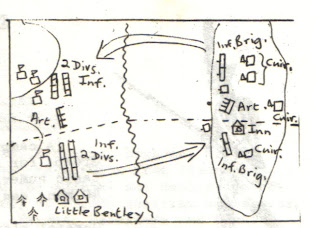
Gambling on the militia not standing up to determined bayonet charges, (Militia throw 2 dice for morale when charged, need 5 or 6, choosing highest dice thrown. Line throw 3 dice, Elite troops 4. 1 dice deducted for disorder per 2%> loss, etc.), the French planned to hold the road area with half the army, sending the other half to attack the English left strongly. Unfortunately the English had most of their regular rifles on this wing, and much energy and manpower had to be expended on simply destroying that one unit. The French advanced half a mile, the English masses falling back as the militia failed to stand when charged by the French cavalry. The English brought over a regiment of Guard infantry to stop the rot, and the French just hadn't the numbers to extend further. They began to withdraw across the brook towards 1.30 p.m. after 1½ hours fighting (8 moves) with the satisfaction of having outshot the English Guard into routing temporarily, and swinging a cuirassier regiment left to ride down an English Line infantry unit near the Inn which had already been gutted by musketry from the Inn defenders. The English right wing had made good progress towards the French ridge, but then had most of their first line of militia regiments flattened and broken by the superior musketry of the French regulars. (For firing, throw one average dice per 9 front rank regulars or 12 militia or other second-grade troops). The second line retired to the Little Bentley position to await the Cambridge army, having the satisfaction of halting the French advance on Colchester and London. The French, with only one infantry regiment still in good fighting trim, withdrew to Harwich to join with the Lowestoft column now crossing the estuary in small craft(evening of 13th).
Almost a third of the French were casualties after this bloodbath, whilst of the English only 8,100 out of the 13,000 were still with the colours at nightfall.
Battle of Harwich, May 14th.
The next morning the English, reinforced by the Cambridge army to nearly 16,000 strong, attacked at dawn to avoid excessive casualties in the approach to the French lines over the very open isthmus - open apart from a few sandpits affording slight cover.
The French, amounting to about 9,000 but of which 2,000 were cavalry, had planned to tempt the English into an attack on the south-east sector, whereupon the French right wing would have swung round and tried to drive the English towards the sea coast.
But due to subordinates' mistakes, the two Young Guard brigades were stationed nearer the centre than the plan had intended, and this confused French reactions when the English surprised them by instead attacking in great force along the estuary shore, straight for Harwich, with a subsidiary thrust at the centre. The massed French field guns for half an hour cut down masses of the leading English assault line, but it was obvious that the English were going to break through at the estuary unless something were done quickly to bring French infantry over from the seacoast side. The situation was serious, as the English had cleverly kept ¾ mile gap clear between their two wings, and 36 cannon were firing with deadly accuracy down this lane.
The French ordered their own infantry to abandon the redoubt and the whole sea-coast sector, and to march at full speed towards the French grand battery, one regiment going straight along the beach to Harwich. To cover this move, the French Hussars and two regiments of cuirassiers were thrown-in against the smaller English assault force. The Hussars routed and practically wiped out some heavy dragoons before being cut down or captured by three light cavalry units, one cuirassier regiment caught a Guard infantry unit in disorder just after an infantry melee and routed them with loss. The remaining cuirassier unit broke two English line infantry units and although it was in the end also swamped by English reserves, the English advance had been held up just long enough to allow a good deal o£ the French infantry to disengage.
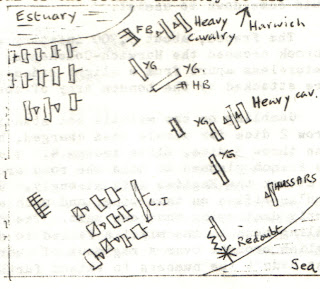
The English main attack had meanwhile reached the French gun line, which succeeded in beating off only the first two waves, having to limber up to avoid being overrun by the 3rd and 4th English lines. On this sector the French used infantry to gain time, the 1st Voltigeurs having a whole battalion engulfed and captured in the process. The English brought up two heavy dragoon regiments and decided the day. They rushed the French horse batteries, which broke, and one went on to hit a fresh Young ;Guard regiment just arrived in disorder after a hurried march from the seacoast side. This did not break, but was too disordered to stop the cavalry, (units in disorder have only half the normal melee points value. So in this case 24 Young Guard at 1¼ points each = 30 points, fought 10 heavy dragoons at 5 points each = 50 points), and was driven back.
Covered by counter-charges by the cuirassier brigade supporting the guns, the French poured back in disorder to Harwich. The two horse batteries could not be recovered, and the 16th Line could not get back to the town through the throng of hostile cavalry and light infantry, bringing the total of prisoners taken by the English to 640 cavalry and 1,440 infantry.
Three cuirassier regiments and two Young Guard regiments still in a good fighting state took up position in the outskirts, and, together with the guns which had been rescued from the pursuing English, checked pursuit for a short time. The English guns were far to the rear.
At first the general in charge thought of digging in to try and hold Harwich, as a base near London, but further orders came in by frigate during the day with fuller information as to just how heavily he was outnumbered by the English armies defending London from the North, and ordering him to embark and abandon the port. The last companies of tirailleurs left the docks in the late afternoon, under fire from the converging English riflemen.
So the English, at the cost of not much more than 1,500 killed, had achieved a decisive victory, leaving their London army free to return to base. The French had been lucky in saving any of their army, against such odds.
General situation prior to the East Coast landings
French strategy during the first ten days or so of the campaign was based on the natural assumption that the English would concentrate most of their forces (about 26,000 regular infantry, 4,800 cavalry, 90 guns) in the London area, or within easy reach. In fact the English had decided to divide their regulars into four small equal armies: one in the South-West, one near Portsmouth, one near London, one in reserve near Reading, and to employ a strategy of immediate counter-attack on all landings. In this way it was hoped to keep the French well away from the key naval bases, and prevent them from building up overwhelming strength in any one region.
The French, with far more regulars available, about 34,000 Line, 4,800 Young Guard and 6,000 cavalry, but limited in shipping, consequently found it difficult to obtain any foothold at first. They landed in small scattered groups which were easily dealt with. Their general plan, to create multiple diversions in the West and Wales and then land in East Anglia with the elite troops, largely failed at first, as the English had massed their militia regiments (one per county) within two or three days of the first May 1st landings into small local reserve armies of about four regiments each. These, appearing unexpectedly from directions different from the English regular armies, bewildered the French strategists as to the English strategic intentions.
For a long time, the French were seldom able to hold an area long enough to raise regiments of Republican sympathisers. It needed about 48 hours in undisputed control of the greater part of a county to muster and equip one such unit.
French Landing on the East Coast, May 10th and 12th.
The second stage of the French invasion began on the 10th with four ships landing a regiment of infantry (960 men) with supporting cavalry and field guns, at Lowestoft. The British reacted at first by sending a reserve army of regulars from Cambridge towards the invasion, and a mixed militia-regular army started out from London, hoping to meet the invaders or any others before Ipswich.
The Lowestoft landing was in fact only a bait, as on the morning of May 12th 4,800 Young Guard supported by 1,600 heavy cavalry and some guns and Line infantry landed at Harwich, and proceeded to march on Colchester next day. The Cambridge army was slightly delayed in reacting, owing to starting for Lowestoft, but the London army, coming leisurely up the main road, had plenty of time to change its plan, swung right at Colchester, and deployed to check the Young Guard until the Cambridge force could come down to assist.
The French, about 5,700 infantry with 1,600 cavalry, deployed just East of where a brook crossed the Harwich-Colchester road near Little Bentley. The ground was featureless apart from a slight ridge on either side of the brook. Here the French were attacked by the London army of about 7,000 regulars and 6,000 militia!
Gambling on the militia not standing up to determined bayonet charges, (Militia throw 2 dice for morale when charged, need 5 or 6, choosing highest dice thrown. Line throw 3 dice, Elite troops 4. 1 dice deducted for disorder per 2%> loss, etc.), the French planned to hold the road area with half the army, sending the other half to attack the English left strongly. Unfortunately the English had most of their regular rifles on this wing, and much energy and manpower had to be expended on simply destroying that one unit. The French advanced half a mile, the English masses falling back as the militia failed to stand when charged by the French cavalry. The English brought over a regiment of Guard infantry to stop the rot, and the French just hadn't the numbers to extend further. They began to withdraw across the brook towards 1.30 p.m. after 1½ hours fighting (8 moves) with the satisfaction of having outshot the English Guard into routing temporarily, and swinging a cuirassier regiment left to ride down an English Line infantry unit near the Inn which had already been gutted by musketry from the Inn defenders. The English right wing had made good progress towards the French ridge, but then had most of their first line of militia regiments flattened and broken by the superior musketry of the French regulars. (For firing, throw one average dice per 9 front rank regulars or 12 militia or other second-grade troops). The second line retired to the Little Bentley position to await the Cambridge army, having the satisfaction of halting the French advance on Colchester and London. The French, with only one infantry regiment still in good fighting trim, withdrew to Harwich to join with the Lowestoft column now crossing the estuary in small craft(evening of 13th).
Almost a third of the French were casualties after this bloodbath, whilst of the English only 8,100 out of the 13,000 were still with the colours at nightfall.
Battle of Harwich, May 14th.
The next morning the English, reinforced by the Cambridge army to nearly 16,000 strong, attacked at dawn to avoid excessive casualties in the approach to the French lines over the very open isthmus - open apart from a few sandpits affording slight cover.
The French, amounting to about 9,000 but of which 2,000 were cavalry, had planned to tempt the English into an attack on the south-east sector, whereupon the French right wing would have swung round and tried to drive the English towards the sea coast.
But due to subordinates' mistakes, the two Young Guard brigades were stationed nearer the centre than the plan had intended, and this confused French reactions when the English surprised them by instead attacking in great force along the estuary shore, straight for Harwich, with a subsidiary thrust at the centre. The massed French field guns for half an hour cut down masses of the leading English assault line, but it was obvious that the English were going to break through at the estuary unless something were done quickly to bring French infantry over from the seacoast side. The situation was serious, as the English had cleverly kept ¾ mile gap clear between their two wings, and 36 cannon were firing with deadly accuracy down this lane.
The French ordered their own infantry to abandon the redoubt and the whole sea-coast sector, and to march at full speed towards the French grand battery, one regiment going straight along the beach to Harwich. To cover this move, the French Hussars and two regiments of cuirassiers were thrown-in against the smaller English assault force. The Hussars routed and practically wiped out some heavy dragoons before being cut down or captured by three light cavalry units, one cuirassier regiment caught a Guard infantry unit in disorder just after an infantry melee and routed them with loss. The remaining cuirassier unit broke two English line infantry units and although it was in the end also swamped by English reserves, the English advance had been held up just long enough to allow a good deal o£ the French infantry to disengage.
The English main attack had meanwhile reached the French gun line, which succeeded in beating off only the first two waves, having to limber up to avoid being overrun by the 3rd and 4th English lines. On this sector the French used infantry to gain time, the 1st Voltigeurs having a whole battalion engulfed and captured in the process. The English brought up two heavy dragoon regiments and decided the day. They rushed the French horse batteries, which broke, and one went on to hit a fresh Young ;Guard regiment just arrived in disorder after a hurried march from the seacoast side. This did not break, but was too disordered to stop the cavalry, (units in disorder have only half the normal melee points value. So in this case 24 Young Guard at 1¼ points each = 30 points, fought 10 heavy dragoons at 5 points each = 50 points), and was driven back.
Covered by counter-charges by the cuirassier brigade supporting the guns, the French poured back in disorder to Harwich. The two horse batteries could not be recovered, and the 16th Line could not get back to the town through the throng of hostile cavalry and light infantry, bringing the total of prisoners taken by the English to 640 cavalry and 1,440 infantry.
Three cuirassier regiments and two Young Guard regiments still in a good fighting state took up position in the outskirts, and, together with the guns which had been rescued from the pursuing English, checked pursuit for a short time. The English guns were far to the rear.
At first the general in charge thought of digging in to try and hold Harwich, as a base near London, but further orders came in by frigate during the day with fuller information as to just how heavily he was outnumbered by the English armies defending London from the North, and ordering him to embark and abandon the port. The last companies of tirailleurs left the docks in the late afternoon, under fire from the converging English riflemen.
So the English, at the cost of not much more than 1,500 killed, had achieved a decisive victory, leaving their London army free to return to base. The French had been lucky in saving any of their army, against such odds.
Thursday, 9 July 2009
Napoleonic rules by Gerard de Gre, modified by Charles and David Sweet, The Courier 1970
Featuring artillery fire using a plastic gun firing Q tips (cotton buds for those of us this side of the Atlantic), and using a home made catapult for howitzer fire, these rules bridge the HG Wells era towards Morschauser and others.


Tuesday, 23 June 2009
The English Civil War by George Gush: Miniature Warfare 1970
Before publishing his marathon 24 part series on Renaissance Warfare in Airfix Magazine from June 1973 to May 1975, George Gush wrote a less well known series in 6 parts on the English Civil War for Miniature Warfare. These articles were illustrated with photographs of Minifigs 20mm English Civil war figures, including some interesting converted personality figures.
His other publications included the Airfix Magazine Guide 28: The English Civil War, with Martin Windrow 1973; contributed much of the excellent little Discovering English Civil Wargaming, edited by John Tunstill (1973); WRG rules (1979) for 1420-1700 and army lists (1984); Guide to Wargaming (1980); and Renaissance Armies 1489-1650, based on his Airfix Magazine series (1982).
The English Civil War by George Gush: part 4, Miniature Warfare June 1970
The generals in the second picture are from Napoleonic Minifigs 20mm personalities - the figure on the right is a converted Ney.
Saturday, 13 June 2009
John Sandars Saturday
I have decided to declare today John Sandars Saturday, and post various items of interest I have been digging out over the last few weeks.
On the back cover of his book Introduction to Wargaming (Pelham, 1975) his publisher's About the Author states:
John Sandars has a wealth of experience in modelling and wargaming to put into this book. He started by modelling ships and soon became interested in military modelling in general. His scratch-built vehicles and figures from the desert campaign of the Second World War have become famous.
He plays many forms of wargaming and has become well-known as the creator of a special game simulating desert fighting. He has recently retired from the navy and lives in Portsmouth.
Among the posts today are a two part series from Miniature Warfare in 1970 on devising a set of rules, which may be seen to be initial thoughts towards his later book. It was always a source of frustration that the book doesn't actually set out the rules completely. In 1988 Dave Tuck and Richard Marsh recreated them in an article in the Solo Wargamers' Association's magazine, the Lone Warrior. Doug Crowther tracked these down and provided a scan which is available on Henry Hyde's Battlegames Magazine site as a pdf to download (6.5 mb). The scanner has cut off one or two words but the document is serviceable one, if you are interested in these rules.
On the Rapid Fire website Richard Marsh and Colin Runford acknowledge the inspiration of John Sandars. For many this inspiration included his modelling and scratch-building, and his series of articles in Airfix Magazine (and later Airfix Magazine Guide) on the 8th Army in the Desert.
Other posts below include some photographs of his work, an article on photographing models in a pre-digital age, and an account of an infantry action in the desert.
Subscribe to:
Posts (Atom)