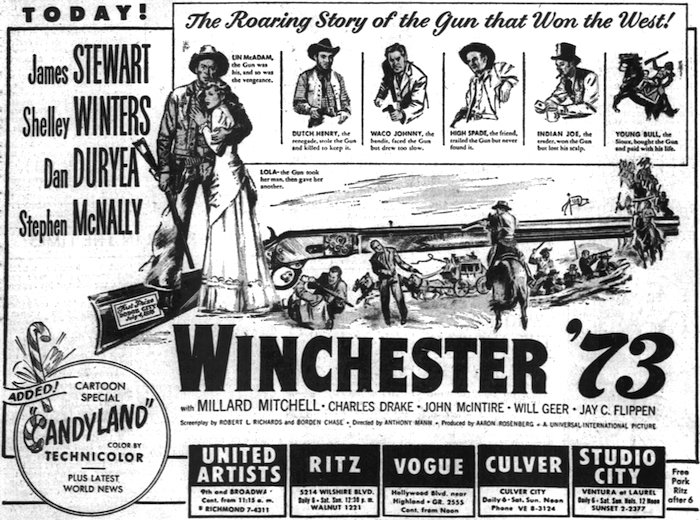
Directed by Anthony Mann
Produced by Aaron Rosenberg
Screenplay by Robert L. Richards & Borden Chase
From a story by Stuart N. Lake
Director Of Photography: William H. Daniels
Film Editor: Edward Curtiss
Musical Director: Joseph Gershenson
Cast: James Stewart (Lin McAdam), Shelley Winters (Lola Manners), Dan Duryea (Waco Johnny Dean), Stephen McNally (Dutch Henry Brown), Millard Mitchell (High-Spade Frankie Wilson), Charles Drake (Steve Miller), John McIntire (Joe Lamont), Will Geer (Wyatt Earp), Jay C. Flippen (Sergeant Wilkes), Rock Hudson (Young Bull)
The last few years have seen huge leaps forward in what movies look like on our fancy new TVs. We’ve seen a few miracles pop up on our screens. The one that comes to mind right off the bat is Anthony Mann’s The Naked Spur (1953), which has been an unsightly, sludgy mess on every video format you care to mention — until Warner Archive gave it a proper restoration for Blu-Ray. That one remains the yard stick I use to measure film restorations.
Now Universal and The Film Foundation have tackled Mann’s Winchester ’73 (1950) and Criterion has released the stunning result out into the world on 4K and Blu-Ray.
Winchester ’73 is the first of Mann’s pictures with James Stewart, and for many, it’s the earliest example of what we like to call Fifties Westerns. (That’s a subject better addressed at another time.) The picture was a big hit, and Stewart’s participation deal made him a whole lotta money. When others followed suit, such deals helped bring down the studio system. Mann and Stewart would make four more Westerns together, along with a few other pictures, in one of Hollywood’s most significant director-star collaborations.
Winchester ’73 doesn’t have a plot in the traditional sense, or it doesn’t seem to. Stewart wins the coveted rifle in a shooting tournament in Dodge City, and it’s promptly stolen from him. The film more or less follows the gun — with the stories of its various “owners” coming together and playing out as the film goes along. One of the scenes that always gets me is that after an Indian attack, Stewart rides off with the missing rifle lying in the brush a few feet away.

It’s probably impossible for us to fathom just how flat-out different this picture must’ve been in 1950. From the shooting contest to the Indian raid to the robbery and the climactic shootout in the rocks, Anthony Mann keeps us on edge throughout Winchester ’73. Of course, if Mann directed an episode of Mister Rogers’ Neighborhood, you can bet it’d be brutal and intense.
William H. Daniels’ camerawork seems more film noir than cowboy movie. Stewart’s character nearly loses it at least once (going Wig City on Dan Duryea), forcing us to see the actor, and our idea of the Western hero, in a whole new way. And on top of that, the bad guys here are really, really bad.
The Western was at a crossroads as the 40s gave way to the 50s. And though there had been hints along the way at what was coming, you could say Winchester ’73 sat right in the middle of that crossroads.

So let’s get to this Criterion set, which folks have been pining for for years. First and foremost, Universal and The Film Foundation have really worked wonders on Winchester ’73. It may be the best B&W film transfer I’ve ever seen (the award for color goes to the new The Searchers). William Daniels does so much with shadows and textures here, and they’re perfectly reproduced. Really sharp B&W has an incredible way of creating a sense of depth — and there’s a lot of that in this picture’s last reel.
You get the feature on both 4K and Blu-Ray disc, which should be appreciated by those contemplating the adoption of yet another format. There are some nice extras, especially a documentary from Ballyhoo on Anthony Mann. But the real jewel is a James Stewart commentary resurrected from the old laserdisc.
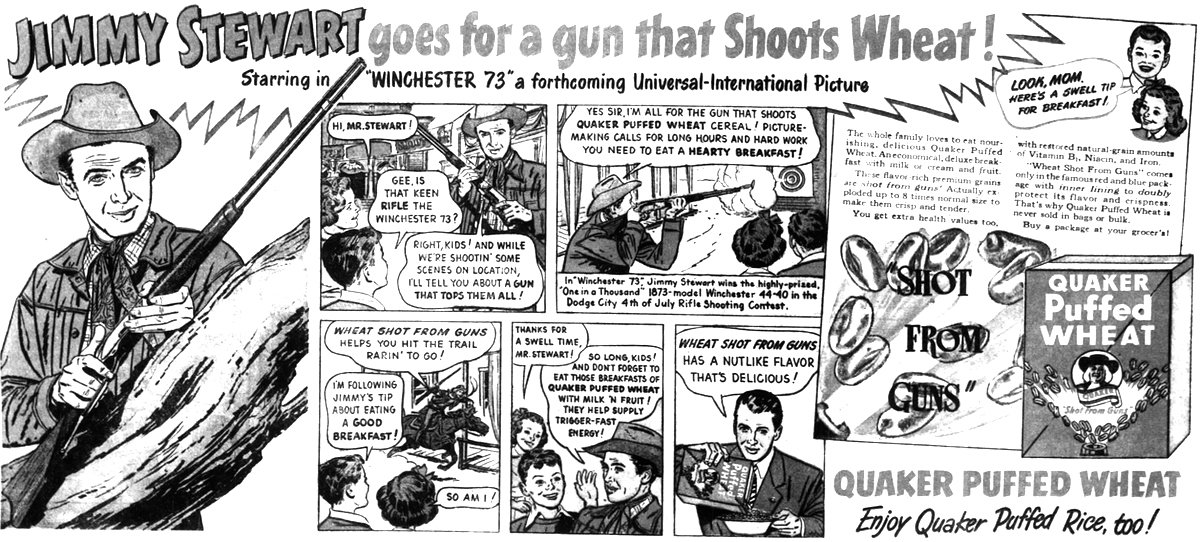
Since I started researching and writing the thing that will eventually be called 50 Westerns From The 50s, I’ve gone back and forth about which of the Mann-Stewart pictures to include — Winchester ’73 or Bend Of The River (1952). After revisiting this one, presented like this, the decision has been made once and for all. Turns out this film is even more essential than I thought.
Special thanks (twice!) to Paula V.
Read Full Post »
 50 Westerns From The 50s.