Feeds:
Posts
Comments

Archive for the ‘Marie Windsor’ Category

Directed by Andre de Toth
Starring Randolph Scott, Dolores Dorn, Marie Windsor, Howard Petrie, Ernest Borgnine, Dubb Taylor, Paul Picerni

This has been near the top of my Want List for a very long time. Heard through the grapevine (Twitter, actually) today that The Bounty Hunter (1954) — the last of the Randolph Scott pictures Andre de Toth directed — is coming to Blu-Ray “soon.” (Warner Archive?)

So stoked about this, hope it actually happens!

I wrote about a bootleg of it years ago (thanks again to the guy who sent that). Seeing it again about six months ago, I realized I’d been way too harsh on it. It’s quite good. With Scott and Marie Windsor in the cast, how could it not be?

Will be back when I know more!

Read Full Post »

Marie Windsor
(December 11, 1919 – December 10, 2000)


My favorite actress, the lovely Marie Windsor, was born 106 years ago today.

Emily Marie Bertelsen was born in Utah and went to Brigham Young University. She headed for Hollywood in 1939 and studied acting at Maria Ouspenskaya’s school. Around this time, she started using the name Marie Windsor.

Marie worked on radio, was a telephone operator and did lots of bit parts before getting a really good role in Force Of Evil (1948) with John Garfield. A string of noirs and Westerns followed: Hellfire (1949), The Fighting Kentuckian (1949), The Showdown (1950), The Sniper (1952), The Narrow Margin (1952, on its way to Blu-Ray), The Bounty Hunter (1954), Abbott & Costello Meet The Mummy (1955), The Killing (1956), Support Your Local Gunfighter (1971) and The Outfit (1973). She was on TV in shows like Cheyenne, Maverick, Perry Mason, Rawhide, Batman and Adam-12.

Not that this ad for Utah Tailoring Mills plugs Hellfire.

Read Full Post »

Cheyenne (1955-62) was more than just an excellent 50s Western TV show. It was the first hour-long Western, the first hour-long dramatic TV show to run more than a single season. It was also the first TV series produced by a major studio (Warner Bros.) that wasn’t derived from an established film property.

Now on Blu-Ray from Warner Archive — 107 episodes on 30 discs, Cheyenne is one of the best examples of classic TV in high definition I’ve seen so far. Scanned in 4K from the original camera negatives, these things are just stunning.

In its first season, Cheyenne shared its time slot with King’s Row and Casablanca, two WB shows based on their films. After the first season, those two vanished and Cheyenne had other slot-mates (Sugarfoot in the third season).

Clint Walker plays Cheyenne Bodie, a cowboy/scout riding across the post-Civil War West. Each week, he rides into a new spot and happens upon a new batch of folks. The plots are very much in line with what the laters B Westerns had been — and what we think of today as a 50s Western. 

Cheyenne was raised by the Cheyenne after his parents were killed by another tribe. He later lived with a white family (the particulars vary a bit from show to show). He’s fair, kind, strong and always ready to help out those in need. And as if to prove the idea that “no good deed goes unpunished,” Cheyenne’s servant nature often lands him in a real mess. 

Warner Bros. put their major-studio muscle behind their TV product, and it shows. Cheyenne fits right in with what Warners was doing with Western features in the late 50s. From the sets to the casts to the music, these episodes play like 50-minute versions of what WB was sending to theaters. For example, James Garner and Angie Dickinson appear in a second-season episode (“War Party”) about the same time they were in Warner’s Randolph Scott picture Shootout At Medicine Bend (1957).

The directors who did episodes of Cheyenne is a bit of a Western Who’s Who, with pros like George Waggner, Paul Landres, Thomas Carr, Joe Kane, Howard W. Koch, Paul Henreid, Lew Landers and Arthur Lubin.

Same with cinematographers. Shooting Cheyenne were folks like Harold E. Stine, Carl E. Guthrie, Bert Glennon, Ted McCord, William H. Clothier, Harold Rosson, William P. Whitley and Ellis W. Carter.

From week to week, the cast was incredible. Here’s just a sample of the folks who turn up over the course of the show: James Garner, Jack Elam, Ray Teal, Myron Healy, Bob Steele, Kathleen Crowley, Leo Gordon, Ann Robinson, Rod Taylor, Marie Windsor (above), Adele Mara, Gerald Mohr, Peggie Castle, Robert J. Wilke, Penny Edwards, Dennis Hopper, James Griffith, Angie Dickinson, John Qualen, Lee Van Cleef, Denver Pyle, Phil Carey, James Coburn, Nestor Paiva, Slim Pickens, John Carradine, Frank Ferguson, Joan Weldon, Tom Conway, Guinn “Big Boy” Williams, Edd Byrnes, Evelyn Ankers, John Russell, Claude Akins, Don “Red” Barry, Don Megowan, Dan Blocker, Adam West, Connie Stevens, Faith Domergue, James Drury, Lorne Greene, Mala Powers, Merry Anders, Alan Hale Jr., R. G. Armstrong, Ahna Capri, Ellen Burstyn, Sally Kellerman, Michael Landon, Harry Lauter and Ruta Lee. In three of the early episodes, LQ Jones (below) is his sidekick Smitty. (I left out dozens because it would’ve made for a pretty ridiculous paragraph.)

Cheyenne was a hit and it made Clint Walker a star. With a hit show, the exacting schedule that came with it, no features on the horizon, and an exclusive contract that paid him just $150 a week, after the third season, Walker was unhappy.

Clint Walker: “… I found out they [Warner Bros.] turned down some pretty nice features that I could’ve done… I heard that when people inquired, they were told, ‘When Clint Walker does features, he’ll do ‘em for Warner Bros.’ So that’s where we had the difference of opinion.” *

So, Clint Walker, well, walked. The show zigzagged to a “fake Cheyenne,” Bronco Layne (Ty Hardin) and kept going until Walker was coaxed back into the saddle. Warners put him in the excellent Fort Dobbs (1958), which I’d love to see make the leap to Blu-Ray. Bronco Layne got his own series for a while, called simply Bronco.

This is an excellent TV series, a consistent favorite of fans of 50s Westerns — and for good reason. And Warner Archive has given us all good reason to pick up this set. They look wonderful. The audio has plenty of punch. They’re uncut and have the original WB openings and closings in place. A nice slipcover thing holds the seasons nice and neat.

Cheyenne was a home run back in 1955 — and it’s a home run on Blu-Ray 70 years later. Highly, highly recommended.

*From a phone conversation with this author back in 2010.

Read Full Post »

A while back, Warner Archive dug the series Colt .45 out of their vaults for a stunning Blu-Ray set. They’ve done it again with a Warner Bros. series that’s been even harder to see over the years — The Alaskans (1959-60) starring Roger Moore and Dorothy Provine.

Roger Moore stars as Silky Harris, a con man in Skagway, Alaska during the state’s Gold Rush. Jeff York is his cohort Reno McKee and Dorothy Provine is the saloon singer Rocky Shaw. It looks and plays much like the other Westerns WB was putting on TV in the late 50s, only this one trades the Wild West for gold-crazy Alaska (which had recently become a state).

Of course, the Alaska we see here is actually the WB backlot. One of Roger Moore’s complaints about the show was how miserable it was wearing a parka in the California sun.

A TV show is almost like a living thing. It’s born, it grows and hopefully it finds its way. Most shows’ early episodes are a far cry from that first season’s final ones. With The Andy Griffith Show, for instance, Andy’s take on his character is almost completely different going from Season 1 to Season 2. And look at how The Man From UNCLE changed as it went to color (and maybe the suits saw the success of Batman).

Though The Alaskans was part of a terrific ABC Sunday-night lineup (all Westerns!), and it boasted an incredible roster of guest stars — from Julie Adams and Claude Akins to Frank Ferguson and Leo Gordon to Ray Teal and Lee Van Cleef to Marie Windsor and Efrem Zimbalist, Jr., the show never quite took off. After a single season, it was done. (Moore was then coerced into joining the cast of Maverick when James Garner left).

The Alaskans has the look and feel of the other WB TV Westerns of the period (and reportedly some recycled Maverick scripts), but something never quite clicks. (Jeff York’s character often seems totally unnecessary.) Close, but no cigar.

But all these years later, with this nice Blu-Ray set at our disposal, it’s easy to give The Alaskans some grace. There’s that cast, directors like Jesse Hibbs, Leslie H. Martinson, Jacques Tourneur and George Waggner, and gorgeous 4K transfers from the camera negatives. I’ve longed to see it (never thinking I would), and even though its shortcomings were what I’d been warned about, it’s easy to recommend it.

It’s more than just a curio from the early days of Moore’s career, and I’m grateful to Warner Archive for putting it out. 

And back to that idea of TV shows being like living things. The Alaskans didn’t get a second season, but here’s its chance at another life. Check it out.

Read Full Post »

You may remember a recent post about Olive Films shutting down. They put out some great DVDs and Blu-Rays over the years, particularly things from Republic and Paramount. (In fact, I watched their The Night Riders this morning, one of my favorite B Westerns.)

Some of these titles have already been re-issued by others (or are on the way). But some may never see the light of day again, given the current state of physical media. From Republic’s Three Mesquiteers series with John Wayne to a handful of Regalscope pictures, there are some real jewels here.

For those trying to pick these things up before they’re either gone or getting crazy collectors’ prices, here’s a list of their Westerns, ranging from the Silents into the 60s. If I missed anything, please let me know.

Special thanks for Laura from Laura’s Miscellaneous Musings, who was a HUGE help with bringing this thing together. 

Wagon Tracks (1919)
Neath The Arizona Skies (1934)
The Lawless Nineties (1936)
The Lonely Trail (1936)
King Of The Pecos (1936)
Overland Stage Raiders (1938)
Red River Range (1938)
Santa Fe Stampede (1938)
Pals Of The Saddle (1938)
The Night Riders
(1939)
Three Texas Steers (1939)
Wyoming Outlaw (1939)
Westward Ho (1939)
Man Of Conquest (1939)
Frontier Horizon (AKA New Frontier) (1939)
Dark Command (1940)
In Old Oklahoma (AKA War Of The Wildcats) (1943)
Ramrod (1947)
Angel And The Badman (1947)
Pursued (1947)
The Fighting Kentuckian (1949)
South Of St. Louis (1949)
Rio Grande (1950)
Silver City (1951)
Bullfighter And The Lady (1951)
Only The Valiant (1951)
High Noon (1952)
Denver & Rio Grande (1952)
Pony Express (1953)

Woman They Almost Lynched (1953)
Johnny Guitar (1954)
Run For Cover (1955)
The Americano (1955)
King And Four Queens (1956)
Stranger At My Door (1956)
Gun The Man Down (1956)
The Quiet Gun (1957)
Showdown At Boot Hill (1958)
Ambush At Cimarron Pass (1958)
The Hangman (1959)
The Jayhawkers! (1959)
McLintock! (1963)
The Hallelujah Trail (1965)
The Night Of The Grizzly (1966)

I’ll forever appreciate the folks at Olive Films. Night Of The Grizzly was my first commentary track.

The non-Westerns list is now available over at The Hannibal 8.

Read Full Post »

Directed by Oliver Drake
Produced by Charles “Buddy” Rogers
Written by Oliver Drake & John Mantley
Director Of Photography: Clark Ramsey
Film Editor: Warren Adams
Music by Joe Sodja

Cast: Anthony Dexter (Billy The Kid), Sonny Tufts (Jack Slade), Marie Windsor (Tonya), Charles “Buddy” Rogers (Rev. Jericho Jones), Jean Parker (Sarah Jones), Robert Lowery (Col. Jefferson Morgan), Bob Steele (Ace Jardine), Bob Duncan (Pat Garrett)


With Pat Garrett’s help, Billy The Kid (Anthony Dexter) fakes his own death so he can live out his life in peace. Traveling to the town of Four Corners, he plans to run his small ranch under an assumed name.

When a big rancher (Robert Lowery) brings in the gunman Jack Slade (Sonny Tufts) to help him take over Four Corners, The Kid stays out of it — even when he finds out they’ve been using his ranch as a hideout. The local preacher (Charles Rogers), who knows The Kid is The Kid, finally encourages him to strap on his guns again.

The Parson And The Outlaw (1957) is a fascinating, if ultimately not very good, Western. It brings together all sorts of things that make 50s Westerns so special to me.

The picture was produced by Charles “Buddy” Rogers, a silent actor (1927’s Wings) maybe best known for marrying Mary Pickford. At various times, Rogers also worked as a writer, gag man, director, bandleader and producer. After producing The Parson And The Outlaw, he did Hot Rod Gang and High School Hellcats (both 1958).

It was directed and co-written by Oliver Drake, who seemed to live a life almost completely saturated with making Westerns. Most of them are really cheap, some aren’t very good, but he made a lifelong career out of it. If nothing else, he co-wrote Riders Of The Whistling Skull (1937) and his story became Dragoon Wells Massacre (1957). His book Written, Produced & Directed: The Autobiography Of Oliver Drake needs to be reprinted somewhere, somehow.

Then there’s Marie Windsor, my favorite actress. Her fake accent is terrible, but it’s Marie Windsor — in Technicolor! Anthony Dexter is wretched, but you can always depend on Sonny Tufts and Bob Steele. 

The cabin set you see Miss Windsor in (above) looks tiny and like it cost 37 cents to construct. But there’s a sincerity to the whole thing that really helps put it over.

Director Of Photography Clark Ramsey shot pictures like I Killed Geronimo (1950), Superman And The Mole Men (1951), Gold Fever (1952) and Hidden Guns (1956). Ramsey was from Palo Pinto County in central Texas (the tiny town of Brad, with just a couple dozen people). My grandparents lived in nearby (and also quite tiny) Strawn.

In short, The Parson And The Outlaw (1957) is a cheap Western that means well, but doesn’t quite deliver — mainly because it’s so obviously cheap. But given the folks involved, it has plenty of curb appeal for fans of 50s (or earlier) Westerns. It’s a real shame it hasn’t made its way to DVD or Blu-Ray.

Read Full Post »

Directed by R. G. Springsteen
Written by Executive Producers Dorrell and Stuart McGowan
Director Of Photography: Jack Marta
Art Director: James Sullivan
Music by Dale Butts
Film Editor: Tony Martinelli
2nd Unit Director: Yakima Canutt
Special Effects: Howard and Theodore Lydecker

Cast: William Elliott (Zeb Smith), Marie Windsor (Doll Brown/Mary Carson), Forrest Tucker (Marshal Bucky McLean), Jim Davis (Gyp Stoner), H. B. Warner (Brother Joseph), Paul Fix (Dusty Stoner), Grant Withers (Sheriff Martin), Emory Parnell (Sheriff Duffy), Esther Howard (Birdie), Jody Gilbert (Full Moon), Louis Faust (Red Stoner), Harry Woods (Lew Stoner), Denver Pyle (Rex), Trevor Bardette (Wilson), Dewey Robinson (Bartender), Hank Worden

This is an entry in The Marie Windsor Blogathon, a celebration of the actress’s life and work.

I love  Hellfire (1949). I’ve seen it countless times, and it’s the main reason Marie Windsor is, and always has been, my favorite actress. Thought I should get all that out of the way before my extreme bias starts to show.

It goes like this. Zeb Smith, a card sharp (William Elliott), is caught cheating. He’s saved by Brother Joseph, a circuit preacher (H. B. Warner), who ends up catching a bullet for his good deed. Elliott tends to the dying old man, and learns that Joseph’s only regret is that he didn’t get the chance to build a church. Elliott promises to square things by building that church — even though he has to do it according to the Bible, not by simply racking up a wad of cash in a poker game.

Enter Doll Brown (Marie Windsor), a young woman with a price on her head for gunning down the abusive Lew Stoner (Harry Woods). Elliott figures her reward will cover Brother Joseph’s church, but when he finds her, things get complicated. You see, the rest of the Stoner boys want to give Doll a taste of frontier justice for gunning down their brother. Marshal Bucky McLean (Forrest Tucker), a friend of Zeb’s, is also on Doll’s trail. And Doll is really Mary Carson, and she’s looking for her long-lost sister Jane. Add to all that the fact that the recently, and reluctantly, converted Zeb has to do things according to the “rule book.”

“According to the rule book, I’m supposed to be
a peaceable man. Sometimes I kinda forget.”
— Zeb Smith (William Elliott)

While Hellfire looks like a typical minor-A Republic Western, with the distinctly weird Trucolor palette, and plays like most of Elliott’s “good badman” pictures, there are a number of things that set it apart.

First and foremost, there’s the spiritual angle, which takes the redemption theme found in so many Westerns to a new, more literal level. Hellfire goes far beyond the religious allegory we find in other Westerns. While Hellfire‘s theology sometimes seems at odds with the picture’s gunplay and violence, it’s heartfelt, it gives Elliott and Windsor nice character arcs to work with, and it’s quite moving toward the end (that’s Psalm 23, by the way). The pastel hues of Trucolor give the film a fable-like quality that perfectly complements the religious themes.
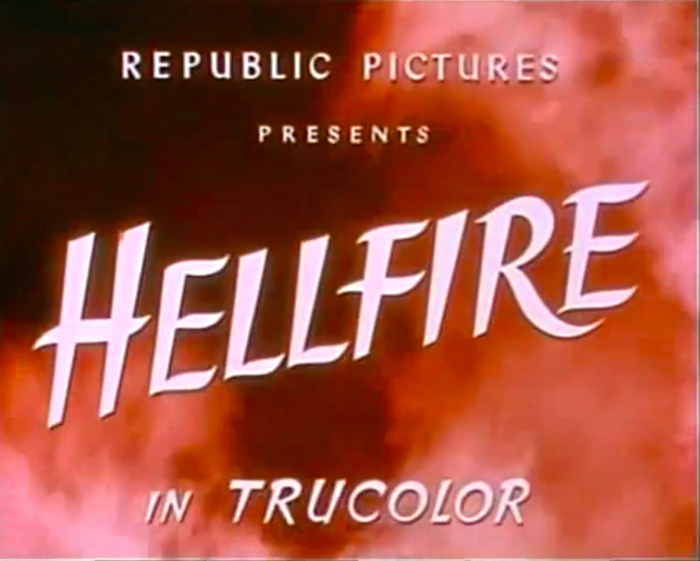
There’s a heavy dose of symbolism here, too. Fire is a common thread, from the titles to Elliott’s getaway after the card game (setting a stack of six-guns ablaze) to Elliott himself being burned along the way (one torture scene is hard to watch) to the name of the movie itself. Fire turns up in the Bible a lot, too, of course — both literally and conceptually. 

Another key differentiator is Marie Windsor. She’s perfect here, as Doll Brown, who’s riding the West looking for her sister. We easily believe she’d be capable of gunning a man down. Her softer side, Mary Carson, works, too. Windsor pulls it off beautifully, a part that could’ve been laughable in less capable hands.
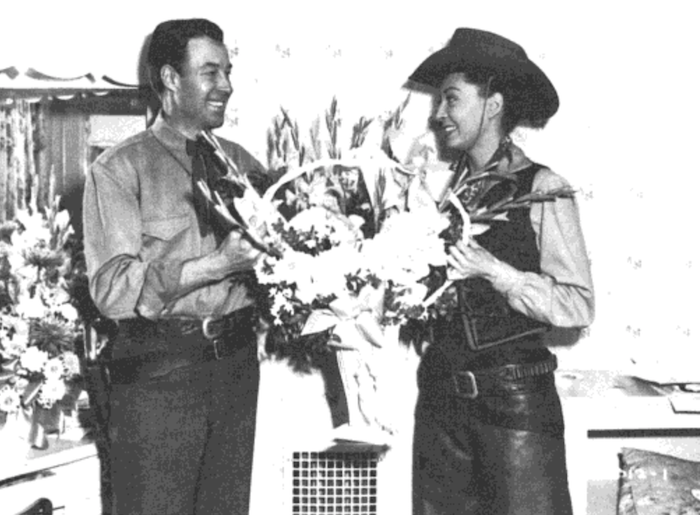
William Elliott greets Marie Windsor on the first day of shooting.

The screenplay came from brothers Dorrell and Stuart McGowan. They’d written a handful of pictures for Republic — from Mountain Rhythm (1943) to Valley Of The Zombies (1946) to Don’t Fence Me In (1946). This time, they were listed as executive producers. Elliott was a producer as well; the film is credited as “An Elliott-McGowan Production.” One  of Republic’s ace house directors, R.G. Springsteen, was given the assignment.

Republic got a lot of press back in 1949 out of William Elliott’s attempts to get the name of his movie past the Johnson Office. “Hell” had not been in a movie title in 15 years.

Elliott also insisted on Marie Windsor. The studio wanted Adrian Booth, who they had under contract. Elliott had seen Windsor in a test and the recent Outpost In Morocco. When he heard she could ride, that sealed the deal. He worked with her on gun-twirling, and she did a lot of her own stunts.

Marie Windsor: “Republic was a cozier and smaller studio… I love Hellfire. I was so thrilled to get that well-written part of a female bandit, Doll Brown.” 
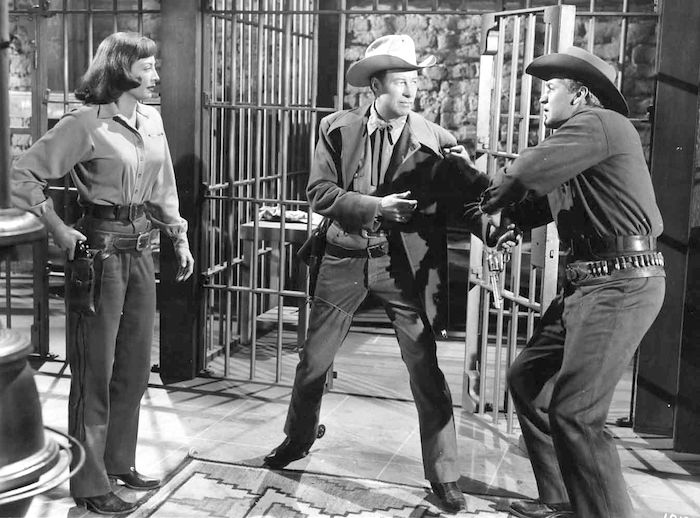
Republic sent a second unit to Sedona to shoot some riding scenes. The rest of it was shot at the Iverson Rancho and the Republic lot. The cast is made up of the usual Republic roster: Forrest Tucker, Jim Davis, Paul Fix, Grant Withers and Denver Pyle.
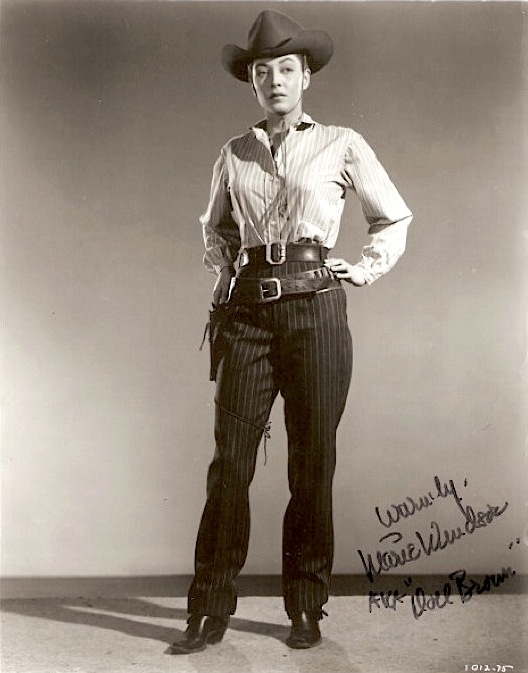
Marie Windsor: “Hellfire should have been a Western that would have changed my whole career. Studio owner Herbert Yates promised to spend a lot of money to sell the film. Mr. Yates suddenly got involved in trying to get the communists out of the industry. He made a film called The Red Menace (1949), which he spent a great deal of money to sell and did nothing for Hellfire.”

Yates’ lack of promotion for Hellfire prompted Elliott-McGowan Productions to sue the studio for not holding up its end of the bargain — and for not letting the producers look at the books.

Marie Windsor: “At his own expense, Bill set up an opening publicity tour in Salt Lake City for Hellfire.”

William Elliott made only one more film at Republic, again with the McGowans, Showdown (1950). Its religion them is subtler, and Trucolor is missing, but Marie Windsor is back. It’s certainly worth tracking down.

Believe it or not, Republic sometimes paired Hellfire with Brimstone, a Rod Cameron Western from the same year. One theater near Cincinnati got creative and had the Devil himself taking tickets. 
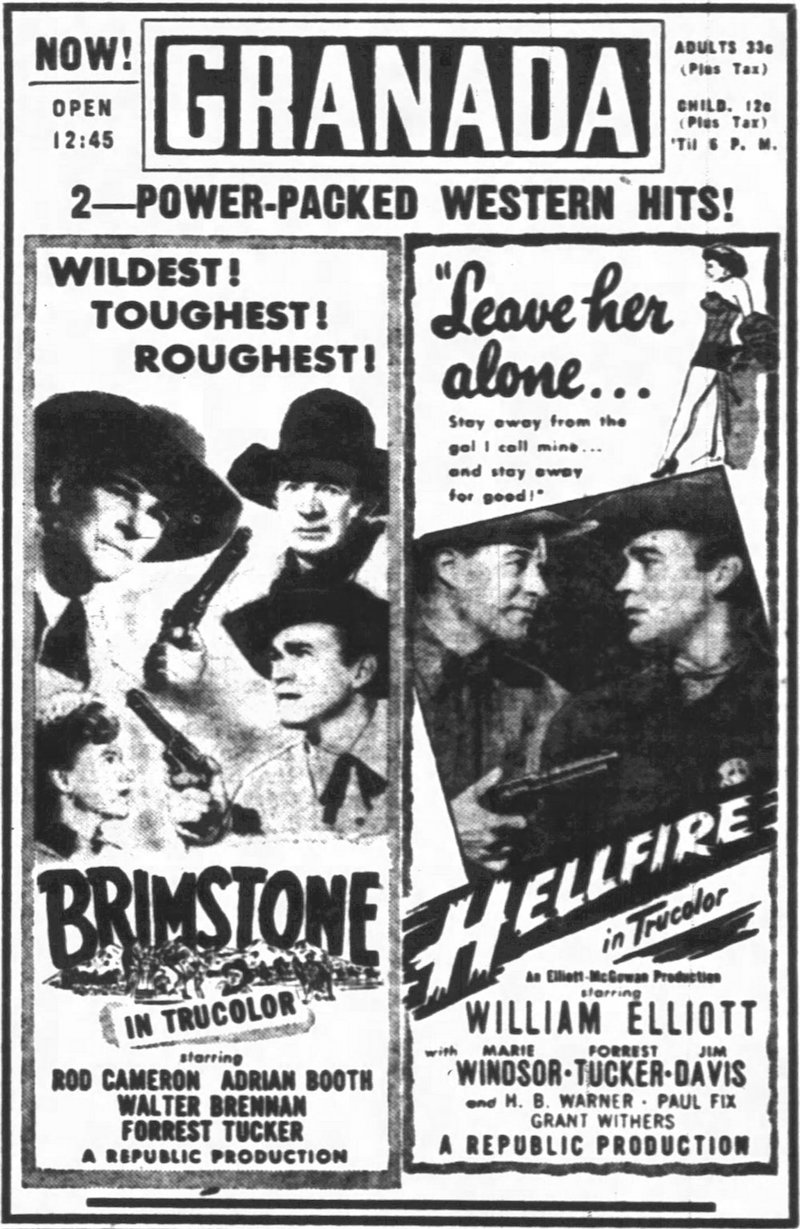
Elliott considered Hellfire his best film, and Marie Windsor always listed it as a personal favorite (along with The Narrow Margin and The Killing). 

Paramount currently owns the Republic Pictures library. They restored hundreds of these films, Hellfire included. And though the restoration played at the Museum Of Modern Art as part of a Republic retrospective, it hasn’t made its way to DVD or Blu-Ray. 

Read Full Post »

Directed by Lesley Selander
Produced by Jack Jungmeyer
Screenplay by Maurice Geraghty
Story by Frank Gruber
Music by Dimitri Tiomkin
Cinematography: Jack Greenhalgh
Film Editor: Francis D. Lyon

Cast: George Montgomery (Tom Horn / Steve Garrett), Rod Cameron (Harve Logan / Kid Curry), Marie Windsor (Dakota Lil), John Emery (Vincent), Wallace Ford (Carter), Jack Lambert (Dummy), Larry Johns (Sheriff), Marion Martin (Blonde Singer), James Flavin (Secret Service Chief), Walter Sande (Butch Cassidy)

This is an entry in The Marie Windsor Blogathon, a celebration of the actress’s life and work. It comes from guest blogger Boyd Cathey.

Marie Windsor always evokes wonderful memories for me, and on this day, December 11, 2020, which would have been her 101st birthday, I think back to the films with her that left an imprint on me, and that since my childhood I’ve managed to see and in many cases finally acquire.

When I was young boy my dad and I would go from time to time to a movie house in downtown Raleigh, North Carolina, usually on a Saturday, to see a Western double feature. Our favorite was Randolph Scott. My dad’s family is from Charlotte, and my grandparents were acquaintances with Randy Scott’s family, also in Charlotte, so we had a connection. One of the first films I recall featuring Marie Windsor was The Bounty Hunter (1954). I think it was a re-release at one of the lesser, second-run theaters that used to exist in the city, as the original release was in 1954, and I was too young to go to movies back then. I remember her role as the wife of a notorious bandit—she wasn’t the main star, but she seemed to give an extra spark to this Scott Western, which like most of his Warner oaters seemed less polished than the Columbia products.

Anyway, I was taken by her. Okay, I was maybe only about 10, but I was captivated—she was beautiful and perky, and along with Sophia Loren, she became my idolized female star. In the late 1950s until her retirement in 1991, she also frequently acted in television. She made appearances in Maverick, Rawhide, Perry Mason, even Murder, She Wrote with Angela Lansbury, one of the best American crime mystery series. And Windsor was always beautiful and captivating, she never seemed to age.

A few years later—probably the early 1960s or so—a local television station broadcast Dakota Lil (1950), one of those films that stations would broadcast usually late at night. I begged my parents to let me stay up—it was a school night, and my normal bedtime was 10 p.m. Somehow they agreed, maybe because dad wanted to see it also. Anyway, we both viewed it, and immediately Dakota Lil became a favorite.

The plot is fairly simple, although the development is more complicated. George Montgomery, Secret Service undercover agent Tom Horn (as Steve Garrett), is charged with breaking a major counterfeit outfit, the “Hole-in-the-Wall” gang in Wyoming. To do this he travels to Matamoros, Mexico, to enlist the aid of Windsor—Dakota Lil—noted for her ability to perfect an exact replication of official signatures. They both head to Wyoming, but she initially begins working with the chief culprit and the particularly nasty Rod Cameron (Harve Logan/Kid Curry)

The first thing you notice is the film score: it’s by the award-winning composer Dmitri Tiomkin, and it is gorgeous and memorable. In fact, its themes remained in my mind long after I first watched the DVD. Certainly, Fox by charging Tiomkin with the music of Dakota Lil intended it to be more than just another “super-B” Western.  Additionally, John Emery, who plays the role of Vincent, a former concert pianist and hanger-on to Windsor, offers up several short pieces by Frederic Chopin! Marie—Dakota Lil—sings various songs, with the singing voice of Anita Ellis. She executes excellent lip-syncing.

Although Dakota Lil showcases a youngish George Montgomery, Windsor steals the show and adds essential sparkle to the film. She invests the generally unremarkable dialogue with some real panache, indeed with just a face gesture or an inflection in her voice she can steal a scene. When she shows up at the Wind River, Wyoming, saloon (owned by Cameron) and comes upon the current diva, that chanteuse asks her: “What are you staring at?,” Windsor responds dryly: “A no talent performance.” Likewise, her dialogue with Cameron on how they plan to split the proceeds of the counterfeit government bonds shows comparable spunk and her mastery of crisp exchange, even humor. One can see how Marie Windsor fit so well into film noir, indeed, Dakota Lil shares certain characteristics of that genre. Consider, for example, Cameron’s preferred method of killing his enemies—by brutal strangling, almost matter-of-fact in its cruelty.

It was only in 2015 that I discovered that a DVD existed, in fact, two DVD releases. And I snatched up a copy as soon as I could. Both are in the PAL European video format, which means they will not play in American NTSC DVD players; but All Region DVD players are easily available and can be had inexpensively via Amazon.com and elsewhere. One copy was issued in Spain, which I have not seen. My copy is issued by Simply Media, a British company, which licensed their copy from Renown Films.

Although Dakota Lil was originally released by 20th Century-Fox in Cinecolor (February 1950), to my knowledge no color issue has emerged since its original release. Neither of the available DVDs is in color. Since Cinecolor was a less stable and reliable color process than Technicolor, one wonders if such a copy still exists somewhere in the Fox archives. Kino Lorber has done some wonderful restoration work with Scott’s The Cariboo Trail and Canadian Pacific, both Fox releases, so maybe we are allowed to hope?

Both the Simply Media copy and the Spanish release are available reasonably from the American firm, DaaVeeDee.com and also from Amazon.com. My copy is a good B & W issue, with a sharp picture and no sign of deterioration.

Directed by warhorse director Lesley Selander, Dakota Lil is surely one of his finer efforts. It deserves to be much better known. No, it’s not perhaps as good a vehicle for Windsor as, say, Hellfire (1949, with Wild Bill Elliott), but it merits attention…and perhaps a full digital restoration?

In any event, it should be seen for Marie Windsor’s fine performance which raises this film above the dozens similar to it released in 1950. Happy Birthday, Marie, and may your legacy on film continue to be enjoyed and appreciated!

Read Full Post »

Marie Windsor
(December 11, 1919 – December 10, 2000)

My favorite actress, Marie Windsor, was born 101 years today. Seems like a good time for a blogathon celebrating her life and work. Through Monday the 14th, there will be posts about Ms. Windsor’s work in movies and TV from a number of film bloggers. This post will serve as a hub, or index, for those posts (see below).

Emily Marie Bertelsen was born in Utah and went to Brigham Young University. She headed for Hollywood in 1939 and studied acting at Maria Ouspenskaya’s school (around the time Ouspenskaya played the old gypsy woman in The Wolf Man). Around this time, she started using the name Marie Windsor.

Marie worked on radio, was a telephone operator and did lots of bit parts before getting a really good role in Force Of Evil (1948) with John Garfield.

A string of noirs and Westerns followed, so much good stuff: Hellfire (1949), The Fighting Kentuckian (1949), The Showdown (1950), The Sniper (1952), The Narrow Margin (1952), Trouble Along The Way (1953), The Bounty Hunter (1954), Abbott & Costello Meet The Mummy (1955), The Killing (1956), Support Your Local Gunfighter (1971) and The Outfit (1973). That’s just a few.

She stayed busy in TV, too: Cheyenne, Maverick, Perry Mason, Rawhide, Batman, Adam-12 and many, many more.

She was often called The Queen Of The Bs, but I think that belittles both her talent and the many terrific little movies she made. No matter how cheap the movie might be (like 1957’s The Parson And The Outlaw, up top), or how small the part, she always, always gave it her best. 

The Marie Windsor Blogathon

Post #1: Double Deal (1950)
The Hannibal 8

Post #2: Dakota Lil (1950) by guest blogger Boyd Cathey
50 Westerns From The 50s

Post #3: Maverick – The Quick And The Dead (1957)
Caftan Woman

Post #4: Hellfire (1949)
Laura’s Miscellaneous Musings

Post #5: Force Of Evil (1948)
The Oak Drive-In

Post #6: Hellfire (1949)
50 Westerns From The 50s

Post #7: So This Is Love (1953)
Pure Entertainment Preservation Society

Read Full Post »

The Marie Windsor Blogathon is getting closer, and I’m getting plenty excited about it.

If you’d like to participate, feel free. Here’s what you do —
• Pick a movie or TV show Marie Windsor appeared in
• Let me know you want to ride along (email fiftieswesterns@gmail.com), what you want to cover and when you plan to post it. Your posts can be in any form, of any length, and on any topic as long as it relates to Ms. Windsor, but I’d like to manage things a bit to make sure we don’t end up with 14 people writing about The Killing.
• Post your piece on anytime between December 11-14, using the Marie Windsor Blogathon banner and link (both will come shortly).
• Send me the link to your post so I can add it to the master list.

Read Full Post »

Older Posts »