Feeds:
Posts
Comments

Archive for the ‘RKO’ Category

Happy Birthday, Tim Holt.

Tim Holt
(February 5, 1919 – February 15, 1973)


Happy birthday to one of my favorite cowboy stars, Tim Holt.

He’s in a few of the finest films ever made — Stagecoach (1939), The Magnificent Ambersons (1942) and Treasure Of The Sierra Madre (1948). But it’s his RKO B Westerns that I turn to time and time again. They’re just wonderful.

Read Full Post »

Tim Holt
(February 5, 1919 – February 15, 1973)


Along with all the comments this blog (and the other one) receive, I get plenty of emails. Got an interesting one the other day about Tim Holt, who was born 106 years ago today.

The question was, what Tim Holt RKO would I recommend as a good entry point? Wow, since they’re all so good, that’s hard. But I settled on Overland Telegraph (1951). While it doesn’t have the incredible Lone Pine locations of some of the others, Tim and Chito (Richard Martin) are joined by a top-notch cast — Gail Davis, Hugh Beaumont, Mari Blanchard, Robert Wilke and George Nader. Lesley Selander does his usual masterful job as director.

I’m curious — which one would you have recommended?

This post goes out to Mr. Jerry Entract, a big fan of the Tim Holt Tuesday posts that used to turn up on this blog (and really should return).

Read Full Post »

Happy Father’s Day.

Here’s Jack Holt with his daughter Jennifer and son Tim — on the RKO lot in the late 40s.

If you’re a dad, it’s your day. Enjoy it, especially if it includes putting on a favorite 50s Western.

Read Full Post »

At the risk of appearing political, here’s an interesting article on Barbara Stanwyck, Ronald Reagan and Allan Dwan’s Cattle Queen Of Montana (1954). It’s from American Greatness, written by Emina Melonic. She’s tougher on the movie than I’d be — I’m a sucker for mid-50s Dwan pictures — but I really enjoyed it.


Click on the chunk above to get to the article. And if you’re like me, you’re gonna want to revisit the movie.

And the marquee image up top, what movie is it from?

Read Full Post »

Directed by Fritz Lang
Screenplay by Daniel Taradash
Story by Silvia Richards
Produced by Howard Welsch
Director Of Photography: Hal Mohr
Film Editor: Otto Ludwig
Music by Emil Newman

Cast: Marlene Dietrich (Altar Keane), Arthur Kennedy (Vern Haskell), Mel Ferrer (Frenchy Fairmont), Gloria Henry (Beth Forbes), William Frawley (Baldy Gunder), Lisa Ferraday (Maxine), John Raven (Chuck-a-luck dealer), Jack Elam (Mort Geary), George Reeves (Wilson), Frank Ferguson (Preacher), Francis McDonald (Harbin), Lloyd Gough (Kinch), John Doucette (Whitey), Russell Johnson, Fuzzy Knight, Emory Parnell, Kermit Maynard, Tom London, I. Stanford Jolley


I love Fritz Lang’s Hollywood movies, Rancho Notorious (1952) in particular. I’ve written about it on this blog before, and it’s got a chapter in my long-promised book.

With the new Blu-Ray from Warner Archive, well, here it is again.

First, the movie. It’s very, very Fritz Lang. You have Chuck-A-Luck, a retreat for outlaws run by Altar Keane (Marlene Dietrich) — sort of an Old West variation on Dr. Mabuse and his criminal network. Then you have Vern Haskall (Arthur Kennedy), whose fiancé (Gloria Henry) is raped and murdered in a holdup eight days before their wedding. Vern is absolutely consumed with revenge, another Lang favorite, and his journey for justice leads to Keane, gunslinger Frenchy Fairmont (Mel Ferrer) and Chuck-A-Luck.

As the ballad that runs throughout tells use, it’s a story of “hate, murder and revenge” — themes that served Lang well in all those terrific noirs.

All this is placed in a low-budget, studio-bound (though there’s a little Iverson Ranch and Republic Western street in there), Technicolor setting that comes off rather dreamy and operatic. Somehow it seems more dated that Lang’s Western Union from 1941. But let me be perfectly clear — all of these are good things.

Rancho Notorious is often compared to Nick Ray’s Johnny Guitar (1954). Some folks hate it, some find it corny and laughable (especially that song). For me, however, it’s just wonderful, one of the few films I’ve watched back to back on the same evening (had to make sure I actually saw what I thought I saw).

Now, on to the new Blu-Ray. Warner Archive often shows us just how good an older film can look in high definition. Their exquisite restoration of Anthony Mann’s The Naked Spur (1953) is a shining example. Rancho Notorious has been given a new 4K transfer from the original nitrate Technicolor negative, and it’s just incredible. From the B&W RKO logo to the final fade, it’s as sharp as anything I’ve ever seen on a TV, highlighting the detail (thanks to the nitrate, grain’s almost nonexistent) and depth of Hal Mohr’s cinematography. The artifice of the whole endeavor is more noticeable than ever, and I stopped it a number of times to study the costumes, sets and backdrops.

The audio has been given plenty of attention, too, and it’s as clear as a bell. (The old DVD’s audio level was a bit low.) If Fritz Lang’s weird Western is ever gonna get the reappraisal it so richly deserves, this is the way to make it happen.

Warner Archive keeps raising the bar. This is a stunning, as-close-to-perfect-as-you-can-get presentation. Highly, highly recommended.

Read Full Post »

Directed by Fritz Lang
Starring Marlene Dietrich, Arthur Kennedy, Mel Ferrer, Gloria Henry, William Frawley, Jack Elam, George Reeves, Frank Ferguson

When The Warner Archive brought Fritz Lang’s Rancho Notorious to DVD back in 2009, I was overjoyed. They’ve now got a Blu-Ray coming in January — and I’m maybe even more excited.

Since that DVD hit our players, the picture has become one of my favorite 50s Westerns. It’s one I return to quite a bit, finding something new each time. That’s something you can say about most of Lang’s films.

Can’t wait to see Hal Mohr’s gorgeous Technicolor in high definition. Highly, highly recommended.

Thanks to John Knight for the news.

Read Full Post »

Directed by Robert Aldrich
Starring Gary Cooper, Burt Lancaster, Denise Darcel, Sara Montiel, Cesar Romero, Ernest Borgnine, Charles Bronson, Jack Elam

Vera Cruz (1954) was put together by Burt Lancaster’s production company, Lancaster-Hecht. Burt was going to play the hero, Benjamin Trane, but it was decided to have Lancaster to play the bad guy — and a more traditional hero type play Trane. Cray Grant turned it down, and it was offered to Gary Cooper.

The picture’s a lot of fun with Cooper and Lancaster as a couple of shifty Americans down in Mexico who join forces to steal a stash of gold coins. With its macho one-upmanship, crosses and double-crosses, flawed characters — even the good guys are bad, Robert Aldrich’s Vera Cruz is one of the 50s Westerns that served as an obvious influence on the spaghetti westerns that would come in the early 60s.

Kino Lorber is working on a Blu-Ray release, which should do justice to the picture’s SuperScope 2:1 presentation (applied to the picture after the fact). Can’t wait to see it looking the way it should. Highly recommended.

Read Full Post »

Rhonda Fleming
(August 10, 1923 – October 14, 2020)

Rhonda Fleming, “The Queen Of Technicolor,” has passed away at 97. Here she is in Allan Dwan’s Tennessee’s Partner (1955).

Read Full Post »

Directed by Robert Wise
Produced by Theron Warth
Screen play by Lillie Hayward
Based on the novel Gunman’s Chance by Luke Short
Director Of Photography: Nicholas Musuraca
Film Editor: Samuel E. Beetley
Music by Roy Webb

Cast: Robert Mitchum (Jim Garry), Barbara Bel Geddes (Amy Lufton), Robert Preston (Tate Billing), Walter Brennan (Kris Barden), Phyllis Thaxter (Carol Lufton), Frank Faylen (Jake Pindalest), Tom Tully (John Lufton), Charles McGraw (Milo Sweet), Clifton Young (Joe Shotten), Tom Tyler (Frank Reardon), George Cooper (Fred Barden), Tom Keene (Ted Elser), Bud Osborne (Cap Willis), Zon Murray (Nels Titterton), Harry Carey Jr., Iron Eyes Cody, Chris-Pin Martin

__________

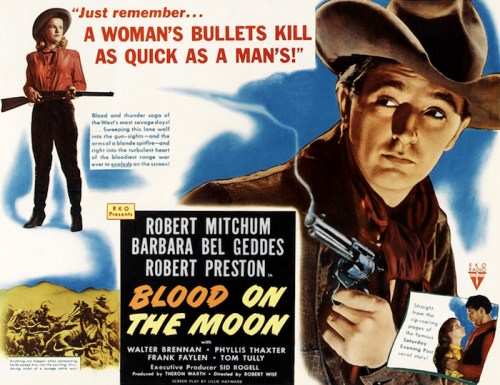
In a strict chronological sense, Blood On The Moon (1948) isn’t a 50s Western. But in other ways — look, themes, etc., it fits right in with the best the 50s came up with. It also stands as maybe the finest example of film noir creeping into a cowboy movie.

Drifter Jim Garry (Robert Mitchum) gets caught up in a squabble between a big rancher, John Lufton (Tom Tully), and the local homesteaders. But there’s more to it than your usual range war plot device. It’s all part of a scheme put together by Mitchum’s old friend Tate Billing (Robert Preston) to swindle Lufton out of both his herd and his lucrative contract to supply meat to the Indian reservation. Mitchum decides he wants nothing to do with Billing’s caper and sides with Lufton and his daughter (Barbara Bel Geddes).

A fairly typical Western plot from the period. What makes all the difference is how its treated, from its look to some of the performances.

In noir-ish fashion, we watch Robert Mitchum wrestle with his conscience as he decides which side of the conflict to settle on. Nobody’s better than Mitchum at the morally ambiguous stuff. Several times he tries to just ride away, only to be pulled back in. Mitchum’s excellent as the down-on-his-luck cowhand turned hired gun, making sure his transition from drifter to hero doesn’t feel forced.

The rest of the cast gathers favorites from both noir and the Western — Charles McGraw, Walter Brennan (he did Red River this same year), Clifton Young, Tom Tyler, even Harry Carey, Jr. and Iron Eyes Cody. Robert Preston was always one of the best of the likable heels, and he’s at the top of his game here. Barbara Bel Geddes (as Mitchum’s love interest) is terrific, and Phyllis Thaxter (as Bel Geddes’ sister who’s duped by Preston) does a lot with a little.

Director Robert Wise didn’t make many Westerns. He said he wasn’t a fan of them. Maybe that’s why he approached this material, based on a Luke Short novel, the way he did Lewton horror movies like The Curse Of The Cat People (1944) and The Body Snatcher (1945) and the noir Born To Kill (1947). Whatever the reason, it works, making for a post-War Western that really stands out. Wise had a pretty funny career. The later films that he’s known for, from I Want To Live! (1958) to The Sound Of Music (1965), are so far removed from earlier pictures like this one. (Wise considered Blood On The Moon his first big feature.) For instance, compare The Day The Earth Stood Still (1951) to Star Trek: The Motion Picture (1979). The films got bigger, for sure, but not necessarily better. 

Robert Wise put this picture together with producer Theron Warth, getting a top-notch script from Lillie Hayward. With the cast was assembled and the shoot approaching, there was talk of replacing Wise with Jacques Tourneur — in an attempt to recapture some of the Out Of The Past (1947) magic. Dore Schary stuck with Wise.

Everything from the shadowy noir touches and more authentic costumes (Wise studied period photographs) to the stunning Sedona locations and well-propped sets make Blood On The Moon a Western unlike any other, something truly unique — as much a character study as it is an action picture. And speaking of action, it’s got one of the damnedest saloon fights you’ve ever seen (between Mitchum and Preston).
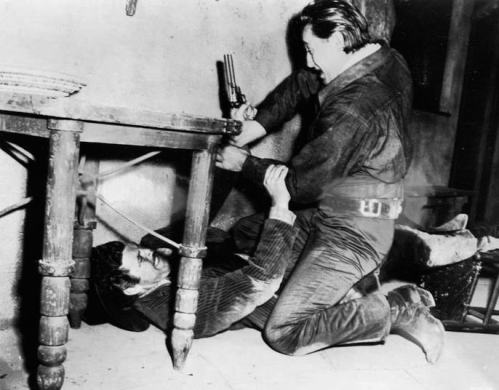
Robert Wise: “I wanted to avoid one of those extremely staged-looking fistfights used in all the movies, where the stuntmen did this elaborate, acrobatic fighting and you saw the real actors only in close-ups. I wanted this to look like a real fight, with that awkward, brutal look of a real fight, and when it was done for the winner to look as exhausted as the loser. And Mitch was excited about this. He knew exactly what I was going for. I think he probably knew more than I did about barroom fights like this one.”

Blood On The Moon gets a huge boost from the atmospherics and deep shadows of cinematographer Nicholas Musuraca. One of the true artistes of the whole noir thing, he shot Stranger On The Third Floor (1940, considered the first film noir), Out Of The Past and Roadblock (1951). He was DP on a few of Val Lewton’s RKO horror pictures, such as Cat People (1942), The Ghost Ship (1943) and Bedlam (1946). And he shot a few of RKO’s Tim Holt pictures, giving them a look way beyond their budget. Thanks to Mr. Musuraca, Blood On The Moon is one of the best-looking B&W Westerns ever made, which makes its release on Blu-Ray something to be excited about.

This time around, Warner Archive has given us one of the best-looking B&W Blu-Rays I’ve seen. It’s clean and crisp, and the contrast levels are absolutely perfect — important in a picture that goes from snow-covered landscapes in daylight to the dark woods in the dead of night. Warner Archive is getting a lot of praise, well-deserved, for restoring 15 minutes to another Mitchum Western from 1948, Rachel And The Stranger. But seeing Blood On The Moon like this, so pristine, is a revelation. Highly, highly recommended.

SOURCE: Robert Wise quote from Robert Mitchum: Baby, I Don’t Care by Lee Server.

Read Full Post »

Warner Archive has announced Blu-Ray releases for a couple of pictures we’ve all been pining for — Robert Wise’s Blood On The Moon and Norman Foster’s Rachel And The Stranger (both 1948).

From its cast (Robert Mitchum, Charles McGraw) to its brooding tone to its cinematography by Nicholas Musuraca, Blood On The Moon is one of the best examples of film noir creeping into the Western — and a big indicator of what the 1950s had in store for the genre. It’s terrific, and I can’t wait to see it in high definition.

Rachel And The Stranger is about as far from Blood On The Moon as you can get, a lighter, sweeter film with an unbeatable cast: Loretta Young, Robert Mitchum and William Holden. It was helped along at the box office by, of all things, Robert Mitchum’s marijuana arrest. Warner Archive is promising an uncut version — Howard Hughes cut over 10 minutes out of it — with Waldo Salt’s writing credit restored. This is a big, big deal.

Read Full Post »

Older Posts »