Showing posts with label Code Cracking. Show all posts

3/14/26

Panic Party: Case Closed, vol. 97 by Gosho Aoyama

Gosho Aoyama's 96th volume of Case Closed starts out, as is tradition, with the conclusion to the story that closed out the previous volume when Conan, Rachel, Sera, Serena and Makoto wandered onto the set of 48 Detectives – confusing a hostage scene for the real thing. Makoto, a karate champion, disabled the stuntman playing the hostage taker and obliged to take his place to finish the shoot.

However, the shoot ends with two murders. The first murder is when one the actors falls to his death from a top floor window of an abandoned building and a member of the crew is mysteriously poisoned with cyanide. There is, of course, a trick that allowed the murderer to pull off both murders with an alibi in the pocket, but this time the tricks aren't the stitched together Frankenstein-tricks bugging some of the stories from these later volumes. They're simple, somewhat elegant and satisfying, especially the first one. Even more fun is what's happening in the background of the story. Sera is convinced Conan and Jimmy are one and the same person. She has been poking and prying for information, which doesn't make it easier for Conan to solve the murders and has to use Serena ("...deduction queen Serena in action") to pull his "Sleeping Moore" act with Sera watching ("he uses Serena when Moore isn't handy"). I also liked how Makoto and Rachel prevented the murderer from committing suicide with Rachel echoing Conan's sentiment ("no matter whose life it is, it's too precious to take"). Conan has always disapproved of detectives turning a blind eye to murderers intending to take the easy way out. A fun and, plot-wise, decent story.

The second story is a good, old-fashioned closed circle whodunit. Richard Moore receives a letter from a client, named Taisei Nichihara, who included a code, a 500,000 yen retainer and four train tickets – destination an abandoned, mountaintop church in Nagano Prefecture. A friend of the client hanged himself in the old church and wants it investigated. But why did Moore need to bring three other people along for the case? The three others include, naturally, Conan, Toru Amura and the sushi chef the mystery loving sushi chef from vol. 92, Kanenorih Wakita. When they arrive at the church, they find a group of five people ("we went to high school together") and discover Moore's client is the man who hanged himself. So they have been all lured to the church under false pretenses and, as to be expected, a blizzard traps them inside church for a day. All they can do trying to figure why they were brought to the church, decipher the coded message and hunt around for clues. Only for one of them to walk straight into a booby trap and another is found poisoned.

Similar to the previous story, the tricks used to build up this story aren't the Frankenstein stitch jobs from recent volumes and wonder if the original Japanese volumes received similar criticism for it. The tricks here are simple, but not too simple and possess a kernel of elegance. Such as how the murderer picked the victims and a good booby trap every now and then is to be appreciated, but it has to be admitted that it also makes for another fairly minor chapter in the series. Very enjoyable nevertheless, if only because it has been a while since this series featured such a classically-styled mystery story.

The third story is short, two chapter inverted mystery in which the killer rigged up a daring, seemingly unbreakable alibi. Maika Zenda, a school teacher, discovers that her fiance, Toji Fukikoshi, is a marriage swindler who has another girlfriend stashed away in luxurious summer house – which throws her in a murderous rage. She stabs him and then have the body appear during a school trip to the woods to forage for wild vegetables. Zenda worked it in such a way proving she could not have dragged the body and propped it up against a tree backed by photographic evidence. Only problem is that the children on the trip are Conan and the other members of the Junior Detective League. This story actually felt more like one of those earlier cases than the previous story nicely balancing the central trick with the characters and story. Not to mention the clueing is surprisingly sharp as Conan reasons the truth from a missing four-leaf clover and mud stains. So a very well done, completely solvable alibi cracker.

The last, incomplete, story being setup here will be concluded, as is tradition, in the next volume and begins with a callback to a case from vol. 12! In that case, Doc Agasa brought the Junior Detective League to the house of his late uncle, "the guy with the sun, star and moon code built into his house," where he found a wooden box containing a small antique plate. A black lacquer tray, to be precise, recently featured on an antique TV show where its value was an estimated 100 yen ("about $1 million"). Doc Agasa was not the only person who had the idea to have his tray appraised, but the appraiser had received three other trays and, to his surprise, "all three trays turned out to have the same carving" ("...at least two are counterfeit"). Doc Agasa is invited, along with the other owners, to the home of the appraiser, but there the appraiser is attacked with a spear. When Doc Agasa goes to get help, the attacker returns to finish the job. So a who-of-the-three whodunit that will be concluded and resolved in vol. 98.

So, all in all, the cases making up vol. 97 aren't the most spectacular this series has produced during its long run, but they had pleasing consistency, purely as detective stories, while the red threads and character-arcs of the main storyline continue to move and develop in the background. A great volume in a small, modest way on way to vol. 100. Just two more to go!

2/18/26

Time Wants a Skeleton: C.M.B. vol. 9-10 by Motohiro Katou

Motohiro Katou's C.M.B. vol. 9 opens with a two-part, two chapter story, "The Sun and a Folklore," which brings Sakaki Shinra and Nanase Tatsuki to Machu Picchu, Peru, accompanied by their mutual frenemy, Mau Sugal – a black market broker and professional nuisance. Sugal explains to a skeptical Shinra a piece of Inca gold has turned up ("most of the Inca gold was melted down by the Spanish into gold ingots"). It happened during a curious incident two weeks ago.

Professor Polaiyu discovered in the university archives an uncatalogued quipu ("a necklace that conveys a message using the number of knots") with knots and markings he had never seen before. After studying the quipu, Professor Polaiyu became convinced it conveyed a coded map of the underground tunnels leading "from the Temple of Sunlight to the Golden City." So he organized a small expedition into the tunnel system with a local guide, Hulio, but only the young guide came back out clutching a piece of Inca gold. Hulio's story is that he lost the professor when the batteries of his flashlight died, but refuses to tell where he found the gold. Not long after getting involved in the case, the body of the professor is found near the exit along with his digital camera with blurry pictures on it. And the first part ends with an unambiguous murder.

I wouldn't call "The Sun and a Folklore" a typical, traditional whodunit, more an adventures mystery of myth and folklore, but thought the problem of batteries presented an inspired piece of clueing – strengthened by its conclusion. A slightly unexpected and unusual conclusion with the last two panels adding a touch of sad tragedy to the whole case. So, in many ways, a typical Katou story and a good one at that!

The second story, "The Metamorphosis," is a one-chapter short taking place at Meiyuu Private High School's library. Shinra and Tatsuki are in the library, helping out with chores, when they spot a picture hanging above the door. A strange picture depicting "a beautiful butterfly with a grotesque looking caterpillar," which turns out to be relatively valuable drawing by the 17th century entomologist and scientific illustrator, Maria Sibylla Merian. So, of course, they let it hang above the door and, as to be expected, it disappeared. The circumstances under which it disappeared makes it something of an impossible crime. There was only one student present in the library and the picture vanished during a 30 minute window, during which nobody could have taken the picture out of its frame without being noticed by the student ("the windows, they were all locked"). So, if the student is innocent, who stole the picture and how? Shinra's solution is as ingenious as it's impractical and liable to misfire, but Katou was obviously aware of the problem and worked the difficulty of pulling off this trick into the solution. I allow it! :)

The third and last one-chapter story from this volume is "Abortive Migration" and brings Shinra and Tatsuki to the island of Okinawa to photograph marine wildlife. They have two diving instructors to along with them, Tsuruoka Nobuaki and his wife Miki, but the two have a badly disguised argument and it later turns out to be related to his first wife, Keiko – who died in a tragic diving accident. Tsuruoka and Keiko had been diving when encountering a lot of dead fish and eventually a humpback whale. But he "lost track of her beneath the shadow of the whale." Keiko's body would not be found until a week later. Tsuruoka Nobuaki has ever since lived under a cloud of suspicion and now it's coming to a head with his second wife. I guess you can pigeonhole this story in the psychological crime slot, but personally found a dull and weak story to close out this otherwise excellent volume.

Katou's C.M.B. vol. 10 has four, one-chapter stories starting with a personal favorite, "Sixty Million Years," in which a brother-and-sister team of archaeologists, Hera and Joyce Colbert, ask Shinra to come out to the Gobi Desert in Mongolia. Hera and Joyce unearthed, what can only be called, an impossible fossil, "human and dinosaur fossils, together in the same strata." But there they are, "together with the dinosaur fossil placed above the human fossil" ("this is clearly impossible"). Shinra, holder of the "C," "M" and "B" rings, is called upon to authenticate and, if possible, explain what they found. It's to be regretted Katou only gave the story a single chapter instead of two, or three, chapters to explore the possibility of faking such a fossil and some of the fringe theories ("...an advanced ancient civilization existed"), which were only mentioned passing. However, Shinra's explanation places this story in the same category as Ross Rocklynne's "Time Wants a Skeleton" (1941) and James P. Hogan's Inherit the Stars (1977) without treading into science-fiction or hybrid mystery territory. "Sixty Million Years" simply is an impressive piece of 19th century-style naturalist impossible crime fiction reimagined in the 21st century with a 65 million year old conundrum. To say I liked this story would be the understatement of the Holocene Epoch!

Unfortunately, the next two, one-chapter stories, "The Nail" and "Summer Holiday at the World End," were both very minor and disappointing stories. "The Nail" begins with a series of good, old-fashioned creepy chain mails, "if you don't make this picture into your background wallpaper, you will receive grave misfortunes," going round Shinra and Tatsuki's school. The place in the picture is easily identified and this leads to hit-and-run incident where the culprits claims the victim was pushed in front of his car. I thought this story was uncharacteristically uninspired as Katou simply retreaded the core idea from "Abortive Migration" (SPOILER/ROT13: gur fhccbfrqyl vaabprag fhfcrpg jub gheaf bhg gb or thvygl nsgre nyy) with pretty much the same results. "Summer Holiday at the World End" is one of those puzzles-with-a-heart taking place on the last day of summer break as Shinra, Tatsuki and classmates go the beach. There they hear a strange story of a student who briefly disappeared while exploring a mysterious cave with their friends. So they go explore it for themselves. Not really a bad story. Just very minor and very forgettable.

Katou pulls it together with the last story and ends C.M.B. vol 10 on a banger. "The Hydraulis" finds Shinra and Tatsuki in Milan, Italy, where Mau Sugal wants them to investigate a music chapel, located on a lonely mountain top, which has a hydraulis – a prototype of the pipe organ. That's the first of two mysteries attached to the music chapel. What's an out-of-date hydraulis doing in a 16th century music chapel? The second mystery has to do with its haunted reputation as a room that kills and harms. Everyone who tries to play the organ either dies or get seriously ill ("...there have been over 10 people who died inside that chapel"). "The Hydraulis" shares the same strengths and one weakness with "Sixty Million Years." Shinra's explanation of both how the music chapel poses a danger to people and why it was designed to do so are brilliant. But it needed another chapter to fully flesh everything out. Like the not unimportant historical background of the chapel and location. Other than that, this is a first-rate impossible crime story and original take of the room-that-kills. Highly recommended!

So, all in all, not a bad score for these two volumes. "Abortive Migration" and "The Nail" are the only two stinkers with "Summer Holiday at the World End" merely being forgettable. "The Sun and a Folklore" and "The Metamorphosis" are both good, solid efforts with "Sixty Million Years" and "The Hydraulis" being the two standouts. You expect one of them to turn up on that future "Top 10 Favorite Cases from Motohiro Katou's C.M.B." Not at all disappointed with these two volumes on a whole. What I'm not sure of yet is whether I'm going with C.M.B. vol. 11 and 12 next or start on Q.E.D. iff series. You'll see eventually.

10/15/25

Straight to Your Heart: Case Closed, vol. 95 by Gosho Aoyama

Gosho Aoyama's 95th volume of Case Closed picks up where the previous, absolutely packed volume ended that was crammed with familiar faces, storyline developments and a cliffhanger to a tantalizing murder case featuring two imaginative impossible crimes – apparently committed the long-nosed Tengu of Japanese folklore. First a short recap. Conan has temporarily returned as Jimmy Kudo to attend a class trip to Kyoto to link up with Rachel complete with will-they-won't-they overtones, but their class trip runs into a class reunion of a university film club that quickly ended in bloody murder.

Their screenwriter is brutally murdered in his hotel room with a big pool of blood and bloody footprints staining the ceiling, which suggests the killer yanked the victim up in the air to kill him and then casually walked across the ceiling. And walked, or flew, out an open window on the 15th floor. A second murder is committed in the open street with another trail of bloody footprints walking sideways along the wall. In this closing chapter, the murderer attempts a third murder with footprints from an apparently invisible man approaching him on a bridge, but, by that time, Jimmy had already closed the net around the killer.

I think this story is far better for its long-awaited developments in the overarching storyline with all its character-arcs than the fantastically-staged series of impossible slayings, which are excellent in presentation, but poor and unconvincing in execution – especially the first murder and the last attempt are unconvincing. I suppose the trick for the first murder could have a whole lot more convincing in a smaller, more intimate setting, but not here or on this scale. I didn't think much about the other impossibilities with the inexplicable appearance/disappearance of the Tengu (SPOILER/ROT13), fbeg bs, tvivat njnl gur zheqrere, orpnhfr gur crefba jub jnf greebevmrq ol vg unq ng yrnfg gb or va ba vg. Lbh pna'g uvqr fhpu n guvat vafvqr fbzrbar'f ubgry ebbz, fhqqrayl fpner uvz jvgu naq znxr vg qvfnccrne, hayrff gung crefba vf chyyvat gur fgevatf be vf na nppbzcyvfu. A commendable attempt to weave four impossible crimes into a fairly short story, but again, far better for the storyline-and character-arc developments.

The second story deals with the direct fallout of the previous story, because Jimmy Kudo, "the top teen detective of the east," resurfacing to solve a murder case involving well-known filmmakers has started a buzz. Kudo's return ("Rumors of His Death Debunked") trended on social media, became the top news story online and attracted the attention of the news media. So now Conan is in deep trouble as reporters with camera crews besiege his home and everyone who knows Jimmy Kudo, which is bound to get noticed by the Black Organization. Meanwhile, Anita and the Junior Detective League go to the home of classmate who failed to show up at school that day. When they enter the home, they find the first of a trail of clue to an indoors treasure hunt and they fear the little girl might have gotten trapped somewhere while following the clues. So they retrace their girl's step by following the clues her grandmother left behind. Yes, a very minor story intended to break away from Conan's precarious situation and the growing interest in Jimmy Kudo's return, but by no means a bad story. Where, and how, they discovered the girl involves something I always imagined would make for a first-rate locked room-trick, but, to my knowledge, it has yet to be used. So overall a better story than the previous landmark story and Conan learns the name of the Black Organization's boss. We all know who he really is, right?

The fallout from Jimmy Kudo's headline grabbing return continues into the third story, but also has a pretty good, self-contained detective story to offer.

Richard Moore netted an aristocratic client, Gunzo Morooka, who received a threatening note to stay clear of the Black Bunny Club ("...if you value your life"). So they meet at the Black Bunny Club to discuss the case. Black Bunny Club is a "gentleman's club" where hostesses are dressed as scantily-clad bunnies raising the question how Conan and Rachel were even allowed on the premise. When food and dinner arrives, one of the bunnies is poisoned and hospitalized with only three suspects who could have poisoned her drink. So, on the surface, it's the customary whom-of-the-three-did-it staple of this series, but how the drink was poisoned is rather ingenious and makes the story standout. Case Closed is going to be interesting study material in the future for how the traditional 20th century detective story adapted itself to the 21th century. So good story that also has Toru Amuro as Moore's disciple to look over Conan's shoulder with a cliffhanger that would been a perfect conclusion to this volume.

The last two chapters begins a story that will be concluded in the next volume and deals with "a serial killer who targets female cops." More precisely, the female cops of the traffic division and colleagues of the series regulars Yumi Miyamoto and Neako Miike. At the end of the last chapter, the serial killer left three bodies behind and his second victim left a cryptic dying message: a bloody finger pointing towards a swing set on a child's playground. So we'll find out what that's all about in the next volume.

So, when it comes to the individual plots, this volume was a mixed bag, but very rewarding for long-time fans of the series as the game finally appears to be afoot. Like Ho-Ling said in his 2018 review, the stories show "Aoyama is busy moving his pieces for an event which might very well be the ending of this series." It really comes across like that, but then again, this volume was originally published in 2018 and vol. 107 was published earlier this year. So maybe not yet, but look forward to the next volume.

7/24/25

Keep Cool, Mr. Jones (1950) by Timothy Fuller

Timothy Fuller was a member of the class of 1936 at Harvard and the son of Richard Fuller, head of Boston's Old Corner Book Store, who reportedly (PDF) penned Harvard Has a Homicide (1936) as a bet with his father to get out of college – stating "he would have a book published within twelve months." Not only was Harvard Has a Homicide published, but "the first contemporary mystery story ever to be serialized" in The Atlantic Monthly. The book introduces Fuller's series detective, Edmund "Jupiter" Jones, who assists the police when his professor is murdered. Fuller returned to Jupiter Jones five years later with Three Thirds of a Ghost (1941), Reunion with Murder (1941) and This is Murder, Mr. Jones (1943). A fifth and final novel, Keep Cool, Mr. Jones (1950), appearing seven years later.

I read Harvard Has a Homicide and Three Thirds of a Ghost, but only dimly recall thinking they were decent, lightweight mysteries. Not enticing or quite good enough to immediately grab Keep Cool, Mr. Jones from the big pile where it has languished ever since. Recently, while tidying up my shelves, I came across my Dell edition of Keep Cool, Mr. Jones and the plot description caught my interest right away.

First of all, Keep Cool, Mr. Jones was published after the series apparently ended following the publication of This is Murder, Mr. Jones, seven years earlier, which reads like a soft reboot of the series – suggesting an intended continuation along modern lines. It's also why I wish I remembered more details about Harvard Has a Homicide, Three Thirds of a Ghost and Jupiter Jones. I believe Jupiter started out as a wisecracking version of 1930s Ellery Queen, but Keep Cool, Mr. Jones finds an older Jones living in the suburban Boston village of Saxon with a wife and three young children. Jupiter had hung up his deerstalker nearly six years ago, however, "much as the banker must bank or the preacher preach," Jupiter "had been grotesquely conditioned to deduce amateurishly." Something that had been suppressed for years when incident made the old urge to detect and deduce resurface.

This incident takes place at Jack Maney's second annual, old-fashioned barn dance to raise funds for the local library. In the barn's basement, Maney has installed a large, state of the art walk-in deep freezer stocked with food ("...the handiest symbol of the Dream..."). During the party, Maney goes down to the freezer to show Mrs. Parker Madison, Harry Dexter and Dr. Wren some birds, but never return. When they go out to investigate, they find the closed freezer door securely padlocked from outside and the four inside. Not dead or even seriously injured, but badly shaken and Jupiter believes the padlock proves intent to murder. However, if it was attempted murder, the murderer had a motive "powerful enough to account for the cold-blooded disposal of three extra, presumably uninvolved, victims." So identifying the primary target is key, but "the unharmed victims unanimously denied having enemies."

Following night, the investigation turns into a full-fledged homicide case when Howie Howland, Chief of Police, is found shotgunned to death in the cabin of the local character, Arnold "The Indian" Baxter – who's nowhere to be found. Jupiter takes Howland's place as acting police chief as the manhunt for Arnold begins, but the case is not as clear cut as it appears on the surface. And is there a link to freezer incident? So not your typical, Golden Age village murders or college slayings from previous decades peppered with social commentary and observations on America bracing itself as it's about to enter the second-half of the twentieth century. In this modernized, updated whodunit a decidedly classical trope is introduced concerning the local legend of old Hiram Potter and his fortune in buried gold. Something his family and treasure hunters have been digging for in the Potter woods the better part of a century. Only clue old Hiram left behind are six couplets found scattered through his diary. I instinctively knew where the gold was secreted away, however, it's solution is perhaps a bit tropey (SPOILER/ROT13: gur tbyq jnf ohevrq va gur przrgrel naq cebcbfr gb anzr guvf gebcr va juvpu n cybg cbvag unf gb or qht hc va n tenirlneq "ohevny cybgf"). Between acting as police chief and amateur treasure hunter, there are a few other minor plot-threads involving the various inhabitants of Saxon that need to be tidied up. Jupiter's basically plays a cross between a fairy godmother and a diplomat on a peacekeeping assignment.

All of this is packed tightly in a svelte 155 pages making for a compact, breezy story, but, needless to say, the plotting is not terribly complex and layered. Nevertheless, the way in which Fuller tied together the freezer incident, the shooting, the disappearance and the buried treasure made for a pleasant tangle with a light sprinkling of those good, old-fashioned fair play principles. Unsurprisingly, Jupiter finds himself trapped inside the freezer towards the end and how he keeps warm, and gets out, is genuinely clever (ROT13: abg gur fahttyvat hc naq xvffvat jvgu Fyvz Znarl, juvyr uvf jvsr naq xvqf ner ng ubzr, ohg gur znxrfuvsg vtybb cneg naq hfvat n pbva gb xrrc oybjvat gur shfrf gb nggenpg nggragvba gb gur serrmre). And had it been whittled down, Keep Cool, Mr. Jones would have made for an excellent, first-rate mystery novella. But it's fine as it stands. More substantial than most of these 1950s traditionally-rooted, but light-on-plot, mysteries (e.g. E.G. Cousins' Death by Marriage, 1959). More importantly, I enjoyed it.

In fact, I enjoyed sufficiently to go hunt for copies of Reunion with Murder and This is Murder, Mr. Jones. After all, the latter is a locked room mystery and they have been a little neglected lately. So... very likely to be continued.

Notes for the curious: Firstly, yes, I hadn't forgotten or overlooked Jupiter Jones also happens to be one of the protagonists from Robert Arthur's The Three Investigator series, but don't believe it has ever been confirmed whether it was a nod to Fuller's detective or just a coincidence. It's not unlikely Arthur had read the books and perhaps was a fan. I can see him appreciating how Fuller handled the buried treasure and its clue, because it's Jupiter's daughter who makes an astute observation about the couplets. So, yeah, possibly. Secondly, it was never suggested in the story, but another possibility to the freezer incident is that one of the four people pulled "The Loubet Sacrifice" to take out the other three. That would have made for an interesting take on the classic locked room situation: how can someone inside a walk-in freezer leave the door padlocked on the outside with three other people present? Now there's a challenge for today's locked room experts.

7/20/25

Wilders Walk Away (1948) by Herbert Brean

Herbert Brean's debuted as a mystery writer with Wilders Walk Away (1948) and, according to Curt Evans, the praise it received from Anthony Boucher, critic and mystery writer, Brean "almost walked away with an Edgar" for best first novel – alongside with a cult status that lasted for decades. Wilders Walk Away was considered to be one of the great impossible crime novels not penned by John Dickson Carr. A reputation that wasn't tested too severely during the post-WWII decades as the traditional, Golden Age-style detective novels entered its dark age. That changed during the 2000s.

Wilders Walk Away remains out-of-print today, but used copies are neither ridiculously rare nor eye-watering expensive. When the internet began to offer a new, open market place copies of Wilders Walk Away began to circulate again and it's cult status began to unravel. Barry Ergang summed it up perfectly in his 2003 review posted on the GADWiki, "for a little while I thought I'd found in Wilders Walk Away a companion to The Three Coffins and Rim of the Pit for ultimate greatness." Somewhat of a shared experience as most of us were promised something like a Wrightsville mystery by Ellery Queen as perceived by Carr, centered on a series of miraculous vanishings across several centuries, but the explanations are disappointingly prosaic and mundane. Nor did the rediscovery of Hardly a Man is Now Alive (1950), Brean's true masterpiece, do its reputation any favors.

So read it at the time anticipating an all-time great, unjustly out-of-print impossible crime classic and soured on the book when the impossible vanishings, generations and centuries apart, were explained away with plain, unimaginative solutions – which probably was too hasty a dismissal. Jim, of The Invisible Event, suggests in his 2017 review Wilders Walk Away is better read "as a prototype for the small town thriller" because it's "much more successful as that kind of book." I wanted to revisit Wilders Walks Away for some time now to see how the story lands without the high, somewhat unreasonable expectations of finding an impossible crime novel equal to the best from Carr and Hake Talbot.

The backdrop of Wilders Walk Away is the historical town of Wilders Lane, Vermont, whose history dates back to the mid-eighteenth century and named after the lane leading to old Ethan Wilder's log cabin. By 1775, a fairly sized village had grown around it that developed into the current town with the Wilders as its richest, leading family. There is, however, something curious about the Wilder family. Some of its members, through out the generations, have to habit of simply vanishing without a trace. Or, as it's locally known, they "walked away" never to be seen again.

Jonathan Wilder was the first to walk away, in '75, when going down to the cellar to fetch a bottle of wine, but his wife swears he never came back up again. There was no other way out of the cellar except going back up the stairs to the kitchen. Forty years later, Langdon Wilder disappeared from his bed and Walter Wilder was on the ill-fated Mary Celeste ("...people hereabouts think that whatever happened on the Celeste happened because Walter Wilder was aboard"). Wilders continued to walk away into the twentieth century. In 1917, John Michael Wilder was seen walking down a wet beach, before inexplicably vanishing from sight leaving nothing more than a trail of footprints, "plain as paint," stopping in the middle of the beach – "no concealment for yards around." Only the previous year, Fred Wilder disappeared from the supply room of his office under impossible circumstances on Columbus Day. These never-ceasing, strange and sometimes miraculously disappearances gave rise to a catchy jingle that became part of the folk lore of Wilders Lane:


"Other people die of mumps
Or general decay,
Of fever, chills or other ills,
But Wilders walk away
."


In recent years, Wilders Lane has done a lot of work to restore the town to its colonial charm to attract tourists with families owning a Colonial house opening their homes to the public between two and five each afternoon. So visiting Wilders Lane was like a trip back in time to the days of the American Revolution. That brings Reynold Frame, a freelance writer and photographer, to Wilders Lane to do several picture pieces on the town, but soon finds consumed by everything Wilder. Particularly with the daughter of Fred Wilder, Constance, who, very much to Frame's horror, has a fiance. But there are other puzzling mysteries surrounding the Wilders and Wilders Lane. Such as a minor historical mystery, a hidden code, indicating where an old diary had been secreted away.

More importantly, Constance's sister, Ellen, disappeared shortly after Frame arrived in town and its him who eventually finds her, but that discovery turns a local legend into a full-blown murder investigation – first in the career of police chief Miles Maloney. Ellen is not the last of the Wilders to walk away and turn up dead, before the story draws to a close. Frame, "a faithful reader, and disciple, of Sherlock Holmes" is prompted to start playing detective to impress Constance, because she believes "someone else could do better than the police." The mysteries of the Wilder family not only involves strange disappearances and murder, but hidden treasure, skeletons and grave digging.

So, as you probably gathered, I enjoyed Wilders Walk Away a lot more the second time around and even got more out of the miraculous vanishings, especially the historical ones, out of this second read – even though they remain largely second-rate. A good example of the strength and weaknesses of these impossible disappearances is the 1775 vanishing of Jonathan Wilder from the windowless cellar with the exit under constant observation. The trick is old hat (n frperg cnffntrjnl), but why he never returned after disappearing has a great answer. So why they all vanished and who's responsible is more important here than how they disappeared, which always has a simple, unimpressive answer. I think Wilders Walk Away would have benefited from ditching the impossible nature of some of the disappearances in favor of their strangeness and habit of repeating themselves across generations. Frame even discusses the work of Charles Fort to explain to Constance that her family don't hold the patent on anomalous phenomena.

After all, "the idea that anyone can vanish off the face of the earth without leaving a trace is uncomfortable." Like the series of very odd, non-impossible disappearances from Freeman Wills Crofts' The Hog's Back Mystery (1933). The impossible disappearances in Wilders Walk Away were less of disappointment knowing before hand that the importance is on why they disappeared, and by whom, rather than how. So, understandably, its reputation cratered when locked room fanatics started getting their hands on it in 2000s.

Wilders Walk Away has more to offer than a string of very odd, inexplicable disappearances. Beside being a fun, old-fashioned whodunit presented as a small town thriller, something is to be said about its style and structure. Something I completely missed on my first read. In 1948, Wilders Walk Away represented a perfect blend of the genre's past and present with glimpses of the future (see Jim's prototype comment). Some all-important elements of the plot would have been very much at home in a Victorian melodrama or Conan Doyle story, but hardly a throwback considering how Brean handled the plot and the answers waiting at the end. Speaking of Doyle, Brean was a Sherlockian and every chapter is headed with a quote from the Sherlock Holmes canon and the story is littered with Van Dinean footnotes – ranging from historical information to a recipe for "easy to make" Jokers. It never tips over to being too much and is surprisingly subtle in how it balances it various plot-threads and characters. Far too subtle for what I demanded from my first read. But it earned a place among my favorite, non-impossible Golden Age detective novels.

So, yeah, Wilders Walk Away proved to be far better than I remembered from my first read and even better than I hoped it would be on rereading it. It's undeserved reputation as an impossible crime classic has done it no favors, but if you don't expect any "Carter Dickson-effects" from the vanishing-tricks, it's going to be difficult for Wilders Walk Away to disappoint. A tremendously fun and enjoyable romp that comes with a heartily recommendations. Just don't expect a fusion between Queen and Carr, but more something along the lines of Theodore Roscoe's Four Corners series and Jack Vance's two Sheriff Joe Bain novels.

7/4/25

Scarlet Skeins: Case Closed, vol. 94 by Gosho Aoyama

The 94th volume of Gosho Aoyama's Case Closed series represents a milestone as the chapter opening the all-important last story in this volume is chapter 1000, but, more importantly, the story itself is a milestone when it comes to the Conan/Jimmy and Rachel character-arc – which should please fans frustrated with its lack of progress over the years. Firstly, this volume traditionally opens with the conclusion to the story that closed out the previous volume. A crossover story!

Harley Hartwell is participating in a high school kendo tournament and a favorite to come out on top, but the competition is rudely interrupted when one of the referees is slashed to death near the bathroom stalls. The murderer, wearing a kendo mask and gear, was heard by a blind witness going into the bathroom. Nobody was heard coming out since then. But the three people found inside didn't have a drop of blood on them. Conan and Harley have to make quick work of the case, before Harley has to appear in the semi-finals of the tournament. There's also a crossover appearance of a character from Aoyama's pre-Case Closed adventure-comedy series Yaiba. Soshi Okita inserts himself into the investigation ("let me have a go first") with an amusingly dumb, not entirely incorrect false-solution. Interestingly, this volume also reveals Okita is a classmate of Momiji Ooka. She has romantic designs on Harley Hartwell and always refers to him as "my future husband."

The actual solution is deduced from an array of kendo-themed clues, red herrings and red herrings doubling as clues, which regrettably diminishes the fair play aspect for the average reader not intimately known with kendo – otherwise a technically sound, fair play detective story. I was really glad the ending didn't trot out another stitched together, Frankenstein-like solution or trick marring so many of the individual cases in later volumes. The next story continues this trend as well as setting everything in motion for the big story.

Conan and Richard Moore notice Rachel has been having strangely lately, acting secretive and generally being a Miss Sunshine, which is why they decide to shadow her. So they follow her around town, ending up a cafe, where Rachel meets up with Serena and Sera to plan a trip to Kyoto for spring break. They, of course, get caught and Rachel tells Conan their trip is not an ordinary one, but before she can explain, someone screams. The unpopular waiter of the place, Daiki Saraie, is found dead in the staff room. Whoever killed him demonstrated some extraordinary feats of strength.

First of all, Saraie's skull had been crushed with a huge, heavy vase, "even empty, it weighs a ton," but it was filled with water. Secondly, the murderer opened Saraie's locker by apparently tearing away the padlock ("how could a human being break a padlock open like this?") and the toolbox contained nothing that could have been "used to smash a padlock." So who killed him and how was it done as none of their suspects appears to have had the strength to lift the vase or tear off a padlock. Admittedly, the solution is not too difficult to anticipate as it also sets up the next two stories, while Conan being seriously distracted by trying to figure out what's so extraordinary about Rachel's trip to Kyoto, but appreciated this little, very well-done borderline impossible crime story. No stitches between the two tricks or between the tricks and the whodunit. Just a well-done (borderline) impossible crime/howdunit story reminiscent of certain short stories by Arthur Porges like "The Puny Giant" (1964).

The ending to this story directly sets up to the next story when Conan learns the trip to Kyoto is not a secretive, all-girls outing, but simply their high school class trip and everyone, especially Rachel, expects Jimmy to finally show his face – which is going to be tricky. Conan asks Anita to give him some of the temporary APTX 4869 antidote, but Anita refuses to hand multiple doses "so you can tour Kyoto with your girlfriend." So time to butter her up! Anita is a big fan of Big Osaka's star football/soccer player, Ryusuke Higo, but she lost her Higo plushie phone charm. Anita considers the charm unique, because Higo touched when he met her in the stands. So she's left emotionally devastated at its lost and Conan is determined to find it. But retracing it proves to be trickier than anticipated. Aoyama skillfully spun a great deal of believable complexity out of a very simple, straight forward story. Still a very minor story, plot-wise, which has its main purpose in getting Conan to the school trip as Jimmy. Nonetheless, a very well done retrieval story.

So the last story brings Conan, as Jimmy, to Kyoto to finally reunite him with Rachel and his class mates. The relationship between them appears to have gone from childhood friends to high school sweet hearts, only for Jimmy to run into an old friend of his mother, Keiko Kurachi. An award-winning actress who got her break through a university film club project ("...they're all big names now") and they have reunited to remake their first movie, but one of them received a weird, coded message with a dried leaf. She wants Jimmy to take a crack at the coded message.

Ho-Ling was not kidding when he said this story is "absolutely packed." Jimmy barely got a chance to glance at the code when their screenwriter is bizarrely murdered in his hotel room. A bloodied Taro Nishiki is found lying on the floor, but the big, ugly bloodstain with a trail of bloody footprints aren't found on the carpeted floor. But on the ceiling! So it looks as if "the killer yanked the victim into the air, stabbed him to death" and "walked across the ceiling," before flying out of 15th floor window – suggesting the handiwork of the Tengu ("...killer clearly wanted us to think it was Tengu"). A second murder is committed in the streets with a similar, bloody presentation, but the question here where the murderer found the time to create the scene. And, in between murders, a giant Tengu appeared in a hotel room witnessed by Jimmy. Jimmy also has to manage his “breaks” when reverting back to Conan with Harley secretly "helping" him out. There are other guest appearances, notably Inspector Fumimaro Ayanokoji and his pet chipmunk, originally created for the Case Closed anime movies, but they have now crossed over to the main manga series. So look forward to its conclusion in the next volume!

So, on a whole, a rock solid, thoroughly engaging volume of stories with the quality of the individual cases representing a return to form, while the quickening pace of the Jimmy/Conan/Rachel storyline rekindled the spirit of an earlier period in the series. Unabashed, quality fan service!

6/30/25

Visitors to the Isolated Island (2020) by Kie Houjou

Last year, Kie Houjou became one of my favorite mystery writers on the strength of two novels, Jikuu ryokousha no sunadokei (The Time Traveler's Hourglass, 2019) and Meitantei ni kanbi naru shi wo (Delicious Death for Detectives, 2022), which are respectively the first and third title in the "Ryuuzen Clan" series – translated by Mitsuda Madoy and "cosmiicnana." Technically, they're hybrid mysteries. The Time Traveler's Hourglass weaves time travel into an intricate, immaculately-plotted detective novel and Delicious Death for Detectives entrenched its plot in an immerse, futuristic Virtual Reality game. However, they're so very well done, well rounded and incredibly innovative mysteries, it would be more accurate to call them the detective series of tomorrow. I especially can see Delicious Death for Detectives becoming the classic detective novel from the first-half of this century (i.e. comparable to Agatha Christie's And Then There Were None, 1939).

I had a sneaking suspicion the second book in the series, Katou no raihousha (Visitors to the Isolated Island, 2020), could become my favorite. A suspicion that proved to be not far off the mark!

Kie Houjou's Visitors to the Isolated Island is the second title in the "Ryuuzen Clan" series, but Meister Hora only appears in the foreword to assure the reader that although "the events of the story seem absurd, there is no need for you to fear" as it will remain a detective story at heart ("I value fair play above all else"). Kamo Touma is only mentioned as the author of an article on the titular island in the Unsolved Mysteries magazine. Instead, the story focuses on Kamo's brother-in-law, Ryuuzen Yuki, who's the Assistant Director at J. Production en route to the lush, now uninhabited Kakuriyo Island to shoot a TV special for the World's Mysteries Detective Club show – which is going to spotlight the 1974 "Beast of Kakuriyo Island" incident. A mass murder robbing the island of the last of its last inhabitants.

Kakuriyo Island, "a perpetual summer paradise," actually consists two islands. A bigger, oval shaped island and a smaller tidal island, known as the Divine Land, which is connected to the main island during low tide when a gravel path appears. In 1974, the entire population (12), in addition to a visiting professor researching folklore, was wiped out in a single night with bodies found in different locations. All the victims had one thing in common: they had been stabbed in the heart by "a cone-shaped object." The police concluded the visiting scholar, Professor Sasakura, killed the islanders when caught digging up the cemetery looking for buried treasure. And died himself in a struggle with the last victim. Furthermore, the police believe the dogs kept on the island were responsible for savaging Professor Saskura's body. A conclusion that doesn't satisfy or hold up, as outlined in Kamo's article, but that's where the case stood for nearly half a century.

Fast forward to 2019, Yuki has come to Kakuriyo Island not only as the assistant director, but to get revenge for a friend whose death can be blamed on certain members of the production company.

However, Yuki plans to break with long-standing (shin) honkaku traditions by opting for practical methods rather than "crimes patterned on old legends or nursery rhymes and serial killings in villas," because locked room murders, fabricated alibis and other fictional crimes "were often useless in real life" – preferring to arouse as little suspicion and panic as possible. Only the appearance of a great detective, which is why invited a well-known researcher of subtropical ecosystems and detective fiction enthusiast, Motegi Shinji, to "reveal a false truth prepared by Yuki." So imagine his annoyance when one of his prospective victims is impossibly killed in a way mirroring the 1974 murders. Unno Nisaburo, the director, is found stabbed through the heart on top of a bush with only his muddy footprints leading to the spot.

So the plot, up till this point, still sounds fairly conventional shin honkaku mystery with the customary closed circle of characters stuck on an isolated island when a murderer begins leaving bodies in bizarre or impossible circumstances. It could describe the plot of Yukito Ayatsuji's Jukkakukan no satsujin (The Decagon House Murders, 1987), MORI Hiroshi's Subete ga F ni naru (The Perfect Insider, 1996), NisiOisiN's Zaregoto series: kubikiri saikuru (Zaregoto, Book 1: The Kubikiri Cycle, 2002) or half the titles from The Kindaichi Case Files series. Not to forget Danro Kamosaki's recently reviewed Misshitsu kyouran jidai no satsujin – Zekkai no katou to nanatsu no trick (The Solitary Island in the Distant Sea and the Seven Tricks, 2022). Where Visitors to the Isolated Island begins to differ is when Yuki proves Sherlock Holmes' adage, "when you have eliminated all which is impossible, then whatever remains, however improbable, must be the truth," correct. Yuki deduces from the circumstances in which the director was killed that "the so-called Beast of Kakuriyo Island actually exists." A creature not native to the island, our planet and perhaps not even from this reality!
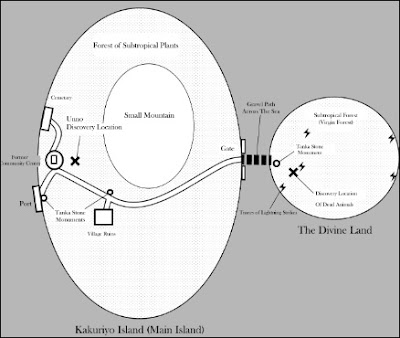


Yuki's outlandish theory is quickly proven correct and places entirely new complexion on both their situation and that of the detective story. Now the problem is not trying to fit motive and opportunity to one of the suspects, but applying the art of deduction to unraveling the nature of the creature ("...so little information and so many unknowns..."). Where did it come from? What can it do? What are its limitations? How intelligent is it? How can they possibly protect themselves from it? One thing that's obvious from the start is the creature, called a Visitor, is halfway between a Chupacabra and a Skinwalker. It sucks living creatures, preferably humans, dry like a juice box. More disturbingly, it can take on the form of its victim in addition to some other distinctly non-human traits and abilities, but its “mimicry” poses a direct treat to the group. Visitor has the ability to replace someone in the group and this danger even extends to animals no smaller than a cat. So they not only have to find answers and trying to draw conclusions from the gathered information, but strategize in order to survive and prevent the Visitor from escaping the island.

A comparison can be drawn with the zombie hoard encircling the villa in Masahiro Imamura's Shijinso no satsujin (Death Among the Undead, 2017), but the Visitor presents the Yuki and the reader with a genuine, ultimate unknown – an intelligent, non-human interloper. An invasive species knocking humanity down a place on the food chain. And with every new discovery about the Visitor, it throws another complication on their various problems while the bodycount and suspicion steadily rises. So not exactly the same obstacle presented by the zombies from Death Among the Undead, but towards the end, the traits and abilities of the Visitors come into play when someone is bumped off while alone in a watched room with a dog guarding the hallway. Solutions to this impossible murder and Yuki's explanation twists and coils right up until the final pages with some wonderful, highly imaginative applications of the Visitor's abilities to the traditional, fair play detective story.

How fairly the game was played here is more impressive than how Kie Houjou handled the ultimate unknown within the confines of the traditional detective story. A good, non-spoilerish example is the coded message the original inhabitants left behind revealing the hiding place of a treasure trove of information on the Visitors. In my experience, Japanese code cracking stories, or subplots, rarely work in translation, but Yuki pointed out that "this code was made to be solved by a complete outsider to the island" – including the reader. Not only is the code 100% solvable, it's solution is a clue in itself. Houjou played it so fairly, she included two relatively short chapters from the perspective of the Visitor. I was, in fact, able to anticipate an important part of the solution without getting all the way. But it was fun trying to find my way in what's new territory for the detective story.

That's another noteworthy aspect of Visitors to the Isolated Island. It demonstrates why hybrid mysteries have become the next frontier for Japanese mystery writers. When done correctly, the hybrid mystery allows to break new ground and create new possibilities, while staying well within the framework of the classically-styled, fair play detective story. Visitors to the Isolated Island is a superb example of the fair play, hybrid mystery done right. Only drawback is how unrealistically perfect, almost dreamlike, all three novels are. Like a collective wish-fulfillment of detective fans come true!

So what else to say, except that The Time Traveler's Hourglass, Visitors to the Isolated Island and Delicious Death for Detectives deserve an official release in as many different languages as possible, because these three detective novels are going to be the classics of the 21st century. To quote Mitsuda Madoy, "they phenomenal, absolute masterpieces" and "boringly perfect" to boot. Highly recommended!

Note for the curious: yes, I know, I rambled on long enough, but something else I liked is how Visitors to the Isolated Island, an experimental hybrid mystery, embodies the past, present and future of the genre. Edgar Allan Poe's "The Murders in the Rue Morgue" (1841) was not only the first modern detective story and first official locked room mystery, but also the first hybrid mystery combining horror with a tale of ratiocination. A line can be drawn from Poe to this book and the direction the genre (in Japan) seems to be headed in the years ahead.

5/3/25

It's the Numbers That Count: Q.E.D. vol. 44-46 by Motohiro Katou

I ended the review of Motohiro Katou's Q.E.D. vol. 42-43 with the plan to have this series wrapped before July, which can be done at the current rate in four twofer reviews, but alluded to similar plans and intentions before – rarely panned as originally intended. Going by past results, it probably would have meant a review of vol. 50 wouldn't have materialized until January or February 2026. I'm going to step up with two threefer reviews this month, review vol. 50 next month and tidy it all up with part two to "The Hit List: Top 10 Favorite Cases from Motohiro Katou's Q.E.D. vol. 1-25." After that, I'll turn my attention to Motohiro's C.M.B. series interspersed with reviews of Q.E.D. iff. I've not forgotten about that recommendation of the archery-themed murder case from The Gordian Knot series. So that concludes these household notes, unto to the review!

The first, of two, stories from Katou's Q.E.D. vol. 44, "Tuba and Grave," brings back the three disaster magnets of the Sakisaka Private High School Detective Club, Enari "Queen" Himeko, Nagaie "Holmes" Koroku and Morito "Mulder" Orisato.

This time, they caused a minor uproar when mistaking a sleeping drunk, on a park bench, for a victim of foul play with their wildly incorrect deductions ("the suspect is possibly an alien, because we didn't find footprints"). So the "absolute imbeciles" get reprimanded, loose access to their club room for a week and warned their club will be disbanded if they get involved in another incident. Before long, those three find themselves in a boy-who-cried-wolf situation when they witness an actual murder: a man being strangled behind a building and his body dragged into an abandoned factory. They decide to call-in an anonymous tip and the police turns up with the man they recognize as the killer to open the factory, which searched top from bottom starting with a suspicious looking case – containing a tuba. A second, obvious place is what looks like a makeshift grave, but only contained a visually pleasing arranged collection of garbage. Props to the police detective for clearing away the junk to continue digging. No evidence of a body or crime was discovered.

So where could the body have been hidden when the police "turned the entire place upside down and didn't find a thing?" The detective club, once again, turn to Sou Touma and Kana Mizuhara to bail them out, but Touma tells them the police will figure it out without their help ("...make sure that you behave and get the club back"). His advice falls on deaf ears as the club goes ahead with their own investigation and Mizuhara doing some legwork in the background, until Touma reappears to reveal what really happened at the factory. Touma's solution to the problem turns, what appeared to be an impossible disappearance of a corpse, into a Columbo-style breakdown of the murderer's alibi and ends up hanging him with his own incriminating words.

So a really excellent and entertaining story. Loved the cheekiness of the method even though (ROT13) vg'f abg n ybpxrq ebbz zlfgrel ng nyy, ohg nppvqragnyyl nccrnerq gb or bar qhr gb gur qrgrpgvir pyho'f vagresrerapr. Gur zheqrere bayl jnagrq gb evt hc na nyvov. By the way, I'm starting to develop a soft spot of the Detective Club. They're absolutely useless idiots, but they mean well.

The second story from vol. 44, "Questions," is one of those puzzles-with-a-heart that are scattered across this series. Touma receives a cryptic invitation to a getaway at a luxurious villa. The invitation is a card with the word "QUESTION" on the front and Fermat's Last Theorem on the inside. And he was not the only one to receive an invitation. Several people going through a divorce have gathered at the villa with similar, cryptically-worded invitations. What follows is basically a cross between a treasure hunt and personal journey's of rediscovery. Touma primarily functions as a sideline oracle giving mini-lectures on mathematics, history of mathematical ideas and "an ever-expanding universe of numbers" ("...didn't understand a thing...").

A decent, if not particular memorable, entry in the series and Katou has done better puzzles-with-a-heart stories before. However, the ending admittedly made for a nice finishing touch to this character-driven story.

The first story from Q.E.D. vol. 45, "Venus," is a somewhat off-beat whodunit. Himichi Sayaka, a second year college student, is arrested on suspicion of having killed her ex-boyfriend, Mizushima Takuya – a third year student. Mizushima Takuya was found beaten to death in his apartment with door and windows securely locked from the inside, however, Himichi Sayaka has a spare key. She was seen near the apartment at the time of the murder and a bloodied baseball bat was discovered behind her own home. They had been fighting over money he owed her. So the prosecution can prove means, motive and opportunity, but the prosecutor has her doubts and asks Touma to see if he can spot a frame job. Mizuhara remains perplexed important people keep asking Touma for help ("but... this guy is still in high school"). If she has been framed for murder, the crime becomes an impossible one.

This story is, strangely enough, interspersed with comic-y vignettes in which a Venusian space girl, named Serge, teaches a talking raccoon in dungarees about the solar system. I really liked the one panel blending the retelling of how the murder was discovered with a floor plan of the crime scene. Some artistic touches that helped to make it stand out and cushion two notable short comings: a murderer who suspiciously stands out and a surprisingly routine locked room-trick for this series. That being said, the conclusion is solid enough with Touma eliminating all but one of the suspects before trapping them with their own words ("...something only the murderer could have known..."). A fair effort.

The second story in vol. 45, "First Love," can be read as an improvement on the previous story. Koba Tomotoshi is pretty average, second year student at Sakisaka High School. And to his very great surprise, Nitobe Rena asked him one day to be her boyfriend.

Nitobe Rena is the beautiful, popular girl at school and their relationship painted a target on his back. Something happened some time later when he took her back to his house and barely inside, they hear a thump coming from the balcony. What they find on the balcony is the body of a fellow student wrapped inside a bag. So how did the body end up on the balcony? It couldn't be a bizarre suicide, because the apartment is on the seventh floor of a twelve floor building and the body would have landed on an upper apartment balcony. Since this incident, Nitobe's parents have forbidden to see Koba. In desperation, he turns to the teenage genius and classroom detective of his school. Touma is currently engaged on, what they call, the Rakugo Artist Case. Mizuhara gets to play detective, collect evidence and contribute a pretty solid false-solution to the story. I had the most fun with this story playing armchair detective. I had a good idea about the who and why, but was stumped by the how. Something I should have figured out, but somehow missed entirely. Yes, I can be very dense at times, but well played regardless!

The first story from Q.E.D. vol. 46, "Broken Heart," is the Rakugo Artist Case and is one of those stolen money stories Katou has done before, but this one has a neat and original wrinkle on the classic locked room situation. The setting of the story is the comedy theater Shitamachi where the princely sum of five million yen is stolen from the senior Rakugo artist, Tsubakiya Kamekichi, who brought the money along for safekeeping. And to ensure its safety during the performance, the money was locked inside a wallet with padlock secured to the handle of a steel ornamental jar. Only to discover later that evening the stacks of bills had somehow been replaced with blank paper! So how was the money taken from the locked wallet? The locked wallet-trick is only a relative small part of this character piece with its theatrical backdrop and backstory of young, aspiring actress/comedian/narrator, but just loved the visual imagery of the locked wallet hanging on a jar.

You don't find that many impossible crime novels or even short stories fiddling around with padlocks, because you have to ignore the fact they're not all that reliable and easily picked open. Suppose the same holds true for this story and the possibility alone should have made the person watching over the jar the primary suspect. Just going with the story, Katou demonstrated yet again you can achieve great effects with relatively simple, straight forward tricks. Loved it!

For those sick and tired of me droning on about locked rooms and alibis, the next story is for you. "Pilgrimage" is probably the darkest, most disturbing story this series has told and has Touma reconstructing a long-forgotten, deeply buried secret dating back to the Second World War. The story begins in the present with Uchibori Koyuki, a proof reader, finding an unpublished manuscript written by her late father, Shoichiro, who was a non-fiction writer. Manuscript is titled Pilgrim and has three handwritten notes on the cover, "rejected," "coincidence?" and "intentional?" Why was it rejected and shelved? She shows the manuscript to Touma and he found the subject matter more interesting than the reason why it was rejected. Pilgrim tells the tragic story from the early 1940s of a serial robber who accidentally killed one of his victims, a young newlywed woman, which forced him to flee the country. Yamai Seimei was eventually captured in Hanoi, Vietnam, ensuring "the bastard will get the death penalty." Usui Shigeru, victim's husband, travels to Hanoi under wartime circumstances, but halfway through he decides to continue the journey to Hanoi on foot – about a 1000 km journey. Two months later, Usui Shigeru arrives at the court in Hanoi and asks the court to spare his wife killer by commuting his death sentence to a prison sentence. But why? More importantly, why was it not enough to save the killer from death? And, of course, the reason is also why the manuscript remained unpublished.

A very dark, disturbing reason. Not that you would get that impression from the description, so far, because “"Pilgrimage" starts out with a human touch of Chestertonian wonder. A man forgiving and sparing the life of his wife's murderer following a mysterious, self-imposed pilgrimage and the wonder what he could have experienced during those two months. Only for it to turn in a terrifying, pitch-black and nightmarish horror plucked from the pages of an Edgar Allan Poe tale. Or, in this case, Edogawa Rampo. Bravo!

So, on a whole, not a bad collection of stories covering these three volumes. "Tuba and Grave," "First Love" and "Pilgrimage" are the obvious standouts and personally liked "Broken Heart" for its locked wallet mystery. Only "Question" and "Venus" trailed behind, but even they had their moments. Far from disappointed and look forward to the next three volumes, which you can expect before too long.

4/10/25

Background Details: Case Closed, vol. 93 by Gosho Aoyama

The 93rd volume of Gosho Aoyama's Case Closed traditionally begins with the conclusion to the story that started in the previous volume, which finds Conan and Harley Hartwell at Coffee Poirot during a brief blackout – used as a cover for an attempted murder. When the lights turn back on, they find one of the customers crumpled up on the floor with a serious knife wound. A messy job spattering both Conan and Harley with blood. So the culprit must also be covered in blood, but none of the four suspects have so much as drop of blood on their hands or clothes. And how could the murderer have navigated a pitch-dark cafe to find the victim?

Plot-wise, the story is typical for this period, in the series, written around a trick-of-the-week which tend to have mixed results. This trick is hampered by its Frankenstein construction. I liked that the problem the stabbing presents is halfway between an impossible crime and an unbreakable alibi, but only the method the murderer employed to locate the victim is really good. I found it pleasantly surprising and had no idea that's actually possible. If you're interested, this YouTube video demonstrates it (spoilers, of course). However, it feels wasted on this story and the trick used to avoid blood splatter is clever in theory, but, considering the amount of evidence the would-be killer left behind, it comes across as delaying tactic rather than a serious attempt to get away with it. Inspector Meguire and his forensic team eventually would have stumbled to it without Conan, Harley or that barista detective.

It honestly would have made for a better, more satisfying, detective story had the murderer just used the location-trick/alibi to slip or inject the victim some poison. That being said, the story is not only about a strange stabbing at a cafe, but sets the tone for the overall volume as the individual cases basically function as stages for the bigger storylines, character-arcs and introducing new faces. This first story introduces two characters tied to a new storyline involving Harley. And it helped this otherwise average, uneven story.

Only exception is the next and best story from this volume. I mentioned in previous reviews I dislike kidnap plots, because they make for lousy detective fiction or paint-by-number thrillers, but Case Closed has delivered a couple of surprisingly good, original even, mystery-thrillers with a kidnap plot – e.g. vol. 72. The kidnap victim this time is Richard Moore's ex-wife and Rachel's mother, Eva Kaden, who's a successful attorney at law with enemies. Some of her enemies banded together, kidnapped her and brought her to an abandoned building to do some uncharacteristic heinous things (for this series) to her. Fortunately, Eva manages to escape and hide somewhere in the building to contact Rachel through a messenger app on her phone, but one of kidnappers joins the group chat under Eva's name ("mom is multiplying"). So now Conan, Rachel and Richard Moore not only have to find out where Eva is held captive, but how to separate Eva's real messages from the false ones. What ensues is a three-way cat-and-mouse game between Eva, her kidnappers and Conan & Co.

Admittedly, the setup is a little bit contrived, tech-wise, as the kidnappers had to strip down their phones (removing sim card, disabling GPS, etc.) to the point where they can make calls or use an app over the internet ("a police station antenna can't pick up WI-FI signals"). But it made for an incredibly fun story. I really liked how the messenger app was used to drive and direct the story, which in turn also provided a neat twist on the related code cracking and dying message stories from this series. Loved it!

Interestingly, Conan had to take charge and direct a panicked Richard and Rachel, which forced him to act more like Jimmy Kudo than Conan Edogawa. Rachel notices Conan's deduction skills aren't "those of an ordinary first grader" and finally demands answers from Conan. The ease with which Conan sidetracks Rachel is just ridiculous so close to vol. 100. We have reached the point where Rachel can catch Conan doing the "Sleeping Moore" routine and all he would need to do distract her is flash a laser pointer or jingle keys with his free hand.

The third story takes place during one of the regular, not always bloodless, camping trips of the Junior Detective League, but Doc Agasa is sick in bed and Rumi Wakasa takes his place – who has been behaving suspiciously since her introduction in vol. 91. She has caught the eye of Superintendent Hyoe Kuroda, of the Nagano Police, who also caught on the fact Conan is pretty much "Sleeping Moore's brains." So he right there at the camping ground alongside the Junior Detective League and a small group of college basketball players. Needless to say, the last group end up providing the story with a body and murderer. One of them burns to death while alone in his tent that had been tightly "zipped and locked shut" from the inside. More importantly, the victim was seen by everyone doing squats in his tent before the tent caught fire. It appears to be an tragic accident, but Conan believes it was murder. And proves it!

Just like the first story, the answer involves a two-part trick. I liked the simple, uncomplicated solution to the locked tent and the elaborate, maybe overly elaborate, fire-trick is undoubtedly very clever, but feels entirely out of place in this story with its outdoors setting. So not bad, on a whole, but it feels very uneven. I think the presence of Hyoe Kuroda and Rumi Wakasa added more mystery to the story than the quasi-impossible murder in a locked tent. Both fit the description of a high-ranking member of the Black Organization.

This volume ends with the setup of a story that will be concluded in the next volume, but setup is a good one with a crossover bonus. Harley is participating in a high school kendo tournament with a good chance of taking home the gold, when the tournament unsurprisingly becomes the scene of a gruesome murder. Someone dressed as a kendo fighter with mask, face covering and knife slashes one of the referees to the death in front of a blind witness – who heard the murderer go into the public restroom. And he heard nobody coming out since then. So the three people inside the restroom form a nice, tight closed-circle of suspects, but they're all free of blood? The solution to that problem will be presented in the next volume, but note that the story has two cameo crossovers by characters from Yaiba ("a hit comedy-adventure series which Aoyama created before Detective Conan").

So not a terribly bad or below average volume, especially not the excellent kidnapping of Eva Kaden, but overall, the stories are very uneven and an undeniable step down from the previous volume. What happened in the background of the stories really is what helped to keep this volume above average by preventing from it becoming terribly uneventful or worse.