I
always try to somewhat vary the type of detective novels and short
stories discussed on this blog. For example, I recently reviewed
James Ronald's pulp-style impossible crime novel Six
Were to Die
(1932) followed by a character-driven whodunit by Nicholas Blake (The
Dreadful Hollow,
1953), two Japanese manga
mysteries (Motohiro Katou's Q.E.D.
vol.
35-36)
and J.S. Savage's retro-GAD The
Mystery of Treefall Manor
(2023) – which I think is varied crosscut of our corner of the
genre. There's, of course, a difference between trying and
succeeding. A firmly established tradition on this blog is that the
locked room mystery is omnipresent and impossible to escape. Whether
discussing Golden Age mysteries, their modern-day descendants or the
detective stories currently getting ferried across multiple language
barriers. The locked room is always present.
obsessed
fascinated with the damn things. This blog is currently going through
one of those periods, but this time, I've an excuse
a pretty good reason to fanboy all over them make a
rigorous study of them.Last
year, I put together "The
Locked Room Mystery & Impossible Crime Story in the 21st Century:
A Brief Historic Overview of the First Twenty (Some) Years." I
very soon realized I should have waited until 2025 as two more years
would have given a much clearer picture of the current developments.
So the plan is to eventually do a follow-up focusing solely on the
ten-year period 2015-25, which is why I have been building a small
pile of contemporary, retro-GAD mysteries. Not all of them are of the
impossible variety, but most are and intend on decimating that pile
in the two, three months ahead – interspersed with some golden
oldies. So that's what you can expect in the coming weeks and months,
but first need to get some odds and ends out of the way.
I
previously compiled three posts under the title "Locked and
Loaded," part 1,
2
and 3,
which reviews uncollected short stories. This time, I had a handful
of uncollected stories from the past 60 years (1963-2023) that I
needed to get out of the way.
Lawrence
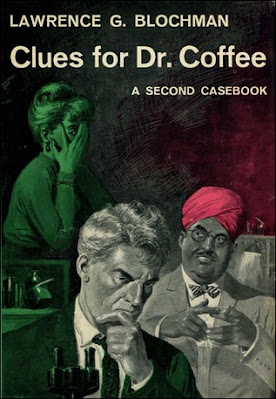
G. Blochman's "Murder Behind Schedule," originally published
in Clues for Dr. Coffee (1963) and reprinted as "Young Wife"
in the November 17, 1963, publication of This Week. A very
short, but legitimate, impossible crime story somehow not mentioned
in Robert Adey's Locked Room Murders (1991) nor Brian Skupin's
Locked Room Murders: Supplement (2019). This is the perfect
filler material for locked room-themed anthology as it's short,
simple and not devoid of interest. Dr. Daniel Webster Coffee, chief
pathologist at Pasteur Hospital, is trying to work on New Methods
of Post-mortem Diagnosis of Drowning when Lieutenant Max Ritter
whisks him away to the scene of a very curious crime ("...like a
case for that Dr. Gideon Fell you made me read about last summer").
Michael Waverly is a patron of the arts and a hard businessman,
"people either worshiped him or hated his guts," who
collected enemies left and right. Even at home. Waverly's marriage is
on the rocks as his wife is having an affair with the second
violinist of the Waverly String Quartet and someone tried to kill him
only a week ago. Ritter received a frantic call from Waverly, "he's
after me again," followed by a groan, loud banging noises and
then utter silence. So what, exactly, happened and how did the
murderer manage to escape from a locked room?
Like
I said this is a very short, good and cleverly constructed detective
story with an interesting and even realistic take on the classic
trope of a murder inside a locked room. A locked room situation that
would not be out of place in an episode of CSI. Despite being,
what can called a realistic impossibility, Mike Grost points out on
his website that the story "contains
a gracious homage to John Dickson Carr" and "Carr in
turn was a fan of Blochman" praising "his stories in
print" – which got Clues for Dr. Coffee moved nearer
the top of the pile. This short story and praise from Carr is enough
to warrant further investigation.
Edward
D. Hoch's wrote "The Locked Room Cipher" for a game-themed
anthology, Who Done It? (1980), which hid the identity of the
authors behind a code. So the story is not particularly well-known
either as a work from Hoch's hand or as a locked room mystery."The
Locked Room Cipher" stars the one-shot detective and newspaper
columnist, Ross Calendar, who's invited by Terry Box to attend a high
profile reunion. Terry Box had once worked in Washington, "doing
something with codes and computers," but nowadays owns and runs "the hottest new disco restaurant since Studio 54," Sequin
City – a place with some peculiar features. Beside giving its
patrons the feeling they're in Hollywood or Las Vegas, every room and
corner is under the watchful eye of closed-circuit TV cameras. The
mirrored panels are actually one-way glass allowing viewers from
above to watch the action below without being seen ("...something
more suitable to a bank or gambling casino than a New York disco").
Now there's a reunion with three of Box's former colleagues from
Washington who all worked with computers, ciphers or both. During the
reunion, Box and Calendar witnesses one of them getting shot and
killed on live CCTV inside the private dinning room with the door
securely bolted from the inside. When they break down the door, the
murderer has vanished and the only clue is a computer print-out of a
cipher found in the victim's pocket.
Just
as to be expected from Hoch, "The Locked Room Cipher" is a
competently put together detective story, but the most difficult one
to crack. The murderer is easily spotted and the method to create the
illusion of an unseen shooter vanishing from a bolted room under
camera surveillance is easy to anticipate. However, the passage of
time turned it into a historically noteworthy "modern" impossible
crime story. Sure, the technology used in the story is hopelessly
outdated today, crude and clunky, but that crudeness gives it a charm
of its own. More importantly, it's technological crudeness is what
allowed Hoch to put a new spin on an old trick. In 1980, "The
Locked Room Cipher" must have impressed as a promising example of
what can be done with the classical locked room in a high-tech
environment.
I
wonder if detective fans of the future will look back on a story like "The Unlocked Locked Room Murder" (Gosho
Aoyama's Case Closed, vol.
79) as crude and clunky, but quaint and pleasantly old-fashioned?
After all, by that time they should be experiencing (which replaced
reading) detective stories in which murderers create unbreakable
alibis with AI-operated, holographic doubles or creating locked rooms
with nanomaterials that can form a sealed door. Anyway...

"The
Painter Who Loved the Truth" could have just as easily been titled "The People Who Played Dominoes," because the story is plotted
around the domino-effect as "crime sometimes takes the form of a
game of dominoes, which are placed half a stone apart and upright"
("if the first one falls, they all fall"). That proved to
be the case when an outgoing minister, Herman van Grootheest, is
shockingly shot to death in his vacation home on Texel, "the
first assassination of a prominent politician since Pim Fortuyn,"
but the police soon have a prime suspect, Joost Leijendekker – a
house painter who was in possession of the murder weapon. And that's
not the only damning evidence the police uncovers. During a
reconstruction on the island, Leijendekker manages to escape and his
flight ends on the doorstep of the two private investigators of
Research & Discover, Robbie Corbijn and Lowina de Jong.
Leijendekker
pleads he's innocent and Corbijn wants to help "the most wanted
man in the Netherlands," but the painter is not exactly making
it easy by insisting the gun was in his possession at the time of the
murder. Not only in his possession, but safely under lock and key!
Nobody except him knows the code to the safe. The trick to explain
this impossibility is a neat one. However, this story is even better
in its cause-and-effect structure as Corbijn and De Jong have to pick
apart a series seemingly unconnected incidents that proved to be
domino stones toppling one after another, which created the
circumstances allowing for the murder to happen. It's a pleasing
effect.
Tom
Mead is a prominent member of today's locked room revivalists who
signed his name to three novels, Death
and the Conjuror (2022), The
Murder Wheel (2023) and the upcoming Cabaret Macabre
(2024), and a growing list of short
stories – which I wish were easily available. Preferably in one
place like a proper short story collection. One easily accessible
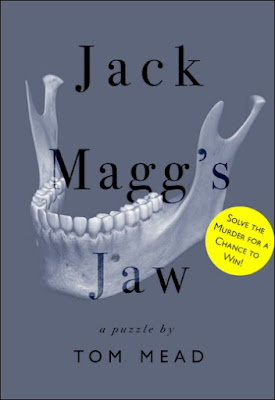
short story from Mead you can read right now is "Jack
Magg's Jaw" (2022).
After
last year's Monkey
See, Monkey Murder (2023), James
Scott Byrnside is currently working on a collection of short
stories featuring his two Chicago gumshoes from the Roaring Twenties,
Rowan Manory and Walter Williams. On the last day of 2023, Byrnside
posted the first short story from that future collection, "The
Silent Steps of Murder," on his blog as a New Year's present.
Thanks! Very much appreciated and enjoyed!
"The
Silent Steps of Murder" begins with Rowan Manory and Walter
Williams out and about on New Year's Eve, "Chicago was ready to
bid farewell to 1927," when they hear someone yelling murder. A
young beat cop, Quinn, who immediately recognizes Chicago's famous
detective and tells Manory he heard a loud crash, or noise, coming
from one of the apartment buildings on his beat. When he goes to
investigate, Quinn finds the body of the woman who lives there with a
gunshot wound to the chest and stab wounds to the face. The state of
the room suggests a robbery gone wrong or, perhaps, arranged to
appear like a botched burglary that ended with a brutal murder. Just
one problem. The murderer has to be still in the building, because
the only footprints in the snow outside belong to Quinn. Manory
assures Williams that Quinn is not the murderer, but, if not Quinn,
who else could have left the place without leaving footprints?
There's
a challenge to the reader, "Rowan has already solved the case.
Have you? Here are some questions you should be able to answer,"
but it took me until after that point until things began clicking
into place. Even then, I considered another variation that was
actually mentioned in the comments. However, the solution deserves a
blue ribbon. A bold move turning the story from an impossible crime
story into a grand-style whodunit. This is exactly what I hoped
envisioned would emerge from the Golden Age renaissance of the past
decade. Go read it now and I look forward to complete collection
which appears to have an overarching storyline.
So
this rambling has gone on long enough. Next up is a (non-impossible)
gem (I hope) from the 1930s.