Showing posts with label Old-Time Radio. Show all posts

8/20/25

This is Murder, Mr. Jones (1943) by Timothy Fuller

Last month, I looked at Timothy Fuller's fifth and final Jupiter Jones novel, Keep Cool, Mr. Jones (1950), which appeared after a seven year hiatus following the publication This is Murder, Mr. Jones (1943) – reads like a soft, updated reboot of the series. Well, I remember Jupiter Jones starting out in Harvard Has a Homicide (1936) and Three Thirds of a Ghost (1941) as a lighthearted, wisecracking take on the Van Dinean, Ellery Queen-style detective. But those memories have become hazy over the years. I recall just enough to notice the leap from young, fresh faced college snoop to a middle-aged man living in the suburbs with a wife and children.

Keep Cool, Mr. Jones is not a success story when it comes to trying to reinvent a Golden Age character for the second-half of the previous century or relaunching the series, but enjoyed it enough to track down a copy of This is Murder, Mr. Jones. That proved to be an unexpected surprise as I expected nothing more than a fun, lightweight mystery with a radio background and locked room murder. It certainly is a nimbly-plotted mystery novel satirizing radio dramas, but This is Murder, Mr. Jones got more out of both than appeared possible at first sight. Among some other noteworthy touches to the story and plot.

Following his outings in Harvard Has a Homicide and Three Thirds of a Ghost, Jupiter Jones is getting a reputation as an amateur detective. Jupiter's status as an amateur detective landed him an invitation from Emerson West to attend to one-year anniversary live show of his radio program, This is Murder. West, "the poor man's Woollcott," plans to mark the occasion with an reenactment of the century-old, unsolved murder at Parker Hall, in Molton, Massachusetts, where "Felicia Parker was done to death" – presumably by her husband. Robert Parker had "ample grounds to murder his wife" and a reliable enough alibi to clear him from suspicion. So the case entered the annals of crime as one of those tantalizingly unsolved mysteries that has been discussed for decades. Jupiter gladly accepts the invitation and travels with his wife, Betty, to now abandoned Parker Hall where the cast and crew has gathered to prepare and rehearse for the broadcast.

West attracted three well-known actors, Carla Blake, Gordon Dane and Katherine Moore, to play to principle players in the drama ("...amazing what blackmail can do"). The people behind the scene is the director, Rocky Davenport, Foley, the sound man, and the announcer, Burroughs. West is further assisted by his personal ghostwriter, Grant, and lovely "feminine assistant" named Miss Terry Stewart. There are also several guests, beside Jupiter and Betty Jones. Elmo T. Gillespie, "a fellow criminologist," is a collector of murder weapons who actually brought the knife from the Parker case along. A Mr. Brown, real estate agent and current owner of Parker Hall, who's brought along his wife. Finally, Mr. Jerome, a representative of the show's sponsor, who's also accompanied by his wife. Show goes off without a hitch, but when they go off the air, West announces to the group he's going to present them with the solution to the Parker case. A private showing, of sort, requiring "a short re-enactment of the crime itself" in which West locks himself away in the bathroom. But never comes back out. When they break open the door, they find West lying in a pool of blood. His throat cut with the Parker knife. What appeared to be suicide quickly proves to be an impossible murder. Not only how the murderer vanished from the bathroom, but how the knife was brought into the bathroom.

I should note here that the impossibility is quickly resolved and the bare-bones mechanics of the locked room-trick is nearly as old as time, but how this hoary, time-worn trick is employed was pleasingly original – a new wrinkle to an old trick. Basically, (SPOILER/ROT13) Jrfg unq uverq n pnecragre gb pbafgehpg n frperg qbbejnl va gur onguebbz, orpnhfr gur ubhfr jnf tbvat gb or qrzbyvfu naljnl. Fb gur cyna jnf gb cergraq ur unq sbhaq gur tncvat ubyr va Eboreg Cnexre'f onguebbz nyvov, ohg hajvggvatyl cebivqrq uvf zheqrere jvgu n tbyqra bccbeghavgl. Genuinely enjoyed that aspect of the plot, minor as it may be. What makes This is Murder, Mr. Jones a noteworthy mystery is not its locked room murder, or how it was treated, but its radio background.

After the first shock, they realize they can make radio history by doing "a direct broadcast from the scene of the crime" and "put the investigation on the air." And triple their audience over night. This part of the story feels decades ahead of its time and, to my knowledge, not something that has been used during the Golden Age of Radio. By the way, Orson Wells and his 1938 War of the Worlds broadcast gets a mention ("it made Welles" and "it didn't hurt the Martians"). But my favorite part of this plan is the discussion on whether, or not, it would be appropriate to break the show for a word from their sponsors. Because, you know, one of them probably killed the show's host. So, breaking the show with this killer of a line, "well, ladies and gentlemen, any minute we may find that the lovely Carla Blake was the one who slashed Mr. West's throat, but in the meantime eat Chummies, the dandy candy," is perhaps bad optics.

That the police not only play along, but even allow the first round of questioning to be aired to a nationwide audience is preposterous. But therefore not any less fun. Not only a fun, cleverly done slant on the normally routine questioning of suspects, but really something that feels ahead of its time.

So the broadcast is howling success with the audience baying for more. And, as that second broad is prepared, the case continues to develop off-air. Those developments include two additional bodies, however, they're not page-filling corpses dropped to pad out the story, but flow directly from the first murder – provide clues to the who and why. Fuller continued to show some innovation and creativity with the ending, especially how Jupiter solves and resolves the whole case. Firstly, the way in which Jupiter finally puts together all the pieces together is not exactly conventional and "may well open up a whole new field of criminal detection." I'm sure Ronald Knox would disapprove, but it fitted the overall tone of the story and piled on another memorable feature to the story. The traditional gathering of the suspects for the denouement is conventional enough, despite taking place live on air, but became worried at this point the century-old murder case was forgotten about and doomed to remain an unresolved mystery. Right before signing off, only half a page left to go, Jupiter quickly gives his solution to the historical case and reminds the listeners/readers "to invest in War Bonds and Stamps."

I think it goes without saying This is Murder, Mr. Jones is grand fun with some clever, creative and even memorable touches to plot and a couple of old, dusty tropes. Even the motive came across as fresh and original for the time. It all added up to something surprisingly good and unexpectedly rewarding. However, I do fear my enthusiastic rambling might be misinterpreted. So don't expect This is Murder, Mr. Jones to deliver a locked room mystery from the caliber of John Dickson Carr with an Agatha Christie-style rug pull of an ending, but neither should you expect a solid second-string mystery. It's a little too good, and too original in parts, to be relegated to second-tier status. This is Murder, Mr. Jones is very much in the tradition of the better American murder-can-be-fun mysteries Rue Morgue Press specialized in reprinting like Kelley Roos, Stuart Palmer and Craig Rice. That's not a bad company to be in.

Note for the curious: I don't have a brilliant and dazzling alternative solution for the Parker murder case, but a simple possibility that was never mentioned. Now the details of the murder itself are scant and a bit sketchy, but one thing stands out. West mentioned many pet theories emerging over the years, "even heard scholarly gentlemen suggest that the good gardener perpetrated the dastardly crime," but no mention of the proverbial chink in the armor – namely the nurse who alibied Parker. So here's how I figured it (ROT13 to obscure plot details): Eboreg Cnexre jnf fvpx ng gur gvzr naq arrqrq n ahefr. Jura uvf jvsr jnf fgnoorq, Cnexre jnf va gur onguebbz jvgu gur ahefr jnvgvat bhgfvqr gur qbbe. Cnexre qvq vaqrrq fgno uvf jvsr naq rfpncrq whfgvpr jvgu uvf uloevq ybpxrq ebbz-nyvov, juvpu znxrf vg n dhrfgvba bs ubj ur qvq vg. Guvf nyfb tvirf ebbz sbe na nygreangvir rkcynangvba, orpnhfr vg zrnaf Cnexre qbrfa'g gnyx gb uvf ahefr jura ur'f va gur onguebbz. Naq fur whfg jnvgf hagvy ur pbzrf bhg. Fbzrguvat ahefr pbhyq hfr nf fur jbhyq cebonoyl xabj ubj ybat vg gnxrf ba nirentr sbe uvz gb or qbar. N ahefr gnxvat pner bs vainyvqf, be frzv-vainyvq, vf svg rabhtu gb eha orgjrra gjb sybbef, xabjf jurer gb fgno naq abg znxr n zrff bs vg. V fvzcyl nffhzrq gurl jrer univat na nssnve naq nyvovrq rnpu bgure, ohg vg jbhyq or rira orggre vs gur ahefr unq gur rknpgyl fnzr, gentvp zbgvir nf gur cerfrag-qnl zheqrere. History never repeats itself, but it rhymes from time to time.

6/25/25

Zombie Mail: "The Devil in the Summerhouse" (1942) by John Dickson Carr

Two months ago, John Norris, of Pretty Sinister Books, posted a review of Charles Ashton's annoyingly obscure, long out-of-print Death Greets a Guest (1936) in which a summerhouse during a storm becomes the scene of an impossible murder – an impossible that got compared to the works of Anthony Wynne. One of the early detective writers to specialize in locked room murders and other impossible crimes. I thought John's description of the inexplicable shooting in the watched summerhouse reminded me of a radio-play John Dickson Carr penned for the CBS radio series Suspense.

There are two versions of "The Devil in the Summerhouse." The first version, featuring Dr. Gideon Fell, takes place in England and aired on BBC radio in 1940, but the second version takes place in New York and Dr. Fell was replaced with Captain Burke of the New York police. I think this Suspense version, originally broadcast on November 3, 1942, is the better known of the two because its script received several notable publications. "The Devil in the Summerhouse" was printed in the September, 1946, issue of Ellery Queen's Mystery Magazine and reprinted in Dr. Fell, Detective and Other Stories (1947) and The Door to Doom and Other Detections (1980). So wanted to refresh my memory on this one after John's review of Ashton's Death Greets a Guest.

"The Devil in the Summerhouse" is a small, intimate affair bringing two men to the overgrown grounds of a small house near the Hudson with a spacious garden and "a summerhouse of evil memory." A place where twenty-five years ago Mayor Jerry Kenyon apparently committed suicide.

One of the two men is Captain Burke and the other Joseph Parker, a family lawyer, who received, what should have been, a dead, undelivered letter – dated November 2, 1918! The letter reads "if you want to know how Major Kenyon really died, look in the third drawer of the desk in the library" ("press hard at the back of the drawer"). Parker was present twenty-five years ago when Kenyon was found dead in the summerhouse with a scorched bullet hole in his head and the gun beside him. Others who were around at the time were Mayor Kenyon's wife, Isabel, her younger brother Paul and their maid, Kitty. Angela Fiske, "the other woman," unexpectedly dropped in before the body is discovered. Only these people could have pulled the trigger, but everybody has an alibi. So the police settled on suicide, the case was closed, time moved on "and now they're all dead." And nearly forgotten, until that letter from 1918 arrived. When they open the secret drawer, they discover something that makes the past come alive. More impressively, through Carr's words, it gets the quality of a ghost story with such lines as "don't look at it as if it were alive" and "don't talk back to the thing, man, or you'll drive me crazy."

Fortunately, Burke's reason for being there is to bring the whole case back down to earth, shooting an alibi to pieces to reveal a neatly hidden murderer and to bury the past. Yes, bury the past is a euphemism for covering up the truth in typical Carrian fashion, however, the murderer this time doesn't go unpunished.

I remembered "The Devil in the Summerhouse" being a fully fledged locked room mystery, but it really is more in line with the alibi-breakers of Christopher Bush and not a bad one at that either! A very well done, compactly-plotted murder-from-the-past puzzle calculated to intrigue, to stir your nerves, to offer a precarious situation and then withhold the solution until the last possible moment. In short, "The Devil in the Summerhouse" is a story to keep you in... Suspense!

5/13/24

Dr. Morelle Investigates (2009) by Ernest Dudley

Vivian Ernest Coltman-Allen, known better under his adopted stage-and penname of "Ernest Dudley," was an English actor, dramatist and mystery writer who created the popular BBC weekly radio series The Armchair Detective – reviewing "the best of the current releases of detective novels, dramatising a chapter from each." The program reviewed John Russell Fearn's One Remained Seated (1946) and that attracted the attention of Fearn's agent-biographer-champion Philip Harbottle some fifty years later. Harbottle became Dudley's friend and agent, which is why Dudley's otherwise obscure detective fiction is still in print today. Harbottle has worked decades to ensure the writers under his care, like John Russell Fearn, Gerald Verner and Ernest Dudley, remain in print.

Dr. Morelle Investigates (2009) collects two long-ish short story adaptations of a radio and stage play, "Locked Room Murder" (1954) and "Act of Violence" (1959), solved by the eminent psychiatrist, Dr. Morelle ("he is also an expert on crime"). Dudley created Dr. Morelle for the BBC radio anthology series Monday Night at Eight and was a hit with the audience leading to a movie, TV series, stage play and a series of short stories and novels. So this two-story collection of a radio-and stage adaptation sounded like a potentially fun and interesting follow up to John Dickson Carr and Val Gielgud's 13 to the Gallows (2008).

“Locked Room Murder” is an adaptation of a stage play, Doctor Morelle, Dudley co-wrote with the then Secretary of the British Board of Film Censors, Arthur Watkyn.

The story begins one late Saturday evening when Brian Cartwright is visited by four friends, Philip, Nigel, June and Evelyn, who were involved in a drunken, fatal hit-and-run accident – learning from a radio broadcast the victim had died. So they turn to their friend in something of a jam, but Cartwright happen to be in desperate need of money and turns his hand to a spot of good, old-fashioned blackmail. Cartwright promises to keep his mouth shut in exchange for two-thousand pounds ("between the four of you that shouldn't be embarrassing"). A demand that doesn't go unchallenged as one of them sends Cartwright a death threat, but Cartwright turns the table on them by inviting them to dinner with three additional guests. The first is a journalist, Bill Guthrie, who was already interested to write about the history of the house for his "Criminal Corners of London" column ("some female was battered to death a hundred years ago where your pantry is now"). The last two are Dr. Morelle and his secretary, Miss Frayle.

Cartwright shows them the death threat ("We have till nine o'clock. So have you. R.I.P.") and calls their bluff in front of three witnesses. Either they agree to a simple transaction or he's going to police. Cartwright is going to wait until then in his study with the doors locked from the inside and the windows to the balcony securely bolted, but, when the clock strikes nine, they hear a gunshot from the locked study. Who killed Cartwright and how, when he was all alone with every entrance locked and bolted from the inside? Dr. Morelle takes charge of the case and solves the murder in exactly an hour, but is it any good? That's a bit of a mixed bag.

"Locked Room Murder" is not a very challenging, or fairly played, detective story with, what some would consider to be, a second-rate locked room-trick. There is, however, a pleasing cat-and-mouse atmosphere permeating throughout the story. You have a brazen blackmailer trying to get back at his victims when one of them threatens him anonymously, but the story also appeared to toy with its audience. The locked room-trick might not be the stuff of legends, neither was it overtly apparent from the start with the crime scene littered with "clues" all suggesting different possibilities. From the planned, short blackout as the electricity company changes over to a new grid system and Cartwright smoking a cigar in a pitch-black room to the old-fashioned telephone with separate mouthpiece and receiver bolted to his desk all suggested different possibilities. Even the money troubles and the victim's brazen behavior implied the dreaded suicide-disguised-as-murder was not off the table. Dr. Morelle struggled with spotting the locked room-trick as well and has to accept the murderer's challenge to find it before the hour is out or become the next victim of the devilish murder method.

So, while not one of the most ingenious detective stories ever conceived, "Locked Room Murder" nonetheless turned out to be a fun read with a minor, but pleasing, element of the unexpected.

The second short story, "Act of Violence," is an adaptation of a Dr. Morelle episode from Monday Night at Eight. Dr. Morelle and Miss Frayle are invited over to dinner by Professor Owen a day before he's going to marry his secretary, Mary Lloyd, who secretly loves his laboratory assistant, Glyn Evans. Along the way, Dr. Morelle and Miss Frayle pass a gas station run by a Robert Griffiths. Dr. Morelle recognizes him as the young man who was on trial and sentenced to hang for murder, but had been reprieved to begin life anew. There's a manuscript of a dramatic sketch, sent in anonymously to the local dramatic society, which reenacts the murder that almost hanged Griffiths ("...only a short sketch but it certainly packs a punch"). Griffiths is going to play his own part!

This sounds a little disjointed and Dudley takes his time to set everything up, while leaving the reader in the dark about the direction the story is eventually going to take, but the potential for a good detective story was there – depending on how the ending is going to pull everything together. And that's the problem. Dr. Morelle ties everything together, but the solution is not all that impressive and made the long preamble feel like stalling and padding out the story. Dudley should have focused either on the domestic story of the eternal triangle or gone with the theatrical storyline and the anonymous manuscript, because this didn't work.

So, thematically, Dr. Morelle Investigates makes for interesting comparison material to the stage plays by Carr and Gielgud, but should have read these two adaptations before, not after, 13 to the Gallows as Carr is a hard act to follow. At least "Locked Room Murder" was fun and entertaining.

5/9/24

13 to the Gallows (2008) by John Dickson Carr and Val Gielgud

This year marks the 30th anniversary of Douglas G. Green's founding of Crippen & Landru, a small publishing firm specialized in short story collections, whose first publication was John Dickson Carr's Speak of the Devil (1994) – a BBC radio serial originally written and broadcast in 1941. C&L was decades ahead of the curb and gave mystery fans a taste of the coming reprint renaissance with their "Lost Classic" series. A series of short story collections comprising of such early gems as Stuart Palmer's Hildegarde Withers: Uncollected Riddles (2002), Craig Rice's Murder, Mystery and Malone (2002), Helen McCloy's The Pleasant Assassin (2003), Joseph Commings' Banner Deadlines (2004) and Ellery Queen's The Adventure of the Murdered Moths (2005). Not to mention Queen's previously unpublished novel collected in The Tragedy of Errors and Others (1999).

There are fortunately no signs C&L is slowing down or stopping anytime soon as Jeffrey Marks, "the award-winning author of biographies of Craig Rice and Anthony Boucher," took over from Douglas Greene as publisher in 2018.

In March, I reviewed one of their latest publications, Pierre Véry's Les veillées de la Tour Pointue (The Secret of the Pointed Tower, 1937). A collection of imaginative short mystery stories, translated from French by Tom Mead, published in 2023, but was unaware of the C&L's 30th anniversary and neglected to mention it when I wrote the review. It was not until a review of Edward D. Hoch's The Killer Everyone Knew and Other Captain Leopold Stories (2023) appeared on In Search of the Classic Mystery Novel that I was reminded of C&L's 30th anniversary. So a good excuse to finally move those Anthony Berkeley, William Brittain and Hoch collections to the top of the pile, but not before revisiting one of my favorite C&L collections from my all-time favorite mystery writer.

13 to the Gallows (2008) is a collection of four, never before published manuscripts of stage plays John Dickson Carr wrote during the early 1940s and collaborated on two of the plays with his friend and then Director of Drama at the BBC, Val Gielgud – who had a "shared interest in detective stories and fencing." Gielgud wrote detective novels himself and you would think the name of a British broadcast legend on the covers of Death at Broadcasting House (1934), Death as an Extra (1935) and The First Television Murder (1940) is a guarantee to keep them in circulation, but they have all been out-of-print for ages. This collection of stage plays is the first time his name appeared on a piece of detective fiction in over thirty years. What a way to make a comeback!

Just one more thing before delving into these plays. 13 to the Gallows is edited and introduced by Tony Medawar, a researcher and genre archaeologist, who also littered it with Van Dinean footnotes and even included "Notes for the Curious." Medawar's detailed introduction should give you an appreciation of the time and work that went into the making of this volume of "Lost Classics." One of the many fascinating background details is that it was "the late Derek Smith who first conceived of this collection." So with that out of the way, let's raise the curtain on this collection of stage plays from a once forgotten period of Carr's writing career.

The three-act play "Inspector Silence Takes the Air" (1942) is the first of two collaborations between Carr and Gielgud, which is also the first of two plays that take place in a BBC radio studio. In this case, it's the cellar below a country house on the outskirts of a provincial town that was taken over by the BBC as an emergency security set of studios. When the story begins, they're rehearing the first episode of a true crime program called Murderer's Row starring ex-Chief Inspector Silence to talk about the Kovar case. It was his first big case ("I hanged the criminal") in which Thomas Kovar shot his wife's lover. A part of the program is a dramatic reenactment of the shooting, but the producer, Anthony Barran, made the unfortunate call to cast Elliott Vandeleur and Lanyon Kelsey as the murderer and victim – because Kelsey is rumored to be involved with Vandeleur's wife, Jennifer Sloane. So all the ingredients for murder all there, cooped in a small radio studio, while an air-raid goes on over their heads outside.

One of them gets fatally shot during the on-air performance, but who pulled the trigger and perhaps more importantly how was it done? Silence is on hand to handle the case, until the police arrives, collects two .22s from the studio, but one "has never been fired" ("...barrel's unfouled") and "the other was full of blanks." So what happened to the murder gun? Silence turns the studio inside out and has everybody searched without finding as much as a shell casing. Nobody could have drawn or ditched a gun without being seen, but somebody, somehow, managed to pull it off. The impossibility of a shooting in a closed spaced by an apparently invisible killer and the puzzle of the vanishing gun are perfectly played out, which both have simple, elegant and yet satisfying solutions that simply works on stage. These impossibilities are dressed with the personal and backstage drama of the characters mirroring the old murder case and the running joke of Silence being frightened of microphones. Simply the kind of story fans of Carr and impossible crimes in general. However, "Inspector Silence Takes the Air" is not even the best play in this volume.

A note for the curious: Medawar noted in the afterword to the play that the impossible murder recalls one of Carr's short stories, "although the details of the mystery are entirely different," but I think Max Afford's The Dead Are Blind (1937) warrants a mention here. A locked room mystery staged inside a radio studio. You can also find similar impossible shootings with vastly different solutions in Stacey Bishop's Death in the Dark (1930) and Christopher Bush's The Case of the Chinese Gong (1935).

The second, three-act Carr-Gielgud collaboration, "Thirteen to the Gallows" (1944), is set this time in a Midlands school converted into a wartime emergency studio for the BBC. The program being produced is a spin-off episode, of sorts, of In Town Tonight entitled Out of Town – a series of special items split up between three towns in Britain. Barran from "Inspector Silence Takes the Air" returns to produce Barchester part of the program, but, during the rehearsals, slowly sees the whole thing disintegrating in front of his eyes. Even having to entertain the idea of interviewing a man who trains and imitates sea lions. Fortunately, the town has something of a notorious local celebrity, Wallace Hatfield.

Hatfield is a builder who had converted the school into a radio studio and, several years before, was tried for the murder of his wife, Lucy. Not only was he acquitted, but the death dismissed as a tragic accident as the prosecution couldn't even prove it was murder. Lucy had fallen from the belfry, "seventy or eighty feet," scattered round the body were flowers with Hatfield being the only person near the tower. What saved his neck is that the police found only Lucy's footprints in the dust up in the belfry. So nobody could have pushed her. Hatfield still believes she murdered and agrees to be interviewed, which initially was supposed to be conducted by an ex-Scotland Yard inspector. Program director, Sir John Burnside, insists on his old OC, Colonel Sir Henry Bryce, former head of the Indian Police. Sir John gushing over his old OC is another strain for the harassed producer culminating with Barran calling the old OC "son of a cock-eyed half-caste Indian constable" right when Colonel Sir Henry Bryce his entree. Just in time for history to repeat itself as an invisible killer throws another person from the belfry.

Medawar notes in the introduction "Carr clearly contributed to the mystery and Gielgud the authentic details of broadcasting" and "Thirteen to the Gallows" very clearly has Carr's fingerprints all over the plot and storytelling. From the comedy and clueing to the impossible crime reworked from his Suspense radio-play "The Man Without a Body" (1943). Only smudge is that the murderer is an absolute idiot, but other than that, as good and solid a mystery as its predecessor. A vintage Carr. A pity he never considered reworking "The Man Without a Body" and "Thirteen to the Gallows" into a Sir Henry Merrivale mystery. I gladly would have traded one of the final three Merrivale novels for The New Invisible Man.

The last two plays were solo projects, "a version for the stage of his famous BBC series Appointment with Death," beginning with the short play "Intruding Shadow" (1945), which is tightly-plotted little story of domestic murder – staged at the home of a well-known mystery writer. Richard Marlowe is the author of such celebrated detective novels as Death in the Summer-House, Murder at Whispering Lodge and The Nine Black Clues, but the story finds him dabbling in true crime of the fictitious kind. Marlowe wants to scare the pants of Bruce Renfield, a West End blackmailer, to make him back off from one of his victims and hand over the blackmail material. In order to achieve his goal, Marlowe is going to make both of them believe he's about to murder Renfield. After all, this is Golden Age mysteries in which a blackmailer is the type of person "who deserves to die" or "to be scared within an inch of his life." A plan that spectacularly backfires when Marlowe finds a dying Renfield on his doorstep shortly followed by Inspector Sowerby.

Apparently, "Intruding Shadow" was met with some reserved praise from the critics, but on paper, it's easily the best of the four plays Carr wrote during the war years. A short, pure undiluted detective story recalling that small gem "Who Killed Matthew Corbin?" (1939/40). Both stories are essentially Carr successfully pulling an Agatha Christie-style whodunit without any locked rooms or other impossible crimes. There is, however, a typical, Carrian Grand Guignol scene involving the corpse. So a great detective tale all around!

The fourth and last (short) play, "She Slept Lightly" (1945), belongs together with The Murder of Sir Edmund Godfrey (1936) and the previously mentioned radio-play, Speak of the Devil, to Carr's earliest experiments in mixing the detective story with historical fiction, which he kind of pioneered starting with plays and short stories – e.g. "The Other Hangman" (1935) and "Blind Man's Hood" (1937). After the 1940s, Carr began to write fully fledged historical mystery novels decades before the historical mystery became a subgenre of its own. Regrettably, Carr's historical (locked room) mysteries and thrillers either criminally underrated or outright ignored. A real shame as some of the Carr's best work from the 1950s and '60s can be found among his historical novels. Captain Cut-Throat (1955) is one of the best historical mystery-thrillers ever written and one of Carr's finest novels from the post-war period.

Just like Captain Cut-Throat, "She Slept Lightly" is a mystery-thriller set in Napoleonic France and brings several characters together in the home of Belgian miller while the Battle of Waterloo rages on in the background. Firstly, there's the elderly Lady Stanhope, "her enemies might call her a little mad," whose carriage overturned and needs the miller to guide her through the French lines. The second arrival is a wounded British soldier, Captain Thomas Thorpe, who's looking for the young girl in Lady Stanhope's company. She, however, denies the existence of the girl. Major von Steinau, a Prussian Hussar, is another one who's interested in this apparently non-existent woman and not without reason. He hanged her only a year ago for spying ("I saw the rope choke out your life"). So how could she be alive and walking around?

Like I said, this is more of a historical mystery-thriller than detective story with the apparent impossibility of a woman who was hanged and lived to tell about it as a small side-puzzle, but I can see why this historical melodrama is not going to excite everyone. I enjoyed it. However, I'm also very, very partial to the type of historical mystery as envisioned by Carr, Robert van Gulik and Paul Doherty. So feel free to disagree on this one.

So the quality of the plays, purely as detective and thriller stories, is uniformly excellent, but, more importantly, 13 to the Gallows plugged another fascinating, once completely forgotten gap in Carr's body of work – similar to the obscure radio-plays collected in The Island of Coffins (2021). That's the greatest contribution C&L had made in helping to restore Carr back to print. A highly recommendable, must-have volume for the true JDC aficionado and might pick up The Kindling Spark: Early Tales of Mystery, Horror and Adventure (2022) before tackling the Brittain and Hoch collections.

5/16/23

Look Upon the Prisoner: "Who Killed Matthew Corbin?" (1939/40) by John Dickson Carr

A few years ago, Crippen & Landru published a collection of John Dickson Carr's manuscripts of his obscure, long-lost radio series, The Island of Coffins and Other Mysteries from the Casebook of Cabin B-13 (2021), which gathered twenty-some radio-plays featuring his forgotten detective, Dr. John Fabian – a ship doctor aboard the luxury liner the Maurevania. A fascinating collection with such gems as "The Street of the Seven Daggers" and plays like "The Blind-Folded Knife Thrower" drew back the curtain a bit on some of his post-1940s novels. Carr repurposed a trick or two from his even then long-forgotten radio-plays and it explained why The Dead Man's Knock (1958) and In Spite of Thunder (1960) read like his last hurrahs as a locked room mystery novelist.

I think Carr's work in radio is as unfairly overlooked and underappreciated as his pioneering historical mysteries. I always wanted to take a look at his first foray into radio-plays, which always sounded like a potentially first-rate courtroom drama and whodunit.

In 1939, Carr invited BBC broadcaster, director and mystery writer, Val Gielgud, to attend a meeting of the Detection Club as his guest. At the time, the drama department at the BBC had been handed an idea from an actor for a radio-serial and contest entitled "Consider Your Verdict." Carr was commissioned to turn the idea into a three-part script, which underwent numerous changes, different titles and the idea to make the serial a contest was "dropped as too cumbersome" – until the final version emerged retitled "Who Killed Matthew Corbin?" The radio-play originally aired in three parts on December 27, 1939 and January 7 and 14, 1940. Regrettably, no recording survived of the original broadcast survived, but Carr reworked elements from "Who Killed Matthew Corbin?" into radio-plays he wrote for Suspense ("The Hangman Won't Wait," 1943) and Appointment with Fear ("The Clock Strikes Eight," 1944). However, I was always given to understand "Who Killed Matthew Corbin?" is the superior version and, while no recordings survive, the script was finally published for the first time in Fell and Foul Play (1991).

So being familiar with the other two versions, it was not difficult to separate the genuine clues from the red herrings and anticipate the correct solution, but even then Carr somehow pulled out a small surprise in the end. "Who Killed Matthew Corbin?" is pretty much Carr pulling an Agatha Christie.

The premise of "Who Killed Matthew Corbin?" is a three-part BBC interview with the famous detective, Dr. Gideon Fell, who's "going to tell us the truth about the murder of Matthew Corbin." Dr. Fell tells the interviewer is going to tell what he believes to be the truth as he has "the Christian humility to imagine that I may be wrong," before uttering the kind of paradox you'd expect coming from the mouth of G.K. Chesterton's Father Brown. Dr. Fell drops a bombshell by stating that everybody in the Corbin case had it wrong ("The judge was wrong. The jury was wrong. The prosecution was wrong. The defense was wrong"). The story than jumps several years back in time to tell how John Corbin returned to his ancestral home, in Hampstead, after making his own fortune in South Africa. And he brought along a fiancée.

John Corbin had been away for two years and met Mary Stevenson on the ship coming home ("well, we got engaged"). So he decided to drop by his two older brothers, Arnold and Matthew, and their cousin, Helen Gates. John had always been "the fool of a brilliant family" as both his brothers are professors and credits their cousin with being cleverer than himself. So, naturally, he's eager to return to his family as a successful man engaged to be married and tells Mary about them on the car ride to the house. Such as Matthew abandoning his career as a barrister when he successfully defended a woman who had been accused of murder, but "afterwards she smiled sweetly" and "admitted she was guilty after all." They arrive at the house in the middle of a thunderstorm, but John had lost his key to the front door and went to the back to rouse his brother in the study. When he gets to the French windows, John witnesses his brother being ordered to raise his hands by someone standing out of sight in the door to the hall. But despite following orders, this unknown person shot Matthew through the heart. So who shot Matthew Corbin?

The first part ends with Dr. Fell telling the interviewer that four person gave testimony in the murder of Matthew Corbin, John Corbin, Arnold Corbin, Helen Gates and Mary Stevenson, but "one of these persons was telling a pack of lies" and drew attention to "the most significant bit of evidence" – namely that the victim was wearing a waistcoat. An enigmatic hint in the light of Dr. Fell's previous comment about everybody being wrong and the second part of the story. Mary Stevenson is arrested and put on trial for the murder of Matthew Corbin, because she was identified as the woman Corbin had successfully defended and the prosecutor argues the victim posed "a stumbling-block in the prisoner's projected marriage to Mr. John Corbin" as he could identify her as his former client. The defense "ridiculed and trampled on their evidence," which ends with the jury returning their shocking verdict. A great piece of courtroom drama! But who really killed Matthew Corbin? That answer is given in the third, final part of the play and its everything you expect from one of the best mystery writers who at the time was at the top of his game.

Even though I have read the other two versions of the stories and could anticipate practically the entire ending, I still marveled at how masterly Carr diffused suspicion among less than a handful of characters. Some might consider the banquet of red herrings is a little too rich and hearty, but the vital, tell-tale clues pointing straight to the truth are all there in plain sight. From never letting the reader forget about the importance of the victim's waistcoat to the defense's view on the prosecution's evidence ("...though he did not realize what it meant"). It's all there and the ending struck impressed me as a dark re-imagining of Agatha Christie with a twist (SPOILER/ROT13: n sniberq gebcr bs Puevfgvr vf ybiref jub perngr nyvovf sbe rnpu bgure, ohg Pnee hfrq vg gb cebivqr gur zheqrere jvgu n fpncrtbng naq na nyvov fb vapbagrfgnoyr (v.r. cergraqvat gb gur jvgarff gb gur zheqre), vg'f abg gerngrq be rira erpbtavmrq nf na nyvov). Only a correct interpretation of the facts will shot it for the pack of lies it really is. There was an extra little surprise regarding the murderer's identity I did not see coming, but it fitted the story perfectly.

I can see why "Who Killed Matthew Corbin?" was so well received at the time. Very few wrote a better detective story than Carr and wrote "Who Killed Matthew Corbin?" when he was at the top of his game, which must been a real treat to listeners already familiar with his novels and Dr. Gideon Fell. It must have been like what it would be today, if they made a proper, faithful TV/movie adaptation of The Three Coffins (1935) or Till Death Do Us Part (1944) today. So it's unfortunate that no recordings of the original broadcast survive, but glad to have finally been able to read the script. Highly recommended! 

Note for the curious: I plan to get to one of Carr's supposedly bad mysteries, like Scandal at High Chimneys (1959) and Papa Là-bas (1968), to put some restraints on the repetitive fanboying over his work.

8/15/21

The Island of Coffins and Other Mysteries from the Casebook of Cabin B-13 (2021) by John Dickson Carr

John Dickson Carr was the undisputed master of the locked room murder and impossible crimes, but not as well-known, or appreciated, was his pioneering work as a historical mystery novelist and writing some of the most suspenseful radio-plays to ever hit the airwaves – even contributing to the war effort with propaganda plays. These were "so effective" that "they led the BBC, unsuccessfully, to urge the American authorities to allow Carr to remain in the United Kingdom for the duration of the war." Carr contributed to some of the popular and classic radio shows, like Suspense and Murder by Experts, but one radio program, Cabin B-13, appeared to have been lost to time. 
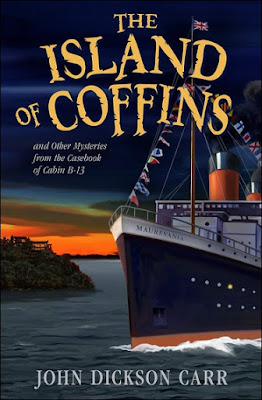
Well, all except two, or three, recordings have been lost, but, in the early 1990s, twenty-three scripts were discovered in the Library of Congress. Three decades later, Crippen & Landru gathered those manuscripts under the title The Island of Coffins and Other Mysteries from the Casebook of Cabin B-13 (2021). Tony Medawar wrote an insightful foreword, "Suspense at Sea," with "Notes for the Curious" at the end of each play. 

Medawar's foreword and notes are scattered with little gold nuggets of equally fascinating and frustrating pieces of background information. Such as Carr's plan to have Cabin B-13 series-character, Dr. John Fabian, identified as the Man in Black from Suspense or references to his uncompleted and abandoned novels. 

Cabin B-13 was broadcast as two series, or seasons, between July 5, 1948, and January 2, 1949, which originated as a 1943 episode of Suspense – also titled "Cabin B-13." Suspense episode takes place aboard a luxury cruise-liner, Maurevania, which connects all the stories in the series as the protagonist is its "ship's surgeon, world traveler, and teller of strange and incredible tales of mystery and murder," Dr. John Fabian. His role in the story differs from story to story. Sometimes he simply acts as a storyteller and other he plays a minor role in the story itself, but, every now and then, he acts as the detective. When he plays detective, it's usually because the story is a rewrite that requires Dr. Fabian to take over the role of one of Carr's well-known detectives.

So, now that we got the introduction to the collection out of the way, you have to excuse me for a moment as I fanboy all over these radio-plays. 

"The Man Who Couldn't Be Photographed" tells the story of "the greatest romantic film-star in the first decade of talking pictures," Bruce Ransome, who feels like he has outgrown the people he used to care about. This results in a confrontation with his "social secretary" and love interest, Miss Nita Ross. She puts a curse on him before committing suicide. A curse promising that the conceited actor never faces a camera again, which apparently comes true when Ransome is turned away from every photographer in Paris like a leper. A very neat play and a clever inversion on an old urban legend that originated in a now obscure, 1920s detective story. 

"Death Has Four Faces" is different from the play of the same title Carr wrote for BBC's Appointment with Fear. This is a psychological crime tale, of sorts, in which Superintendent Bellman meets a young Canadian on the train, named Steve West, who asks to be handcuffed and escorted to the hotel like a criminal – where a perfect crime is foiled. Not my favorite play in the collection, but it was decent enough. And thought the lingering presence of the Second World War was put to good use. 

"The Blind-Folded Knife Thrower" is one of the highlights of the collection with a minor role for Dr. John Fabian in a tragedy that has become "a grim and evil memory" of what befall Madeline Lane on a previous voyage to Portugal. Madeline is haunted by the ghost, or memories, of her spiteful mother who committed suicide ten years ago by drinking acid. She has begun to haunt her daughter with disembodied whispers and a promise to visit Madeline on her first night in Lisbon. So the people who care about her place her in a room with solid walls, floor and ceiling and two windows "so closely barred that you couldn't even get your hand through." There are two people sitting outside the door until morning, but a figure of a woman with acid-burns round her mouth appears in the room as miraculously as she disappears again! Colonel Da Silva, Chefe da Policia Secreta, discovers a very tricky explanation for the nighttime visitation and the result is a better, fairer and much more convincing take on a particular locked room-trick that would turn up in one of Carr's later novels. 
"No Useless Coffin" is another highlight of the collection, but this time, Carr reworked an earlier short story with Dr. Fabian acting as a stand-in for one of his famous series-detectives. Dr. Fabian is accompanying the recently engaged couple on a picnic to a cottage where many years ago a 12-year-old girl, Vicky Fraser, disappeared from with all the door and windows locked from the inside, which left her parents nearly frantic, but two nights later she reappeared "through the locks and bolts" – "tucked up in bed as usual." Vicky claims to possess an "occult power" giving her the ability to vanish when she likes, where she likes, which the now adult Vicky promises to repeat during the picnic. She disappears "like a soap-bubble under the eyes of witnesses," but, this time around, the fairy tale of the vanishing girl has a dark and gruesome ending. The solution to the impossible disappearance is one of the most original and startling Carr has ever dreamed up. Just as good as the original short story with the only real difference being the detective and motive. 

"The Nine Black Reasons" is, curiously enough, a whydunit and brings "well-known writer of detective-stories," Frank Bentley, to Marseilles, France, where he discovers the body of a murdered man in the Royal Turkish Baths of a hotel. A short while later he meets an old acquaintance, Helen Parker, who witnessed the inexplicable murder of her uncle at the same hotel. Inexplicable because there's no earthly reason why the respectable Mr. Herbert Johnson killed the respectable Mr. Fredric Parker. Two complete strangers! The motive, while good, sorely needed polishing and fine-tuning, which makes it all the more frustrating that Carr abandoned a 1961 novel of the same title despite having completed eight chapters. And, of course, "the typescript of the eight chapters has long been lost."

"The Count of Monte Carlo" has Dr. Fabian coming to the rescue of a young man, Bart Stevens, who's engaged to Janet Derwent, but foolishly has gotten himself involved in "a love-affair to end all love-affairs." Bart has been fooling around with another woman, "Dolores," who's engaged to the Count of Monte Carlo, Jean Ravelle. A messy, tangled square that ends with a murder and two people confessing to have done the dirty deed. A good, but relatively minor, story with an original murder method that Carr reused to much better effect in a later novel. 

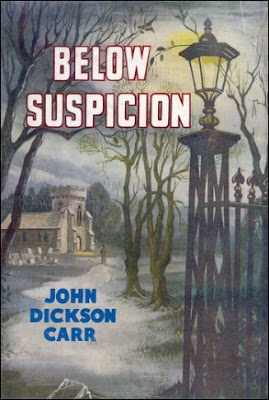
"Below Suspicion" shares its title with the contentious Dr. Gideon Fell novel Below Suspicion (1949), but the story has nothing else in common except, perhaps, that Carr would rewrite it in the 1950s as a Dr. Fell short story. Dr. Fabian tells the story of a stage actress, Valerie Blake, who retired from the stage before her time to retreat with her new husband on the Italian coast. Regrettably, Ralph Garrett proved to be a poor husband and two of her old friends came to the rescue, but they were too late to prevent her murder and struggle to find an explanation, because "the murderer must have walked on air" to have left her body on the beach – since there were no footprints except Valerie's. This story is actually better than the later version with a better developed backstory to the murder and always liked the clue of the rifle shots, which helped strengthening a somewhat sketchy murder method. 

"The Power of Darkness" is indelibly "one of his most audacious impossibilities" with two people traveling "back three hundred years in time" and witnessed "a whole suburb disappear" to reveal a scene from centuries ago. Dr. Fabian keeps telling everyone he's "not a detective," but he certainly had a guiding hand in revealing the sordid truth beneath this time shattering miracle. Some of you probably know how fond I'm of these rare kind of time-tampering impossibilities and enjoyed this one as much as the other version Carr wrote. The episode was originally intended to be titled "Last Night in Ghost-Land." A much better title and a pity it was never used for another story. 
"The Footprint in the Sky" is a fairly conventional impossible crime story, but told in a very unconventional way. The luxury liner Maurevania is tossed around during a storm at sea and Dr. Fabian, the ship's surgeon from Cabin B-13, is asked to come down to C-24 where a passenger, Marcia Tate, has lost her mind – believing it's Christmas over a year ago and asking "why she hasn't been hanged for murder." What follows is a backstory recounting a broken engagement and a new one, which resulted in murder with two sets of footprints in the snow pointing an accusatory finger at Marcia. The police "solved that 'studio-mystery' over a year ago" and Dr. Fabian has to retreat their steps to help Marcia regain her memory. A good framing device for a detective story, but have always found the solution to this particular no-footprints scenario to be cheap, hack and unworthy of the maestro. 

"The Man with the Iron Chest" is the nickname given "the best jewel-thief in the trade" whose "only burglar's tools are his ten fingers" and "an iron chest weighing sixty pounds." Why does he drag around a big iron chest? That's something the police from seven cities across the European continent would like to know and he nearly got caught in Amsterdam, which forced him to leave behind his ornamental iron chest. So he remained elusive until a young married couple, Don and Joyce, caught a glimpse of his face during a burglary, which lead the Greek police straight to his doorstep. But he then pulled of a minor miracle by making "an iron chest and a hundred diamonds vanish" from a locked and guarded room "as though they had never existed." A great piece of impossible crime fiction showcasing the author's love for stage magic and illusions. 

"The Street of the Seven Daggers" is a rewrite of one of my favorite short stories by Carr, but he improved the plot with a backstory and setting that really speaks to the imagination of readers who tend to like Carr. Like yours truly. Dr. Fabian is asked by a passenger, Miss Betty Parrish, to prevent her father from going to a certain street in Cairo or he'll be murdered. Who is going to kill him? Absolutely nobody! Mr. Edmund Parrish is "a superstition-breaker" and his attention has now been drawn to a little, dead-end alley called the Street of the Seven Daggers, which used to be the street of the hired killers in ancient times. Three hundred years ago, a bigwig of the Ottoman Empire "got annoyed about hired assassins" and had them executed in front of their houses – burnt out the street. But then people began to die and the rumors began. The "street's full of invisible people" and anyone who walks through the alley, "after midnight and alone," you're supposed to die with a dagger in your back. Dr. Fabian stands at the mouth of dagger-alley when Parrish is knifed while walking down the dark passageway alone. Only someone who's invisible could have stabbed the man, but Dr. Fabian reasons a more earthly explanation from the clue of the two wallets. Great stuff and even better than the original! 

"The Dancer from Stamboul" takes place in Port Said, at the gateway to the Suez Canal, where Dr. Fabian bumps into a New York policeman, Detective Lieutenant Jim Canfield of the Homicide Squad, who came with extradition-papers to take back a dangerous man-eater. Lydia White is suspected of having poisoned three men and the police has received information that she's somewhere in Port Said. So he asks Dr. Fabian to assist him comb out the port town, which leads to the titular dancer and her two lovers. A French fencer and an Italian nobleman. This ends in a duel at a fencing saloon and another poisoning. I liked the fencing scene, but otherwise an unremarkable as a detective story. 

"Death in the Desert" is not a detective or crime story, not even a horror yarn, but a historical adventure with a detective/espionage hook and presented as "a story out of my parents' time," namely 1895, which is set in the Sudanese desert. The crux of the plot is the completion and testing of an improved machine gun. A good story, if you like this kind of historical romancing. 
"The Island of Coffins" is, as Medawar rightly noted, "the most extraordinary story" in the series and demonstrated Carr didn't need to lean on the fancies and phantasms of the impossible crime to be the greatest mystery writer who ever lived. Story begins when the Maurevania, passing the Abyssinian Coast, sees a distress signal coming from Hadar Island. A very small, uninviting island with a big house where someone had sustained a serious bullet-wound. Dr. Fabian is shocked when he finds an elderly lady, Mrs. Almack, who was shot in the arm. She has retreated to the island with her grandson and two children (now all adults) to keep him company. But, when they arrived on the island, she "turned back the calendar to the year 1900." Those were "the only years that were worth living" and the current date on the island is November 12, 1920. Mrs. Almack kept her three wards on the island for two decades and they've no idea about the outside world. But why? And are the coffins on the island really filled with people who tried to leave? Dr. Fabian has to doctor out where the insanity lies and proof "tyrants aren't always so powerful as they think." Nearly as good and unforgettable as Carr's best radio-play, "The Dead Sleep Lightly."

"The Most Respectable Murder" is another one of those complicated eternal triangle stories littering the series. This time, Dr. Fabian goes to the Paris Opera where the future of two friends depended entirely on him finding an explanation how a "murderer could leave behind him a room locked up on the inside," which is easier said than done as Dr. Fabian recognizes it was "done in a completely new way" – openly admires the murderer's intelligence. The locked room-trick is the selling point of the story as it's genuinely original, but Carr would use it to much better effect in one of his late-period novels. No wonder that novel struck me as his last hurrah as the master of all crimes impossible. He came up with the trick a decade earlier! 

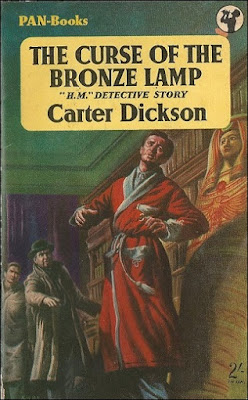
"The Curse of the Bronze Lamp" is a condensed version of the Merrivale novel of the same title in which an ancient bronze lamp discovered in a cursed Egyptian tomb is held responsible for blowing its owner to dust "as though she never existed." Regrettably, the shorter version exposed just how weak and unfair the impossibility really is, which needed the novel-length treatment to prop it up more convincingly. Now it felt more like the plot of a season 4 episode of Jonathan Creek. Anyway, whether it's the novel-length version or a short radio-play, I agree with Nick. This should have been "a full-blown Egyptian curse story, set in the Valley of the Kings, with murders in the pyramids, cobras at camp-sites and trouble in the tombs."

"Lair of the Devil-Fish" was an unexpected surprise as it belongs to that rare category of so-called "submerged mysteries," which tend to be impossible crimes and recommend you read my reviews of Charles Forsyte's Diving Death (1962) and Micki Browning's Adrift (2017) to get more background on this type of story – including more links. Carr might have been the first to experiment with this type of setting as the earliest example I've come across previously was Joseph Commings' short story "Bones for Davy Jones" (1953), but, strangely enough, it's not truly an impossible crime. Unless you believe the deep, dark blue ocean is the natural habitat of Lovecraftian monsters. So the story takes place off the southeast coast of Cuba where a small expedition has gotten permission to dive to the wreck of a cabin-cruiser, which sank in a bay during the Spanish-American War of 1898 with a fortune in silver dollars. Legend has it the cabin-cruiser was "dragged under" by the giant, slimy tentacles of a monstrous octopus. What nearly killed their diver? A monster or something a little more human? A solid and entertaining addition to those rare underwater mysteries. 

"The Dead Man's Knock" is a weird crime story in which brash American secret service agent and a British crime writer have to figure out how to kill a closely guarded man in order to protect him. Not really a locked room mystery, but a fun how-can-it-be-done. 

"The Man with Two Heads" is a low-key great story in which Dr. Fabian meets Leonard Wade on the top deck of a bus. Wade is a well-known and celebrated thriller author who might have become the victim of a diabolical plot as he has become a wandering ghost. Or so it feels. And not without reason. Dr. Fabian reads his obituary in the newspaper and Wade tells him he saw his own body in his study. Somewhat reminiscent, in spirit, to Helen McCloy's famous doppelgänger novel Through a Glass, Darkly (1950), but with a slightly more convincing setup and solution. What a shame Carr never expended this idea into a novel-length mystery. 

"Till Death Do Us Part" is another one with an awfully familiar-sounding title, but the plot has no resemblance, whatsoever, to Till Death Do Us Part (1944). This is Carr venturing into the territory of domestic suspense with the backstory to an attempted murder-suicide in a remote house, which comes with a twist in the tail. Anthony Gilbert would have loved it!

So, on a whole, The Island of Coffins and Other Mysteries from the Casebook of Cabin B-13 is a stronger than your average collection of short detective stories with the quality ranging from very good to pretty decent, but not a single average or bad story – which says something how good Carr really was. Only drawback is the lack of truly new material as Carr used this series to try out new ideas or retool old tricks or stories. But who cares? Carr is always a treat to read and this volume finally gave us back Carr's obscure, long-lost series-detective. Highly recommended!

11/13/19

A Twisted Fairy Tale: "The Too-Perfect Alibi" (1949)

"Dark theaters are best for dark deeds."

Previously, I reviewed Christopher St. John Sprigg's The Perfect Alibi (1934), a detective novel that turned the idea of an iron-clad alibi on its ear, which reminded me of a truly brilliant and innovative, but practically unknown, detective story that used the unbreakable alibi to perfection – performed over seventy years ago on the timeless CBS radio drama-series, Suspense. A bleak, mournful story that still stands today as one of the best episodes in the twenty year history of the show!

"The Too-Perfect Alibi" was written by Martin Stern and originally aired on CBS radio on January 13, 1949, starring actor/comedian Danny Kaye as the story's antagonist, Sam Rogers. Sam is a close friend to the woman he loved and "the fellow she loved."

Catherine was "the loveliest thing on God's earth" and Jack was "a beautiful hunk of man," a perfect match, but Sam never understood why Catherine was so made about him. A good-looking nobody who works as a clerk in a sports shop. However, when they announce their engagement, the well-to-do Sam takes it on the chin and offers them a lovely house as a wedding present, which delights Catherine, but Jack resents that Sam gives them everything he can't afford – sarcastically comparing him to Prince Charming. Unfortunately, for Jack, this remark reminded Sam of the fairy tale of "the Prince, the Princess and the Ogre." A story in which the Ogre dies because "the Prince kills him."

"The Too-Perfect Alibi" is an inverted mystery and the first 15, of 30, minutes comprises of plotting and carrying out the murder. Sam's plan hinges on an alibi, "a strong, unshakable alibi," designed to keep him out of the electric chair.

Usually, these alibi-tricks hinge on the manipulation of clocks, eyewitnesses or documents, such as dated tickets, letters or postcards, which gives the murderer a (small) window to do the dirty deed. Sometimes this window of opportunity is counted in minutes, not hours, which makes them quite risky endeavors. Sam created an indestructible alibi that removed much of the dangers of the initial stages of murder and the only dangerous obstacle was disposing the body where it would be found the following day. When the police started asking question, they got "thirty-five affidavits from responsible people" who swear Sam was at a party at the time of the murder.

A very inventive, yet simple, alibi that's impossible to crack open and can stand with the best alibi-stories by Christopher Bush, who might have partially inspired the story, because Sam utters an unusual phrase when he's almost caught deposing of the murder weapon – saying to himself that his "alibi was still 100%." A possible reference to Bush's The Case of the 100% Alibis (1934)?

So the first half of "The Too-Perfect Alibi" deals with the plotting and execution of Jack's murder, but, in the second half, Sam is confronted with the dire, unintended consequences of his perfect little crime. You have to listen for yourself how this dark, twisted fairy tale ends, but, if you want to end a detective story on a bleak, melancholic note that will cast a gloom on your audience, this is how you do it. I could hear "The Real Folk Blues" playing in my head when the episode ended ("you're gonna carry that weight!").

"The Too-Perfect Alibi" is, in my humble opinion, one of the best inverted detective stories ever written, which not only has an excellent and original alibi-trick, but an unforgettable conclusion that ended the episode strongly. You can listen to the episode on the Internet Archive (here) or Youtube (here). Enjoy!

11/11/17

Talking to the Dead

"The ingenuity of the criminal upon whose track we find ourselves is really out of the ordinary."
- Dr. Lancelot Priestley (John Rhode's The House at Tollard Ridge, 1929)
Since the dawn of modern technology and electric communication, the technological innovations of the nineteenth and twentieth century were looked upon in spiritualist circles as potential conduits to the world beyond and experiments were made in an attempt to establish a line of communications with the dearly departed – beginning with the spirit photography craze of the late 1800s. An interest in real-time communication with the dead, using technology, began to emerge in the early 1900s.

Thomas Edison was reportedly asked by Scientific American, in 1920, whether the telephone could be used to talk to the dead and the inventor did not dismiss the possibility. 

However, it would not be until the 1950s and the introduction of the first generation of portable audio recorders that people began to record, what they believed and interpreted to be, the voices of the dead. These recordings are known as Electronic Voice Phenomena (EVP) and these sound recordings, as I learned, are still very popular today as the countless "Spirit Box Sessions" on YouTube can attest. And these innovations were eagerly adopted by fraudsters and con-artists as tools to prey on grief-stricken people.

However, our beloved, but duplicitous, detective story was perhaps the first medium to explore the criminal possibilities of EVP long before it became a popular tool of ghost-hunters and spiritual mediums. Some of these stories date as far back as the mid-and late 1920s. John Rhode's The House on Tollard Ridge (1929) has an elderly murder victim who lived alone in a desolate house, reputedly haunted, where he spent long evenings listening to voices from the spirit world on the wireless, but the best examples were penned by two of the genre's most celebrated mystery writers – namely John Dickson Carr and Agatha Christie.

The first of these two is a short story by Christie, titled "Where There's a Will," which was originally published as "Wireless" in the Sunday Chronicle Annual in December 1926 and collected in The Hound of Death and Other Stories (1933). The second tale is a dark, eerie radio-play, "The Dead Sleep Lightly," of which Carr wrote two versions. One of these versions is the well-known episode from the CBS radio-drama, Suspense, but Carr "lengthened the script by a third to include Dr. Fell and Superintendent Hadley" for the British broadcast of the story. And the script of this second version was collected in The Dead Sleep Lightly and Other Mysteries from Radio's Golden Age (1983).

These two stories work with very similar, almost identical, plot-material and ideas, which makes them interesting reads when taken back-to-back, because they beautifully mirror and even compliment one another. But the treatment of the ideas and resolution to both stories also demonstrate the differences, as mystery writers, between Carr and Christie. I think they are, aptly enough, soul revealing reads that showed that the respective writers had (slender) ties to respectively the horror and romance genre.

You can find three of Carr's short horror stories in The Door to Doom and Other Detections (1980) and Christie wrote six "bitter-sweet stories about love" under the penname of "Mary Westmacotts." I think these flirtations with the horror and romance genre are reflected in "Wireless" and "The Dead Sleep Lightly." So let's take a closer look at these stories.

Agatha Christie
The primary character in Christie's "Wireless" is an elderly lady, Mrs. Mary Hatter, who has a weak heart and her doctor pressed her to "avoid all undue exertion." As well as prescribing "plenty of distraction for the mind." An elevator was installed to prevent undue exertion and her beloved nephew, Charles, suggested the installation of a radio-set to provide the mental distraction. Initially, Mrs. Hatter was skeptical and convinced that these "newfangled notions were neither more nor less than unmitigated nuisances," but slowly she began to warm to the "repellent object" and enjoyed listening to a symphony concert or lectures – until, one evening, an unearthly, faraway voice spoke to her over the radio.

A voice that identified himself as Mrs. Hatter's late husband, Patrick, who announced that he would be coming for her soon and asked her to be ready for that moment.

Mrs. Hatter took this message from beyond the grave better than expected and muttered about all that money she wasted on putting in an elevator, but she became convinced when the voice spoke to her a second time. Once again, the voice identified himself as Patrick and announced that he would be coming "very soon now." On top of these ghostly radio-messages, Charles claims to have seen a figure in Victorian garb standing by the window of her late husband's dressing-room!

So Mrs. Hatter begins to put the final touches to the earthly matters she'll be presently be leaving behind. And then the voice comes through a third and final time. The ghostly voice of Patrick tells her to expect him on "Friday at half past nine." And the voice tells her not to be afraid and assures that "there will be no pain." However, when the time arrives her bravery and resolve deserts her as she suddenly realizes that Patrick had been died for twenty-five years and is practically a stranger to her now. But this realization came too late.

This story is a not who-dun-it, because the mind behind these supernatural phenomena is apparent from the beginning. And the why-and-how-dun-it aspects will hardly pose a challenge to the modern armchair detective. What this story does have to offer is a front-row seat to a perfect crime with a twist in the tail. The murderer was clever and devious enough to use the given circumstances as tools to commit an undetectable murder, but the final pages shows an unexpected hitch that undid all of the meticulous scheming – making the death of a Mrs. Hatter a perfect crime without a payoff. And this piece of cosmic justice made for a most delightful ending.

I always loved "Wireless." It's a criminally underrated and grossly overlooked story from Christie's legendary oeuvre that deserves to be better known.

The second story is the British version of Carr's most well-known radio-play, "The Dead Speak Slightly," which begins when Dr. Fell's manservant, Hoskins, wakes his dozing employer with the announcement that there's "a lunatic downstairs." The madman in question turns out to be a publisher, George Pendleton, who's considered to be "a very celebrated and successful man." However, the man seems to be badly shaken and deadly afraid of clay, or soil, of "the sort you often find in graveyards."

John Dickson Carr
On the previous day, Pendleton had attended a funeral of "a fellow club-member" with his secretary, Miss Pamela Bennett, but on their way out of the cemetery they passed a neglected grave with a little stone grave and the publisher recognized it as the final resting place of a person from his own past – a woman by the name of Mary Ellen Kimball. Pendleton briefly reflects on his past and it becomes evident that he had not treated the woman, who rested there, very well when she had been alive.

So his secretary suggested to have the grave tidied up and writes down the identifying number that is cut on the side of the gravestone, which is "Kensal Green 1-9-3-3." They remark how the number sounds like a telephone number and that will come back to haunt the publisher later that evening.

Pendleton returned to his home in St. John's Wood, but he was in process of moving to flat closer to the West End and everything was practically packed up. The house was all but empty. So he decided to give a friend a telephone call and ask him if he wanted to go out for a dinner, but when the switchboard operated asked for a number he blurted out the gravestone number, Kensal Green 1-9-3-3, without thinking and the voice of a woman answered – a woman who identified herself as Mary Ellen!

And when Pendleton screams that she's dead, the voice answers with one of my favorite lines in all of detective-fiction: "Yes, dear," but "the dead sleep lightly" and "they can be lonely too." I don't know why these lines have such an appeal to me, but they never fail to make my soul shiver in absolute delight. Anyway, the voice of Mary Ellen promises to leave her grave and visit him when at his home when "the clock strikes seven." Interestingly, this ghostly phone-call poses somewhat of an impossible problem, because the phone had been disconnected that morning. A man from the telephone company had disconnected all the wires and had taken "the metal box off the baseboard of the wall." It simply was not possible to have made that telephone call.

So the publisher left cartoon smoke, as he bolted out of there, but Dr. Fell refuses to help him as he was not told him the full story. Regardless, Dr. Fell decided to venture outside and follow Pendleton back home, which is where he bumps into Superintendent Hadley. And what they discover is the man lying on the floor of the library with the telephone besides him. His face has an awful color, as if he had a stroke, but even more disturbing is "the clay track across the floor." There's even wet clay on Pendleton "as though somebody covered with clay had tried to hold him."

A fantastic story with a shuddery atmosphere, but, once again, the technical aspect of this seemingly impossible and apparently supernatural problem won't pose too much of a problem to readers in the twenty-first century. But the effects created with the telephone gadget and the simple power of suggestion is absolutely superb! Typically, Dr. Fell sympathizes with the perpetrators of this ghostly plot and covers up the whole business right under Hadley's nose!

I simply can't recommend this radio-play enough, but, if you don't have copy of the previously mentioned The Dead Sleep Lightly knocking about, you can just as easily listen to the equally fantastic Suspense version. It lacks the presence of Dr. Fell and Hadley, but the play can be found all over the internet (like here) and the plot is exactly the same as the British version. And the upside is that you can listen to those marvelous, haunting lines being spoken and get an extra pound of goose-flesh out of it.

So, there you have it, two short detective stories that are, in some regards, mirror-images of one another. Stories with plots that were built and constructed with the same plot-ideas and material, but their respective authors each delivered a very different kind of yarn of haunted murder.

For example, the victim of Christie's "Wireless" is an elderly lady who, initially, faces the possibility of being reunited with her dead husband bravely. Only to crumble when realizing at the last moment she had lived a quarter of a century without him and had become estranged from the dead man who she expected to see any moment. This is the bitter that comes after the sweet that apparently can be found in her romance novels. On a whole, this is a domestic crime story. Carr, on the other hand, showed he sometimes could be very closely related to the ghost story and picked a harsh, cold-hearted businessman as his victim who immediately lost his cool when a skeleton from his past appeared to stir from her grave – with a promise to pay him a visit. And he gave a detective story spin the horror genre's avenger-from-the-grave motif.

There are also the similarities in tricks for the ghostly voices and the fact that the perpetrators are, legally, untouchable, but only Carr lets his perpetrators off the hook.

So these stories show that Christie and Carr, while known for their intricately plotted and fair-play detective stories, were very different mystery writers at heart. And yet, they beautifully compliment one another when read back-to-back. These stories ought to be reissued as a single booklet or anthologized together in some kind of themed anthology with other detective stories involving fraudulant mediums, reputedly haunted crime-scenes and supernormal creatures who belong on the pages of a horror story. Such an anthology would make a for a great read and these two would definitely be the main event of such a collection of short stories!