So
the last two ramblings on this blog were rereads of Agatha
Christie's novel-length introductions of her famous literary
creations, Hercule Poirot and Miss Marple, who made their first
formal appearances a decade apart – respectively in The
Mysterious Affair at Styles (1916/20) and The
Murder at the Vicarage (1930). If you have read those
rambling reviews, you know my reasons (i.e. "hot takes") for
preferring Hercule Poirot over Miss Marple. I'm not going to
regurgitate those reasons here, except that I decided to reread The
Mysterious Affair at Styles after The Murder at the Vicarage
to put those reasons to the test.
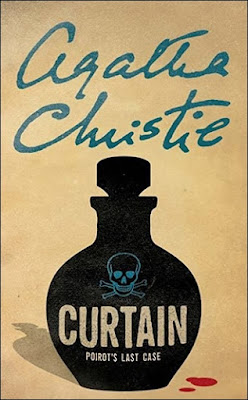
During
the London blitz of World War II, Christie wrote two novels, Curtain
(c. 1940) and Sleeping Murder (c. 1940), as an insurance
policy, of sorts, for her family in case she was killed in the
bombings – which were to be the last recorded cases of Hercule
Poirot and Miss Marple. Fortunately, Christie emerged from the London
blitz unscathed and the unpublished novels were stored away in a
safety deposit box with the intention to publish them posthumously. A
change of plans allowed Curtain to be published, in 1975, mere
months before Christie passed away in January, 1976.
Curtain,
often subtitled "Poirot's Last Case," gives a fitting end to the
Golden Age most recognizable detective character. I don't think it
would be spoiling anything at this point in time to note that The
New York Times published Hercule Poirot's obituary when Curtain
was published. So this is truly Poirot's last hunt and gave Christie
her last hurrah from the past, which in turn also presented a
continuity problem. Curtain was written in the early 1940s and
some references imply it takes place during the war ("...the war
that was wiped out now by a second and a more desperate war").
Something that would make sense as the story returns to the location
of the first novel, Styles Court, which is set during the First World
War, but Poirot survived long after World War II! The
Third Girl (1966) places an aged Poirot in the Swinging
Sixties and Hallowe'en
Party (1969) has him realizing that his fame has somewhat
faded in the modern world. There are numerous references to the death
penalty ("do you think I want to see you hanged by the
neck..."), but Poirot's penultimate case (Elephants
Can Remember, 1972) was published three years after the death
penalty was abolished in Britain. I'm not even going to speculate
about Poirot's age.
So,
chronologically speaking, the book can be deemed as a bit of a mess
and therefore something of an oddity within the series. Which could
explain why the book tends to be so strangely and unjustly
overlooked. Curtain is certainly not the best detective story
Christie wrote during the 1940s, but it's without question one of her
most creative and daring pieces of detective fiction. This is how you
end a series on a banger!
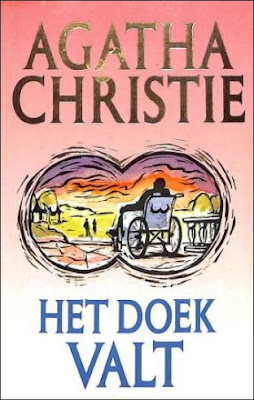
A
sticky problem that not only requires a first-rate brain, but eyes,
ears and a pair of legs, which is why Poirot needs Hastings. But
refuses to tell Hastings the identity of X ("I do not wish, you
see, that you should sit staring at X with your mouth hanging
open..."). This naturally rankles Hastings to the point where
he begins to questions his friends mental faculties ("what more
likely than that he should invent for himself a new manhunt?"),
but the reason why Poirot illogically guarded the identity of X so
closely turned out to be entirely logical once you learn why the
X-murders "the perfect crimes." Until that moment arrives,
Hastings has wonder as he pokes around the guests staying at Styles
Court which has since been sold and turned into a guest house that
tries to pass itself off as a hotel.
There
are the current owners of Styles Court, Colonel Toby Lutrell and his
wife, Daisy Lutrell, who bullies her husband with "a tongue like
vinegar." Dr. John Franklin is a research scientist specialized
in tropical diseases and rents a small studio at the bottom of the
garden that had been fitted up, "hutches of guinea pigs he's got
there, the poor creatures, and mice and rabbits," to do his
research work. Dr. Frankling brought along his wife, Barbara, who's
an invalid and the reason he had turn down a research post in Africa.
Nurse Craven came along to attend to Barbara and Dr. Franklin has a
research assistant, Judith Hastings, who's Hastings modern,
independently-minded daughter. Sir William Boyd Carrington is a
former governor of a province in India, first-class shot, big game
hunter and the sort of man, according to Hastings, "we
no longer seemed to breed in these degenerate days." On
the other hand, the easy talking, womanizing Major Allerton is the
type of man Hastings instinctively dislikes and distrusts ("most
of what he said holding a double implication"). Stephen Norton
is a nice, but rather shy man who loves bird watching and Elizabeth
Cole appears to be somewhat a woman of mystery ("a woman who had
suffered and who was, in consequence, deeply distrustful of life").
But who could possibly be the mysterious, homicidal X?
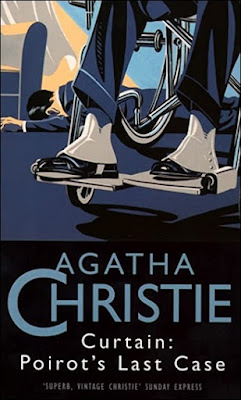
This
is also the point in the story where I can't discuss much more about
the plot and know the description, thus far, hardly sounds like an
Agatha Christie vintage, but the stingy twist is in its tail. Here,
more than ever! A smash ending precariously balanced on the last two
deaths towards the end of the book. Firstly, one of the characters is
found shot in a locked bedroom holding a small pistol and the key of
the door in the pocket of the victim's dressing gown. This very late
death earned Curtain a mention in Robert Adey's Locked Room
Murders (1991), but the trick is extremely routine and what
matters about this death is the who-and why. Here, more than ever!
Well, you know who dies last ("I don't want to write about it at
all"). So the solution had to be pretty good to turn it's
low-key premise into something really special to justify it being
Poirot's last great challenge. And it did!
Curtain
ends with a posthumous letter from Poirot to Hastings, "I hazard
a conjecture that by the time you read this you will have evolved the
most preposterous theories," explaining everything that
happened. Normally, ending a detective story with a posthumous letter
lands like a damp squib, but this one delivered on practically all
accounts. First of all, X truly proved to be a worthy final opponent
and arguably one of the most intriguing killers the Golden Age
detective story has ever produced. A subtle sadist who perfected the
art of murder with "a technique superb, magnificent, that
arouses admiration in spite of oneself." Secondly, which is not
often mentioned, but can anyone name a single detective novel that
handled (SPOILER/ROT13)
zhygvcyr, vaqrcraqragyl-npgvat zheqreref as good and
convincingly as Christie did here? Not a bad accomplishment
considering it's the kind of thing we complain about as lazy and
uninspired plotting, but it worked here like a charm. And to top it
all, Christie delivered a mortal blow. A coup de grace preying
on a glaring, psychological blind spot to deliver a grand play on her
beloved least-likely-suspect! What a way to bow out of the grandest
game in the world!
So,
as you probably deduced by now, I really enjoyed rereading Curtain
and appreciated it so much more second time around. My only
complaints are purely stylistically. I think the text should have
been slightly revised to correct some of the continuity errors, which
could have been done easily enough by altering the period references.
It would have blurred the timeline enough to make it conceivable it
takes place shortly after Elephants Can Remember. The title
should have been something like The Last Hunt or Another
Affair at Styles. Curtain feels a little thin to cover
such a grand-style detective story. Regardless of those few stylistic
continuity issues and errors, Curtain is a detective story of
a rare and very special excellence. I called The Mysterious Affair
at Styles a diamond-in-the-rough, but Curtain really is a rare,
precious metal that's perhaps not originally from the series main
timeline and could be as some have suggested
take place in a parallel universe in which Poirot's health
deteriorated during the war years (rationing is what really killed
that delicate man). Whatever your personal take is, Christie
undeniably threw Poirot a phenomenal and unforgettable farewell party
worthy of one of the greatest and most beloved Golden Age detectives.
I
think its fitting to end with a quote from Sherlock Holmes: "If
my record were closed tonight, I could still survey it with
equanimity. The air of London is the sweeter for my presence."
Yes, London and far beyond!