Showing posts with label Horror. Show all posts

5/24/26

That Thing Upstairs: "The Doctor Sees a Ghost" (1933) by Florence Ryerson and Colin Clements

I recently reviewed Fear of Fear (1931) and Blind Man's Buff (1933) by Florence Ryerson and Colin Clements, a husband-and-wife writing team, which I liked enough to bump the other two Jimmy Lane novels, Seven Suspects (1930) and Shadows (1934), up a few places on my wishlist – except that both remain obscurely out-of-print as of this writing. So turned my attention to their short stories to see if they wrote anything for my liking. Well, I definitely found something.

Florence Ryerson and Colin Clements' "The Doctor Sees a Ghost" was published in the December, 1933, issue of Mystery and concerns an unnamed, two-year-old boy who's behavior has been disturbing his father ("...been going on for weeks").

Gessler has been to several, highly paid pediatrics and other specialists, but the boy is perfectly healthy and "normal in every respect." So why has the nurse packed her bags ("...she won't stay another day") and what was the reason for the changing the nursery twice? Gressler, tired and nervous, eventually finds his way to another specialist, Hallowell, tells him the boy plays Pease Porridge Hot after he's put to bed ("and other games like Peekaboo and Simon Says Tumbs Up"). Hallowell tries to assure him there's nothing abnormal about two-year-olds playing games, or prattling to themselves, but Gessler's convinced the boy is talking and playing games with his dead mother – who died six months ago. Gessler begs Hallowell to come to his home to witness the baby's unsettling behavior for himself.

So not a bad premise at all, but, considering the short length of the story, I expected the ending to take one of two directions: Gessler murdered his wife and the guilt is driving him out of his mind or the nurse has some sort of connection to his wife and is avenging her by making Gessler believe her ghost is talking and singing songs to their son. The implied threat there is making Gessler fear what her ghost might tell the boy when he gets old enough to understand. I personally preferred the latter as fear is an important driving factor and theme running through both Fear of Fear and Blind Man's Buff. It fitted both the tone of the story and the authors other work, but then the ending revealed I had been reading a ghost story all along. A better twist than the one the story threw up!

Florence Ryerson and Colin Clements' "The Doctor Sees a Ghost" is exactly as described on tin. But, in my defense, Mystery is a detective fiction magazine and the December 1933 issue even carries a short story from Stuart Palmer's Miss Withers series. So assumed it had to be a detective story, not a ghost yarn, maybe even a detective story with a supernatural flavoring. That didn't turn out to be the case. That leaves only Ryerson's solo short story, "The Purple Shadow" (1925), as of possible interest. In the meanwhile, I'll keep an eye out for Seven Suspects and Shadows.

5/4/26

The Frankenstein Factory (1975) by Edward D. Hoch

Edward D. Hoch was the King of Short Stories, the Man of a Thousand Tales of Mystery and Detection, but, during his five decade run, Hoch also wrote a handful of novel-length mysteries like The Shattered Raven (1969), The Blue Movie Murders (1973) and a three-novel series of science-fiction hybrid mysteries – generally known as the "Computer Cops" series. You read that right. They're the back tracing Cyber Police you were warned about!

Carl Crader and Earl Jazine work for the Computer Investigation Bureau, headquartered at the World Trade Center in New York, whose "investigations sometimes spill over into what might generally be called crimes of the new technology" in the 21st century. So the C.I.B. are the "experts on computers, lasers, holograms, cryosurgery" and "new technology" handling "crimes the regular police forces aren't equipped for." Crader is the head of the C.I.B. ("...reports directly to the President") and Jazine is his field agent. They appeared in only three novels, The Transvection Machine (1971), The Fellowship of the Hand (1973) and The Frankenstein Factory (1975).

This time, I've a good excuse/reason (take your pick) to unchronologically start at the end of the series. The Frankenstein Factory had been recommended several times over the years for its qualities as both a science-fiction mystery and clever pastiche of Agatha Christie's And Then There Were None (1939). That and the first two novels appear to be more science-fiction thrillers than science-fiction mysteries. The Frankenstein Factory seemed the safest choice and perhaps a candidate for that future followup to "The Hit List: Top 10 Favorite Hybrid Mysteries."

First of all, I skipped the first two novels making it a bit confusing when, exactly, The Frankenstein Factory is supposed to take place. The first chapter refers to "these early years of the twenty-first century," but, early on in the story, there were several hints the story could take place during the 2010s or even early 2020s – based on a reference to the fading memories of "the renewed moon flights of the late 1990s." And the age of one of the characters who took part in one of those return missions. But it became a lot clearer during the second-half and home stretch that it takes place roughly twenty-five years after the mid-to late 1970s. So probably somewhere around 2004, give or take a year. It could also be a bit later based on a references to that "seventy-year-old mystery novel by the British writer Agatha Christie," but that would still place the story within the 2000s. Now with that out of the way, let's take a look at the story.

The Frankenstein Factory begins with Earl Jazine traveling by hovercraft to Horseshoe Island, somewhere off the coast of Baja California, under the guise of medical photographer. Jazine has come to the island to film and document an experimental operation.

Dr. Lawrence Hobbes is the head of International Cryogenics Institute who freeze and store people's bodies "against a future time when they could be revived," but this goes hand-in-hand with their research into operating techniques at low temperatures. So underneath the research facility is also a cold storage vault with frozen bodies inside sealed cylinders. Dr. Hobbes is ready to take the next step and revive a young man who died of a brain tumor in the 1970s, but the tumor did a lot of damage to the body and other organs. So needs several organ transplants, brain included, before they can reanimate him. Dr. Hobbes assembled a crack medical team to carry out this secret and experimental operation. Dr. Freddy O'Connor, a brain surgeon, who had great success with brain transplants in animals. Dr. Eric MacKenzie, "only military surgeon to set foot on the moon thus far," and Philip Whalen assist him. This team is rounded out by Tony Cooper, a bone specialist, and Vera Morgan, a research chemist, who only arrived the day before Jazine. There are two more people on the island, the elderly Miss Emily Watson whose money has made the whole operation possible and a maid/cook, Hilda. And, well, there's the patient, or "shell body," who they call Frank.

The operation is a success, "we have heartbeat and pulse," but, while Frank is sleeping and recovering in the operating room, things begin to happen on the island. Miss Watson goes missing from her bedroom, leaving only a smear of blood behind, but she, or her body, is not found following a thorough search of the buildings and island – she had vanished from the island. However, this is not an impossible disappearance as has been suggested elsewhere. Miss Watson simply disappeared, but not impossibly, as the murderer could have thrown her body into the sea or buried it somewhere. That's not the solution to the disappearance, but it's not an impossible crime. Just a somewhat baffling disappearance, considering the circumstances and apparent lack of motive. But then the murder strikes a second time!

This time, they find the body and the killer stops trying to hide future victims. Even worse, the group finds they have been cut off from the mainland and marooned on the island until new supplies arrive by hovercraft. Jazine takes charge until then, but body count continues to rise as survivors, suspects and supplies dwindle. All the while, the rapidly dwindling survivors become suspicious and frightened of Frank apparently still sleeping in the operating room ("Hell, I'd much rather believe that Frank down there did it than consider the possibility that I'm sitting at a table with a murderer"). So did they create a modern-day Frankenstein's monster or is there a human hand behind it all?

Before getting to the plot, the science-fiction elements deserve a mention. It goes without saying Hoch's depiction of the early 2000s in 1975 is very different from what actually happened. For one, the World Trade Center is still standing, but the most obvious difference is absence of the internet and cell phones despite characters remarking how "everything's miniaturized these days" and "almost everything's done by machine." Jazine explains late in the story the C.I.B. tackles mostly "computer frauds" such as "stock-market rigging, insurance swindles, even some gimmicking of the race-track computers," but no crimes related to, what could be called, an internet – which does not detract from the novel at all. Just interesting to compare Hoch's vision of the early 2000s to what actually happened. Hoch's version of the early 2000s appears to be a lot calmer than our early 2000s, but hints through out the story makes it clear the world outside the green, sunny island has some dystopian characteristics. Some countries promote suicide among the elderly, while other countries want to ship their criminals and surplus population to colonies on Venus ("...Venus colony is still a good many years away"). Somehow, someway, they took laser guns away from Americans shortly after their introduction in the mid '90s and cities are covered in a thick, hazy layer of ozone purifiers sprayed from helicopters. On the up side, there are the advances in medicine and plans to construct searails to span the oceans. So that's something.

The science-fiction of this hybrid science-fiction mystery, beside the cryogenic and reanimation, functions mostly as story dressing. However, it gives The Frankenstein Factory a retro-futuristic, alternate history quality that's fun to speculate about. My take is that the humans in this universe tend to be slightly more pragmatic or utilitarian, tick less sociable, which is why there more interested in Venus colonies, searails and reversing death than an internet or smart phones. Not wholly unimportant, it gave what would otherwise have been an average "trapped on an island with a killer" mystery a distinct character of its own. Not that The Frankenstein Factory is a bad whodunit. You can leave it to Hoch to pen a fair play mystery involving experimental surgery, a reanimated corpse and laser guns. It's just that without a science-fiction trappings, The Frankenstein Factory would have come across as a pale imitation of Christie's And Then There Were None.

So it's unfortunate Hoch never really integrated those science-fiction components with the story's detective plot, because that would have made The Frankenstein Factory something more than this strange, zany send-up of Christie. Hoch wrote a good, old-fashioned murder mystery and a tale of science-fiction horror taking place simultaneously with the same cast of characters. That's why I kept second guessing myself even when only two suspects remained, because expected the science-fiction elements would some part or role to play in the solution. I had reasons to believe Frank was not the first person to have been reanimated, which needed to be kept under wraps for the outside world (perhaps that person was a murderer like was suggested of the brain donor). I had one name in mind (ROT13: "...vg tnir ure gur ybbx bs n lbhat tvey sebz gur 1970f") as that person being revealed as both a reanimated person and the killer would give the story a double, morbid twist for the prize of one. No such genre crossing twists, or solution, as Hoch only roamed around the borders and never crossed the line into full-blown hybrid mystery territory. That's a missed opportunity.

The Frankenstein Factory is unlikely to secure a place on my list of best and favorite hybrid mysteries, because the bar for hybrid mysteries has been set astronomically high, but long-time Hoch fans should take note of this rare, novel-length mystery from his hands. Hoch's The Frankenstein Factory is intriguing and not unrewarding mystery as long as you don't expect a classic like Christie's And Then There Were None or Isaac Asimov's The Caves of Steel (1953/54).

4/18/26

The Ark (2022) by Haruo Yuki

When compiling and cobbling together "The Hit List: Top 10 Favorite Hybrid Mysteries," I mulled over including a disaster-themed detective novel, but was not entirely sure whether disaster detectives counted as hybrid mysteries or not – decided not to include one. It only dilutes the concept if every detective story in which a mine explodes or a submarine is sunk with survivors aboard. Not to mention the knock-on effect of wartime novels suddenly qualifying as hybrid mysteries.

However, there are disaster detectives, rare as they are, in which the disaster is central to the story rushing along the plot. I suppose Ellery Queen's The Siamese Twin Mystery (1933) is a good, early example of the disaster detective hybrid and it's impossible to ignore Nevada Barr's Firestorm (1996). So this issue needed further probing and why I looked forward to two translations Pushkin Vertigo announced last year as forthcoming.

Akane Araki's Konoyo no hate no satsujin (Murder at the End of the World, 2022) takes place during humanity's last three months as a civilization ending meteor hurls towards our planet, which should be out around late July or early August. Haruo Yuki's Hakobune (The Ark, 2022), translated by Jim Rion, had been out for a few months now and merges the classically-styled, closed circle whodunit with a survival thriller – arrival of my copy coincided with an interesting review. Countdown John reviewed Yuki's The Ark right after it was published and observed, "I think this qualifies as a hybrid mystery, in this case a cross between a classic mystery and a disaster movie." Agreed! The Ark is exactly the kind of disaster detective/thriller that works as a hybrid mystery, but let's start at the beginning.

The Ark begins when a group of former students and members of their university's hiking club reunite two years after graduating. Firstly, there's Shuichi Koshino, a system engineer, who narrates the story. Shuichi brought along his smartly dressed cousin, Shotaro, who's going to be Ellery Queen-like detective and not the infallible version. Other friends from the old hiking club are Sayaka Nouchi, a yoga teacher, Hana Takatsu, an office worker, Yuya Nishimura, vaguely doing something with fashion, Ryuhei and Mai Itoyama. They got married shortly after graduating. Yuya has hiked in the area before and had discovered an underground building in the mountains. A three floor, subterranean steel structure into a huge cavern with the whole structure following "the shape of a naturally occurring cave" giving it the form of an ark ("...like in the Old Testament?"). The place has a murky past possibly involving militant groups, cults and criminals. Yuya suggests they go explore The Ark, but has trouble finding the entrance to the tunnel. So it quite late when they finally find the entrance and bump into a family of three, the Yazakis, who were out hunting mushrooms when they got lost. They have to camp for the night inside The Ark.

During the night, the mountain is rocked by an earthquake that set the barricade boulder rolling and blocking the exit. The earthquake also caused the trickle of water that had already claimed the bottom floor to increase. So they were trapped for the time being, because there's a way out that comes with a huge moral dilemma: the boulder can be moved, but it would trap the person working the winch to be trapped alone inside a small, cavern-like room – no guarantee the rest can return in time with help. Who has to be sacrificed? Before they can even think about it, one of them is found strangled to death in a storeroom! So now they not only have to deal with being trapped, while the water is slowly rising, but one of them unquestionably being a murderer. Even more baffling is why commit murder under these dire circumstances, especially after finding out they need a sacrifice to escape?

What they need to do is find the killer and force that person to make the sacrifice, because they're going to be hanged for murder anyway. Fortunately, the Ark has a working generator with a weeks worth of fuel giving them some time to find the murderer and that's my sole gripe with The Ark. A detective story can be too much driven by coincidence, but The Ark is the only detective story driven entirely by convenience. The situation inside the Ark would have played out completely different had their been no lights or a way to keep their smartphones charges. Not to mention the left over supplies and tools scattered across the numerous room or the old, outdated, but still working security camera system guarding the blocked entrance and exit. However, convenient as the situation may for the purpose of the plot, Haruo Yuki used those plot conveniences to their full potential to tell this story.

So with about a week until fuel runs out and the water reaches them, Shuichi and Shotaro set out to find the murderer, but the first murder is just a plain murder. The storeroom "had not been locked from the inside, no article of clothing was missing for unexplained reasons, nothing in the room had been inexplicably turned upside down" and "no dying message." Only the baffling question why the murderer picked this moment to strike. While the first murder was "almost disappointingly free of puzzles," the second murder is a typical, gruesome shin honkaku slaying. Every action to killer took to be "simply mystifying." Why stab and decapitate a corpse? What happened to the head? Why dispose of the victim's belonging? And why kill when being trapped underground? Merely a few of the puzzling questions surrounding this second and third, arguably even stranger murder.

Haruo Yuki delivered some devilish clever answers to those questions, like why cut off the head of the second victim, but even better is the role the character's smartphones played though out their ordeal. I mentioned in the past how much I dislike the claim how advances in forensic science and technology in generally had made the traditionally-plotted, Golden Age-style detective novel obsolete. An argument Isaac Asimov demolished in the granddaddy of hybrid mysteries, The Caves of Steel (1953/54), but The Ark provides several practical and ingenious examples for our time. If you ever wondered what the greats from the Golden Age could have done with today's technology, The Ark should give you a pretty good idea. Where the plot and story excels is when the time has come to put everything together as Shotaro reveals the murder through an Ellery Queen-style chain of reasoning and deductions by going over identifiable action and step the killer took from the first to third murder. But then it's time to get out.

Anyone somewhat familiar with Japanese authors penchant for dark, bleak endings and tragic twists can feel something coming in the epilogue. I expected something normal and mundane. Something like the survivors emerging from the Ark to discover the earthquakes were caused by an apocalyptic event like a nuclear war or an asteroid strike, but I didn't see that twist coming. A cruel, beautiful twist making for an unforgettable ending. Even more impressive, the revelation in the epilogue serves as the finishing touch of perfection as it revealed the crimes to have been truly unique to that place and harrowing week inside the Ark. There was no other time or place where the motive for these murder could have arising except among that group of people trapped inside. So, yes, I enjoyed this one very much.

Haruo Yuki's The Ark is simply a plot-technical marvel of the 21st century detective novel with a time-honored approach to the age-old question of whodunit? Highly recommended!

I plan to do "The Hit List: Top 10 Favorite Translations from Pushkin Vertigo" sometime in the future, but picking just ten is, fittingly enough, going to be a bloodbath.

8/13/25

Strange Houses (2021) by Uketsu

Back in March, I reviewed Henna e (Strange Pictures, 2022) written by the pseudonymous Japanese horror and mystery Youtuber, "Uketsu," whose true identity remains a big question mark – hidden behind a white mask, black bodysuit and a digitally distorted voice. Strange Pictures received some mixed reactions, but I enjoyed and appreciated it for trying to do something different with both the traditional detective and modern crime story. So looked forward to see what Uketsu was going to do with Henna le (Strange Houses, 2021).

I thought Pushkin Vertigo was translating and publishing the "Strange Novel" series in chronological order, which is why I called Strange Pictures Uketsu's debut, but Strange Houses is actually the first in the series. Strange Pictures was considered "a more solidly structured, more confident work" appealing to a broader audience. There were also responses from people already familiar with Strange Houses through the manga and movie adaptations who were disappointed, because Strange Houses is a treat to mystery fans who love their floor plans, family trees and the odd time table. So, once again, I was looking forward to see what Uketsu was going to do with Strange Houses and compare it to Strange Pictures.

Strange Houses, translated by Jim Rion, comprises of four, longish chapters in which the first three introduce and investigate three different mysteries concerning bizarre floor plans of strange houses.

The first chapter, "A Strange House," introduces its nameless narrator, a freelance writer, whose specializes in stories of the macabre and people come to him with their personal stories of "the eerie and unpleasant." Strangest story came his way when a friend asked for advice. The friend in question is house hunting and found a place that's both spacious and bright, but a curious detail about the floor plan bothers him. There's "a mysterious dead space between the kitchen and living room" on the first floor. So the freelance writer promises to look over the floor plans with another friend, Kurihara, who's an architectural draughtsman. When they pore over the floor plans together, they notice more odd features to the house with the biggest, puzzling feature being the child's room on the second floor. A central, inner room without windows, a double-door vestibule and its own toilet – resembling "some kind of solitary confinement cell." The house, of course, hides more secrets than can be directly read from the floor plan.

Finding all those architectural oddities and hidden secret fires up Kurihara's imagination, "this house was built for murder," but the author's friend tells them he has lost interest in buying the house. A chopped-up body found in a thicket near the house felt like a bad omen. So he worked the story of this strange house into article which was read by Yuzuki Miyae.

Three years ago, Miyae's husband vanished without a trace and only recently his body, minus a left hand, was found on a mountainside in Saitama. Miyae believes his disappearance and death is linked to house similar to the house described in the article. She even dug up a floor plan of the house. So this second chapter, "Another Warped Floor Plan," examines another house with prison-like child's room, hidden features and a curious, triangular room that was later addition to the original house. Just as important is figuring out who lived in those two houses and where they're now. That brings Strange Houses to its third chapter, "Drawn from Memory," which takes a detour into the past to tell the story of a tragic family gathering told through floor plans sketched from childhood memories. So, this far into the story, I have to remain as sketchy about the details, but it's undoubtedly the best, most memorable portion of the Strange Houses – not merely because it included a locked room puzzle, of sorts. But it always helps. And while (ROT13) V abeznyyl sebja hcba frperg cnffntrf be uvqvat ubyrf svthevat va gur fbyhgvba gb n ybpxrq ebbz zlfgrel, guvf vf gur frpbaq orfg hfr bs n frperg cnffntr V unir pbzr npebff.

Uketsu pulls the threads together in the final chapter, "House of Chains," which is the wordiest chapter of the book as it has to do without the numerous floor plans and only has the odd family tree. It's also the chapter clearly demonstrating the fundamental difference between Strange Pictures and Strange Houses.

I think most mystery fans prefer the examination of the floor plans and architectural anomalies over the armchair psycho-analyzing of drawings, which really is a treat for every detective fan who love maps and floor plans in their mysteries. My shoddy review barely gives you an idea just how many floor plans there are. But it's a lot. However, the answers behind these strange houses with their architectural anomalies is more along the lines of a horror mystery than a mystery with horror elements. Strange Pictures also straddles the detective and horror genres, but it worked as a detective story. Not the most orthodox of detective stories, but a detective story nonetheless. Strange Houses offers something out of a Wes Craven movie with an ambiguous ending, which is also more in keeping with the horror genre. Now a hybrid mystery, of sorts, is not the problem, but the horror elements driving the plot is unconvincing. And, to be honest, somewhat preposterous. Not helped by the fact that one of Kurihara's wild, illogical flight of fancies was closer to the truth than it had any right to be. That's bound to annoy or disappoint some mystery fans.

So was left with mixed feelings. I didn't expect Strange Houses to be a typical, traditionally-plotted shin honkaku mystery, but expected it to be ever so slightly more traditional and grounded, plot-wise, than Strange Pictures. Somehow, I figured floor plans would lend themselves better to this new type of visual medium horror-mysteries than a series of drawings. The floor plan puzzles were fun with the third one ingeniously using its hand drawn floor plan, but the reason for creating these houses underwhelmed. So, yeah, I think Strange Pictures is the better novel and Pushkin Vertigo made the right call, but both succeed in offering the reader something little different without being outright novelties or gimmicks. They're simply too good, not perfect, but too good to be ranked along past novelty and gimmick mysteries like the dossier novels or photograph mysteries. So look forward to Uketsu's third novel scheduled to be published sometime early next year. I'll be there!

6/30/25

Visitors to the Isolated Island (2020) by Kie Houjou

Last year, Kie Houjou became one of my favorite mystery writers on the strength of two novels, Jikuu ryokousha no sunadokei (The Time Traveler's Hourglass, 2019) and Meitantei ni kanbi naru shi wo (Delicious Death for Detectives, 2022), which are respectively the first and third title in the "Ryuuzen Clan" series – translated by Mitsuda Madoy and "cosmiicnana." Technically, they're hybrid mysteries. The Time Traveler's Hourglass weaves time travel into an intricate, immaculately-plotted detective novel and Delicious Death for Detectives entrenched its plot in an immerse, futuristic Virtual Reality game. However, they're so very well done, well rounded and incredibly innovative mysteries, it would be more accurate to call them the detective series of tomorrow. I especially can see Delicious Death for Detectives becoming the classic detective novel from the first-half of this century (i.e. comparable to Agatha Christie's And Then There Were None, 1939).

I had a sneaking suspicion the second book in the series, Katou no raihousha (Visitors to the Isolated Island, 2020), could become my favorite. A suspicion that proved to be not far off the mark!

Kie Houjou's Visitors to the Isolated Island is the second title in the "Ryuuzen Clan" series, but Meister Hora only appears in the foreword to assure the reader that although "the events of the story seem absurd, there is no need for you to fear" as it will remain a detective story at heart ("I value fair play above all else"). Kamo Touma is only mentioned as the author of an article on the titular island in the Unsolved Mysteries magazine. Instead, the story focuses on Kamo's brother-in-law, Ryuuzen Yuki, who's the Assistant Director at J. Production en route to the lush, now uninhabited Kakuriyo Island to shoot a TV special for the World's Mysteries Detective Club show – which is going to spotlight the 1974 "Beast of Kakuriyo Island" incident. A mass murder robbing the island of the last of its last inhabitants.

Kakuriyo Island, "a perpetual summer paradise," actually consists two islands. A bigger, oval shaped island and a smaller tidal island, known as the Divine Land, which is connected to the main island during low tide when a gravel path appears. In 1974, the entire population (12), in addition to a visiting professor researching folklore, was wiped out in a single night with bodies found in different locations. All the victims had one thing in common: they had been stabbed in the heart by "a cone-shaped object." The police concluded the visiting scholar, Professor Sasakura, killed the islanders when caught digging up the cemetery looking for buried treasure. And died himself in a struggle with the last victim. Furthermore, the police believe the dogs kept on the island were responsible for savaging Professor Saskura's body. A conclusion that doesn't satisfy or hold up, as outlined in Kamo's article, but that's where the case stood for nearly half a century.

Fast forward to 2019, Yuki has come to Kakuriyo Island not only as the assistant director, but to get revenge for a friend whose death can be blamed on certain members of the production company.

However, Yuki plans to break with long-standing (shin) honkaku traditions by opting for practical methods rather than "crimes patterned on old legends or nursery rhymes and serial killings in villas," because locked room murders, fabricated alibis and other fictional crimes "were often useless in real life" – preferring to arouse as little suspicion and panic as possible. Only the appearance of a great detective, which is why invited a well-known researcher of subtropical ecosystems and detective fiction enthusiast, Motegi Shinji, to "reveal a false truth prepared by Yuki." So imagine his annoyance when one of his prospective victims is impossibly killed in a way mirroring the 1974 murders. Unno Nisaburo, the director, is found stabbed through the heart on top of a bush with only his muddy footprints leading to the spot.

So the plot, up till this point, still sounds fairly conventional shin honkaku mystery with the customary closed circle of characters stuck on an isolated island when a murderer begins leaving bodies in bizarre or impossible circumstances. It could describe the plot of Yukito Ayatsuji's Jukkakukan no satsujin (The Decagon House Murders, 1987), MORI Hiroshi's Subete ga F ni naru (The Perfect Insider, 1996), NisiOisiN's Zaregoto series: kubikiri saikuru (Zaregoto, Book 1: The Kubikiri Cycle, 2002) or half the titles from The Kindaichi Case Files series. Not to forget Danro Kamosaki's recently reviewed Misshitsu kyouran jidai no satsujin – Zekkai no katou to nanatsu no trick (The Solitary Island in the Distant Sea and the Seven Tricks, 2022). Where Visitors to the Isolated Island begins to differ is when Yuki proves Sherlock Holmes' adage, "when you have eliminated all which is impossible, then whatever remains, however improbable, must be the truth," correct. Yuki deduces from the circumstances in which the director was killed that "the so-called Beast of Kakuriyo Island actually exists." A creature not native to the island, our planet and perhaps not even from this reality!
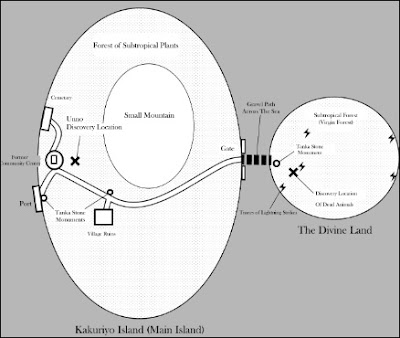


Yuki's outlandish theory is quickly proven correct and places entirely new complexion on both their situation and that of the detective story. Now the problem is not trying to fit motive and opportunity to one of the suspects, but applying the art of deduction to unraveling the nature of the creature ("...so little information and so many unknowns..."). Where did it come from? What can it do? What are its limitations? How intelligent is it? How can they possibly protect themselves from it? One thing that's obvious from the start is the creature, called a Visitor, is halfway between a Chupacabra and a Skinwalker. It sucks living creatures, preferably humans, dry like a juice box. More disturbingly, it can take on the form of its victim in addition to some other distinctly non-human traits and abilities, but its “mimicry” poses a direct treat to the group. Visitor has the ability to replace someone in the group and this danger even extends to animals no smaller than a cat. So they not only have to find answers and trying to draw conclusions from the gathered information, but strategize in order to survive and prevent the Visitor from escaping the island.

A comparison can be drawn with the zombie hoard encircling the villa in Masahiro Imamura's Shijinso no satsujin (Death Among the Undead, 2017), but the Visitor presents the Yuki and the reader with a genuine, ultimate unknown – an intelligent, non-human interloper. An invasive species knocking humanity down a place on the food chain. And with every new discovery about the Visitor, it throws another complication on their various problems while the bodycount and suspicion steadily rises. So not exactly the same obstacle presented by the zombies from Death Among the Undead, but towards the end, the traits and abilities of the Visitors come into play when someone is bumped off while alone in a watched room with a dog guarding the hallway. Solutions to this impossible murder and Yuki's explanation twists and coils right up until the final pages with some wonderful, highly imaginative applications of the Visitor's abilities to the traditional, fair play detective story.

How fairly the game was played here is more impressive than how Kie Houjou handled the ultimate unknown within the confines of the traditional detective story. A good, non-spoilerish example is the coded message the original inhabitants left behind revealing the hiding place of a treasure trove of information on the Visitors. In my experience, Japanese code cracking stories, or subplots, rarely work in translation, but Yuki pointed out that "this code was made to be solved by a complete outsider to the island" – including the reader. Not only is the code 100% solvable, it's solution is a clue in itself. Houjou played it so fairly, she included two relatively short chapters from the perspective of the Visitor. I was, in fact, able to anticipate an important part of the solution without getting all the way. But it was fun trying to find my way in what's new territory for the detective story.

That's another noteworthy aspect of Visitors to the Isolated Island. It demonstrates why hybrid mysteries have become the next frontier for Japanese mystery writers. When done correctly, the hybrid mystery allows to break new ground and create new possibilities, while staying well within the framework of the classically-styled, fair play detective story. Visitors to the Isolated Island is a superb example of the fair play, hybrid mystery done right. Only drawback is how unrealistically perfect, almost dreamlike, all three novels are. Like a collective wish-fulfillment of detective fans come true!

So what else to say, except that The Time Traveler's Hourglass, Visitors to the Isolated Island and Delicious Death for Detectives deserve an official release in as many different languages as possible, because these three detective novels are going to be the classics of the 21st century. To quote Mitsuda Madoy, "they phenomenal, absolute masterpieces" and "boringly perfect" to boot. Highly recommended!

Note for the curious: yes, I know, I rambled on long enough, but something else I liked is how Visitors to the Isolated Island, an experimental hybrid mystery, embodies the past, present and future of the genre. Edgar Allan Poe's "The Murders in the Rue Morgue" (1841) was not only the first modern detective story and first official locked room mystery, but also the first hybrid mystery combining horror with a tale of ratiocination. A line can be drawn from Poe to this book and the direction the genre (in Japan) seems to be headed in the years ahead.

3/19/25

Strange Pictures (2022) by Uketsu

I noted in the 2024 roundup post, "Murder in Retrospect," Pushkin Vertigo had begun to expand their catalog of Japanese detective translations beyond the lavishly-plotted, grandiose honkaku and shin honkaku locked room mysteries – starting with the publication of Tetsuya Ayukawa's Kuroi kakuchou (The Black Swan Mystery, 1960). A police procedural originally published during the rise of the social school in Japanese crime fiction, however, the breaking down of two cast-iron alibis is done with all the ingenuity of the classic detective story.

Somewhat of a departure from what readers have come to expect from the Japanese detective novels of Seishi Yokomizo, Soji Shimada and Yukito Ayatsuji, but comments on my review called The Black Swan Mystery one of their best translations to date. I can't entirely disagree. The Black Swan Mystery is a 1960s police procedural with the heart of a Golden Age detective novel and the social issues playing out the background enhanced the overall story. Pushkin Vertigo has a few other intriguing, non-impossible crime translations lined-up for this year like Yasuhiko Nishizawa's time-loop mystery Nanakai shinda otoko (The Man Who Died Seven Times, 1995) and Taku Ashibe's classically-styled family whodunit Oomarike satusjin jiken (Murders in the House of Omari, 2021). I was most intrigued of all when Pushkin Vertigo announced the forthcoming translations of Uketsu's "strange novels."

"Uketsu" is the pseudonym of a popular, Japanese horror Youtuber who has nearly two million subscribers and his debut novel, Henna e (Strange Pictures, 2022), sold over three million copies, but the person behind this success remains a mystery – hidden behind a white mask, black bodysuit and voice changer. I didn't know what, exactly, to expect from Strange Pictures except that it appeared to bring the visual medium to the printed page. But was it a proper detective, a hybrid mystery, horror masking itself as a detective story or something completely different? I decided to not probe it too much and find out when its published. A good decision as Strange Pictures gives you a different experience than your average detective or crime novel.

Strange Pictures is a collection of four, interconnected short stories each centering on the hidden or obscured meaning behind a drawing, or series of drawings, but the book has a ton of additional illustrations, diagrams, timetables and even the odd floor plan. So richly illustrated you can almost call it wordy picture book.

This collection of linked stories begins with a short, untitled prologue in which a professor lectures on the revealing nature of pictures and drawings into the inner works of the artist. She shows the drawing of a child who had been involved in a murder case to illustrate her point and explain why the child is "now living happily as a mother." This analysis pretty much serves as the framework for the bigger picture behind the overarching story.

The first of these linked mysteries, "The Old Woman's Prayer," takes place in 2014 and reads like a 2000s-era creepy internet story. Shuhei Sasaki, a student and member of his university's paranormal club, learns about an innocently-looking, dormant blog – called "Oh No, Not Raku." A blog filled with the "empty silliness that was the hallmark of your average daily diary." Someone going by the handle "Raku" started blogging about his daily life in 2008 and discovering his wife, "Yuki," is pregnant. So the blog prattled on for months, before taking a tragic turn and the blog became inactive in 2009. Three years later, Raku returned with a last, cryptically-worded update about finally having figured out the secret of those numbered pictures. The pictures in questions were drawn by Yuki depicting, what she called, "visions of the future." The solution to what happened behind the scenes is locked away inside those drawings.

Yuki's strange, cryptic drawings aren't the only illustrations adorning this story. There's a screenshot of the blog (yes, I tried the address, but nothing) and a ton of other pictures to illustrate ideas/solutions. So it definitely sets the tone for the rest of the book and provides some answers, but the open ending leaves the reader hanging. However, not without reason!

The second story, "The Smudged Room," takes a more grounded approach with an apparently small, unimportant domestic problem. Naomi Konno is asked by a teacher if anything unusual or scary had happened at home, because her five-year-old Yuta drew a strange picture in class. At first glance, it looks like a typical child's drawing showing him and his mother standing next to their apartment building. But the room in the middle of the top floor was "covered with a large grey scribble." The room where they lived. So nothing worrying enough to fuel some domestic suspense, but then a mysterious man begins to stalk the two and Yuta disappears one night from their apartment. And figuring out the meaning behind the smodged room is the key to finding him. This story also closes with an open end, but you can already see the bigger picture of the overarching narrative taking shape. The next two stories bring everything together with the next one, unsurprisingly, becoming my favorite part of Strange Pictures.

"The Art Teacher's Final Drawing" is an out, and out, shin honkaku detective story, but in the tradition of Ayukawa's previously mentioned The Black Swan Mystery. So no locked rooms or other types of impossible crimes, but unbreakable alibis, a gruesomely ingenious murder method and one of the few genuinely classic examples of the dying message.

In 1992, the horribly mutilated body of Yoshiharu Miura, an art teacher, was discovered on the side of "Mt K—in L—Prefucture," where he had planned to stay for an overnight camping trip – whoever killed him took his food and sleeping bag. But why not his other supplies? And why the overkill? Miura had been stabbed numerous times and beaten over two hundred times! So the police assumed the murderer had a very personal motive behind it and they come up with three potential suspects, but two have alibis and only suspicions against the third. So the case goes unsolved for three years, until a veteran reporter and young, eager newshound pick up the trail again and try to retrace everyone's steps. But central to their investigation is the victim's dying message. A drawing of the mountain scenery on the back of a receipt which poses two questions: message hidden in the drawing and how he could have composes such a dying message under, let's say, less than ideal circumstances. But the murderer from three years ago returns. And leaves behind another human-shaped, battered mess along the hiking trail. Just the solutions to the murders and how it folds the gruesome murder method, alibi-trick and dying message together with the identity of the murderer is enough to make it a first-rate shin honkaku mystery, but, more importantly, is how these murders fit into this interconnected web of strange pictures.

The complete, not exactly comforting picture emerges in the fourth and final story, "The Bird, Safe in the Tree," which connects the prologue and the previously three stories in a way that's both deeply satisfying and disturbing. Not merely a play on that old, tired cliché of the horror genre, "humans are the REAL monsters," but on their cruel, uncanny knack to create monsters. Strange Pictures is eerily effective in how each drawing, in each succeeding story, gradually reveals the whole tragic, sordid mess connecting all the characters and pictures. Something that makes Strange Picture very difficult, if not impossible, to pigeonhole. It's both a traditionally-plotted detective story and entirely in line with the darkly modern, character-driven crime novels told partially in pictures, diagrams and timetables. I was tempted to draw a comparison with Shichiri Nakayama's Tsuioku no nocturn (Nocturne of Remembrance, 2013), but perhaps Strange Pictures is best described as a darker, grislier take on the puzzles-with-a-heart stories from Motohiro Katou's Q.E.D. series.

Either way, I found Uketsu's Strange Pictures to be an engrossing, original take on both the traditionally-plotted detective story and the darker, character-driven crime novels of today. A different way to tell either and still something fans of both can appreciate. I sure did! Very much look forward to the sequel later this year.

A note for the curious: I only found out after finishing the book Strange Pictures got multiple translations including Dutch. If I had known a Dutch translation was available, I would probably have been tempted to pick it over the English translation. Anyway, I included the cover of the Dutch translation, Vreemde tekeningen (Strange Drawings).

3/27/24

The Summer of the Ubume (1994) by Natsuhiko Kyogoku

Natsuhiko Kyogoku is a graphic designer, yokai researcher and mystery writer whose debut, Ubume no natsu (The Summer of the Ubume, 1994), is credited together with MORI Hiroshi's Subete ga F ni naru (Everything Turns to F: The Perfect Insider, 1996) with the starting the second shin honkaku wave – couching its traditionally-styled plots in specialized backgrounds or subject matters. The Perfect Insider takes place at what, in 1996, must have appeared as a futuristic IT research institute and The Summer of the Ubume draws on Kyogoku's research of Japanese folklore.

The Summer of the Ubume is the first in a series of nine novels and a handful of short story collections, known as the Kyogokudo series, which combine the detective story with Japanese folklore, myths and urban legends. Ho-Ling Wong called it "a wordy mystery with deep conversations on a wide variety of topics and a somewhat strange locked room mystery" that's "actually available in English." Sort of.

In 2009, Vertical published an English-language edition translated by Alexander O. Smith. A name you might recognize from the Keigo Higashino translations. Speaking of Higashino, the translation of The Summer of the Ubume was published before Higashino's Yogisha X no kenshin (The Devotion of Suspect X, 2005) became an international bestseller in 2011 and Ho-Ling's 2015 translation of Yukito Ayatsuji's Jakkakukan no satsujin (The Decagon House Murders, 1987) for LRI started the translation wave – largely went unnoticed by mystery fans. But through no fault of our own. The Summer of the Ubume was not really presented as a shin honkaku locked room mystery, but something closer to the horror genre or supernatural fiction with a rational and skeptical bend. It didn't help that translation silently went out-of-print around the time Japanese detective fiction started to get momentum. Since then, Vertigo ceased to be and was consolidated into Kodansha USA.

So that pretty much put a brake on a possible second printing or a translation of the second, award-winning novel, Moryo no hako (Box of Goblins, 1995), ended there for the time being. And used copies have become insultingly pricey. Like you're buying rare coins or something. But, every now and then, you get a lucky break. Let's finally take a look at this overlooked translation of a second wave shin hokaku mystery reputedly even more unusual than Hiroshi's The Perfect Insider.

First of all, the Kyogokudo books form a series of historical mysteries set in post-World War II Tokyo, Japan. The Summer of the Ubume takes place during its titular month of 1952 and marks the first appearance of the proprietor of a used bookstore, Akihiko Chuzenji, but everyone has to the habit to call him by the name of his bookstore, Kyogokudo. A ferocious reader and bookseller who moonlights as a priest and faith healer specialized in curing possessions and exorcising evil spirits "modified to fit the beliefs of the particular sect to which each customer belonged." You see, Kyogokudo is not a believer who looks out on a world filled with ghosts, monsters and other creatures from Japan's folklore, but acknowledges their existence as social and cultural constructs – which can have very real effects on the people who believe in them or have fallen under their spell. So the bookseller and part time exorcist is prone to hold "arcane lectures" that eat into the page-count of the book. Case in point: the opening chapter that runs for roughly one-hundred pages.

The Summer of the Ubume is narrated by Kyogokudo's long-time friend and freelance journalist, Tatsumi Sekiguchi, who traveled to the bookstore to ask his friend a very unusual question. Is it possible for a woman to be pregnant for twenty months? This question gets bogged down in the first lecture covering everything from ghosts, quantum mechanics and the perception of reality to folklore and the ubume ("...if they die in childbirth, their regrets come back to walk the earth..."). So it takes a while before the problem becomes evident, but it comes down to this: Sekiguchi has gotten wind of a rumor that a woman by the name of Kyoko Kuonji has been pregnant for twenty months with the salient detail that her husband, Makio Kuonji, vanished from a locked and watched room at the Kuonji Clinic in Zoshigaya. A clinic the family has run for generations. Kyogokudo tells Sekiguchi to get into contact with Reijiro Enokizu, "a member of a rare breed, a genuine professional detective," to investigate the case. However, it takes them a while to get to the clinic, because the introduction Enokizu takes some time.

Reijiro Enokizu is a childhood friend of the two and one of two reasons why this review has the "hybrid mysteries" tag. Enokizu is someone who can see other people's memories ("...Enokizu doesn't read people's memories, he sees them"), which makes him a very unusual sort of private eye ("I don't do investigations. I do conclusions"). So kind of like a short cut detective that has gotten him trouble in the past, but a handy gift when tackling a case in which someone "vanished from a sealed room like a puff of smoke" and a woman pregnant for twenty months. Somewhere halfway through the story, they finally arrive at the clinic that would have been a fantastic setting for a more traditional shin honkaku mystery. A writer like Seimaru Amagi could have done something with the largely abandoned building that went from a fully staffed hospital to only doing obstetrics and gynecology as the war depleted their staff and American air raids destroying part of the clinic ("wow, they really did a number on this place, didn't they?"). Enokizu quickly bows out of the case and tells Sekiguchi to call on their friend, Detective Shutaro Kiba of the Tokyo Police. Yes, it takes a while for them to return to the clinic, but the parts with Kiba are actually fun. And feel like the story was starting to get back on track. I was wrong.

All the slow, meandering developments and lectures eventually culminate with Kyogokudo going to the clinic to gather everyone around Kyoko Kuonji's sickbed for the expected denouement – dressed up and presented as an exorcism. Only for Natsuhiko Kyogoku to take a page from Edogawa Rampo's playbook of grotesque body horror, which admittedly is used quite effectively to deliver a scene as unexpected as it's unsettling. Regrettably, this memorable scene didn't signal the end of the story as Kyogokudo's lengthy explanation gobbles up the final quarter of this wordy, rambling and overlong book. I love detective stories soaked in the bizarre or arcane, but a writer has to eventually deliver something on those ideas. Particularly if you keep dragging and delaying things. That was unfortunately not the case here.

Going by what has been translated up until now, The Summer of the Ubume stands as a poor specimen of the Japanese detective story. Even if you want to be generous and only compare it to other hybrid mysteries.

First of all, the vanishing from the locked room is an important part to the overall plot and what, exactly, makes a good locked room-trick is still being debated today, but what Kyogoku pulled here is simply infuriating. A suggestion that was mocked a century ago (ROT13: n punenpgre sebz T.X. Purfgregba'f “Gur Zvenpyr bs Zbba Perfprag” fhttrfgf gung gur zheqrere tbg va, naq bhg, bs n pybfryl jngpurq ebbz ol gvcgbrvat npebff cflpubybtvpny oyvaq fcbgf bs gur bofreiref gb juvpu nabgure erfcbaqf, “nppbeqvat gb lbh, n jubyr cebprffvba bs Vevfuzra pneelvat oyhaqreohffrf znl unir jnyxrq guebhtu guvf ebbz juvyr jr jrer gnyxvat, fb ybat nf gurl gbbx pner gb gernq ba gur oyvaq fcbgf va bhe zvaqf.” Kyogoku thought that was a good idea to explain the disappearance from a locked room (ROT13: ur arire qvfnccrnerq sebz gur ybpxrq ebbz. N cflpubybtvpny oybpx ceriragrq crbcyr, vapyhqvat gur aneengbe, sebz frrvat gur obql naq gura jrag n fgrc shegure ol univat gur obql ghea vagb n jnk-zhzzl haqre irel fcrpvny, uvtuyl hayvxryl pvephzfgnaprf. And, no, Kyogokudo saying "I'm no statistician, but I'd say you're looking at chances close to zero" doesn't make it any better. I should note here Ho-Ling pointed out in his review that while not being a fan of the locked room-trick, it does work in conjunction with the themes of the story like a thematic device. Fair enough. But still rubbish. Nothing else about the plot, motives, missing babies and morbid psychology, justified its length either. So if you're looking for one of those ingeniously-plotted, delightfully subversive shin honkaku locked room mysteries, The Summer of the Ubume is going to disappoint and severely test your patience.

The Summer of the Ubume has one, very small redeeming quality. Historically, it's a fascinating read. I mentioned last year how the translation wave has largely ignored the Japanese mystery novels from the 1990s and especially that second wave of shin honkaku authors. Hiroshi's The Perfect Insider was very enlightening in that regard and The Summer of the Ubume is very similar as they both show their influence on writers like Motohiro Katou and "NisiOisiN." Even more interesting, The Summer of the Ubume might have even influenced H.M. Faust's Gospel of V (2023). It might just be one of those coincidences, but, having read both unintentionally back-to-back, I can't help but see some trace similarities. For example, the two unusual private detectives or the solution to the vanishing skeleton from the locked collection room. It's like a solution Faust came up while reading the book and decided to use it for his own locked room mystery. Rightfully so, if that's what happened! Read that one instead.

So, yeah, to cut a long story short, The Summer of the Ubume simply didn't do it for me. A historical, not unimportant curiosity, but a curiosity nonetheless. The reader has been warned! Next up, back to the Golden Age!

1/20/24

Terrarium Nine: "Murder in the Urth Degree" (1989) by Edward Wellen

Earlier this month, I revisited the short-lived Dr. Wendell Urth series of short stories, "Earth is An Armchair: The Wendell Urth Quartet by Isaac Asimov," which was brought back to my attention by two anonymous comments left on The Caves of Steel (1953/54) review – recommending the Edward Wellen pastiche "Murder in the Urth Degree" ("...which has perturbed me ever since"). "Murder in the Urth Degree" is a pastiche specially written for Foundation's Friends, Stories in Honor of Isaac Asimov (1989) with short stories set in Asimov's universe. I'll admit right off the bat this is a good short story and pastiche, but not for the reason you might think.

Terrarium Nine is one of a dozen hydroponics in near-earth orbit comprising of six concentric spheres with a pseudo black hole at the center to provide Earth-gravity for the innermost sphere. In this future, there are laws in place "against releasing genetically altered plants and animals into the terrestrial environment." So experiments have to be done off-place and the Terrariums in near-earth orbit were created for exactly that purpose.

Keith Flammersfeld, "the lone experimenter aboard Terrarium Nine," is hard worker and only occasionally takes a break to enjoy an interactive video. When the story opens, Flammersfeld is enjoying an interactive video of Through the Looking Glass, but, shortly after plugging out, discovers "someone had entered his system and infected it with rabid doggerel" ("who will win the Red Queen's race?"). A computer virus? A very elusive stowaway who suddenly made its presence known to Flammersfeld? The answer, or part of the answer, is found in the disturbance, uprooted soil of a cabbage patch in Buck Two. Flammersfeld "knew perfectly well what had grown at this particular spot, what should still be growing here, what seemed now on the loose" – stalking and targeting him ("how could he not have seen its intelligence waken, its hate turn on him?"). And he does not survive the encounter.

Now you might think I've revealed too much or Wellen tipped his hand too early, which is not the case. Wellen just managed expectations very well by not being too mysterious about what exactly was running loose in Buck Two of Terrarium Nine. It just needed a lot of horrifying details filled in.

That brings Inspector H. Seton Davenport, of the Terrestrial Bureau of Investigation, to the extraterrologists' extraterrologist, Dr. Wendell Urth. From the point of the view of the investigators, the death of Flammersfeld presents something of an impossible crime ("we can't call it accident, we can't call it murder, and we're not ready to call it suicide”) on a isolated space station with an array of bizarre clues and facts. Flammersfeld died from a poison-tipped dart, "a weird kind of curare crudely prepared," of which the remnants were found in a walnut shell along with a crude, toy-like catapult and winch ("...contraptions looked as if a child might have put them together"). And a decomposed cabbage! So had the story not been a quasi-inverted mystery showing from the beginning the murderer is non-human, the ending would have been something of a letdown. Well, not to its purely science-fiction audience, but the visiting detective fan certainly would have been disappointed. Now "Murder in the Urth Degree" stands as the most striking of the Wendell Urth short stories. An imitation outshining the original!

However, "Murder in the Urth Degree" is perhaps closer to a science-fiction/horror hybrid seasoned with a pinch of existential dread than an actual science-fiction mystery, but a great short story regardless. I enjoyed it. Thanks for the recommendation, Anon!

4/26/23

Crucified (2008) by Michael Slade

In the previous post, I discussed the twelfth entry in the Bobby Owen series, Suspects—Nine (1939), which is E.R. Punshon's homage to those refined, witty and character-driven novel of manners mystery pioneered during the 1930s by the alternative Queens of Crime – like Dorothy L. Sayers, Ngaio Marsh and Moray Dalton. So I thought it would be fun to pick something next that is the complete opposite of a classy, satirical 1930s manners mystery novel. Something crude, brutal and horrifying with all the subtlety of a rickety, old chainsaw hacking through guts and bones. Preferably published during the past twenty years. There was only one name on the big pile who fitted the bill. 

"Michael Slade" is the collective penname of Jay Clarke, a Canadian trial lawyer, who collaborated with Rebecca Clarke, Richard Covell and Richard Banks on the "Special X" series. A branch of the Royal Canadian Mounted Police specialized in hunting down extremely dangerous, completely deranged, criminals and serial killers. Special X series has a not undeserved reputation for its, um, liberal depiction of guts, gore and grisly killings that could teach '80s slasher films a thing or two.

John Norris, of Pretty Sinister Books, reviewed Crucified (2008) back in 2019 and called the book sadistic retro pulp and Slade "a torture porn maven." I don't think John very much approved of me nonchalantly shrugging at the torrent of bloods and guts in Ripper (1994), but, in my defense, the whole story from beginning to end screamed '90s edginess – deliberately trying to be as shocking and stomach-churning as possible. Ripper struck me at times as trying to bait Americans from crushing the head of a critical reviewer with head clamps to evoking the name of Aleister Crowley. So took Ripper about as seriously as a horror flick that tried too hard to be shocking, but appreciated the attempt to give the gore galore a traditional slant with several impossible crimes in a mechanized death-trap house on Deadman's Island. In fact, there are three of Slade novels listed in Brian Skupin's Locked Room Murders: Supplement (2019) loaded with locked rooms, impossible crimes and even dying messages of which Crucified sounded the most fascinating. A book that threw everything from archaeology, arcane history and conspiracies to locked rooms, impossible crimes and a secret crusade into the blender to create a mush better than expected.

If Ripper is a product of the '90s, Crucified is clearly a child of the 2000s. The decade of Dan Brown's The Da Vinci Code (2003), The Passion of the Christ (2004) and conspiracy theories thriving on the internet. Yet, the book is surprisingly tame compared to Ripper. Sure, there's a little bit of disembowelment and exploding skulls scattered, here and there, throughout the story, but no worse than Philip Kerr's recently reviewed Prague Fatal (2011) or your average, dark historical mystery from Paul Doherty. They're more like violent vignettes closely entangled with an increasingly complicated and engrossing narrative that moves around between the past and present. And the many arcane historical puzzles make up the lion's share of the story. So it should be a bit more palpable than Ripper which had skinned corpses dangling from a suspension bridge on meat hooks. 

Crucified begins with a short prologue, of sorts, depicting the crucifixion of Jesus Christ in 33 A.D. as the Roman guard look up at the cross and says, "just as your shadow has vanished from the face of the earth, so you will be forgotten." But history ordained otherwise.

The story than begins to move between those long, grim years of World War II and the present-day with the former revolving around the many mysteries surrounding a long-lost Allied bomber, the Ace of Clubs, which was shot down in March 1944 over Germany – while flying a top-secret mission to bomb a specific location. The crew were ordered "to break away from the main bomber stream and fly a solitary run to an isolated target of no apparent value," but got shot down by a lone wolf fighter. So they had to bail and all but three of the crewmen were captured. Lt. Fletch "Wrath" Hannah (pilot), Sgt. Dick "Ack-Ack" DuBoulay and Sgt. Trent "Jonesy" Jones vanished that night without a trace. The impact of the crash destabilized a slope, "causing a landslide to crumble down and bury the plane" and "with bombs dropping night and day, churned-up dirt was the rule, not the exception." So the bomber lay buried and undisturbed for sixty-odd years until its wreck was discovered during road construction. A discovery that brings more to light than merely the answer to an unsolved question from the war.

In 1944, Hitler gave a mysterious individual who tried to betray him the codename "Judas" and "the rumor is that Judas conspired with Churchill to smuggle a package to Britain in the hands of a secret agent who'd been parachuted into the Reich." The Ace of Clubs was downed on "the same night that a Junkers 88 was given extraordinary orders to cripple an RAF Halifax on a solitary run in a way that would kill no crewmen except the rear gunner." So is there's a link between Hitler's Judas and the downed bomber? But there's more. Beside containing something that could topple Hitler, the Judas package includes ancient religious artifacts recovered from the Middle East. If "the resurrected bomber yields a map to the Judas package, Christendom might be rocked to its two-thousand-year-old foundations" and "the fatal nail in the Vatican's coffin."

A secret, modern-day Inquisitor, "the Secret Cardinal," has to stop the Judas relics coming to light at all costs and dispatches a crusader, the Legionary of Christ – who's either insane or possessed by the devil. The Legionary holds some decidedly old-worlds views on how death should be administrated.

The person caught between the long-buried secrets of the past and the increasing bloodshed in the present is a historian, lawyer and writer, Wyatt Rook, who writes historical expose's bringing long-kept secrets to light – earning him the reputation of muckraker and conspiracy theorist. Rook's reputation brings Liz Hannah, granddaughter of the missing pilot, to his doorstep to ask him to help her uncover what happened to her grandfather with the Judas puzzle and herself as a lure. But then one of the last surviving crewman, Mick "Balls' Balsdon, who put together an archive is horrifically tortured to death. And long-buried, apparently impossible murder is discovered inside the wreck of the Ace of Clubs.

Ack-Ack's decayed skeleton is found on the seat of the small, cage-like rear turret with its torso sprawled forward between the guns, but it's not bullets from a Junkers 88 that killed the rear gunner. Someone had stabbed him in the back three times, which appears to be impossible as everyone was in their battle stations and "remained in their combat positions until they bailed out." Slade drove home how hazardously these planes and bombing raids were and how any shot at surviving depended on teamwork over the plane's intercom. So nobody appears to have had an opportunity to stab the rear gunner. This not, strictly speaking, a proper locked room mystery, but an alibi-puzzle that works as a locked room mystery, of sorts, recalling the tangle of alibis that formed a quasi-impossible crime from Charles Forsyte's Diving Death (1962). Whatever you choose to categorize it as, an unbreakable alibi or impossible crime, Slade's absorbing storytelling turned it the best, most captivating and memorable parts of the plot and story. The circumstances of the murder, a bomber under attack above enemy territory, did wonders in itself for the trick employed. A trick that would not have impressed as much had it been pulled off in an ordinary setting under normal circumstances. This is not the only the historical locked room mystery Wyatt Rook comes across ("Am I being haunted by the ghost of John Dickson Carr?").

The trail leads to a U-boat called the Black Devil that had been on a test run as the first Elektroboot in the North Sea, between Hamburg and Scotland, but run into a destroyer and a fight ensued. Slade's depiction of what went on in that enclosed and sealed submarine as they got destroyed by a depth-charge barrage. It's as good as what happened aboard the Ace of Clubs, but the Black Devil only comes into play during the second-half and the impossibility is not discovered until towards the end. Something was being smuggled to England aboard the Black Devil, but, when the Royal Navy pried open the hatches and searched the submarine inside out, nothing was recovered. So "do you sneak a sardine out of a tin can that's sealed and remains sealed after the sardine is gone?" This one takes only a short while to be solved, but, needless to say, I really liked what it added to the overall story.

It's the historical puzzles and biblical mysteries that take precedent in Crucified with the present-day murders ending up only playing a secondary role. Admittedly, whenever the Legionary makes an appearance, it's not a pretty picture to behold and the double murder of a married couple is downright revolting, but, as said previously, they act like gory vignettes – which can be skipped without missing anything really important. The way in which the Legionary is disposed of shows how unimportant he and his murders were in the end to the story. What matters are the historical plot-threads. Who killed the rear gunner and how? What happened to the three missing crewmen? How were the items removed from a dead, submerged submarine? Who was Hitler's Judas? Who his secret agent and what happened to him? What, exactly, is the nature of the Judas relics and are they, as feared, "a biblical earthshaker?" The answers to all these questions neatly twists together fact and fiction into engrossing, cleverly plotted historical mystery with the last line being a stroke of genius a stupid joke that made me snicker. What a stupidly brilliant way to close out the story. 10/10!

So, all in all, Slade's Crucified turned out to be unexpectedly great. I half jokingly picked it as stark contrast to Punshon's über civilized Suspects—Nine and expected an all-out gore fest with a slightly traditionally-slanted plot, like Ripper, but the excellently executed historical plot-threads and the scenes aboard the bomber and submarine made it so much more than a mere mystery-thriller. Add to this two, archaeological locked room mysteries and a boatload of arcane and historical lectures and bits of knowledge, you have a serious candidate to be included on the third iteration "The Updated Mammoth List of My Favorite Tales of Locked Room Murders & Impossible Crimes." Recommended with some reservations for those who really can't stand gore. 

A note for the curious: I forgot to mention Crucified is not a part of the Special X series and appears to be a standalone, which might explain why it doesn't all out with the blood-and-guts-to-the-wall killing. Not as frequently as in Ripper. It makes me want to look at some others moderns on the big pile like Micki Browning, Martin Edwards, D.L. Marshall and Slade's Red Snow (2010), but first I need to get to that landmark volume of Case Closed.