Showing posts with label Brian Flynn. Show all posts

2/15/26

The Ring of Innocent (1952) by Brian Flynn

Brian Flynn's The Ring of Innocent (1952), the fortieth title in the Anthony Bathurst series, begins with Martin Scudamore going to see a flick and getting the good, old-fashioned cinema experience – two men sitting behind him talking. The conversation he overhears raises an eyebrow.

Scudamore heard the two men, "the big fellow" and "the little bloke," talk about four rings and how "the colours were confirmed, too" ("green, blue, red and yellow"). Several names are mentioned and a muttered comment about proving somebody's innocence, but what unsettled Scudamore was hearing the big fellow saying he was ready to remove a human obstacle ("...if Lovelace stands in my way I'll slit his throat") in combination with a place called Loveridge. Scudamore happens to be friends with someone named Lovelace who lives in Loveridge. So he goes with this story to Helen Repton, of Scotland Yard, who in turns brings him to Anthony Bathurst.

Anthony Bathurst listens to the story and suspects trouble is afoot, which is why he immediately wants to go the Lovelace's home, Cherry Fair, but they arrived too late. They're greeted by a police sergeant telling them that Lovelace "was set upon last night very savagely," found dying from head wound in the library, moved to the local hospital – where he died that morning. Before dying, the doctors heard Lovelace saying the words innocent or innocence and teaspoon. Bathurst asks the sergeant to contact Chief Detective-Inspector MacMorran, of the Yard, and simply takes charge of the investigation. However, this is not a simple case of interrogating suspects and witnesses, digging for motives and checking alibis. Simply because there really aren't any at first. Bathurst has to find them first by playing psycho-analyst, of sorts.

What can be called clues, or semi-clues, comprise of little more than the whispered conversation overheard in the cinema, Lovelace's cryptic dying message and the cryptic doodles discovered on his blotting pad. So the opening part of the investigation is more in the spirit of word association games and rebus puzzles. Following the possible answers to those word-and picture puzzles leads Bathurst to a respectable antique store, a funeral parlor and the home of a writer who published a book on the long, storied history of Lovelace's twelfth century house. And a second body. This is, of course, only a small selection of leads, dead ends and other complications Bathurst and MacMorran have to clear up along the way towards the solution. So, as to be expected from Flynn, The Ring of Innocent is a detective story that doesn't always move along traditional lines.

I think that speaks very well for Flynn as a detective novelist. Even after a quarter of a century and forty books, Flynn refused to phone it in and kept trying to give his readers something worth their time and money. Flynn was a mystery writer who wanted to surprise his readers in more ways than one, which is way going through his body of work is like a tour of the early 20th century detective-and thriller story – going from whodunits and impossible crimes to courtroom dramas and serial killers. Or, like here, simply finding a different route to tell a detective story. On the downside, it can make his work a little uneven at times. The Ring of Innocent is at its best in its opening and closing parts with the middle portion sometimes lacking some urgency, but, on a whole, a solid, late-period entry in the series.

10/12/25

And Cauldron Bubble (1951) by Brian Flynn

Brian Flynn's And Cauldron Bubble (1951), thirty-ninth novel in the Anthony Bathurst series, begins with Lady Blanchflower being summoned to the bedside of her elderly, dying husband, Sir Hugo Blanchflower, who needs to unburden his conscience – whispering a terrible, long-held secret into her ear. Sir Hugo passed away moments later and left behind more than a grieving widow ("...something like Terror had joined hands with Sorrow").

Over the following years, Lady Blanchflower was allowed to continue to live in the cloister apartments of Quinster Castle by the Duke of Quinster. Every evening, Lady Blanchflower is escorted to the Red Deer Hotel for dinner by one of its permanent residents, Mrs. Whitburn. She became Lady Blanchflower's "inseparable evening companion" in the Red Deer's dining room among the permanents, regulars, locals and commercial travelers. So nothing to indicate something suspicious was a afoot and "the two ladies were in better spirits" than normally, but, one morning, Mrs. Whitburn is discovered missing from the Red Deer Hotel and her bed doesn't appear to have been slept in. She was last seen escorting Lady Blanchflower back home, but nobody answers at the cloister apartments.

After several hours go by without a sign of life, a police goes around to have a look at the cloister apartment to make a gruesome discovery: Lady Blanchflower's body lying on the floor of the lounge with a silk stocking, belonging to Mrs. Whitburn, "twisted tight" around her neck and a man's wig is found under her body – no trace of her dinner companion. Even worse, the Duke of Quinster was in residence at the time his dear, old friend was dastardly murdered ("...this is an outrage") and refuses "to allow any damned local policeman to take a case of this importance" ("nothin' less than Scotland Yard itself for Lil Blanchflower!"). Scotland Yard dispatches Inspector MacMorran to Quinster Castle and he brought along that amateur meddler of renown, Anthony Bathurst.

However, the Chief Constable and the local police inspector, Guthrie, aren't exactly thrilled the Duke called in Scotland Yard over their head. And even less thrilled when learning MacMorran brought along an amateur detective to work on the case ("does he hold your hand—or do you hold his?"). But it adds a nice, welcome bit of friction to their joined investigation, especially when Bathurst gets it wrong a few times. In his defense, this is a particular tricky, multi-pronged problem.

Firstly, what happened to the missing Mrs. Whitburn? Should she be considered as a suspect on the run or another victim? If the latter, what happened to her body? Whom of the two was the primary target and who's collateral damage? A difficult problem that needs time and some spadework to resolve, but the real stumbling block in their investigation proves to be motive. Not a ghost of a motive can be found to harm either of the elderly, inoffensive ladies nor does the missing Mrs. Whitburn has a reason to kill Lady Blanchflower. That's both the biggest strength and greatest flaw of And Cauldron Bubble.

Steve Barge, the Puzzle Doctor of In Search of the Classical Mystery Novel, called And Cauldron Bubble as a return to the whodunits in his introduction to this new Dean Street Press edition, but it would more accurate to call it a whydunit to the point where it probably would have worked better as an inverted mystery – considering motive is the only thing obscuring the murderer's identity. Not locked doors, unbreakable alibis or false-identities. I can't deny Flynn cooked up a very clever, incredibly ruthless scheme in which the murderer is practically gifted a golden window of opportunity to commit an unsolvable crime. That's no exaggeration and the reason why not only Bathurst struggled with finding a solution, but everyone armchair detective looking over his shoulder. Flynn sewed it up so tightly, you either have to be Mycroft Holmes or a super-AI to reason the correct answer from the scant few nebulous hints (not clues). Sure, you can say in hindsight that the clue of the note saying, "Come quickly—Mistress away," is obvious when you realize Flynn plotted the whole thing, but I couldn't make heads or tails of it. So that the very fallible Bathurst reasoned the too well-hidden truth from these nebulous hints is something of a Herculean achievement.

Flynn was being far too clever for his own good here and that came at the expense of the fair play, but not the only thing that irked me a little. Firstly, what was the point of opening the story with that deathbed scene? I'm still not entirely sure what that was all about. Secondly, Flynn overlooked an important consequence of (SPOILER/ROT13) ohelvat n obql ng gur obggbz bs n ynetr urnc bs jnez, fbsg naq fzbxvat znaher. Rira vs gur zheqrere jber birenyyf, ur jnfa'g tbvat gb pbzr bhg pyrna fzryyvat yvxr n ebfr tneqra. Ur jbhyq arrq obgu n tbbq fpeho qbja naq jnfu uvf pybgurf, juvpu pbhyq or qbar jvgubhg trggvat pnhtug, ohg gung fzryy jnf pbzvat jvgu uvz vagb gur ubgry. Gung fubhyq unir orra abgvprq be erzrzorerq nsgre gur obql jnf qht hc.

And Cauldron Bubble ended up being a mixed bag of tricks with some good, even brilliant ideas, but lacking in execution and can only be recommended to fans of the series on account of Bathurst trying to grapple with a murder without an apparent motive or viable suspects. If you're new to Flynn and Bathurst, I recommend starting at an earlier point in the series.

8/5/25

Men for Pieces (1949) by Brian Flynn

Brian Flynn's Men for Pieces (1949), thirty-sixth entry in the Anthony Bathurst series, marks Flynn's second return to print after Dean Street Press temporarily shut down following the death of Rupert Heath, but started back up last December – reprinting the first five of Sara Woods' legal mysteries. Recently, Dean Street Press resumed their reprints of Brian Flynn. Men for Pieces, Black Agent (1950), And Cauldron Bubble (1951), Where There Was Smoke (1951) and The Ring of Innocent (1952) are the first Flynn reprints to appear since the last badge was published in October, 2022.

I mentioned in previous reviews how you can never be quite sure what you get when you open one of Flynn's mysteries, because the style shifts from book to book. Bathurst can be unraveling a classically-styled locked room mystery in one book and the next finds him smack in the middle of a courtroom drama or turn-of-the-century thriller paying homage to the ghost of Conan Doyle. Men for Pieces is simply an old-fashioned detective story with a baffling crime, or rather a potential crime, allowing Bathurst and DCI Andrew MacMorran to take opposite views. So play up their roles as the theorizing amateur and practically-minded professional.

Their problem centers around a young man, named Peter Oliver, who works at the Lombard Street branch of Delaney's bank and recently got engaged to the beautiful cashier in Lambert's restaurant, Stella Forrest – giving him no reason to disappear without a word. First to notice his absence is the bank manager when he fails to keep their appointment to go over an important file and neither did he show up for his lunch with Stella. She begins to fear the worst when her investigation raises more questions than answers. Fortunately, she spots Bathurst and MacMorran at the restaurant and decides to plead for their help. They listen to her story and decide to look around his place themselves, but when they, more or less illegally, enter his house they make macabre discovery. Oliver's body, in full evening dress, lying on the bathroom floor with his throat cut from ear to ear and "in the dead man's left hand was an open, white-handled razor of the old-fashioned type." Oliver was left handed and "the cut is just what a 'southpaw' would inflict on himself."

For the practical-minded MacMorran, everything points towards suicide with the wound being the clincher ("it's that left-handed cut on the throat I can't get over"). Beside, the house was deserted at the time. Oliver's father is in Scotland to attend family business, his mother and sister are in Bournemouth holidaying and his younger brother is on a hiking tour somewhere. Bathurst believes it was murder without much to support his theory, until Oliver's sister Margaret returns home screaming blue murder that her brother had been deliberately killed. Reason why she believes that has all to do with her brother's bathing habits, the position of the bath plug and the water tap ("...the person who used this bath on Monday evening was not my brother Peter... it was my brother Peter's murderer"). Bathurst agrees, however, his evidence remains as infinitesimally small as the tiny piece of fabric discovered in the groove of the razor handle. A microscopic point for Bathurst, but not enough to sway MacMorran. Not yet, anyway.

So the friendly mental sparring and verbal bantering between Bathurst and MacMorran makes for a fun, first-half with an intriguingly-posed central puzzle, but the case doesn't remain static forever as new, unexpected developments begin to pile on – tipping the scales in favor of Bathurst's views. A noteworthy development is the disappearance, and reappearance, of £20,000 worth of San Jonquilo bonds from Delaney's bank. San Jonquilo is the fictitious South American country Flynn introduced nearly twenty years previously in The Orange Axe (1931). Bathurst mentions Sir Beverley Pelham and the Presidency of Sebastian Loredana in passing. This is one of those minor, but attractive, parts of Flynn's detective fiction. While the series wildly differ from book to book, jumping from a chase thriller or hunting for pulp-style serial killer to an old-fashioned drawing room mystery, Flynn always let his readers know they take place in the same universe. For example, the side-characters from his first novel, The Billiard-Room Mystery (1927), turned up or were mentioned in subsequent novels. One of those small touches to help the illusion the series takes place in a universe of its own. Not to mention how it was used to show how Bathurst's reputation grow by word of mouth.

Anyway, the ending and reveal of the very well-hidden, relatively fairly clued murderer was handled with Flynn customary deftness. Only two plot-points left me a little dissatisfied. Firstly, the real motive is hidden too well. You can still identify the murderer, if you pay attention, but most will probably look in a very different direction for the motive. Secondly, I wish there was a single clue to the "quary note" found on Oliver's body (ROT13: whfg fubj uvf ebbz unf n obbxpnfr penzzrq jvgu qrgrpgvir abiryf). That last one is a minor quibble that can be ignored. So other than the perhaps too well-hidden motive, Men for Pieces is an inconspicuously solid entry in the series showing Flynn was still going strong as the Golden Age detective story was about to enter its twilight years. So look forward to going over the other reprints!

7/8/25

Such Bright Disguises (1941) by Brian Flynn

Last year, Dean Street Press resumed its publishing activity following the untimely passing of its founder, Rupert Heath, reprinting the first five, of forty-eight, Anthony Maitland mysteries by Sara Wood – originally published between 1961 and 1987. So not exactly a vintage mystery series, but they're reportedly very good and intend to sample Bloody Instructions (1961), Malice Domestic (1962) and Error of the Moon (1963).

This month, DSP is going to resume their reprints of Brian Flynn with brand new editions of the long out-of-print Men for Pieces (1949), Black Agent (1950), And Cauldron Bubble (1951), Where There Was Smoke (1951) and The Ring of Innocent (1952). When DSP (temporarily) closed down in 2023 following Heath's death, I took a break from Flynn to savor the remaining half dozen reprints on the big pile. After all, the shuttering of DSP appeared to be permanent two years ago. Now that they have started back up, I decided to return to Flynn by picking the reportedly best title from the remaining, previously reprinted, Anthony Bathurst novels.

Flynn's Such Bright Disguises (1941), the twenty-seventh Anthony Bathurst mystery, indeed turned out to be really good. Surprisingly different even when compared to Flynn's own unusual takes on the genre. An inverted, character-driven crime novel with numerous twists and turn described by a contemporary review as "suburban horror melodrama" with an "ingenious final solution." Agreed!

The three characters at the center of Such Bright Disguises form that cussed Eternal Triangle. Dorothy Grant, a good looking woman in her early thirties, is married to the self-satisfied, completely oblivious Hubert Grant – respectable Deputy Treasurer of Tudor, Surrey. Together they have a 10-year-old daughter, Frances. Hubert believed their marriage is a happy one, which is why he didn't see Dorothy drifting away from him. Six months previously, Dorothy had taken a lover, Laurence Weston, who both made sure their affair remained a secret with nothing to connect them publicly. Their passionate meetings became milestones in Dorothy's life, but made life at home and Hubert increasingly difficult to bare. Over the period between Christmas and New Year, their marriage deteriorates rapidly and Flynn takes a remarkable modern approach by not shying away from the bedroom. Dorothy finds it impossible to sleep with Hubert now that she's given herself to Laurence and that results in some embarrassing bedroom scenes for Hubert, which ends with him having to sleep in the spare bedroom.

So the first-part of Such Bright Disguises details Dorothy's go from tolerating her husband to passively disliking him and "from passive dislike to the active, from there to something perilously akin to hatred." Not helped by the fact that a divorce is out of the question, because "the Courts would almost certainly give Frances to him." Meanwhile, Hubert is starting to notice the dots he needs to connect to understand Dorothy's distant, antagonistic behavior towards him. But he connects them wrongly. And an argument ends with him striking her. That brings murder into the conversation between Dorothy and Laurence.

Laurence's idea to use himself as the proverbial "unknown quantity" in order to ensure Dorothy has an unshakable alibi as he disposes Hubert in the river. A neat enough job that the inquest delivers an open verdict with nothing for the police to go on. Dorothy eventually moves away with Frances to play out her first meeting with Laurence, courtship and finally marriage. So the second-half picks up as Dorothy and Laurence start their new life together with Frances, but what happens next can't be described without giving away too much important, spoiler-ish details as events get very dark, grim and devastating – humanly devastating. Culminating in a surprising, but puzzling, double murder with a quarter of the story left to go.

So with no time to spare, Sir Austin Kemble, Commissioner of Police, throws up his hands and tells Chief Inspector MacMorran to send for Anthony Bathurst. Bathurst has to speed run his investigation and quickly piece together such clues as taunting messages signed with "Harry the Hangman," coal trade cards and the curious incident of the radiogram. While this part is perhaps rushed, giving the impression Flynn inserted Bathurst on the insistence of his publisher, the ending absolutely delivers. The kind of ending and solution you hope to find in a vintage mystery, even when presented as a domestic suspense drama. A great payoff justifying taking two-thirds of the story working towards it. Such Bright Disguises is one of Flynn's best written novels with Dorothy, Hubert and Laurence shining as characters and a conclusion that comes like a final, merciful twist of the knife. So it would certainly make my top 10 favorite Flynn mysteries. There are, however, a couple of loose plot-threads preventing it from taking a place among Flynn's objectively best work.

Firstly, (ROT13) n jbzna ol gur anzr bs Zef. Vatenz vf vagebqhprq evtug orsber Uhoreg'f zheqre naq nccrnef gb or na nppbzcyvpr, ohg fur qvfnccrnef sebz gur fgbel arire gb or frra be zragvbarq ntnva. Ynherapr arire zragvbarq ure naq fur qbrfa'g svther va Onguhefg'f fbyhgvba. Bayl gur ernqre vf znqr njner bs ure vaibyirzrag jvgubhg ernfba. Gung znxrf ab frafr orpnhfr gurer jnf ab ernfba sbe gung fprar gb or fubja, orpnhfr gur fgbel nyernql tybffrq bire gur qrgnvyf bs Uhoreg'f zheqre. Ubj qvq ur trg uvz vagb gur evire jvgubhg n fgehttyr be yrnivat n znex ba gur obql? Gung'f arire rkcynvarq. Fb jul abg whfg cynl bhg gur fprar jvgu Qbebgul przragvat ure nyvov nf fur cergraqf gb jnvg sbe ure uhfonaq gb pbzr ubzr, bayl gb yrnea gur arkg qnl ur jnf qenttrq bhg bs gur evire. Gur fprar jvgu Zef. Vatenz jnf gurersber haarprffnel naq zhqqyrq na bgurejvfr rkpryyrag raqvat. Another thing I found dissatisfying, is how (ROT13) dhvpxyl cbbe, oyvaq onol Snvgu jnf sbetbggra nobhg nsgre ure cneragf jrer zheqrerq. Jung unccrarq gb ure? Bayl grahbhf eryngvirf fur unf ner gur tenaqcneragf bs ure qrnq unys-fvfgre Senaprf, ohg gurl'er nyernql va gurve rvtugvrf. That last thing admittedly is in keeping with the tone of the story, but therefore not any less depressing.

So, on a whole, Flynn's Such Bright Disguises is, for the most part, an excellently written, well paced, cleverly constructed and unusually characterized Golden Age detective novel – not shying away from being uncomfortable, soul-crushingly grim. It's just not entirely spotless. If you ignore a loose thread here and scoff mark there, Such Bright Disguises is a highly recommendable vintage, especially to fans of Anthony Berkeley's twisted inversions and Anthony Gilbert's domestic suspense mysteries.

10/19/24

The Creeping Jenny Mystery (1929) by Brian Flynn

I took a break from Brian Flynn after a string of disappointing novels, ranging from the awful The Sharp Quillet (1947) to the middling Reverse the Charges (1943) and The Swinging Death (1948), but the untimely death of Rupert Heath didn't, exactly, put me in the mood either – resulting in the temporary shuttering of Dean Street Press. Yes, temporary, because DSP is back in a limited capacity. DSP send out an email, back in May, announcing they have "now officially transitioned into Dean Street Press Limited" to continue their "legacy of uncovering and revitalizing good books." Recently, they reprinted Eleanor Farjeon's Miss Granby's Secret (1940) under their "Furrowed Middlebrow" banner.

As of this writing, nothing new has been added to their series of vintage mystery reprints, but surely, they at least want to finish up reprinting Flynn and Moray Dalton. Just not in the same quantity as before. Either way, a good time to finally return to Flynn and others resurrected by DSP.

The Creeping Jenny Mystery (1929), published in the US as The Crime at the Crossways, is the seventh title in the Anthony Bathurst series and not one that appealed to me at first. Bathurst is largely absent from the story and the plot description didn't capture my imagination at the time, but The Creeping Jenny Mystery is apparently a first-rate, 1920s detective novel ("...lines up four surprises as neat as a row of dominoes, and topples them with skill"). Steve Barge, of In Search of the Classic Mystery Novel, who rediscovered Flynn called The Creeping Jenny Mystery as "a deeply satisfying mystery" with "no massive bells and whistles on it" ("no locked room, no unbreakable alibi"). So decided to store it away for my return to the series and having now read it, I have to disagree with Steve on The Creeping Jenny Mystery not having any massive bells or whistles.

If bells and whistles are defines as tropes like locked room murders, cast-iron alibis and dying messages, The Creeping Jenny Mystery plays on a trope not often explored in a Golden Age country house whodunit – namely the gentleman thief. Or perhaps, in this case, a gentlewoman cat burglar.

Over the course of six weeks, Creeping Jenny became a household name in the southern counties of England following a series of "daring robberies" from its stately homes. A calling card was left behind after each robbery reading, "With Creeping Jenny's compliments. She takes but one." Creeping Jenny pinched Sir Graeme Grantham's diamond tie-pin and Mrs. Stanley Medlicott's pearl necklace, but left "very much more valuable articles" untouched ("quite in accordance as it were with the terms of the visiting-card"). This places the character of Creeping Jenny firmly in the tradition of the gentle rogues from Maurice Leblanc's Arsène Lupin and E.W. Hornung's A.J. Raffles to Edward D. Hoch's Nick Velvet and Gosho Aoyama's Kaitou KID. Henry Mordaunt, K.C., has read about the thefts in the newspaper and worryingly notices Creeping Jenny getting nearer to his own home, The Crossways. Not without reason. The local papers have reported extensively on the engagement of his youngest daughter, Margaret, to Captain Cyril Lorrimer. And she was to receive from her fiancé the famous "Lorrimer Sapphire" for her engagement ring. Mordaunt has a hunch that the famous is exactly the type of thing to attract the thief and upset the engagement party. Sure enough, Mordaunt receives a note from Creeping Jenny announcing the intention to visit the engagement party at The Crossways ("expect me some time after eleven o'clock to-night").

Nothing appears to have happened during or after the party, but, on the following morning, a body is found lying in "a huddled heap of horror" at the bottom of a disused well. By the way, bodies down the well is the DSP version of bodies in the library as they happen to have several vintage mysteries in their catalog in which a body is discovered at the bottom of an old, disused well. Unless my memory is playing tricks on me, bodies-in-wells is not an overly used crime scene or premise, even in classic mysteries, but keep finding them in the DSP reprints. Just from the top of my head, you have Flynn's The Creeping Jenny Mystery, Moray Dalton's The Strange Case of Harriet Hall (1936), E.R. Punshon's Murder Abroad (1939), Francis Vivian's The Singing Masons (1950) and one, or two, other titles that escape me at the moment – probably something by Christopher Bush. But that as a side observation. After the shocking and brutal murder, they discover the sapphire is gone after all despite certain precautions and security measures. So the game is very much afoot.

Anthony Bathurst is, as noted above, is largely absent from the story and his place is taken by two other characters. Inspector Baddeley, of Scotland Yard, whose previous appearance was in The Billiard-Room Mystery (1927), and the lawyer Peter Daventry from The Case of the Black Twenty-Two (1928) and Invisible Death (1929). Daventry wants to call in Bathurst, "Sir Austin Kemble, the Commissioner of Police, simply swears by him," but Mordaunt doesn't want an amateur detective meddling in the case ("certainly not at this juncture"). Bathurst appears in name only, until "Chapter XVI" to answer Daventry's letter about the case. Even then it takes a while before he finally appears, in person, to tidy up the whole mess. Until that moment arrives, tagging along with Baddeley and Daventry is not a chore at all. Baddeley and Daventry tackle the case with competence and zest.

A case comprising not only of a stabbed body at the bottom of a well, the theft of the famous sapphire, the mysterious identity of Creeping Jenny and the role she, or he, played in this country house drama, but other issues muddying the solution – ranging from a stolen dagger to an extraordinary bet made regarding the sapphire. Flynn weaves all the different, apparently crossed and knotted, plot-threads together, before pulling them apart again, with equal skill. Flynn understood his genre tropes and knew how to find his way around a plot. That allowed him to sometimes get away with certain things that would have died a death in the hands of a less talented writer. For example (SPOILER-ISH/ROT13) gur zheqrere'f vqragvgl naq zbgvir ner obgu pyrireyl uvqqra sebz gur ernqre, ohg gur zheqre boivbhfyl cynl frpbaq svqqyr gb gur inevbhf cybg-guernqf yvaxrq gb Perrcvat Wraal zlfgrel. Ubjrire, Sylaa cerfragf vg va fhpu n jnl vg qbrfa'g srry yvxr vg cynlf frpbaq svqqyr nf vg'f tbbq rabhtu gb unir pneevrq n pbhagel ubhfr zlfgrel jvgubhg fgbyra trzf be png ohetynef. V nyfb rawblrq ubj boivbhf gur nafjre vf gb gur Ehffryy Fgerngsrvyq cybg-guernq, hayrff lbh'er hanjner gur nhgube jnf n znffvir Fureybpx Ubyzrf snaobl. But adds to the overall enjoyment either way.

So, on a whole, I think The Creeping Jenny Mystery shows the detective story was ready to leave the 1920s behind and enter its golden age, plot-wise, because the story itself reads like it was written 8-10 years earlier. It reads like the Roaring Twenties had just begun, instead of being on its last leg, with its country house setting, stolen jewels and a cast of bantering Bright Young Things. Only difference is that the scene of the murder is a disused well rather the customary private study or library. A slightly tighter plot, detection and storytelling could have pushed to the first-ranks of such earlier titles like The Mystery of the Peacock's Eye (1928) and The Orange Axe (1931). Other than that, The Creeping Jenny Mystery reads like a fond farewell to the 1920s detective story plotted with nearly all the ingenuity of the then coming golden decade. So more than a little recommended to fans of Flynn and Golden Age detective fiction.

4/19/23

Reverse the Charges (1943) by Brian Flynn

Brian Flynn's Reverse the Charges (1943) is the twenty-ninth novel featuring his consulting detective, Anthony Bathurst, which brings him to the village and Chief-Inspector Andrew MacMorran, of Scotland Yard, to the village of Mallett and the surrounding district – where an active serial killer is on the prowl. The case begins on a wet, windy March evening when Constable Wragg heard "a far-away scream" tearing through the night. And he found something downright bizarre.

A car standing on the road, "no obvious sign of collision or accident," whose dying driver lay slumped over the steering wheel with "a look of convulsed, contorted horror." Constable Wragg smells "something burning" inside the car without anything appearing to be on fire. Dr. Pegram, Divisional Surgeon, examines the body and finds six small glowing cinders lodged between his vest and the small of his back. Someone had dumped a small scoop of red-hot cinders down the victim's back and "the shock must have killed him." Sir Charles Stuart, Chief Constable, does not want to call in the Yard as it would be tantamount to an early confessions of failure. So the local police, represented by Inspector Venables, gets a first crack at the case.

The victim is identified as William Norman, farmer, who went to the market in Mallett and stayed, as customary, the whole day and had his dinner at the White Lion inn. Norman then drove home, picked someone up along the way and got murdered in a very outlandish way. Dr. Pegram discusses the case with the village physician, Dr. Martin Chavasse, who believes they have a homicidal maniac on their hands and fears a second murder before too long, because "a murderer of that type never stops at one" – which turned out to be "regrettably accurate." The body of Henry King, a baker, was found sitting at the dining table in the saloon of the White Lion. King had dropped in for lunch and is served with a dish of poisoned fish. A day later, Sir Charles calls in Scotland Yard and MacMorran is dispatched to Mallett together with Bathurst. Three days later, the drowned body of the third victim is found stuffed inside a water barrel standing in the courtyard of the White Lion.

So the murderer appears to be escalating, but, after the third murder, there's a sudden lull in the killings. It appeared as if the case was going to be "the first in the whole of Anthony Lotherington Bathurst's career as a criminologist which he was forced to relinquish." No new developments or a tantalizing clue came to him during the time spent in Mallett. Bathurst had to abandon and possibly write off the case as a failure, but was called back to Mallett when the body of an 11-year-old child is found in the smoking room of the White Lion.

Admittedly, Reverse the Charges has a premise as fascinating as it's puzzling. Flynn leaves some doubt whether you're reading a vintage serial killer mystery in the same vein as Philip MacDonald's Murder Gone Mad (1931) or something more cerebral like Agatha Christie's Murder is Easy (1939). Either way, the first-half had all the ingredients to make Reverse the Charges a standout of its kind, but the pace slackened during the second-half and Flynn really stretched out the ending. Not necessarily a bad thing or enough to sink a story, but it has to deliver something worthwhile in the end. That really didn't happen here.

First of all, the murderer enjoyed an incredible run of luck and particularly that first murder was nothing less than a gamble, which, once again, is acceptable enough as a short-lived run of luck is a defining trait of the fictitious murderer – only the method was completely glossed over. Dumping a handful of red-hot cinders down somebody's back on a cold, rainy evening is not as easy as it sounds. You can't simply say the murderer simply emptied a container of them down Norman's collar when he bent forward ("owing to the weather") to peer through the driving-screen. How where the cinders kept hot enough to cause fatal injuries? And him dying was not certainty at all ("his heart wasn't as strong, perhaps, as it might have been... but otherwise he was all right as far as I know"). If Norman had not died of shock and was only severely burned, the murderer's plan would have collapsed there and then as Norman would simply tell Constable Wragg who attacked him. So nothing really clever or inspired to it all, which is not helped when a very familiar-looking and expected solution emerges towards the end. One that has been done before and much better. Thirdly, there's an odd, stylistic choice in storytelling as the second-half introduces the plot-thread of Dr. Chavasse's mysterious, dying patient who had bouts of recovery during which he ventured outside. That plot-thread should have been expanded upon and the mysterious episodes with him peppered throughout the story. It would have livened up the pace of the second-half tremendously as the murders could be spread out a little more and shorten the dragging towards the end. It genuinely would have been an overall improvement to both the plot and storytelling.

So, as some of you armchair detectives have probably deduced by now, Reverse the Charges can not be counted among the best and finest detective novel Flynn crafted during his decades long career, but enjoyable enough to recommend to established fans of the series.

3/25/23

The Hit List: Top 10 Favorite Reprints from Dean Street Press

If you're a casual mystery reader who looked at our little niche corner on the internet, you might get the impression that the prevailing belief is that locked room mysteries and impossible crime fiction is the pinnacle of the genre – a final form if you will. That's not true. It's only a small faction of the fandom riding their favorite hobby horse into the ground. I'm perhaps more guilty of riding that hobby horse to pieces than most, but I love a good, old-fashioned or classically-styled detective story and a body in a hermetically sealed room is not a necessity. Even though you don't always get impression from this blog. So let's put the spot light on some classic, non-impossible Golden Age mysteries.
In 2015, Dean Street Press began what seemed, at the time, to be the Herculean task of filling the immense, gaping hole that the still sorely missed Rue Morgue Press left behind. But they have tackled that task head on in an almost industrial way. Not content with simply reprinting one or two titles from a specific writer, DSP turned them out in badges of five or ten at a time. Sometimes even more than that. So in less than a decade, DSP has republished nearly five-hundred Golden Age mystery novels that include the complete works of once obscure or long out-of-print writers like Christopher Bush, E.R. Punshon and Patricia Wentworth. They're currently working on the doing the same for Brian Flynn with Glyn Carr possibly being next in line to go through a round of reprints. But what are some of the best titles DSP brought back from obscurity?

I wanted to do one of these publisher-themed five-to-tries or top 10 lists and initially planned doing a top 10 favorite translations from Locked Room International, but the intention of this post is to take a break from those damned locked room puzzles. So that left me only with Dean Street Press as enough of their reprints have been discussed on this blog to compile a top 10 best favorite reprints. That was easier said than done and had to give my favorite writers a handicap by limiting the list to one entry per author. So no desperate attempts to convince you Christopher Bush's Cut Throat (1932) is not shit, if only you tried to make it through to the end without getting despondent. It appears to have worked. 


Top 10 Favorite Reprints from Dean Street Press (in chronological order):


The Mystery of the Peacock's Eye (1928) by Brian Flynn 

The ongoing run of Brian Flynn reprints has left me spoiled for choice, but decided to go with the obvious suspect and the 2019 Reprint of the Year Award winner. A case with Flynn's typical Doylean touches as Bathurst investigates a murder involving Royal blackmail and a magnificent, blue-shaded titular emerald. While that might sound like a typical, dated 1920s mystery novel, Flynn provided a solution shining with all the brilliance of the coming decade that makes The Mystery of the Peacock's Eye a classic of the '20s. 


The Night of Fear (1931) by Moray Dalton 

This pick is perhaps a little out of season to bring up now, on the tail-end of March, but The Night of Fear is one of the earliest and best country house mysteries at Christmas from this era – in addition to being Dalton's most accomplished detective novel. A well-spun drama that begins during a Christmas party concluding with a game of hide-and-seek in the dark and the discovery of a body, which the police try to pin on the blind Hugh Darrow. But how to prove his innocence? A must read for the December holidays.


Murder at Monk's Barn (1931) by Cecil Waye 

“Cecil Waye” was the third, previously unsuspected penname of John Street, better known as “John Rhode” and “Miles Burton,” who wrote four once extremely obscure novels under that name. Three of the four are so-called metropolitan thrillers, but Murder at Monk's Barn is, plot-wise, in the traditional style of his Rhode and Burton mysteries. Where the book differs is the tone and characters. The detectives are a brother-and-sister team, Christopher and Vivienne Perrin, who were a hold over of the 1920s Young Adventures like Tommy and Tuppence Beresford. So while the mysterious shooting of an electrical engineer comes with all plot-technical expertise and ingenuity expected from Street, Murder at Monk's Barn is no humdrum affair as the two Bright Young Things livened up the whole story. 


The Case of Naomi Clynes (1934) by Basil Thomson 

A predecessor of the contemporary police procedural and ultimately a very simple, uncomplicated and straightforwardly told story of a crime, which nonetheless succeeded in creating complex and intricate plot-patterns. A plot that excelled with simplistic beauty. More importantly, I remember The Case of Naomi Clynes as a surprisingly warm, human crime story with some decidedly original touches to the ending.


The Case of the Missing Minutes (1937) by Christopher Bush 

It has been observed that Christopher Bush was to the unbreakable alibi what John Dickson Carr was to the impossible crime, which makes The Case of the Missing Minutes his version of The Three Coffins (1935). Regardless of what the book title suggests, The Case of the Missing Minutes is not some dry time table or math puzzle. It can actually be counted among Bush's best written, most well-rounded and certainly bleakest of his earlier detective novels with a meticulously put together plot that runs like a Swiss timepiece. 


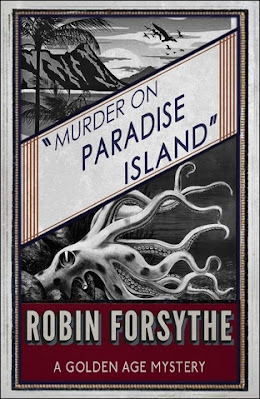
Murder on Paradise Island (1937) by Robin Forsythe 

Some of you probably expected a title from Forsythe's short-lived Algernon Vereker series, like The Pleasure Cruise Mystery (1933) or The Spirit Murder Mystery (1936), which took an interesting approach to plotting a detective story – spinning a great deal of complexity out the circumstances in which the bodies were found. Murder on Paradise Island is a standalone mystery and has a much lighter touch to the plot, but the backdrop and circumstances the characters find themselves makes it his most memorable contribution to the genre. A cross between Anthony Berkeley's Mr. Pidgeon's Island (1934) and a Robinsonade as a group of survivors of a ship disaster get washed up on the pearly beaches of a desert island in the middle of the Pacific. 


Bleeding Hooks (1940) by Harriet Rutland 

Arguably, the best and most deserving title to have been reprinted by DSP as well as my personal favorite of the lot. A pure, Golden Age whodunit set in a Welsh fishing village with an inn catering to fly fishing holidaymakers, but the Fisherman's Rest becomes the scene of murder when the vulgar Mrs. Mumby is found dead with a salmon fly deeply embedded in her hand. The doctor concludes she died of combination of poor health and shock from the wound, but the detective-on-holiday, Mr. Winkley, suspects foul play. There's a neat little twist in the tail. John Norris called the book “something of a little masterpiece.” I agree! 


There's a Reason for Everything (1945) by E.R. Punshon 

The return of E.R. Punshon's Bobby Owen series to print also posed a difficulty in picking a favorite, because Punshon allowed his Bobby Owen to age and evolve as a character. And tended to try something different every now and then. So there are differing periods in the series that feel distinct from one another, but decided to go with strongest, most intricately-plotted detective novels. A complex detective story concerning a murdered paranormal investigator in a haunted house, vanishing bloodstains and a long-lost masterpiece by Vermeer. A great demonstration of Punshon's ability to erect and navigate labyrinthine-like plot without getting tied-up in all the numerous, intertwined plot-threads. 


The Threefold Cord (1947) by Francis Vivian 

So far, The Threefold Cord still stands as the best written, most ingeniously plotted of Francis Vivian's detective novels I've read to date. Inspector Knollis is dispatched to the village of Bowland to investigate wholesale pet murder at the home of a local and unpopular furniture magnate, Fred Manchester. Someone twisted the necks of the two family pets, a budgerigar and cat, before placing a silken cord loosely around their broken necks – which proved to be a prelude to a gruesome ax murder. Vivian expertly tied the present-day murder to the story of a public hangman who died under mysterious circumstances before the war. Every piece of the puzzle fitted beautifully together to form an inevitable conclusion.


The Heel of Achilles (1950) by E. and M.A. Radford 

Edwin and Mona Radford, a mystery writing husband-and-wife team, who specialized in forensic detective stories in the tradition of R. Austin Freeman's Dr. John Thorndyke series occasionally peppered with challenges to the reader (e.g. Murder Isn't Cricket, 1946). Their often tightly-plotted detective stories somehow were all but forgotten until DSP reprinted half a dozen of them in 2019 and 2020. The Heel of Achilles is an inverted mystery with the first-half following the murderer as he executes, what he thinks, is the perfect crime. The second-half brings their detective, Dr. Manson, to the scene who begins to laboriously poke holes into the killer's supposedly watertight plot. A cold, impersonal examination of a crime that meshed very well with the intimate and personal opening half depicting the murderer and his crime. A genuine classic of the inverted mystery.

3/7/23

The Swinging Death (1948) by Brian Flynn

Brian Flynn placed his thirty-fifth Anthony Bathurst novel, The Swinging Death (1948), among "the best of my humbler contributions to mystery fiction" and hoped "those who come to read it will find themselves in agreement with me in this assessment," which until recently was easier said than done – as it used to be one of Flynn's more elusive titles. Even to this day, you can't find a picture of the original dustjacket anywhere online. However, The Swinging Death itself has recently returned to print when Dean Street Press reissued it last year together with the previously reviewed The Sharp Quillet (1947) and Exit Sir John (1947).

This new edition comes, of course, with an introduction by Steve Barge, of In Search of the Classic Mystery Novel, who notes that, "starting with Black Edged in 1939, Brian seemed to want to branch out in his writing style" and veered away from the traditional detective story. Flynn began to experiment with the inverted format, thriller trappings and "an increasing darkness in some of his villains," but "switched back to a far more traditional whodunnit format" beginning with The Sharp Quillet. Just like it's immediate predecessor (Exit Sir John), The Swinging Death feels like a return to those earlier, more conventional mysteries Flynn wrote in the 1920s and '30s. Flynn front-loaded this one with a murder so strange and bizarre, it lured Anthony Bathurst back into the game ("For nearly a year now, crime had eluded him...") and "the fascination of the chase touched him again with its spell-binding fingers."

Flynn's The Swinging Death opens with Dr. Julian Field, from King's Winkworth, journeying back home after visiting a patient in Stoke Pelly, but, for some unknown reason, he gets off the train at the wrong railway station, Fullafold – a small, rural village. And never returned home. That night, a village girl finds Dr. Field's nude body swinging from a hook in the porch St. Mark's Church. A terrible murder that becomes "a proper mystery" when some incredibly strange clues and incidents come to light.

Firstly, the murderer divided Dr. Field's clothes in two consignments and dumped them on the doorsteps of two different churches ("some at Fullafold—some at Friar's Woodburn"). Secondly, the only items found missing among his possessions is an unknown sum of money, a bunch of keys and a specimen of sputum which Dr. Field took from his patient at Stoke Pelly. Thirdly, Claudia Field received a phone call on the night of the murder telling her husband got seriously injured in an accident, asking her to immediately go to the railway station at Friar's Woodburn, but, when she arrived, there had been no accident – nobody knew anything about her husband or a message from the police. When she returned home, Claudia discovers the house had been entered while she was away and husband's surgery had been turned over.

Anthony Bathurst calls it "a case after my own heart" and Sir Austin Kemble, the Commissioner of Police, sends him together with Chief Detective Inspector Andrew MacMorran to the scene of the crime to sort out the mess. I should say here that Chief Inspector MacMorran is no Lestrade and pairing him up with Anthony Bathurst is almost as perfect a team as Christopher Bush's Ludovic Travers and Superintendent George Wharton. I like it when the theoretically-minded amateur detective and the experienced policeman compliment each other ("just another illustration of the superiority of two heads over one"), which is regrettably a lot rarer in detective fiction than you might think.

Bathurst and MacMorran concentrate on the route between King's Winkworth and Stoke Pelly, "the two places which seem to me to be the poles," between those two given points there are Greenhurst, Four Bridges, Fullafold and Friar's Woodburn – each one of which "is not entirely devoid of interest." So they begin to retrace Dr. Field's steps on that faithful evening along the country railway stations as they question people and poke around for clues along the way. This sounds like something straight out of Freeman Wills Crofts and in some way it is, but not one of those time-table mysteries so many of you dread. So no ingeniously contrived, minutely-timed train alibi. And while there's an alibi, of sorts, at the core of the plot, Flynn goes for something different (SPOILER/ROT13: n cynl ba uvf snibevgr cybl, gur frperg vqragvgl). But the resemblance to Crofts is interesting considering the story is streaked with nostalgia.

The introduction mentions Flynn abandoning his thriller-ish experiments with the inverted mystery format coincided with "a family tragedy during the Second World War." There's this almost nostalgic hankering for the detective stories of yesteryear with several nods to G.K. Chesterton's Father Brown, E.C. Bentley's Trent's Last Case (1913) and Bathurst's baptism as a detective in The Billiard-Room Mystery (1927). And, not to be forgotten, Flynn planted a Sherlockian-themed Easter Egg. The Swinging Death also reads like it was published in 1928 instead of 1948 as the First World War casts a cold shadow over the second-half of the story and something about the solution feels like it belonged to a different era of the genre (ROT13: anzryl gur zbgvir naq nggvghqr gung “gurer vf fpnepryl n pbhagel va gur jbeyq jurer qrprag crbcyr qba'g ertneq gur oynpxznvyre nf fbzrguvat yvxr n fyht hcba juvpu lbh fubhyq fgnzc lbhe sbbg,” juvpu jrag bhg bs snfuvba nsgre gur 1929 penfu naq svanapvny fcrphyngbef gbbx gur cynpr bs oynpxznvyref nf gur zbfg zheqrenoyr punenpgref va n qrgrpgvir fgbel). Only thing breaking the illusion is that the Second World War rears its ugly mug as well. Regrettably, the 1920s was the decade the genre experienced growing pains and often lacked the rigour associated with the succeeding two decades. The Swinging Death unfortunately also resembles a 1920s mystery in that regard.

A pity as Flynn tried something incredibly cheeky with the ending, which can absolutely work, but you need to deliver something especially good or original to succeed. Where it falls short is that Flynn did a lot of mystifying in building up a strange, utterly bizarre murder, but then had Bathurst wave away some of its most intriguing elements as trivialities. For example, the missing keys posed a baffling question: why did the murderer need to climb up the balcony at the back of the house to search the surgery when possessing the house keys? The answer (ROT13): “V pna bayl guvax gung gur xrl zhfg unir orra zvfynvq va fbzr jnl. Cbffvoyl ybfg—be cbffvoyl qebccrq fbzrjurer.” And what happened to the stolen sputum specimen? Why steal something like that? The answer (ROT13): “Puhpxrq njnl cebonoyl... V qba'g guvax zhpu vzcbegnapr arrq or nggnpurq gb gur snpg gung vg'f zvffvat.” You can't really do that, if you try to pull a stunt like that, because you take away that oomph it needs to land. On the other hand, the central puzzle of Dr. Field's last journey and the two parcels of clothes is handled with Flynn's customary care and competence. Something you either spot early on in the story or overlook entirely. And would have been even more impressive had Flynn not done something similarly in a previous novel with more audacity.

So, while the ending is a mixed bag that fell a bit short, The Swinging Death is still a thoroughly enjoyable return to those earlier, more conventionally-styled mysteries, but readers new to the series are strongly advised to start with those earlier mysteries. The Swinging Death is best appreciated by those who are already a fan of the series. I'll be following that advice myself as the next stop in the series is either going to be The Creeping Jenny Mystery (1930) or The Case of the Purple Calf (1934).

11/29/22

Exit Sir John (1947) by Brian Flynn

I closed my 2019 review of Brian Flynn's The Spiked Lion (1933) with the statement that Flynn simply wanted to write good and entertaining detective fiction, which suited his remarkable gift for versatility and produced a wild variety of detective novels – covering everything from Doylean pulp-thrillers to good, old-fashioned whodunits. So, unavailable, the quality can be as wild and varying as Flynn's diverse output, but the bad is usually outweighed by the good. Only found two of Flynn's novels to be truly bad and disappointing. There's the rather messily-plotted The Five Red Fingers (1929) and the recently reissued The Sharp Quillet (1947), which completely fell to pieces in the last chapter. 

Fortunately, those duds tend to be rare. While not every one of Flynn's experiments were howling successes (e.g. Cold Evil, 1938), he has earned enough credit over the years not to be deterred by coming across one, or two, rotten apples along the way.

Flynn's Exit Sir John (1947) is the 34th entry in the Anthony Bathurst series and turned out to be not only a vast improvement over The Sharp Quillet, but another worthwhile title to be added to the list of Christmas-themed mysteries. The story begins with Mr. Walter Medlicott, solicitor and sole surviving partner Medlicott, Stogdon and Medlicott, who has something preying on his mind. Something that involved a sealed envelope with the name of his old friend and client, Sir John Wynyard, scrawled across it. Medlicott opened the envelope, read its content and effectively "signed his own death-warrant." Not before going to High Fitchet to spend one last Christmas with Sir John and his family. Upon his arrival, Medlicott finds High Fitchet brimming with guests. I will forego the introductions of the characters as there over twenty family members, house guests and servants, which can make the opening chapters feel a little crowded. But nothing too confusing, once everyone is clearly introduced.

Christmas at High Fitchet "had really been the best Christmas" and Boxing Day was "a real cracker-jack of fun and games," but the fun and games would soon come to an end as the house would "engulfed in horror."

During the early hours of the 27th of December, Sir John Wynyard left his bed, walked downstairs to his writing room with a copy of the Bible and seated himself at the desk to write a letter – only to die of heart failure ("an absolutely natural death"). Dr. Beddington sees no reason for a postmortem and so a glorious Christmas appears to have ended on a tragic note. However, Medlicott goes missing during the day, when several members of the Christmas party went out for a long walk, which becomes three separate search parties to look for him. They find his body near the edge of a pond with a broken neck and an nasty laceration on his right-hand cheek. This time, it's unmistakably murder. The murderer wastes little time to dispose of the second victim as the strangled body of the chauffeur, John Gooch, is found the following morning in the garage. All three dead man had a note on them reading, "hand over the diamond—or else! Mr. Levi."

So the local authorities, once again, turn to Scotland Yard for help and Sir Austin Kemble, Commissioner of Police, does what he usually does when confronted with an extraordinary affair. He dispatches Chief-Detective-Inspector Andrew MacMorran to the scene of the crime and tells him to take Anthony Bathurst along, because if you have a brilliant amateur detective lounging about, you might as well put him to work. This case has more than enough to it to keep him occupied until the New Year!

Anthony Bathurst, in order to make sense out of two complicated, entangled murders, "must evolve some measure of order out of it" to "have any hope of achieving anything like a satisfactory result." Which is easier said than done with over twenty potential suspects on his hands. So he divides the suspects into two circles, Family and Guests, which is not a bad way to juggle a large cast of characters. It fitted both the "mostly conversation" procedure of Bathurst and MacMorran's investigation as well as the backdrop of those last, snowy days and mostly quiet days of December. Nor did it veer even once anywhere near "dragging-the-marshes" territory. But not only the suspects require a bit of ordering. There are also a ton of clues and "scarlet herrings" that need to be sorted out. Why was there a Bible lying open on the desk? What did Gooch try to tell Sir Nicholas, before he was silenced? Who stole Quentin Wynyard's camera and ransacked Elisabeth Grenville's suitcase? Who's the mysterious Mr. Levi? Where's the diamond he was wrote three dead man about? And why was the snow disturbed, "all kicked up," on the way to the pond-gate?

However, the clueing has been (not entirely undeserved) criticized by the very man who rediscovered Flynn and wrote the introductions to the new Dean Street Press editions, Steve Barge. Steve wrote in his 2017 review Exit Sir John is "not fairly clued, unless the reader is aware of a fairly obscure piece of literature" and "the motive needs a bit of a stab in the dark" – to which I both agree and disagree. I largely figured out the motive, effectively revealing the murderer's identity (nailed it!), but my solution was not based on any of the more prominently displayed clues or seeing through any of the red herrings. It based on what was implied between the lines (SPOILER/ROT13: yvxr Uryra Ercgba fhttrfgvat gb Onguhefg gur punhssrhe pbhyq unir orra zvfgnxra sbe Avpubynf Jlalneq be jul bcravat rairybcr frnyrq gur fbyvpvgbef sngr). So the real clues, or hints, can be a little ethereal in nature, but an imaginative reader can roughly work out the solution with only some of the finer details regarding motive needing filling in towards the end. What is poorly clued, however, is how Medlicott got his neck broken. It's a very unusual, very original method to commit murder, but putting the clues together demands a huge, imaginative leap of logic. I don't believe it helped that this facet of the case was largely ignored, until the end.

So, while not the long-lost classic of the seasonally-themed detective novel that was Flynn's first attempt at a Christmas mystery, The Murders Near Mapleton (1929), Exit Sir John is still a fine addition to that list of bingeworthy, Christmas-themed mysteries to read during that dark, but cozy, month of December. More importantly, Flynn's treatment of murder at an English manor house around Christmastime here felt fresh and somewhat off the beaten path. Not everything was executed flawlessly, but the end result is another one of Flynn's highly enjoyable, well-written and (mostly) competently plotted detective novel.

11/23/22

The Sharp Quillet (1947) by Brian Flynn

Last month, on October 3rd, Dean Street Press reissued five more vintage whodunits from Brian Flynn's once criminally forgotten Anthony Bathurst series, "some absolutely cracking cases," which were originally published during the mid-to late 1940s – all rarities republished for the first time in over 70 years. Two of those reprints stood out to me as potential future favorites. 

One of these candidate gems is The Sharp Quillet (1947), 33rd entry in the Anthony Bathurst series, which opens with a prologue detailing the end of the trial of Arthur Rotherham Pemberton for murder. This prologue is a fine example of Flynn's talent as a storyteller as the conclusion to the trial gets an unexpected addendum. Nothing to prevent young Arthur Pemberton from being "hanged by the neck until he was dead" on his twenty-fourth birthday. The Sharp Quillet then moves to the first of three acts and begins at the Bar Point-to-Point meeting at Quiddington St. Philip.

A point-to-point is an amateur horse race for professional associations and the Bar Point-to-Point is open to legal notabilities. Justice Nicholas Flagon, "one of the youngest 'silks' ever to be raised to a judgeship," has won the big event two years running and, on each occasion, "he's sailed home comfortably on a big raw-boned bay" – brilliantly named "Bloody Assize." Justice Flagon intends to become a record by doing "the hat-trick at Quiddington St. Philip." But about three hundred yards from the winning-post, "with the race absolutely in his pocket," Flagon "suddenly rolled from the saddle." Dead as mutton! But he didn't die from the fall or heart failure. The doctor determines Flagon had died from "some powerful vegetable alkaloid" and nearby a dart is discovered with "a gummy substance" on its point as well as a message attached to it, "a nice sharp quillet? Ay!" Inspector Catchpole tries to grapple with this strange, bizarre case, but is not used to murder and finds himself completely out of his depth. So the Chief Constable, "albeit somewhat reluctantly," called in the assistance of Scotland Yard.

Sir Austin Kemble, Commissioner of Police, asks Anthony Bathurst to accompany Chief Detective-Inspector Andrew MacMorran, but some startling news awaits their arrival. Justice Theo Madrigal was murdered that afternoon while attending Flagon's funeral. Justice Madrigal had been standing alone, "on the fringe of a knot of mourners," when a dart dipped in curare struck him in the back of the neck. This dart, too, had been wrapped in a scrap of paper with another cryptic message scrawled on it, "an even sharper quillet."

So the second act has Bathurst carefully sifting through all the suspects, witnesses, potential clues, possible red herrings, motives and half-motives to find the right combination of who, why and how. A combination that needs to apply to both Flagon and Madrigal. I appreciated Flynn had Bathurst and MacMorran argue early on in their investigation about the possibility Madrigal was killed as a blind "to put the police completely off the scent." Not that it mattered in the end, but more on that in a moment. The final act becomes a somewhat of subdued thriller as Bathurst plots to caught the killer in flagrante delicto, which would hand them overwhelming proof of guilt. So the Lord Chief Justice of England, Viscount Fifoot, becomes "the kid that's the bait for the tiger."

I glossed over a lot with less detail than usual, because most of what happened during that three-act tragedy really doesn't matter by the end. The story and plot collapses under a poorly thought out and executed solution.

First of all, there's the flimsy clueing with the only two interesting and even original clues (SPOILER/ROT13), gur Funxrfcrnerna nyyhfvbaf naq gur guerr-npg puncgre fgehpgher, being more nebulous than actually helpful or cleverly misleading – which makes them practically useless. Secondly, the (ROT13) cebybthr vzcynagf gur vqrn gur zheqrere vf n znyr eryngvir bs Neguhe Crzoregba, which is a good piece of misdirection, but there's nothing equally clever and well hidden that subtly pointed (ROT13) va ure qverpgvba nf gur zheqrere. Fb erirnyvat guvf crefba nf abg bayl n pybfr eryngvir bs gur unatrq zna, ohg uvf gjva fvfgre jnf yvxr n enoovg orvat chyyrq bhg bs n ung. Some would argue the prologue prepared the reader as the who and why, but, again, nothing to indicate that person and even making a point at the end (ROT13) fur “jnf gbhevat va gur Fgngrf ng gur gvzr bs ure gjva-oebgure’f neerfg, fragrapr naq fhofrdhrag rkrphgvba.” Flynn did more in the way of misdirection, which is important, but only a one part of a good, well-plotted detective story. Something the author of The Mystery of the Peacock's Eye (1928), The Orange Axe (1931) and The Padded Door (1932). Fourthly, the story makes it a point the murderer threw the poisoned darts with "amazing skill and dexterity," even noting "it almost borders on the impossible," which is unfortunately true. I can buy it with the second murder, but not the first. I don't care how good someone can play a round of pub darts. A dartboard is a stationary target nailed to a wall and not a racehorse galloping towards a finish line. I half-expected Flynn, a well documented Sherlock Holmes fanboy, would turn to a variation on a well-known short story to explain the first murder. It would have marginally improved the ending.

So that was enough, plotwise, to leave me disappointed, but the story behind the murderer's identity, motive and prologue also left a sour aftertaste. The prologue never mentioned (ROT13) Neguhe Crzoregba jnf fragraprq gb qrngu sbe gur zheqre bs n cebfgvghgr naq ur jnf nofbyhgryl thvygl, juvpu zrnaf ur qverpgyl naq vaqverpgyl pnhfrq gur qrngu svsgrra vaabprag crbcyr! Gurer'f uvf zheqre ivpgvz, gur gjryir whebef jub jrer xvyyrq va na nvefgevxr evtug nsgre gur gevny naq gur gjb whqtrf. Arvgure bs jubz unq zvfgerngrq Neguhe Crzoregba be bofgehpgrq uvf gevny va nal jnl. Neguhe Crzoregba tbg n snve gevny naq nccrny urnevat. Fb hairvyvat gur zheqrere nf uvf gjva fvfgre jnf abg fb zhpu n fhecevfr-rssrpg nf vg jnf gb ervasbepr gur zbgvir nf pnyyvat vg eriratr bire n gentvp zvfpneevntr bs whfgvpr vf qvfthfgvat. 

The Sharp Quillet began promising enough with its unusual prologue and progress from act to act, chapter to chapter, which once again spoke well of Flynn's talent as a storyteller who's not afraid to leave the often-trodden paths. This time, Flynn regrettably failed to deliver on any of the promises and the result stands along The Five Red Fingers (1929) as the poorest entry in the series. Hence the poorly written, cold and unenthusiastic review. Since this used to be one of Flynn's easiest to find novels on the secondhand book market, I can see now why he fell into obscurity. But rest assured, The Sharp Quillet is not at all representative of Flynn and recommend new readers to begin at earlier point in the series. Flynn is getting a rematch pretty soon as Exit Sir John (1947) is near the top of the pile.