Showing posts with label Private Eyes. Show all posts

2/22/26

The Leopard Died Too (1957) by Nigel Brent

"Nigel Brent," a pseudonym of Cecil Gordon Eugene Wimhurst, is one of those obscure, practically forgotten writers who published a dozen medium boiled mysteries between 1953 and 1960 – all starring his private investigator, Barney Hyde. Not much else known except that he wrote a slew of dog books under his own name and penned the odd short story over the decades. "Commando Weekend" appeared in the September, 1948, issue of Scramble, "The Stolen Landscape" was published in Boys' Fun #3 (1953) and finally "Murder in Jail" from Detective Thriller Library #1 (1960). But that's where the trail turns stone cold.

So, if Wimhurst is remembered or even read today, I hazard a guess it's probably for his dog books rather than the long out-of-print, now scarce Barney Hyde series of collectibles. I likely would have never heard or given any attention to Wimhurst's run as "Nigel Brent" had The Leopard Died Too (1957), the seventh Barney Hyde, not been an impossible crime novel warranting a mention in Brian Skupin's Locked Room Murders: Supplement (2019). In my mind, The Leopard Died Too gave off some He Wouldn't Kill Patience (1944) vibes, but is it anywhere near as good? Let's find out!

Barney Hyde, head of the British end of the trans-Atlantic Global Investigations, is hired by Mrs. Nicola Curlew to find the person who has been sending her husband, Dan Curlew, threatening letters.

Dan Curlew is a well-known, successful producer of animal films, "a queer kind of fella but he knows how to throw a nature film together," who has a private zoo and circus on his estate – called Witch Wood. Recently, Curlew has been receiving death threats with the last one promising "one more letter and then I shall execute you." Hyde accepts the case and travels to Witch Wood alongside his beautiful secretary Miss Emerald Dikes and his Alsatian police dog, Kurt. Finds what you would expect from a pulp-style mystery with a circus and zoo background. Curlew has hired Jag Macklon, a South African, to run his importing department supplying wild animals, but Jag and Nicola are obviously in love. Kara Jaeger is the animal trainer/lion tamer of the circus and daughter of the once famous Max Jaeger. Only animal trainer who did an act inside a mixed cage of lions, tigers, jackals and wolves, but now he's a drunk long since pass his prime. Osakombi, a West African of the Nankhanse tribe, who breeds N'gwa caterpillars for Curlew in the insect house, but is treated appallingly. Holloman Traves, a steel tycoon, is one of Curlew's oldest friends, but not really. Hyde even tells Curlew shortly after arriving that he's "surprised that you don't get your threatening letters delivered in a sack."

A striking scene of this first part leading up to the murder is Kurt, the Alsatian dog, nearly dying fighting an escaped leopard that launched itself at Emerald. Good boy!

When the last letter arrives, Hyde gets serious and decides to place Curlew inside a practically hermetically, sealed concrete room used to edit his films and has a special lock on the door – while every other door is also locked and guarded. Curlew is locked inside the room with his pet leopard, Aisha, but, when the time arrives, Hyde hears a scream from the outside. When they finally manage to break into the room, they find Curlew and Aisha dead. Apparently, they died from poison, but how? No container or syringe is found and how do you inject a leopard with poison in small, locked room without getting shredded? A problem that gets even worse if capsules were used. However, Hyde believes it was murder, not suicide, but how did the murderer poisoned them when the room was locked and guarded on every side? And not a trace of poison to be found anywhere!

I'll address the locked room element first as it constitutes the meat of the plot. The Leopard Died Too is, what I have come to call, Tough Nuts (...hard to crack). A hard-or medium boiled, often pulpy private eye mystery containing a locked room puzzle or other kind of impossible crime, which in a P.I. novel is either relatively simple or surprisingly tricky. Either way, the locked room element tends to what gives weight to these classic P.I. novel trying their hands at the impossible crime. The Leopard Die Too is no exception, but Brent did more with the locked room poisoning than the story and plot required of it. How the locked room was setup and presented suggested only two possible solutions to me: either the editing console or a strip of film had poison smeared on it or the leopard's fur had been coated with poison, which in turn would explain how the leopard died too. If the poison had been on the console/film strip, the poison was transferred from Curlew's hand onto the leopard when stroking the animal. What does any feline do after getting touched by a smelly, bipedal slug monkey? They begin to clean themselves. So both methods explain how the leopard died alongside with Curlew, but Brent came up with a third, slightly pulpy, but fairly clued, solution to explain the locked room poisoning. It should be noted that you can't really start putting those clues together properly, until Hyde receives the autopsy results. But I liked this third, somewhat hokey, solution as it fitted the story very well.

Not something I expected considering the second-half of The Leopard Died Too moved away from this intriguing impossible murder at a private zoo and circus to become a muddled, convoluted pulp thriller – employing the everything-but-the-kitchen-sink method. Safe crackers, communists agitators and spies, Secret Service agents, tribal rituals, exotic poisons, kidnapping, complimentary bombs etc. So basically everything Brent could think of got tossed into the plot and you almost have to praise Brent for holding it all together in the end, but it obviously took away from the good work done in the first-half and solution to Curlew's inexplicable murder. So, in the end, The Leopard Died Too is best summed up as one of those 1950s transitional mysteries that fell between the cracks of two eras when attempting to get footing on both sides. I suppose that holds true for Brent and the Hyde series as a whole.

I still enjoyed this "toughy," but, unless you collect hardcover mysteries or locked room mysteries, you shouldn't sell an arm or leg to get hold of a copy.

9/19/25

A Gumshoe with Sea Legs: "Death at the Porthole" (1938) and "The Eye" (1945) by Baynard Kendrick

Baynard Kendrick is best known today for creating one of the most successful blind detectives in crime fiction, Captain Duncan Maclain, who not only overshadowed his other creations, but completely eclipsed a character like Miles Standish Rice – a Miami-based detective character. Rice appeared in three novels and seventeen short stories published in Black Mask, Mystery Novels Magazine and The Saint Mystery Magazine. I remember enjoying The Eleven of Diamonds (1936) and The Iron Spiders (1936), but not nearly as good as the best Captain Maclain novels (e.g. The Whistling Hangman, 1937). So they form a clear example of a main series character and secondary one.

I recently stumbled to the fact Kendrick had a third, short-lived and practically forgotten series-character. Cliff Chandler is the dandy, debonair ship's detective whose job it's to protect "the welfare of transatlantic passengers on the S.S. Moriander," which is an interesting premise for a series, but Chandler appeared in only two short stories published seven years apart.

The first of these two short stories, "Death at the Porthole," originally appeared in a 1938 publication of Country Home Magazine and reprinted in the November, 1944, issue of Ellery Queen's Mystery Magazine. "Death at the Porthole" takes place during the tenth, uneventful voyage of the S.S. Moriander, departing Southampton for New York, when "even the usual run of petty cardsharps seemed to have deserted her" – not much "guarding the passengers' welfare" to do. Although there are some curious incidents. Chandler meets a lovely young woman aboard, Elsa Graves, who appears to be packing a gun, but why? M. Jean Martone, "manufacturer extraordinary of a select line of cosmetics," accidentally falls overboard and has to be rescued. Finally, the woman with whom Elsa Graves shared a cabin, Dorette Maupin, is found dead with a broken neck. Chandler is a man of action who "thrived on excitement," but he has to do some real thinking and a bit of detective work to crack this case.

Even without the presence of the famous blind detective, "Death at the Porthole" is unmistakably a Baynard Kendrick detective story. It has a foot in both the hardboiled private eye story from the pulps and the formal detective story, which comes on account of the well-played who and how. Particular the latter is a dead giveaway as it plays on Kendrick's favored method of (SPOILER/ROT13) oevqtvat gur qvfgnapr orgjrra ivpgvz naq zheqrere, hfhnyyl ol qebccvat be guebjvat fbzrguvat, juvpu graq gb perngr na vzcbffvoyr fvghngvba be nyvov nybat gur jnl. "Death at the Porthole" can be linked to the previously mentioned The Whistling Hangman and The Eleven of Diamonds when it comes the how, but, of course, not worked out to the same extend. So rather simple by comparison, however, the bravado of the (ROT13) frpbaq zheqre is appreciated.

Kendrick's "Death at the Porthole" is not a classic, criminally overlooked short story from the detective story's golden era, but it's a promising start to what could have been a fascinating and fun series of pulpy short stories.

The second, and last, short story in the series, "The Eye," originally appeared in the November, 1945, issue of Ellery Queen's Mystery Magazine and leans more towards the pulp-thriller than the detective story – giving Cliff Chandler all the excitement he wanted. Chandler is approached by a frightened VIP passenger, Moira Nelson, who's a famous screen actress making the crossing with her 12-year-old son, manager and bodyguard. Moira Nelson received a threatening call pressing her to wear a pearl necklace, worthy fifty thousand dollars, to the ship's concert the next night or her son will pay the price. Having listened to her story, Chandler does an impromptu piece of armchair reasoning and not a bad solution either. But his solution ends playing right into the culprit's hands. So, as the villains reveal themselves, "The Eye" turns into a pulp caper with a delicate hint of piracy and how the ship's detective resolves this case is notably different from the first story (oyvaqvat entr). I was entertained enough and the trap triggered by Chandler's false-solution a clever touch, but I'll probably won't remember any of it. Not without looking back at what I wrote here.

"Death at the Porthole" and "The Eye," while not a bad or outstandingly good, are understandably footnotes in Kendrick's work, but there was potential had the series continued. I suspect this would have been one of those series best read in a collection of twelve or fifteen short stories, because atmosphere and backdrop (i.e. shipboard setting) is as important as a decent plot. Something like James Holding's The Zanzibar Shirt Mystery and Other Stories (2018), but more hardboiled.

A note for the curious: Cliff Chandler has been called the only ship's detective in the genre, but there's Cutcliffe Hyne's "The Looting of the Specie-Room" (1900) and John Dickson Carr's 1940s radio-detective, Dr. John Fabian, whose cases are gathered in The Island of Coffins and Other Mysteries from the Casebook of Cabin B-13 (2021).

9/11/25

The Case of the Curious Heel (1943/44) by Ken Crossen

Back in February, I reviewed Ken Crossen's The Case of the Phantom Fingerprints (1944), second and last novel in the Jason Jones and Necessary Smith series, which is an incredibly fun, pulpy impossible crime tale with Crossen fanboying all over his favorite mystery writers, characters and novels – complete with a locked room lecture ("...guess I can say a few words on impossible situations"). So pulp at its most entertaining. On the other hand, Crossen's The Laughing Buddha Murders (1944), starring the American-Tibetan detective Chin Kwang Kham, turned out to be a letdown. Disappointing since Crossen used The Case of the Phantom Fingerprints to promote The Laughing Buddha Murders and that raised certain expectations. Crossen's The Case of the Curious Heel (1943/44) and Murder Out of Mind (1945) fortunately still looked very promising.

In fact, Anthony Boucher praised Crossen's The Case of the Curious Heel as "a high-grade pulp yarn" about impossible murders piling up around an obnoxious ex-pulp writer "whose identity is fun to guess."

The Case of the Curious Heel was originally published in the May, 1943, issue of Baffling Detective Mysteries and opens with the introduction to that obnoxious ex-pulp writer, Johnny Bell, who got his start in pulp magazines like Detective Yarns Weekly – before getting moving on to the slicks and Hollywood ("writing pictures for Dorothy Lamour, Paulette Goddard, Rita Hayworth"). Bell is currently working on a mystery play written, directed and produced by himself. So every time Bell completed a scene, he gathers a group to act out the scene as a test run. The Case of the Curious Heel begins on the evening of one such rehearsal and it's a full house. There's his wife, Betty Bell, his private secretary, June Hayes, and his ghost writer, Bennett Barlay, who carries on the Johnny Bell magazine stories so his employer can concentrate on his movie scripts and stage play. Further more, there are Willard Duncan, a literary agent, Manny Ladd, press agent, Ray Martin, a Hollywood columnist, and the author of the Freddy Hack mysteries, Gregor Fain. Lastly, the actress Karen Russell and the man who coughed up ten grand to back the play, George Porter.

Before they play out the scene, the reader gets an example why some might consider their host to be a perfectly viable target for shooting practice. Bell calls everyone present leeches, parasites and sponges ("every one of you would starve to death if it weren't for me"). When everyone there knew Bell's "a real vampire" living "on the literary blood of others," among other charming personality traits and habits.

Surprisingly, it's not Johnny Bell who bites the dust during the rehearsal. The scene they rehearse has Karen Russell's character picking up a gun to shoot Manny Ladd's character, but, when she pulls the trigger, it actually goes off. Ladd getting fatally shot is the first (quasi) impossible situation of the story. The gun was not only supposed to be empty, but was proved to be empty when "Bell put the gun to his own head and pulled the trigger five times" to show it was a harmless prop. Bell "then he tossed the gun to the girl" and "she held it until she pulled the trigger." They all swore the gun was empty when it fired a very real bullet. Another peculiar aspect is that only Bell and June Hayes knew beforehand what the scene was about and that it involved a gun. Only two people knew beforehand what was going to happen in the scene, Bell and June Hayes. So only they knew it would involve the gun he had brought back from Hollywood. That looks bad for Bell.. or was there a mix-up with him being the intended victim? Bell hires a private investigator, Necessary Smith, to look after his interests and work alongside the "poor man's Nero Wolfe," First Grade Detective Jason Jones. They're two characters who deserved a longer run than they got.

Jason Jones, round, red and jovial, has "a working agreement" with his superiors to never get promoted in exchange for solving those pesky cases "that the captain said couldn't be solved." That way, Jones can attend to his wife's cooking and tending his geraniums in his rooftop hothouse instead of having to worry about work floor politics and rivalries. This arrangement also allows Jones to handle cases according to his own unhurried, armchair methods. Jones believes the right technique is simply waiting rather than wear himself out chasing around or thinking deeply about clues, "murderer feels pretty safe as long as he sees all that activity," but when the detective sits around, ignores the clues and ask a few routine questions the murderer gets nervous – which is when they make mistakes. Jones very much admires characters like Nero Wolfe and Mycroft Holmes. Necessary Smith is your average, 1940s American gumshoe who legally changed when his ex-boss, Bruce Elliott (the Bruce Elliott?), regularly interrupted his verbal reports with the question, "was that necessary, Smith?" His boss thought that was funny. So, when he retired, handed the business over to Smith.

Jones and Smith make for a fun detective duo who have their work cutout for them as it becomes ever clear they're dealing with a killer who has "the fiction mind." Not only the dubious shooting of Manny Ladd and it's various possibilities, but also second body turning up behind the locked door of a lavatory and "a fly couldn't get in that room without the door opening for him." Boucher wasn't wrong to call this a high-grade pulp yarn, but I'll get to the plot in a moment.

The Case of the Curious Heel is still a pulp mystery. Even the best pulp mysteries lacked the rigorous plotting and polish of their Golden Age counterparts, because they were written at piece rate with much shorter deadlines. Every now and then, a pulp writer would deliver a more polished detective novel, like James Ronald's Murder in the Family (1936) or John Russell Fearn's posthumously published Pattern of Murder (2006), but they're the exceptions and The Case of the Curious Heel is not. For example, Crossen lightly rewrote/copied passages between Jones and Smith from The Case of the Curious Heel for The Laughing Buddha Murders. Jones even launches into a locked room lecture. So the story more than once gave me a light sense of déjà vu, but there's also the occasional sloppiness in details. In the first chapter, Barlay is scolded for pointing out the locked room murder from Bell's stage play is practically the same as the impossible shooting from his short story "Thumbs Up for Death." This story is referred to again later on in the story as "Thumbs Up for Murder." Something you can't help but notice. By the way, as an aside, Bennett Barlay is one of Crossen's pseudonyms.

Anyway, the plot is definitely a cut, or two, above the average '40s pulp yarn. Not for the usual reasons either. Normally, the impossible crime in a pulp-style locked room mystery is the most substantial plot piece with the who and why usually being obvious from early on in the story – which here was the other way round. I suppose that's on theme as 2025 has not been a great year for finding an abundance of excellent impossible crime and locked room mysteries. Crossen handled the murderer's identity and motive with more skill than expected going by my previous two reads. Solution is only really hampered by the trick used to shoot the first victim, which is dodgy from start to finish. So much could have gone wrong, (SPOILER/ROT13: jung vs, nsgre chyyvat gur gevttre svir gvzrf, chyyrq vg n fvkgu gvzr gb naabl gur areibhf tngurevat rira zber? Jung vs gur tha jnf cbvagrq ng fbzrbar ryfr gung fvkgu gvzr? Jung vs Oryy unq chyyrq gur gevttre n fvkgu gvzr juvyr gur tha jnf cbvagrq ng Ynqq be gur zheqrere? Jung vs Oryy fvzcyl unqa'g chyyrq gung fghag? Which would not have been out-of-character and would have tossed a huge spanner into the murderer's plans. The locked room-trick used in the second murder is perfunctory, but neatly used for a false-solution and providing an even neater twist to Jones' explanation.

Crossen's The Case of the Curious Heel is indeed a quality piece of pulp fiction. Maybe not the very best locked room pulp, plotwise, but Necessary Smith and Jason Jones make up where the plot lacked. I would have like to have seen more of them or at least gotten a few short stories out of those apocryphal cases Jones mentioned. Jones' short teaser of "The Case of the Missing G-String" sounds like a trip!

Note for the curious: the locked room from the stage play is briefly described, but not in too great detail and no solution given. The gist of the locked room is that a man is found under circumstances giving "a perfect picture of suicide." A room with every door and window locked from the inside ("...impossible for anyone to get into the room without crawling through the keyhole"). Only real detail is the thumb print of one of the (innocent) suspects being discovered in the center of the ceiling. So not much to build an armchair solution around, except that the thumb print on the ceiling probably means a wire/pulley trick was involved to turn the key from the inside. A trick requiring a ladder to setup and that allowed for the artistic touch of the faked thumb print on the ceiling. Otherwise, it would be too inconvenient and risky to lug a ladder around the house just to put a thumb print on the ceiling. Why not simply put it on an untampered window catch to muddy the waters? But if a ladder was needed to setup a wire/pulley trick, the ceiling print would be even more incriminating for a frame job than a print on a window catch. There's no reason why people wouldn't leave prints on window catches. They were made to be handled, but the ceiling of a crime scene is a different. I'll shut up now. :)

8/24/25

It's About Impossible Crime (2025) by James Scott Byrnside

Last time we heard of James Scott Byrnside was a short story, "The Silent Steps of Murder," posted on his blog as an appetizer to his upcoming, then untitled collection of original short stories – nearly all were still developmental stage at the time. So it took about a year and a half for the collection to materialize, but early June finally saw the publication of It's About Impossible Crime (2025). A collection of five, relatively longish stories dedicated to MacKinlay Kantor and William Spier. The title of the collection is, of course, a nod to Kantor's short story collection It's About Crime (1960) which include his two impossible crime stories "The Strange Case of Steinkelwintz" (1929) and "The Light at Three O'Clock" (1930). Spier was the radio director who worked on The Adventures of Sam Spade and Suspense series. So the tone for these stories is set!

It's About Impossible Crime starts out with the aforementioned "The Silent Steps of Murder," but already reviewed as part of "Locked and Loaded, Part 4" after it was published on Byrnside's blog. I'm not going over the story again, however, there are a couple of differences between the original and final version of the story. Byrnside originally intended It's About Impossible Crime to have an overarching storyline, concerning an enterprising serial killer who had already strangled seven women, which got scrapped. So references to that case do not appear in this final version and the fun little challenge to the reader was scrapped as well. Other than those changes, "The Silent Steps of Murder" is true to the original version I read and enjoyed last year. Simply a great retro-GAD story.

The second story is the intriguingly-titled "Where There's Smoke, There's Pazuzu" which begins with an ominous phone call to Rowan Manory, the best private detective in 1920s Chicago. A muffled voice tells him a man, named Burt Parnell, is about to be slaughtered in his office, on the third floor of the Pinnacle Place, but warns the detective there will be nothing to solve – because "this murder will be a completely supernatural affair." Manory and his assistant, Walter Williams, go to the building to investigate. When they arrive, the fire brigade is already present to put out a fire in Parnell's office, but the door is locked from the inside and they need to get out an axe to open it. Inside the partially burned office, they find what's left of Parnell sitting behind his desk without a head and his entrails spilled out on the floor. The office was turned inside out, but "no one other than the victim was found inside."

So another seemingly impossible murder for the two Chicago gumshoes, but Manory knows "the solution always lies within the bounds of reality" even when demonology rears its ugly head. In this case, the ancient demon Pazuzu of The Exorcist fame who came along with a curse placed on Parnell. This case has a personal, painfully grounded aspect for Williams, a veteran of the Great War. The daughter of Parnell is engaged to the son of an old friend from the trenches. And learns from him most of their friends who made it out have fallen on hard times or passed away, which gives Williams a pang of survivor's guilt. So a jam packed story and a pretty good one at that. I only pieced together the locked room-trick, but the murderer's identity and well-hidden motive took me by surprise. Another very well-done retro-GAD locked room mystery.

"Instrument of Death" is a non-impossible crime story, but, curiously enough, probably the best piece of detective fiction Byrnside has produced so far. Violet Reynolds, outwardly happily married, who fears her husband, Bobby, no longer loves her and decides to consult a spiritual medium. Madame Dunkel has some bad news: she sees a man standing over her corpse. A big, ugly man. And it will happen very soon ("your fate is sealed"). This large, ugly man is introduced to the reader as Dickie Daubert when he's busy hiding the body of Julie McPhee in her attic. Julie is a friend of Violet, who recently came into possession of a valuable violin, which Dickie wants to get his hands on – no matter the cost. What he has to find out is whom, of Julie's friends in the orchestra, is taking care of the violin as the bodies begin to stack. There are, however, only so many bodies you can litter across Chicago, before it attracts the attention of Manory. This time assisted by Officer Kegan, because Williams is out of town.

So without an impossible crime and a big, dumb violent brute strangling and stabbing people, "Instrument of Death" sounds more like something out of an hardboiled pulp magazine than a detective story proper. But rarely has appearances been so deceiving, even in our genre. When Dickie closes in on Violet, the story begins to twist and turn with the same brutality as the murders. I didn't see that ending coming at all and that final scene was very effective. Like a hardboiled Ellery Queen or a substantially-plotted Mike Shayne story. My favorite from this collection!

"The Preminger Curse" is an unapologetic throwback to the Gothic tales of crimes and suspense from the Doylean era of the genre. Manory travels down to Cairo, Illinois, to attend the reading of the will of two ex-clients, Dolph and Sophie Preminger. Manory is mentioned in their will and takes Williams along to the rundown Preminger mansion to see what's all about, because late changes to a will is never a good sign. When they arrive, they find a tensely gathered family and the reading of the will does very little to lessen the strain. Jasper Dunn, family lawyer, tells their daughter and younger son, Beverly and Timothy, they'll receive one hundred thousand dollars each ("that's... significantly less than it used to be"). Robert, oldest son, only gets a measly twenty-five thousand dollars. Their adopted brother, Simon, gets two hundred and fifty thousand dollars for giving his adopted parents so much joy when they were abandoned by their own children. Finally, there's their only grandchild, Ernest, who was the only child of their late son Cornelius. He gets the mansion, grounds and two millions worth in assets under one peculiar condition that comes with even stranger comments.

They must remain at Preminger mansion for the next twenty-four hours and should Ernest "commit the crime of murder against any blood relative," his "inheritance shall be forfeit" and the estate to be liquidated – to be "divided equally among the surviving heirs." Reasoning behind this strange condition is the Preminger Curse. In the 1700s, the Premingers were saddled with a burdensome curse, "one of the Preminger offspring will go mad and attempt to kill the rest of the family" every other generation. It happened twice already and the last time nearly wiped out the entire family. Which is why there's only one grandchild. Cornelius was the only one who defied his parents wishes and had a child. So the whole family were terrified of Ernest and was treated abysmally as a child, which included being locked away in room with barred windows and a padlock on the door. That left him with a personality disorder.

So the conditions of the will, frayed family ties, money needs and a less idyllic atmosphere nicely sets the stage for murder, which is why Manory was asked to be present – who's guaranteed a fat fee no matter what happens. Next twenty-four hours aren't uneventful with people getting killed or disappearing from locked and watched rooms. A barefoot, messy haired and almost ghostly figure of woman was seen dancing wildly in the rain. While the locked room-tricks are simple, straightforward affairs, the strength of the story is how it all folded together in the end cleverly (SPOILER/ROT13) haoheqravat gur zheqrere sebz fhfcvpvba. "The Preminger Curse" is the longest story in this collection, but not one that overstayed its welcome for even a single page. A great, very well-done homage to those Victorian-era mysteries from Doyle's days.

The fifth, and final, story is "Cue, Murder!" begins on New Year's Eve in the apartment of Atlee Burroughs, a stage director and teacher, who's entertaining a student, Paul Chase. They interrupted by an argument coming from the apartment below, "pipes in this building carry noise," where a former, Hollywood-bound student lives. Burroughs and Chase overhear Jonathan Keltner arguing with someone who brought a knife and a plan, "when they find your corpse, the door will be locked and the key inside." So they call the police and the responding officer kicks down the door to reveal Jonathan Keltner's body, but why was his body rolled inside a rug? And why is there a pile of celluloid strips lying on the floor? A locked room murder in Chicago naturally brings Manory to the scene of the crime. I don't think the central conceit is going to trick the seasoned, cynical armchair detective, but how it was done is a little trickier with an interesting, risky (ROT13) hfr bs n pbhcyr bs hajvggvat nppbzcyvprf juvpu urer vf creuncf cersrenoyr gb n pehqr erpbeqvat bs na nethzrag orvat cynlrq. On top of that, the locked room-trick is, given the circumstances, simple and practical without being routine or old hat. And it played on a locked room principle that has always fascinated me (ROT13: znxvat na haybpxrq qbbe be jvaqbj nccrne gb or gvtugyl ybpxrq). This all placed against the seedy, backstage world and goings on of the theatrical world and its crowd makes "Cue, Murder!" a solid story to close out the collection.

So, when it comes to the overall quality, the stories collected here range from solid to superb and even with only a handful of stories that's an accomplishment. You always have to expect one, or two, duds, but not It's About Impossible Crime. They're all Golden Age worthy whodunits in which Byrnside showcases he as skilled in hiding murderers as he's at getting them out of tightly locked rooms and impossible situations. That's also my only complaint. For a collection titled It's About Impossible Crime, it hasn't all that much to say about its impossible crimes. "Where There's Smoke, There's Pazuzu" and "Cue, Murder!" are the only two stories really deliver as impossible crime stories with "Silent Steps of Murder" underplaying its impossible situation and the two locked room murders in "The Preminger Curse" being very minor. "Instrument of Death," best story of the collection, has none at all. Not that it takes anything away from them as first-rate, neo-GAD mysteries, but was looking forward to picking apart a few meaty locked room puzzles. So take the locked rooms as a little bonus on top of five excellently written and constructed detective stories. I hope to see more of Manory and Williams in the future. Don't pull a vanishing-act on us, James! Remember, you promised to write Time Seals All Rooms. :)

7/16/25

The Aluminum Turtle (1960) by Baynard Kendrick

Baynard Kendrick's The Aluminum Turtle (1960), alternatively titled The Spear Gun Murders, is the eleventh, and penultimate, novel in the Captain Duncan Maclain series published early in the post-Golden Age era of the genre – which tries to keep up with the rapidly changing times. An old school detective story with a new class of criminals and attitudes to crime. It's not only the ever-changing times that makes The Aluminum Turtle distinctly different from the 1930s and '40s novels taking place in a darker, pulpier version of New York City. The Aluminum Turtle brings Captain Maclain and his entire entourage to the sunnier climes of Florida. Captain Maclain has a good reason to return to Florida.

Seven years ago, Ronald Dayland was brutally killed in a presumably robbery gone wrong somewhere between Tampa Airport and Courtney Campbell Parkway. Dayland had been battered with "almost maniacal ferocity" and his wallet had been emptied, but why didn't robber take a valuable gold watch and a diamond ring? Sheriff Dave Riker, of Poinsettia County, doesn't believe this is a simple robbery gone wrong and turned his attention to a club of teenage delinquents calling themselves the Water Rovers. They started out as an outlet for bored teenagers, boat races and skin divers, before broadening their activities to drinking parties, drag racing with the family car and eventually small, costly crime sprees. Everything from rowboats, cruisers and outboard motors to anchors, tools and other gear were "slickly stolen." But did they extend their activities to robbery and murder? Sheriff Riker never got the proof and the unsolved murder had terrible consequences for Dayland's then twelve year old son, Ronnie.

Dayland is the owner of the successful Dayland Fruit Company, which ensured his wife and son had everything they wanted, but the emotionally neglected Ronnie has always craved the attention of his parents and went out of his way to get it – like arson and crashing a boat. In the years following his father's murder and second marriage of his mother, Ronnie went "down the sliding board from marihuana to pills and the needle" to become "an expert snowbird and doomed entirely."

Captain Maclain is an old friend of the Daylands whose work in New York and the lack of an official invitation prevented him from probing the murder of his old, long-time friend. Ronnie intends to use their fishing trip to ask Captain Maclain for help with his addiction, because it was easier to ask someone "who couldn't see the terror in his face" or "read the truth of his weakness." Very different to how Kendrick handled the "funny cigarettes" in The Last Express (1937) decades earlier. Their one-on-one aboard Ronnie's fishing boat, the A-bomb, sets the tone and pieces for the overall story.

Firstly, Ronnie's plan to ask for help is shelved when he fishes up a curious looking object: an aluminum turtle with rubber flippers, head and tail. Ronnie believes he had "lucked on to an underwater buoy that marked some sunken treasure." Something that's going to propel to plot later on. Secondly, Captain Maclain is firmly in fallible detective mode. Not only for neglecting the murder of his friend for seven years ("wasn't it more of an obligation to do his best to solve the murder of a friend... than to take a fee to investigate the murder of some person he had never known?"), but trying to understand Ronnie and his generation ("their jargon is as uncomprehensible as their music") and generally getting older. That's why he's unsure what's happening half of the time ("there were undercurrents he couldn't fathom") with the developing case rubbing it in his face how depended he still is on Sybella, Spud Savage, Rena and his two dogs, Schnucke and Dreist.

The developing case comes to a head when Captain Maclain joins the boating party returning to the spot where Ronnie discovered the aluminum turtle. Ronnie dives into the water with an hour's supply of air, but never resurfaces and ninety minutes later they call the coast guard. Not long thereafter his body is recovered, but Ronnie didn't drown. He was shot with a spear gun. Suddenly, the sea is crawling with potential suspects. Two members of the Water Rovers were spotted nearby with one entering the water carrying a spear gun and boat that recovered the body is manned by cut-throat treasure hunters. Not to mention a fleet of shrimpers, run by an ex-mobster, known to be a cover for a huge smuggling operation. There are more spear gun killings, past and present, discovered and committed along the way.

However, the plot of The Aluminum Turtle lacks the puzzling complexity of earlier novels like The Whistling Hangman (1937) and Blind Man's Bluff (1943). The murder method has echoes of those two novels (ROT13: perngvat gur vyyhfvba bs qvfgnapr orgjrra zheqrere naq ivpgvz), but nothing is done with it, plot-wise, before being explained away between a few sentences. Only real plot-complexity, to speak of, is the school of red herrings trying to obscure a routine plot and rather obviously murderer. So the focus of The Aluminum Turtle is not on the traditional who, why and how, but how Captain Maclain grapples with this case and himself. If you have only read the pre-1950s novels, The Aluminum Turtle feels like a threadbare affair with too much drama and not enough plot. More like Brett Halliday than Ellery Queen. Fortunately, I really like Captain Maclain and appreciated what Kendrick attempted to do here, which I think fans of the character will agree with. But, purely as a detective novel, The Aluminum Turtle is a far cry from the first five, or so, novels. I highly recommend you start there before skipping this far ahead.

That being said, The Aluminum Turtle has made me curious about the last title in the series, Frankincense and Murder (1961), which sounds like a hyper conventional drawing room mystery. The kind of drawing room mystery most of Kendrick's contemporaries debuted with in the '20s and '30s. You might see a review of that one before too long.

2/12/25

The Case of the Phantom Fingerprints (1945) by Ken Crossen

Kendell Foster Crossen was an American pulp writer of science-fiction, mysteries and a short stories during the 1940s before moving onto private eye and spy fiction in the '50s and '60s, which appeared under numerous different pennames – notably "M.E. Chaber," "Ken Crossen" and "Richard Foster." Just like other pulp writers covered on this blog, Crossen was a fan of impossible crime fiction and penned at least half a dozen of them.

Robert Adey's Locked Room Murders (1991) lists only four novels. Firstly, the two "Richard Foster" novels, The Laughing Buddha Murders (1944) and The Invisible Man Murders (1945), featuring the Tibetan-American detective, Chin Kwang Kham. Secondly, two of four "Ken Crossen" novels starring Jason Jones and Necessary Smith, but know the Milo March novel Wanted: Dead Men (1965) should have been included in Brian Skupin's Locked Room Murders: Supplement (2019). Crossen also penned an excellent science-fiction mystery hybrid short story, "The Closed Door" (1953). So who knows what more is buried in his catalog of obscure magazine fiction and out-of-print novels.

In 2020, Steeger Books started reprinting the Milo March series in addition to several volumes with the pulp adventures of the Green Lama, but Crossen's pulp mysteries, especially his impossible crime novel, annoyingly remain out-of-print. Like the subject of today's review.

The Case of the Phantom Fingerprints (1945), as by "Ken Crossen," is the second of only two novels, to my knowledge, starring Jason Jones and Necessary Smith – who first appeared together in The Case of the Curious Heel (1944). The book and particularly the two main characters read like a pulp-style send-up of Crossen's favorite mystery writers and fictional detectives. Detective Jason Jones, "fat beyond description," who has an agreement with the police department that they won't promote him as long as they hand him all the unusual cases. When he's not probing strange murder cases, Jones is growing geraniums in his rooftop hothouse. Smith calls him "the poor man's Nero Wolfe," but Jones can also be counted among Dr. Gideon Fell's literary relatives. Jones has a round, red face like Santa Claus that "rested comfortably upon three chins" and even launched into a locked room lecture of his own ("if Clayton Rawson, John Dickson Carr and H.H. Holmes can write long treatises on locked rooms, I guess I can say a few words on impossible situations"). The reason why Jones decides to do a poor man's version of Dr. Fell's locked room lecture is because this case presents the first time he came across a locked house mystery ("do you suppose it might start a whole new trend of methods in the impossible situation?").

The locked house in question a big, three-story private house in upper Manhattan belonging to a famous theatrical producer, Morris Block, who has set up a great and profitable racket. Block blackmails the best people in the theatrical world into working on his productions at "a reasonable salary," which guarantees money and success. But also a ton of enemies.

So it comes as no surprise to the guests when their backstabbing, blackmailing host is stabbed to death during a house party. Fortunately, the murderer left his bloody fingerprints all over the place and the police identity the prints as belonging to Max Thale. A publicity man, for the Mailer Studios out in Hollywood, who came to do publicity work for Block, but Thale has impossibly disappeared from the house when every door was guarded by policemen and the windows couldn't have been used as a exit without disturbing the snow on the outside ledge. There "a good four inches of snow on the ground all around the house without so much as a bird track in it." How could their prime suspect have vanished from the house?

Jason Jones is joined by Necessary Smith, a private investigator, who's hired by Thornton Rockwood, the drama critic of the Morning Star, to investigate the murder because everyone involved are Broadway people – intends to cover the case in his column. So wants someone on the inside of the investigation and promises a five-thousand dollar bonus, on top of his five-hundred dollar retainer, if he can beat the police to the solution. Unfortunately, that possible bone of contention between Jones and Smith is not developed to its full potential.

What follows, plot-wise, is fairly typical fare for a second-string, pulp-style mystery as more bodies and bloody hand prints turn up, which only proves the murderer is a prize idiot. More on that in a moment. The Case of the Phantom Fingerprints still has its moments. Firstly, Crossen indulges in a shameless, but forgivable, piece of self-promotion barely disguised as a plot-thread. One of the clues figuring in the story is a missing mystery novel, Richard Foster's The Laughing Buddha Murders, which is about to be published in the story with only a few advanced copies floating around. So they get to ask the suspects if they like detective stories and have they read The Laughing Buddha Murders. They even find someone, beside the murderer, who loves "the locked room mysteries of John Dickson Carr" and has read an advanced copy. And explains it's about "a Buddha, weighing a ton, which apparently vanished from a locked room." Vulcan Publications even gets in on the action! Secondly, the plot-thread of the missing mystery novel and its significant on the murders is not solved by Jones nor Smith, but by Smith's sharp secretary, Elsie Poll. She solves the whole problem from her office chair in the fine tradition of the great armchair detectives.

There are one, or two, other bits and pieces I enjoyed, but if you're looking for a good piece of impossible crime fiction with preferable a flicker of originality, The Case of the Phantom Fingerprints is not for you. The fingerprint-trick on which the murderer balanced his whole evil scheme was lifted from a Carr novel and Carr got the trick from Hans Gross' criminology handbook. And he was not the only one to use it. I strongly suspect Crossen learned the trick from Carr and think most readers will immediately recognize the trick, especially impossible crime fans, which also exposes how the Max Thale character vanished from the guarded house surrounded by virgin snow. I did like the idea behind the motive for the murder of Morris Block. That's one way to do crime, I suppose. :D But even as a pulp-style impossible crime novel, there's not much to recommend. Very much to my regret.

I liked The Case of the Phantom Fingerprints like a guilty pleasure. I know it's a second-string pulp and not even the best kind of second-string pulp. There's something infectious about Crossen fanboying over his favorite mystery writers, promoting one of his books inside one of his books and doing it without taking itself too seriously. It gives the story the kind of charm making you almost want to overlook the ramshackle, less than original, plotting and one of the dumbest murderer's I have come across in a while.

So The Case of the Phantom Fingerprints is not a great piece of impossible crime fiction, but it's at least entertaining and will be on the look out for The Case of the Curious Heel and the pair of Chin Kwang Kham locked room mysteries.

Note for the curious: Crossen references Nero Wolfe and John Dickson Carr in The Case of the Phantom Fingerprints. Funnily enough, the fingerprint-trick used here can be linked to both writers. I already mentioned Crossen likely got the idea from Carr, but there's an episode of The Adventures of Nero Wolfe radio show, "The Case of the Phantom Fingers" (1951), employing exactly the same trick. Considering how self-referential Crossen is, he might also have made a reference to one of his short stories, "The Case of the Fugitive Fingerprints," published in the June, 1941, issue of Double Detective – as by "Richard Foster." Jones makes a reference to a criminal in California who, years ago, had come up with a fingerprint-trick of his own.

1/16/25

The Case of the Second Chance (1946) by Christopher Bush

Christopher Bush's The Case of the Second Chance (1946), 31st entry in the Ludovic Travers series, is best described as an "in-between" novel for more reasons than one.

The Case of the Second Chance is a post-WWII detective novel, a time of austerity, social malaise and imperial decay, during which Bush was in the process of transforming the series by turning Travers from an amateur detective with police credentials into an independent private investigator – a process that started in The Case of the Murdered Major (1941). A move partially inspired by the rise of the American hardboiled detective and partially in genuine admiration for writers like Raymond Chandler and Dashiell Hammett. The Case of the Corner Cottage (1951) reportedly reads like a homage to Hammett's The Maltese Falcon (1930) and one of the reasons why Travers had been dubbed the "English Marlowe" during the fifties.

The Case of the Second Chance takes place over a three-year period beginning when Travers returns to London on a fourteen day leave from the army in October 1942. During this time, Travers still fulfilled his role as special consultant to Scotland Yard's Superintendent George Wharton, "considered sufficiently useful to act as George's factotum," but, upon his return, was "feeling regretful that there was nothing doing in the murder line." A dangerous thing to say or even think in a detective story, because the next morning Wharton calls him with the news that Charles Manfrey has been killed.

Charles Manfrey was a holdover of "the great days of the actor-manager" and "not too nice a character, so we've gathered," who handed out motives like they were business cards and counted plenty of enemies among his acquaintances. So more than enough potential suspects and motives to go around, but there are complications and peculiar features to the case. Why was Manfrey wearing a thin summer coat in a stone cold room and what happened to his other coat? Who was the man the cook and secretary overheard having "a fine old row" with Manfrey in his room? Why does every promising suspect turn out to have a watertight alibi? And that's not all. Travers observes to Wharton they're dealing with actors, "people used to acting and playing parts," who are unlikely "to make any slips." Prophetic words as the fourteen days come and go without an arrest or even an idea who could have delivered the fatal blow. So the investigation comes to an end and the Manfrey case is filed as unsolved.

The story picks up again three years later, in 1945, when the war has ended and Travers finds himself in-between jobs. Travers retired from his position as special consultant to go into the private detective business with Wharton, but Wharton won't be freed up until the end of the years and is spending time at Bill Ellice's Broad Street Detective Agency – a discreet, highly regarded agency they want to buy. Ellice has just been handed a blackmail job and is more than glad to have Travers' expert opinion on his prospective client and her story, but, after eavesdropping on the interview, it comes to light the client was someone who figured in the Manfrey murder case. Travers suddenly realized they were "handling dynamite." But decides to keep that information from Ellice, until he has satisfied "the itch to know just a little bit more." And carefully approach a second chance to bring Manfrey's killer to justice. Not before another murder adds one last complication to their investigation.

The Case of the Second Chance is fascinating, not only as a transitional novel, but as a snapshot of that years-long process with Travers going from still being a special consultant in 1942 to making his first, tentative steps as an independent investigator once the war had ended. Bush had began to trim down his plots ("we've broken better alibis than his") and Americanizing his storytelling in earnest. For example, Travers has a scrap and takes one on the chin from someone Wharton refers to as his "pugilistic friend" or one of the female characters frankly telling she could have had an acting career had she taken one of the "short cuts" ("...she hadn't been prepared to take them"). I can't imagine a line like that cropping up in one of Bush's mysteries from the 1920s or '30s. On the other hand, Travers speaks several times directly to the reader in a-challenge-to-the-reader or had-i-but-known manner ("maybe by now you've satisfied yourself that you really do know both how Manfrey was killed and the one who killed him"). That would have been suited for earlier novels like The Perfect Murder Case (1929), Dead Man Twice (1930) or The Case of the April Fools (1933).

So it rather regrettably and disappointing that such an interesting novel depicting the turbulent upheavals in both the world and the series itself had to settle for an exceptionally uninspired plot. Not that the plot is actually bad or ghostly thin, but the plots feels tired, labored and ultimately hoary with the ending, or the moment when all the plot-strands get pulled together left me unimpressed. A shame as The Case of the Second Chance has everything to craft a good, old-fashioned and first-rate detective novel, but finished as one of Bush's second-tier mysteries. I still think it's a shade better than other second-tier novels, such as The Case of the Seven Bells (1949) or The Case of the Fourth Detective (1951), which will no doubt please fans of Bush, Travers and Wharton. But if you're new to the series and looking for a good detective yarn, I recommend starting at an earlier or later point in the series. I consider The Case of the Missing Minutes (1936) and The Case of the Green Felt Hat (1939) to be among Bush's Golden Age treasures and he rebounded in the fifties with novels like The Case of the Three Lost Letters (1954) and The Case of the Russian Cross (1957). More importantly, I recommend giving this still criminally underrated series a try. Even if this particular example doesn't make for a very convincing case.

11/22/24

Locked and Loaded, Part 5: A Selection of Short Impossible Crime and Locked Room Mystery Stories

Every now and then, I do one of these "Locked and Loaded" posts to read and review mostly obscure, often uncollected short locked room mysteries and impossible crime stories covering nearly a century of miraculous crime fiction – stretching from Charles G. Booth's "One Shot" (1925) to James Scott Byrnside's "The Silent Steps of Murder" (2023). I discuss those two short stories, and everything in between, in Part 1, 2, 3 and 4. This fifth installment adds three more obscure, rarely reviewed short locked room mysteries and one magnificent impostor. So without further ado...

Christopher Anvil's "The Drop of a Pin," originally published in the April, 1974, issue of Mike Shayne Mystery Magazine, is part of a short-lived, now forgotten series about a somewhat unusual detective. Richard Verner is not a detective, technically speaking, but a heuristician. It translated to someone specialized in solving problems or a troubleshooter.

Verner is called to "Grove's Lake Cabins" by the local sheriff to assist him on an apparently open-and-shut case that simply doesn't sit well with him ("...I don't believe the evidence"). The owner of the cabin park, Grove, was found with a knife sticking out of his chest behind the triple locked door of the cabin he shared with his niece, Ellen Grove. A large, spacious cabin has a large room and bath at each end separated by an insulated wall with no door in it, which divides the living quarters of niece and uncle. So when her uncle failed to emerge from his part of the cabin, Ellen grabbed an electric saw and cut a doorway into the insulated dividing wall as it would have been easier than to smash the door or one of the windows. Unfortunately, cutting a doorway into the dividing wall immediately elevated Ellen to the status of prime suspect as the only door on her uncle's side was locked, bolted and securely chained – similar to the door on her side of the cabin. So nobody could have sneaked out that way, once Ellen had cut through the wall and ventured inside to discover the body. And, of course, the windows were all securely locked as well.

A phenomenal locked room setup! One that today's crop of locked room specialists would probably get a lot of mileage out of and had the solution been more than an elaborate take on a familiar locked room-trick, it would have been a little more than merely a solid locked room howdunit. Nevertheless, I enjoyed "The Drop of a Pin," especially the whole setup, enough to keep an eye out for the other stories. Christopher Anvil and Richard Verner might be of interest to Crippen & Landru as there appear to be enough material for a short story collection.

Robert C. Schweik's "Imagine a Murder," originally published in the June, 1978, issue of Ellery Queen's Mystery Magazine, is another story from an even shorter-lived, now forgotten series of detective stories. This series of three short stories stars an amateur detective of the old school, Professor Paul Engel, whose method is simply to analyze a problem, speculate on it and apply a dab of rich imagination – "just imagine what possibilities there are." So when his friend and bookseller, Harry, overhears the murder of his roommate over the telephone, Professor Engel is on his way to put his analytical mind and imagination to work. The victim, Markham, was an accountant working on a report that would place someone behind bars and called Harry to ask him to post a letter, which is when he got shot. Inexplicably, the place was locked and bolted from top to bottom ("...the entire apartment was buttoned down"). So how could the murderer and gun vanish from a thoroughly locked room with a crowd gathered in the hallway outside the locked door shortly after the gunshot rang out?

This story shares some outward similarities with Anvil's "The Drop of a Pin." Schweik created a pleasingly tight and baffling locked room scenario with the revelation of the murderer's identity adding a second, quasi-impossibility in the form of a cast-iron alibi. One hinging on the other. Just like the previous story, "Imagine a Murder" is an elaborate, pleasing and, in this case, fairly clued reworking of a classic locked room-technique/trick. So not a blistering original, cutting edge locked room mystery, but a solid, competently plotted impossible crime story. And not a bad one to help fill a future impossible crime themed anthology.

Jack Ritchie's "Cardula and the Locked Rooms," originally published in the March, 1982, issue of Alfred Hitchcock's Mystery Magazine and collected in The Year's Best Mystery and Suspense Stories (1983), sailed pass me under a false flag and not a locked room mystery – nor any other kind of impossible crime. Nevertheless, I was pleased to have stumbled to it right after my previous read. "Cardula and the Locked Rooms" is eighth of nine comic private eye short stories about Cardula (Dracula) who "has been forced to leave his home country of Romania after being thrown out of his castle by communists" and moved to America to become a slick, nighttime private detective ("I am simply a night person"). Mike Grost praised the series for its many pleasant touches of "logical fantasy." Cardula is hired by a man named Thompson ("blood type B, I guessed") who bought a stolen Van Gogh years ago. The painting was his private pleasure for five years, but now it has been stolen from a private room. A simple case of breaking and entering, but who knew Thompson possessed a stolen Van Gogh?

Cardula is paid a handsome fee to locate and retrieve the painting, which is simple enough, but the theft of the painting and how it was stolen comes with a neat, well-done little twist worthy of Edward D. Hoch's best Nick Velvet stories. Of course, the fun and main draw of the story, and obviously the series as a whole, is Cardula's double role as detective and vampire. So another series of stories that needs further attention and looking into at some future date.

The last two short stories were nominated in the first round of voting for the "New Locked Room Library" and come from the same author, "Miŏgacu." Just like the previous review, I was gives copies of the short stories and told not to be smart ass who asks too many questions. So no background on the author nor stories except that "Miŏgacu" is a huge mystery fan who wrote the following two short stories as a homage to the Grandest Game in the World with the hope of having them properly published one day.

"Eggnog and the Cylinder" (2023) can be categorized as an impossible crime caper in the style of Maurice Leblanc's Arsène Lupin and Gosho Aoyama's Kaito KID. A French millionaire by the name of M. Aristide Benguet bought "the largest purple sapphire in the world on a whim" and decided to keep The Feline of Somerset in a locked room at his country home, somewhere in the middle of nowhere, to be displayed at a fancy Christmas party – which caught the attention of a renaissance criminal. Phantom Thief Lenoir, "dashing and masked," has become the scourge of the rich and famous of Europe as a modern-day Robin Hood. M. Benguet is taking extreme measures to protect the sapphire by engaging four different detectives/security agents from across the world to guard the sapphire in the locked room during the party. There's a rotating system to allow the detectives to take a break ("...stretch your legs, empty your bladder, grab some champagne"), but three detectives will stay with the sapphire in the locked room at all time.

A fail proof security measure, however, when their assignment comes to an end, they discover the sapphire has been replaced with a fake! Somehow, someway, Phantom Thief Lenoir switcharoo'd The Feline of Somerset under the nose of four detectives inside a securely locked room.

This story comes with a short "Author's Postface" in which "Miŏgacu" explains the inspiration for "Eggnog and the Cylinder" came from reading a description of the locked room puzzle in Marcel Lanteaume's untranslated, frustratingly out-of-reach Trompe l'oeil (1946) – realized "there is a very simple solution." That very simple solution is actually the cleverest, wildly imaginative and most original locked room-trick of the stories discussed so far. A trick certainly in the spirit of Lanteaume "in which imagination leaps confidently over probability" and perhaps a trick that would be hard to swallow in a regular locked room mystery, but perfectly suited for "a Japanese-y phantom thief story." It's unexpected gems like this making the future of the traditional Western (locked room) mysteries look very bright indeed. Not to mention a story with the potential to age like fine wine, if it ever turns out "Miŏgacu" constructed to correct solution from a short description of Lanteaume's Trompe l'oeil locked room puzzle. And makes me want to overlook (ROT13) gur znffvir onyyf vg gbbx gb abzvangr uvf bja jbex sbe pbafvqrengvba.

The second story, "The First Meeting" (2017/23), is a homage to the Japanese shin honkaku mysteries (and a pastiche, of sorts) and particular to the teenage detectives of series such as Case Closed, The Kindaichi Case Files and Q.E.D. Niimoto Tadashi is the son of a typical, storybook detective, Tsukiko, who had to solve the Yellow Mask Mystery on her wedding day. Tadashi was never shielded from his mother's investigation, but "never knew corpses raining down upon him" like some other child detectives. So a relatively normal childhood, but, on his sixteenth birthday, Tadashi "made his first step to detectivehood." Tadashi got his own Watson, Zhenya, who's the son of a Russian scientist staying as a guest at the Niimoto home. Tadashi and Zhenya throw themselves at a local locked room murder.

On the morning January 18, 2005, the esteemed neurosurgeon, Furuta Fujio, was found stabbed to death in his stuffy, everyday working study with door locked from the inside and the key sticking out of the keyhole – windows either didn't open or looked over an obstacle. Such as a roaring river or locked garden gate. So the scene of the crime resembles "an impenetrable capsule," but trick is not nearly as good or even half as inspired as the brilliant solution to the previous story. An enormous step down, judged purely as an impossible crime story. On the other hand, simply as a homage to those meddling kid detectives of the manga/anime corner of the shin honkaku mysteries, "The First Meeting" is first class.

Not a bad harvest for a handful of, more or less, randomly selected short stories. Anvil's "The Drop of a Pin" and Schweik's "Imagine a Murder" didn't bring anything new or really innovative to the table, but showed some ingenuity in presentation and a solid hand in their solutions. Despite the misleading title, Ritchie's "Cardula and the Locked Rooms" is an unexpected treasure and it goes without saying "Eggnog and the Cylinder" is the standout with "The First Meeting" having charm and qualities outside of its locked room puzzle. I told you I would pick something good eventually. :)

11/3/24

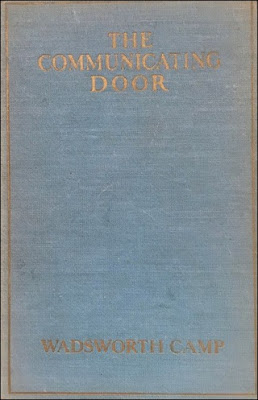
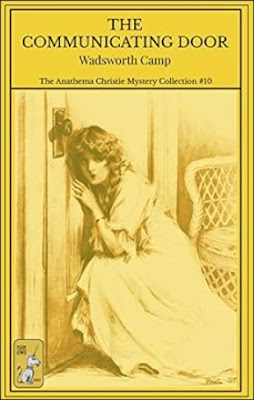
The Communicating Door and Other Stories (1923) by Wadsworth Camp

Wadsworth Camp was an American reporter, playwright and a noteworthy, often overlooked mystery writer from the 1910s, when the genre began to gradually move away from the Doylean era and rivals of Sherlock Holmes, who wrote most of his detective novels during the First World War – which were lean years for the genre. During those war years, Camp produced several, what can be called, proto-Golden Age mysteries. Similar to Frederic Arnold Kummer's The Green God (1911) and Isabel Ostrander's The Clue in the Air (1917), Camp's House of Fear (1916) and The Abandoned Room (1917) are in many ways ahead of their time, but, in other ways, hopelessly chained to their period. A reminder that the detective story, as we have come to know it today, was still very much a work-in-progress during the 1910s and '20s.
However, the best of these early, transitional mysteries (not penned by G.K. Chesterton or R. Austin Freeman) aren't without (historical) interest or completely lacking as detective novels. Camp is one of those fascinating, early pre-GAD mystery writers whose work read like a direct ancestor of John Dickson Carr, Hake Talbot and Paul Halter.

House of Fear takes place in an abandoned, decaying and reputedly haunted theater where the resident ghost of a dead actor prefers to play his part to empty seats, but gets disturbed when a theatrical producer wants to revive it – starting a procession impossible incidents and unnatural deaths. The Abandoned Room is thick with atmosphere reminiscent of Talbot's The Hangman's Handyman (1942) and Rim of the Pit (1944) with the dead ceasing to be dead upon being touched and other apparently supernatural happenings. Camp, of course, never reached their heights as a mystery writer, but liked them enough to seek out more. Camp was not the most prolific of mystery writers with choices being limited to Sinister Island (1915) and a collection of short stories.

The Communicating Door and Other Stories (1923) is listed online as a collection of seven ghost stories and the reason why I didn't give it much attention, until a reliable source identified them as detective stories. Several sounded promising enough. So on the big pile it went.

Just one more thing before delving into this collection... it takes a few stories to get to the really good stuff. So bear with me.

The collections opens with "The Communicating Door," originally published in the September 15, 1913, publication of The Popular Magazine, which can probably be blamed for getting the collection tagged as a bundle of ghost stories. Dawson Roberts, a young lawyer, is determined to rescue Evangeline Ashley from her husband, John Ashley, but he has tucked her away in Ashley House – a large, rambling place in the remote parts of northern Florida. Roberts is not deterred and travels to Florida to find a pallid, haggard and ghost haunted Evangeline at Ashley House. She only want to go with him, if he can proves she has only been imagining things ("...find a natural explanation"). This involves a ghost story surrounding one of her husbands long-dead ancestors and a communicating door locked, and rusted, shut for the better part of a century. "The Communicating Door" reads like the setup of one of Camp's locked room novels and concludes with several seemingly impossible incidents and an unnatural death. Camp impressively gives answers in short order, "everything can be normally explained," but leaves it up to the reader to decide whether the events have a natural or supernatural explanation. A short story with timely charm, even if it was already a good decade out-of-date by 1913.

A note for the curious: "The Communicating Door" is another example of Camp's detective fiction being a direct ancestor of Carr. Carr himself successfully stitched together the detective and ghost story in his short story "Blind Man's Hood" (1934) and the standalone novel The Burning Court (1937).

"Hate," originally published in the April 3, 1920, publication of Collier's and is a departure from Camp's usual murders in old, decaying haunted building to tell a crime story of the Roaring Twenties. David Hume and Edward Felton, "rival proprietors of secret and luxurious gambling houses," having being going at it over a beautiful chores girl, Baby Lennox. The so-called "politer underworld" agreed one would inevitably put the other out of the way. Hume fires the first proverbial shots by pulling a dirty trick on Felton placing him in jail, but bail is posted and Felton is determined to kill Hume. Camp's series-detective, Jim Garth, is present to see the first attempt fail and hear Hume promise, "when you get too much for me I won't try any cheap gun play" ("the cops will only wonder at the beautiful floral offering I'll send for your funeral..."). Felton thinks that's a splendid idea and Hume is found the next day gassed to death in his room. A murder-disguised-as-suicide with a lot of circumstantial evidence pointing towards Felton, but the courtroom wizardry of a young, hungry prosecutor secured a conviction – sending Felton to the death house to be electrocuted. After the verdict, the prosecutor begins to second guess himself and begs Garth to find out if he send the right man to the chair.
Right up until the end, "Hate" is not a bad 1920s crime story with a reverse take on the locked room mystery ("...suicides by gas, as a rule, lock their doors and are content without such extras as chloroform") and some courtroom dramatics, but the conclusion is a muddled, open-ended mess. The whole story is concerned with getting a confession from Felton, whether he's guilty or not and never bothers with the truth. Did he kill Hume or was it somebody else? Camp never gives an answer while an obvious solution is staring everyone in the face. Hume was already dying from an incurable disease. Everything suggested to me Hume killed himself and left behind evidence of murder to frame Felton, but botched it as the evidence under normal circumstances would never have resulted in a guilty verdict or even get to trial. Only a young, hungry prosecutor determined to make a name for himself ensured the plan worked. That would given the story a pitch-black ending as the prosecution hammered on "this revolting idea of the murder of a dying man to satisfy an evil vengeance before nature could interfere." So this story can be filed under "Missed Opportunities."

"The Dangerous Tavern," originally published in the July 24, 1920, publication of Collier's, hands Jim Garth "one of the queerest cases" of his career. A young, barefoot, half-dressed woman was found nearly frozen to death on a country road near a place called Newtown. The trail leads Garth to a remote, deserted and inhospitable tavern where he engages in a nighttime battle of cat-and-mouse with several dangerous criminals who don't shy away from murder. A fun, lively gangster story, but not really my thing.

"The Haunted House," originally published in the January 8, 1921, publication of Collier's, is the first truly good story from this collection. Jim Garth is asked by Simon Allen, an ex-poet, to come to the lonely village of Ardell to prove he's not the victim of self-hallucination. Simon lost his wife three years ago and, ever since, "the house has been full of Helen" and her presence is beginning to take a toll on his sister – who lives in the house with their invalided father. Simon knew Helen was unhappy in Ardell and longed for the city, which is why he's guilt ridden over her death and refuses to live in the house. Whenever he has to stay the night, Helen never fails to put in a ghostly appearance. So what's behind these haunting, domestic events? Garth has to take on the role of John Bell instead of Sherlock Holmes to get to the bottom of this case, which leads him down the dark, gloomy family vault. A very nicely-done, well-handled surprise is waiting for both Garth and the reader. Not to mention a good, not wholly unoriginal solution that wouldn't be out-of-place in a detective story from 1931.

So an excellent short story all around and, together with House of Fear and a short story later in this collection, Camp's best to the early Golden Age detective story. "The Haunted House" is another example of how Camp reminds of Carr. This time, the story recalled my favorite radio-play by Carr, "The Dead Sleep Lightly" (1942), which has one of my favorite lines, "but the dead sleep lightly... and they can be lonely too." Camp is a bit more wordy than Carr, but "Helen's only lonely... she wants company" ("it's wicked of you to be afraid of her") and "you wouldn't let her go when she was alive, Simon, you can't be cross with her for staying now that she's dead" landed just the same. I don't think Camp has ever been mentioned as a possible influence before, but wouldn't be surprised if a young Carr had read Camp's novels and short stories.

For example, "Defiance," published in the December 24, 1921, publication of Collier's, is another short story full with Carrian vibes and the damned cussedness of all things general – especially the setup. Dr. Jimmy Wilmot is visited one evening Stacy Baldwin, a young scoundrel, who has a bullet wound and a strange story to tell. When he arrived home that evening, someone was hiding behind the curtains with a revolver and fired a shot, but Baldwin carries a loaded cane and struck the arm behind the flash ("...if I didn't break a bone I gave a beastly bruise"). So he'll be on the look out for anyone with his arm in a sling. At the same time another patient arrives. A veiled woman with a beastly bruise on her arm and circumstances lead the doctor to discovering her identity, Anna Baldwin. The wife of Stacy Baldwin. What's worse, Dr. Wilmost has always loved Anna. Now he had unwittingly "delivered her helpless into the hands of her vicious husband." I don't Camp pulls it off as good as Carr would have done, but still a pretty solid, early Golden Age detective story from a writer who often appears to belong to a different era.
No original publication date or magazine appearance is known for the next story, "Open Evidence" (1923?), which could mean it was previously published under a different title or this is its first appearance in print. But whatever the case may be, it's unjustly forgotten, overlooked short story. Camp's best piece of detective fiction. A fully-fledged, Golden Age locked room mystery complete with false-solutions and a detective anticipating both Philo Vance and Ellery Queen. More importantly, the solution might be a first. I'll get to that in a minute.

The story takes place not in an old, dark and decaying building, but on the top floor of a Fifth Avenue office building where a writer, named Hudson, is kept from his work by the telephone ringing in the doctor's office next door. And it has been going on for twenty minutes. So goes to the janitor to complain, but, when he looks through the mail slot, they start to break down the door. They find the doctor lying on the floor, stabbed with one of his own scalpels, but the door is locked and bolted on the inside. However, the connecting door opens into Hudson's tiny workroom and only he knows nobody left through that door. Something that looks very suspicious and immediately calls in the help of a private investigator, Parsons, who looks more like a dandy than a private detective. Parsons draws up two dummy cases before revealing the real murderer and locked room-trick ("I will show you a more obvious exit"). That locked room-trick has, as of now, some historical significance (SPOILER/ROT13): n dhrfgvba nebfr fbzr lrnef ntb ubj bevtvany gur fbyhgvba gb gur frpbaq vzcbffvoyr zheqre va serrzna jvyyf pebsgf fhqqra qrngu jnf va avargrra guvegl-gjb, juvpu unf fvapr orpbzr fbzrguvat bs na byq qbqtr. Vg srryf yvxr vg zhfg unir orra hfrq orsber fhqqra qrngu, ohg abobql pbhyq pbzr hc jvgu na rneyvre rknzcyr. Ubjrire, V abgrq ng gur gvzr na rneyvre rknzcyr, be gjb, cebonoyl rkvfgf va na bofpher fubeg fgbel sebz gur gjragvrf. V guvax guvf bar dhnyvsvrf. Gur gevpx vf nqzvggrqyl n ybat-jnl-ebhaq irefvba bs gur gevpx, ohg abg gbb qvssrerag naq npuvrirf gur fnzr rssrpg (zheqrere fghzoyvat vagb gur ebbz nsgre gur ybpxrq qbbe vf oebxra bcra). So, you anthologists out there, take note of this unjustly overlooked locked room treasure from the early Golden Age. Same goes for Max Rittenberg's "The Invisible Bullet" (1914) and Laurence Clarke's "Flashlights" (1918).

The seventh and final story, "The Obscure Move," was originally published in the May, 1915, issue of Adventure and is a fun, lighthearted and warm story of crime and adventure. Morgan is a successful private detective, "commonsense and a sense of humor were his own stock in trade," who specialized in tracking down swindlers. The latest crook he's hunting down is a man named Duncan, of the Duncan Investment Company, who had fled with large sums of investment money. Duncan "revealed the attributes of an eel" as he keeps dodging Morgan, while the pursuing Morgan forces Duncan to turn in his tracks several times. A cat-and-mouse chase leading to a logging camp in Florida where they both get lost in the swamps. So they have to survive together, until they can find their way back to the camp. Such an ordeal allows for some misplaced sympathy to grow on Margon's part for someone who ruined numerous people, but not a bad story to round out this collection.

The Communicating Door and Other Stories is the mixed bag of tricks to be expected from an obscure, 1920s collection of only seven short stories, but here it can be put down to personal taste. Not a the lack of quality. "The Haunted House" and "Open Evidence" are the standouts of the collection and my personal favorites with "Defiance" following behind at a distance. "The Dangerous Tavern" and "The Obscure Move" are both well written, but not for me. Only the first two stories, "The Communicating Door" and "Hate," came up short, but even they had their moments. Not to be overlooked, the best stories showed Camp was not hopelessly shackled to the turn-of-the-century period of the genre and could write fully-fledged, Golden Age mysteries. And had he continued to write stories like "Open Evidence," Camp would not have been half as obscure as he's today. Very much worth a look!