Showing posts with label Dennis Wheatley. Show all posts

Thursday, October 31, 2019

HALLOWEEN SPECIAL 2: Kthulhu Reich - Asamatsu Ken

Rudolf Hess battles the elder gods. Adolf Hitler monkeying around with black magic books after he dropped out of art school. A female vampire lures Nazi soldiers to her castle and tricks them into setting in motion an apocalyptic plot. So you thought Dennis Wheatley was the only writer obsessed with Nazis and black magic? Think again.

Kthulhu Reich (2019) is a collection of bizarrely over-the-top, sometimes ludicrously entertaining, horror stories from the fertile imagination of Asamatsu Ken. The tales have been meticulously translated into English by Jim Rion, an expatriate English teacher and translator formerly of Kansas now living in Yamaguchi prefecture. Publisher Edward Lipsett of Kurodahan Press assures me that while Rion’s translations seem to be near parodies of the Weird Tales school of writing they are accurate and in the spirit of the original Japanese texts. I found them to be generously peppered with enough American vernacular and colloquialisms to give the stories a retro-pulp magazine feel. Lipsett joked that though I may think they may be too Western or “Americanized” these are German characters written by a Japanese writer who speak in Japanese in the original stories and now English in this translation. But in all accounts they should be speaking in German! No matter. They do indulge in the typical “Ja wohl, Herr Kapitän!” we are used to hearing from British accented actors who play Nazis in the old war movies of days gone by.

I didn’t really know what to make of this book before I cracked it open. I figured I should prepare myself for some kind of Dennis Wheatley/H. P. Lovecraft mash-up by way of Japanese worldview. Was I ever wrong! These stories could easily have been lifted from the pages of any of the American shudder pulps. Rion, the translator, must clearly be a fan of the kind of stories Lovecraft and all his imitators wrote back in the day. So faithful are these stories to the spirit of Lovecraft’s Cthulhu Mythos that the entire book is annotated with scholarly footnotes that make it sound as if the creatures encountered in the pages are actually real. In addition to the detailed descriptions recounting the history of Lovecraft’s many “elder gods” that appear in the book, along with the lives of Lovecraft characters (and those created by Derleth, Bloch and Robert E. Howard) there are eye-opening footnotes on the historical facts surrounding the occult interests of Rudolf Hess and his influences on Hitler. We also learn about the members of The Hermetic Order of the Golden Dawn who were also wrapped up with the Axis powers and German soldiers. Who knew there were magicians in wartime England sympathizing with the Nazis?

But onto the stories themselves…

Those that are modeled after Lovecraft and pay homage to his Cthulhu Mythos are by far the most entertaining. Minor stories like “The Colonel’s Self-Portrait” and “April 20, 1889” rely too much on gimmicks. The first is a shaggy dog story with an ending I should’ve seen coming from page two. The other is done as a collection of diary entries and letters. Both stories are less effective if the reader is an avid student of World War 2 history. The title of the second is a dead giveaway to the final twist and lessens the power of what might have been an eyebrow raising surprise on the last page had it been named anything else. And a warning to the fainthearted (are there any among horror fiction fans?) -- "April 20, 1889" also deals graphically with the Jack the Ripper murders and goes into disgustingly obscene detail in how the crimes were committed. Splatterpunk fans have something to look forward to there.

The most successful and effective stories of the seven in this volume are those that abandon the traditional trappings of vampires and witchcraft and go all out in depicting the wild adventures of trippy black magic obsessed Nazis.  The footnotes tell us that a lot of this stuff is based on fact. That's double the trippiness for your buck right there.

First published in separate issues of Hayakawa S-F in 1994 and 1995 two stories make up one long novelette of recurring themes and characters. These two should be read in the order as arranged and saved for last for they are truly the cream of the crop in this nifty book. The first of this double feature "The Mask of Yoth Tlaggon" is like a Hammer horror movie on paper. Instead of Charles Gray as the evil sorcerer I'd cast the more appropriate Klaus Kinski as the evil Rudolph Hess, Hitler's Deputy Führer, bent on mastering the universe and conquering Third Reich with the help of an ancient artifact that allows the wearer to commune with powerful gods from an alternate universe.  It's a wild ride of a story that almost tops the best scenes in Dennis Wheatley's masterful occult thriller The Devils Rides Out. Hess is joined by Tatewaki Goto and Clara Haffner, two intelligence agents in disguise as diplomats. Clara is also "a runic magus" well versed in reading the language of ancient spells that will come in handy during the rousing climax, an operatic showdown of black magic and phantasmagorical visions.

"Call of Cthulhu"
(courtesy of redskullspage.tumblr.com)

The saga of the Mask of Yoth Tlaggon continues in the story immediately following “In the Wasteland of Madness” in which a young aristocratic Nazi, Major Erich von Müller, is forced to wear the mask and report what he's seen. His visions offer up clues of an impending expedition to the Antarctic where Kriegsmarine Leutnant Krenze, the brawny, blond haired "very model of a German soldier" expects to uncover the lost world of Thule, believed to be the origin of the Aryan race. What they discover there instead is more horrifying than beautiful.  Lovecraft fans will eat this one up. Once again the plethora of footnotes fills in the background on the origins of the strange creatures, the lives of the historical figures who appear or are mentioned in passing, and the litany of arcane occult texts and forbidden books created by Lovecraft and his acolytes. It's hard to believe that the Nazis genuinely were involved in explorations of the occult and black magic, but there are documented facts to reveal it is in part true. The legendary and secretive exploration of the Antarctic seems to be more anecdotal and apocryphal than factual though many people believe it did take place. What the German soldiers discovered there is left to the imagination of the true believers and writers like Asamatsu.

This is a bizarre and surreal example of mash-up of fact and fiction that delivers the goods in three of the seven stories. Reading these stories seemed like a flashback trip to the 1960s drive-ins that used to show Hammer horror movies overstocked with bloodthirsty vampires and vengeful creatures from the dark side.  I had a blast reading this book, loved the Lovecraft homage, and recommend it to  the horror hounds out there in search of something completely different.  Dennis Wheatley and Lovecraft I'm sure are smiling somewhere in the Great Beyond knowing that this book exists.

Friday, March 8, 2019

FFB: They Walk in Darkness - Gerald Verner

They Walk in Darkness (1947) opens with a dinner party held on Halloween night. The main topic of conversation is hardly palatable for any dinner party no matter what the date. In the village on Fendyke St. Mary children have been disappearing, five over an eighteen month period. Only one has been found so far. The Robson’s infant was taken from its pram but three days later was found horribly butchered, its throat cut and the body dumped in “a clump of reeds at the edge of Hinton Broad.”

You can imagine all the characters reaching for the whiskey, gritting their teeth, clutching the arms of their chairs. You imagine they would want to change the subject as soon as possible. But no one does. Can there be more? Oh, yes there is--

The prelude to this ghastly murder and subsequent disappearances of other children was the slaughter of lambs killed in a similar fashion and just as ignominiously disposed of. Verner's narrative style is so detached, so British, presenting such monstrous acts in as tasteful a manner as possible.  The guests feel more challenged by how to conduct themselves with decorum rather than show their true feelings. The men shake their heads and dismiss it as the actions of a lunatic, the woman utter euphemistic platitudes. Collectively the dinner party basically shakes their head mumbling about “nasty work”. We expect outrage but get lackadaisical resignation.

If that weren’t enough their hostess Helen Wymondham is more concerned about how the evening was ruined, "all gaiety vanished" no matter how many “valiant efforts” she made to restore it to a pleasant evening for all. She babbles on interminably as she tries to say her good nights to her nephew Peter Chard and his wife Ann: “Such a dismal atmosphere, I’m really quite relieved that the evening is over. I do wish it hadn’t happened today of all days. It would have been so nice if we could have had a really jolly evening…”

Of course this is just a precursor to more unspeakable acts.

The next day four people, two men and two women, are discovered dead at another party held in a reputedly haunted house known as Witch House. It had snowed on Halloween and footprint trails travel towards the house showing all four entered, but none travel away showing anyone left. The door was locked from the inside and had to be broken down. All four people are found seated at a dinner table, some meats are still on a sideboard, a wine bottle is empty,  and all four have eaten and drunk wine. There is a fifth place setting at the table but the plate and glass are untouched, empty of food or drink. Examination of the bodies indicates cyanide poisoning, later corroborated by autopsy, administered via the wine. When mass suicide is ruled out the police are faced with what appears to be a locked room and four impossible murders. Who poisoned the wine, locked the room, and escaped without leaving footprints in the snow?

Peter Chard, a thriller writer, and his wife assist the police in the murder investigation. Eventually, the lamb slaughter, the vanished children, and the poisonings are all tied together when Peter’s wife Ann suggests that everything smacks of ritual and superstition. Peter’s Aunt Helen who hosted the dinner party tells them stories about the house where the murders took place, and of the ugly history of witchcraft and executions that took place in the village centuries ago. Ann dares to suggest that a coven of witches may be active in the village and Peter begins to seriously contemplate that possibility. The truth, however, is far worse -- more outre, more bone-chilling.

The detection and clues are here, but Verner is sloppy in his handling of his sinister plot. While we watch Peter discover things like an ornate jeweled brooch in the shape of capital L in the home of victim Laura Courtland, and read up on witchcraft and horrid occult rituals in the library of Anthony Sherwood other pieces of detective work are shaded in ambiguity or just plain unfair. There are two blatant references to an aspect of one character’s unusual past that stick out like a sore thumb indicating a major clue as to how the the impossibility was pulled off, but on the other hand we never learn (until the last chapter) what Peter found when he investigated the front porch of the Witch House. All the reader knows is that he sees it, smiles and walks away.

Verner seems to lack the confidence to play fair with his readers. He’ll hide a couple of aces up his sleeve but then let one drop out onto the table ineptly. Too much detection happens offstage or is described so obliquely that the reader is unclear what has been discovered. The clues are a mix of the utterly absent or completely obvious. When the solution to the impossible crime comes many readers may be disappointed by its familiarity in the impossible crime subgenre, a gimmick used almost as frequently as knife throwing.

In the end They Walk in Darkness comes off as an inferior homage to a Dennis Wheatley occult thriller moreso than a traditional detective novel. Verner has been described as being inspired by Edgar Wallace in that even when he sits down to write a detective novel he ends up with action oriented thrillers, often with gangsters and career criminals as the antagonists. However, the more I read of Gerald Verner the more I'm reminded of a similarly prolific crime writer who wrote under multiple pseudonyms. Edwy Searles Brooks whose "Ironsides" Cromwell books written in his “Victor Gunn” guise are very much in line with what Verner wrote. Both include impossible crimes, haunted houses, Gothic atmosphere galore, elements of weird and supernatural fiction always rationalized, and the standard heightened melodrama exemplified by this Lovecraftian passage:

Something had come into that quiet, warm, cosy room -- a disturbing, unpleasant something, as though a door had partially opened and through the crack had come writhing abominable and hideous things from an unspeakable hell.

Luridly cliche? Yes, but a perfect evocation for what's to come. And it would have been fine if Verner ended the chapter there. Instead he undermines the terror with the prosaic by tacking on this absurd coda:

Peter slid the brooch into his pocket."Let’s go to bed, shall we?" he said soberly. "I think I’ve had enough horrors for one day.…"

Despite all the flaws in construction and fair play technique Verner is a born story teller and the book does not fail to grip hold of the reader.  Of all the books I've read this one seems his most mature, he is trying to do something than merely entertain.  There is social criticism and satire of British stoicism in the face of "nasty business." Amid the lathered on histrionics and the intentionally melodramatic prose there is a subversive thread being played out. They Walk in Darkness slowly transforms from occult thriller with detective fiction elements into a contemporary morality play with a motive for murder steeped in vigilantism presented as the only true course for justice and retribution. We watch the disintegration of a community and witness them suffer in helplessness, rise up in anger and violence in order to stop the unseen malevolent force terrorizing their village. Who among them will be brave enough to dispel the superstition and at long last see the truth no matter how improbable?  The novel begins in tragedy and ends in tragedy when at last two characters step out of the shadows take the law into their own hands and fight evil the only way they can. Even Peter Chard recognizes this as the only solution possible in the final pages.

Wednesday, March 1, 2017

NEW STUFF: Cat Out of Hell - Lynne Truss

While browsing in a Barnes & Noble bookstore (one of three left in the entire city of Chicago) I came across Cat Out of Hell (2014) by Lynne Truss. The blurb on the book was enticing enough for me to make an impulsive purchase and I started it that very day. I didn't stop until I was finished. I can tell you that never happens with me reading a new book any more. What made it such an "un-put-downable" read? It's 100% original, 100% unpredictable, and 100% just plain fun.

On the dedication page Truss has this public notice: "To Gemma, who loves proper horror, with apologies". I don't know who Gemma is, a relative or friend of Lynne Truss, but she's a girl (or woman) after my own heart. I love proper horror, too. And this is the real thing. Plus, it's funny! Why Truss finds it necessary to tack on an apology I don't really know. Maybe because the book is about a talking cat? A couple of them, in fact.

Roger is a cat who has literally lived nine lives. He has suffered eight torturous deaths at the hands of his surrogate father -- a wiser, older, somewhat sinister and utterly intimidating black cat who goes by the moniker "the Captain." There is a mystery about The Captain and Roger isn't telling his present owner, a middling actor who makes a living touring in a production of that British farce chestnut See How They Run! The first part of the story -- the bizarre life of Roger and his owner Will Caton-Pines, the actor -- is told through a series of documents and emails sent to Alec Charlesworth a retired librarian who is getting over his wife's recent death. It's all a bit hard to swallow for Alec. Is the story a hoax? Much of it is told in the form of a bad screenplay. And why has Alec been sent these documents about a talking cat who seems to have been responsible for the deaths of several humans? Alec has several mysteries to solve. But all will be explained as this exceptional, brightly funny, and often bloodcurdlingly gory black comedy makes its way to the inevitable battle of good vs. evil in the final pages.

When a book is this good I cannot begin to summarize the plot. I don't want to. The thrill of this kind of popular fiction so well done, so imaginatively thought out, and suspensefully told is in the actual reading. Cats have always been a source of sinister inspiration from Edgar Allan Poe to Sax Rohmer to Stephen King. The movies also are filled with tales of villainous or murderous cats with Cat People, The Uncanny, and Eye of the Cat some excellent examples that come immediately to mind. Even heroic cats have been depicted trying to thwart evil human deeds as in the nasty revenge story Shadow of the Cat with a screenplay by George Baxt. But here is a horror story in which a cat is an anti-hero, a sort of feline Tom Ripley. You can't help but like this rather unlikeable, potentially murderous ball of fur. For much of this short and briskly told novel there is a Highsmithian air of ambiguity about the proceedings. Are the villains the cats or the humans? Is it all a coincidence that Roger's previous owners have all died in a series of bizarre accidents? How do Roger and the Captain figure into Alec's life? The denouement is completely unexpected and reminded me of Dennis Wheatley, Sax Rohmer, Aleister Crowley and a dash of H. P. Lovecraft all rolled into one weird hodgepodge in the insane blood-soaked finale.

For a thoroughly original spin on familiar horror themes, an ingeniously thought out feline conspiracy theory about the purpose of cats in the world, and a well plotted multiple murder mystery Cat Out of Hell gets high marks from me. I feel like reading it all over again. Rush out and get a copy right now!

Thursday, May 19, 2016

FFB: The Hammersmith Maggot - William Mole

UK 1st edition (Eyre & Spottiswoode, 1955)
Illustration by collectible DJ artist Biro
THE STORY: Alistair Casson Duker (Casson to his friends) is a wine merchant, gourmand, and a self-confessed collector of "human oddities." He watches, observes and investigates when his sixth sense alerts him to people whose behavior suggests that they "live beyond the law." His success with the Witch of Bath case and the journal article he published based on his experience has lent him a reputation for a very different kind of amateur detective work. At the opening of The Hammersmith Maggot (1955) he has set his eyes on a fellow club member Lockyer whose drinking has increased, whose normally unruffled, polite manner is becoming self-involved and worrisome. Duker is sure that something is wrong. So he takes the man home and through a combination of subtle conversation aided by Lockyer's alcoholic loosened inhibition gets Lockyer to admit that he is being blackmailed. But the blackmail scheme is for a wholly fabricated story. Yet so insidiously constructed and damaging to his reputation that Lockyer cannot prove it false. He has succumbed to the blackmailer's demand but as with all blackmail the fear that this "maggot" will strike again with another false accusation has practically ruined him. The story he threatens Lockyer with is that he is a pedophile.

THE CHARACTERS: Duker is a fine creation. A vigilante of the soul, a man driven to root out injustices that would otherwise never be noticed by the law. He marvels at the perversity of a man who would imagine he could extort money from people by telling them complete lies spun from a few threads of credibility based on the truth of the person's private life. How did he know of Lockyer's involvement in charity that benefits misfit teenage boys, that Lockyer spends his free time teaching young men how to sail on his yacht? How did he know Lockyer had enough money to pay without drawing attention to a sudden large withdrawal of cash? Duker starts to paint a portrait of this parasite of a criminal -- a petty man, one privy to his target's banking history and personal life, and -- through a series of coincidences and dogged detective work -- that the blackmailer is a collector of unusual objets d'art. This last bit of information provides Duker an idea for a clever trap in order to expose the blackmailer.

Duker has a policeman friend from whom he manages to extract information that supports his theory of the blackmail scheme. There are others who have been victimized and all of them have been forced to pay for fear of the lies being exposed to their loved ones or employers.

UK 1st paperback (Beacon Books, 1957)
The rest of the cast is made up of the blackmailer's victims all of whom have been threatened with exposure for false accusations similarly constructed so that no proof can be presented to clear the victim's name and yet enough truth exists to make the lie very plausible. Marital infidelity, lax business practices are just two of the other threats of exposure that result in the victims paying out large sums of cash to the "maggot" that Duker knows under his real name of Perry. The novel becomes a game of cat-and-mouse as he forces Perry out of hiding, catching him out of one of his many assumed identities, and by revealing himself and playing to his weaknesses. Duker plans to make the man pay for his crimes by making him feel exactly like his victims. But this game does not come without terrible unplanned consequences. When Duker realizes that he is responsible for the death of one of his witnesses he is even more determined to bring about Perry's undoing.

It is interesting that the author's wife, Elizabeth Hely, only a few years later would try her hand at a crime novel that in essence explores exactly what Mole did here. Duker is a vigilante for unknown victims just as Mark was a seeker of justice for his raped and murdered wife in I'll Be Judge I'll Be Jury. Both husband and wife writers seem to have an uncanny skill in dreaming up stories which uncover the darkest and most hidden of motivations. While Hely's book is perhaps the more unnerving of the two The Hammersmith Maggot certainly is one of the most original twists of the tale of a blackmailer and the kind of Dorian Gray world of a small-minded vengeful man who allows his dreams of unbridled vanity and thirst for power over others to turn him into a monster.

QUOTES: "When would the English learn that a pleasant face and an aptitude for sport were not automatic guarantees of honesty?"

"You say that Fenton's threat was fit only for a cheap novelette. So it was. But there is a part of everybody's mind which yearns to believe in cheap novelettes, in music under the moon, in handsome heroes, in masked intrigue and love triumphant. It is trash and it is untrue, and that is why people believe it."

"Some men collect postage stamps. Some spend their holidays hunting for rare flowers in Continental woods. Some, like your husband, stalk stags. I collect human beings who live along the fringes of illegality. And I collect them Mrs Gordonstoun, because it is then that their behaviour is least inhibited and most human."

"He could just imagine Perry in, for example, [his club], moving like a prim and voracious lamprey between the pillars and the pictures."

"When you were faced by the abyss over which the human mind hung poised, then you got vertigo. You got the height sickness that urged you to throw yourself over and end the intolerable strain of clinging to your balance. And you got nausea, too, when you saw the things which moved with rustling, unclean wings in the depths."

"To blackmail, and in the end to kill, for snobbery was a repulsive comment on the human mind. To do those things for silver candlesticks he could comprehend. But to kill for a handshake was ludicrous, ten-dimensional, a music hall joke."

William Younger as seen on the
rear of the Beacon paperback
THE AUTHOR: William Younger was Dennis Wheatley's step-son from his wife's first marriage. Under the pen name "William Mole" he wrote several thrillers and crime novels, three of which feature Alistair Casson Duker. The Hammersmith Maggot was the first. Under the title Small Venom (as it was published in the US) it became part of Jacques Barzun & Wendell Taylor's series of reprints called "50 Classics of Crime Fiction 1950-1975". Oddly, Younger first started writing poetry and his first book was Inconstant Conqueror (1938), a collection of his poems illustrated by his sister Diana. This was followed by two more books of verse in 1944 and 1946. Much later in life he also collaborated with his novelist wife on a handful of travel books and one book on their great love in life -- wine.

EASY TO FIND? Your chances are pretty damn good for this one, gang. There are about 50 copies right now for sale, mostly in affordable paperback editions. Pick a title, any title. There are three titles the book was published under!  I've shown three editions on this post:  the original UK hardcover, the first UK paperback, and the US paperback published under the title Shadow of a Killer. The only two not shown are the original US hardcover called Small Venom (Dodd Mead, 1956) and its later 1980 reprint in Barzun & Taylor's series. The 1980 reprints were created specifically for sale to libraries, come in dull green unadorned boards with no DJs, and aren't worth using as illustrations. I had no luck in finding a Dodd Mead edition for sale with the DJ.

William Mole's Crime & Detective Novels
(Only the last three feature Casson Duker in the lead role)

Trample an Empire (1952)
The Lobster Guerillas (1953)
The Hammersmith Maggot (1955)
 -- US title: Small Venom
 -- in paperback: Shadow of a Killer
Goodbye Is Not Worthwhile (1956)
Skin Trap (1957) -- US title: You Pay for Pity

Friday, April 22, 2016

FFB: I'll Be Judge, I'll Be Jury - Elizaberth Hely

THE STORY: Newlyweds Mark and Laura Needham are just starting their honeymoon when tragedy strikes. Laura is attacked and killed. Suspicion falls on a unsavory grocer who showed an interest in Mark's wife. Commissaire Antoine Cirret enlists Mark's help in hunting down the grocer and gathering some evidence via subterfuge. Initially reluctant to take part in what he feels is clearly a police duty Mark grudgingly gives in and discovers he has a knack for spying and underhanded interrogation. But when he cannot separate personal feelings from police business the undercover work transforms to vigilante style retribution as the US title I'll Be Judge, I'll Be Jury (1959) suggests. And is usual with the case of unrestrained vengeance there are horrible consequences for everyone involved.

THE CHARACTERS: Elizabeth Hely spares no punches in this bravura debut performance. Mark Needham is a husband haunted, longing for love yet finding himself bereft of emotion and impotent in the bedroom. He has only two people to turn to for comfort and solace -- Alex Trevor and Andrée de Montdoux.  Alex is Laura's gay best friend, and Andrée is a former flame of Mark's. Alex notices troubling changes in Mark's usual no-nonsense behavior: he is guarded, less than forthright, and has started drinking heavily. Alex suspects his lawyer friend is too interested in Theo Bondet, the grocer, that he has turned sleuth and that his rash behavior may lead to a dangerous confrontation. He and Andrée try their best to distract Mark from the undercover work by taking advantage of Andrée's past history with Mark and her still lingering affection for him. The plan backfires when Mark is physically incapable of carrying through with their passionate affair and his frustration and embarrassment unleash an anger he has held at bay since his wife's death.
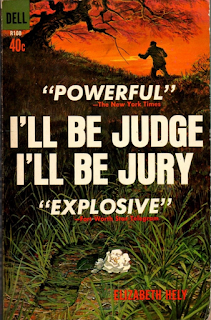
The supporting cast is just as complex and fascinating as Mark. At first Alex is presented as a typical gay character of 50s genre fiction. He's an artist, of course -- a classical pianist whose specialty is Chopin. He's self-effacing, a bit of a fop. A past love affair with a man who abandoned him to get married left Alex so heartbroken he become an avowed bachelor. He is introduced to us in a park where he is seen chasing after a Pekingese named Lillith, calling her a naughty bitch and generally acting like a cartoon of an effeminate man, though he's a hulking giant. You think he's going to be a comic character, an object of ridicule. Nothing could be further from the truth. Alex turns out to have a coldhearted thirst for revenge just as Mark does and he's no wimp or limp-wristed queen in the final terrifying scenes.

Andrée too undergoes a startling transformation over the course of the novel -- from spurned old flame, to teasing tart, to Nemesis personified. She proves she's tougher than all the men when she's willing to sacrifice her safety, nearly her life, and sustain scarring injuries for the cause. After all, she was a member of the French Resistance just like Cirret. She has to prove she still has what it takes to face off with a brutal criminal.

Every single character is a force to be reckoned with. Hely spares no mercy for her characters as she sets them loose on one another in the quest for their personal form of justice.

INNOVATIONS: Hely has set her novel in France to take advantage of that country's unusual legal system. Police have less authority than judges and in this case it is the Juge d'Instruciton who seems to be in charge of the case. It is only because he has issued a Commission Rogatoire that Cirret, a commissaire of the Sureté in Paris, has been placed in charge of the case in Beaune, in the heart of French wine country. "We don't like foreigners to get murdered," he tells Mark reassuring him with his customary sarcasm that the case is being treated with urgency. Still, Antoine Cirret is one of the most unorthodox of policemen in crime fiction of this era. By trusting Mark to use his skills as a lawyer to entrap Theo Bondet and to find out things that the grocer might otherwise hide if questioned by police Cirret unwittingly sets in motion the stratagems that fuel this very Hitchcockian story.

THE AUTHOR: Elizabeth Hely is the pen name chosen by Nancy Elizabeth Brassey Younger for her crime fiction. Hely was the wife of William Younger and part of a long line of writers all related in one way or another to bestselling thriller writer Dennis Wheatley. William Younger, who also wrote crime novels under the pseudonym William Mole, was Wheatley's beloved stepson. In fact, this book -- originally published in Hely's home country as Dominant Third -- has an endearing dedication page marked "For Mole, with love". Hely's biographical sketch on the rear DJ flap mentions her love of wine, a book about wine and a travel memoir of Portugal she and her husband wrote, her fondness for Pekingese dogs and that Hely included "an engaging one in the cast of characters." The scenes with Alex and Lilith, the dog, are one of the very welcome examples of Hely's wry sense of humor in an otherwise stark story of relentless tension and angry retribution.

QUOTES: "Hate is nearly always destructive. It's only rarely that hate can be used constructively. In your experience, you've never had to hate; not until now. Your country has never been occupied. Occupied. An odd word for cataclysm. Our children learnt to hate while they were young. They learnt to hate with discretion; to use their hatred as a stimulus to their intelligence. Do you imagine that a resistance movement could have existed if every Frenchman had spat in the eyes of Germans? No. We hated with smiles, those of use who had to, and we did it because, when the time came to stop smiling, we knew them."

"To live close to your enemy. Smile at him, talk to him, listen to him; admire and flatter him; gain his confidence. Learn him by heart. Then you can break him."

"Young people are belligerent animals, my dear Andrée, and we were no different from the rest."

"This is not a dog. This is my psychoneurosis. I wrap it in mink to keep it in a good temper."

TV ADAPTATION: Four years after the book was published I'll Be Judge, I'll Be Jury was adapted for "The Alfred Hitchcock Hour." The script was by Lukas Heller with direction by James Sheldon. For unknown reasons Heller decided to transplant the entire story from France to Mexico and most of the supporting players were re-written to suit his needs. The cast included Peter Graves as Mark; Albert Salmi as the rapist/killer renamed Theodore Bond; Rodolfo Hoyos played a Mexican version of Cirret named Inspector Ortiz; and Ed Nelson appeared as Alex Trevor who, of course, was not gay but was married to Sarah Marshall playing Louise Trevor, the substitute for Andrée. The basic plot of a backfired revenge scheme remained the same with a different twist in the finale due to the change in locale.

EASY TO FIND? I'm happy to report that this is one book that is in ample supply. Both hardcover and paperback editions of the US edition which goes by the title reviewed here are numerous. Hardcovers first editions are scarce in the UK under its original title Dominant Third, but copies of the Panther paperback seem plentiful. No contemporary reprints have been published, but I have suggested the book for reissue to a well known reprint house. Cross your fingers that they agree with my assessment.

The Antoine Cirret Crime Novel Trilogy
Dominant Third (1959) - US title: I'll Be Judge, I'll Be Jury
A Mark of Displeasure (1961)
The Package Deal (1965)

The last book was also adapted for a TV movie retitled The Smugglers starring Shirley Booth and Donnelly Rhodes as Antoine Cirret. I think he's on vacation on a cruise in the book and the story follows the "busman's holiday" type of crime plot. In the TV movie adaptation Booth is a woman traveller who unwittingly becomes a pawn in a smuggling operation. Unsure of whether or not this sticks to the original plot. I have yet to find a copy of that last book, but I'm on the hunt!

Friday, October 18, 2013

FFB: To the Devil -- a Daughter - Dennis Wheatley

Christina Mordant cannot enter a church without getting ill. The very smell of a chapel is enough to make her nauseated. Animals shy away from her and growl for apparently no reason when she walks by. When night falls her usual polite and timid demeanor gives way to an indulgent and hedonistic personality that is more cruel than kind. What is going on with this young woman who has been abandoned by her father and left to fend for herself in a small house in the south of France?

Long before The Exorcist almost single handedly was responsible for an explosion of suspense novels and thrillers about demonic possession there was To the Devil--a Daughter (1953) Dennis Wheatley's first book to deal with the supernatural phenomenon. He handles the subject matter less luridly than those more familiar books of the 1970s displaying his usual staunch occult beliefs and a detailed look at Black Magic rituals. It's all wrapped up in a fast moving adventure novel that outdoes much of what is found in the pulp magazines of the 30s and 40s.

To the Devil -- a Daughter is one of Wheatley's later novels incorporating his fascination with all things occult. Because it was written in the 1950s the Satanists turn out to be a bunch of dirty Commies not Nazis, his usual target for villainous evil.

Wheatley has a kind of Ann Coulter rant he lets loose early in the book outlining his ideas about all things evil:

Now that more than half the people in the world have become godless, they have also become rudderless. Once they have put away from themselves the idea of the hereafter they think only of their own selfish ends of the moment. That leaves them easy prey to unscrupulous politicians.  Before they know where they are, they find themselves robbed of all personal freedom; their family life, which is their last tie with their better instincts, is broken up, and their children are taken from them, to be educated into robots lacking all individuality. That is what nearly happened in Nazi Germany and what has happened in Russia; and if that is not the state of things that Satan would like to see everywhere, tell me what is?
The story is pretty much a by-the-numbers pursuit adventure story with a smattering of witchcraft and black magic to spice up the usual fist fights, kidnappings and other derring do. Wheatley has a real gift for making the most cliche adventure set piece come alive with genuine excitement and suspense. The scene where Molly Fountain's son John, the over confident hero, manages to get aboard the villain's yacht, subdue a bad guy and make his way to rescue Christina, the imperiled heroine, is a great example of taking the standard potboiler action sequence and enlivening it with character traits that humanize both the good guys and bad guys. John is flawed, not a superman and acts with a trace of guilt always thinking of the consequences of committing murder. (At the time the guillotine was still the death sentence for capital crimes in France.) The bad guys are devilishly smart not stupid. And Canon Copely-Syle, a corrupt clerical figure intent on attaining "Oneness with God," outshines any of the wicked sorcerers and occultists created by Sax Rohmer. Wheatley was probably one of the first writers to take the conventions of pulp thrillers with their over-the-top action and superhuman heroes and make them more believable and realistic.

From the very first sentence ("Molly Fountain was now convinced that a more intriguing mystery than the one she was writing surrounded the solitary occupant of the house next door") the reader knows this is a book that will tell a gripping story. The manner in which Wheatley unveils the secret life of Christina, how thriller writer Molly Fountain slowly puts together the pieces, and the discovery of the mysterious plot behind Christina's strange exile in the French Riviera and her instructions to talk to no one of her past are all masterfully executed. The story is everything here and it is easy to forgive the frequent lapses into ultra-conservative political tirades like the one previously quoted.

Bloomsbury has purchased the reprint rights for all of Dennis Wheatley's novels. All of them will be available in eBook format with a select few also released in paperback.  The first few have already been released and To the Devil--a Daughter is one of three titles that will be released in both formats. The other paperback editions released this month are The Forbidden Territory (Wheatley's first novel) and the classic black magic thriller and one of Wheatley's truly excellent books The Devil Rides Out. Click here to read more about Bloomsbury's Dennis Wheatley reprints in both paperback and digital editions.

A movie version (very loosely adapted) of To the Devil--a Daughter was done in 1976. It was the last of Hammer Horror movies and starred veteran Hammer actor Christopher Lee as an excommunicated priest bent on world domination. It's nothing at all like the book and Wheatley hated it. He even called it obscene! Now that's strong criticism coming from a secret sadist.

Thursday, April 11, 2013

Wheatley Resurrected!

Last week I learned that I'm not the only one who thinks Dennis Wheatley deserves another life in print.  In an article published in the The Bookseller it was announced that Wheatley's first 20 titles will be released as ebooks in October 2013. The rights to 56 titles in Dennis Wheatley's long writing career have been purchased. So far only three of the more popular books -- The Devil Rides Out, The Forbidden Territory and To the Devil - A Daughter -- have been slated for paperback releases.

Hoping The Haunting of Toby Jugg will be one of those receiving a paperback edition. Get the Wheatley lowdown  here.

Thanks to Shotsmag for this news.

Friday, March 15, 2013

FFB: The Man Who Missed the War - Dennis Wheatley

For some time now I've been meaning to give a small tribute to Dennis Wheatley whose black magic thrillers I greatly admire.  But the first post on Wheatley will be on a book described by Jessica Salmonson as "a lost race extravaganza." It is indeed! Once having read The Man Who Missed the War (1945) it is difficult to shake the fantastical scenes from memory.  In only 288 pages Wheatley manages to tell a story that spans eight years and includes a spectacular shipwreck during wartime, an ordeal by sea, an attack by giant land crabs, a journey to Antarctica, and an evil mind controlling lost race of descendants of Atlantis who are responsible for the rise of the Nazi party. Extravaganza is an understatement, I think. The book is a mini epic displaying Wheatley's still fervent imagination and crammed with more action than a book twice its length.

My edition has an intriguing publicity blurb giving the reader an explanation not only for Wheatley's absence from the bestseller lists of Britain, but insight into his contributions during World War 2.  He was for three years "a member of the Joint Planning Staff in the Offices of the War Cabinet" where he was privy to classified information.  While working there he chose to go on hiatus as a spy novelist and he did not want to be tempted to borrow from reality. The preface further explains:
...he felt it a wise precaution to refrain form chronicling...further thrilling deeds until a little time [had] elapsed for major war secrets to be given to the public through official releases and war histories.
Dennis Wheatley, circa late 1930s
Instead of continuing his usual espionage novels with Gregory Sallust, Duke de Richelieu and Julian Day, he decided to write this tale of a Philip Vaudall who misses the war through a series of bizarre escapades, death defying adventures, and a fantastic discovery at the South Pole. During the eight years from shipwreck at sea to landing at the Antarctic Philip will spend most of his time with Gloria, a spunky survivor intent on getting back to America. Through chance and Fate, however, she becomes Philip's companion, advisor, and common law wife. They even manage to raise a family over the course of the book. All this despite being held prisoner by a tyrant of a king who rules over a pygmy race of slaves.

Is this enough to whet your appetite?  Those among you who scoff at this kind of adventure novel would be missing out as much as Philip Vaudall.  I found a passing reference denigrating the book in Antarctica in Fiction by Elizabeth Leane who called it "a very forgettable fantasy."  I am here to countermand that slur! I found it to be one of those incredible yarns so brimming with imagination and the surreal as to be fairly intoxicating. Revealing any further details of the dense plot would deprive any armchair adventurer from revelling in its remarkable pages.

Luckily, this book and nearly every other book in Wheatley's output are available in multiple editions, both paperback and hardcover, all of them affordable.  Wheatley is an acquired taste but his fiction has been wrongly disparaged for decades due to the revelations by biographers of his political and personal beliefs.  Some may find it hard to separate the man from his work. I am not one of them.  True fiction lovers who dare to sample any of his early adventure novel, but in particular The Man Who Missed the War, may just find themselves in awe of the depth of his imagination. Fantastic, outrageous, even ridiculous -- call it what you will -- it's a enviable achievement for a writer to let himself go to the edge the way Dennis Wheatley always did.

For more info on The Man Who Missed the War visit this website. It's not so much a review as it is an in- depth plot summary that is spoiler laden. Caveat lector. And for everything you ever wanted to know about the author stop by the absolutely awesome Dennis Wheatley Website.  I'd start in the museum section if I were you. But be warned -- I was there for two and half hours last night!

Monday, September 5, 2011

Crime Fiction on a EuroPass - Germany

Deutschland, Deutschland, über Alles! The train is pulling into Germany this week on our grand tour of Europe as depicted in crime fiction through the ages.

Decades ago, in my teen years, I traveled to the Rhineland area and Bavaria for three weeks. Germany will always bring back memories of peppermint tea, reckless driving, my first visit to a farm of any kind (pigs, cherries, apples and bees), my first taste of unhomogenized, unpasteurized milk that sent me running to the bathroom, a visit to a German movie theater for Krieg der Sterne (the German dubbed version of Star Wars), and lots of drunk teenagers in Munich (that would be us Americans behaving badly).

But when I think of Germany in terms of crime fiction I think of two things immediately - spies and Nazis. Sorry, Germany, but you just can't escape your past as far as thriller fiction goes. Travel with me into the cobweb enshrouded section of the Pretty Sinister Books' vault while I drag out a few dusty and forgotten tomes that capture Germany in fictionalized terms from the 1920s through the 1960s.

Francis Beeding was the pseudonym created by British writers Hilary St. George Saunders and John Palmer. Palmer was a drama critic and Saunders was an ex-military man. They met while at the League of Nations. Naturally, when they decided to collaborate as novelists they wrote about wartime and espionage. Their main contribution to crime fiction was Colonel Alistair Granby, of the British Intelligence Service who was primarily involved in battling wicked German spies all over Europe. His adventures in Germany included The Secret Weapon (1940). The other 16 books were set in Geneva, Italy and France but with quite a cast of double agents and duplicitous characters in disguise who would almost always turn out to be German spies.  They also created German master criminal Professor Kreutzmark who first appeared in The Seven Sleepers (1925), also Beeding's first novel. It's a roller coaster ride of a thriller, heavily populated with vivid characters, action galore and a plot similar to the pursuit adventure novels of John Buchan.


Dennis Wheatley loved to write about Nazis and Satanism. His genre blending thrillers incorporated spybashers and ghostbusters. The books could convince you that Adolf Hitler had no part in the nefarious work of the Nazis and that they were actually in service to the Devil himself. They Used Dark Forces (1964) although written in the 60s was set in 1943 and featured Gregory Sallust, a sadistic British spy, who does battle with Ibrahim Malacou -- hypnotist, astrologer and Satanist. They form an unlikely partnership in the war against Nazi Germany. Two earlier books with Sallust as the series protagonist were also set in Germany -- Faked Passports (1940) and The Scarlet Impostor (1940) -- but were more mainstream espionage thrillers lacking any of Wheatley's usual fascination with the occult.

Finally, Sax Rohmer wrote another of his over-the-top thrillers with supernatural overtones but which turns out to be more science fiction/fantasy about a criminal mastermind who sets up shop in the Black Forest and uses the superstitions of Eastern Europe to his advantage. In The Day the World Ended (1929) Brian Woodville discovers an army of bat-like creatures thought to be vampires terrorizing the citizens of a village outside of Baden Baden in the Black Forest. Here is his first encounter with one of the creatures:
Descending with hawklike motion was a gigantic bat! It had a sort of vague luminosity. The incredibly long body as well as the extended wings were of a gleaming purplish-gray colour: I can only liken it to that of a meat fly or common bluebottle. The wing span, I was prepared to swear, was no less than four yards; the legless body of the thing, which, as it descended, resembled less a bat than a monstrous dragonfly, was close upon six feet! [...]
"Merciful heaven!" I whispered. "What does it all mean?"

Woodville will eventually team up with series character Gaston Max and together along with some other do-gooders will discover a criminal organization headed by yet another of Rohmer's mad scientist/evil geniuses with world domination on his mind. The bat-like creatures thought to be vampires turn out to be something altogether far worse and bizarre as only Sax Rohmer could dream up.


For more sampling of thrillers, mysteries and crime fiction set in Germany (with and without Nazis) please visit Mysteries in Paradise, our host site for this tour of spy-ridden, criminal Europe.  Beer and schnitzel will be served in the dining car promptly at seven.

Friday, April 15, 2011

FFB: Broken Boy - John Blackburn

Readers who enjoy the Peculiar Crimes Unit detective novels of Christopher Fowler and are impatient for the next Bryant & May adventure into the bizarre and macabre should turn to the works of John Blackburn as a more than suitable substitute. His books are amazingly similar in structure and theme to Fowler's work. Blackburn also shares Fowler's interest in arcane legends and folklore as well as the secrets of old London's infrastructure and architecture. I have to thank Mike Ripley for sending me a promo on Top Notch Thrillers, a reprint line he edits for Ostara Publishing. In that email there was some info on Blackburn that prompted me to investigate this writer. Though Blackburn wrote straight crime and straight espionage as well, it is his own special blending of crime supernatural and espionage that has made him according to the Top Notch Thriller publicity "the link between Dennis Wheatley and James Herbert."

One of the most intriguing of Blackburn's thrillers is his fourth book, Broken Boy, published in 1959 in his native England and released in the US in 1962. The melding of crime, detection, and the supernatural ranks with the best of not only Fowler but groundbreaking genre-benders like Dennis Wheatley, A. Merritt and the stories of Seabury Quinn. While Blackburn is not shy to indulge in pulpy thrills like those last three writers he is more interested in the psychological motivations of characters who employ the occult and supernatural for their own selfish purposes.

The book begins as any standard detective novel with the investigation of a crime. What at first seems like a brutal murder of a prostitute dumped beneath a bridge by an angry and savage john will prove to be something far more complex. General Charles Kirk and his fellow Home Office agents, Michael Howard and Penny Wise, are called in when the prostitute is identified as Gerda Raine, a former East German spy, with a particularly callous and sociopathic nature. She is linked to the selling of British government secrets in exchange for a British passport that would allow her a freer life. But while the reader may think this will morph into a spy novel he will be dead wrong. When Kirk visits Gerda's apartment he meets her very strange landlady and the landlady's son. He also finds a weird idol in her room.

Queen Ranavalona I - a nasty piece of work
The title refers to that idol - a disturbing figurine of apparently African origin with blind eyes and unnaturally disjointed arms and legs. It is this object that leads Kirk and his team to the discovery of a strange cult in the town of Minechester. With the help of an anthropologist and a medical doctor Kirk learns that the idol is tied to ancient black magic studies with their roots in the French Revolution era that made their way to Madagascar where purportedly they were adopted by the very real historical figure of Ranavalona the Cruel. 

Mothers and sons play a big part in the story. Each mother Kirk and his team encounter has the odd habit of referring to her no longer living husband in this fashion: "My husband? Oh, he...died." In each case a slight pause before the word "died." Kirk only realizes this strange speech pattern very late in the book. It's a subtle clue to a larger and nightmarish revelation.

There is a point in the book where one of these women reveals her true nature and the entire book shifts in tone. It's a real "Aha!" moment for the reader. What seems like just another detective story with some bizarre plot elements instantly transforms itself. From this point on I kept thinking of the old TV series The Avengers. The finale, however, is something straight out of a 1960s Hammer horror movie or even the weird menace pulps of the 1930s. There is a perfect scene where one of the villains shouts out "You fool. You wretched, interfering, foolish fool." And she punctuates each adjective by slapping her bound captive across the face. How's that for a throwback to the pulp era?

Broken Boy is the kind of book I crave. It has the perfect blend of action and detection, the surreal and the supernatural, and the utterly bizarre. When I come across something as weird as this I want to find every other book the writer has written and read them all. As a matter of fact I've already ordered four more Blackburn supernatural thrillers and eagerly await their arrival in my book crammed house.

Reviews of other John Blackburn thrillers on this blog are hyperlinked in the lists below.

The General Charles Kirk Supernatural Thrillers
  # also with Marcus Levin and Tania

John Blackburn, circa 1959
A Scent of New-Mown Hay (1958)
  US paperback reprint title: A Reluctant Spy
A Sour Apple Tree (1958)
#Broken Boy (1959)
The Gaunt Woman (1962)
#A Ring of Roses (1965) US title: A Wreath of Roses
Children of the Night (1966)
Nothing But the Night (1968)
#The Young Man from Lima (1970)
The Household Traitors (1971)
#For Fear of Little Men (1972)
#The Face of the Lion (1976) - Marcus Levin only
#The Sins of the Father (1979)
A Beastly Business (1982) - crossover book features Bill Easter & Peggy Tey (see below)
The Bad Penny (1985) - with Bill Easter

Other Supernatural & Bizarre Thrillers
   * feature Bill Easter & Peggy Tey
Bury Him Darkly (1969)
Blow the House Down (1970)
Devil Daddy (1972)
*Deep Among the Dead Men (1973)
Our Lady of Pain (1974)
*Mister Brown's Bodies (1975)
*The Cyclops Goblet (1977)
A Book of the Dead (1984)

Crime, Espionage & Suspense
Dead Man Running (1960)
Blue Octavo (1963) US title: Bound to Kill
Colonel Bogus (1964) US title: Packed for Murder
The Winds of Midnight (1964) US title: Murder at Midnight
Dead Man's Handle (1978)

Saturday, April 9, 2011

Old House of Fear - Russell Kirk

On the dedication page Kirk says that this "Gothick tale [is] in unblushing line of direct descent from The Castle of Otranto." Well. Authors are allowed their hyperbolic dedications, aren't they? The novel owes more to Edgar Wallace, Sax Rohmer, and even Guy Boothby but the only thing "in direct descent" from Walpole's masterful Gothic thriller is the creepy castle of the title. Nothing else.

The story starts off very much like a Gothic and there is a lot of legend and lore filling the pages, but after a rather protracted exposition (in which our hero attempts to get to the remote and unfriendly island of Carnglass at least four times) the hero does indeed arrive only to discover that the island has been taken over by a gang of thugs and criminals under the leadership of Dr. Edmund Jackman. The novel ceases to be a Gothic at this point and transforms into an adventure/crime novel.

Jackman is of the sinister master criminal type "in direct descent" from Dr. Nikola and the oddball occultists in Sax Rohmer's supernatural novels. Although all the gunplay and violence seemed to me very much like it was "in direct descent" from Edgar Wallace or Dennis Wheatley. Hugh Logan is our hero; Mary MacAskival, the heroine; and Dr. Jackman, the truly evil villain. It's all melodrama and heavy handed stylized prose. There is the usual business of who will inherit the castle; our poor hero trying to figure out who is telling the truth and with whom he should ally himself; death traps; narrow escapes; and a crazed bloody shoot out in the finale with the MacAskivals coming to rescue our hero and heroine. Dr. Jackman gets a fitting violent death of which I'll say no more.

It's entertaining and often gripping, but in the end all very familiar. Even the supernatural elements are rationalized. I was disappointed by that since at one point they seemed very other worldly. Not at all in line with Walpole, Radcliffe or any other genuine Gothic writer.