Showing posts with label illustrations. Show all posts

Sunday, November 17, 2019

A Wealth of Wells - Pulp Covers of Carolyn Wells' Stories & Serials

After finding a five page long list (!) of Carolyn Well's work published in magazines from 1897 - 1940 I was curious to see the covers that promoted her stories in the numerous pulp magazines over her long career.  Some of them were so striking and evocative had I been alive decades ago I would've easily been tempted to spend my last dime or quarter on one of these magazines.

I picked out a selection of the finest examples, mostly those that advertise a serial that was beginning in the given issue, some are promoting a short story like "Common Sense Cutler." Nearly all of these are Fleming Stone detective novels that were later published by either George H. Doran (until about 1922) and then Lippincott, her book publisher for most of her career. The final one pictured (Skeleton at the Feast) is a Kenneth Carlisle mystery and he was the detective character who was published by Doubleday Doran's "Crime Club."

Scroll away, gang!


One of Well's serials that appeared in a "slick" magazine rather than a pulp. Her work also regularly appeared in the dream publication of her era -- The Saturday Evening Post. Usually it was her poetry and humor they bought. OH! The title of the book the boy is reading is How to Develop a Pleasing Personality. Took me a while to discern that!


Friday, April 12, 2019

FFB: Murder Draws a Line - Willetta Ann Barber & R. F. Schabelitz

THE STORY: Christopher "Kit" Storm has a moderately successful career as a commercial artist in his Manhattan studio. On occasion he serves as an artistic consultant to police drawing sketches of crime scenes and evidence in lieu of using a police photographer. Kit becomes implicated in a murder when the across-the-hall neighbor is found brutally stabbed inside his studio and the police start viewing Kit as a suspect rather than a colleague.

THE CHARACTERS: The narrator for Murder Draws a Line (1940), and the entire series, is Sheridan Locke, Kit's fiancée in this book, later his wife. Sherry is a children's book writer and is cajoled by her artist paramour into becoming the documentarian, so to speak, of their adventures in murder. But she goes about it in an entirely verbose and overwrought manner. One imagines that Sherry read way too many Mary Roberts Rinehart novels in her day (or at least Willetta Barber did). The narration is drowning in words, bursting to the seams with minutiae and unnecessary tangents, and burdened by the often annoying intrusion of the phrase "Had I known..." Even Rinehart never resorted to those telltale words as often as Barber does in the guise of Sherry Locke. In a review of this book in the August 10, 1940 issue of The Saturday Review the pseudonymous Judge Lynch said "Plot excellent, characters vivid, numerous illustrations -- but superabundance of had-I-but-knowing annoys cranky judge." I started to count them all but gave up when it exceeded 15 instances well before the novel's midway point.

Our heroes: Sherry Locke,
Kit Storm and Det. Tony Shand
I sincerely hope that Barber abandons this type of writing in later books because she is a fine storyteller and an excellent plotter. Her debut novel is a fine example of a traditional detective novel and its most unique aspect, what makes it truly noteworthy, is the inclusion of the illustrations (see "Innovations" section for more). She also has the gift of creating nuanced characters who seem like real people. It's a shame that she manages to undermine all her talent by ruining the suspense with all her heavy-handed foreshadowing. Only once did she make it work to her advantage when she discussed a bloody baseball bat before the bat became bloody. The passing remark (coming as the final sentence of a chapter as nearly all these HIBK remarks do) makes you think that Kit will be attacked yet again after being shot at once. In truth, however, the way the baseball bat gets bloodied has nothing to do with Kit and is one of the most horrific surprises in the book.

The cast of characters is large and as vivid as Judge Lynch says they are. We get all types of suspects from blustery and temperamental Alessandro Marioti, a failed opera singer, to Albert Putnam, nervous lovelorn singing student of Freda Bransen's. In an attempt to fill in the puzzle of Freda's life Barber finds it necessary to dig into her past and introduce nearly every person she ever encountered. As a result we get several bogey characters who serve no purpose whatsoever and who offer little insight into Freda other than superficial commentary. They exist only as the many examples of vain upper-crusters of Manhattan's elite. However, one supporting player from Freda's past appears to deliver the bombshell piece of evidence. She is a flighty, bubbly and garrulous ex-member of the Metropolitan Opera chorus. Freda has also worked there for a time as did the fiery Marioti. Daisy Jackson (aka Mrs. Elmer Schlummer) is a delight in her one big scene. What she has to say is key to understanding why Freda was killed and wraps up the bigger mystery of why the murder took place in Kit's studio.
The story is fascinating as an early example of a murder mystery that revolves around the identity of the victim and her past life. Kit and Sherry knew very little of their neighbor who lived across the hall. Freda Bransen was a lonely spinster who took in singing students as her sole source of income in her tiny studio apartment. But the day she stops by to deliver a letter for Kit mistakenly put in her mailbox changes her life and brings her past speeding into the present. Both Kit and Sherry slowly discover who Freda was, what she was escaping from, and how her past came to bring about her violent death. In one of the most poignant passages in the book Sherry sums it all up: "All at once, as I sat there listening to Daisy Jackeson's blithe and insensate jabberings, the horror attending [Freda's] dying seemed of no great importance. The real tragedy lay in what her life had been, not in the guise of its end. She had had so little, and that little she had not kept for long. A pitiful few years of happiness, perhaps, before her own dark destiny had caught up with her, never to let her again escape. It seemed to me suddenly unbearable that this should have been so."

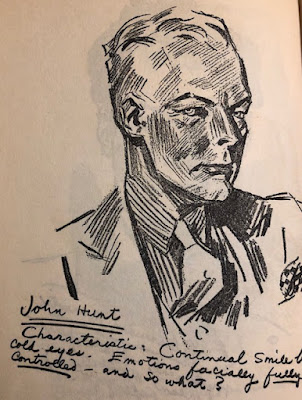
Other interesting suspects include the dentist who lives upstairs, Peter Rollins, who seemed to be too interested in Freda's money; John Hunt, another of Barber's ne'er-do-well New Yorkers who at first seems like a superficial guy with no skills or ambition (he's a part time artist's model) but whose background in the military as a psychologist will play a significant factor in an intriguing subplot; and Ralph Whitley, a friend of Kit and Sherry's who stops by frequently to show off his very good caricature drawings but who is harboring a deep, dark secret.

INNOVATIONS: The Christopher Storm mysteries are unique in all of detective fiction because they include Kit's sketches (provided by artist Schabelitz) some of which have clues to help the reader solve the mystery. I believe these novels were the first of their type. Many detective novels, notably the The Baffle Book solve-it-yourself mysteries also published by The Crime Club, often included maps, floor plans and other sketches to help the reader visualize the crimes. No other detective novels from the Golden Age that I know of include a police artist whose sketches reveal his perceptions of the crime scene, the suspects and curious incidents that add to the mystery. As Sherry says of his method: "Kit has long since given up trying to explain that by drawing he sometimes sees things which would otherwise have gone unnoticed. That more than once, what looked perfectly correct to the eye proved completely out of drawing when sketched, thereby giving him a sure clue something was definitely wrong." Tony Shand has learned many times, she continues, the value of Kit's unusual technique in gathering evidence. This is why he often calls on Kit for help and a second eye. Obviously, he cannot avoid Kit's involvement since the crime took place in his own home and workplace. Even more significant is the fact that in this first novel drawing and painting are crucial to the plot. There are two very important sketches which actually reveal the identity of the killer and a work of art that Kit was working on provides one of the most noteworthy clues. The sketches are a mixture of full page portraits, drawings of the rooms, and idly drawn cartoons revealing Kit's thought processes. Most of the sketches include Kit's commentary along the perimeter of the art work. I've included several examples in the post.

THINGS I LEARNED: The deluded and vain Marioti exclaims to the police: "I shall be a great tenor. As great even as Melchior." Not being too much of a opera fan I was clueless who he meant. Are you as curious as I was? Probably not, but I'll tell you anyway. Lauritz Melchior was a Danish American opera singer who was the leading Heldentenor at the Metropolitan Opera for three decades, from the late 1920 through the early 1950s. He specialized in Wagner and made the previously lesser-thought-of German composer one of the better regarded musicians in opera companies. Thanks to Melchior's fantastic singing, a voice remarkable for carrying over the orchestra, Wagner's work became mainstay of opera repertoire in the US.

When Ralph Whitley first appears in Kit's studio carrying a portfolio and talking of his pictures Sherry thinks he is "just another Thornton or Model Guild chap, with the inevitable photos." Once again I was clueless. She is referring to Walter Thornton Modelling Agency, at the time of the story one of the "Big Three" in model agents in New York. Thornton, like many of the characters in this book, started out as an artist's model and then gained connections to the more lucrative fashion photography side of modelling. He opened his agency located in the Chrysler Building in 1929 and it lasted until 1955. Some of his clients included a bevy of gorgeous soon-to-be movies stars like Susan Hayward, Lizabeth Scott, Lauren Bacall and Grace Kelly.

THE AUTHORS: Although a newsletter published by the Doubleday Crime Club claimed that Barber and Schabelitz were married this does not appear to be true. Willetta Ann Barber (1911-1977) married Matthew Smith, an actor and writer, in 1948 and there is no record of her marrying any other person. She was the step-daughter of shipping magnate Edward J. Barber, son of Irish immigrant James Barber who founded Barber Steamship Lines of which Edward became president in 1917. [Small Worldism: In 1942, the Barbers lived in my hometown of Ridgefield, CT on a thrillingly hilly street where I regularly rode my bicycle while growing up!] Supposedly Willetta was one of Schabelitz' models according to that same newsletter article. But I have no way of knowing whether that's true or not. You can see a photo of her posing on one of her stepfather's passenger ships here. Just scroll down to the entry on Willetta Ann Scott.
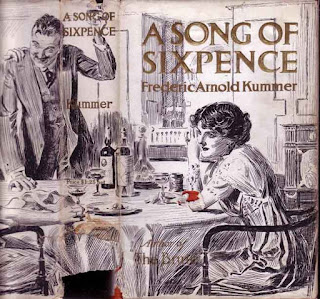
DJ illustration by Schabelitz
A Song of Sixpence by Frederic Arnold Kummer
Rudolph Frederick Schabelitz (1884-1959) began his career as a portrait painter and exhibited at a few galleries when he was only 22. Quickly he became better known for his book and magazine illustrations. He was one of several well regarded book illustrators who showed their work at The Society of Illustrators' exhibit in 1919. His work is found in numerous novels of the early 20th century, illustrations for magazine stories, and commercial advertising art. One of the more unusual aspects of his career was when his highly prized fashion drawings were offered by The Woodruff Art Service on a subscription basis to department and clothing stores via a trade magazine called The Haberdasher. He even contributed the interior artwork to two issues of the Shadow pulp: May 1946 (The Curse of Thoth) and June 1946 (Alibi Trail). Schabelitz was married in 1910 and I found no record of a divorce making the tale of his marriage to Barber even more suspicious.

EASY TO FIND? Some of the Kit Storm mysteries were reprinted in paperback, but not his debut in print. Published only in the US by Doubleday Crime Club and later reprinted by Doubleday owned Sun Dial Press, Murder Draws a Line is relatively scarce. I found only eight copies of both first edition and reprints for sale using the usual online book search services. Only two of those come with dust jackets. Prices range from $29 for a reading copy to $100 for a VG/VG copy with DJ. There are an additional six copies held at various US academic libraries as well as The Library of Congress. It's a possibility your local library may have a copy.

Christopher Storm Detective Novels
Murder Draws a Line (1940)
Pencil Points to Murder (1941)
Drawn Conclusion (1942)
Murder Enters the Picture (1942)
The Noose is Drawn (1945)
Drawback to Murder (1946)
The Deed is Drawn (1949)

Monday, February 10, 2014

Hothouse Melodrama!

Check out that pistol packin' mama!  If Fritzi Haller ever carried a weapon she couldn't look any more threatening. That gorgeous illustration is the cover painting for the latest reprint from Raven's Head Press.  The artist for our new edition is Fernando Vicente whose sexy artwork can be viewed here.

Desert Town by Ramona Stewart is the second release from Raven's Head Press and is now available for purchase here. Our new edition includes a nifty foreword by yours truly detailing the interesting writing career of Stewart from her debut in the pages of Collier's to her offbeat stories for other "slicks" and her culmination as a 1970s occult horror writer.  I'll be receiving a few copies for promotional purposes and once again I'm offering two books as giveaways.

To be eligible for a free copy of Desert Town just leave a comment below. This time in your comment I'd like you to tell me your favorite pulp cover artist or your favorite pulp cover illustration.  Book or magazine, it doesn't matter which.  On Saturday, February 15 I'll announce the two winners who will be chosen by a very amateurish random selection process that I'd rather not divulge.

Unfortunately, the giveaway is limited to the United States and Canada.  We're a small operation here and the shipping is coming out of my pocket. Sorry, I can't afford the $15 or more airmail postage to the UK or parts farther away.

If you missed my review of the book last fall please do read it.

COMMENTS ARE CLOSED. THE GIVEAWAY IS OVER. - Feb 16, 2014

Wednesday, January 29, 2014

Drawing on the Past #13: G.K. CHESTERTON

Lilly Library (photo by "Vmenkov")
While researching Victor L. Whitechurch, whose books I am currently reading, I came across a fascinating post at the website for Indiana University's Lilly Library which has one of the most remarkable collections of detective and crime fiction in the United States. Back in 1973 the library celebrated the 130th anniversary of the publication of "The Murders in the Rue Morgue" with an exhibit entitled "The First Hundred Years of Detective Fiction, 1841-1941."

Among the books are some other ephemera including the drawing reproduced below.  I've long known of G. K. Chesterton's ability as a sketch artist and cartoonist but never knew that he was commissioned to illustrate an edition of Sherlock Holmes stories. Below is his rendering of the near fatal struggle on the cliffs of the Reichenbach Falls.


The note in the exhibit catalog accompanying this drawing says:
G. K. Chesterton was once commissioned to illustrate the Doyle stories (imagine Father Brown on Sherlock Holmes)! The volume was never published, but Lilly has his sketches, among them the Reichenbach scene, done in blue crayon.
The entire contents of the exhibit along with program notes are posted at the Lilly Library website here.  It's an excellent resource for any devotee of the history of detective fiction. I've already made note of three writers who until I read the catalog I had never heard of. Unfortunately, the exhibit's catalog notes for one of those writers ruined a book for me by revealing the ending.

Sunday, January 12, 2014

Drawing on the Past #12 : GEORGE H & WILLIAM L THOMAS

Work: Armadale by Wilkie Collins
(Harper & Brothers, 1866)
1st US edition

Artists: George H Thomas (drawings)
and William Thomas (engraving)

As a teaser for an upcoming review here are the illustrations taken from the original United States edition of Armadale. This mammoth novel was originally published serially in The Cornhill Magazine from November 1864 to June 1866. The illustrations used in both the first UK and US editions were taken from the magazine serial. While the UK first edition includes all the original illustrations by the Thomas brothers the US edition is missing about five drawings.

George Housman Thomas (1824-1867) studied wood engraving with George Bonner, set up an engraving business in Paris, and illustrated books for both American and British publishers. Some of his work is included in the Royal Collection in England. Perhaps his most notable work appeared in the first US edition of Uncle Tom's Cabin. While living in New York for a brief period he was also contracted to engrave American banknotes.

William Luson Thomas (1830-1900) did the engraving and signed all the illustrations for Armadale. George, however, is credited as the primary illustrator on the title page of the first UK edition (Smith & Elder, 1866). William founded the illustrated newspaper The Graphic late in his life. Explaining the original concept of the paper he writes: "The originality of the scheme consisted in establishing a weekly illustrated journal open to all artists, whatever their method, instead of confining my staff to draughtsmen on wood as had been hitherto the general custom… it was a bold idea to attempt a new journal at the price of sixpence a copy in the face of the most successful and firmly established paper in the world, costing then only five pence."

For detailed biographical information on William Luson Thomas go here. For the life of his brother George visit this website.

Click on the images below for full size appreciation.


Sunday, June 2, 2013

Drawing on the Past #11: Edwin & Harold Betts

Work: Prince Izon by James Paul Kelly
(A. C. McClurg, 1910)
Listed in 333, a bibliography of lost race, fantasy, super-natural and science fiction works.

Artists:  Harold H. Betts & Edwin Betts, Jr.

One of the many lost race novels that were popular from the late Victorian era through the early 20th century Prince Izon deviates from the usual African and South American tales and instead chooses for its setting the good ol' U S of A. In the story Professor Raymon and his team of explorers, along with their American Indian guide, go in search of a forgotten tribe who are presumed to be living in the Grand Canyon in Arizona.  They get more than they bargained for when they encounter a tribe of Aztec warriors led by the title character.

Harold and Edwin Betts were the sons of Edwin Betts, Sr, a well established artist in Chicago who taught both his sons  and daughter Grace in painting. Edwin Jr. had an exhibit at the Art Institute of Chicago in the late 19th century.  Other than that I could find little info about Edwin.  His brother, on the other hand, has a much more prominent presence on the internet.

Harold Betts was an illustrator for magazines and books and an accomplished landscape and portrait painter.  He traveled to the Southwest and began specializing in the Grand Canyon and its environs making him the perfect choice for illustrating Prince Izon. Like Edwin, Harold also showed his paintings at the Art Institute.  A list I found at the U. S. Department of the State website gives the dates of eight different exhibitions at the AIC. Many of Harold's paintings are part of a large collection at the Smithsonian Institute and show he spent time in Rio Grande Pueblos from Taos to Santa Domingo; in Colorado Springs, Colorado; at the Grand Canyon, on the Navajo and Hopi reservations; and in Southern California.

Among the illustrations Betts did for books are Princess Sayrane by Edith Ogden Harrison and Ruth of the USA by Edwin Balmer.  All of the illustrations in Princess Sayrane can be viewed here.  Some of his paintings sold at auction can be seen at ArtFact, LiveAuctioneers, AskArt, and various other sites. Harold Betts' work is collectible and found in numerous galleries and private collections throughout North America and Europe.

Below are the five full color plates found in my copy of Prince Izon.  Two -- the one used for the plate on the cover and the frontispiece battle scene -- are signed by Edwin Betts, the others are by his brother Harold.  Only the battle scene on the cliffside can be enlarged by clicking on the image.


Friday, May 24, 2013

FFB: Thirteen Women - Tiffany Thayer

I really don't know what to make of Thirteen Women (1932) by the eccentric stylist Tiffany Thayer. Is it a thriller? Is it a character study? Is it some kind of allegory on Fate? What I do know is it's tawdry, vulgar, lyrical, pulpy, poignant, disgusting, frustrating, infuriating, and utterly addictive. It's sort of the equivalent of driving by an utterly gruesome car wreck on the highway. You don't want to look, you know better. You, of course, are not a gawker or a rubbernecker. But when you get close enough you do slow down and you stare in horror and then look away, but you look back and you gape again. Then you move on. That's what it's like to read Thirteen Women. What can you say about a book that in the first chapter includes a dinner party scene in which the guests discuss a sex act that a depraved nanny performed on her charge and who ended up giving the boy a venereal disease? Of course it's all done in a sly innuendo type of writing, but it's just down right wrong, isn't it?

Thayer is not interested in making you comfortable as a reader. He wants you to squirm and recoil and shudder. He's a bit too obsessed with the nastiness and cruelty of life. He revels in pointing out his character's flaws -- their ignorance, their stupidity, their hedonism. The book is, I guess, meant to be a nihilistic view of the early years of depression era America told mostly from the viewpoint of female characters. But these women are merely symbols and puppets for Thayer's intensely cynical and fatalistic philosophies. Few of them resemble anything approaching a real person. The plot involves an absurd revenge plot decades in the making that stems from the villainess' life of abuse, neglect and bullying. She blames a group of schoolgirls for all her problems and vows vengeance on them all. She devises a ridiculous plan in which she creates the persona of an astrologer who sends letters to all the women in her past. The astrologer foretells death, suicide and disease for everyone.  And when the predictions start to come true one of the women sees not the power of superstition and Fate at work but a very real murder plot starting to unfold at the hands of a mad genius.


Illustrations from the 1st edition by David Berger

Laura Stanhope take her collection of letters to the police along with a packet of powder she received from the astrologer who goes by the preposterous name of Swami Yogadachi (a Japanese swami?). The powder was to be given to her son on his birthday according to the Swami's instructions and is meant to save the boy from a potentially fatal disease he predicts. Laura suspecting it harmful never did a thing but instead of disposing of it she saved it. For five months! She had to or else it wouldn't further the plot, right? The police have the powder analyzed and it turns out to be a highly poisonous compound usually intended as a pesticide for vermin. Thus begins the hunt for the murderous Swami Yogadachi and the search for the other recipients of his letters to prevent any further deaths.

The story is a veritable Pandora's box of ills and pestilence released upon the reader. Murder, suicide, insanity, venereal disease, abortion, sex addiction -- it's all there in abundance. In keeping with the shock factor Thayer also includes a lesbian romance and makes it as tawdry and unattractive as one can imagine for a 1930s audience. Simultaneously making fun of the butch/femme stereotypes and also writing in such a manner as to titillate the easily aroused. It's not as tasteless as the sex addicted nanny story -- at times the relationship between Hazel and Martha is touchingly rendered -- but clearly the scenes are there for the reader who picked this book to be shocked.

Thirteen Women is told in a hodgepodge mess of letters, telegrams, newspaper articles, and author omniscient narration. We get to know the women through their own voices in their letters, but also through the condescending viewpoint of Thayer's narrator who at times is the author himself. Often Thayer steps into the story addressing the reader as "you" and giving his opinions of his characters as if they are real people ("You can't have Josephine Turner. Make up your mind to that. In the first place, I want her myself.") It's only one of the many unexpected parts of the book that make it a genuine head-scratcher yet strangely entertaining in a very offbeat way.

Tiffany Thayer's life, however, would make for a much more interesting book than any of his novels. There is a fascinating article here that goes into great detail about his beginnings as a writer, his friendship with Charles Fort, the origins of the Fortean Society which Thayer helped found, and his megalomaniac takeover of the society and its first magazine/newsletter Doubt. Someone should write a biography of the man. I'd read that with great interest. But as for further investigating the fiction of Tiffany Thayer I have had my fill after indulging myself in the pages of Thirteen Women.

This review was suggested to me by Curt Evans who has written about Tiffany Thayer's publisher Claude Kendall here. This week we chose to write about Thayer's bookend titles Thirteen Women and Thirteen Men. His review of Thirteen Men can be found at his blog The Passing Tramp.

Friday, May 17, 2013

FFB: Scream for Jeeves - P.H. Cannon

Sheer serendipity, this one. Was in the library looking for something completely different and saw the title of this little book just to the left of some Victor Canning books. P. G. Wodehouse's best loved characters entering the world of the Cthulhu Mythos? How could I resist?

The subtitle for Scream for Jeeves (1995), seen on the book's cover, is "A Parody" and that it is. With Bertie Wooster narrating, Jeeves supplying his usual brand of wry wit and wise advice, and creatures from other dimensions, seen and unseen,  looming ominously in the background it's not exactly going to be all that terrifying. Especially when Cannon creates absurdly apt characters like Captain Tubby Norrys who "resembled one of those Japanese Sumo wrestlers after an especially satisfying twelve course meal" and who "shook in gratitude like a jelly -- or more precisely like a pantry full of jellies." The juxtaposition of Wodehouse and Lovecraft does make for some bizarreness. Witness this section taken from the first story "Cats, Rats and Bertie Wooster":

"The walls are alive with nauseous sound--the verminous slithering of ravenous, gigantic rats!" exclaimed the master of the manse.

"You don't say. As a child I think I read something about a giant rat of Sumatra--or at any rate, a passing reference."


Towards the end of the story Jeeves pronounces a typical warning to the reader found in all of Lovecraft's work: "We shall never know what sightless Stygian worlds yawn beyond the little distance we went, sir, for it was decided that such secrets are not good for mankind."

You get the idea. It's lightweight parody getting just the right flavor of a frothy airy cappuccino. In addition to pastiches of Wodehouse and Lovecraft there are allusions to the work of Arthur Machen, Conan Doyle, Poe and even "Fawlty Towers." I had a fun evening reading the tales. Knowledge of both Wodehouse and Lovecraft is not all that necessary, but I imagine the enlightened and well read will better appreciate the stories.

There are three stories in the brief volume, the other two are "Something Foetid" and "The Rummy Affair of Young Charlie."  The book concludes with the essay "The Adventure of Three Anglo American Writers" in which Cannon -- who claims membership in three societies devoted to Conan Doyle, Wodehouse and Lovecraft -- describes among many observations, the friendship between Doyle and Wodehouse; Lovecraft's admiration for Sherlock Holmes; Wodehouse's familiarity with Lord Dunsany's stories; and manages to find similarities in the works of all three writers. Sometimes Cannon is convincing in his analogies, sometimes he stretches them far too thin.

The Jazz Age style illustrations are by J.C. Eckhardt. The homage to the two writers extends even to paired initials in the book's creators.

Monday, October 22, 2012

DRAWING ON THE PAST: In Homage to Oscar Wilde

It's the 158th anniversary of the birth of one of my idols -- Oscar Wilde. Ages ago (when I was still in high school!) I wrote my first thematic analogy paper that examined the similarities between The Picture of Dorian Gray and Stevenson's The Strange Case of Dr. Jekyll and Mr. Hyde. Little did I know that essay would eventually lead me into a world of similar content comparisons in crime and supernatural fiction. It seems to have become my trademark as anyone who reads this blog may have already discovered.
In honor of Oscar's natal anniversary I offer up a variety of illustrations from his brilliant tale of terror and crime.

We start with the thoroughly aged and corrupted portrait as revealed in the final scenes from the 1945 movie adaptation starring Hurd Hatfield, George Sanders and Angela Lansbury. I believe this color photo was taken as a screen capture from the extras available on the DVD.  The film itself is in black and white and yet I found several color photos of Hatfield's portrait both before and after the transformation.


Next, a young illustrator and art student who goes by the web name of "spyders".  This brilliantly realized version was found at the website DeviantArt.


This one is by artist Stephen Alcorn as part of a series of relief block prints interpreting literary characters.


The Dell paperback version from the 1950s. The artist got it completely backwards here. Strange.


Another cartoon interpretation.  I was unable to identify the artist or its source.


From a graphic novel version of the book as retold and illustrated by Ian Edgington and Ian Culbard:


Artist Dan Hipp's idea for a cover on a non-existent edition of Wilde's novel.

Basil Hallward and Dorian admire the portrait before it begins its gruesome transformation. Taken from an illustrated edition, neither publisher nor artist was attributed on the website where I found it.  For shame.


And finally...a publicity still from one of the most infamous (and horrible) movie versions. An utterly wrong adaptation of the tale set in mod 1970 starring Helmut Berger and including various absurd sex scenes and lots of nudity. I like to think that Oscar would most likely have found this movie version  hysterically funny.