Showing posts with label alternative classics. Show all posts

Saturday, April 9, 2022

ALTERNATIVE CLASSICS: Along Came a Spider - Elizabeth Davis

I'm putting the sinister back into the Pretty Sinister Books blog this month as I tear through a pile of old horror novels and detective novels with supernatural and occult content.  Today's post also touches on the 1970s mania of the demon child in popular horror fiction.  I've read so much of this kind of book over the 11 years this blog has been around that I've finally decided to create yet another tag to label them all. If this is a subgenre in horror and mystery fiction that lights your chandelier you can click on the "Demon Child" tag at the end of this post and read more about them, perhaps find some obscure books dealing with killer children and demon-like adolescents.

Last month I had a mystery novel that incorporated a demon child motif -- well, more of a precursor to the Bad Seed trope -- in I Am Afraid (1948).  Today we go from the sublime and restrained domestic horror of that book to the outrageously ridiculous, horror bordering on parody in Along Came a Spider (1970).

Stephen, the nasty tween in I Am Afraid was 11 years old.  The bad kiddo in Elizabeth Davis' novel (apparently her sophomore effort in horror fiction under a second pseudonym) is remarkably only 9 years old. I found it incredibly hard to believe Anne Bishop, the evil little girl, was this young because for much of the book she comes across as a 45 year-old worldly wise woman.  But as you get to the the over-the-top finale our narrator posits her theory of why little Anne is such an adept sorceress.  She's basically the Wolfgang Mozart of black magic.

However, I'm getting way ahead of myself...

Davis's 2nd occult novel deals
with witchcraft and reincarnation
Inspired no doubt by Rosemary's Baby (1967) which almost single-handedly launched this new subgenre about children spawned from Satan and children possessed by demons, Along Came a Spider has been overshadowed by more well known (and better written) books employing this popular and by now hackneyed horror motif.  We have a wiseacre of a narrator in Eve Mercer whose colloquial voice is filled with idiomatic speech, sarcastic asides and a quasi stream-of-conscious narrative style that works against the suspense when Davis allows Eve to constantly interrupt her own thoughts. The narration is punctuated with dashes and ellipses as Eve trails off from one thought to the next like a distracted housewife running on a permanent caffeine high of extra strength Maxwell House.

The plot?  The Bishop family have moved in across the street and Eve fears her daughter Laurie has fallen under the diabolic influence of creepy little Anne, a primly dressed, too polite, too aloof miniature adult in the guise of a 9 year old girl.  Eve's first high-strung reaction to her daughter's new found friend comes when she learns that Anne is adept at painting. Laurie describes these paintings as nightmarish images of brutish monsters and other weird things she's never seen before.  They're so gory they look like they might have been painted with blood.  But Anne dismisses what was intended as an exaggeration by telling Laurie you can't paint well with blood. "It clots," says Anne's voice of experience, "and won't go on too smoothly."

The absurdity has entered the story early, my friends. This is only page 40!

There is an element of a detective novel in the story when Eve learns that the Bishop family knew a friend of a friend of a friend.  And so she hunts down some phone numbers and makes a couple of phone calls.  She reaches the boyfriend of a girl who died in an automobile wreck recently.  The young man tells Eve that his ex-girlfriend lived in the same building as the Bishops and ran into little Ann one day at the trash chute in the hallway. Anne was startled as she tried to shove something down the chute and quickly ran off leaving the object stuck. The now dead girlfriend went to see what Anne was trying to get rid of and found a mouse crucified on a handmade wooden cross.

It only gets more insane from here on.

There are strange rituals that Anne teaches her playmates. A girl dies in a cemetery but not before uttering a mysterious dying message.  Laurie begins to act strangely.  She has nightmares, disappears from her bedroom and can't be found late at night. Eve continues her detective work by consulting books on witchcraft and demonology and learns that Anne has been teaching Laurie and the other girls the ABCs of summoning demons and makes sure she is nowhere in sight when those rituals are being performed.

Ultimately the book is self-defeating because Davis allows Eve's hysterical imagination to get the better of her too often. The narration grows increasingly hyperbolic and her frequent wisecracks undermine the horror making it all seem like a black comedy.  Eve is also susceptible to superstition and imagines that her husband Jim who recently died has come back from the dead. He sends her warnings in her dreams, she hears his voice intoning "Move away! Take Laurie with you!"  Unfortunately as soon as that ghostly element is introduced Davis never follows through. Jim's ghost literally fades away as soon as he almost appears never to be talked of again. Davis seems to be suggesting that Eve might be headed for a nervous breakdown. Are we to think that Anne is innocent of all that Eve imagines her to be doing? The preposterous finale extinguishes that doubt as quickly as a sorcerer blowing out a scented black candle. But you must discover that on your own...if you dare.

You can read for yourself how this madness unfolds and whether or not Eve is a nut job or Anne is the spawn of a demon by buying one of the many copies available for sale out there in this vast shopping mall we call the internet.  I turned up about a baker's dozen in both English and foreign language translations.  It's an odd book, entertaining to be sure in an Alternative Classic way, but never really frightening at all.

Elizabeth Davis was born Lou Ellen Davis in Pennsylvania and raised her family in Connecticut.  Her fascination with witchcraft and psychic phenomena led to two other novels of crime and occult:  Suffer a Witch to Die (1970) and There Was an Old Woman (1971).  The 1971 novel was adapted for TV in 1972 and re-titled Revenge!  The made-for-TV movie has a script by Joseph Stefano (best known for his screen adaptation of  Psycho) and stars Shelley Winters (in one of the many badass biddy roles she succumbed to in middle age) and Bradford Dillman.

I will be reviewing both There Was an Old Woman and the movie Revenge! later this spring. Stay tuned!

Friday, December 6, 2019

FFB: Flying Clues - Charles J. Dutton

UK 1st edition (Bodley Head, 1927)
Provocative illustration of a character
who appears nowhere in the book
There are a handful of Charles J. Dutton's books that I have recommended repeatedly and I’ll do that again right now before I launch into this review. Dutton had a fascination with criminal psychopathology but is never mentioned in the development of the American mystery novel for being perhaps the first writer of detective fiction to delve into criminal profiling before that methodology actually had a name. The three books I always recommend for this facet alone are Streaked with Crimson (1929), The Crooked Cross (1922) and Out of the Darkness (1922). Unfortunately, Flying Clues (1927) has nothing to do with criminal pathology, serial killer behavior, mental illness as related to homicide, or any genuinely clever plotting.

In the New York Times Book Review of Feb 13, 1927 the anonymous reporter said this about Flying Clues: "With a sextet of mystery stories to his credit it is scarcely surprising that Charles J. Dutton's latest work should show the signs of a practiced hand. Indeed, the presence of those signs stands out in the book as almost a defect." The review goes on to call his book "too accustomed, too usual and much in its matter that is too routine."  Someone one once accused me of writing a review of a book I thoroughly enjoyed as "damning with [it] faint praise."  The accuser was wrong and I defended my stance. However, the NY Times reviewer gives us the epitome of that phrase. I will not be so kind nor ambiguous at all in my feelings here.

Flying Clues, though intermittently entertaining and eyebrow raising in its 1920s social commentary, has its share of storytelling flaws and the most egregious is its title. The very last lines in the book consist of the detective telling his Watson (the ultra dull Pelt who has no first name) that the best title for his write up of this case should be Flying Clues. But I tell you it’s not. Why? Because it is a giveaway to one of the “mysteries” that befuddle Professor Hartley and the police. Well, the title tells you everything, doesn’t it? And it doesn’t take much imagination to figure out exactly what kind of flying clues are responsible, especially when Dutton spends two paragraphs describing a flock of what looks like falcons in the sky and another time when some ignoramus sees some birds in a cage on board a ship, birds that look like chickens. They turn out to be pigeons.

Chickens Pigeons roosting in a rooftop coop
Now I know you are asking yourself exactly the same thing I did: “When have pigeons ever looked like chickens?” Is this some odd evolutionary quirk of the 1920s? Doubtful. I’ll tell you when pigeons look like chickens. When a mystery writer is trying his hardest to plant a red herring in his mystery novel by creating some dumb yokel who has never seen a damn pigeon in his life but has seen more than his share of chickens. You’re welcome to blow a raspberry at Dutton as I did. The louder the better. He’s dead, he’ll never hear you, but it’ll feel really good.

So onto the rest of Flying Clues. We have an impossible crime! A murder that takes place in a physician’s private exam room located in his own home. A woman has been stabbed in a chair in his “waiting room” and then moved to the “operating table.” I’m not going to address the operating table in the private exam room. You can do all that research on your own. And good luck.

The murder was committed in a room where the door was open and yet no one managed to see anyone go in or out of the room. A window leads to the outside but after a heavy rain that very night there are no footprints anywhere near the window and no signs of mud or anyone having entered or exited via the window. How was the woman killed without being seen? Trust me. It’s extremely obvious. There is hardly anything that will puzzle even the most neophyte of mystery readers.

A much better detective novel is
Streaked with Crimson (1929)
Still Dutton insists on trying to make it all seem baffling. The police are convinced that the butler did it! He, after all, was the one who was supposedly watching the room and the only person to leave the dining hall adjacent to the exam/waiting/operating room. During the only span of time that the woman could have been killed a dinner party is going. There are twelve possible suspects besides the butler and the physician who hosted the party and yet all of them were in the dining room at the time of the murder. The bulk of the book is spent discovering who the woman is and her connections to the people at the dinner party. None of it really matters. The killer is as obvious as the title.

What is interesting are two other aspects of the book. One is a subplot dealing with a cult religion called the Home of Universal Truth run by scarlet silk robe clad, turban wearing prophet named Savitr. The other is the apparent motive for the killing which involves cocaine smuggling, illegal drug use and widespread drug dealing. Dutton who was a Unitarian minister gives us a theology lesson in comparative religions, focusing on Hindu spirituality, and exposes the false gods that Savitr claims to represent. As bonus lecture we get the fundamentals of Vedic mythology which helps to explain the self-proclaimed guru's odd name.

Prof. Bartley, Dutton's criminologist sleuth, is just as informed on drug dealing as he is on ancient Indian mythology. In a page long lecture he offers up current cocaine pricing:  $14/ounce purchase price for dealers; $300 to $400/ounce for the users. I have to tell you I gasped when I read this. The handy internet US inflation calculator tells me that $400 in 1927 is equal to $4,437 in 2019. In an eerily prescient passage all too resonant for our troubled times Dutton accuses pharmacists all over the USA of being collaborators, whether unintentional or not, in the cocaine problems that plague 1920s America. One can only draw parallel to the opioid crisis we're dealing with now, more than 80 years later.

So if social history is your thing by all means pick up a copy of Flying Clues (if you can find one!).  Otherwise, here is a yet another early American murder mystery that is deserving of its forgotten fate.

Friday, November 15, 2019

FFB: Boo Hoo: Not So Scary Houses of Horror - Carolyn Wells & Michael Crombie

Today's Friday's Forgotten Book post is on two books that belong more to Alternative Mystery category and are forgotten with good reason. Both published in the early 1930s each book shares some conventions already becoming mystery novel cliches in this early period. Horror House is an example of Carolyn Wells at her most turgid and unimaginative self pulling out every hoary cliche -- or as she would put it "hackneyed device" -- and then some. Michael Crombie (aka James Ronald, one of my favorite unsung and under-appreciated writers of the Golden Age) does the same in The House of Horror but at least he does it with tongue firmly planted in cheek. Both writers are known for their offbeat sense of humor: Wells was a punster and wordplay enthusiast, while Ronald was a master of witty banter and bitchy comebacks. But while both writers show their skill at comic scenes and dialogue neither book is a very good detective novel.

Let's dispense with Well's horror first. Horror House (1931) is her 51st mystery novel! It comes in her mid career, with 50 detective novels and close to that in juvenile books already under her belt. She was a veteran by 1931 and would write another 31 books before she called it quits in 1942. One would expect some snappy modernity to her writing by this point. But no, like so many of her 30s and 40s novels this one is still redolent of that bygone era when she was only a fledgling mystery writer. Her indefatigable detective Fleming Stone was growing ever grayer -- meaning colorless rather than aging -- and tiresome displaying his "transcendental" gifts at amateur sleuthing. The convoluted and utterly preposterous story is one of Wells' many attempts to emulate her more successful contemporaries. On the surface Horror House most resembles The Greene Murder Case(1928) in that it is yet another of those family decimation plots. A diabolical murderer is knocking off the members of a single household, one by one, using as many methods as he can get his hands on. Not satisfied with bullets (Wells has never used a gun in her books because she said she knew nothing about them and couldn't be bothered to learn) Wells' killer in Horror House dispatches his victims by stabbing, poisoning, automobile sabotage, and strangling.

15 century gauntlet
(courtesy: Metropolitan Museum of Art website)
The strangulation is particularly baroque as it is carried out with gauntlets taken from a suit of armor, affectionately dubbed Max by the Bailey family. But the victim had also partaken of alcoholic punch spiked with knockout drops in order that the strangling could be efficiently carried out. Clue #1 - murderer is not too strong and therefore either a woman or a feeble old person theorizes our genius Fleming Stone. If you know Wells then of those choices there is only one possibility and the murderer's identity is a dead giveaway. Nevertheless, I pressed on hoping that the book would elicit some cheap thrills, some more weird murders or an odd example of her histrionic melodrama. Instead I got cheap laughs, often at Carolyn Wells' expense.

Luckily not a secret passage in sight in this one, but the absence of that frequently used hackneyed device is made up for in annoyance factor by her choice of vocabulary and her treatment of one of the female characters. Poor Agnes, a housemaid of "exquisite beauty" prone to sneaking into Mrs. Bailey's boudoir to "loll in the luxurious furnishings" and dip into her mistress' cosmetics, is dismissed as an airhead. Referred to as "dumbbell" and having "an unattractive personality" she is relegated to the dumpster of red herrings, yet another example of Wells' overt class prejudice and snobbishness. The servants in Wells' books are never given any signs of cleverness, intellect or vivaciousness. Agnes may be beautiful but her beauty is of the Old Testament 'sinful' type -- to tempt men and be symbolic of the foolishness of vanity.

If you aren't irritated by this supercilious worldview then the strange word choices ought to set your eyes a-rolling. Some examples? Wells prefers inutile to 'useless', persiflage rather than 'mocking banter' pops up twice, a hostile witness at an inquest is heard "murmuring anathema all around". Instead of simply saying that Owen Bailey snorted she writes "well mannered though he was, [Owen] gave utterance to a sound that is colloquially known as a snort." All of those examples occur on a single page! I grew impatient with her florid syntax and antiquated vocabulary. Clearly this is her equally antiquated sense of humor giving rise as we approach the climax of the book, but I just wanted her to get the point as I reached a body count of four victims and occurrence of a second inquest in a nearly 300 page novel.

Her final affront is the constant drawing parallels between detective fiction and "real life." As if the book we are reading is supposed to be some kind of extremely hip and modern 1930s crime novel reflective of the violent world of gangster ridden America. The plot and crimes are as ludicrously fantastic as the fiction she is constantly alluding to.

It was a relief that Wells had not resorted to filling her Horror House with secret passages as she usually does. But the same cannot be said of Michael Crombie. The House of Horror (1935) is a veritable labyrinth of secret passages, underground tunnels, priest holes and hidden rooms. There are so many passageways in Hunter's Keep, Wilmer Basingstoke's house, I was half expecting someone to press on a wooden panel and, rather than sending a gigantic portrait swinging open on its well oiled, hidden hinge and stepping into a shadowy corridor between the walls, to be spontaneously disintegrated and sent into another dimension. For not only are there people creeping about in these hidden corridors there are multiple disappearances of four separate characters, including the bloody corpse of Wilmer Basingstoke himself.

Coincidentally, this book also talks about about detective fiction, but there is an express purpose for it. Basingstoke is a crime writer. He began with true crime, Capote style true crime that uses the conventions of fictional narrative rather than reportage. He then branched out into murder mysteries. We get to read two full chapters of one of his novels over the course of The House of Horror. Peter Wootton, our lead detective -- in an effort to explain the relationship of the victim to the prime suspect, an escaped criminal known as "the Basher" -- pulls down a book from the Basingstoke's crammed library shelves and reads aloud from it to his Watson. Here was a chance for James Ronald (aka "Crombie") to show off his gift for narrative shifting but the tone and style of Basingstoke's book within the book is no different than the book we are reading about the characters at Hunter's Keep. Written with more blood and thunder and colloquial language the book-within-the-book serves no purpose at all. Those two chapters could easily have been replaced with a short dialogue scene. Wooton could have explained in a few sentences how Basingstoke wrote of his adventures in amateur sleuthing by turning them into novels and changing the names of those involved.

The whole of The House of Horror is lacking in any genuine thrills or scares. The title is hyberbolic and obviously meant to attract people like me with a taste for cheap lurid entertainment. The ploy of the title worked, but I can't say I'm at all satisfied with what I got. I'm sure some will find what occurs in its pages to be wildly entertaining. I only kept on reading for a few of the characters.

Philip Lavery and Irma Dering are two perfect embodiments of wealthy layabouts posing as sufferers of ersatz weltschmerz, bored with everyone except each other. Irma is a delight of brusque opinions and catty dismissals, a welcome contrast to the virginal goodness of Lucy Halperin. We're probably meant to hate Irma as much as Lucy does for her superior posturing and cruel barbs, but I thought Irma Dering was one of the best characters in the book. She crumbles under pressure when the body count gets too high and she has a wonderfully frank scene with Lucy where she admits to her fraudulent persona and wishes she could be more real like Lucy. These were the moments that made the book worth sticking with. However, The House of Horror overall is presented like a genuine parody of the country house murder mystery. In terms of plot it is the most stereotypical story I've read from Ronald who usually displays a more original and ingenious imagination in his crime fiction.

Despite the caustic humor and witty banter as a mystery novel this House of Horror is more House of Ho-hum. Ultimately, the various mysteries are self-defeating, the book one long shaggy dog story. Those of you who have read The Curse of the Bronze Lamp by Carter Dickson may know what I mean by that. Its abundance of cliches and "hackneyed devices", the ridiculous amount of secret passages and all the rest of its pseudo-Gothic trappings tip off the reader to the anticlimactic revelation in the final chapter. The House of Horrors collapses like a house of cards and the time spent reading of its many "baffling" disappearances and gruesomely bloody deaths proves to have been a waste, the story as flimsy as the pasteboard playing cards metaphorically lying at our feet.

Monday, April 1, 2019

ODDITIES: The Hand of the Chimpanzee - Robert Hare

Imagine a mystery novel that is an extravagant conglomeration of Planet of the Apes, The Island of Dr. Moreau and that creepy cult classic 1973 TV movie A Cold Night's Death. Is such a melange possible? Oh yes my friends, it is. It's called The Hand of Chimpanzee, written in 1934 by Robert Hare who was inspired to write his fantastical novel after a visit to a primate research center. He even dedicates the novel to four "anthropoid apes" that he observed at that center. And what -- I hear you ask -- exactly goes on in this genre-blending alternative classic? Is it a detective novel? A horror novel? Or science fiction? Do the apes talk as in Pierre Boulle's novel and the later fantastic series of 1970s movies? Calm down, gang. All will be revealed.

The setting is the home and laboratory of Damian Strengland, former medical doctor who was stripped of his license after ethical questions about his research. The man has been involved in some genetics research and behavioral studies of chimpanzees. The usual glandular and endocrine mad scientist stuff crops up in the story and we learn that in addition to producing chimps who are now capable of performing human tasks and following orders guided by simple language commands some of the ape servants are actually hybrids of chimps and humans, altered by experimentally changing their endocrine systems that result in physiological changes like lightening of skin. One of the chimps in fact is completely hairless, wears human clothes and responds in simple, one word guttural syllables that seem like genuine speech. Another chimp has mastered spelling out the word "mad" on a typewriter which later turns out to be a key plot element in the solution of the various mysteries.

Hairless chimps and gorillas are a
natural phenomena of aging apes.
There are several murders, all of them rather gruesome, all of them apparently the work of either the gorilla in the research facility or the most violent chimp named Sebastian. Long finger marks and scratches are found on each of the strangled victims. Fingers that are too long to be human. Everyone is convinced that someone among the lab staff has trained one of the apes to become a killer. Increasingly it appears that Strengland whose behavior becomes more unhinged and erratic might be the culprit. But might it also be Gatrall, the slovenly lab assistant? He view their work as the wave of the future when all menial jobs will be performed by apes allowing humans more free time and better job opportunities in more challenging and cerebral work. Or perhaps De Silva, the primary trainer and caretaker of the apes? An aloof and cynical man DeSilva has the cruel streak of sadism in his blood. And what of Lenka, the sinister Greek housekeeper? Thanks to her creativity the apes have all been named, names which supposedly come from her native language. In my translations, however, I get completely different meanings in English (see THINGS I LEARNED for more).

As the story progresses and Strengland's monomania for his ape research begins to affect his sanity the story often also descends into scenes of unintentional self-parody. During the investigation of the violent deaths the police begin to treat the apes as suspects and Strengland launches into a series of tirades. In one scene after trying to figure out how a window that was always locked is now unbolted and hearing one of his chimps accused of fiddling with the bolt he sees the accused ape in his cage locked and secure. He turns to the others and says: "This ape is innocent. Thank goodness! He's a valuable one!"  Later Strengland rants about the most dangerous animal of all: "The police! What do they know of apes? They think all apes are dangerous. Any young fool in a sports car is ten times more dangerous than an ape!"

One of the many splendid pulps offered for sale at John W Knott Jr., Bookseller

I am so tempted to reveal some of the more outrageously horrific sequences but will only allude to Hare's clear influences of H.G.Wells, Maurice Renard, and a humorous nod to Poe. There is quite a bit of Dr. Moreau in this story and more than a fair share of homage to French crime novels, weird menace pulp magazine stories, and mad scientist movies of the 1930s.

THINGS I LEARNED:  Greek lessons!  Strengland and Lenka (and of course this is really Hare speaking) claim that Vlaha means "blabber" (name of a chittering female chimp) but the closest Greek word I found was Vlacha and that translates as shepherdess; Tima he says means "timid" but I got honors in my translation. Basho (name of the gorilla at the lab) does not come up in the Greek dictionary at all. Hare says its English equivalent is "horrible", but the closest phonetic match (páscho) translates as to suffer.  Only Philologos, the ape who has mastered the typewriter and can speak a few words, has a name that any elementary Greek student could figure out and that's because it's a neologism coined by Hare, an elementary student of Greek himself who perhaps got very poor grades in both transliteration and translation.


I wanted to find out how early ape and primate research was being conducted in the United States and that's how I discovered Robert Mearns Yerkes (1876-1956) who is shown above. Yerkes was a prominent psychologist and academic who studied at Harvard and taught at both Harvard (1902-1917) and Yale (1924-1944).  His research was varied beginning with intelligence studies (he developed as test used by the military during WW2) then moving on to human behavior and eventually correlations between ape and human behavior.  In an article for a 1916 issue of Science he wrote: “I am wholly convinced that the various medical sciences and medical practices have vastly more to gain from the persistent and ingenious use of the monkeys and the anthropoid apes in experimental inquiry.” He founded the research laboratory for primate study in 1930 and based it in Orange Park, Florida. The Yale Laboratories for Primate Biology belonged to Yale University for decades but was sold to Emory University in 1956 upon Yerkes death. It was renamed Yerkes Primate Research Center and eventually relocated in 1965 to its present location in Atlanta where Yerkes' work and vision still continue.

Oliver, a trained chimp that started
the human/ape hybrid insanity
Sometime in the late 1970s and becoming blown out of proportion by the age of the internet in the late 1990s several bizarre conspiracy theories began to surface about human and ape hybridization projects conducted at the Yerkes Primate Research Center. Although there have been factual stories of horrible cruelties perpetuated on the animals during one period of poor management when the facility was under the direction of a non-scientist there has been no proof of the existence of "humanzees" being created at the facility. I wonder if anyone had read this book and used it as fodder for the rumor mill and creating the Wellsian nightmare conspiracy theories.

HARE & YERKES: Robert Hare Hutchinson was a 1910 graduate of Harvard University. After his marriage to Delia Dana in 1912 and their tour of New Zealand he returned to the US and planned on getting his Masters degree at Harvard. He attended the university at the graduate level from 1912-1913. There he met Robert Mearns Yerkes who was Assistant Professor in Comparative Psychology during the same time span. Both men were also active in the eugenics movement. The Hand of The Chimpanzee addresses the concept of eugenics and ethical medicine at various points in the book. The unusual dedication of the novel coupled with their shared Harvard background leads me to believe that Hutchinson kept in contact with Yerkes and must have visited his research center in Florida prior to writing this detective novel.

Don't mess with me, Doctor!
INNOVATIONS:  The first murder to occur in Strengland's home involves a locked laboratory with a body found on a table several feet away from the door and the key still in the corpse's hand.  The two self-appointed amateur sleuths, Evan Heath and his fiancee Jessie (Strengland's niece), try to convince the police that the victim could not possibly have locked the lab and kept the key in his hand afterwards. He would've locked the door, put the key in his pocket or the desk. But the key is found lying loose inside the dead man's hand. And so there is, in fact, a locked room problem, one not listed in Adey's bibliography Locked Room Murders. The solution is suitably bizarre for such a fantastical book.

EASY TO FIND? Those interested in owning their own copy ought to act fast. There are is only five  ONE! copy for sale on the usual bookselling sites. Three copies are priced fairly but have no dust jackets. The other two copy is in better condition, comes with the original DJ, and of course is priced well above $100. Though published both in the US and the UK I only uncovered US editions for sale. I guess the UK first edition is a genuine rarity. I'd suggest trying libraries for other copies out there.

UPDATE:  Please note the strikeouts and grammatical changes in the above paragraph. Once again, within one week after I wrote about an obscure book nearly every available copy was sold to readers of this blog. Where are my referral royalties?

Friday, February 3, 2017

FFB: The Screaming Portrait - Ferrin Fraser

Continuing my salute to Alternative Facts Week I offer this pan of a mystery loaded with them. It belongs to the dubious pantheon of Alternative Mysteries. I'll warn you all right now that this post is littered with spoilers.

The Screaming Portrait (1928) is 100% malarkey. A very poor book filled with nonsensical detective novel and pulp thriller trappings. I nearly didn't finish it because the first chapter keeps referring to a tiger hunt that took place in South Africa! A stupid impossibility. The second chapter is devoted to an overly detailed hunting party scene in which the slaughter of several game birds is described with bloody gusto with lots of talk about how the guns work and who shot what in how many minutes. Who cares?  Blood sports enthusiasts, I guess. The rest of us would be nauseated by it.

Guns and shooting do play a part in the real story about a long ago hunting accident in which Sir Charles Dorrington's father, Sir Walter, died a gruesome death. There are whispers of a covered up murder. Arthur...Someone (I never bothered to write down his last name and sold the book several years ago so I can't look it up) receives a letter from Sir Charles begging him to come and stop something dreadful from happening. Guy Sherwood, one of the several guests at Dorrington Castle, confides to Arthur that he is sure that Sir Walter's death was a murder and intimates he knows who was responsible. That night at dinner Sir Charles is cajoled into telling the legend of a haunted room in the castle in which several ancestors died mysteriously. According to that legend one can hear a scream emanate from a portrait hanging there. Guy insists that someone stay in the room that night to witness proof of the legend. They draw lots, Guy wins. Or in this case loses. Oh yeah, you know he's doomed.

That night the guests hear a horrid scream, rush to the bedroom where Guy is staying and find him dead. Not a mark on him. How did he die? It is of course a murder, but the method is not revealed until the third to last chapter when the results of the autopsy are delivered verbally by the village doctor. Prior to that the murder method is guessed at several times. Had the method been mentioned sooner the book would never have been a novel.

The "detective" is an amateur investigator (apparently French) who accompanies the nearly inept coroner to the scene of the crime. His name is Lorillard, he is 25 and is the embodiment of the egomaniacal "brilliant" detective that was popular in the late 1920s in these books by lesser writers. His brilliance, sadly, is all show and bravado. He makes a series of absurd leaps of logic, dreams up a bizarre murder method (poisoned candles that emit hydrochloric gas) and outrageous accusations against nearly every member of the household. All of it proves wrong in the end.

What I found most irritating was how everything was contrived. No one bothers to investigate the portrait until the final pages. Anyone would've looked at it in detail immediately. It is obvious from several incidents and hints throughout the story that there is a secret passageway in the castle. But once again no one bothers to look for it until the author deems it necessary – in the final pages.  Had any of the truly logical behavior and truly common sense reactions taken place when they should have the solution would have come within a few paragraphs.

Here comes the massive spoilers, gang. Those who really want to read this book are advised to skip to THE AUTHOR section now. We learn that Sir Charles killed his father but remained silent and allowed everyone to think the shooting was a hunting accident. There is also a stupid ambiguous ending in which an errant brother, Hubert Dorrington, suddenly turns up and forces a confession out of dying Sir Charles. Hubert, of course, is the murderer but killed Guy Sherwood, we are told, in error thinking he was in the bedroom of Sir Charles. The murder was intended to be retribution for their father's murder with Sir Charles the intended victim. Hubert denies his guilt, however, and as proof he reveals the secret of the screaming portrait: the painting is hinged to the wall and behind it is a secret passage which leads to several rooms. When the painting is pulled away from the wall to reveal the passage there is silence, when closed the hinges emit a terrible wailing sound similar to a woman's scream. Idiotic. A tacked on "Epilogue" suggests that Sir Charles was innocent and confessed out of fear – a fear of his brother he had all his life. Bleech. My reading experience of The Screaming Portrait will haunt me for the rest of my life. It is not recommended at all.

The author in his happy youth
THE AUTHOR: Ferrin Fraser (1903-1969) was born in Niagara County, New York. He started out working for his family's coal business, then opted for a writing career. Fraser began by contributing hundreds of stories to the slicks like Blue Book and Ladies' Home Journal. In the 1930s and 1940s he turned to radio script writing landing gigs with Lights Out, Suspense, and Little Orphan Annie. He later adapted some of those radio scripts for TV in the 1950s. But the bulk of his writing came as a collaborator with hunter and animal trainer Frank Buck. Together the two wrote five books including Buck's autobiography All in a Lifetime (1941).

EASY TO FIND? Oh, why bother? For those sticklers who must know, there are four copies for sale: two reprints and two first editions both with DJs. Wisely, no paperback publisher ever reprinted after the Grosset & Dunlap edition in the 1930s. Seriously, it's not worth tracking down. Not even as an unintentional chortle fest. This one is a true stinker.

Thursday, March 3, 2016

FFB: The Empty House - Irina Karlova

The last time I wrote about a book by Irina Karlova (Dreadful Hollow, reviewed here) I talked about its preposterous vampire plot and the unintentional self-parody that resulted from her overly serious attempt to capture the spirit of an old fashioned Gothic   thriller while retelling the plot of a couple of Universal horror movies. I wasn’t sure she would deliver in her second book – the very rare The Empty House (1944) – a copy of which I serendipitously uncovered through the miracle of want lists. She did not disappoint.

The Empty House is just as creaky as Karlova's debut in its imitation of the lurid 18th century novels of Regina Maria Roche, Francis Lathom, and Eliza Parsons. She also manages to outdo herself in delivering a battalion of clichés resulting in what I like to call the "Icy Fear” school of writing. Yes, it runs through the heroine's veins. It not only runs through her veins it practically races down the street chasing after a catalog of synonyms for "eerie" accompanied by miasmas of fog, lightning that illuminates the street and flickering candles used anytime someone has to explore the two -- count 'em, two -- creepy cellars. It's 1944, by the way, not 1786. No mention of the war, no mention of the blackout, no mention of the bombings in London. Still... Doesn't anyone have a damn flashlight?

Her penchant for using two dollar words and obsolete adjectives when plain old English will suffice only serves to undermine the intended atmospheric touches. She prefers abashed instead of embarrassed, benignant instead of benign. She relies heavily on pet phrases, too. "Cheek by jowl" occurs over twenty times throughout the book. The police inspector uses the term “sanguinary stains” when talking to his sergeant at a crime scene. More than once. "Come on, Irina!" I screamed at the book. "Policemen do not talk like that." I doubt they ever did even in the late 1700s when the Gothic novel flourished.

Amid all the eccentric vocabulary choices, outmoded syntax, derivative plot motifs and outright borrowing of other writer's stories Karlova (aka Helen Clamp) has only one true innovation. Clamp blends psychic phenomena and reincarnation with a case of dissociative personality disorder and creates one genuine mystery of identity and real versus imagined events that are not fully explained until the final pages.

Yet she undermines the entire construct of her novel before the first paragraph starts. For some reason Clamp adds an author note at the start of the book that gives away something that should have been left as a penultimate surprise. That ought to tell you how inept she is at constructing a "Spine-Chiller" that ought to shock, or at least surprise, the reader with unexpected plot twists. I'll attempt to be concise in my summary of the insane story and will most likely spoil a lot in the telling. You may want to skip down to the "Things I Learned" section. But the book is so rare you'll probably never find a copy in your lifetime. Took me close to fifteen years to find this one.

Ready? Here we go…

Catherine Lee has stumbled upon a gruesome murder and is fleeing the scene in a fog ridden street. A gold match case has been shoved into her hand by the dying man who gasps out these final phrases “For God's sake -- take it -- It's murdered me!  give -- police" just before shuffling off this mortal coil. She seeks shelter in the closest house and the Professor who lives there convinces her to stay with him lest she be thought responsible for the crime. Her hands are bloodstained and Clamp has the Professor say, "You have been caught red handed, my dear" and he actually giggles. Her only options, he tells her, are these: 1. Leave and you’ll surely be arrested and hanged for murder or 2. Stay here and I can shelter you and turn you into a beauty. Because she is a ninny of a heroine she believes these are her only two choices and decides to stay. This is her first of many foolish decisions.
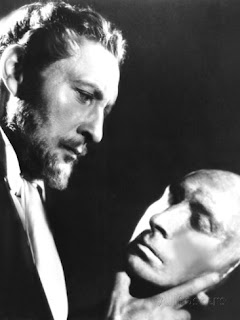
Lionel Atwill and friend from
The Mystery of the Wax Museum (1933)
The professor is actually a famed Austrian wax sculptor who lost his mind years ago and turned into a homicidal maniac. His house is filled with "startlingly lifelike" wax figures that "keep [him] company." (One guess as to what they really are.) He makes her a wax mask that transforms her into a beauty and either due to a weird magical chemical bath he immerses the mask into or through hypnosis, or a combination of both, he gets her to believe she is a completely different person while wearing the mask. He calls her Lilith and she soon is switching on and off between these two personas like the atmospheric lightning strikes that occur every ten pages or so. Later, we learn that she is re-enacting the life of Lucretia Borgia, one of the many wax figures in the Professor's long destroyed traveling Chamber of Horrors.

As if a mad scientist/wax sculptor and reincarnation via hypnosis or chemicals or whatever wasn't enough over-the-top plotting Catherine also has a gift for psychic time traveling. She is able to feel the presence of evil and past events and manages to either conjure up the events and relive them or travel back to when the events took place. It’s really not made clear and it’s poorly explained in the final pages by Sir Marcus Syme, the requisite brilliant psychiatrist who “cures” Catherine/Lilith/Lucretia and makes her whole again.

There’s a lot more to this -- murder, abduction, assumed identities, asylum escapes, and the mysterious empty and boarded up house that gives the book its title -- but I’ll spare you all that. Frankly, it’s a mess of a plot so crammed full of horror movie trappings and Gothic excess it was a bit too much even for me. Added to the over-the-top fantasy and supernatural elements is the continual shift in the action between the past and the present. I never knew where I was, what really happened, what was imagined, who was a ghost, who was real, or whatever.

While Dracula served as her template for Dreadful Hollow Clamp chose to pilfer from many sources for her second supernatural “spine-chiller”. She has crammed as much as she can into its brief 167 pages with references to both books and movie scripts, uses every hoary cliché from Gothic writers and pulp magazine fictioneers, and throws in an ample helping of pop psychology circa 1944 no doubt picked up from the magazine racks and Hollywood screenwriters of the era. There are allusions to Bulwer-Lytton’s “The House and the Brain”, Mrs. Danvers, Igor in the Frankenstein movies, as well as blatant "borrowing" of the plots of The Mystery of the Wax Museum, Lost Horizon, The Old Dark House, The Murders in the Rue Morgue, and every lurid thriller featuring a gorilla on a rampage made between 1930 and 1943. She tosses everything she can into her blender, turns it on high speed and comes up with a heady potent cocktail guaranteed to give you a nasty hangover.
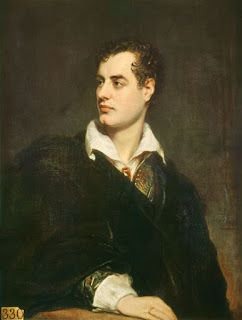
The killer bears a striking resemblance
to Lord Byron...with very hairy arms
As was the case with Dreadful Hollow the plot twists in The Empty House fall flat because they are so easily predicted. No one could possibly be shocked by the italicized sentences Clamp employs to jolt the reader. Even if there were no drawing of a gorilla on the DJ all her straightforward descriptions of a hairy armed beast with fifteen inch non-human footprints can only mean one thing. The dull policeman in the case, however, clearly has never been to the movies or read Poe. At the halfway mark in the book, and thirty pages after he has been told by a forensic expert that some reddish black tufts of hair found in the gold match case belong to an “anthropoid ape” Inspector Gregory wisely starts to talk about the famous Poe story. Then he muses, "I wonder if in this modern case these mysterious crimes can be traced to a creature whose logic and reasoning powers are sub-human, showing merely a brute ferocity..."

Clamp tries hard to misdirect the reader with this statement and later descriptions of the hairy beast. Could the human villain who looks like Lord Byron and the phantom ape be one and the same? She hints at this throughout the story. I was hoping it would be the first instance of a were-ape in supernatural fiction. No such luck. I have no problem spoiling the fact that the gorilla wears a wax mask of a gorgeous Lord Byron look-alike that makes everyone believe that there is a half human/half ape kidnapping and killing people. "Wait!" (I hear you exclaim.)  "A gorilla manages to keep a wax mask on its face and not rip it to pieces?" Well, my friends, this is one very well trained ape. And those masks are genuine works of art with some sort of chemical magic mixed in. Plus, the ape did come from a traveling circus. Yes, he's a performing gorilla. You gotta love Irina Karlova for her chutzpah.

THINGS I LEARNED
1. Clamp used the phrase "prunes and prisms" to describe the entire Victorian era. I had never heard this before. Apparently, it was invented by Charles Dickens in his novel Little Dorrit which features a pretentious guardian named Hortensia General who tries to teach the heroine to speak properly by forming her lips around several words that start with P. Two of the words are prune and prism.  The phrase "prunes and prisms" later was adopted to refer to affected, primly precise speech and behavior.  There are mutliple citations in annotated dictionaries showing its use throughout the Victoran era and well into the mid twentieth century. This is the first time I have ever encountered the phrase in anything I've read.

2. The retina image nonsense is used in this book!  I couldn't believe that a police officer seriously considered this as forensic evidence in a book published in 1944. He takes a picture of "the retina and the brain", develops the photograph and sees the last image seen by a murder victim. And it's the face of Lord Byron! As if the performing gorilla wasn't enough she threw that into the works. I literally burst out laughing.

3. More stuff about eyes. Her long Kalmuk eyes glanced his way for a fleeting instant. That sentence occurs on page 36 and I hadn't a clue what it meant.  So I headed to my smart phone and did an internet search. Kalmuk is a variant spelling of Kalmyk, a forgotten group of Asian people also known as Oirats, whose ancestors came from Mongolia and settled in an region now a federal state of Russia called Kalmykia.  I'm guessing Kalmuk eyes is an esoteric and "non-racist" way to say someone had "almond eyes", a very popular term used to describe Asian women in genre fiction back in the day. Even if she recycled other writers' plots at least Clamp found new ways to be offensive.

I so much wanted to like this book, but now that I’ve completed the trio of novels by “Irina Karlova” it is overwhelmingly clear to me why she was not reprinted and has fallen into the limbo of forgotten books. Every now and then there are books I heartily recommend you avoid and not bother searching for. Ever. This is one of them. Farewell, Irina. It was a fun fifteen years looking for your books. Onward and upward!

[Many thanks to fellow obscure mystery fiction aficionado Darrell, way up in Saskatoon, for the scan of the ultra rare DJ. My copy, sadly, is a naked one.]

Friday, January 16, 2015

FFB: The Official Chaperon - Natalie Sumner Lincoln

Chances are if you are asked to name one woman mystery writer from the early twentieth century you wouldn't immediately think of Natalie Sumner Lincoln. I'd wager that you are probably reading her name for the very first time. She was a contemporary of Anna Katharine Green, Isabel Ostrander and Carolyn Wells all of whom are better known and all of whom she was clearly trying to emulate.  Ostrander was the most innovative and talented during the heyday of these women's careers. Green gets all the accolades for being the Grandmother of Female Mystery Writers. Carolyn Wells.... um... she has a special place all her own in the history of mystery fiction. Lincoln, however, is truly forgotten and most of her books have been out of print for close to a century, some longer than that.

As examples of early 20th century detective novels her work is not the best of their kind. An intense perusal of multiple magazine reviews of Lincoln's more exemplary work published between 1915 and 1925 indicates she was popular during her time and probably sold a lot of books. Based on my reading of The Official Chaperon (1915), the first book I've read of hers, I think she may also be a candidate for inclusion in that dubious Hall of Fame known as Alternative Mystery Classics.

Lincoln was born and raised in Washington DC where she worked as a newspaper reporter and later editor and where the majority of her novels are set. The Official Chaperon, while not exactly typical of the kind of detective novel she was known for, is a template for the characters and situations Lincoln was obsessed with. It tells the story of a group of entitled wealthy Washington socialites and politicians who are primarily concerned with their reputations and social standing. When a string of thefts upset their status quo they are alternately forced into both protecting their loved ones at whatever cost and outing the kleptomaniac hiding in their society.

Margaret Langdon as
illustrated by Neysa McMein
Margaret Langdon is the primary suspect. She has been hired as a chaperone to Janet Fordyce, only a few years younger than herself, and together they attend dances, parties and make social visits to wealthy households. Each time Margaret and Janet make one of their visits someone loses a valuable item. Jewelry, lace handkerchiefs (apparently highly prized in this era), and money are stolen. Coupled with these thefts is the fact that Margaret was recently fired from her secretarial position in the home of Admiral Lawrence when the codicil to his dying wife's will went missing. He accused Margaret of destroying it in order that her sometime boyfriend Chichester Barnard, Lawrence's nephew, would benefit from Mrs. Lawrence's estate. Eventually through a series of absurd coincidences and plot contrivances Margaret comes to be accused by multiple characters as the ballroom thief. But the reader knows better.

Early in the book Margaret witnesses Janet Fordyce pocketing a valuable jeweled brooch. She manages to retrieve the brooch and attempts to return the item to it rightful place. Of course she is caught doing so by the woman who owns the brooch. And of course it appears that Margaret is taking the jewelry not replacing it. The entire story is predicated on this kind of cliche incident. Lincoln manages to reinvent this scene about four or five times over the course of the story making Margaret seem like a true kleptomaniac.

Margaret catches Janet in the act
(illustration by Edmund Frederick)
Here's a perfect example of her plotting. Janet and her soldier boyfriend Captain Tom Nichols are caught in a speed trap. Tom asks Janet not to use her real name if the police ask for it. Whose name do you think she uses as her alias? That's right. Poor ol' Margaret Langdon. When they have to pay a fine of $50 (admittedly very steep for 1915) and Tom doesn't have enough money he offers to use a combination of his $23 in cash and Janet's bracelet as collateral. The police agree to the loan of the jewelry (!) as long as Tom returns the same day with a cash balance. It turns out the bracelet is not Janet's. She lifted it from a society matron and ten minutes later the matron's husband is also pulled over by the cops at the speed trap. He also has to pay a fine and sees the bracelet on the cops' desk. He immediately recognizes it and asks who left it behind. The cop refers to his arrest records and says: "Oh some woman named Margaret Langdon."

This is not really a detective novel at all. It's not even a crime novel though thievery makes up much of the plot. It's nothing more that an early twentieth century version of a 1980s nighttime soap opera. It all reminded me of episodes of Dynasty in which wealthy people dressed in expensive clothes (a lot of space is devoted to the wardrobe descriptions), drink champagne, carry themselves haughtily and accuse each other of stealing each others spouses and partners rather than jewelry and handkerchiefs.

While there's no adultery going on in The Official Chaperon there is a lot of philandering mostly by the ne'er-do-well Chichester Barnard, the obvious villain of the piece. There's even an Alexis Carrington in the cast. Pauline Calhoun-Cooper (how do you like these hoity-toity names?) adds a contemporary spice to the proceedings and at least made me laugh with her constant accusations, her bitchiness and superior attitude. Only nineteen years old Pauline is also one of the youngest women in the cast of characters. So young, yet so old. Sigh...

Speaking of bitchy -- Lincoln has quite a way with her dialogue. Here are some zingers that I particularly enjoyed:
"Life is too short to bother with ill-bred and stupid people. I came to Washington to avoid them."

"Congressmen of today belong to the ancient and honorable order of inkslingers."

"If thee made virtue less detestable, Becky, thee would have more converts."  (Spoken by Madame Yvonett, a Quaker who likes her thees and thys, to her cousin Rebekah, an uptight religious hypocrite)

But these quips and intentional moments of humor are rare. Lincoln reserves her dialogue writing talent for paragraph long tirades filled with melodramatic pronouncements of anger and pitiful displays of desperate "love-making." Most of it is over-the-top even for 1915. I found myself laughing at most of these moments of high drama when I wasn't rolling my eyes.

And now a warning... (Now a warning?) Here comes a HUGE SPOILER. You may want to skip this paragraph...but I'd continue if I were you.

Most ridiculous of all is the novel's resolution when the reader learns that Janet is not really a kleptomaniac at all. Through the erudite pontifications of psychiatrist Dr. Paul Potter we learn that Janet's thievery was achieved through hypnosis.  She was the victim of an insidious post-hypnotic suggestion triggered by the mesmerist villain's blowing in her ear! This ending was so absurd and out of left field I could only think of Harry Stephen Keeler. He had yet to write a single story in 1915 so I can't even credit him as one of Lincoln's influences. But you can be sure I'll be reading more books by Natalie Sumner Lincoln. My hope is that she outdoes herself in terms of the absurd ending of The Official Chaperon. Stay tuned!

*   *   *


Reading Challenges:  1.  1915 Book for Rich Westwood's challenge.
2. Golden Age Bingo card space G3 - "Book with a crime other than murder." In fact, there is no murder in this book at all!

Tuesday, June 10, 2014

ALTERNATIVE CRIME: Claim of the Fleshless Corpse

Claim of the Fleshless Corpse (1937). Great title, isn't it? The title alone would have got me to read the plot blurb. Conjures up all sorts of gruesome images and violent crime. Perfect title for a story in a shudder pulp like Dime Detective. A story that screams out for a lurid painting of a woman in bondage screaming out in terror while a madman hovers over her with a red hot poker or some other tool of devilry. But a fleshless corpse is after all nothing more than a skeleton, right? And that's what insurance investigator John "Toughy" Nichols faces in the furnace room of Albert Browning's "elegant residence" in the tony Long Island town of Briarcliff Manor. An incinerated skeleton but still a skeleton. Claim of the Incinerated Skeleton just doesn't trip off the tongue, does it?

Browning was carrying a hefty $500,000 life insurance policy and "accidental death gets him two-for-one" as Nichols puts it. He's sent by his boss to check out the incinerated body and find out if it is indeed Browning or yet another case of insurance fraud. In the first two chapters Nichols treats us to three separate cases of fraud and it seems like his job is a never ending battle with no good con artists trying to dupe their insurance agents with a shifty get-rich-quick scheme. With Nichols on the case, an expert in all sorts of fraud, Continental Insurance has been saving thousands of dollars a day. But when the case gets too scientific Nichols turns to his surgeon pal Dr. Lester Lawson, one of those wizard geniuses of pulp fiction. Lawson has an arsenal of up-to-date medical techniques that help him prove accidental deaths have been faked.

This story is very early forensic techno-thriller with all sorts of scientific detection. Over the course of the book Dr. Lester Lawson gives mini-lectures on Hans Müllner's technique of making a plaster cast of hand prints and fingerprints; George Weber's perfection of the Müllner technique used to get a "shadow" of a footprint off of a concrete floor; Dr. E. M. Hudson's method of getting latent prints from cloth, wood, metal or anything without a shiny or glossy surface; and the involved process of moulage used to reconstruct a face on a skull. Some of it is fascinating, some of it is old hat to crime fiction readers. All of it, however, was probably new to a 1937 reader. It might have been a lot more interesting and less frustrating to read had Bruce decided to make Lawson more of a gentleman.  Lawson's petulance and sarcasm outdo even the wisecracking narration we get from Nichols. The surgeon and the claims investigator are an oil and vinegar kind of detective team; somehow despite their bickering and insult trading they manage to solve the case.


Yes, Hans Müllner was a real criminologist.  The others are real men, too.

Of course the body turns out to be someone other than Browning. It is through the combination of this unlikely duo's investigative skills that the fraud is uncovered. Lawson's diligent scientific detection leads to the true identity of the corpse. Nichols' legwork and scene of the crime investigating uncovers the unusual method of faking an electrical accident in the furnace room.

But I've filed this book under "Alternative Crime." That means you get a fair share of absurdities and implausibilities amid all the scientific and criminological facts. Not to mention a less than literary writing style. Bruce's wordsmithing is pure pulp. Examples? I knew you'd want some.

Wise guy insults galore:
Lawson: "And you probably couldn't spell corpse."
Nichols: "I'll show you, you flat-faced, mummy-pussed, belly-opener. All I need is a lot of paper and pencils."
Lawson: "And the prayers of the congregation. And listen, you spell it c-o-r-p-s-e."
Nichols: "Try n-u-t-s!"

And the usual plethora of quirky metaphors:
"She was a swell kid, too, with her head in the right place and her heart ditto."
"...because the old boy had picked a pretty bizarre way of chucking in his chips and kicking off for the Styx." 
"...at this point my old brain did a few nip-ups of its own."
"...whether this tall story that Lawson's been assembling in his junkshop has any angles to it I'd dare take to [my boss] without a catcher's mitt and knee-pads."

Lawson pulls off a few crazy Holmesian miracles of observation and inference as in his assumptions about the lifestyle of the fleshless corpse. He tell Nichols to look for a "...a man who has hung around barrooms, who hasn't been so damned particular about keeping himself clean. When he worked he was a stone-cutter or a stonemason... The day before he died he had a job unloading flour from a truck." Quite a bit of info all gathered from a burnt up skeleton! It's all explained in the final chapter but I didn't buy much of it.

And all this work to identify the body! What's the first thing most police would do with when confronted with an incinerated skeleton and intact skull? Check the dental records, of course. Why then doesn't this dawn on anyone -- including the genius Dr. Lawson -- until page 174? But wait, the best is yet to come.

The skeleton is taken to Lawson's private hospital lab where he does the full autopsy and reconstructs the skull. Clearly the police are too inept to do it right. Then the "fleshless corpse" is transported (by ambulance no less) back to the police station! The station itself, not the morgue. Dr. Lawson wants the body now with its simulated face to be dressed in clothing and put into a line-up for policeman to study! I couldn't stop laughing throughout this section.

If you want to find out more, read it for yourself. Those arbiters of eccentric taste in mystery novels over at Ramble House have generously reprinted George Bruce's  wacky book. You can get a nice trade paperback edition of The Claim of the Fleshless Corpse direct from Ramble House (published under the UK title of Corpse without Flesh) or at the usual online bookselling sites. But if you've read this entire review, you have also been warned!

UPDATE - June 11, 2014: Just discovered a detailed biographical article about George Bruce who was indeed a pulp writer as I had guessed. His specialty, however, was airplane adventures and military aviation stories not crime. He also has a few screenplay credits. I should've known someone who wrote wiseacre dialogue as sampled above would succumb to the lure of Hollywood. Please visit the blog Bear Alley for Steve Holland's excellent article on this forgotten pulp writer.

*     *     *


Reading Challenge update:  Golden Age Bingo card, space E1 - "Book with a detective team"

Saturday, March 16, 2013

ALTERNATIVE CRIME: A Woman in Purple Pajamas

I continue my reading of the Scarlet Thread Mysteries with this oddball book with an oddball title. Turns out it's by a writer who is the only person to have more than one book published by this imprint. Wilson Collison wrote The Diary of Death under his own name and it appeared as one of the first books in the Scarlet Thread series of mystery novels in 1930. A Woman in Purple Pajamas followed one year later in February 1931. It purports to be a police procedural with a quasi-impossible crime. The result is indeed impossible in a completely unintended connotation of that word.

A Woman in Purple Pajamas is a casebook pastiche. Collison, in a nod to the late Victorian police procedurals, creates narrator Willis Kent, a "first-grade detective" and Harvard graduate, who also serves as the books "author." Kent gives a brief background in his Foreword on how he quickly rose to his current rank under Lt. Martin Brannigan and attempts to get the reader to believe that this novel is a work of non-fiction. Kent is continually reminding the reader that the police work of fictional characters in detective novels is entirely unlike that of authentic policemen. He proposes that his story of the Rand murder will reveal how police really investigate a murder. The book is to be a sort of experiment in which the reader follows Kent from start to finish, viewing evidence and hearing eyewitness accounts as he received them in chronological order. The entire book takes place over the span of twenty four hours.

Jimmy Rand, libertine millionaire playboy, is shot in his bedroom on the night of one of his loudest and busiest weekend parties. Brock Warwick, secretly in love with Rand's wife Denise, just happened to be outside at the time of the murder and is the first of many eyewitnesses to come forward. Just prior to seeing Rand shot in the open French windows leading out to a second story balcony Warwick claims to have seen a woman wearing purple pajamas who disappeared after Rand fell to the ground. There is some business which makes the room appear to be locked and inescapable but later interviews with suspects quickly dispenses with the impossibility angle. The bloodstained purple pajamas appear and reappear in a variety of locations but finding which woman had been wearing them -- something that should be easy and obvious based on the different heights and shapes of the women involved --  proves to be one of this Harvard educated cop's most difficult tasks. Lying suspects are Kent's undoing.

During the investigation Kent learns that his chief seven suspects were all in Rand's bedroom at some time during the night.  He also learns that at least three suspects had planned to kill Rand. One of these would-be murderers is also an eyewitness to the killing and makes the mistake of trying to talk with Kent in confidence. He is, of course, overheard and becomes the second victim. This unleashes a wave of hysteria among the party-goers when his dead body is found at the foot of a staircase in the main hallway. Despite the fact their host was killed and that the police on are on the premises at the time of the second murder the reveling extras are still drinking and dancing oblivious to a murder investigation. It takes a second murder for the police team to get the news out.

Suspects are found hiding in closets, hiding in clothes trunks, and otherwise behaving like stock characters in a bedroom farce. Denise Rand is depicted as a hysteric who can't answer simple questions without being reduced to a quivering, stammering neurotic. When asked how tall she is, she replies, "I don't know," her answer to most everything asked of her. Kent is merciless in questioning Mrs. Rand, moreso than any other character. There is a third degree scene in which he badgers her about the purple pajamas until she finally cries out, "I don't know! stop -- for God's sake, stop asking me questions!" 

Like most mystery novels of the Alternative Classic School to which this book assuredly belongs there are frequent passages of unintended comedy.  Here is a random sampling:
At this point, you assisting detectives may well point out my stupidity and utter uselessness of my method of procedure.

Once a man becomes vexed and loses his temper, fifty percent of his efficiency and powers of deduction are destroyed. You can't reason when the blood is circulating too freely.

Silence persisted then for a long moment...

I felt abruptly tantalized; as though I were a little boy being teased; as though some disgusting prank-player had run a grater over my skin and irritated it.

It was a fertile thought; it came to me with large chunks of logic and interesting possibilities.

I simply can't be a fictional detective, so I must admit that the servants had meant little to me in connection with the case. I had, of course, blundered stupidly in not questioning Parker [the butler] -- but then, how was I to know that the poor fellow was to be murdered...?
The repeated comparison between real life and fiction like that last quip above gets to be grating. Why do writers think this is clever? Additionally, Kent constantly brings up his Harvard education which as the story progresses becomes an increasingly dubious claim. Either that or he was in the bottom of his class. In this case the mention of an Ivy League education has nothing to do with Kent's intellect. He is counter-intuitive to the point of exasperation. Despite his claim about "large chunks of logic" filling his "fertile thoughts" many of his so-called unorthodox techniques are not radical, but inane.

There is an interesting coda to the publication of this book. It appears to be a novelization of a screenplay. Wilson Collison named his narrator/author in A Woman in Purple Pajamas after movie producer and screenwriter Willis Kent. This seems to be some kind of in-joke between Collison and Kent. It can be no coincidence that the title of the movie, A Scarlet Week-End, is blatantly used to promote the book on the rear panel (see photo at right). I was unable to unearth anything else about the reasoning for using Kent's name as the policeman narrator.

The film version is apparently a lost movie according to the imdb.com entry even though the website links to a review of the film on Cinefania, a Spanish movie website . Reading the brief review it seems that the film is very much in line with what I read in the book. But is it a legitimate review? Does the film truly exist? Or did the reviewer read the book and write a summary passing it off as a review of the movie? There is all sorts of similar fraudulent review and ratings of lost films are perpetrated on the internet day in and day out. If anyone has truly seen A Scarlet Week-end I'd be interested to know what the movie is really like.

READING CHALLENGE UPDATE:  This serves as the second book in the "Vintage Mystery Reading Challenge 2013 - Scattergories" sponsored by Bev at My Reader's Block.  The book fulfills the category Colorful Crime. Previous reviews for the challenge are listed below:

Category 1: Murder is Academic
Murder from the Grave by Will Levinrew (also a "Scarlet Thread Mystery" coincidentally)