Showing posts with label webwork. Show all posts

Wednesday, March 30, 2022

FIRST BOOKS: The Seven Sisters - Jean Lilly

Mr. Spencer, a gemologist, visits newlywed Nancy and Stanley Kent at the famed Prentice mansion. He informs them that he is doing research on the renowned Prentice Dowry Chain, an elaborate jeweled necklace made up of seven star sapphires known as the Seven Sisters. Much to Mr. Spencer’s dismay Nancy, Mrs. Prentice’s granddaughter, has never heard of the Prentice Dowry Chain and knows nothing about its existence among the many valuables in the house. Stanley, however, a clever young man if there ever was one, leads Spencer to a portrait of one of the Prentice ancestors. It’s Nancy’s great grandmother who is wearing an elaborate necklace and Spencer stands in awe of the painting sighing almost inaudibly, “The Seven Sisters!” Spencer allows the family to try and locate the necklace and he promises to return at a later date hopefully to examine the jewels in person. Thus begins a strange and macabre adventure involving buried secrets, stolen jewels, and murder.

I was utterly unprepared for what awaited me in the pages of The Seven Sisters (1928), the first mystery novel of Jean Lilly. The rambling narrative meanders through Stanley and Nancy’s courtship, an overview of Prentice genealogy, the setting up of the house, the relegation of the dozens of ancestral portraits that covers the walls, etc. etc. and so forth. This meandering all seemed to be going nowhere for the first 75 pages. Finally when Spencer shows up and delivers his two page monologue on the mineral composition of gemstones, the phenomenon of asterism, the difference between faceted gem cutting and the en cabochon method I started to see this would be yet another mystery novel about a missing item of jewelry and the crimes that follow in the wake of the jewels’ recovery. Little did I know that the story would take a bizarre detour into the land of pulpish gore and macabre thrills.

A star saphhire displaying
the asterism effect
Nancy’s grandmother Penelope, the only occupant in the Prentice home other than the handful of servants, refuses to talk about the Seven Sisters. A few days after Spencer showed up she dies of fright when a different strange man appears and confronts her and her gardener/handyman about the Prentice Dowry Chain. Just before Penelope dies she utters a fragmented message: “Under…oak...next…” Stephen takes the message to be a literal clue to the necklace’s hiding place, most likely beneath one of the oak trees that line the property. He spends one night digging and to his shock (and the reader’s) he uncovers some skeletal remains. Buried with the bones he finds an engraved pocket watch. Only a capital R is legible while the other two letters in the monogram have been worn away.

Increasingly the story becomes like Harry Stephen Keeler webwork concoction. An apt analogy because this is a book from E. P. Dutton, publisher of Keeler’s books from 1927 through 1942. Along with disinterred skulls and skeletons and the engraved pocket watch we get anonymous letters, a mystery woman residing in Room 34 of a hotel on Andover Road, an acrobatic burglar, and another buried body!

Surprisingly, with a small pile of buried corpses and a break-in at the Prentice home there’s not a single policeman in sight. Stephen in trying to protect the family name does call the coroner but tells him as little as he thinks the coroner needs to know. Stephen may be clever with his dying messages and handy with a shovel but he’s extremely foolish not to report the nuttiness going on at the Prentice property. His foolhardy decision to protect his wife’s family reputation leads to more death and violence. Coroner Bailey then takes matters into his own hands. He and Stephen turn sleuth and ultimately, after various wild adventures and more crime, the greedy culprits are tracked down, the necklace is recovered and the secret of the skeleton buried beneath the oak tree is explained.

Jean Lilly is as mysterious as the goings on in this debut novel. I know more about her husband and daughter than I do about her.  Jean McCoy Lilly (1886-1961) was born in Michigan and died in Pennsylvania.  She married Scott Barrett Lilly, well known professor of engineering at Swathmore College,  for whom an endowed scholarship is still named.  Her daughter Mary, born in 1910, graduated from Swathmore in 1933, studied painting at the Philadelphia Art institute and taught art there. Later she spent much of her life as an art teacher at Charlestown Elementary School in Malvern, PA.

Lilly is the author of four mystery novels with the last, Death Thumbs a Ride (1940), the easiest to find and the only other Lilly book that has been written about on the internet. While her first crime novel has no series character another Lilly mystery novel I own but have yet to read -- Death in B Minor (1934) -- features Bruce Perkins, her lawyer-detective who appeared in the last three books.

The Seven Sisters exists only in one US edition and is the scarcest of all the Lilly mystery novels. It was not reprinted in either hardcover or paperback during the author’s lifetime. While I enjoyed this oddity I wouldn’t break my neck (or bankbook) tracking down a copy. Despite its strange turn of macabre events it’s typical of 1920s American mysteries: not really a traditional detective novel but rather an adventure thriller overloaded with preposterous coincidences. Ultimately it all ends in a sadly predictable finale. With its old-fashioned prose style, unusual narrative tricks and creaky plotting it all reminded me of a book that might have been written in the late Victorian or early Edwardian era by either Richard Marsh or Mary Elizabeth Braddon.

Friday, June 1, 2018

FFB: The Weird World of Wes Beattie - John Norman Harris

THE STORY: Wes Beattie, chronic liar and hapless young banker, is on trial in Toronto for a capital crime. No one seems to believe his fervent and outrageous tale of a conspiracy to frame him. He claims total innocence and is doing his best to tell the truth about a man and woman who have not only framed him for the theft of a handbag but the murder of his uncle. So bizarre is his story that a psychiatrist has turned him into a unique case history and hits the lecture circuit presenting Wes and his grandiose delusions and pathological lying as a treasure trove of psychosis. However, Sidney Grant a lawyer who attends one of those lectures hears something in Dr. Heber's talk that bothers him. Intrigued and fascinated by a kernel of truth in what appears to be nothing but fanciful possible paranoid ramblings, Sidney starts to look into The Weird World of Wes Beattie (1963) intent on proving Wes' story of conspiracy to be truth and to uncover the motive for the frame-up. What he finds is a preposterous labyrinth of interconnected coincidences and random bizarreness that proves more and more that Wes is indeed telling the truth. And when the full story is revealed hardly anyone can believe it including Sidney.

THE CHARACTERS: Though the title seems to indicate that this is Wes' story, the real protagonist is our hero lawyer/sleuth Sidney Grant and his small band of cohorts in truth-seeking. Sidney is dubbed "the Gargoyle" for his menacing and imposing attitude described by his colleagues "like some evil figure leering down from a Gothic cathedral" and "frowning down on his guests like some Mephistophelian judge. Really though Sidney is an attractive and likable young man "called to the bar only a few months before" who respects the law and abhors the abuse and incompetence of his lessers, sometimes even his betters. Sharp as a tack and more than clever Sidney manages to coax his friends and colleagues, along with the daffy June, Wes' sister, as a junior league of con artists and co-detectives as he manages to trick a motel voyeur into revealing the truth about what happened when Wes supposedly stole the woman's handbag from her parked car in the motel lot. This scene is a highlight in a comic novel that satirizes everything from Canadian law to Canadian banks, from the 60s phenomenon of wife swapping and drunken swinger parties to hockey and ice fishing.

June Beattie is one of the best characters of the books. She's the antithesis of her uptight and haughty wealthy family members, entirely devoted to her brother for whom she feels ample amount of sisterly love. Moreso than anyone she understands why Wes has retreated into his fanciful world and why he cannot help but embellish the truth with his overly active imagination. In some respects this satirical mystery novel is a retelling of "The Boy Who Cried Wolf" taken to utterly absurd extremes. You can't help but join in June's caring for her brother when she relates in her amusing narrative voice just why Wes is the way he is.

There are also some fantastically rendered minor characters who come into the story for such brief moments but leave long lasting impressions. Sidney recruits a "second story" man who he had previously helped acquit of burglary charge due to lack of physical evidence. This thief along with the reliable June travels with Sidney to the Ontario backwoods where he assists Sidney in breaking into a cabin in a remote forest to find incriminating evidence that will help prove the guilt of one of the conspirators. What they find in the cabin only further complicates the already mind-boggling plot.

INNOVATIONS: The modern reprint of The Weird World of Wes Beattie touts the novel as "the first truly Canadian mystery". This is a gross exaggeration that publishers like to plaster on their books to help sales, but after completing the novel I can see why the original writer of that phrase felt it necessary to label the book as such. It certainly is filled with every Canadian cultural tidbit that you can think of -- hockey, ice fishing, officious banking to name only a few. Harris works very hard to tie the book to his native Toronto and its environs and the book really feels like it could not have taken place anywhere other than Canada. But as far as the first Canadian mystery that is far from the truth. The prolific writers Grant Allen and Frank Packard were publishing well before Harris was born and Douglas Sanderson (aka "Martin Brett") was writing thoroughly Canadian private eye novels set in Montreal a full decade before Harris' novel was published.

Notably the entire structure of the book recalls the intricately plotted and coincidence-laden novels of Harry Stephen Keeler who practically invented the "webwork" crime novel. The Weird World of Wes Beattie is one of the finest examples of this kind of maze-like storytelling where everyone and everything is tied to a seemingly simple crime like the theft of a handbag. The conspiracy to frame poor Wes Beattie is an ingenious and awe-inspiring work of finely tuned plotting and a brilliant use of apparently innocuous events -- the way an old school chum is snubbed in a mechanic's garage, for example -- that all fall into place like a skilled magician shuffling a pack of cards. As in real life it's the oddities the characters tend to remember and these odd incidents, no matter how trifling or insignificant, have great importance and are compounded tenfold within Harris' truly awesome plot.

The climax takes place in a Canadian courtroom and Sidney's expert cross examination of one of the key witnesses is on par with -- perhaps even surpasses -- the legal fireworks and melodramatic courtroom pronouncements of Perry Mason at his ruthless best. So astounding is the preponderance of incredible evidence that Sidney in essence gets a confession from the witness stand without the testifier actually verbally admitting his guilt. A real coup in crime writing, I'd say.
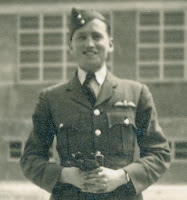
John Norman Harris (age 23)
in his RAF uniform, 1938
THE AUTHOR: John Norman Harris (1915-1964) was a former RAF pilot with an astonishing wartime life that included being shot down in Germany, taken as prisoner of war, and planning "one of the greatest prison breaks of all time" which he used to form his award-winning short story "Mail" (Maclean's, 1950). He worked in public relations for Bell Canada as well as advertising for Canadian Imperial Bank of Commerce, two careers which obviously provided him with ample fodder to lampoon in his first novel. In addition to the two comic crime novels featuring lawyer Sidney Grant, Harris wrote about military life and the Canadian air force in Knights of the Air: Canadian Aces of World War I (Macmillan, 1958).

EASY TO FIND? Those interested in a first edition may not be too lucky. I found my US edition with the rare DJ a few months ago on eBay for a pittance and it was in very good condition. But a search of used book markets show very few US or UK hardcover editions from the 1960s when it was originally published. There are numerous paperback reprints (Corgi in the UK, Popular Library in the US) offered at very affordable prices. But the best news is saved for last. Happily, ...Wes Beattie was reprinted by Felony & Mayhem several years ago. (Such good news for a change, eh?) Harris' last novel published after his death -- Hair of the Dog (1989), a sequel of sorts featuring Sidney and his new bride June -- was also reprinted by Felony & Mayhem this year and with it came a new edition of The Weird World of Wes Beattie. Both books are available in either paperback or digital format. If you prefer eBooks you need to buy it directly from Felony & Mayhem. Click here and you'll be taken to the page for the book with Kindle already selected for you. They also sell the book in EPub format. Use the pull down menu to find the other digital version.

Sunday, January 22, 2017

Harry Stephen Keeler Remembered

Harry Stephen Keeler in his youth.
On January 22, 1967 the world lost one of its premiere imagineers. Harry Stephen Keeler shuffled off this mortal coil to join his beloved Hazel on that date and the world of mystery fiction became a little less joyful, a smidgen less madcap, and whole lot less fun. Today Richard Polt, founder of The Harry Stephen Keeler Society has put out a special issue of Keeler News, that fanzine dedicated to all things Keelerian, to commemorate the 50th anniversary of the passing of this true original. In preparation he asked Society members to join in with their own tributes of one sort or another. I decided to take down from the shelves one of the handful of Keeler novels I hadn't read, devour it as quickly as I could, and churn out something suitably honorary. I missed the deadline of January 15 to make the issue, but just in the nick of time here is my bit to honor the memory of one of mysterydom's most original and audaciously imaginative writers.

The Skull of the Waltzing Clown (1935) is quintessential Keeler.  It contains every one of his trademarks that made a Keeler mystery novel unique and absurd, laughable and sweet. We get the usual Keelerian arcane lectures on everything from the history of antique safes to the origin of obscure Texan surnames; a rainstorm of letters handwritten and typed (one lasting over three chapters!) detailing background adventures of the large cast of characters; lunatic dialogue rendered in intricately composed phonetic dialects capturing everything from Southern Black to Southern Texan; and of course the pursuit of an oddball Macguffin, in this case the skull of the deceased clown in the title.

But how can I overlook the story -- or, rather stories, as is the usual case with good ol' Harry. Here's a sampling of one of his most convoluted, interfolding and overlapping, multiply plotted books. George Stannard, salesman for Recherche Shirt Company, tells of his meeting with Harold Colter in Honolulu where he barely escapes the horrors of being drugged with the weird exotic Pau-Ho capable of putting a person in an amnesiac coma for six weeks only to reawaken and be compelled to tell the truth for another 72 hours. Simon Stannard, George's uncle and owner/publisher of 7-Tales Magazine, talks of his brother's $1000 promissory note and how he intends to get George to repay the note in the most ridiculous roundabout way possible by intervening the crooked plans of one Titus Fenwick, con artist, former sleight of hand magician and notorious card sharp. Fenwick (according to a monstrously long letter Uncle Simon has in his possession) got involved with a trio of crooks nicknamed Charon, Nitro and Sparkle-Eyes whose plan to commit insurance fraud involves stealing the skull of one of their now deceased cronies and passing it off as the skull of another dead crook who just happens to have a large insurance policy waiting to be claimed. The identification by skull, by the way, is now a legality thanks to a Supreme Court decision that allows for dead bodies to be identified via phrenological reporting. And wouldn't you know it -- both dead men recently underwent phrenology readings by a new-fangled invention at the Chicago World's Fair and have their skull bump findings meticulously reported and on file in the inventor/doctor's research office. Whew! I better stop there before I further entangle your minds with weirdness.

The true action of the book takes place in a single room and consists of nothing more than a conversation between George and Uncle Simon who has summoned George to his Chicago home for a favor or two. Over the course of 247 pages nephew and uncle share anecdotes of their lives and a horde of letters and telegrams each relating a series of outlandish adventures, stories filled with coincidence and Fate. The long conversation culminates in a journey to El Paso, Texas where George meets up with his Fate and Keeler ends his surreal tale of the Law of Cross and Re-cross with one of his most outlandish twist endings.

Just what exactly is this Law of Cross and Re-Cross? In essence it's Keeler's own way of putting into simple language (if that's remotely possible for dear ol' Harry) the metaphysical idea of Karma. It's one of the first times a character in Keeler gets remotely intellectual or philosophical with an exchange of ideas about Eastern religions and the mysteries of Life. But more importantly its really the crux of the novel and the worldview of the Keelerian universe put forth all at once. For nothing is ever pointless in the world of Harry Stephen Keeler. Each bad act is paid for years down the line just as every good act will be rewarded. Simon Stannard believes that everyone will meet up for a second or third time, in one way or another, with every person they have ever encountered throughout their life. George initially scoffs as such an idea: "Damn Foolery, I would say. Everybody's lives would re-cross--and an infinite number of times, too--if all lived long enough. Doctrine of chances." And Uncle Simon counters with this bit of mumbo jumbo:

"...this theory isn't based on chance, I tell you. It's based on some occult principle that the deviative effect--on each other--of two people crossing one another's paths, diverts their progress in space and time by such a four-dimensional angle that they positively must cross again."

George shakes his head and says it's all way too deep for him. And how!

Yet Uncle Simon manages to prove the theory by producing the monstrous letter mentioned several times already and show how Titus Fenwick has entered his life multiple times. George will also discover how his adventure in Hawaii with the Pau-Ho trickster will come back to haunt him as well as George's decision to have a story called "The Verdict" by one O Lily Sing Lee published as a last minute replacement in Uncle Simon's pulp story rag 7-Tales Magazine.

I ought to mention to all my locked room and impossible crime fans that "The Verdict" appears in its entirety in the novel and is Harry Stephen Keeler's only contribution to the "locked room" crime subgenre in detective fiction, though many of his books contain impossible crimes, whether intentional or not. A man is found stabbed to death in a locked room, the Chinese dagger fallen on the floor.  The only other entrance/exit is an unlocked window "looking down 10 stories into the street and the park." Additionally, the only fingerprints found on the weapon belong to the person who packed the dagger and sent it to the collector. Who stabbed the man and managed to escape from the locked room? The solution propounded by the forensic pathologist is suitably ridiculous as well as bordering on the supernatural which makes it perfect for its appearance as a chapter in The Skull of the Waltzing Clown.

Let it not be forgotten that amid all the raucous dialogue and the absurd shenanigans of the cast of a thousand lunatics that our pal Harry is an incurable romantic. While George is being blackmailed into a criminal enterprise by his wicked avaricious uncle the fickle fingers of Fate conspire in the ethereal shadows of the fourth dimension to work out a scheme that will reward the seemingly hapless young man with something far richer than money. George, you see, has met the girl of his dreams. But he never discovered her name and knows her only by his invented nickname --"the Rebel". She has eyes that are "blue like the stars over Boston on a winter's night---and her hair was stolen from a cornstalk in Fairyland."  If that's not a romantic talking, than I'll eat my winter ski cap with a generous helping of soy sauce! While Keeler's preposterous crime plots are impossible to solve the outcome of his romantic subplots are happily easy to guess. It's no coincidence at all that the only real candidate for being "the Rebel" will cross paths with George just prior to his setting foot in El Paso, that he will have done something previously to increase the young girl's fortune without her knowing, and that they will plan out their lives in an optimistic bliss promising marriage and happy endings. All of this --of course -- will coincide with the thwarted plans of wicked Uncle Simon.

And if that's not the best reason to believe in Fate, coincidence, and the Law of Cross and Re-Cross then I don't know what is.

Wednesday, February 13, 2013

NEW STUFF: The Invisible Code - Christopher Fowler

Each new Bryant & May crime novel brings with it the anticipatory thrill of discovering more arcana of London that Christopher Fowler loves to share with his readers. (There should be a word for all these nuggets of England's past. Londoniana? Albionisms? Mull those over.) The latest escapade of the Peculiar Crimes Unit or PCU does not disappoint. Within the labyrinthine plot of The Invisible Code (2012) the reader is treated to the fascinating world of Sir John Soane's museum housed at 13 Lincoln's Inn Fields; the secrets of the "Scarlet Thread" and what it means to the Knights Templar; St. Bride's, the church of journalists; and more tidbits about the occult that always work their way into the adventures London's much maligned and unappreciated specialized police squad. For fans of vintage crime and adventure novels there is the added bonus of allusions to the work of Dennis Wheatley and especially a particular title by Fritz Leiber.

Oskar Kasavian (familiarly known to the PCU staff as The Prince of Darkness), an executive in the Home Office, is the top level overseer of this unusual police unit set up to protect the public. He is also their number one enemy. For years Kasavian has been doing his best to shut them down and now Arthur Bryant and John May are surprised to be called into his office for a personal favor. He needs their specialized help in handling the embarrassing public behavior of his wife Sabira who is becoming increasingly erratic and violent. She's been raving about demons and witches and seems to have submerged herself into a world of paranoid imaginings. Kasavian thinks for that reason the PCU team are perfect for discovering the cause of Sabira's delusions. Or are they delusions? And what about the odd death of the woman found in St. Bride's Church who apparently was the target of some children playing an RPG called Witch Hunter? Like all PCU cases the coincidences prove to have more significance the further the team plows.

Arthur Bryant talks about the importance of connections and patterns at one point in the book. This is the basis for all the PCU books. There is a wealth of information that at first comes at the reader in random incidents, then are fired out in rapid succession. Fowler, unwittingly perhaps, is one of the greatest modern practitioners of an old subgenre known as the webwork novel. Harry Stephen Keeler was the best known American writer of webwork novels. He even wrote a manifesto -- "The Mechanics (and Kinematics) of Web-Work Plot Construction" -- about the art of creating a single story out of random multiple narrative threads. John Russell Fearn, prolific British pulp magazine writer of SF and detective fiction, credited Keeler with influencing him in his SF webwork stories.

Synopsis in diagram form depicting the webwork plot of Keeler's Voice of the Seven Sparrows (1924)
Fowler's story incorporates the mysterious death of Amy O'Connor in the opening chapter, the death of a character in a previous novel, the madness of Sabira Kasavian, and several other apparently random acts of violence in a tour de force of webwork plotting. Webwork might be called the fictional counterpart of a conspiracy theorist's obsessive hunt for nefarious patterns real and imagined in the operations of global conglomerates and world politics. Allusions in The Invisible Code to modern paranoid thrillers like Ira Levin's Rosemary's Baby and the movie The Parallax View add another level of enjoyment to the randomness that will eventually reveal a pattern of sinister construction. The novel is the best of this type I have read in all of the ten Bryant & May detective series. Though there is sometimes a tendency towards didactic dialogue passages -- the kind typified by forensic crime TV shows and The X Files -- Fowler mostly manages to introduce the Albionisms (I used it!) in a way that flows naturally out of the densely compacted action.

Bryant & May find a victim in St Bride's Church
(Artwork by Keith Page)
 The series characters each have a turn in the spotlight with some interesting developments in Janice Longbright's life and the usually bickering partnership of detective constables Colin Bimsley and Meera Mangeshkar. Dan Banbury and Giles Kershaw do their usual forensic wizardry in the morgue and in the technosphere. Maggie Armitage, the "white witch", is featured prominently offering much lore and occult knowledge to help Arthur Bryant in explaining some of the baffling elements of the case. And, finally, we are introduced to a new character, Mr. Merry, who appears to be a 21st century Aleister Crowley and who promises to be a formidable foe in the future books as hinted at in a teasing final chapter.

Sampling the escapades of the Peculiar Crimes Unit can be an addictive reading experience but also a dangerous one. In relating to us his love for all things bizarre and strange about the city he loves so unabashedly Fowler not only fuels a crime fiction lover's taste for the bizarre he is something of an alluring siren for the armchair traveller in all of us. He sings a song of London better than any music hall chanteuse. This armchair traveller has been tempted more than once to dip into the savings for a overseas trip to see up close and personal the many unusual places recounted in these extremely entertaining books. And that's the kind of connection I like between a writer and his readership.

Bryant & May and The Invisible Code by Christopher Fowler
Transworld/Doubleday,  August 2012
ISBN: 978-0857520500 (hardcover in UK and Canada only)
GBP 16.99

Available as an eBook and audio book in the US now
US hardcover edition release date is unknown

Thursday, July 12, 2012

NEW BOOKS: Lucky Bastard - S. G. Browne

I was astonished at how this book undergoes a subtle and winning transformation from broad comedy to moving drama. Here we have the overworked trope of the wise acre private eye who has a talent for getting into trouble, can't keep his mind off of sex, and is always in need of money. He encounters a few wacky characters (nearly all of them unnamed - more about that later), more than his fair share of wild predicaments and all the while not changing one bit from his oversexed, overbearing, overgrown frat boy persona. Until one bizarre life threatening encounter forces him to re-evaluate his entire worldview. Nick Monday also has a special talent that sets him apart from your run-of-the-mill private eye. He can steal a person's luck -- good or bad -- with a simple handshake. His resolute worldview that you can't change luck, that you are either born with good luck or bad luck, however, is thoroughly shaken and turned inside out by the end of his surreal journey.

It all starts with the usual sultry woman entering the private eye's San Francisco squalid office. She wants to hire him for a hush-hush job. But instead of locating a missing sibling or husband she wants Nick to recover her father's luck. Her father turns out to be Gordon Knight, mayor of San Francisco, whose recent change of luck has transformed him from a golden boy of the news headlines to favorite topic of the scandal sheets. Nick can't believe that this alluring woman -- ridiculously named Tuesday Knight -- could possibly have known about his reputation as a "luck poacher" when he has done such a good job of keeping it secret from the masses. But it's hard to resist the job when she offers him $10,000.

Then Nick is approached in quick succession by a Chinese ganglord and an unnamed agent from an unnamed secret branch of the federal government. Both want to hire him for his luck poaching skills - Tommy Wong wants to amass as much good luck as he can in order to dominate San Francisco like any proper master criminal and the federal agent (who is a dead ringer for Barry Manilow) wants Nick's help in bringing down Wong's reign of terror. Nick has no choice but to give in to both when each of his potential employers resorts to blackmail and threatens his family.

These three plot lines are interwoven in a tapestry of coincidence and complexity to rival any webwork epic by Harry Stephen Keeler. Like Keeler there is an eccentric humor as well (though I found much of it in the early part of the book to be tiresome and sophomoric) and the action never lets up. To reveal any more would ruin the pleasure of discovering the many absurd plights Browne has planned for Nick.

I started out not really liking this book or the main character. Nick Monday is the kind of egotistic, womanizing, devil-may-care asshole I can't stand in real life. A fictional character with these traits who is saddled with a sense of humor that matched Kartman's of "South Park" wasn't going to get me to like the book any better. But with the introduction of one of the most endearing characters -- a wigga wannabe gangsta rapper named Doug (aka Bow Wow) -- Browne started to win me over.

It's the relationship between Doug and Nick that kept me reading to the end. Not only do they make for a truly eccentric Holmes-Watson partnership (Doug even calls his boss Holmes) they are something of a surrogate father and son duo. The scenes between these two raise the book from a weary, smart alecky parody to an offbeat buddy story with genuine charm and humor.

Slowly and slyly Browne veers away from his action-oriented parody and instead uses the fantastical elements of stealing luck, acquiring luck and becoming addicted to luck as a way to explore the universal tenet so succinctly put in Howard's End by E.M. Forster: "Only connect!" Nick eventually learns that luck can be changed, that life is richer and better when rather than distancing himself from relationships he genuinely connects to other people. He will soon be bidding good-bye to his smartass solitary life made up of nothing but empty one night stands with "corporate coffeehouse baristas" and lonely hours spent surfing the internet for lucky marks to poach from.

One of the most unique parts of the book is Nick's encounter with a mysterious Eastern European accented luck poacher who has the unfortunate fate of having become a Specter. That is, he poaches only bad luck. It's both creepy and poignant as we read of Nick's reaction to a poacher who has surrendered to the dark side and yet ironically reveals a deeper dimension to his hidden compassion for misfits and outsiders, something we've previously seen in Nick's kindness towards the homeless drunks who hang out in the alleys that line the streets of his favorite coffe joints. This is point when the book becomes richer, more dramatic, and -- most importanly -- more human.

All those unnamed characters further illustrate Nick's isolation and his chosen path of indifference. He never bothers to learn anyone's real name. He gives them nicknames like Scooter Girl, Thug One and Thug Two or dubs them with celebrity names based on their appearance like the fed who is Barry Manilow's twin or the Tommy Wong's cronies who resemble Jake and Elwood of Blues Brothers' fame. Few of the major characters receive full idenities. It seemed odd to me at first this cast of the anonymous or nicknamed. I thought Browne was a lazy writer, but by the end it all made sense. It proved to be one of the more clever aspects of the book by the time I finished it.

Here's a real original in the crime fiction world. A book that mixes comedy and thrills and fantasy into a work of fiction that's both wildly entertaining and uncommonly moving. Lucky Bastard is one of the better contemporary novels I've read in a long time. You'd be a lucky devil yourself if you decided to add it to your list of summer reads.

Wednesday, December 21, 2011

NEW STUFF: An Uncertain Place - Fred Vargas

There is no one quite like Fred Vargas in crime fiction today. You have to go back to the "webwork" novels of Harry Stephen Keeler and John Russell Fearn to find any writer who comes close to her unique way of constructing novels that blend the weird, the bizarre and the absurd into a mind-tripping, eye-opening, jaw-dropping phantasmagoria. Luckily with Vargas you also get dreamy readable prose and not convoluted syntax or wacky word-winging as in the case of Keeler or mysteries with transparent solutions as in the case of Fearn. In the Vargas universe everything is truly connected. There is a ubiquity of significance in her books. The absurdities and oddities of life cease to be merely strange and carry a hidden meaning that sometimes borders on the supernatural. She brings the mystery back to the mystery novel on so many levels.

Randomness has no place and there are no coincidences. In a Keeler book, for example, the works of George Barr McCutcheon, a mysterious violin playing thief, and the science of acoustics all come together in the plot of The Mystery of the Fiddling Cracksman. A man eating a bowl of chow mein nearly chokes on a tiny hand made of jade in The Green Jade Hand, but the scene is not there merely to make us laugh it will have some greater importance to the story. Similarly, with Vargas the birth of a kitten is not thrown into the story offhandedly for cuteness factor; it will have repercussions throughout the entire novel. Likewise other events and discussions that seem to be mentioned in passing -- a brief talk about a man who decided to eat his wooden wardrobe piece by piece, the macabre history of Highgate Cemetery including what was discovered when the body of Dante Rossetti's wife was exhumed nine years after her death -- all have later ramifications in this hypnotically addictive book.

The ripple effect begins when Adamsberg who is in England for an international police conference quite by accident stumbles across a bizarre crime. Eighteen pairs of shoes have been found in front of Highgate Cemetery. And the shoes still contain feet. They have all been cut from nine different corpses and none of them are English. The shoes show signs of Eastern European manufacture and many of them are decades old. It appears that the feet have been collected over a period of years. But who on earth has dismembered several dead bodies and placed their feet in front of a cemetery with a past of legendary proportions? What have those feet do to with the horribly mutilated corpse of a reclusive Frenchman whose body quite literally was chopped up to tiny bits? Why are so many variations of a single name continually turning up in the course of the investigation - Plogerstein, Plögener, Plogoff, Plogodrescu.These names become so prevalent that one of the characters coins the term "Plog" as an exclamation denoting significance or surprise.

Commissaire Jean-Baptiste Adamsberg will face one of the most unusual criminals in his career. He will discover that nearly everything in his life will be related to the solution of the crime. The people he encounters and takes for granted will play major roles. And most importantly he will discover that a long forgotten night in his past will come back to haunt him with a startling revelation. The less said about the wild fantastical plot the better.

And now a word about the oft forgotten yet very important translator. Sian Reynolds' translation is an intricately built, ingenious example of how translation can become a true art. Finding the right word is less important than crafting sentences that retain the original flavor of the author's native language. Vargas' books are intrinsically French and in this case have an added international dimension when Adamsberg must travel to England and later Serbia where he does not speak either language. There are ample opportunities for linguistic wordplay in these new settings. There are amusing scenes with Adamsberg repeatedly mispronouncing the name of a British police officer and his habit of calling the infamous cemetery Higg-gate and in Serbia he goes out of his way to learn a handful of Serbian words to better impress a woman who runs the guest house where he is staying. Finally, there is a policeman on Adamsberg staff who speaks in alexandrines a French verse of 12 syllables which Reynolds has confessed to being one of the most difficult tasks she tried to duplicate in English. For that alone she deserves the awards she has garnered from the CWA.

This is the time of the year when everyone is making lists of the Best of the Year. I can never make one of those lists. But I can tell you that An Uncertain Place is definitely a book I would consider to be included as one of the best of the new books, if not the absolute best, I have read this year. A little masterpiece of a book that is also an enviable work of contemporary fiction. It may not be to everyone's taste judging from a variety of indifferent and confused reactions in other reviews I've come across on other blogs. For me, however, this is pretty damn awesome crime fiction.