Showing posts with label Stage Blood. Show all posts

Friday, November 27, 2015

STAGE BLOOD: Sherlock Holmes touring production

In his own words David Arquette admitted that he is an odd choice for Sherlock Holmes, but for me the entire conceit of this uneven production is the odd choice. An amalgam of melodrama, parody and groaning "breaking the fourth wall" gags this schizophrenic production of a new treatment of the Holmes canon never really knows what it wants to be. Add to the mix an array of different performance styles, turgid dialogue with speeches handled ineptly by unskilled actors more suited to vaudeville comic turns than delivering long winded speeches that require verbal dexterity and vocal flexibility and you have the makings for a very tiresome evening. Greg Kramer's script does its best to celebrate Holmes, his prowess as a detective and tries to honor the adventures as written by Conan Doyle with several clever allusions like mentioning The Sign of Four several times and subtitling one section "The Man with the Twisted Hip", however, in the hands of director Andrew Shaver the production is burdened with inept direction in the dramatic sections and weighed down with silly, groan inducing gags in which the actors comment that they are on stage performing a play.

David Arquette not known for his work on stage (though his Playbill bio tells us he has a few Broadway credits under his belt) does his best with a role he is entirely unsuited for. He uses an odd voice deeper than his own tenor register that he has obviously worked very hard on. In his effort to maintain his British accent he shouts all of his dialogue at his fellow actors as if they are all deaf. Not once do we get any shift in colors or tone in his voice. He declaims ever line whether it is an egotistical pronouncement or a confidential aside in a stentorian faux baritone. At times his persona of the arrogant and vain Holmes gives way to a quirky mischievous imp. When he scampers about the stage with arms waving about as if he has no bones or flops lazily onto the chaise longue crossing his legs almost femininely we are reminded this is the giggling nervous David Arquette from the Scream movies and not David Arquette trying to be Holmes.

I was not impressed with James Maslow as Dr. Watson who is far too young in appearance and demeanor nor did I find Renee Olstead as the damsel in distress interesting in the least. The less said about the actor playing Inspector Lestrade the better. I won't even mention his name to spare him the embarrassment. Horrid work -- one of the most bombastic, utterly unfunny, "comic" interpretations of Lestrade I've ever seen. His character belonged in a farce not this show. Just one example of an acting style that didn't mesh with the rest of the people on stage.

The story involves Professor Moriarty and Sebastian Moran (enacted with delicious villainy by two of the best actors in the show: Kyle Gatehouse and Graham Cuthbertson) in a confusing plot of two murders related to the anti-opium movement and some law trying to be passed in Parliament. Historically, there was an attempt to eradicate the opium dens and control the sale of opium based drugs in Victorian era England when this play is set, but the real battle against opium and the successful laws passed didn't take place well until the early part of the 20th century. The parallels with contemporary medical marijuana laws are easy to see. Still, Kramer find s it necessary to hammer home his point by making jokey references as when Moriarty quips "Who would ever want to outlaw a plant?" It's this quasi-hipster, anachronistic and self-aware tone that repeatedly takes us out of the world of Holmes. In the hands of unskilled director Shaver it makes for an uneasy night at the theater.

James Maslow (left) looking more like Ed Norton from "The Honeymooners" than Dr. Watson
and David Arquette as Holmes in a laboratory scene that has nothing to do with the plot.

The real star of the show is set designer James Lavoie. To accomplish the challenging task of depicting the dizzying number of locations, both interior and exterior, that fill the stage in this invigoratingly paced, action filled show Lavoie has resorted to tall sliding walls and projections. As the story unfolds the sliding walls become wallpapered rooms, a study with a blazing fireplace, sooty brick lined alleyways, and a dockside with reflecting water. At several points in the show the characters take hansom cabs not seen but only suggested by the tightly placed bodies of the actors and their bobbing movement while the projections behind them give the illusion of the cab rapidly travelling through the mazelike streets of London.

For those unfamiliar with the actual stories or those modern viewers who find his method of ratiocination and miraculous powers of observation more absurd than awesome this touring production of Sherlock Holmes might make for an entertaining night out. But for the true devotees of Conan Doyle's iconic fictional character this production is best to be avoided.

Thursday, September 17, 2015

STAGE BLOOD: Holmes for the Holiday

Basil Rathbone, Peter Cushing, Jeremy Brett, George C Scott, Stewart Granger, Rupert Everett, and Benedict Cumberbatch have all played the great detective. Add to this list now the most preposterous of casting decisions: David Arquette!

Yes, good ol' goofy David Arquette perhaps forever ingrained in moviegoers' minds as the affable, slightly inept policeman Dewey Riley from the Scream movies will be playing the latest re-envisioned version of Sherlock Holmes. And on stage no less! Arquette will be touring in the award-winning production originally mounted in Montreal by director Andrew Shaver and playwright Greg Kramer who died unexpectedly and rather mysteriously on the eve of the final rehearsal.

Described by the producer as having "frequent laugh-out-loud moments, melodramatic mysteries and sometimes nightmarish moments [that] proved irresistible" Kramer's Sherlock Holmes has been fashioned as a Victorian steampunk adventure with scenery projected onto high tech metal scrims. The plot is summed up in this tantalizing paragraph:

The opium wars have ended. The Ripper has wreaked his havoc. Electricity is on the rise and Scotland Yard is in its infancy. Lord Neville St. John gives a moving speech in the House of Lords to ban opium and a vote on the matter is imminent. Meanwhile, Professor James Moriarty, notorious criminal kingpin, plots to thwart the upcoming opium vote. When a drowned body is discovered, and Lord Neville goes missing, Scotland Yard turns to “the world’s only consulting detective”.

In the Montreal production Holmes was portrayed by someone who seems an even more outrageous choice than Arquette -- Canadian comic actor Jay Baruchel, part of the Seth Rogen pack who did some very funny work in the apocalyptic farce This is the End.

Jay Baruchel (right) as Holmes in the original Montreal
production at The Segal Center back in 2013.

The tour opens in Los Angeles next month and will make stops in Toronto, Washington DC and --- Chicago! We get to see Arquette as the master detective around Thanksgiving. You better believe I'm buying tickets.

The latest incarnation of Sherlock Holmes
For more info about the tour visit the website for the touring production. Oddly, when you click on the "Cast" tab you will not see a list of the actors in the cast, but instead will get info on Arquette, the director and the producer. Guess I'll just have to wait until the curtain goes up on the production to find out who'll be playing Watson, Mrs. Hudson and Professor Moriarty all of whom appear in the show according to the production's publicity.

Tune in again around the end of November for my review. I hope I will be as pleasantly surprised and impressed as the self-confessed skeptical Canadian theater reviewer who was quite taken with the show.

Thursday, October 24, 2013

STAGE BLOOD: Veronica's Room

Just a few days ago I learned of a local production of Veronica's Room by Ira Levin and it received rave reviews from all the Chicago newspapers plus a few theater blogs.  So I had to see it.  I had read it many years ago and never seen a production and have always wanted to.  A perfect creepy night out just a week before Halloween. Did it live up to all the raves? Well, yes and no.

A college age student named Susan Kerner is cajoled into impersonating a long dead girl named Veronica in order to appease an older couple who are taking care of a dying woman named Cissy.  As her dying wish Cissy longs to see Veronica, who she believes to still be alive, so she can finally put to rest her fear that Veronica died angry over some sins of the past.  Susan thinks it'll be fun and sees it also as the act of a Good Samaritan.  No harm could possibly come from such a charade that has at its heart good intentions.  Well, that's what she thinks.  The charade starts to veer into the fearful when moments after agreeing to the impersonation she is locked in Veronica's room and left alone for a very long time.

From then on the play strays into a strange and surreal world of make believe and time travel. Has Susan lost her mind?  Is she the genuinely crazy one?  Or is she the victim of an elaborate mind game engineered by two insane servants?  What did Veronica really do?  Is she still alive?  All questions are answered as the plot is slowly unveiled and the architects of the nightmare step out of their roles to reveal their true selves and, more importantly, their deeply twisted secrets. 

From the reviews I read I was expecting something truly frightening.  But the production falls short of all the hyperbolic praise.  In the lead role of the terrorized and terrified Young Girl Amanda Jay Long does a convincing job of the woman in peril. You feel for her plight. The scene when she realizes what she must do in order to escape her nightmare packs an emotional wallop. She does an enviable job of getting the audience to feel her imprisonment. The intimacy of the theater itself adds to a atmosphere of claustrophobia and entrapment.  Long is making her Chicago debut in this production and she is certainly one young actress I'll be looking out for in the future. She has a range of emotion and talent on display here though she's still a little raw.


The bravura performance I would single out is that of Sarah Wellington (above, extreme right) in the role of the Old Woman.  Over the course of the eighty minutes Wellington plays four different parts, is the only actor who masters all the accent and regionalisms the script calls upon her to replicate, and is a powerhouse of strength, determination and eventually madness.

Reading Veronica's Room just doesn't compare to seeing it performed. Theater and role playing are such an integral part of the drama that a performance is truly the only way one can appreciate this deliciously devilish and perverted little thriller.  If you live in Chicago I recommend it for a creepy evening out during this Halloween season. Just don't believe all the hype. It'll give you a chill or two,  but you won't be scared out of your wits.

Veronica's Room plays through October 27 at the Heartland Studio (a tiny little storefront theater with a very intimate performance space) just north of Lunt on Glenwood Avenue.  It's a short two minute walk from the Morse Red Line stop.  The play was produced by Boho Theater Ensemble.

Friday, June 14, 2013

FFB: Murder in a Nunnery - Eric Shepherd

Jacques Barzun is quick to point out in his brief Catalog of Crime entry for this humanistic detective novel that the setting is not a nunnery but a convent school. True the primary setting is a school, but where do nuns live but in a nunnery? More hairsplitting from our dear departed academic. Titular misnomers aside Murder in a Nunnery (1940) was quite the sleeper when it was first published. Though published by small press Sheed & Ward it managed to get picked up by the Catholic Book Club in 1940 and turned into a minor sensation. Twenty two years later it was reprinted as a paperback from Dell's Chapel Books imprint and sold thousands of more copies.

Eric Shepherd has written both an engaging detective novel and a primer in the life of 1940s British nuns. Shepherd's sister was a mother superior according to a book review in Rockford, Illinois Catholic newspaper The Observer, (see the article here) so he presumably knows of what he writes. The most interesting thing I discovered was that most of the elderly nuns refer to themselves as Mother rather than Sister. Perhaps that's peculiar to England or to this order, though we are never told to which order these nuns belong. But onto the story itself...

Baroness Sliema, a temporary guest at the convent, has been found stabbed in the chapel during daily mass. Not particularly well-liked by both the staff and the students her death becomes the topic of girlish gossip peppered with flagrant talk of a well deserved violent end. When the police are called in we begin to see what Shepherd has in mind as the secular world meets the religious world head on. The police are in for quite an education themselves as the murder investigation progresses.

First to arrive on the scene is the brash Detective Sgt. Osbert whose insensitivity and rudeness is matched only by his own discomfort at being treated as a guest, not as a cop, by so many old women in funny costumes. He can't wait to call in Scotland Yard and hand the case over to Chief Inspector Andrew Pearson. Pearson is the complete opposite of Osbert -- gentlemanly, suave, decorous to the point of embarrassment. He first mistakenly asks to see the Lady Abbess and is immediately corrected, almost reprimanded, by Mother Peck, second in command:, "Reverend Mother is not in the habit of receiving visitors on the doorstep." Pearson experiences his own level of discomfort as well, but he soon warms up to Reverend Mother Superior in whom he sees kindness, wisdom, and a love of strict discipline. It is the disciplined life of the nuns that most impresses Pearson and he surprises himself in drawing analogies between life in a convent and the life of a policeman. As the case progresses he sees that nuns and police have a lot in common.

There is an element of the rambunctious gang of St. Trinian's among the girl students. Led by Verity Goodchild, who is anything but good or truthful, they are the typical ragtag bunch of unruly girls you come across in books of this sort. Inez Escapado, a tall tale telling South American student, is saddled with thick phonetic accent Harry Stephen Keeler would've been proud of. And Philomene, Verity's best pal, has a temper issue and a speech impediment that comes and goes depending on how emotional she gets. You'd expect them to all turn Nancy Drew and try to solve the murder for themselves but they are more interested in the ghostly figure of a mysterious nun seen wandering the grounds at night. Only Verity is brave enough to wander the school grounds looking for evidence. While trying her best at girl sleuthing she encounters a group of nosy tabloid reporters and photographers and ends up the subject of exploitive glamour shots. One of the photographers rewards her with a piece of cloth he found that turns out to be a torn piece from a nun's veil. Evidence! Apparently, there was someone in a nun's habit roaming the grounds at night. Whether it was a genuine nun or someone in disguise Verity leaves to Chief Inspector Pearson to uncover.

Among Pearson's primary adult suspects are the haughty Venetia Gozo, a Maltese woman who acted as secretary to the Baroness; Mrs. Moss, the Baroness' companion; Baron Sliema, the victim's son; and Mr. Turtle, the handyman-gardener for the convent grounds. Turtle was my favorite of the lot. He seems to have wandered into the book from the pages of a George Eliot novel complete with Yorkshire accent. He's filled with the refreshing kind of common sense and common talk so welcome after pages of theology and philosophy from Reverend Mother and girlish antics from the students. Turtle is also the only man in this world of women. Having the inspector around gives Turtle a chance to kick back and let down his guard. His invitation to Pearson at the tail end of his interrogation scene is priceless: "And should you ever find the oppression of women too much for you up at the 'ouse, you come down 'ere and refresh yourself with Turtle."

One more thing about Pearson's detective skills. He is equipped with an overly sensitive sense of smell. Throughout the book his olfactory bulb is assailed with a pungent odor that seems to permeate certain rooms. It's vaguely familiar, but each time he tries to put a name to the scent he comes up wanting. The piece of veil Verity finds is reeking with the smell. It trails throughout the cloisters near the scene of the crime. The smell haunts him throughout the story. And it will prove to be the most damning clue in determining the identity of the murderer when that odor's source is discovered and it's given a name.

Margaret Wycherly and Pedro de Cordoba in
the first production of the play version
In looking for images from the various published editions of Murder in a Nunnery I discovered it was also adapted into a play. Emmet Lavery, a screenwriter, condensed the large cast of characters to one of only eight adult female roles, three adult men, and five girls. It was produced in May 1942 for Catholic Theatre Guild of Los Angeles with the playwright also serving as director. Incredibly, for what appears to be a community theater troupe, several of the leading roles were played by film actors. Lavery must have had impressive studio connections. In the role of Reverend Mother Superior was Margaret Wycherly best known as James Cagney's mom in the classic gangster movie White Heat. Inspector Pearson was played by Pedro de Cordoba, a character actor with over 125 of films to his credit including Saboteur, The Mark of Zorro, Juarez, Captain Blood and Anthony Adverse. John McGuire, a B movie leading man and supporting player whose best role is probably as the reporter accused of murder in Stranger on the Third Floor, played the shifty Baron Sliema who in the play adaptation has an added secret and a surprise scene not found in the book. I bet that was some production to watch.

Fourteen years later Eric Shepherd wrote a sequel called More Murder in a Nunnery (1954). I have yet to find a copy so I am unsure if Pearson meets up with Reverend Mother Superior at Harrington Convent School again or if she acts as an amateur sleuth with her sister colleagues without Pearson.

Wednesday, December 19, 2012

There & Back Again

The winners of the "Challenge to the Reader" Trivia Contest will be posted later this evening. I was away from Dec 14 - Dec 17 in New York City for my big blast of a birthday bash. We saw five plays in three days including the fabulously fun Mystery of Edwin Drood, ate at three amazing restaurants, avoided Guy Fieri's Times Square tourist trap, saw a musical version of The Silence of the Lambs that was hysterical and filthy, talked with Ed Asner and got his autograph, took Paul Rudd's picture by the stage door of the Cort Theater, and tried our best to avoid the insanity of SantaCon. Go here if you are clueless about that bizarre urban holiday "festivity".  Reviews of the plays I saw will appear in "Stage Blood" posts in the coming days.

The contest was easier this year and I was hoping for an increase in participants. Just the opposite happened. I was disappointed by the very low number of entrants. This will most likely be the second and final trivia contest. More anon...

Sunday, October 21, 2012

STAGE BLOOD: Invitation to a Murder - Rufus King

Invitation to a Murder became the lurid thriller
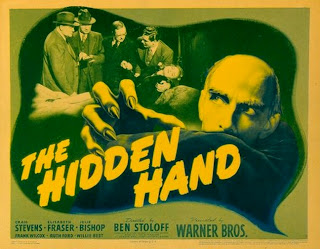
The Hidden Hand nearly ten years after it closed

There have been a few recent posts on crime fiction blogs about crime in the theater and now I'm jumping on that bandwagon. As you might infer from the post title I'm also planning on making this "Stage Blood" talk a regular feature here at Pretty Sinister Books. Whether I actually attend a performance or only read the play I hope to add to the growing diversity on this blog which originally was begun to honor books and gradually included movies, TV and now theater.

For my first exploration into crime on the stage I chose Invitation to a Murder (1934), a little known melodrama by Rufus King, the mystery writer recently celebrated in grand style over at Curt Evan's blog The Passing Tramp (all the posts can be read in succession by clicking here) and on this blog by yours truly here.  King had a minor success in theater with Murder at the Vanities, a musical murder mystery for which he wrote the book in collaboration with producer/director Earl Carroll, which ran for 207 performances and was later turned into a movie. A musical murder mystery was very unusual for the 1930s theater. One of the tunes in the show is called "Who Committed the Murder?" that gives the impression of a genuine detective story told through music but other songs, like "Virgins in Cellophane" and "Fans" both performed by the large number of women in the cast, make me think that the show was really about leggy dancers than solving the mystery of a dead chorus girl. In any case the success of Murder at the Vanities allowed King the chance to dabble in more theater and his next play, Invitation to a Murder, opened only two months after ...Vanities closed.

The play is a combination of melodrama, suspense thriller and mystery. Wisely King chose to veer away from the traditional whodunit in favor of a thriller with a plot which lets the audience in on various events other characters are unaware of. These kinds of crime dramas play much better on stage as they engage the audience, give the work immediacy, and have more at stake than the average whodunit which usually has its only real punch in the revelation of the killer just before the final curtain. There's a lot going on in Invitation to a Murder in its three acts, each one ending with a cliffhanging scene. Its clever multilayered structure can easily be seen as a forerunner to classic crime dramas like Wait Until Dark, Dial M for Murder and Deathtrap.
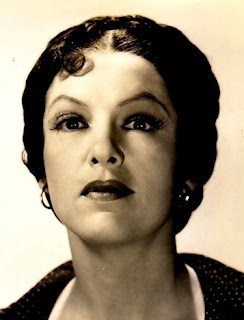
Gale Sondergaard (the original Lorinda) won an
Oscar for Anthony Adverse two years later
Lorinda Channing is the imperious leading lady of the piece. She has converted the family fortune back into gold and hidden it on the estate. Someone in the family, she thinks, has been searching for it. By the end of the first scene we see how ruthless she can be when she accuses her gardener of blackmail and theft and sends him to a watery grave via a hidden trapdoor in the living room floor. No one will stop her from her plans to reveal who among her relatives is after her money. She joins forces with the easily tempted Dr. Linton and together they hatch an incredible plot.

Inspired by the final scene in Romeo and Juliet she asks Dr. Linton to use a special drug he has acquired that will simulate her death. After explaining the bizarre family ritual having to do with a Channing ancestor's superstition of being buried alive she will be placed in an unsealed coffin for 24 hours in the family crypt. She is then to be released from her temporary resting site and the coffin sealed and buried empty. The family will think she is dead allowing her to spy on the survivors to see who among them is the greedy would-be thief. Linton has a secret in his past that Lorinda knows of and she uses this to pressure him into being her co-conspirator. The plan, however, backfires.
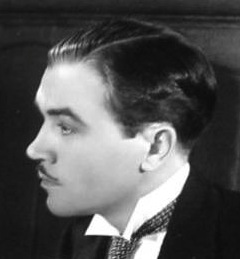
Walter Abel (Dr. Linton) in
The Lady Consents (1936)
Linton at the last minute decides to seal the coffin and send Lorinda to a horrid death by suffocation when she regains consciousness in the crypt. He wants the money for himself. Several plot complications involving other spies and hidden witnesses implicate Linton though he does his best to escape detection. Chief among these spies is Walter, Lorinda's weak cousin always in need of money, and he attempts to blackmail Linton. To the surprise of the audience Lorinda appears again on stage and she goes about preparing yet another trap to get even with the double crossing doctor. She confronts Linton who is astonished by her escape from the coffin. Martin, the butler, then appears and reveals himself to be Lorinda's secret guard who witnessed Linton screwing down the coffin and the one who revived her and set her free. This scene is key to establishing Lorinda's plans to get even with her betrayer. When Walter enters the scene Lorinda shoots him knowing that Linton had previously handled the gun and then disappears leaving him to explain to the others what they will never believe -- that a dead woman murdered Walter.
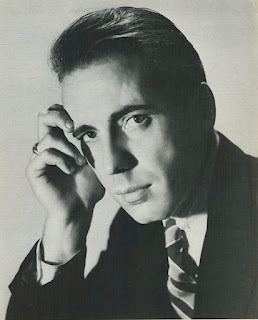
Bogart's publicity still for The Great O'Malley (1936)
It's all a little too much, I know. But it works remarkably well. King has worked out everything so tightly. Once you accept the Channing superstitious fear of being buried alive and the odd ritual of leaving a dead Channing in an unsealed coffin to allay any fears of the dreaded premature burial then the rest of the play works. The scenes with Linton fervently denying his guilt and desperately trying to get anyone to believe him that Lorinda is still alive are tense and exciting. There is even a great bit when Estelle Channing, the ingenue, turns amateur sleuth to reveal Lorinda's fatal mistake proving she was alive at the time of Walter's murder. Typical of King he gives one of the best scenes in the play to his two strongest female characters. His detective novels are populated with women who are much more interesting and complex than the men.

Lorinda is a killer part for any diva actress. As sleek and wicked as any femme fatale in a film noir piece. She's given the best dialogue, an opportunity to wear stunning gowns as described in the script, and two magnificent stage bits that would make for chilling scenes in live theater. I would have given anything to have been alive in 1934 to see Gale Sondergaard do the part. She must have been fabulously wicked in the role. Dr. Linton was played by versatile character actor Walter Abel who was the first talking D'Artagnan in the 1935 version of The Three Musketeers. Also in the cast was young Humphrey Bogart, already making a name for himself in supporting roles in the movies, playing the trenchant sophisticate Horatio Channing, a part that hints at the sinister tough guy movie roles that will be his trademark in the 1940s and 1950s.
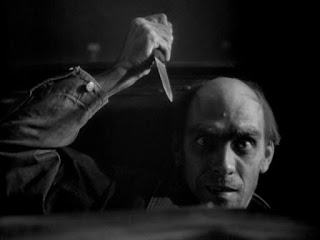
Milton Parsons is Lorinda's murderous accomplice
in the 1942 film adaptation The Hidden Hand
Invitation to a Murder was adapted for the movies in 1942 several years after it had closed its run of only 53 performances on Broadway. The story was considerably rewritten and retitled The Hidden Hand. In its movie incarnation the story resembles more The Greene Murder Case with the Channing family being knocked off one by one by a homicidal maniac. The bit about the faked death and burial remained though this time it was a new character -- escaped lunatic John Channing -- whose death was faked and not Lorinda's. Strangely this theme was also lifted from the play and inserted in the film adaptation of King's novel Murder by the Clock which introduced Lt. Valcour to the 1930s mystery reading audience. Craig Stevens, famous as TV's Peter Gunn, played Peter Thorne who acts as the amateur sleuth rather than Estelle. Thorne does appear in the stage version but only as a very minor character. The rest of the cast is made up of minor actors who are unfamiliar to me. The Hidden Hand was shown in 2011 on TCM. The convoluted plot synopsis can be read here for those curious to know the differences between stage and screen versions.