Showing posts with label con artists. Show all posts

Sunday, February 2, 2025

NEGLECTED DETECTIVES: Rosalie LeGrange, medium turned sleuth for hire

THE STORY:  Dr. Walter Blake meets Annette Markham on a train and falls in love with her.  She tells him she is not meant for men according to her aunt and guardian, Paula Markham, a student of Eastern occult religions. Annette says her Aunt Paula told her she has "the Light" and is meant for higher things. Dr. Blake soon meets Paula and is suspicious of an ulterior motive, possibly fraud,  in tutoring her niece. The physician seeks out Rosalie LeGrange, a medium, to help him expose Paula Markham. But Rosalie cautions Dr. Blake that Mrs. Markham is not a fraud at all, but the real thing. Exposing such a powerful woman (if she is faking it) will be difficult to impossible. Dr. Blake's real concern is the possible exploitation of Annette and he admits to his love for her.  Immediately Rosalie gives in for she has soft spot for young love. Turns out Mrs. Markham is in need of a new housekeeper and through clever manipulation Rosalie gains the job. The investigation begins! Stock manipulation and con artistry abound as Rosalie and Dr. Blake make their through The House of Mystery (1910).

THE CHARACTERS:  Rosalie lets Blake know that most medium fakery grows out of the genuine thing. She should know because she is a real medium herself having from her teen years had visions and heard voices telling her things that later prove true. In charging money for consultations she confesses that it is easy to give in to fake stories when the client is eager to hear anything positive. This, she says, is the crux of the fortune telling racket no matter how it shows up - crystal balls, tarot cards or seances. It's the showmanship that is so tempting and the resulting ease of foretelling good news rather than doling out the awful news that more often make up the real truth. She likes a challenge, though, and facing off with Paula Markham will test her like no other job she's taken on.

Rosalie is sharp witted, highly observant, sometimes wise, but hardly an intellectual. All of her dialogue is rendered in a working class style peppered with period slang and folksy idioms. She makes for a refreshing detective fiction protagonist as most of these characters from the late 19th century and early 20th century are all cut from the same cloth: aloof, dispassionate, so logical as to appear ruthless and cruel. Rosalie bears little resemblance to those super sleuths. No surprise that such a likeable, warm-hearted, amateur detective proved to be popular with readers for she returned in a sequel, The Red Button (1912), this time trying her hand at solving a murder.


In Paula Markham we actually see a personality that would make the perfect fictional detective of this time. Paula's personality is the coolly aloof sophisticate and she proves adept at subterfuge and deceit.  Rosalie has met her match just as she feared. Paula Markham seems inspired by the master criminals that were so popular in serial fiction and magazine short stories in the pre-WW1 era. She meets up with Arthur Bulgar, a corrupt mining company executive fearful that his company is about to fail, who in turn seeks out Robert Norcross, Wall Street financier, haunted by the death of his lost love. Bulgar and Markham use this knowledge to cajole Norcross into helping bail out the mining company. Annette will play a part in the scheme acting as the voice -- and sometimes "body" -- of Norcross' dead lover.

THE AUTHOR:  Will Irwin (1873-1948) was a journalist and novelist. He covered the 1906 San Francisco earthquake for The New York Sun, wrote about Japanese racism in California, and had a series of newspaper articles appear in Colliers Weekly exposing fraudulent mediums and the "spirit racket".  No doubt that series led him to write The House of Mystery.  In addition to his two detective novels, Irwin was the author of numerous nonfiction books ranging from a history of San Francisco to a biography on Herbert Hoover for whom he worked from 1914-1915. Irwin was married to the writer Inez Haynes Irwin, noted feminist, novelist, and also a dabbler in detective fiction.  See my review of The Women Swore Revenge for a look at his wife's style of mystery novel

THINGS I LEARNED:   On p. 141 Rosalie says: "It all come from Mrs. Markham. It was like a sweet smell radiatin' from that room, and just makin' me drunk. It was like--maybe you've heard John B. Gough speak. Remember how he had you while you listened?"  Gough was a Temperance orator and revivalist, apparently known for his smooth and persuasive voice.  The internet is teeming with info on him.  Google away if you want to know more.

Two other personalities -- Marsh and Miss Debar -- are mentioned in passing as topical references which led me to look them up.  Marsh is Luther Marsh, a lawyer who was swindled by Ann O'Delia Diss Debar (at left), one of America's notorious crooked spiritualists. Houdini called her "one of the most extraordinary fake mediums and mystery swindlers the world has ever known."  In 1888 she was finally undone when her extravagant greed led her to tricking Marsh into signing over the deed to his townhouse on Madison Avenue in Manhattan. The police caught up with her leading to a sensational trial. She was convicted and went to prison... for a mere six months! There's a wealth of info online about Debar. She makes for fascinating reading. Look her up!

Walter hears a piano playing a tune on p. 202.  Some lyrics pop into his head "Wild roamed an Indian maid..."  Turns out these are lyrics from the first American "popular hit" written by a woman. The song  is "The Blue Juniata" by Marion Dix Sullivan with lyrics by her husband J. W. Sullivan.  In the novel the song is used as a hypnotic cue to induce Annette to play her part in the spirit fakery.  For an upbeat 1956 arrangement of the folk tune click here.  It's a pleasant recording with a quick tempo featuring the male singing group The Plainsmen.

AVAILABILITY:  Lucky you! (a rare cry around here)  The House of Mystery has been uploaded to Project Gutenberg.  You can read it for free there, may be even download it.  As a bonus you get all eight original illustrations from the first US edition which I freely used to decorate this post. My edition has only four illustrations and the plates are tinted a faint yellow which I don't like. The artwork most likely appeared in a magazine when the story was first serialized. Illustrations are by noted American artist Frederick C. Yohn.

Wednesday, June 30, 2021

IMPOSSIBLE PROBLEMS: Still Life with Pistol – Roger Ormerod

In Still Life with Pistol (1986), the second outing featuring ex-police detective Richard Patton and his paramour Amelia, we find the two taking part in a private art teaching seminar sponsored by Bruno Fillingley, reformed art forger turned teacher and mentor of the arts. Lucky participants rich enough to spend the high admission price get to spend a fortnight (that’s two weeks to us North Americans) at Bruno’s art-filled mansion painting, sculpting, drawing and indulging in whatever other medium tickles one’s fancy. Bruno provides not only lodging, meals and studio space in the price tag but tips and guidance to bring out the artist’s best work. Amelia is the artist of the two while Richard is merely along as an observer. He had formerly consulted with Bruno on an elaborate electronic security system to help protect the valuable collection of impressionist paintings and Chinese pottery Bruno has amassed over the years. The alarms are turned off during the day and go back on at 11 PM sharp each night. Only Bruno knows the secret code words that set the alarms.

So we have the setting for a possible art heist, don’t we? And it all sounds very much like Ormerod’s sophomore mystery novel, The Silence of the Night, previously reviewed here at PSB. The security system, Chinese vases, fake art work, a burglary and a violent death that might be accident or might be murder are all features of that other novel. But there the similarity ends. There is no theft – fake or otherwise – in this novel. It’s an unequivocal murder that takes place.

Like most of Ormerod’s books we also are dealing with a crime in the past in the intricate plot. The victim is former police detective Roy Towers, currently Bruno’s newest security man and a painter in his own right. And he was the lead detective responsible for arresting a murderer in a crime of passion that involved Roy's former mistress. That murderer, now behind bars, has a wife who is hounding Roy for sending her husband to prison. The oddity is that woman was Roy’s mistress and the reason for the murder her husband was convicted for. That old murder case seems to be at the core of the motive for the killing that takes place at Bruno’s estate.

Roy’s odd hobby is taking part in the bi-weekly art seminars and working on an acrylic still life that gives the book its title. He has painted the same still life made up of a Chinese vase with yellow flowers, a hunter’s trumpet and a pistol (see the illustrations on the dust jackets) for several months. The full set is handled by a gallery owner in London and bizarrely the paintings are extremely popular and sell quite regularly. [Still lifes popular in the 80s? And selling repeatedly? Hard to believe.] Roy’s latest painting and the still life props are crucial to the plot of this mystery. Most interesting is that the novel involves not one, but two impossible problems! Nowhere is this indicated on the book jacket of my copy or anywhere else. You won’t know this until you actually read the book...or this review.

Roy is found shot and through ballistics tests the gun from the still life is proved as the murder weapon. But Richard who found the body had noted that the gun had been sitting on the table unmoved and matching exactly the position as depicted on Roy’s canvas. Further complicating the impossibility of the gun being used to kill Roy is the fact that there were four flower petals on the gun itself, also seen on the exact spots on the gun in the painting. Richard who just happened to have his trusty Konica with him immediately takes several photographs of the crime scene in case the police disturb the still life while conducting their investigation. The problem of how the petals were on the real gun and the one in the painting will be a cause of much debate and obsession for Richard, Amelia and the police inspector in charge of the case.

This impossible problem reminded me of the clever ideas Edward D. Hoch dreamt up in the hundreds of stories he wrote for Ellery Queen’s Mystery Magazine. It would be a fantastic idea for a short story. But it wears out its welcome in this novel. The two possible solutions can be thought out rather quickly by any reader with a modicum of common sense. Richard and Amelia come up with the more improbable of the two solutions. But it takes Inspector Poynton to point out to Richard the real explanation of how the gun was used to kill Roy and still end up on the table in the exact spot with the flower petals undisturbed.

What does keep the book interesting as a murder mystery is trying to figure out which one of the guests at the art seminar killed Roy. There are multiple suspects and multiple motives, some of which are trickily exposed in the usual surprise-filled chapters Ormerod so often delivers in his crime fiction. The second impossible problem, one of lesser intricacy but still quite baffling, is the puzzle of the Chinese vase and the nine fakes up on display in a corridor upstairs. How did the genuine vase used in the still life get switched with a fake one after the murder when the studio was locked and sealed? And why is one of the artists who is interested in recreating that Chinese vase so intent on getting into the studio to use the kiln to fire his vase?

Still Life with Pistol seems to be thought out too intricately and I confess that its complexity left my mind reeling a couple of times. I found myself re-reading passages trying to keep straight which vase was where and who was trying to get into the studio. The plot smacks of the kind of overly fanciful plots that hearken back to the Golden Age. Of course Ormerod is a huge fan of these types of mystery novels, but there is a kind of overkill in Still Life with a Pistol that defies logic. The methods employed in the murder scheme are baroque and time consuming and in the end senseless. Even the motive seems unreal. And then Ormerod delivers one more unexpected touch in the melodramatically macabre final pages. It all ends with a kind of a fizzle despite the sound of the final bang from a pistol in the last scene.

But... even lesser Ormerod is good Ormerod. Unlike Reginald Hill who criticized his mystery writer colleague for being overly complicated in devising his crime plots and accusing him of being a failure I disagree. I’ll keep coming back for more. Roger Ormerod has a fascinating and teeming imagination. There was enough here to tantalize me and keep me reading to the end.

I have more Roger Ormerod books to read and more reviews planned throughout the summer. Stay tuned!

Friday, May 28, 2021

FFB: The Man Whose Dreams Came True - Julian Symons

Confession #87: I am not a fan of Julian Symons. Years ago when I was a teenager my treasured copy of Murder Ink introduced me to hundreds of mystery writers I was eager to sample. In that seminal anthology and history of crime fiction I learned of Julian Symons’ unique suspense novel The 31st of February. This was the first Symons “mystery” I read and only because of Dilys Winn’s rave calling it one of the best books with an unforgettable surprise ending. Well, it bored me more than my algebra class. I was only 15 so maybe the gravitas of a man being mentally tortured and hounded by someone who knows he killed his wife was beyond my experience. But shouldn’t the telling at least engage any reader? I’ve also read The Three Pipe Problem (too arch in its humor for my teenage mind), The Kentish Manor Murders (sequel to the previous book, snobby and pompous and tiresome), and The Blackheath Poisonings of which I remember nothing. I’ve tried a handful of others over the past couple of years and never finished them. Why on earth then did I specifically reserve two little read Julian Symons books from the Chicago Public Library?

Confession #88: it was for a silly idea I had. Review a slew of books with titles that begin The Man Who… Symons wrote three of them, one right after the other back in the 1960s. I read one excellent book by Dolores Hitchens (The Man Who Cried All the Way Home) and posted that a few days ago. Now here’s the second in my series of “Man Who…” reviews. And was I ever surprised! This book may single-handedly have changed my mind about Julian Symons.

The Man Whose Dreams Came True (1968) is an inverted detective novel with an anti-hero in the Patricia Highsmith mode. We know from the very first chapter that Anthony Scott-Williams is a cad. He dreams of a life in Venice, Italy while working as a researcher and secretary for an old General who is compiling a memoir that grows ever longer and may probably never see publication. Tony has several different identities. He willfully steals from his employer to supplement his gambling addiction, manipulates his friends and associates, lies and cheats to get what he wants and does it all with good humor and charm. Tony is bound to get mixed up with the wrong people as he continues to exploit the women and men he meets in his life of leisure. His girlfriend turns out to be a con artist but does he learn his lesson with her? No, he tries again with an older woman and his life turns upside down.

At first there is admiration for Tony’s hutzpah and a longing to see him taken down a notch. We briefly watch Tony in action trying to exploit a young woman he thinks is a rich heiress but when it all backfires he is more than a little angry. But when he next plies his charm on another wealthy woman, Genevieve Foster, he surprises himself by falling in love with her. Mrs. Foster has a plan, however, that includes a crime Tony has never dreamed of committing. This time he thinks his life will finally change for the better and he’s willing to anything for Jenny -- including murder her husband.

Like his own creation Symons seems to be playing the reader and exploiting his emotions with twists and layers of irony. First the novelist presents us with a likeable cad, then reveals him as a foolish and rash young man with an anger problem, and then ultimately as a victim of someone much more malicious and self-serving than himself. The shifts are all done with astonishing skill.

The one aspect that is unsurprising is that Tony has had a rather miserable life. We learn about his drunken father who beat him as a child, his ineffectual mother whose love was not enough to protect him from abuse, and his eventual descent into a life of crime. Free from maudlin sentimentality this history is told as cold and distant as an idealistically unbiased journalist. And yet the narrative elicits an affinity for the young man and a hope for a better future. The reader may join Tony in desiring a happily ever after ending no matter what he has to do in order to achieve his dreams.

When the tables are turned and Tony becomes a victim of an obvious frame-up, carried out in a heartlessly malicious manner, it only strengthens the reader’s desire for positive change in Tony’s life. He finds himself on trial for the murder of a man he never met. No amount of explaining to either the police or his wise team of public defender lawyers can muster much sympathy, even when he is forced to confess that he was conspiring to kill someone entirely different than the person he is charged with murdering! All the while the reader knows Tony is telling the truth and is eager for his lawyers to find the evidence that will prove Tony’s innocence. We find ourself rooting for this thoroughly unscrupulous and selfish man who was going to kill but never fulfilled his plans.

A bit past the halfway mark a private detective enters the story. He has been hired by a mysterious benefactor who has Tony’s best interests at heart. Dimmock works for Second to None Agency has been put on this case because the owner Clarence Newhouse trusts his most reliable and senior agent to do the kind of determined work he well known for. While other agents at Second to None may be fiddling with expense accounts and wasting time in pubs drinking away last week’s paycheck Dimmock is always on the case. As Symons describes him: “If Dimmock was asked to find a missing woman last seen in Birmingham he would go on doggedly looking until he found her or was called off the trail.”

The scenes with Dimmock are filled with a humanity and quiet dignity. The man is suffering from a cold while performing his job, the result of spending too much time chasing after witnesses during wet and rainy weather while dressed inappropriately. Sneezing and wiping his nose at nearly every home he visits Dimmock displays a skill in saying the right things to ward off anger and bring out the best in the witnesses who were guarded when questioned by police. With a down-to earth nature, an unapologetic manner, and despite his aggravating cold, Dimmock gets the various people on the list of witnesses for the prosecution to admit to facts that the police were not offered. He turns up crucial observations and perceptions that led him to finding damning physical evidence of Mrs. Foster’s guilt. Dimmock is the real hero of the novel and was my favorite character.

In the end for all its humanity, for all the shifts in sympathy we have for Tony, and even with the surprise of a nifty detective novel in miniature in the chapters that feature Dimmock The Man Whose Dreams Came True proves to be a darkly ironic piece of noir fiction. Can there really be a happily-ever-after for Tony? With a vicious attack on his character, with his ultimate admission of plotting to kill someone completely different than the victim of the murder trial, with that brazen and brave confession as his only defense can Tony receive redemption? He should be on the road to reform and ought to be rewarded with something other than the much desired acquittal. Perhaps a cruel Fate will intrude as happened when he met Mrs. Foster. The fourth section of the novel is titled “How the Dreams Came True” and in it Symons delivers a nasty punch to the gut. Despite all his dreams, despite all his good fortune after the trial, we get a finale that perhaps was the only possible ending for Tony.

QUOTES: “Tony understood that if there had been no threats it was a good thing for him, it meant that he had no reason to worry about the money. This meant also that it didn’t always pay to bring out the truth. Would it be right to say that truth was one thing and justice another?”

“Newton’s hand fell like an accolade on Dimmock’s shoulder as he said that they would need him also in court. That was an exciting prospect, but Dimmock afterward thought of the hour he had spent in those chambers, rather than the session in court, as the crowning point of his career. He had the prescription made up. And although it had no effect upon his cold he treasured the piece of paper to the end of his life.”

Wednesday, May 26, 2021

IN BRIEF: Man Who Cried All the Way Home – Dolores Hitchens

The Man Who Cried All the Way Home (1966) is a return for Dolores Hitchens to pure detective novel. What makes this novel all the more unusual is the detective. He is Chuck Sadler, a septuagenarian lawyer, slightly crippled who must use a cane to walk, and yet is still sharp as a tack and savvy about criminal procedure. He’s the perfect person to help Dorrie Chenoweth when her husband dies under suspicious circumstances and the police suspect her of possibly causing his death. It helps that Sadler is also her beloved uncle, a cherished friend as well as her elderly relative. Uncle Chuck steps in to help Dorrie identify her husband’s body with battered face found by his wrecked car at the edge of the Borrego Reservoir. Too many odd elements surrounding the man’s death lead Uncle Chuck to believe this is not an accident but a murder and he starts making inquiries on his own to help clear Dorrie’s name.

As he delves into Sargent Chenoweth’s business at his privately accounting firm he discovers the Dorrie’s husband was duping many of his friends and leading a double life. Shady business deals and stock market manipulation are uncovered as well as plans to flee to South America. Uncle Chuck also traces Chenoweth’s secret life to a love nest where he was entertaining a young woman both he and Dorrie knew since the woman was a teen in high school When that young woman now, barely 20 years old, is also found dead Chuck begins to fear that his niece may not be as innocent as she claims to be. The police are beginning to formulate a similar theory as Uncle Chuck, that Dorrie found out about her husband’s infidelity and decided to get rid of both of Sargent and his much younger mistress.

Dogs play a unique role in the story, too. Pete is the Chenoweth’s collie mix that got into trouble and came home injured. Uncle Chuck looks at the dog’s wound and tells Dorrie that its unmistakably a bullet that grazed Pete’s neck and ear causing a furrowed scar. When a variety of suspects turn up at the Chenoweth home as part of Uncle Chuck’s routine Q & A sessions the dog behaves skittishly. There are three separate people the normally friendly dog acts strangely around serving as a clue to the person who probably tried to shoot the dog. But why? Uncle Chuck is certain Pete was around when Sargent was killed. The dog’s odd behavior sets Chuck’s mind imagining an ingenious way to reveal the murderer. He finds a look-alike dog at the local pound and begins an vigorous training program for the quick to learn rescue animal. Ultimately Uncle Chuck’s plan proves to be one of the cleverest and original methods of unmasking a murderer to appear in any detective novel of this era.

Fast paced and a real page turner The Man Who Cried All the Way Home is one of the most engaging books I’ve read from Hitchens’ long career. It’s a definite throwback to her days as D. B. Olsen when she wrote traditional detective novels. The plot is fairly clued and populated with a wide array of colorful suspects all with varied motives. And she delivers the goods here in a rousing action-filled finale that reveals  a totally unexpected culprit.

It’s a shame that this particular title is so hard to find in either its paperback or hardcover editions. Currently, I uncovered only twelve copies for sale in English and some if those are the old Detective Book Club 3-in-1 volumes. Other copies are of French and German translations. I stumbled upon a copy of the ultra-rare Curtis paperback (pictured at the top) with the intention of offering it to Stark House for a possible reprint then learned that the remainder of all of Dolores Hitchens’ reprint rights (including all her books written under her various pen names) were recently outright purchased by Mysterious Press/Open Road Media. Sadly, we won’t be able to get this one in a Stark House reprint. And it may only be a digital version of this book that may turn up in the future…if it ever does.

Friday, April 16, 2021

FFB: By Death Possessed – Roger Ormerod

Photographer Tony Hines inherits a painting from his grandmother and takes to it to be appraised by experts on the Antiques Road Show (yes, the TV show). Dr. Margaret Dennis tells him that he has a rare painting by British ex-pat Frederick Ashe. Rare because only six of his paintings are known to exist and are held in a few museums in Europe and in private collections. Tony disbelieves her. He was always told that it was the work of his grandmother. Margaret says she knows Ashe’s brushwork and she points out the distinctive overlaid FA initials in the corner of the painting as his unique signature. “No, you’re looking at that the wrong way,” Tony tells Dr. Dennis. The initials actually read AF which stands for Angelina Foote, the name of his grandmother. Margaret assures him that he is the mistaken one. There is no doubt in her mind that the painting is by Frederick Ashe. She urges Tony to take the artwork home and insure it for £20,000. So begins Tony Hines’ unwanted adventure into the world of manic art collectors, art theft, and con artistry.

A quick visit to Grandma Angelina for background and the final word on the real artist behind the painting reveals a secret relationship and the discovery of Tony’s true heritage. His grandmother was in an arranged and loveless marriage but prior to the actual wedding had an affair with Ashe when she lived in Paris. She returned to England engaged to marry the man she did not love and pregnant with Ashe’s child. Tony's father was that child making Ashe Tony's grandfather.

She tells Tony that Ashe recognized in her a talent for painting that he fostered. As a joke she learned to paint exactly like Ashe and had so much fun that they made a ritual of their art creations. They would literally stand beside one another and paint the same scene or person, but each with a slightly different viewpoint, at a slightly different angle. It was almost impossible to tell the two paintings apart from each other as they both painted in the same style, used the same brushstrokes, shading and even shared the same palette of paint. They also signed their works using the same overlaid initials of F and A. That was Frederick’s idea – a monogram that would work for both of them on paintings that each of them had created.

Shortly after this remarkable life history Tony’s grandmother dies unexpectedly but not before he has uncovered 81 paintings in the attic. But who painted them? There is a story about the other set of paintings that involved Angelina’s enraged husband who in a fit of jealousy destroyed all the art work by Ashe and his wife – all but one painting that Angelina managed to rescue from a huge bonfire her husband lit in their backyard. It is this painting that Tony had appraised. His grandmother cannot remember exactly which ones were burned and which managed to survive. She is sure that Ashe’s were all destroyed. Only one other person may know the truth -- Angelina’s lifelong companion and servant Grace with several secrets of her own.

Together Margaret and Tony do some complicated detective work trying to figure out who painted the 81  paintings stored in the attic. They track down a British collector of rare art work with the wonderfully evocative name of Renfrewe Coombes, who claims to own two of Ashe’s paintings. Coombes is like a modern day Count Fosco in both his physical appearance and his sinister persona.  As disreputable as Wilkie Collins' archetypal Victorian villain Coombes surrounds himself with thugs and bodyguards and a secret treasure trove of rare art work. Tony at one point dwells on Coombes as a formidable adversary:  

 "I realize now that I must have been in a state of euphoria, brought about by the sheer magnitude of Coombe's villainy. To a person like me, he was so far from anyone I had ever before met I was quite unable to contemplate him as a serious obstacle. I was nervous, but strangely confident.  I was over simplifying."

Will Coombes be able to help Tony and Margaret or is he after the Ashe paintings to complete his own collection?

I may have given too much info about the set-up for this novel but all of that happens in only the first three chapters!  By Death Possessed (1988) may seem like pure suspense, but it is a definitely murder mystery with some surprising twists which I have learned to expect from the inventive and devious mind of Roger Ormerod.  I enjoyed this book quite a lot.  Some readers may feel there is an avalanche of double crossing in the finale and that some of the wrapping up is too pat and convenient. Despite that I'm all for a writer who will fully enter the world he has created. Ormerod is not afraid to wallow in the Machiavellian betrayals of these people who will do anything to own one of kind art.

This is quite a good example of the art caper subgenre and a nifty addition to the many crime novels featuring an Average Joe caught up in a world of con artists and criminals who uses his own knowledge (photography, to be specific ) to outwit them at their own game. Ormerod was a photographer himself and we get abundant detail on how Tony's photo lab operates. It's not just the author showing off, it's all for a purpose. Pay attention to the sections on photography and you may see what Tony is up to.  I missed it all and it was right in front of me.

Recommended for both Ormerod fans and those who enjoy mystery novels about art forgery and rare paintings.  By Death Possessed, like many of Ormerod's books is now available as a digital book (Kindle format) from Lume Books and -- luckily! -- is available for purchase in both the US and the UK.

Tuesday, March 9, 2021

Only Couples Need Apply - Doris Miles Disney

Jay & Gretchen are looking to relax after a series of “projects” they’ve finished in various states across the country. They find a charming furnished coach house in Connecticut after seeing an ad that states Only Couples Need Apply (1973) and successfully rent it from Mrs. Mercer. They'll stay here before heading to Maine where they intend to retire from their “business.” All is well until we discover that those projects were elaborately planned robberies that drained the bank accounts and financial investments of several unmarried senior citizens. Gretchen gets herself hired as a secretary or companion, inveigles her employer to turn over control of their finances to her and with the help of Jay she robs them blind. The project usually ends (quite unnecessarily) in murder. Are the couple planning to do the same to Mrs. Mercer? It doesn’t seem that way. In fact, nothing much happens at all until Jay gets the egotistical idea to go solo, but this doesn't happen until well past the halfway mark.

When Jay tries burglary on his own mayhem ensues. But all this action and genuine suspense comes too late.  And the tying up of the unusual plot complications is very rushed.

If nothing really happens until the last three chapters then what is the book about? Character study -- and it's mostly in the past. More than three quarters of the book is the story of the five different “projects” that Gretchen and Jay have already completed. Disney attempts to compare and contrast the criminal worldviews of Gretchen and Jay. We get the horrible childhood Gretchen had that led her to stealing and her first thrilling murder. Jay is nothing more than a puppy in training and he’s bitter and resentful in his role of last minute hitman and getaway driver. He wants his own “project” and sees his chance when they land at the coach house in Connecticut. But the needless repetition of these projects with the same M.O. with the same kind of gullible and lonely victim gets increasingly tiresome and dull. Only when the penultimate project is described and we have a very cautious daughter overseeing the interview and hiring process for her invalid mother is there any real variety and a modicum of suspense in what amounts to a litany of thefts and death by gunshot.

And converting the stolen money into traveler’s checks?! It seems such an old person’s habit --especially in the 1970s -- not the practice of a hip young woman in her 30s. Gretchen only makes things more difficult for herself. She has three different sets of traveler’s checks all with different signatures of fake identities. Far from clever this absurd idea unsurprisingly proves to be her biggest mistake.

This is the most hardboiled of Disney’s books I’ve read. I thought she did malice domestic really well, but here she allows the 1970s vibe to intrude in a way that she can’t quite handle. Her dialogue gets stilted when she means Gretchen and Jay to be harsh and cruel. The sex scenes are laughably tame when I think she intended them to be steamy. But the violence and torture is right on target for a hardboiled crime novel. A truly odd mix from this writer.

All the while the entire plot is utterly preposterous. Through a series of plot contrivances Gretchen always manages to find people who do no background checks on her, never see her out of her disguise (a brunette wig, nerd glasses and fat suit) and allow her to take over their money managing as if she were hired to be their CPA. That Gretchen thinks she needs Jay as an accomplice is the biggest flaw of the story. She has a disguise, he does not. She does all the work prior to him stepping in for the final theft and execution of the victim. In the final stage (always the same) he shows up, points a gun at the victim, while Gretchen demands that her employer call the bank and allow her to close the account and leave with cash. Then after all that is done they tie up and shoot their victim. If Gretchen has so cleverly managed to drain the bank account on her own all those weeks why is it necessary for her to ask permission to get the last portion in cash? And why does she have Jay walk in with a gun and not bother with even a simple disguise? He uses the same gun for each murder. Never bothers to get rid of it. His fatal mistake for the book just as Gretchen had hers.

The final three chapters are mixture of suspense and sloppiness. Disney excels at creating tension in parallel scenes like the cinematically inspired section when Jay is committing a burglary in the main house while Mrs. Mercer is on her way home. This particular book, however, is overloaded with plot contrivances and last minute background info that comes at the most inopportune moments. We learn of a deep, dark secret in Mrs. Mercer’s past that changes the way she behaves for the rest of the book. It was a bit outlandish and would have made better sense had we been told the secret much earlier in the book. As it occurs everything from the climax onward to the finale is rushed and compacted. Crucial scenes are condensed to a few sentences that should have taken several paragraphs to lay out. Disney spent so much time on the history of her antihero couple that she seemed to have run out of patience with her characters. Eager to get everything over and done with she has the FBI enter the picture and prove to be super agents in connecting all the murder/theft cases and doing it all in what seems like a couple of hours. They prove Gretchen guilty for all of the murders thus allowing Mrs. Mercer to live happily ever after. Never mind that she herself is guilty of something horrible.

Betrayal. Amanda Blake as Mrs. Mercer
at the mercy of cruel Gretchen played
by Tisha Sterling (in wig cap)

In the end so much of this book is either disappointing or dumb.  Only Couples Need Apply – a title, by the way, that has no real significance – comes very late in Disney’s career, her fourth to last novel. She must have been running out of ideas and watching too many made for TV movies.

Interestingly, many of Disney's books were adapted for TV -- including this one! Only Couples Need Apply was made into the TV movie Betrayal (1974). Amanda Blake (best known as Kitty, the saloon owner, from the ancient but long running western TV series Gunsmoke) stars as Mrs. Mercer with Tisha Sterling and Sam Groom (both 1960s-1970s TV stalwarts) as Gretchen and Jay. You can watch it on Amazon Prime but even with its minor improvements -- only one "project" is shown with Jay as the aggressor in the duo, Gretchen is trying to reform, Mrs. Mercer's secret makes more sense and is introduced earlier in the story [just as I suggested!] -- it still doesn't change the overall ineffectiveness of this sadly unexciting suspense novel.

Wednesday, February 10, 2021

NEW STUFF: The Cabinets of Barnaby Mayne – Elsa Hart

Collector mania. Why have I read yet another book about an aspect of my own life? Am I really that self-obsessed? Must I read about collecting in order to understand my own obsession with obscure genre fiction and my almost pathological acquisition of hundreds of these books? Do I really need to read one more novelist’s ideas about the psychology of monomania? Yes to all questions! And after all this book is set in the 18th century. (OK, that was just a feeble excuse to look the other way when faced with answering those questions I posed) But guess what? This was quite a page turner. And the best part? The Cabinets of Barnaby Mayne (2020) is a legitimate detective novel.

Until I stumbled across Elsa Hart’s fourth novel in the library I knew nothing of her or her books. According to the jacket blurb and her bio she has written three other mystery novels featuring Li Du, a librarian of 18th century China living in exile near the Tibetan border who accidentally becomes a detective. The subject matter of each of those books seemed a bit eggheady to me and would not have appealed to me. But The Cabinets of Barnaby Mayne despite its possibly dreary 18th century setting and a self-consciously decorous writing style won me over almost immediately. Hart knows how to tell an engaging story, creates lively and flawed characters, is masterful with her plotting and actually employs fair play detective novel conventions. I devoured this book the way a mad collector goes after a rare specimen to complete a set of wondrous objects.

Cecily Kay travels from her ex-patriated home in Smyrna where her husband is a diplomat to London in order to study the collection of plants in the awe-inspiring and vast collection of oddities in the museum like home of Barnaby Mayne. While conducting a tour of his home for Cecily and other like-minded collectors there to marvel at the shells, plants, insects, taxidermized animals and esoteric artwork Mayne is distracted by an urgent message. He excuses himself allowing his guests to wander his home on their own. Shortly afterward he is found brutally murdered in his private study. His assistant is found in the room holding a knife in his hand and screams out “I killed him!” and then flees.

Is it all over before it has even begun? Oh no, my friends. Cecily has noticed things that just don’t add up. She disbelieves the confession from the meek assistant and is convinced he is protecting someone. She and her friend Meacan, a talented illustrator hired to do some drawings of Mayne’s collection, turn amateur detectives to ferret out the truth. When Lady Mayne arrives to take care of her dead husband’s estate she is encouraged to have the collection catalogued. Meacan and Cecily are quickly appointed to undertake the daunting project. Their presence is the house then allows them opportunity to investigate the murder site. They can also pore over the rooms without being questioned as they simultaneously carry out the cataloguing task and hunt for evidence the police might have overlooked since they have in custody the confessor and think the case is closed.

The suspects are numerous but mostly confined to the men and one woman who were present in the house during the tour. Over the course of their sleuthing and probing Cecily and Meacan uncover an investment project that is financing the search for sunken treasure at a shipwreck, a cabal of occultists who may have been involved in secret rituals, and meet with a sinister coffee house owner who is part con man and part vigilante. Hart gives us an abundance of thriller conventions like abduction and eleventh hour rescues in addition to the requisite, sometimes slyly underhanded, questioning as part of the murder investigation.

And while there are some well-placed clues that I missed the book suffers from one of the cardinal sins of this type of adventure thriller – a not so well hidden villain.  I immediately suspected one character the moment he first appeared and was proven correct. I didn’t have to examine his motives or behavior, My targeting him was based solely on the fact that he exemplifies a certain archetype found in Gothic and neo-Gothic novels from which The Cabinet of Barnaby Mayne has most definitely evolved whether Hart is conscious of it or not. When I see that type of character in a novel of this sort I always expect the worst outcome, underhanded manipulations of even seemingly good actions.

On the final page Cecily mentions she has received a letter about the current tenants fleeing her home that she and her husband leased while they were in Smyrna. The letter writer implies something rather mysterious was going on. She offers Meacan a chance to travel with her and investigate the reason why the family left. This most likely indicates a sequel in the works. Perhaps the second book of another trilogy? I’ll be sure to check out the next adventure of Cecily Kay and Meacan. Even with its obvious villain this was one entertaining contemporary mystery novel -- well written with a couple of excellent lead characters and a cast of eccentric people who hide unexpected secrets and so detailed and steeped in its milieu that I felt I was reading a book written centuries ago rather than only last year. Elsa Hart is worth watching. I may even try one of the Li Du mystery novels now.

Saturday, October 3, 2020

FRIDAY FRIGHT NIGHT: The Come Back- Carolyn Wells

Boo!

It's October, the season of of black cat and witch inflatables on front lawns, jack-o'-lanterns on front porches and pumpkin spice in everything. October and especially Halloween will be different in this age of the COVID pandemic. Maybe there will be fewer jack-o'-lanterns on front porches and definitely fewer children trick-or-treating door-to-door but that doesn't mean we can't still keep the Halloween spirit alive on our vintage mystery blogs. Curtis Evans of “The Passing Tramp” proposed a "Friday Fright Night" meme for the entire month in which we will celebrate all things spooky, eerie and perhaps even terrifying. Right up my alley, friends! I jumped on board in an instant. Without further ado here is this week's contribution...one day late.

The Come Back (1921) is one of the books in my favorite short series from the indefatigable Carolyn Wells. Her most interesting books are those that feature her detective Pennington Wise and his enigmatic, quasi-psychic assistant Zizi. In each of the Penny Wise books this detective duo faces apparently supernatural happenings while Wells presents her murder mystery plot. Often the ghosts, haunted rooms and apparitions turn out to be rationalized.  I have previously reviewed two books in the series: The Room with the Tassels and The Man Who Fell through the Earth.  The Come Back is the fourth book in the eight book series and deals with spiritualism (a favorite topic of early 20th century mystery writers and a blog topic worthy of a post all its own) and the ghost of a dearly departed relative.

Like many of Well's better written books the plot is intricately complex. The story begins with the tale of three friends who go to Labrador in Canada on a hiking and camping trip and fall victim to severe snowstorm. One of the three, Peter Crane, is separated from the group and cannot be found afterward. When months pass and no word is heard from Peter his family and friends give him up as lost and presumed dead. An attempt to find his body when the snow melts in spring turns up nothing. Essentially Peter Crane has vanished.

Peter's mother Helen is a devout believer in spiritism. Peter's fiancée has an affinity with the Ouija board and the two women begin experiments in contacting Peter. When they start receiving messages from Peter via Ouija communication Helen Crane aches to find out exactly what happened to her son on that trip.

Of course there are skeptics and doubters. Christopher "Kit" Shelby, one of Peter's friends who survived the disastrous camping trip, loathes "spook idiots" and tries his best to warns the Crane family and Carly, Peter's fiancee, against accepting the messages from Peter as genuine "words from the beyond world." Julia Crane is Peter's sister and she resents Carly's introduction of the Ouija board into her house, dredging up supernatural nonsense, and making her parents into superstitious obsessives. Gilbert Blair, the third member of the camping trip and other survivor, is also suspicious of the spirit messages. Still, he makes his move on Carly now that she is apparently available for other men.  We know that he expressed an interest in her during an intimate conversation he had with Peter back in the camping trip section of the book.

Meanwhile, Benjamin Crane at the suggestion of a friend involved in the Society of Psychic Research visits the renowned medium Madame Parlato. He wants the help of an expert to prove that Peter's messages are real. She impresses him immediately when she contacts Peter and reveals his nickname "Peter Boots" known only to immediate family members, and details of how he died freezing to death in the snowstorm. How could she know any of this with no time to do any research other than hearing the stories from Peter's own ghostly lips?  Crane continues to visit the medium and becomes as devout in spiritism as his wife. He writes a book about his experiences, it becomes a huge bestseller and revives a nationwide interest in spiritism.

The plot thickens when Gilbert Blair is poisoned in an impossible crime situation. This may or not be related to an architectural prize that Blair was competing for with his jealous architect/illustrator roommate McClellan Thorpe. Blair had recently accused his roommate of stealing ideas. Perhaps someone in Madame Parlato's close circle of friends killed Gilbert because he was close to exposing her as a fraud.  Or... Is Peter's ghost seeking revenge?  Or --even more miraculous -- is Peter still alive and out for retribution for those he feels abandoned him months ago in Labrador?

The book is filled with all sorts of seance sequences, and the kind of spook busting detective work that is the hallmark of early 20th century mystery novels involving mediums and contact with the dead. The characters who disbelieve the supernatural elements, Kit and Julia are intent on exposing Madame Parlato as a fraud.  At one of the seances a tobacco pouch with Peter's initials materializes. Mr Crane begins to suspect that Peter is alive and hires a private detective. This is where Penny Wise and Zizi enter the book (very late in the story as per usual with Wells). Oddly, Wise himself does very little in this story.  It is Zizi and Julia who are the detectives and they do some admirable sleuthing.

The overall mystery is not difficult to figure out and all supernatural elements, of course, are in the end rationalized and the mediums exposed as frauds. But that doesn't take away from its genuinely entertaining story. Many unusual twists and complications enliven the story and make for some page turning excitement. There is a mysterious man named John Harrison, a reporter named Douglas who shows up at the Crane house asking prying questions, a movie called Labrador Luck that becomes all the rage and, in a reverse of most spook-buster mysteries, a blackmail scheme that involves enlisting the help of Madame Parlato to entrap the murderer.

Zizi is fast becoming one of my favorite female sleuths in early American 20th century mystery fiction.  She has intelligence, sarcastic humor, spunk and a fertile imagination. She often resorts to chicanery and con artistry with her boss in order to unmask the villains and miscreants in the books in which she appears. I highly recommend investigating these little known books. There are the best of Wells' early mystery writing career and do not infuriate the reader with the kinds of fantastical and improbable murders that arise from ludicrous motives in her later books of the 1930s and '40s.

Like many of Carolyn Wells' early novels The Come Back is in the public domain. It appeared at the Project Gutenberg over a decade ago and as a result has been pirated by profiteering "reprint publishers" who download the entire novel and repackage it under their "publishing name." So you have myriad editions to choose from. You can buy a pirated copy from about ten different repackagers of free content or download the book for free from Project Gutenberg.  Local libraries may have a copy on their shelves. A few actual used copies of the 1921 editions are out there for sale as well, including an A.L. Burt reprint in a beautifully intact and colorful DJ.

For more ghosts, monsters and things that go bump in the night visit Cross Examining Crime, My Reader's Block, The Passing Tramp and Clothes in Books.  And tune in next week for more Vintage Horrors!

Friday, April 10, 2020

FFB: The Footprints on the Ceiling - Clayton Rawson

In preparation for my upcoming "In GAD We Trust" podcast with JJ (of The Invisible Event) on stage magic, theatrical devices and misdirection in GAD fiction I thought I'd finish up the series of Great Merlini mysteries which shamefully have been on my shelves for over twenty years and still remain unread. I did not get along with Death from a Top Hat (1938) when I read it decades ago, but I did very much enjoy all of the Don Diavolo stories Rawson wrote as "Stuart Towne" which I gobbled up within days and wished there were more. Since I was approaching this read from an older and wiser perspective and also because I was specifically looking at tricks and misdirection I did enjoy The Footprints on the Ceiling (1939) almost as much as the Don Diavolo novellas. There are still elements of the Great Merlini novels that irritate the hell out of me and I'll talk about those in the podcast, but here's my basic impression of the book along with "Things I Learned" (as you will with any of Rawson's mystery stories and novels) that seem to make up about 75% of the book.

This is one of the many mysteries between 1900 and 1940 dealing with spiritualism debunking and the trickery and gadgetry that was (and probably still is) employed by fake mediums and phony psychics.  Two characters from Death from a Top Hat re-appear in Footprints on the Ceiling in an altogether different light and play much larger roles in the novel.

Merlini is going to host a new radio show on NBC called "The Ghost Hour" and his pal Colonel Watrous asks him to come to Skelton Island where their former associate from Death from a Top Hat Madame Eva Rappourt is hosting a seance for agoraphobic Linda Skelton obsessed with psychic phenomena and the drug induced trances she thinks will help cure her of her mental illness. Watrous is beginning to think that Madame Rappourt, whose powers he previously extolled in a book called Modern Mediums, is in fact one of the most clever frauds he ever encountered. Merlini and his playwright friend Ross Harte (our narrator) travel to Skelton Island armed with skepticism and infrared cameras hoping to catch the medium in the act of an elaborate charade and expose her with the photographs they plan to take while the seance is conducted in the dark.

Of course something goes wrong the minute they arrive on the island.  On route to the seance Merlini tells Harte about the legend of a pirate who supposedly haunts the island.  The two men see lights in an abandoned house on the north end of the island and rush to investigate. There they find the rigid dead body of Linda Skelton who has apparently been poisoned with cyanide. How and why did an agoraphobic who never left the main house end up so far away? And who killed her?

The story is one of the most complicated plots I've read of any era, let alone the Golden Age.  It's filled to the brim with baffling incidents that all seem to be impossible. A fire that no one could have started, the transporting of Linda's body to the haunted house, a bullet that seems to have traveled around a corner at 45 degree angle, a seemingly encoded message found on a typewriter ribbon, a nude body found in a locked hotel room, and of course the titular marks found on the ceiling at the scene of Linda Skelton's death. Magic, misdirection, acrobatics and clever gadgets all play a part in the solution of the various mysteries and murders.

There are many mini-lectures in this murder mystery reminding me of one of the issues I had with Death from a Top Hat. Rawson is one of the writers who likes to fill his books with arcane information and minutiae and go on at length. It was like reading a 1930s version of an X-Files script. But at least in the TV show those lectures were brief. We get overly detailed lectures on caisson disease ("the bends") and the precautions needed in decompression to prevent that condition; the diagnosis, causes and treatment of agoraphobia; three pages listing shipwrecks and lost treasures and the 1939 dollar values placed on those treasures ranging between 8 to 100 million; and three other things I'll discuss in the Things I Learned section. Had these lengthy lectures been condensed or removed the book could easily be 25 - 75 pages shorter. OH! and there are Van Dine-like footnotes, too!

The cast of characters consists of so many rascals, evidence tinkerers, vengeful would-be murderers, that at one point it almost seems like a parody of Murder on the Orient Express (1934). As a consequence of the convoluted shenanigans of this shifty devious group, in addition to unmasking the somewhat surprising murderer, everyone is arrested for some offense and hauled away by the police. The many pronouncements of this teeming mass of miscreants and their misdeeds makes for a long trawl through the final chapters consisting of three -- count 'em three -- summing-up explanations unnecessarily peppered with tangential commentary and sarcastic quips from Merlini. It goes on interminably and the many readers will no doubt find themselves agreeing with the impatient and irascible Inspector Gavigan who keeps demanding that Merlini get to the point faster.

Original map of Skelton Island used as frontispiece in US 1st edition
(Click to enlarge for to see all the detail)

THINGS I LEARNED:  Simon Lake (1866-1945) was a mechanical engineer and inventor who specialized in designing and building submarines and salvage equipment for the burgeoning underwater construction industry and salvage and recovery businesses.  He is mentioned in passing and provides a major clue to a fine detail in a portion of the solution. For more on Lake's ingenious work visit this website.

This is more of a refresher for me rather than something wholly new, but Ross Harte launches into monologue mode in the chapter titled "Thirty Deadly Poisons" with a litany of toxic chemicals. He reminds us that photography is one of the most poisonous professions of the pre-World War 2 era and could prove hazardous to one's health if not fatal.

I learned of an unusual dermatological side effect of the use of silver nitrate in medicine called argyria. It's an irreversible condition in which the silver turns one's skin blue-gray. Merlini talks of the Blue Men (and sometimes women) who suffered from this horror and tells Harte and Dr. Gail many of these people joined circus sideshows in order to make a living and escape shame and embarrassment in "normal" civilization.

Even with the long lectures, the complicated plot and several subplots, and Merlini's insufferable ego and sarcasm it cannot be denied that Rawson has made the book exciting and action filled. The opening chapters read more like an adventure novel than a murder mystery. Footprints on the Ceiling mixes haunted house legends, pirate lore, the search for lost treasure, deep sea diving techniques and new inventions, con artists and fraudulent spiritualism, and circus performers in a dizzying plot of inventive murders and ingenious criminality. Rawson almost succeeds in making his second novel a brilliant addition to American mysteries of the Golden Age. His penchant for show off esoterica so reminiscent of the Philo Vance and Ellery Queen novels and the innumerable instances of shunning the fair play techniques of his colleagues, however, keep this mystery novel from being a true masterpiece. As it stands it can only be thought of as a clever and entertaining diversion.

Saturday, February 8, 2020

FFB: Villainy at Vespers - Joan Cockin

THE STORY:
The lost art of brass rubbing, crooked antiques dealers, and smuggling all figure in this tale of an unidentified man found naked and ritually murdered on the altar in a Cornish church.  Inspector Cam, on vacation with his family, is asked to help out the local police in this superbly plotted and literary mystery novel.

THE CHARACTERS: Inspector Cam who appears in only three novels by Cockin, is having a field day in this entry in the subgenre known as the policeman's holiday mystery. Nearly every mystery writer has at least one of these novels in which their detective attempts to get away for a vacation until murder interrupts and in a combination of professional routine and curiosity ends up investigating the crime or crimes. Sayers (Busman's Honeymoon) , Christie (Evil under the Sun), Stout (Death of a Dude) and Brand (Tour de Force) come to mind immediately.  But Cam is with his family and we are reminded of his distractions with the crime when his family pop in periodically to get him back to the business of relaxation.  His wife is impatient with him and in his absence and apparent disinterest in their family she befriends Betsey Rowan, an American schoolteacher. Betsey is travelling with a group of rambunctious students who have all set up tents while camping on the beach.  Cam's children pester him hoping they can get an insider's look at the gruesome crime scene simply because their father is a police officer. The harried policeman manages to take it all in stride with good humor and minor irritation, only twice scolding his unruly children for their lurid curiosity.

Joan Cockin has created a perfect microcosm of the Cornish village in Villainy at Vespers (1949) and delights in populating the town of Trevelley with all manner of eccentric locals and oddball tourists. Apart from gregarious and engaging Betsey Rowan and her entertaining gang of students there is a cast lively and eccentric characters.  These include: spinsterish Miss Cornthwaite who is nearly done in by the ruthless villains in an astonishing sequence along a cliff side; Red Cowdrey, a cantankerous old man with a reputation for smuggling and other unscrupulous business; John Briarley, a visiting historian and antiquarian, obsessed with getting the best possible rubbing from the Pollpen brass, a 13th century work of art embedded in the floor of St. Poltraun's; a travelling antique dealer who may know the identity of the naked corpse; and Mr. Copperman, the town vicar, and his wife Mrs. Cooperman who have been sly and elusive in answering routine questions about who the murder victim is and how he came to be in their church.

Leading the investigation is a nearly incompetent and irascible local policeman named Honeywether who enlists the help of Cam though it is mostly the promise of free beer that decides the vacationing copper to join the investigation. Together Cam and Honeywether (though it is mostly Cam doing the abstract thinking and true detective work) uncover the identity of the naked corpse, connect a spate of thefts of art work and artifacts from local churches to the murder, and unravel a web of deceit and cover-ups among the mistrustful citizens who succeed in mixing up the police by not fully cooperating with the murder investigation. Along the way the reader is treated to some fascinating local legends, one ghost story featuring a visit from Satan, and more than anyone would ever want to know about monumental brass rubbing.

INNOVATIONS: Mostly it is Cockin's writing that makes this a noteworthy if completely unknown detective novel.  The first paragraph alone led me to buying the book. It is almost impossible to put the book down after this startling opening:

Human sacrifice --primitive physical sacrifice-- has long been out of favour in England. A considerable stir was, therefore, created when the body of a man, naked and with his throat cut was discovered upon the altar of St. Poltraun's Church in the village of Trevelley. Murder -- and from the beginning it was assumed that not even the most theatrically-minded suicide would make his way without his clothes into church, lie upon the altar, and cut his throat with a pruning knife -- murder, then, is at least a diversion from the grim perplexities of the daily news.

With wit and panache Cockin tells an entertaining story of rogues and con men, satirizes British tourism and foreign visitors, pokes fun at the sensational nature of newspapers, and the public's prurient interest and insatiable desire for blood, guts and gore. That we have Cam along as our wise detective with a sense of humor as sharp as his creator makes the reading all the more satisfying.
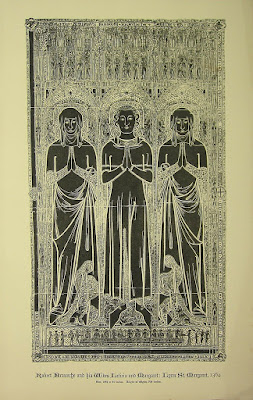
Lithograph of original brass rubbing done in 1891,
from a British 14th c. monumental brass
(click to enlarge)

THINGS I LEARNED:  The phrase "Dog in a manger" is as old as the hills, but I swear I've never come across it anywhere in my reading until it popped up on page 90 of Villainy at Vespers. I wasn't at all sure of what it alluded to nor was I too clear on its meaning. After diligent Googling I uncovered its source in Aesop's Fables. The phrase alludes to a person who stubbornly refuses to give up something that he is not entitled to and, more importantly, has little real use of just like the dog in the fable refuses to give up his relaxing in the manger to allow the cows to feed.

Palimpsest also comes up over the course of the story.  My only other encounter with this unusual word is seeing it as the title of Gore Vidal's dishy memoir.  The modern definition of the word -- "something reused or altered but still bearing visible traces of its earlier form" -- vaguely refers to its origin from ancient monasteries when supplies for manuscripts were scarce which led to the practice of recycling and reusing old, outdated manuscripts to create new works. In the context of this mystery novel the word applies to the legend that the Pollpen brass may in fact be a palimpsest, that an earlier brass work is possibly visible on the reverse side.  Briarley is excited to get his hands on the brass and examine it to prove that the legend is fact.

QUOTES: Cam: "The work of a police officer in a case like this is to discover and explain the abnormal. It is in the deviation from the normal that a crime reveals itself."

Edmund Crispin allusion (!!):
"A humorist! Do all our village policeman try to model themselves on Gervase Fen, do you suppose?"

"This is no way to spend a holiday. Bothering your heads about death and murder when you ought to be out in the fresh air and sunshine."
"We can do both at the same time," reasoned one [son], but Cam made a threatening gesture.
"I don't want any lawyers in my family. So be off with you and don't give your poor father as much trouble as a Royal Commission."

Mr. Copperman admonishing his congregation prior a ceremony to re-sanctify the despoiled church:
"You are no body of people gathered together for the united purpose of prayer and thanksgiving. Instead, you are inspired by an infinite variety of motives -- curiosity, superstition, vanity, perhaps a little pity, perhaps a little awe. But there is no common ground amongst you. You are spectators, not participants. You have come to take all you can and give nothing."

Cam, at the beach in swimming attire, receives patronizing glares and smirks from younger men:
"Look on. Take your fill. And please heaven that you may one day be like me. Fat, over forty, and free from the need to prove I'm a man by excessive athletics."


THE AUTHOR: I've uncovered another moonlighter!  "Joan Cockin" was in reality Edith Joan Burbidge Macintosh, PhD, CBE, one of the first women to work in British diplomatic service during World War Two. According to to her obituary published in The Scotsman, June 12, 2014 her "illustrious career" was cut short within a few years when she was forced to resign her position as First Secretary to the High Commission in New Delhi after marrying a Scottish banker.  Foreign Office "bureaucratic red tape" prevented women who married non-diplomats from remaining in diplomatic service.

Prior to her diplomatic career she had attended Oxford as a history major and worked for the BBC upon graduation. The Ministry of Information sent her to Washington, DC where she was charged to create anti-Hitler propaganda and encourage Americans to join in the fight against the Third Reich.

In addition to three detective novels she wrote educational books for children as well as local and ancient Scottish history.  Long involved in charitable work dating back to her days in India Macintosh helped found several charitable organizations, and was largely involved in consumer advocacy. She appeared on a Scottish radio program inspired by her work on the Citizen's Advice Bureau which led to her becoming the first chairman of the Scottish Consumer Council. Finally, her work led her to legal advocacy and she held chairman positions on the Scottish Constitutional Commission, Scottish Child Care Centre and was a member of Victim Support Scotland's council.

Macintosh had three children with her husband Ian and died in June 2014.

EASY TO FIND? It's a rare one, my friends. Nothing new there. Only four copies out there as of this writing and all of them rather pricey.  I stumbled across a very cheap copy of the book in some eBay listings which included a photograph of the first page of text.  I read that from beginning to end and wanted to read the rest of the book. So I hit the Buy It Now button. That proved to be one of the best impulsive book buys of the past couple of years. I have already been looking for the other two books with Cam as detective. I've found the first one, Curiosity Killed the Cat (1947), and will be reviewing that one soon.

Inspector Cam Detective Novel Trilogy
Curiosity Killed the Cat (1947)
Villainy at Vespers (1949)
Deadly Ernest (1952)

Friday, November 8, 2019

FFB: The Reluctant Medium - L. P. Davies

THE STORY:  A self-described "business consultant" is recruited into becoming a ghostbuster when strange apparitions manifest themselves at Butchart House. Either a ghost is seeking retribution or a very clever and cruel human is serving up a nasty bit of revenge. David Conway, with the help of his policeman friend Clifford Pearson, digs up the past and unearths secrets spookier than a mere ghostly visitor.

THE CHARACTERS: Jennifer Rawson, ward of the ancient invalid Matthew Rawson, turns to her friend David Conway to help root out the truth of the ghostly visitor who scared the daylights out of her houseguest Sheila Brand.  The apparition complete with lemony scent and wailing and moaning seems to be the ghost of Walter Hudd, a former business associate of her "uncle" who was framed for a crime he never committed.  He committed suicide several years ago vowing shortly before his death to get his revenge on those who wronged him.  When a sample of Hudd's handwriting delivered in person by a woman spiritualist who claims the message was part of an seance and automatic writing she composed while under a trance even Matthew Rawson, Jennifer's foster father and guardian can be convinced that something supernatural is happening.  David Conway is however not so gullible.

This is a fine example of the ghostbusting occult detective subgenre wherein an amateur detective is determined to prove ostensibly supernatural events are nothing more than the work of clever frauds and con artists.  Fictional accounts of these types of detective novels were very popular in the days following World War 1 when spiritualism had a resurgence and fraudulent mediums were quick to capitalize on the overwhelming number of people grieving for loved ones lost to the carnage of war.  The Ghost Girl (1913) by Henry Kitchell Webster, is one of the best examples of crooked mediums preying on the grief-stricken and draining their bank accounts with the promises of communication form the Great Beyond.  In The Reluctant Medium (1967) we find two questionable spiritualists in a mother and son team, Mrs. Proudfoot and Sidney. David Conway visits their very freeform operation run out of the Proudfoot home hoping to see some of the usual tricks and gimmicks of fraudsters. A surprise is in store for David when, while in an attempt to communicate with one of the regular client's dead relatives, Mrs. Proudfoot in a weird trance begins to utter words and phrases that have meaning only to David.  He is spooked and shaken and leaves the Proudfoot home thinking that the old woman may in fact have a supernatural gift.
UK 1st edition with original title:
Tell It to the Dead (1966)


Later he hears a confession from Sheila Brand, the witness to the ghostly manifestation at Butchart House. She too feels that she has some sort of talent. To her it is a curse, not a gift.  Eerie things happen wherever she goes: strange visions appear, odd smells manifest and other worldly voices cry out to her.  She is convinced the ghost is all her fault and begins to behave increasingly neurotic with paranoid imaginings. Everyone around her fears she is headed for a nervous breakdown. David listens attentively, leaves Sheila in the care of the women, but treats all he hears and sees with suspicion. He is sure that Simon Proudfoot is colluding with Walter Hudd's son Leslie in a sort of combined blackmail and psychological revenge scheme.  The bulk of the story is spent in some complex detective work as David looks into the past lives of Walter and Rose Hudd and the bizarre trail of foster families where Leslie ended up after his father committed suicide and his mother refused to raise her own child.

Then tragedy strikes. Just as David is about to visit Mrs. Hudd for a second time and get the full details on Leslie's past history and some connections to the Rawson family she has a fatal accident. It seems all too convenient to David, ever quick to suspect bad deeds and devious characters at work behind the scenes. He convinces Det.-Sgt. Pearson to treat the accidental fall as a possible murder. Together the two conduct a covert investigation combining the ghost activity at Butchart House with Mrs. Hudd’s death. What they uncover will prove to be more astonishing than the possibility of a real ghost or genuine psychic ability.

INNOVATIONS:  Of all the books I have read by L. P. Davies this one comes closest to a traditional detective novel. That is also an occult detective novel is an added bonus. There are well planted clues, lots of genuine detective work, surprises galore, several shocking deaths beside Mrs. Hudd's, and a final twist right out of the pages of an Agatha Christie novel. Yes, literally out of the pages of a Christie novel. I dare not tell you the book that has the exact twist, but that Davies managed to fool me is the highest praise I can give both the writer and this book.  Once again, I found myself gasping aloud on the bus when I read a single sentence in the penultimate chapter.  "Just like in UNMENTIONABLE TITLE by Agatha!" I said to myself. I challenge any Christie fan to read this mystery novel and pick up on the trick Davies uses. The story is so well told that never once did I ever suspect anything off in the narrative and still he easily pulled the wool over my eyes. It was masterfully accomplished and yet should have been all too obvious!

OTHER EDITIONS:  The Reluctant Medium was originally published in England under the title Tell It to the Dead (see cover of that edition above). It is this edition that is most easy to find in the used book market.  The US edition, a copy of which I found only few weeks ago as a cheap ex-library book in surprisingly excellent condition, is very scarce. In the U.K. the book was released as by "Leslie Vardre", one of Davies' many pseudonyms. He wrote two novels as Vardre and apparently wrote several short stories using that pen name, too.  I have yet to see any of his short stories under any name, let alone his own.