Showing posts with label Cdn. NWR. Show all posts

Thursday, 9 March 2023

Not everyone is in scarlet...

 While most of the British full-dress uniform of the Victorian era was scarlet, not all units were thus dressed and the rifle units wear a dark-green, almost black, dress uniform. The Canadian militia, closely following the home-country's example, would wear their parade ground attire, having no other, onto the Canadian Prairies for the Northwest Rebellion campaign in 1885.  These riflemen are my conversions from Perry plastic Union American Civil War miniatures with mostly just a head change using the Perry 'Home Service' helmets or creating glengarries from green-stuff.  The bases are made from a home-made styrene sheet from empty sprues melted in acetone. The log marker, also on one of these home-made bases, indicates the "suppressed" status for the unit.  It is still a visible reminder for the players, yet blending into the terrain.


In the background is a dice tray created specifically for the collection as it matches the terrain mat. It looks inconspicuous on the tabletop hiding as a field.  


Saturday, 28 January 2023

Various Games

This post is a bit of a photo summary of the various collections and play in the past while. ("various" is a definite theme of my hobby) .

Napoleonics:

A practice game for the boys as we set up for a “One Week Campaign”.  This was a 1805 scenario from a Shako rules scenario book but readily enough converted to our home-brew set.  It was fought over the holidays period during a day our gaming group all had available.

Prussians advance

overview of the battle with French in the distance holding off the Coalition forces waiting for the Italians to come in from the flank but across a river and through a woods

Italians make their way encouraged by the commander. The small black dice represent current combat strength.

A Canadian Affair:

Not really noted for armed conflict fought on its own soil, Canada did have the Northwest Rebellion during 1885. Certainly not much of an affair, but does offer inspiration for small skirmish scenarios.  That the rebellious Metis and native Cree choose set piece battles obviously outnumbered by the Canadian Militia forces rather than ambush and hit-and-run is interesting. Solo play using “The Men Who Would Be Kings” rules with half-ish unit sizes - usually the Metis have no figures on the table at all. (as I don't have any...)

Canadian militia advance upon a suspected Metis position across the creek.  (Perry ACW plastics mostly with new headdress additions - either their Home Service helmets or my 'green-stuff' glengarries.


Northwest Mounted Police in 'full dress', cross the stream on the dry open prairie.  Perry ACW plastic cavalry converted with new arms, heads and detailing.


Sinai, 1956:

Result of an estate sale, I came in possession of 15mm T-34s and Shermans. I have no other armour of that scale and those two particular model of tanks did not fight each other during WW2….but I did discover that during the Suez Crisis, clashes occurred between Egyptian and Israeli forces using those respective vehicles. Using “What a Tanker” rules.  

Egyptian and Israeli tank forces clash near a Sinai village. The destroyed Sherman is a result of my putting on the two-part tracks incorrectly.  By the time I discovered my error the glued had melded the parts together as to create too much damage while trying to pull them apart; thus INCREASED the damage to create this terrain obstacle.

The fingers are handling my conversion of a straight up Sherman into the Israeli M-50 (Super Sherman)
I used the WW2 "Sherman Firefly" stats which I think replicate the power of the gun for the game.
Noticeably in WaT, tabletop distances between tanks become very close indeed.(note my Israeli tank colour is much less green than my camera would suggest!) 


“On Folium III”  

On a distance verdant planet, humaniods long exposed to an enzyme which turns the skin a blue hue and creates over-developed muscles, fight ‘Raptors’ a reptilian species especially deadly and aggressive. Think: Schwarzenegger as a “Rouge Trooper” in Jurassic Park.

Using new “Xenos Rampant” rules. 

old style 40K "Catachans" recently painted using inks. 

"Oh sh@t!  Where did she come from!" Raptor by Wizkids.  Some time ago I bought 2 packs of these (4 models) as they are VERY nice models BUT had no idea what I was to do with them! However in Xenos Rampant these four can form a potent 'detachment' or table-top force of 24 points by themselves!  


“The ‘Incident’ at the Outpost near Plotnaty”

During sometime in the future, the U.N. was allowed to set up observation posts in the Donbas Region.  But this peace was quickly swept away as the outpost of U.N. blue-clad soldiers were attacked by “Russian” forces.  Used the new “Xenos Rampant” rules.  The “neo-Russian”/old 40K Valhallans mortars (artillery) proved exceedingly (too) powerful but the rest works fairly well.  

After-action photo as,  in the game, the "Russian" units did not need to close assault the outpost. Old-time Valhallan 40K figures painted by me A LONG TIME AGO.

The outpost. My scenario had the three U.N. units randomly placed at tents around the fortified position so not to immediately be in position and so must activate to move or shoot.  However the rule modifications I added gave them no cover at all to oncoming artillery rounds within the outpost and so the bright blue troopers died (too) quickly.  The "U.N Troopers" are old GW Imperial Guard Cadians with symbols removed and given the characteristic United Nations bright colour with camo uniforms.  I gained these, in this case, from the local club's Door Prize winning ticket but had, at the time no need for them nor any want to expand upon them.  Having seen a photo of U.N. troops, I thought to use them as a very small, under armed (no heavy weapons) contingent. They had been sitting, thus painted, in the box for years.  Now with Xenos Rampant I can use them as a complete force.

While not used in the game, I have two fighting vehicles for the Valhallans/Neo-Russians in the form of two 1:35 scale WW2 KVs modified with the ridiculously oversized 40K weaponry.  In this case, should I ever play old style 40K I could use them as a Leman Russ and Chimera respectively.  They are given a sloppy covering of whitewash in keeping with the winter Russian-y theme.


Wednesday, 7 September 2022

Somewhere south of Battleford....


The ‘birth’ of my new unit of NWMP newly painted last night.

 The North-West Mounted Police, were the Canadian Constabulary of the later 19th Century used in modern-day Alberta, Saskatchewan and Manitoba “the Prairie Provinces”.  This is a vast area, some 1,780,000 km2.  For comparison, the UK is 243,000 km2.  The southern area of Saskatchewan, the primary theatre of operations during the North-West Rebellion is approximately the size of modern Germany.  For all this area of patrol, only some 500 officers were employed and so thus the very small contingent for my force made from conversations of the Perry American Civil War plastic cavalrymen.  The dismounted trooper happens to be a Brigade Games Boer with a new plastic Home Service head to represent the mounted infantrymen status of the contingent. 


While the historical relationship of the NWMP and the native aboriginal population was generally good, some of the Cree joined the Metis of Louis Riel in conflict with the Canadian government.  Under this guise, I created a very small scenario to use my newly painted NWMP contingent for that campaign and that of the native teepees built during the summer.


Not sure about the accuracy of this work but certainly presents an interesting portrait of the NWMP 


NWMP on parade at Fort Calgary. Note helmet and white gloves from which I took my inspiration. Actually doubtful that the patrolling troopers would continue to wear such gear but this IS wargaming and we all do the full-dress appearance of our miniatures, don't we?


The scenario has the NWMP to determine the belligerent status of the native encampment.  The camp was large with a woods to the south and unknown to the policemen, a slight escarpment in front of the camp.

 Cree tipi/teepee.  My tipis are from old conical drinking paper cups held in storage for many years!

The Canadians trotted toward the camp with careful view to the small copse of trees to their right. A high-pitched voice was followed by firing, wounding one of the troopers. In the commotion the NWMP were unaware of the firing from the escarpment (no hits from this direction at all, so presumably no effect or reaction from the otherwise involved troopers).  

The log marker represents a 'pinned' status, the blackened cotton ball (those often stuffed in oversized pill bottles are wonderful for this purpose) represents a shot from the Cree hidden in the trees. The troopers are converted from Perry plastic American Civil War cavalrymen. While the mounted fellows have retained their heavy gloves (which I have given them from 'green stuff') their dismounted companion has placed his under his belt on the back - also green stuff.

Recovering their motivation (making the pinning test) they moved away from the fire and toward the camp.  More firing came from the woods but to no effect. However the troopers were now startled from the close range fire from the hidden position in front of them, and the same trooper was again hit ( I diced to see which of the three would be hit)  Pinned once again, they waited the Cree reaction but none was forthcoming.  Unbeknown, the Cree were short of ammunition and arrows thus equally unable to continue the fight. (I rolled very low for the amount of shots the Cree could deliver)

But the policemen had their answer about the Cree attitude and decided to quickly retire to report. ( I rolled maximum on the dice for their morale/activation!)


Monday, 1 August 2022

"Fine Day's" Battle of the Broken Wagon

 Fine Day, the Cree Warrior Leader stared upon the Canadian soldiers with much confusion as they slowly walked in unison, a slow walk, their legs moving as a centipede. “Why do this?”  he asked Small Bear. But his companion shook his head.  “Starlings?”, Small Bear offered as the red-coated soldiers did walk as those birds flew,  seemingly as one following unknown commands. But perhaps it is so we are confused as we are and will not attack? If that is their plan, it is working well thought Fine Day. Do we?, the warrior contemplated. 

Stepford's contingent in full dress, practicing their formation drill on the open prairie.

Across the meadow and for several hours now the rest of the convoy had moved north leaving a small contingent of the York and Simcoe Regiment to stand guard over the broken wagon, empty of its cargo, and guarding the artillery piece left here so it’s limber horses could provide the extra power to move the other overloaded wagons 

Sgt. Simmons, commanding the gun crew, was resting looking up at the circling birds when his loader made the comment , “The gun just moved!” Getting up from his supine position, the sergeant witness the gun slowly but methodically gaining speed, muzzle first, toward a small gully. “Get up you buggers!”,  he shouted to no one in particular. 
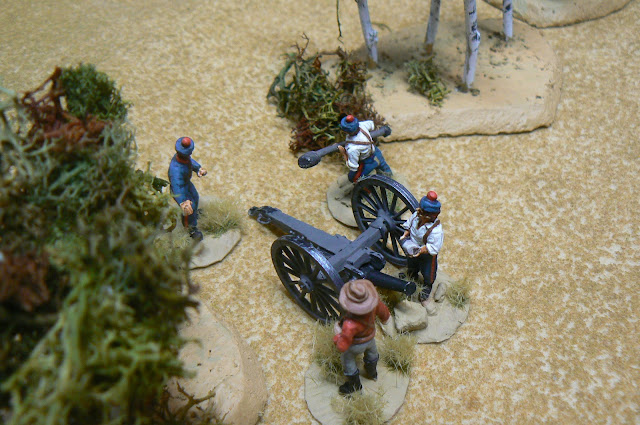
Simmons, Dobkins and crew working to upright the cannon and get it into action.

Two companies of the York and Simcoe Battalion were equally lounging in the midday sun, lifted their heads to see the artillery crew run after their cannon.  Interestingly none got up to help as they remembered the afore mentioned artillery Sergeant suggest to the column’s commander that they could provide the horsepower to move the gun along. “We are not bleeping mules!” was the general consensus and the matter was dropped. Let the artilleryman now become their own mules to drag the damn gun from the bush. Heads returned to the reclining positions as their ears still could hear the sounds of frustrated artillerymen and the shouts of particularly ambitious colour sergeant who was parading his charges in full uniform up and down the grasslands.

This would continue for several minutes when a lone person walking with a limp, came into camp asking for the commander. “ I am one of Bolton‘s Scouts. I encountered a group of Cree moving this way.  They shot my horse and I landed with a slight slight sprain. Got here as quick as God allowed but I must warn that you may be attacked”

Then the shots rang out from the clump of trees to the north-west…..
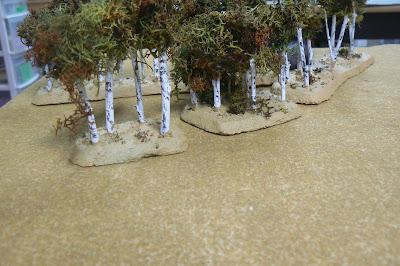
My simple terrain try of birch trees.  the Cree are hidden somewhere amongst. [spoiler alert: I have no Cree.  But in my defence, historically, the Canadian soldiers would not see any either!] 

So begins the solo scenario set up during the Canadian Northwest Rebellion using the ever unpredictable rules “The Men Who Would Be Kings”. The game begins with the cannon overturned in some scrub, an exposed Canadian militia unit in close order in the middle of a featureless prairie, two other companies unprepared for battle, and a number of natives firing away.

I had rolled for the Scout to give advance warning and my extremely low rolls for his movement speed suggests he was on foot only and hobbling at best. 

Smith consults with the wounded Bolton Scout and his contingent faces the tree-line.

For entertainment I rolled for the traits of each of the Canadian Leaders per the rules. The artillery has Simmons “a weakling” so no melee bonus [well, that makes sense for an artilleryman].   The marching unit under Stepford has a weak leadership of 7+ but with the trait as a “Musketry Buff” if activation orders for fire or volley he increases to 5+. [and this on the unit already in close formation, the volley fire bonus could be advantageous. Unfortunately it could not be used during the game] 

The forward unit has a steady officer under Smith with the leader ship of 6+ and the rear unit under Gallant has [surprisingly I rolled box cars] hero status activation at 4+ 

The Cree shooting immediately gave Stepford’s marchers almost 50% casualties but they would not break and retired to the road as Smith’s Company poured steady but ineffective long range fire against the tree-line. To the south, Gallant’s company led by the “hero”, steadily moved to the flank of the Cree position and, yes, the artillery crew continued to upright the cannon and prolong it into a firing position 

At this point the Cree fire ceased.  The Canadians pondered whether the Cree had abandoned the attack or not [actually the Canadians were all out of affect of a long range fire, so I ceased to roll for firing!]

The artillery finally moved into position but… “Dobkins, you bloody idiot! Go back and get the ammunition!” …the artillery it fails it’s firing activation.

Dobkin at left. Does he finally have the correct ammunition? ( or more to the point, can I roll enough to activate the artillery firing?!)

Meanwhile Gallant leads his company to flank the tree line when the tree-line explodes with gunfire, frightening in the militiamen and pinning them despite their fine leader.

The Canadian militiamen ready to charge into the woods. Smith's in the foreground, Gallant's depleted group in the distance.  The smoke-balls are an indication of the Cree fire expenditure. Historically they were quite low on ammunition so I roll for the amount they have to fire, and lose d6 pip per activation attempt.  Thus often they are forced to retire due to lack of ammo. 

“Dobkins! Bring the correct ammunition, damn you!”  I read the rules with the artillery ignoring cover.  Well, this should cause some Cree casualties.   Wrong. I rolled no hits on 4+!   But a turn later, finally the gun got into action regularly hitting the southern Cree unit and repeatedly pinning them.  This allowed Gallant’s militiamen to approach closer without oncoming fire.   Smith finally giving up on his long distance fire, double-timed it towards the tree line. He was rewarded by no further casualties.  My Cree fire was rolling poor. The Canadian militiamen were surviving the weakening Cree fire; and for the most part the Cree were not willing to engage in hand to hand combat so with only a few rounds of ammunition left, they got on their horses and retired from the “Battle of Broken Wagon” 

------------------------------------------

Game Notes:

-I needed a back-story to why one of my units is in march order but not the others; so the “centipede” narrative. This unit may only have convoy duties henceforth.

-no warning explanation in the story is for my very low movement rolls

-I only remove 1 figure regardless of hits, but account for the total hits for the important Pinning Tests. This serves to make the overall miniature removal a little more realistic but the rule’s pinning numbers remain intact.

-historically, the Canadian militiamen were enthusiastic but had very little training.

-the miniatures are with a metal artillery crew having new headdress modelled, and the infantry converted Perry plastic ACW Union types.  Not perfect but with a wargamer’s squint….. 

-I added the Perry Home Service helmets because I was given them, they did indeed wear them (!), and I did not thus need to model more glengarries!  


Thursday, 24 March 2022

A Canadian colonial clash

 The Battle of Batoche, 1885 

While the famous American conflicts against the native populations of the ‘West” were almost over by the time of this battle, Canadian expansion into the Prairies was continuing apace.  In the area of Saskatchewan, the indigenous Cree and Metis ( a mixed race and culture of farmers and hunters of French-Canadian and Native inhabitants ) were feeling the pressure on an ever increasing eastern homesteader possession; with Louis Riel the ‘spiritual’ leader of this very autonomous people. History has called this conflict ‘the Northwest Rebellion’.

While a few other major skirmishes had occurred, it was at the village of Batoche in modern-day Saskatchewan, Canada that the decisive battle to end their resistance to this pressure was backed by the military of the Canadian government which rested upon militia units from the eastern provinces.  These units made up of civilians were certainly enthusiastic enough but inexperienced.  The few Metis were often good shots and very experienced in ‘field craft’ but ill-supplied.  

Faced with the Canadian advance upon their ‘capital’ village, the Metis built small, effective and well disguised, three-man rifle-pits blocking the plodding Canadian advance by Frederick Middleton.   

The Metis rifle pits.  The figure within are Brigade Games Boers without any alteration.  Period photos show the Metis in similar attire.

What is interesting about this whole affair is the decisive battle was a prolonged four-day affair with only some 24 dead and 76 wounded total from both sides from the 1,166 engaged (Wikipedia). With my calculator at the ready, this is only just over 8% casualties over a lengthy 4 days. With an eight hour ‘work day’, this would have on average 1 casualty every 20 minutes or so.    No Somme, Cannae, Shiloh, or Little Big Horn here.  But with that, most rulesets have great clumps of miniatures removed from firing and combat.  Obviously this will not do.  However my new, go-to rule set of “The Men Who Would Be Kings” (a colonial set by Osprey Publishing) could be modified to accommodate the lack of casualties but still have units pinned, unable to effectively operate and have ‘morale’ issues to prevent much activity.  One other aspect of the battle was the ever decreasing ammuntion supply of the Metis.  They simply did not have the supplies needed.  Their fire had so decreased by the fourth day, along with the withdrawal of many who had given up the fight, that the Canadian soldiers frustrated by their commanders slow activity took it upon themselves to charge the Metis rifle-pits thus ending any further Metis resistance. 


The 'TMWWBK' rules are adequate but for two small changes.  First, any casualties would be limited to one per successful firing regardless of the actual number of hits. Pinning, not casualties, would be the important issue.  Secondly the Metis would set up in the rifle-pits designated as ‘hard cover’ and combined with their good-shooter ability and the Canadian militia poor firing, will have the unequal shooting which occurred.  However, the Metis ever decreasing ammunition supply would be handled by giving them a secret die roll (from the Canadian player) how many shots they would be allowed. I gave a 1d6 roll per rifle-pit;  but each day would see that amount decreased by one. Thus at best the Metis would have only 50% firing minus any further casualties or abandonments in the final phase of the game.   The Canadian player might see less fire power but would be unsure of the amount remaining thus continue with caution which was the trademark of the engagement.  

A “day” ( the historic battle lasting four days) would be 8 turns in length.  The Canadian player must have overcome all resistance to win.  If at the end of each ‘day’ (the 8 turns) and the terms of victory not met, the ‘day’ is over and the action pauses.  Immediately in the ‘morning’ the players can reposition their units with their morale afresh  (minus previous casualties of course ) in any new attack position along the start line for the Canadians or any available rifle-pit for the Metis.   

a Canadian Rifle unit in a staged photo.  During the game they did not reach this close to the Metis rifle  pits!

a red tunic clad Canadian militia unit. Indeed, some of the units sent by the Government, were still to wear their dress uniforms including the Home Service uniforms  

The TMWWBK rules are interesting as activation and morale are key aspects but can be very dice fickle.  The resultant lack of action and easily gained pinning effects are perfect for re-creating this battle. The photos are from my second solo play-test.  

The Canadian Militia, whose dress was very much influenced/copied that of the British home country, were in either contemporary rifle-green or red tunics.  As far as I know, the only source for miniatures are 1980s RAFM miniatures.  These are small “true 25mm” very stiff in posture and lacking multiple poses.  Thus I needed to create my own and used Perry Union ACW plastics. While not completely accurate, they do look the part and I needed to only to remove the oval badges and green-stuff the glengarry caps or, in some cases, add a Perry ‘Home Service’ helmet head.  (indeed some units wore these! )…. oh, and a different paint scheme, of course.  Much of the militia had no other uniform for campaign but their full dress version.  

The Canadian uniform of the era

The very dark green - almost black of the Rifle Regiments. I highlighted a dark green over a black base color on the miniatures.  

the model within the Park Site's pavilion 

I built my model rifle pits on this example.