Showing posts with label 100Days. Show all posts

Sunday, 11 August 2019

The big battle style....


The previous post had a 6mm big battle which each element was brigade strength.  My Napoleonic rules employ a similar ratio but using 28mm figures (but obviously fewer of them for the ‘footprint’!)
Here are some pictures of a Waterloo refight done a while back.  The area of this game would be but a square foot or two on Kevin’s table, but I assume (due to being a historical refight) all the fun maneuvering has already been done (all the corps been committed to one area of the countryside or the other like Grouchy and Gerard's) and the true tactical fighting is to begin……
Looking from the north-east 
the view Napoleon might have witnessed
and that of Wellington

Thursday, 30 May 2019

"Ney's Folly" Enfilade 2019

In my third hosted game the critical part of the Battle of Waterloo was reenacted having Marshal Ney order much of the French cavalry unsupported over the crest line of the ridge only to find themselves unable to break the Allies infantry squares and be met with the one coming squadrons of Allied horse to force them away.

Preface:  one year ago at the 2018 convention....in one of our suites after-hours drinking beer... we decided that "it would be cool" to combine the Lion Rampant medieval rules to the showy uniforms and dash of the Napoleonic era into a fun ruleset.  I was tasked with making it happen.  After many trials, some of which have been previously documented in this blog, the rules seem to have operated well especially after having undergone a major trial of a convention setting, having 14 players move around 28 units ..and my voice virtually at a whisper from speaking in the din for the entire day.  Nevertheless, it seemed to go along well for all the players many of which painted up their favourite Waterloo units specifically for this game.

  I cannot describe much/any of the action as I was involved clarifying to the many players the charging procedures (a bit tricky at first but with experience players seemed to have them understood) but I wanted interesting action and not your standard "you set up there and they set up opposite" deployment.  So I had each side dice for their position in a random method: French from the south and west, the Allies from north and east. THAT produced some interesting angles!  I also used random bases of casualty figures as "terrain pieces" to provide delays in movement and charging (horses don't like treading on dead things and so will cause problems for the riders!)


Saturday, 15 September 2018

D-B Heavies

Dutch-Belgian Napoleonic heavy horse...ironically in lightweight plastic....

While yes, Perry Miniatures do have the Dutch-Belgian Carabiniers in metal, I rather fancied doing them in plastic so upon spotting a Perry French Dragoon box on sale at the local store, I could not resist converting these into a couple of companies for the 1815 Hundred Days campaign.

While many sources suggest the helmet was only worn by the 2nd (Belgian) contingent, I went for full-on regulations mode and gave my 3rd (Dutch) Carabiniers spare French plastic versions modified with addition of the badge plate on the front and plume. The bicorne is the suggested head gear but these helmets could have been worn and are far more handsome!

The existing French valise version has the greatcoat folded on the top which was removed and the greatcoat was added using ‘green stuff’ around the shoulder on most, which was a common D-B trait apparently.  The Perrys, for production sake, attached the cartridge box to the valise, but a minor point to glue to the appropriate location on the torso.

The French Dragoon saddlecloth, sheepskin fur and basic uniform was close to identical to the Dutch-Belgian version so no changes required other than the colours of course. (perhaps the valise should be rounded instead of square but I consider that a minor issue).  Many of the sources do not indicate the fringed epaulettes on the Dutch as the Perrys put on theirs, so the existing shoulder straps are fine.

As the intended use is with a group of fellows doing primarily French and British for Waterloo, I am having fun creating the rarely thought of Dutch-Belgians to add a bit of different color to the affair.

addendum:  Found the following Knotel illustration (famous military uniform author) for the Dutch heavies, in this case the other Dutch regiment often also shown in the bicorne rather than the helmet I have opted.


Wednesday, 29 August 2018

Painting gone rampant


Coming off the painting table quickly from the last couple of days. First off, an elite company of French CaC with the fringed epaulettes. Perry plastics.


The Netherlander 4th (Dutch) Light Dragoons of the Waterloo Campaign were a bit more interesting build.

Within the Perry British Light Dragoon box of plastics one can build either the earlier 1800-1812 types or the later 1812-15 uniform. The troopers horse is the same for both (the officer’s saddlecloth comes with the end either pointed or rounded for earlier or later era) Thus, you get an early and late uniform together with different headdress for the changes during the years.

I noticed a great similarity between the 4th Netherlander LD of 1815 and the early British uniform tunic both showing ‘hussar’ lacing so began with the earlier torsos adding spare French hussar campaign trousers from which I removed the large side buttons leaving a wonderful leg seam. Painting hides much of the scraping to a large degree.  I used a brighter dark blue uniform color to add to the distinction from other British and French units and which I have seen in several illustrations.

The later British uniform added a sabretache and portrayed by the Perrys in addition, thus leaving the earlier era scabbard-only, which is perfect as the Dutch light dragoons did not use them.

The headdress is the 1809 Russian infantry shako with the nice long cords and on which I glued a plume removed from spare mirliton headdresses.


The big drawback from using the “second-set” of figures from the box is the lack of horses to mount them upon.  Yes, Perry does offer horses separately but I had a group of Fireforge medieval horses available on which I added green-stuff as front blanket roll to make them a bit more Nap.
I made an error of not allowing for a rear saddle valise/portmanteau under the sword slings (the belts holding the scabbard) so I did not add.  But I did make a few GS forage sacks for variety.

Why the medieval horses?  Well I had picked up them up, along with half-built riders at a Bring&Buy.  At the time I had little interest in another collection of medievals ( I bought them anyway…the hoarder within me, I guess…) but looking at pile of plastic for fantasy but nicely caparisoned horses  ( again, hoarded away....) I decided that, while not fitting perfectly, the riders could be ‘glued’ on with GS forming the saddle.
Thus those medieval riders lost their plain mounts for covered versions and I gained 12 additional Napoleonic horse and, with the add-ons provided, created another two units for what is essentially free.

And their missing saddlecloths? Well, the story is: the colonel seeing them dirtied and water soddened from the heavy June rains, had the men remove these expensive items.  My take anyway!

Thursday, 22 December 2016

Another Napoleonic ambulance

Following a rather fun production of a Russian Field Station (link), I sought to do a "the after-effects of combat"  for each of my Napoleonic armies.  What this says about my phycology vis-a-vis playing war but having enjoyment with toy soldiers is something I do not want to contemplate - mainly as it takes away from the fun! But it is something interesting to look at and eye-candy to place within the blank spaces on the tabletop.

This Belgian ambulance started as the Perry ACW version ( link )  I coveted and which I saw the possibility to convert.  Surprisingly little was needed.  Of course the heads needed to be replaced as to provide the appropriate headgear.  I added tails and turnbacks to the tunics along with epaulettes and cuff-flaps. The Belgians often tucked their trousers into the half gaiters so the pants, together with  the era's mens fashion having them wear loose under shirt and suspenders, has the original ACW fellow standing at the back of the wagon not out of place and thus without need of change.

The wagon, perhaps confiscated from a hapless Brussels civilian, surrounded by the Perry casualty pack, sets the scene of the clean up of the carnage of Waterloo.


Friday, 18 November 2016

the 100Days Campaign Part 1

I volunteered to use my collection to occasionally fight out the miniatures battles of a campaign organized by David (see:link) Not knowing of the players or their intentions, it is very interesting getting "marching orders" without knowing the larger picture.  Just as a soldier in like real life!

Part 1 of this campaign (for me) was the playing out of the maneuvers of the players for the Battle of Thuin.

Battle of Thuin…the morning.

It was a wonderful asset to have a portion of the reserve to reinforce his contingent Steinmetz mused. But for it to be of full use, it must be deployed, along with his own artillery, in the open plain in front of the town.  To protect the guns, he was forced to deploy before the town and not in the better defensive position within, and thus, in the open.  He hoped the guns might reduce the French attack but it would depend upon the numbers the French would place against him.  He certainly wondered why he was so isolated.

Steinmetz deployed his meager units in a line south of the town, with the jagers in the woods in a position to offer a threat to the French left as they advanced from the south.  The various limbers, wagons and caissons of the artillery were arrayed in an area to the north-west of the town along the road network.

The French General Vandamme certainly did not believe in subtlety and advanced on a broad front with his horse on the far right (east) to swing in behind Thuin to cut off any Prussian retreat.
He soon discovered the firepower of the extra guns used by the Prussians but continued to press the point. One of Lefol’s brigades recoiled out to the woods in a failed attempt to clear the Prussian jagers and Vandamme was forced to move his reserve of Girard’s small division to keep the jagers threat at bay.
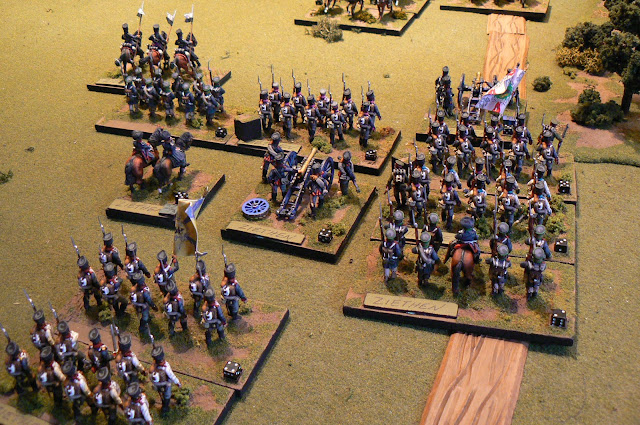
The height of the French (top) attack on Steinmetz's Prussians (bottom) before the town of Thuin
With the massed Prussian guns slowly reducing his effectiveness, Vandamme had no choice but to move into the Prussian infantry defending the guns in a sweeping attack, even though at poor odds. From 10am to noon, there was attack and counter attack as the guns boomed.

Hearing the cannon fire, French Cavalry General Kellerman hastened his pace; but shortly, exhausted couriers gave him word of a Prussian cavalry force following him.  As he gave a questioning thought of how did the Germans get in behind him, he issued orders to about face and meet this new threat.  Those officers whose units were indeed among the Prussian wagons placed behind Thuin also gave pause to question why, in the moment of attack, they were ordered to about face and move away, but such is the maneuvers of war.
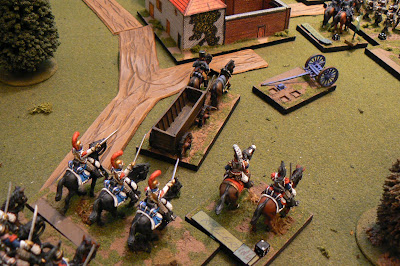
Kellerman's foremost units among the Prussian rear echelon before being ordered to about-face.

However, the effect of masses of French cavalry near the Prussian rear echelon and the subsequent panic by the wagoners strained the morale of the Prussian force which, for the moment held, as the 24th Regiment counterattacked to protect the guns and the 12th refused its left from being outflanked.

The indomitable red-coated Swiss of Habert’s Brigade broke the 24th exposing the whole Prussian centre. So by noon the Prussian line was essentially broken with their substantial artillery intact but near to be overrun with nowhere to retreat as the town would inhibit any rapid withdrawal.
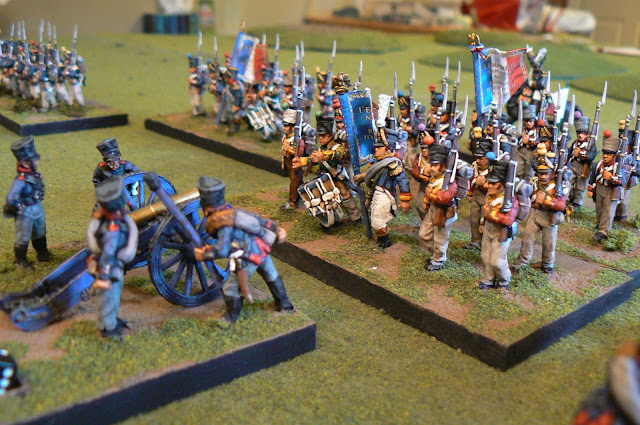
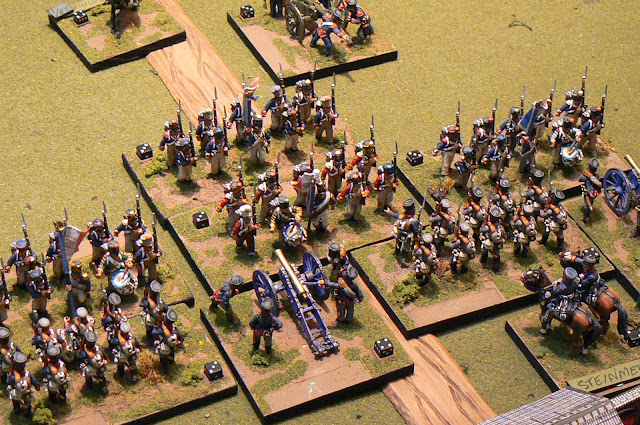
The red tunics of the Swiss of Habert's Brigade in assault of the Prussian guns 


Battle of Thuin…. the afternoon

Around noon Vandamme needed to reorganize his infantry supports bringing fresh troops in his continuing head-on attacks on the massed Prussian guns.  While these attacks forced the Prussian guns to flee, the French suffered further casualties but nonetheless were in a position to take the village of Thuin by 2pm.

To the north of Thuin, Kellerman with his heavy cavalry now facing the new Prussian force from the north.  Leaving his small contingent of horse-artillery on the road he extended his troops to the right. The leading Prussian light horse fell back from the French advance exposing the columns of Ziethen's Prussian infantry in squares and the Prussian artillery which quickly eliminated the French cannon. Now faced with a large corps sized force ready to withstand any charge, with a good cavalry reserve and plenty of artillery, Kellerman was forced with the impossibility of attack due to the complete lack infantry support and, if remaining in position, only the slow destruction of his force by cannon fire. Rather than wait for the infantry of Vandamme to mop up the Prussian forces remaining around Thuin to eventually come to his ‘rescue’, Kellerman would again about-face his horsemen and cross the river to link up with Vandamme.

As Kellerman was facing his choices to the north, Surprisingly, the Prussian morale of Steinmetz’s command at Thuin was still holding (the required 6 was rolled!) allowing some of the remaining Prussian units to take a defensive position in the eastern section of the town.

In spite of Vandamme’s success, his was spent force by 2pm, and no more action would be taken.  He spent the rest of the day consolidating his force south of the town.
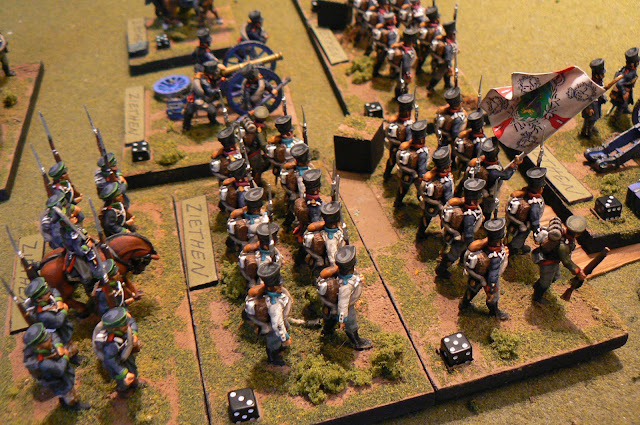
The Prussians of Pirch II in Ziethen's Corps included the 28th Regiment (ex-Berg) clothed in white tunics.  The cube on the base of the 6th Regiment (at the right) shows it to be in square to defend itself against Kellerman's heavy cavalry during this Battle of Thuin

 Kellerman retreated before Ziethen [ “My command then advanced in a different direction” he wrote in his report to Napoleon ] and fell into the fleeing Prussian limbers and caissons of the Prussian Reserve Artillery thus eliminating this force from the campaign. Late in the afternoon he would meet up with Vandamme south of Thuin.
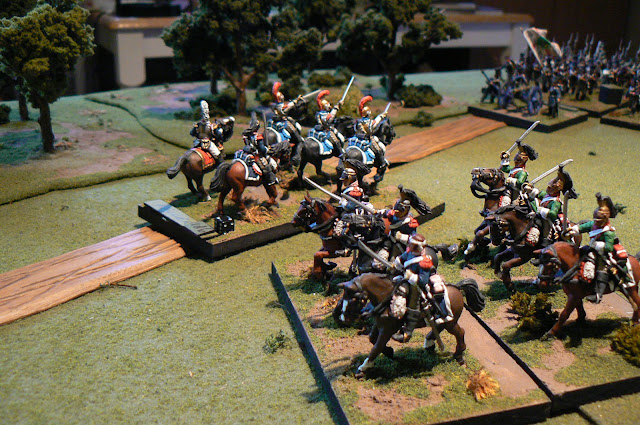
The French Carabineers (in the distance, with Kellerman directing) continue to face Zeithen's Prussians while the rest of the cavalry corps retreat advance in a different direction led by the 11th Cuirassier Regiment (who were without cuirasses during the campaign)
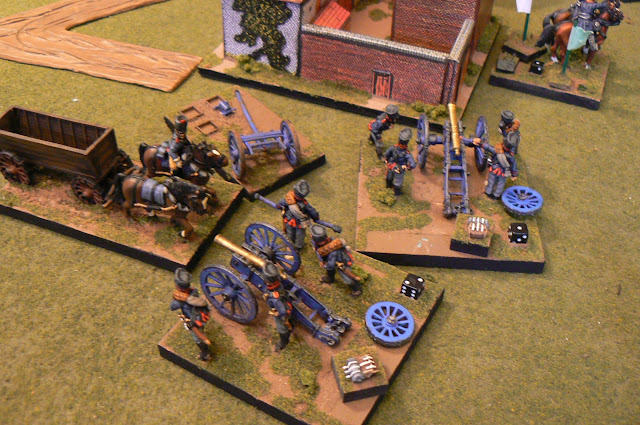
The rather haphazard retreat of the Prussian artillery assets of Steinmetz's command (shown in a limbered state by the wheels on the bases).  The knapsack marker indicates they are also disordered by retreating from the French.  These would soon be destroyed by Kellerman's French cavalry.
Ziethen's Prussian Corps

Zeithen for his part, was confused about the French intentions and so halted his advance at the north side of the bridge.
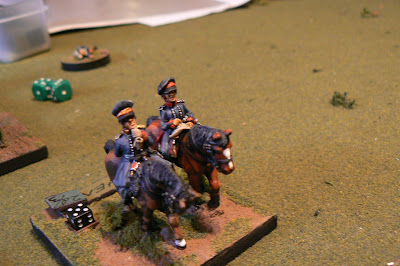
Ziethen ponders the rather unsupported maneuvers by the French

Steinmetz remaining very weak brigade held half the town but any further French attacks would inevitably have it destroyed.