Showing posts with label War of 1812. Show all posts

Tuesday, 1 November 2022

War of 1812 Fictional affair

Having concluded one of the interesting Campaign battles between Craig and KevinA using PeterM's campaign rules, the troops and terrained tabletop had me bring out my bigger battalions for a long-neglected War of 1812 solo-battle. 

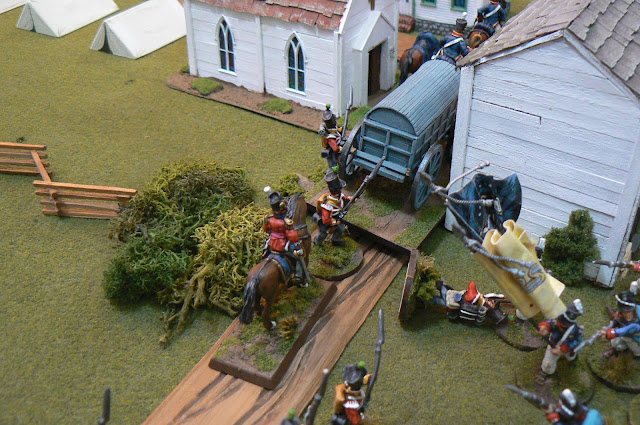
Canadian Militia (in early war green tunics) deploying within the village. The regulars of the 89th Foot can be seen in the distance.

I can quickly describe the action: the Americans with two units of Kentucky militia (poor) and the 28th Infantry (also recruited in Kentucky and also poorly trained....) came up against two units of Canadian militia and the 89th Foot. The mounted Kentucky Rifles leading the American advance were in scout mode which covered the American advance but when ordered into formation decided their duty was done a sulked in the rear for the remainder of the engagement - rather unfortunate dice rolls for them were made!  

While the Canadian militia are rated poor, the 89th Foot is good.  Not having played the rules for awhile, and that they are based on random dice for unit control, nevertheless the outcome was what might be predicted.  The Americans marched up (mostly in column so to actually move!) only to be frozen in place and decimated by musket fire. The Canadians even had the gumption to move against the rattled militia, routing them and their friends with them.  The American regulars of the 28th, not having much resolve, so followed as the British 89th, having poured several volleys into them, rolled high enough to advance and have these Americans follow their fellow Kentuckians back across the bridge so confidently crossed only a short time before. 

The Americans marching on the road from the bridge crossing. The American horsemen seen behind the trees would soon call it a day and leave the infantry to do the fighting.... The simple terrain was left over from the campaign I have been hosting.

The lead Canadian militia unit, upper left, is advancing upon the shaken Kentucky militia in their hunting  jacket attire. The other Kentucky militia is aggressively advancing but needing to be in march column which will soon face fire from the 89th Foot ( at right ).  The buildings are my old home-built models.

The 89th Foot.  These have been around for awhile as the flags are hand-painted a requirement before all the nice printed flags became available.  I have the 21st Fusiliers yet to paint because I have the regiment's hand-painted flag done and ready to be used for many years now!


Thursday, 12 May 2022

Royal Marine Artillery (Napoleonic era)

 I recently pulled out an old reference page I had photocopied years ago and discovered that the rocket battery I had painted wore the Royal Artillery, not the correct Royal Marine Artillery uniform. Well...

Uniform plate from "Military Uniforms in America, Years of Growth 1796-1851, The Company of Military Historians, pg.81.

Actually it was just the shako cords and tunic lace from yellow to white but it does give a slightly different look and a distinctive unit on the table.


Wednesday, 11 May 2022

Dice Fields


My newly painted 103rd Foot for the War of 1812.  It participated in the Niagara Region in 1814.  Old Glory 28mm.  I have now some 15 units of redcoats for that war and have painted over 500 figures of 28mm Napoleonic era British Infantry for my various collections....oh dear that is a lot of scarlet and lace....

Inspired by a gamer-friend's idea, I recently created nice terrain pieces but also very utilitarian to keep dice together and not hurling across the table when rolled by some of the more 'energetic' players.  These are for North America c.18th and 19th C.  I will be building others for the other various topography to blend into the terrain work.

The newly built "dice fields" in my quest to have 'visual continuity' for the table-top. I subsequently added more 'shrubbery' under the fences to make them a bit more 'organic'. Made from coffee-stir sticks.  But ready-made plastic fences could be employed;  as can walls of various constructions.


Tuesday, 22 March 2022

War of 1812 mini quiz

 Way back, I started this blog with posts on the War of 1812 as that was my current interest at the time. As followers of this blog know, I am interested in the military history and the modelling of MANY different periods and subjects.  Well, I finally sought to bring out the old War of 1812 units and randomly picked two from storage.

Old Glory British line in the foreground, Knuckleduster American Frontier Militia in the background
The flags are hand-painted, obviously, but do offer clue to the answer of the quiz.

Can you name the two British units with their unique flags?  You can place your guesses/confirmations in the comment sections.  Bonus points to disclose what these two units have in common within the British army of c.1814, the year of their involvements.


Monday, 7 February 2022

a Natives raid on Nateville


The Abenaki raid on Nateville.  


Gleaned from email correspondence between Nate and Mr. Brewster, and CC’s to me, apparently the natives got restless as it were and attacked Nateville while the bigger battle of Towe's Field was being fought (see my previous post).

  I have dutifully come up with the following:

----------------

While the large battle of Towe’s Field was occurring, some of the Abenaki warriors took it upon themselves to do a raid on Nateville.   

The local volunteers of Nateville had gathered to guard the town, while some were unwilling soldiers, many were pleased with the task.  The screams of war cries broke the afternoon air as a small band of warriors emerged from nearby and attacked the volunteers. The Volunteers were pushed back by the onslaught but either side did much damage. The natives followed up the charge but the Americans held their composure despite their timidness to fight.  It was the tired and hungry natives who decided their gambit had failed and they melted back into the fields.  

skirmishers or lights troops are offered additional cover despite being "in the open"

This was a very small affair using "Rebels and Patriots" rules, and with both sides fighting at half effect, so little loss (few dice throw and my traditionally poor rolling anyway, made for very few hits!)

This was an interesting game having only 1/2 effective units which makes each dice rolled that much more critical and actions proceed quickly.    

Friday, 4 February 2022

Battle of Towe's Field (fictional War of 1812)

The Battle of Towe’s Field Final Battle of the Nateville Campaign. 

We have a first hand account by an American Engineer with the US 31st Infantry Regiment.
the photo shows William and the author finishing chopping down a log for work on the "bridge of boat(s). The US 30th Infantry Reg't is starting to cross, drums a drumming. As the American military used the old fashioned "reversed colors" for musicians, these Americans indeed wore redcoats. A supply was even provided by a captured British shipment! 


 “Dear Father, Were the battles of the revolution such as this? I thought my regiment a splendid unit but it did not perform well today. Nor did any. But I did my part. William and me we were tasked to cut down some trees along the river bank to allow the captured boats to ferry the Combined Light company in the very early morning. The lack of boats and lack of oars made for slow crossing. The officer of the 30th was impatient to cross.(my regiment crossed by the bridge while I was here…I do not understand the logic of the army….) William suggested we could build a bridge on the boats. (1) The officer, a new graduate of West Point, an engineer student, thought this a grand plan and soon had his regiment tearing down the nearby fences. I only a few hours we had a nice looking crossing. When Bill and I returned from refreshing ourselves, the regiment had passed and we had no orders. Thinking we did out part and exhausted, we went to the local mill and its second story afforded us a grand perch to view the battle."
The author's position is in the Mill, the large building on the left near the river.


"Father, we were looking towards the enemy lands. To our left is the bridge with an artillery battery deployed on our side of the river, and the Kentucky horse crossing first followed by the 31st Infantry. closer to us was our boat bridge with a hill on the other side of the river on which the Lights deployed. To our right, the 10th Infantry made crossing by a narrow ford, They had artillery support. We could see the enemy had made field works and used abattis (sharpened tree branches facing out) This was in front of Brewsterburg, the same town we attacked before."

 view from the Canadian side in front of Brewsterburg:
note the RIP grave marker.  This is my indicator that the unit is now at 50% or under strength, which for Rebels and Patriots, is a very bad and indeed grave situation for the unit's morale.

"The battle started in the plowed field of Cardon Towe’s farmland. Our Lights were surprised by having early opposition from some grey-clad fellows with fur caps. They stood on the far side of the field and seemed to get the better of the Lights who then broke and ran. This was earlier in the battle as they came past us before our boat-bridge was completed. Many were very wet and without arms. The 30th’s officers made some attempt at halting them and their men jeered them but as they were fully employ with us, did little. It was rumored that the officer soiled his pantaloons during the firefight" (3) "In our view, off to the left, the Kentucky boys seemed to freeze the Redcoats in place allowing the mounted riflemen to shoot up the artillery in the fort. The artillery over there kept up a steady pounding of the fort also. Why the redcoats kept in place we could not fathom but we admired their courage." William made the observation that every one of our regiments seemed to be glued in place trying to cross the water. It was, William said, “were be like they ‘fraid of drowning” This lasted several minutes. (2). While the infantry came under scrutiny after the battle, the artillery was commended as the ‘B’ Battery firing into the field works did good work as was ‘A’ Battery mentioned already. The red capped locals manning the works and the sheds nearby took a pounding to be sure but only retreated very late in the day but gave enough time for some more redcoats to come up in support to face the 10th who finally attacked. William later spoke with a man of the 10th who said the officer insisted on keeping close order but unwilling to engage in frontal assault had them slowly move around the abattis and into the volley fire of the British regulars. This broke them."
"Back on the left, a rocket battery was set up. We done never seen these before and Will and I were in stitches, laughing most hardedly at the smoke trails going this way and that, usually over the grey-coated unit who were most distressed at the fiery things going close over their heads. Not one came near our boys. We could clearly see a mounted officer ride over and gesture for them to stop. Father, it was particularly funny!"
the hex marker shows the direction of the rocket...not good for their side, eh?


 "While the rockets didn’t come near the Kentucky horses, the artillery from the fort did and soon they galloped back to the bridge. While they tried to calm the jittery horses, my 31st which had moved past in grand style to form a close order assault column, was hit by well-aimed close range canister fire which suddenly turned our parade ground into a carnal house. I lost many friends and think myself fortunate to be here than there, truth be told. The rest of the regiment turned to flee but there was no where to run. The horses blocked the bridge, the river was deep. More losses" (4).
"While this tragedy was occurring, the 30th moved up but was met and defeated by the grey-clad unit- we later were informed this unit was the French-Canadian “Voltiguers” and a unit of redcoats who also poured a well-aimed volley into them. Of the redcoats, we learned this was the same unit that captured our ammo supply some while back. "

" At this point the battle seemed to just petter out. The British would not, could not(?) advance; our boys in confused huddled masses. Our leadership it was said, had lost faith that any of the units could be reformed. Were your battles of the revolution like this too? "

 "Your loving son, "

 ————————- 
Editors notes:
 The General would be sacked the next day. But his After-Action Report would explain that the limited crossing of the river would not allow easy retirement of the easily spooked American troops, making traps and causing traffic jams for units entering or exiting the fray. Due to this terrain, high command deemed it impossible to conduct any more offensive actions in the area. With the Canadians not wanting to invade over the border formed by the river, the Nateville area soon will become a backwater of the war, with units slowly dispersed elsewhere. Peace thus has come back to the residents of Brewsterburg and Nateville. 

 ————————— 
Footnotes:
(1) Nate’s ‘orders’ for the American attackers were to gain boats and cross mid-river. I took the opportunity to create a ‘pontoon’ with a boat as the support. 
(2)No Activation was made for these units all on the crossings for three turns straight! 
(3)The “Rebels and Patriots” rules has a delightful “Brown Trousers” effect for a unit’s command. 
(4)The rules have any unit unable to retreat in full, take losses equal to the measurement not moved and as the river and the Kentucky unit blocked the road back, the unit was essentially destroyed.

Friday, 21 January 2022

The Nateville Campaign - #3 the initial situation

Nate provided the following (very secret....) American Plan: Two columns and one shore party. Shore Party The boats that were gathered have transported the Combined Lights across the river during the night.  They are formed on the central hill on the Canadian side across the river ( kiddycorner ) from the house near the ford. There is also a Line unit on the American side waiting to cross on Turn #1.  (thinking...roll a 2d6 and that is how many stands cross on boats each turn.  The unit can not move on the Canadian side (other than making table space) until the whole unit has crossed as per above.   Objective...to provide support to either of the columns (Bridge and Ford) if those columns are stalled.  If both columns have crossed successfully, they 1) ensure lines of communication to Nateville are not threatened, 2) then move on Brewsterburg then Fort Hammton. Bridge Column An artillery piece is located near the bridge to provide fire support.  The Kentuckians are to rush the bridge followed by the half of the remaining infantry.  Objective..Fort Hammton Ford Column An artillery piece set up to provide fire support.  Rest of the American force is to cross here.  Objective...Brewsterburg....then on to Fort Hammton. Additionally, if the Canadians have an artillery piece, it comes onto the table with the Voltigeurs. The Abenaki remain home and avoid confrontation. ———————— for the ‘boats’ I went ahead and constructed a ‘boat bridge’ for the American assault. It was made from the surrounding fences and would assist in the quicker flow of troops. I really needed to make one anyway. The additional artillery piece along with the Voltigeurs is in fact a rocket troop (its firing should create no end of amusement!)
The following shows the American forces ready to assault Brewsterburg
The British forces and the half-completed fieldworks protected by abattis (sharpened tree branches)
the following are the American forces lead by the Kentuckians moving along the road to the bridge.
The boat bridge recently made.

Thursday, 6 January 2022

The "Nateville Campaign" #2 - the battle

The initial scenario set up can be found at the previous post.


The food stuffs and pork on the hoof and escorted to the fort as the Fencibles march to reinforce the defences of Brewsterburg.

The Abernaki before going back their village, had warned the Canadians of the impending attack.  Not that the Americans made that activity unknown as they formed a long narrow column snaking to the ford.  


Hardly was the column moving quickly as the ford limited the lead element, the Combined Lights crossed the creek to come under immediate fire from Brewsterburg by the SEM and the half troop of Sedentary militia. To this they bolted and ran back into the now blocked ford as the US 30th Regiment tried to cross.  In the “Rebel and Patriots” rules, those retreating units unable to retreat further must reduce their numbers by the number of inches not traveled!  This and the failure to rally had the American Combined Lights evaporate. 


Due to the slow movement of the American column, the Kentucky unit, destined to be at the rear of the column, impulsively decided to move through the town towards the bridge. Along the way they picked up a small unit of locals who had recently formed up (another of my “dramatically improbable” die rolls) but this force was later met with accurate cannon fire from the fort losing half their number and quickly losing heart about the venture.

435

At the ford, the next unit in the column, the US 30th, moved slowly over the ford and into close order formation.  They were blasted by the Canadian 3rd SEM and militia causing 4 casualties at one time but the sergeants held them firm. (my usual wide swings in dice rolls, this time with two sixes, allowed them to stay for more punishment.) The advantage of large formations is demonstrated as another blast from the Canadian troops in the town has them now with 8 casualties but not yet at the dreaded half way point insuring them a permanent disorder marker. 


The US 30th holding firm despite huge casualties.

But unable to retreat as the following artillery is now slowly trying to cross, yet might not stand any further fire,  the Americans in close order charged at the Sedentary militia, some of whom were literally protecting their homes. An exclaim of “Remember Your Homes!  Remember Your Homes!” (and a really high dice roll of course!)  had the militia hold thus forcing the Americans back.  While their rolls were good, the SEM unit had an ignominious retreat with a poor action.  However, the Fencibles travelling from the fort arrived to stabilize the defences.

The skittish 3rd SEM [on the left], the surprisingly edept Sedentary militia positioned in the sty, [top centre], and the arriving Fencibles, [right]

The American CO seeing the Canadian retreat from the village but not the arrival of reinforcements believes the time has come for a final push and rushes back to the artillery struggling across the stream to move and set up to fire.  “They are retreating! They are retreating!” but to no avail as more musket fire from the small militia unit proved again devastating and with 50% casualties the American artillerists run away.  The second American gun while set up on the far side of the creek could not manage any effective fire and they too, retreated.

Soon the struggling American artillery in the creek ford will be receiving deadly musket fire

 The American attack faltered at this point with no units willing to move (yup. no successful activations by ANY unit!)

The American commander reports that the Combined Lights have been eliminated as a combat unit, the US 30th also at 75% casualties. One battery was destroyed having lost all their equipment and half their numbers. The Kentucky Mounted Rifles had sustained almost 50% loss while the Canadian losses were very light and Brewsterburg saved from the ravages of the American raid.


"Nateville" Campaign #2 - initial situation

  Nate, my "campaign narrator" provided that Brewsterburg will be the focus of the next campaign action. The Native Abernaki were pleased with my visit and only if a roll a 1 will I lose some of their support (and yes, of course I roll the 1 and rolling again lost much of their support. Later that of activation rolls would convince me - and them - they were not willing to help…) Not asking the boss for more support and rolling a 1 means I will lose a unit to his greater command. ( and yes, once again I roll a bleeping 1!!) So I lost the services of the Voltigeurs. The final condition that rolling 2d6 and either boxcars or snake-eyes would have consequences for my troops morale ( and, well, this time I did not roll wrongly….)

The Americans are to capture Brewsterburg and were given two cannon, have “native” support of one unit of Kentucky Mounted Riflemen, but, due to the earlier Canadian raid destroying their ammunitions, the American units fire poorly and will need to make charges when possible.

The Canadians are “alert and ready”

To that end, the bee-hives were moved into the woods and out of harms way, the pigs and other food stuffs were shuffled off to the fort by half the Sedentary militia, and the Fencibles  already moving at break of dawn while the fort garrison were at the walls and ready.


Canadian Fencibles exiting "Fort Hammton" A unit of SEM mans the north perimeter.

The local militia escort the food supplies from Brewsterville to the safety of the fort. 

In Brewsterville, the SEM (left) and part of the local Sedentary Militia prepare to defend the village.

The long column of the Americans lead from Nateville to the objective of Brewsterville and its food supplies.

The Kentucky Mounted Rifles are impatiently waiting their turn to file into the column. The wagons are ready and empty to receive the bounty of the excursion.

Stay tuned to the second part of this exciting battle!

Tuesday, 14 December 2021

“Nateville Campaign” the first engagement


My new wargaming pen-pal offered to create scenarios for me to play out for which I am using one of my War of 1812 collections. This is the solo-play of the first of the engagements. The set up can be seen at:link to my previous post of this campaign

While Canada was, at the time of 1812, very much British territory and all those (well most anyway) would say they were British citizens, this particular miniatures collection has only military units made up of people who were of North America and has no British Regulars.  It is based on an all-Canadian, both French and English speaking inhabitants, who fought the Americans along the Chateauguay River in 1813. Thus, I will call them "Canadian" throughout the narrative. 

 The Canadian raid on the Town of Nateville had party of Abenaki Natives, the Canadian Fencibles (Regulars) and supporting Sedentary Militia downriver of the main force of Select Embodied Militia (SEM) (well-trained militia), and Voltigeurs (well-trained, experienced light infantry) to cross the main bridge to take out the American ammunition caisson to hamper the forming American invasion of Canada.

The engagement thus formed two distinct areas of operations which we shall call "the left flank" and "the centre" at the bridge or town.

The day started on the left with the Abenaki crossing the river together with the Fencibles.  The American Combined Light Infantry (a unit of those companies of the various regiments who were considered to be light infantry trained.  Some debate as to their training or even if they had distinct uniform differences) quickly formed up into close order to meet the oncoming Fencibles who would forego any shooting and use the bayonet charge.  A bloody melee ensued causing casualties and disorder on both sides. 
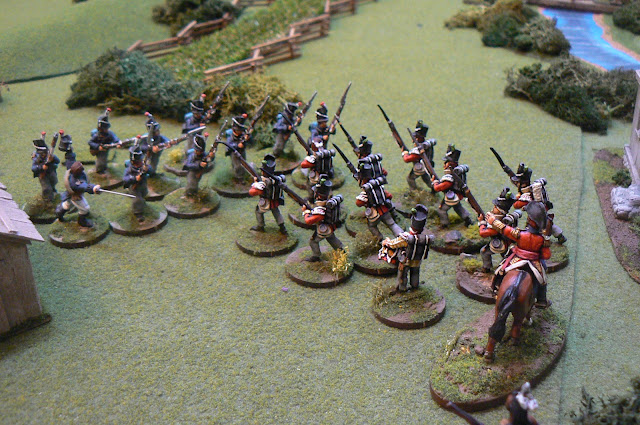
The Fencible charging the defending American Lights (in blue uniforms), the British officer on this flank directing the attack.  During the entire battle the American commander did not emerge from his headquarters in the town. (I would have him on a separate activation as the raid was to catch the Americans by surprise)

Meanwhile at the bridge the Voltigeurs were in mid-stream fording the river when they heard much screaming and stopped frozen in place - well, they failed to advance for whatever reason! - as the American Volunteers ran passed in front of them in rout away from the charge of the 3rd SEM.  The American Pioneers simply put down their tools and surrendered.
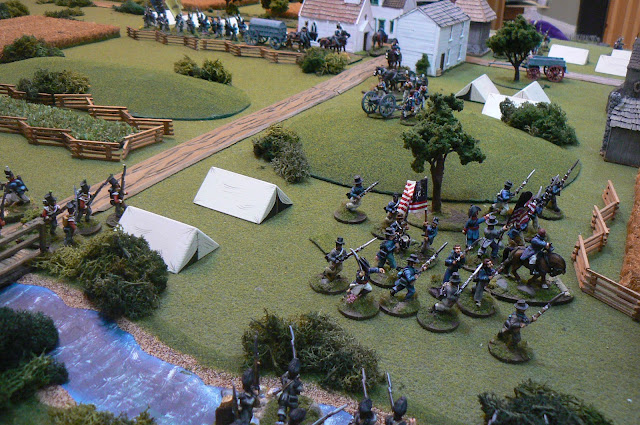
The rout of the American Volunteers from the 3rd SEM (left) and watched by the grey-clad Voltigeurs (bottom) in the river.  The artillery can be seen on the hill.

The rout of the Volunteers did clear the field of fire for the American gun on the hill, but in the haste to load the cannon they inadvertently reversed the cartridge...or because I rolled a poor 4 on their activation dice?...

In Nateville, the bulk of the US infantry seemed obvious to all this fighting as they did nothing. At this time I had now rolled under 4 pips - on two d6 - for four successive activation rolls!  Do note that for Rebels and Patriots rules activation for a unharmed unit is only 6+ on two dice.  Perhaps the dice did have a bias this day as the Canadians favoured well than the American rolls.

The brave 3rd SEM kept up to task and quickly proceeded up the road to Nateville and a double-sixes activation roll brings into action the reserve of the 1st SEM unit. 
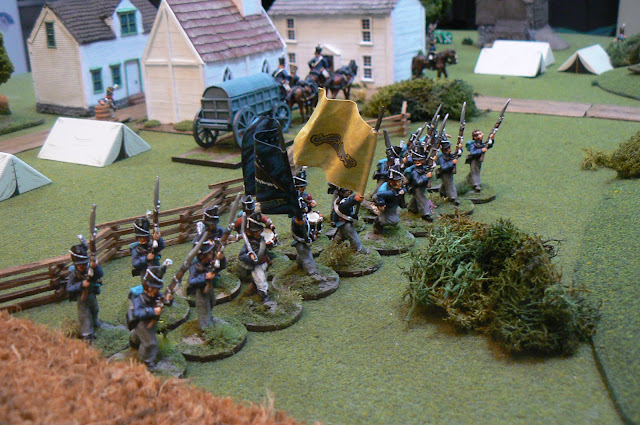
The 30th US Infantry moving up (slowly....) to support the Combined Lights 

Back on the left, both the US Lights and the Canadian Fencibles reform after their combat but the Natives continued musket fire causes further disorder to the Americans.  The fight would continue until the action in the town was resolved to signal the Fencibles to give up their fight with the American Light company who gave a surprisingly good account of themselves.  Both units sustained 30%+ casualties.

But it was on the road to Nateville that the battle hinged. The 3rd SEM, not seeing anything of the Voltigeurs (yes, yet another failed activation from this unit.  It was to have two more in turn and thus play no part in the engagement) saw the gun on the hill as a distinct threat and poured a devastating fire upon it causing half the crew to go down and breaking the morale of the artillerists.
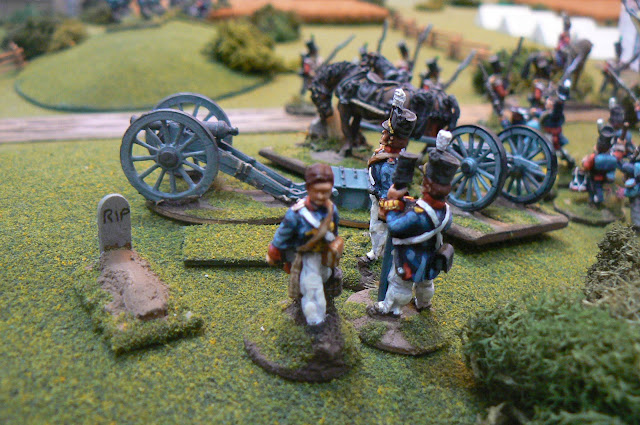
The marker to the left indicates 50% casualties on the artillery unit.  A grave morale situation indeed in the Rebel and Patriots rules.  

The officer with the 3rd SEM at the ammo wagon. 

The sounds of gunfire finally drifted to the town and eventually all three Infantry Regiments started to move in its defence.  
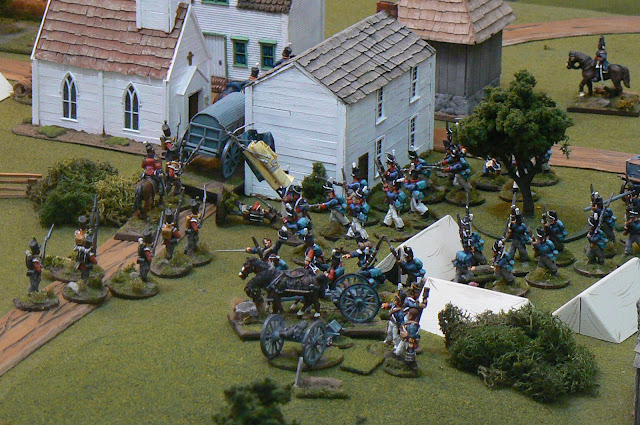
The final moments of action as the wagon is alight and the Canadians (in red) about to depart. The American units could only fire off a single weak volley of fire. 

With the new reinforcing 1st SEM moving up to the bridge to secure the route of retreat and ignoring the plight of the artillery, the heroic 3rd SEM continued up the road to find the prized ammunition wagon just ahead of them with the teamsters desperately trying to move out of harms way.  The SEM officer also could see the masses of the 10th and 31st US regiments emerging from the camps towards him.  He decided to risk a further run up the road might get his unit up to the wagon to disable it or alight it and hope the following 1st SEM would help his inevitable hasty departure. And indeed fortune favoured the brave as a fortunate Attack Activation roll of 10(") and a quick thinking musketeer jamming his weapon into the spokes of the rear wheel had the wagon come to a stop. A lit cloth was deposited under the lid of the wagon and the unit made a hasty departure under rather poorly aimed gunfire by the oncoming American regulars to the sound of a mighty explosion.  The American ammuntion supply was destroyed and the Canadians made their escape.

Casualty count:

Americans: Combined Lights  4 figures out of 12, Artillery 3 of 6, Volunteers 1 killed, 4 missing (rolled for), Regulars - all three units 0 of 18 each.

Canadians: 3rd SEM 2 of 12, Fencibles 5 of 12, Abenaki 0 of 6, Montreal Sedentary Militia, Voltigeurs, 1st SEM all 0 of 12.  


Saturday, 4 December 2021

The 'Nateville' War of 1812 campaign #1


A new wargaming pen-pal suggested the following to be a idea of a scenario:

“For you, Doug H,  I'm thinking some War of 1812 action to blog about.  A solo campaign that i can feed a bit.

The Americans are preparing an offensive and are gathering supplies and mustering troops in a town.  The Brits have caught wind and have decided to launch a spoiling attack before their own reinforcements arrive.

Scenario #1.  River crossing raid.  A smaller British force with Iroquois allies launches the spoiling attack versus the inferior quality but superior numbers American force.  A bridge (defended) and/or boats can be used to cross the river.  The river is only partially defended, then the heights to cross (also partially defended) before the town can be reached.  The majority of the American troops are in/near the town.  The British objective is to destroy the ammo dump and retreat without catastrophic casualties.  Terrain is wooded with a few farms and the major road to and from the town, bridge, and table edges.

-American activation.  Units are unaware of the raid and can not activate unless they make a successful roll.  Roll modifiers include LOS to British units, or being x distance from a firing unit”.  

------

I therefore came up with the following table set-up for my upcoming “Nateville Campaign”:

the War of 1812 theatre of operations around the fictional border town of Nateville, Vermont in the year 1813.

The American volunteers guard the bridge while the Regular Pioneers (stand on the left) do repairs on the bridge strengthening the timbers to allow the artillery to cross supporting the upcoming invasion of Canada. The artillery is in guard position on the hill in the background before the town.  Little that they know the Canadians have other ideas than to accept the invasion with little activity of their own....

The object of the Canadian raid: the important American ammunition supply. A unit of American regulars form up in front of their tents. Of note: the horse teams are Perry British but I replaced with Old Glory early war American heads.  The wagon is a Warbases MDF version of a Napoleonic baggage wagon painted in the light blue color of the American equipment during this time.  These Warbases wagons are quite good and easy to put together.

More American regulars camped on the far side of "Nateville, Vermont".  Of interest are my wooden tents. Yes, indeed they are made from wood found abandoned at a construction site in a nice triangular shape ready to be cut into tent sized portions and carefully sanded edges to give that 'canvas-draped-over-a-pole' look. The rest is just paint.

Further to the east of the bridge, the Abenaki natives (left), the Canadian Fencibles (Regulars near the creek), and French-Canadian militia (at right in the red caps) are ready to surprise the American 'Combined Lights'' Battalion (near the cabin).  The bridge is at the upper right ready to be assaulted, and  Nateville is in the distance. Most of the buildings are scratch-built by me.

I think I will use the Osprey Publishing rules "Rebels and Patriots" for the games.  Hopefully soon, but currently I find I am drifting from one 'project' to another in rapid fashion worse than a Ritalin-deprived butterfly.  

Monday, 22 October 2018

War of 1812 - a fictional affair


Battle for Sheppard’s Bridge - fictional War of 1812

American General Jim needed to capture the important bridge near the Sheppard Farm to continue his advance into Upper Canada during the War of 1812 in this fictional affair.  The British commander Kevin was to hold this advance with his British and mostly Canadian contingent.  Both sides were populated with units of dubious quality militia.

Kevin, hearing that the rules were based upon the excellent “Loose Files, American Scramble” rules by Andy Callan, and knowing the strengths and weaknesses of the various qualities of the troops,  went for a ‘defence in depth’ strategy remencent of Greene’s deployments in the American Revolutionary War and so created lines of units with his best in reserve.

Canadian militia line the fence, the Glengarry Fencibles behind and the greatcoated 49th Foot in the rear.  The successive lines of the British defence.

Jim meanwhile, in the attack, concentrated the Kentucky frontier militia on his left, while he lead his regulars, many of which were the usual poorly trained stuff of the American early war efforts, on the right of the large field which dominated the centre of the battle area.

The American advance of their Right. The militia lead.  My newly painted 'sky' backdrop employed.

The Kentucky militia perhaps evoking their constitutional rights to only defend the territory of the United States and not invade Canada, or were having internal debates or in-fighting, nevertheless refused to advance and indeed removed themselves from the action altogether before even engaging the enemy. (hard to get the militia to do much and Jim’s abundance of 1 rolls certainly did assist in their rapid dispersal!)

The milling Kentucky militia.  Their disorder displayed by the 'cannonballs'

With that flank stalled, Jim continued his advance by units on his right until the final effort to take the hill before the bridge.  The US 16th Infantry Regiment lead the attack against the defending British 13th Foot.  While engaged in an equal battle for the hill, they were joined by additional forces from both sides.  The British barely came out the victors.   With that, the American effort was thwarted.

The critical fight on the hill with the 13th Foot still wearing their white tropical shakos.  (In reality, these were quickly exchanged for the usual black shakos, but they are just too cool not to not represent!)
both sides add to the combat

Wednesday, 15 August 2018

“Glutson’s Run”


Battle of Harmony Creek - A ‘War of 1812’ fictional game

The local New York State militia commander needed to help his flagging political career and what better way for an American politician than a good ‘ol military victory!  What excites the American voter more than the triumphant conquerer.

A decent orator, he was quick to enflame the local militiamen to quickly leave their jobs and loved ones and, still in their civilian dress, conduct a raid into Canada across Harmony Creek to capture the nearby farmhouse.

Singing patriotic songs the American militiamen were oblivious to the green-jacketed Glengarry Fencibles (a trained long-term Canadian militia unit) deployed along the creek.  The Glengarry commander had strict instructions not to engage the Americans unless fired upon or the creek was crossed, so was somewhat baffled as the noisy American column seemed not even to notice his unit but continued to the bridge upstream.
The Glengarries, uniformed in riflemen's green but armed with muskets wait along Harmony Creek.  The seemingly nearsighted officer checking his orders once again.  "What to do if they ignore you?"
Mrs. Secord informs the Canadian commander of the threat.  "Many thanks Madam".
 The uniformed militia await orders.  Many of the Canadian militia were provided British infantry uniforms but in green with a variety of red, yellow or blue facings along with blue coloured pantaloons and stovepipe shakos or top-hats. 

Mrs. Secord, escorting her cow, had warned the British commander of the threat and the local Canadian militia had formed at her farm to meet the threat.  The oblivious New Yorkers (the US commander’s second roll for ‘situational awareness’ was again a 1 ! ) continued his advance toward the farm only to have the Canadians emerge from the wheat field and along the side fence mere yards from his column.  The combat was rather one-sided routing the first NY unit who piled into the second.  Shocked by the sudden fighting, all the Americans started running for home.
The American column.
The combat near Harmony Creek

The Glengarries meanwhile had advanced across the stream to follow the American column and were reforming from the slight disorganization of this maneuver as the Americans came back in great confusion. While the greencoat’s musket fire caused little in way of casualties, their fire pushed the New Yorkers into the woods away from the blasts.  No hope for the Americans to reform.
The first militia unit collides into the column following.  Quickly both are in rout. The knapsack markers indicate disorder effects
The bird-eye's view near the end of the affair. The routing Americans in the middle with the Canadian militia to the left and the Glengarries in the upper portion of the photo.

The Canadians, now in US territory, did not pursue but quickly returned across the creek with no casualties.

With some dead and many wounded, the main casualty was the Senator Glutson’s election bid.  He lost by 6,200 votes.

The solo game was conducted with my rather simple rules of random rolls for unit’s orders and combat results.  The diced actions then form the narrative.
I started this game by randomly bringing out of the boxes an American civilian dress unit. During this era,  they are usually commanded by a local politician, thus the beginnings of my story…..