A comparative videographic study by Catherine Grant showcasing the repetitions and variations across two sets of corresponding sequences from the three direct film adaptations of Christa Winsloe's MÄDCHEN IN UNIFORM (aka RITTER NÉRESTAN and GESTERN UND HEUTE, 1930-32). Video first published at MEDIÁTICO in December 2019, alongside a great text on the Mexican adaptation by Roberto Carlos Ortiz.
Better late than never, so they say. But it is especially late for this to be the very first, as well as the very last, blog entry of 2019 at Film Studies For Free...
What else can this blog's author say, but sorry / not sorry for being distracted by an incredibly busy year spent in hot pursuit of other excellent open-access screen studies initiatives - all listed immediately beneath this introduction.
It has also been a year of tremendous loss for many, especially, it seems, in the realm of film and moving image studies. So this end of year/end of decade FSFF post has a somewhat sombre tone and distinctly commemorative content. It offers warm tributes in links to the work and lives of the two foundational film scholars-filmmakers who sadly died late in 2019: Thomas Elsaesser and Peter Wollen. We owe them so much. It also offers a further deeply-heart-felt tribute to a brilliant young film scholar who, in February of this year, died way too soon: Katharina "Kat" Lindner.
FSFF's author had the great fortune, honour and pleasure of meeting all three of these wonderful contributors to our discipline. She sends much love and sincere condolences to their partners, families and close friends. As further online tributes to these scholars appear, the entries below will be updated.
Other huge film studies losses, in this cruel year, have included Edward Branigan and Eileen Bowser.
Below FSFF's tributes, this end of year entry continues with this blog's customary lists of links to some of its favourite open-access film and moving image studies resources from 2019.
Film Studies For Free wishes all of its readers and viewers a happy and healthy 2020! It hopes to see a lot more of you in the next decade!
Film Studies For Free's Author's OA Activities in 2019
- 3 new open-access co-edited collections:
- Beast Fables: On Animals in the Cinema with Tracy Cox-Stanton at The Cine-Files;
- New ways of seeing (and hearing): The audiovisual essay and television with Jaap Kooijman at NECSUS: European Journal of Media Studies;
- Pride Revisited: Cinema, Activism and Re-Activation, with Diarmaid Kelliher at the Open Library of Humanities Journal.
- 2 new open access, multimedia websites:
- The Videographic Essay: Practice and Pedagogy, which collects both previously-published and new versions of writings by Christian Keathley, Jason Mittell and FSFF's author Catherine Grant, and many videos by them and others, among other useful material;
- screenstudies.video, another still in production research resource by this blog's author, coming very soon in 2020...
- Service on the steering committee of the brilliant new pre-print initiative MediArxiv: Open Archive for Media, Film, and Communication Studies, as well as on the boards of numerous other OA archives and journals... Also check out the new bilingual Spanish/English journal Tecmerin: Revista de Ensayos Audiovisuales / Journal of Audiovisual Essays
- 2 great podcast interviews on video essays: one with Will DiGravio for the new The Video Essay Podcast; and one with José Arroyo for his Conversations with Film Scholars series
- Much ongoing co-editorial labour of love at [in]Transition: Journal of Videographic Film and Moving Image Studies, which, in 2019, added two brilliant new co-editors to its team: Neepa Majumdar and Kevin L. Ferguson.
- 16 new online video essays on screen studies topics: 14 published here; and 2 more here; including probably her best one ever.
- And continued daily or weekly sharing at FSFF's Twitter and Facebook accounts.
-------------------------
In Memoriam Thomas Elsaesser
(1943–2019)
Personal tribute by Catherine Grant
I still can’t believe Thomas Elsaesser has died. A foundational and inspirational figure in our field - and for me personally, especially given his utter dedication to open access publishing, both by his own example, sharing so many of his publications at his website, as well as as a hugely important figure at Amsterdam University Press.
I met Thomas in 2001 at the Forever Godard conference and remained in touch. In the last years, especially, I got to spend time with him in person quite a lot as our paths crossed on many conference trips and he visited the institutions I have worked in numerous times, including to screen his lovely film The Sun Island. From his work on melodrama, authorship (his Fassbinder book, linked to below was a huge influence on my work), media history and archaeology, through to, latterly, research by film and video practice, he was always leading the way. He was hugely supportive of Film Studies For Free over the years, and of the scholarly endeavour of videographic approaches to our discipline, in which he was also a pioneer (see below).
Where will we go now, Thomas?
Online Tributes and Festschrifts
- 'Stories we tell: Remembering Thomas Elsaesser, by Malte Hagener, NECSUS: European Journal of Media Studies, 12 December, 2019
- 'In Memoriam Thomas Elsaesser' by Patricia Pisters, UvA website, 7 December, 2019
- Mind the Screen : Media Concepts According to Thomas Elsaesser, edited by Patricia Pisters, Wanda Strauven and Jaap Kooijman (Amsterdam University Press, 2008)
- 'Remembering our colleague and friend Thomas Elsaesser', by Maryse Elliott, Senior Commissioning Editor at Amsterdam University Press, December 2019
- Tributes to Thomas Elsaesser, by David Hudson, Criterion Daily, 10 December 2019
- 'In Memory of Thomas Elsaesser, film scholar and filmmaker extraordinaire', The Essay Film Festival, December 2019
- Thomas Elsaesser, Film Scholar With A Broad View, Dies At 76, New York Times, by Richard Sandomir, December 19, 2019
Open Access Books
- Writing for the Medium : Television in transition, edited by Lucette Bronk, Thomas Elsaesser and Jan Simon (Amsterdam University Press, 1994)
- Fassbinder's Germany : History, Identity, Subject, by Thomas Elsaesser (Amsterdam University Press, 1996)
- A Second Life : German Cinema's First Decades, edited by Thomas Elsaesser (Amsterdam University Press, 1996)
- Harun Farocki : Working on the Sight-Lines, edited by Thomas Elsaesser (Amsterdam University Press, 2004)
- The Last Great American Picture Show : New Hollywood Cinema in the 1970s, edited by Noel King, Thomas Elsaesser and Alexander Horwath (Amsterdam University Press, 2004)
- European Cinema : Face to Face with Hollywood, by Thomas Elsaesser (Amsterdam University Press, 2005) - this collection includes Elsaesser's essay on Peter Wollen's first solo-directed film Friendship's Death (1987).
- And Mind the Screen : Media Concepts According to Thomas Elsaesser, edited by Patricia Pisters, Wanda Strauven and Jaap Kooijman (Amsterdam University Press, 2008)
Websites
Thomas Elsaesser - Including a list of Publications (many downloadable as PDFs)
Film Theory: An Introduction Through the Senses
Online Interviews (more to be added)
Essay Film Festival 2018: Thomas Elsaesser in Discussion with Erica Carter
about his 2018 film The Sun Island
Videos and Video Essays
Thomas Elsaesser's Vimeo Account
BERGMAN SENSES (Thomas Elsaesser, Anne Bachmann and Jonas Moberg)
Film Studies For Free Tribute videos
Installations and Compilations: Elsaesser Senses - Commentary version
-------------------------
In Memoriam Peter Wollen
(1938-2019)
Personal tribute by Catherine Grant
I only met Peter Wollen once in real life - also at the 2001 Forever Godard where I met Thomas Elsaesser and other foundational film scholars. But I encountered him in my head many many times, and will continue to do so. His work - particularly his brilliant filmmaking explorations with Laura Mulvey, and the second edition of his book Signs and Meaning in the Cinema, with its groundbreaking arguments about film authorship and 'patterns of energy cathexis' - were of huge importance to my own writing, teaching, and also filmmaking. His 2001 account of cinephilia in "An Alphabet of Cinema" (NEW LEFT REVIEW, 12) is even more of an influence on what I and others are doing now in our video essays and works of creative criticism. I am very much looking forward to the cinematic re-release of Friendship's Death, his 1987 solo-directed essay film, in 2020, and feel sure that Wollen's work, with its timely prescience, will endure in many ways that we cannot yet predict.
Online Tributes
PETER WOLLEN (1938–2019), Artforum, December 20, 2019
Online written work by Peter Wollen
'Knight's Moves', PUBLIC, 25, 2002 (about Mulvey/Wollen's joint work)
'The Field of Language on Film', October, 17, Summer 1981 [Lux Online version] (about Mulvey/Wollen's joint work)
'Interview with Tony Garnett and Ken Loach: Family Life in the making', by Anthony Barnett, John McGrath, John Mathews, and Peter Wollen, from Jump Cut, no. 10-11, 1976
Ch. 2, Signs and Meaning in the Cinema; 'The Auteur Theory' [PDF]
S.T.R.O.B.E. by Peter Wollen
Work about Wollen's Research and Filmmaking
Nicolas Helm-Grovas, Laura Mulvey and Peter Wollen: Theory and Practice, Aesthetics and Politics, 1963-1983, PhD thesis, Royal Holloway, University of London, 2018
European Cinema : Face to Face with Hollywood, by Thomas Elsaesser (Amsterdam University Press, 2005) - this collection includes Elsaesser's essay on Peter Wollen's first solo-directed film Friendship's Death (1987), and numerous other references to his work.
Lux Online Entry on 'Laura Mulvey and Peter Wollen'
European Cinema : Face to Face with Hollywood, by Thomas Elsaesser (Amsterdam University Press, 2005) - this collection includes Elsaesser's essay on Peter Wollen's first solo-directed film Friendship's Death (1987), and numerous other references to his work.
Lux Online Entry on 'Laura Mulvey and Peter Wollen'
Wollen epigraph by Christian Keathley
Film Studies For Free Tribute video
-------------------------
In Memoriam Katharina Lindner
(1979-2019)
Personal tribute by Catherine Grant
Online Tributes
'Towards a Queer Feminist Vernacular: Dr Katharina Lindner’s Film Bodies'
(1979-2019)
Personal tribute by Catherine Grant
Kat Lindner is missed so acutely by so many in her twin worlds of football and film studies. I met her only once in person, a few years ago, though we corresponded about our work over the years. She came to an event in Glasgow at which I was talking, as usual, about video essays. She was a razor sharp, deeply original thinker, with a truly glowing presence. Afterwards we talked for a long time - me trying to convince her, and almost succeeding, I think, that her fabulous work on queer cinematic phenomenology would translate brilliantly to this audiovisual format if only she would take it up. It was an exhilarating conversation and I wish it hadn't had to end. Even before that memorable encounter, I loved her work (especially her path-breaking 2017 book Film Bodies: Queer Feminist Encounters with Gender and Sexuality in Cinema), and used it in my own research directly and indirectly. One day I would like to make a video essay about her writing - but I haven't been able to yet.
Online Tributes
'Katharina Lindner, 1979-2019: Tributes paid to footballer turned queer theorist', by Matthew Reitz, THE, 28 February 2019
'Obituary: Kat Lindner, academic and footballer for Glasgow City', The Herald, 14 February 2019
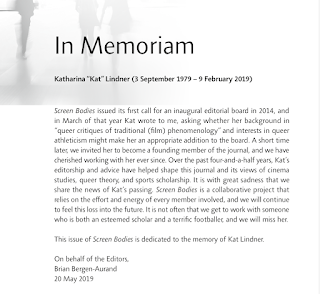
'Screening Expectation' in Screen Bodies, by Brian Bergen-Aurand
DOI: https://doi.org/10.3167/screen.2018.030201 [PDF]
Online Film Studies Writing by Lindner
'Questions of embodied difference: Film and queer phenomenology',
NECSUS: European Journal of Media Studies, Autumn 2012
‘Situated bodies, cinematic orientations: Film and (queer) phenomenology’, in Saer Ba and William Higbee (eds), De-Westernizing Film. London: Routledge, 2012, [pre-print]
'Spectacular (Dis-) Embodiments: The Female Dancer on Film', Scope, 20, June 2011 PDF
‘‘There is a reason why Sporty Spice is the only one of them without a fella...’: The ‘lesbian’ potential of Bend it Like Beckham’. New Review of Film and Television Studies, Vol. 9, No.2, 2011, pp. 204-223 [pre-print]
‘Bodies ‘in action’: Female athleticism on the cinema screen’. Feminist Media Studies, Vol.11, No.3, 2011, pp. 321-345 [pre-print]
‘Fighting for subjectivity: Articulations of physicality in Girlfight’. In Journal of International Women’s Studies, 2009, Vol.10, No.3, pp.4-17. [pre-print]
(Other online publications and pre-prints on media studies topics by Lindner are accessible here)
Writing about Lindner's Research
Davina Quinlivan, 'Film Bodies: Queer Feminist Encounters with Gender and Sexuality in Cinema, by Katharina Lindner' Times Higher Educational Supplement, January 18, 2018
Jules O'Dwyer, Katharina Lindner (2017) Film Bodies: Queer Feminist Encounters with Gender and Sexuality in Cinema, Film-Philosophy, 22.3
Kat's Inspirational Hartford Hawks Hall of Fame Acceptance Speech, Class of '03
Video link
-------------------------
FSFF's Favourite Online Film and Moving Image Studies 2019
'Obituary: Kat Lindner, academic and footballer for Glasgow City', The Herald, 14 February 2019
'Screening Expectation' in Screen Bodies, by Brian Bergen-Aurand
DOI: https://doi.org/10.3167/screen.2018.030201 [PDF]
Online Film Studies Writing by Lindner
'Questions of embodied difference: Film and queer phenomenology',
NECSUS: European Journal of Media Studies, Autumn 2012
‘Situated bodies, cinematic orientations: Film and (queer) phenomenology’, in Saer Ba and William Higbee (eds), De-Westernizing Film. London: Routledge, 2012, [pre-print]
'Spectacular (Dis-) Embodiments: The Female Dancer on Film', Scope, 20, June 2011 PDF
‘‘There is a reason why Sporty Spice is the only one of them without a fella...’: The ‘lesbian’ potential of Bend it Like Beckham’. New Review of Film and Television Studies, Vol. 9, No.2, 2011, pp. 204-223 [pre-print]
‘Bodies ‘in action’: Female athleticism on the cinema screen’. Feminist Media Studies, Vol.11, No.3, 2011, pp. 321-345 [pre-print]
‘Fighting for subjectivity: Articulations of physicality in Girlfight’. In Journal of International Women’s Studies, 2009, Vol.10, No.3, pp.4-17. [pre-print]
(Other online publications and pre-prints on media studies topics by Lindner are accessible here)
Writing about Lindner's Research
Davina Quinlivan, 'Film Bodies: Queer Feminist Encounters with Gender and Sexuality in Cinema, by Katharina Lindner' Times Higher Educational Supplement, January 18, 2018
Jules O'Dwyer, Katharina Lindner (2017) Film Bodies: Queer Feminist Encounters with Gender and Sexuality in Cinema, Film-Philosophy, 22.3
Kat's Inspirational Hartford Hawks Hall of Fame Acceptance Speech, Class of '03
Video link
-------------------------
FSFF's Favourite Online Film and Moving Image Studies 2019
Favourite Contributions to Online Film Scholarly Culture by a Single Scholar
Jennifer Proctor for 'Am I Pretty? and a “Sonic Gaze”', [in]Transition: Journal of Videographic Film and Moving Image Studies, 2019, plus her article 'Teaching avant-garde practice as videographic research', in Screen, 60.3, Autumn 2019; and especially for her inspirational continuing work on the inclusive teaching initiative, EDIT Media (Equity, Diversity, and Inclusion in Teaching Media), http://www.editmedia.org
Favourite Open Access Journal Article
'“Our Bravest and Most Beautiful Soldier”: Pola Negri, Wartime and the Gendering of Anxiety in Hotel Imperial', by Elisabetta Girelli, in Film-Philosophy's special issue on Stardom and Film-Philosophy (23.2, 2019), edited by Lucy Bolton
Favourite Open Access Journal Article
'“Our Bravest and Most Beautiful Soldier”: Pola Negri, Wartime and the Gendering of Anxiety in Hotel Imperial', by Elisabetta Girelli, in Film-Philosophy's special issue on Stardom and Film-Philosophy (23.2, 2019), edited by Lucy Bolton
Favourite New Open Access Journal Issue
Issue 16, Winter 2019, edited by Ana Maria Sapountzi & Peize Li
Favourite New Open Access Journal
Media+Environment, edited by Alenda Chang, Adrian Ivakhiv and Janet Walker
Most Missed Online Journal That Stopped Publishing in 2019
(Read about its demise here. But, thanks to the generosity of filmmaker Barry Jenkins, you can purchase a compendium of the best writing in its six year run).
Favourite Three New Open Access eBooks
The Cinema of Marguerite Duras : Multisensoriality and Female Subjectivity
By Michelle Royer (Edinburgh University Press, 2019)
Frame by Frame: A Materialist Aesthetics of Animated Cartoons
By Hannah Frank (University of California Press, Oakland, 2019)
The Structures of the Film Experience by Jean-Pierre Meunier:
Historical Assessments and Phenomenological Expansions
By Julian Hanich and Daniel Fairfax (Amsterdam University Press, 2019)
The Cinema of Marguerite Duras : Multisensoriality and Female Subjectivity
By Michelle Royer (Edinburgh University Press, 2019)
Frame by Frame: A Materialist Aesthetics of Animated Cartoons
By Hannah Frank (University of California Press, Oakland, 2019)
The Structures of the Film Experience by Jean-Pierre Meunier:
Historical Assessments and Phenomenological Expansions
By Julian Hanich and Daniel Fairfax (Amsterdam University Press, 2019)
Favourite Film Studies Blog (as Ever)
Observations on Film Art by David Bordwell and Kristin Thompson
Favourite New Film and Moving Image Studies Related Podcast
Observations on Film Art by David Bordwell and Kristin Thompson
Favourite New Film and Moving Image Studies Related Podcast
Favourite Online Videographic Approach to Screen Studies
Poor Jesse by Jason Mittell,
Part of "The Chemistry of Character in BREAKING BAD: An Audiovisual Book"
Favourite Collection of Online Video Essays (Not Published by FSFF)
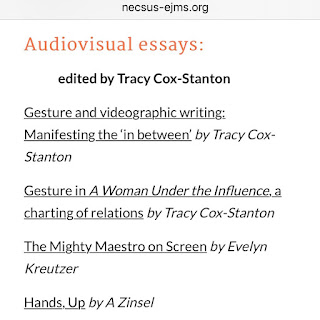
In an excellent new issue of NECSUS European Journal of Media Studies, Autumn 2019, devoted to treatments of gesture, came this collection of three excellent video essays in a section edited by Tracy Cox-Stanton: (scroll down)
Favourite Collection of Online Video Essays (Not Published by FSFF)
-------------------------
14 of Film Studies For Free Video Essays Published in 2019