Spy Vibers, I'm on a mission and look forward to sharing photographs with you from all the major filming locations from the great 1960s series like The Prisoner, The Avengers, The Saint, and many more. Stay tuned! I'll try to post updates en route. In the meantime, check out a Spy Vibe classic that may have slipped off the radar. If your vibe is architecture and design, this Le Corbusier book may be of interest. Phaidon's new massive edition, Le Corbusier Le Grand, clocks in at 768 pages and the original slipcase edition apparently weighs almost 20 pounds! A new (and cheaper) format was published last year. Details on Amazon here. Le Corbusier is celebrated for his sleek modernist buildings, interiors, and furniture. Details: "A spectacular visual biography of the life and work of Le Corbusier (1887–1965), one of Modernism's most influential architects, urban planners, and theorists. Approximately 2,000 images and documents, many previously unpublished, feature his major built works, urban plans, paintings, publications, and furniture as well as sketches, archival photographs, and personal correspondence. Rarely seen photographs and correspondence shed new light on Le Corbusier’s relationships with Josephine Baker, Eileen Gray, Fernand Léger, Pablo Picasso, Jean Prouvé, and many others. Insightful introductory essay by France’s most authoritative architectural historian and critic, Jean-Louis Cohen, and incisive chapter introductions by highly regarded Le Corbusier scholar Tim Benton. The same grandly oversized format as Warhol 'Giant Size'." As much as we celebrate modern design, however, it is interesting to note that James Bond author, Ian Fleming, had a great dislike for architects like Le Corbusier. In fact, Modernism itself has been under fire since it began. What's the beef? Story continues below.

Ian Fleming found Le Corbusier's work too stark and rational. In his book, Thrilling Cities, Fleming even referred to one of the designer's environments as a "flattened human ants' nests." And the author's negative feelings about Brutalist architect, Erno Goldfinger, even inspired the name of one of his most legendary villains. Fleming's reaction is not surprising, considering his preference for unpretentious dwellings and his famous need to escape away from his wife's stuffy dinner parties. There's no room to escape in open-plan living. He was most at home at GoldenEye, a simple house he had built for himself in Jamaica. Despite our love of modern design now, Fleming wasn't alone in his criticism. There has been a kind of mistrust in the culture. Some attribute it to the link between Fascism and Futurism, which launched in Italy in 1909. A cold, orderly, and technological existence versus the more traditional image of hearth and home, with its emphasis on family, cosy fireplaces, and comfy furniture. The mistrust runs along the same lines as the fear and fascination with science. An early cinematic critique can be found in The Black Cat (1934), which featured evil architect Hjakmar Poelzig (Boris Karloff) living in a mechanized, modernist mansion -with his own gallery of frozen women in the basement! The Cybernauts story in The Avengers famously criticized a modern world taken with gadgets and people replaced by machines. And doesn't this line of dialog ring true? "This heralds a new age. Computers no bigger than a cigarette box. Pocket television. And radios smaller than a wristwatch." Even Star Wars was founded on a thematic contrast between nature/spirit and technological terror. It is no mistake that on-screen Bond villains, with their aim to redesign society as an ordered utopia, are closely linked to Modernism. Compare the sleek, corporate environments of the baddies in almost any 007 adventure with M's world of club chairs, libraries, gourmet dining, and pipe smoke, and a thematic contrast really becomes apparent. Below: work by Le Corbusier.


We are so attracted by the modern aesthetic, from the new wave of loft-style real estate to the success of Apple products. But filmmakers continue to issue these subtle warnings, either by convention or design. An interesting example was the most recent version of the Body Snatchers story (The Invasion/2007), where the soulless duplicates suddenly became a well-dressed army representing consumerism and globalization. As much as we love to envision ourselves lounging in a minimal lair, I think Fleming and many filmmakers would caution us not to lose our humanity or individualism. I have noted "good-guy" spaces in contemporary Bond films becoming sleeker and more mechanical, which the designers try to balance by showing quirky desk ornaments and more traditional home environments. Is it a sign our heroes are becoming too rational and orderly? Is it a military mindset? Skyfall did a great job weaving in this theme by frequently calling attention to how the "old ways are the best." Despite my aesthetic critique from a cinematic lens, I do encourage Spy Vibers to check out the new Le Corbusier book from Phaedon. It's stunning! But maybe read it with a cup of tea by the fireplace- just in case. Learn More: Le Corbusier, Ian Fleming. Related Spy Vibe posts: Erno Goldfinger, Modern Architecture LP, Set For Adventure. Below: Contrast between some of my favorite 007 Baddie set designs by Ken Adam and variations of M's traditional office. Enjoy!


Selected Spy Vibe Posts: Interview: Mod Tales 2, Umbrella Man: Patrick Macnee, New Beatles Film, The Curious Camera, Esterel Fashion 1966, Exclusive Ian Ogilvy Interview, 007 Tribute Covers, The Phantom Avon novels return, Ian Fleming Festival, Argoman Design, Sylvia Anderson R.I.P., Ken Adam R.I.P., George Martin R.I.P., The New Avengers Comics, Trina Robbins Interview, The Phantom at 80, 007 Manga, Avengerworld Book, Diana Rigg Auto Show, The Prisoner Audio Drama Review, David McCallum novel, Andre Courreges R.I.P., Who's Talking on Spy Vibe, UFO Blu-ray, Avengers Pop Art Interview, Fergus Fleming Interview, Avengers: Alan Hayes Interview, Jaz Wiseman Interview, Diana Rigg BFI Interview, Casino Royale Interview: Mike Richardson, Lost Diana Rigg Interview, Honor Blackman at 90, UNCLE School, Ian Fleming Memorial, Portmeirion Photos, Doctor Who Exhibit, Farewell Steed, Pussy Galore Returns, Diana Rigg birthday, Sherlock at 221B, Invisible Agent, Saint Interview: Ian Dickerson, Saint Doppelgänger, Fleming's Typewriter, Rare Fleming, Fleming's Music, Ian Fleming's Japan, Jim Wilson Corgi Interview, Fantomas Design, John Buss interview, Saint Volvo, Mod Tales Interview, Agente Secreto Comics, Danger Man Comics 2, Danger Man Comics, John Drake Comics, Der Mann Von UNCLE, Golden Margaret Nolan, Man From UNCLE Rocksteady, Pussy Galore Calypso, Cynthia Lennon R.I.P., Edward Mann Fashion, Leonard Nimoy Tribute, Shatner at 84, Bob Morane series, Thai Bond Design, Bond vs Modernism, Tokyo Beat 1964, Feraud Mod Fashion, Green Hornet Manga, Avengers Interview: Michael Richardson, Ian Fleming: Wicked Grin, Jane Bond Hong Kong Records, Ryan Heshka Interview, Comics Week: Man From R.I.V.E.R.D.A.L.E., Comics Week: Archie, Comics Week: Robots, Comics Week: Cold War Atomic, Comics Week: SPYMAN, Comics Week: Jimmy Olsen, Shakespeare Spies: Diana Rigg, Shakespeare Spies I, Rodney Marshall Avengers Interview, Richard Sala: Super-Enigmatix, Cold War Archie, Playboy Bunny Interview, The 10th Victim Japanese and Kindle, U.N.C.L.E. Japanese Books, Catsuits, Batman '66 Green Hornet Interview: Ralph Garman Ty Templeton.
Shout Factory has announced the upcoming Blu-ray release of Joe Massot's Wonderwall (1968), starring Jane Birkin and Jack MacGowran. The film was released on by Rhino on DVD in 2002 (with handmade edition in 2004), but has since gone out of print. Shout Factory's release will offer the first Hi-def edition of the movie. George Harrison provided the soundtrack, which fused electric and traditional Indian instruments in a kaleidoscope of sound. Harrison recorded the Wonderwall Music album between December 1967 and January 1968, and it was the first solo Beatles record and first release on the band's Apple label (personnel included Ringo Starr, Eric Clapton, Peter Tork of The Monkees, and members of The Remo Four).

From the press release: "Jack MacGowran plays Oscar Collins, an eccentric butterfly
scientist who becomes obsessed with his neighbour, Penny Lane ( Birkin) after
discovering a secret peephole in the wall between their flats. Penny is a young
and beautiful fashion model, who spends her days in her rainbow painted pop
apartment smoking dope, cavorting around in various states of undress and
making love to her sexy boyfriends. Collins is soon overcome by his delusional
fantasies about her, and repeatedly loses himself in trippy musical daydreams." The film also includes an appearance by Anita Pallenberg (Candy, Barbarella, Performance). Notable credits include Cinematographer Harry Waxman (The Wicker Man, The Pink Panther Strike Again, and The Family Way- w soundtrack by Paul McCartney), Production Designer Assheton Gorton (The Bed-Sitting Room, Get Carter, and The Magic Christian- starring Ringo Starr), and Costume Designer Jocelyn Rickards (From Russia With Love, The Knack…and How To Get It, and Blow-Up). Movie trailer below:
Spy Vibers will recognize the stars of the film from their iconic performances in the 1960s. Jack MacGowran appeared in The Fearless Vampire Killers (Polanski/1967), How I Won the War (Lester/1967), and in episodes of Danger Man, Secret Agent, The Avengers, and The Champions. Jane Birkin has been featured often on Spy Vibe. In addition to her relationships with James Bond composer John Barry and French composer/actor Serge Gainsbourg, Birkin had a successful career as a model and singer. She appeared in The Knack…and How to Get It (Lester/1965) and Blow-Up (Antonioni/1966). One of my fave Birkin releases is her 2006 arrangement of Bryan Ferry's In Every Dream Home a Heartache. Image below of Jack MacGowran in The Avengers ("The Winged Avenger") from Mrs. Peel We're Needed.

Wonderwall provides an interesting window into the world of 1967-1968, which began to highlight counter-culture and psychedelic pop fantasies in the context of youth, the arts, and society. This was the era of Barbarella, The Monkees Head, Magical Mystery Tour, Easy Rider, Yellow Submarine, Tonite Let's All Make Love in London, Girl On a Motorcycle, 2001 A Space Odyssey, Planet of the Apes, Rosemary's Baby, The Party, and Danger Diabolik. There was definitely something in the water! Shout Factory will release Wonderwall on March 25th. Amazon pre-order page here. George Harrison's soundtrack album is currently out of print. The band Oasis often mined 1960s Fab culture for inspiration. They released their gorgeous mega-hit Wonderwall in 1995. Spy Vibe's review of the 1968 Exhibit here. Spy Vibe posts about the satire boom in England in the 1960s: UK Satire Boom, UK Satire/Surrealism Peter Sellers to John Lennon, The Prisoner Fallout.


Recent Spy Vibe posts: David Bowie at 67, Kevin Dart talks Ringo & Powerpuff Girls, Sherlock Exhibit, Fu Manchu history panel, Andy Warhol box set, Six-Million Dollar Man, Striped Light Nude, Buckminster Fuller, Dylan at Newport, Jane and Serge, The Goldfinger Variations, Mod Tales Interview, Pete Seeger nominated for Grammy,Kraftwerk returns to US, Beatles BBC on Fresh Air, Steranko S.H.I.E.L.D. Artist Editions, David Tennant's Ian Fleming audio books, Atomic Art, Modern Architecture LP, Julius Shulman, Shane Glines Batman, The Prisoner and Captain Scarlet, Diego Fortunato and Verner Panton, Saturday Morning Cartoons, Assassination Bureau on DVD, new Young Bond series, new Hercule Poirot novel, Early Beatles image archive, Julie Newmar, Erno Goldfinger, Hitchcock tribute.
Recent Ian Fleming posts on Spy Vibe: Ian Fleming Letters, Erno Goldfinger, Ian Fleming Music Series links: Noel Coward, Whispering Jack Smith, Hawaiian Guitar, Joe Fingers Carr, new Ian Fleming Catalog, Jon Gilbert interview, Double 007 Designs, Bond audio book reissues, discovery of one of Ian Fleming's WWII Commandos, James Bond book covers, Ian Fleming's Playboy interview for Kindle, Spy Vibe's discovery of a rare Ian Fleming serialization, rare View to a Kill, Fleming's Royal gold typewriter, Ian Fleming's memorial address, Spy Vibe's Ian Fleming image archive.
Some of my agents have been looking at stylish stereos from the 1960s and it's difficult to top the designs made for Braun by Dieter Rams. Here is post with images I took at his SFMOMA exhibit.
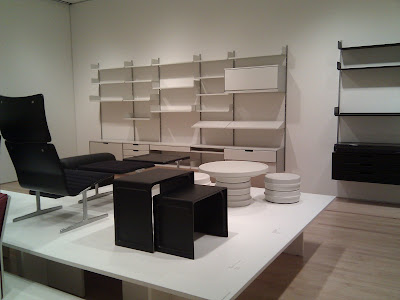
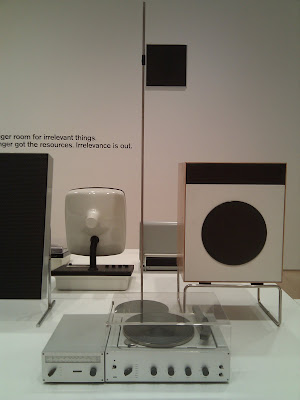
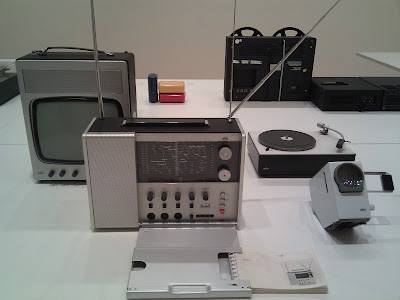
If your secret lair or bachelor pad has a modernist vibe, employing minimal Ikea shelving systems or Apple computer products, your environment owes a lot to German industrial designer, Dieter Rams. Rams, who is recently retired, was the visionary behind decades of sleek and functional gadgets produced by Braun and home organization and furniture by Visoe. If you're like me, you might have grown up in a household filled with Rams-designed clocks, coffee grinders and coffee-makers, juicers, hair dryers, and electric razors. Rams also designed cameras, and my favorite, a long line of stereo components and speakers. The philosophy that tied his work together was the notion that objects should be created to be instantly understood and useful. His pieces had a beautiful simplicity and functionality that were a direct inspiration for Apple products. In his foreword to a new book about Rams, Apple designer Jonathan Ive said, “surfaces that were without apology, bold, pure, perfectly-proportioned, coherent and effortless. No part appeared to be either hidden or celebrated, just perfectly considered and completely appropriate in the hierarchy of the product’s details and features. At a glance, you knew exactly what it was and exactly how to use it (Examiner)."
 The exhibit, Less is More: The Design Ethos of Dieter Rams, ran at SFMOMA from Aug 2011 through Feb 2012. From SFMOMA: "Widely regarded as one of the most influential industrial designers of our time, Dieter Rams produced iconic works and innovative ideas (in particular his advocacy for "less but better" design) that have proved seminal for our contemporary design culture. For more than 40 years, Rams was the lead designer for the German household appliance company Braun. He has also been the active designer for German furniture company Vitsœ since his start there in 1959. This exhibition includes more than 200 models and objects by Rams and his team, as well as contemporary designs influenced by his Ten Principles of Good Design, such as Apple computers."
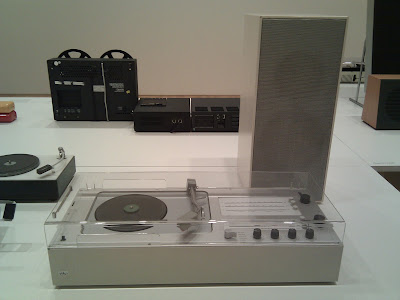
Here are some preview images I made at the museum to share with Spy Vibers. The piece that excited me most was his 1956 record player, the SK4 (image #6 below). When the original sheet metal hood rattled at higher volumes, Rams suggested using a transparent plastic lid- a material that only recently had appeared on the market. Detractors thought the plastic hood was too much in line with temporary fashion (see Spy Vibe's article Fear and Fashion), and the SK4 was nicknamed "Snow White's Coffin". Of course, the clear cover became ubiquitous around the world and changed the look of turntables forever. To learn more, check out the books, Dieter Rams: As Little Design as Possible, Less and More: The Design Ethos of Dieter Rams, Braun- Fifty Years of Design and Innovation. There is also a short video presentation with Rams at SFMOMA on Vimeo. Portrait above from the nice overview post, Who is Dieter Rams?



In concert with our previous post about Dieter Rams, we though Spy Vibers might be interested in exploring the new line of speakers from Libratone. Based in Copenhagen, the Libratone concept is to offer a single high-end speaker solution for any room that is both wireless and customizable in a variety of colors. Wrapped in beautiful Italian cashmere and carved wool, Libratone aims to make a flexible speaker for your wireless Hi-Fi that is also an integrated and stylish piece of furniture.
 They have been selling in the European market and recently started to introduce their products at US Apple stores. If any Spy Vibers have used Libratone speakers, please comment and tell us what you think. Here is a cnet UK review and a recent cnet US announcement. Below is a promotional video from Libratone:
From Design Within Reach: As the creative director and co-founder of Designit Munich, Copenhagen-based Kristian Kroyer spent 10 years working with design and electronics brands including LG, Bang & Olufsen, Hitachi, Philips and JBL, before joining Libratone, an audio company whose products combine wireless technology, hi-fi quality, and Scandinavian design. The Libratone Live Speaker (2011) streams music wirelessly from your iPad, iPhone, iPod touch or Mac/PC using Apple’s new AirPlay technology; no extra remote is required, simply download the Libratone App to control the volume from your compatible wireless device. Its patent-pending FullRoom™ technology provides 360-degree sound, much like an acoustic instrument. High-end components such as ribbon-based tweeters, digital signal processing and digital amplification put out premium sound, all tucked away inside a minimal form covered in Italian wool (slate grey) or cashmere (all other colors). Made in Indonesia.
- Great sound doesn’t have to come from a black box. Libratone is covered in acoustically transparent cashmere or wool.
- This single unit has speakers on all three sides and packs a powerful punch with 150 watts of total output power, coming from five dedicated amplifiers.
- The drivers inside are: one 5" bass, two 3" midrange and two 1" ribbon-based tweeters.
- The Libratone Live allows for versatility due to its small size and built-in handle.
If your secret lair or bachelor pad has a modernist vibe, employing minimal Ikea shelving systems or Apple computer products, your environment owes a lot to German industrial designer, Dieter Rams. Rams, who is recently retired, was the visionary behind decades of sleek and functional gadgets produced by Braun and home organization and furniture by Visoe. If you're like me, you might have grown up in a household filled with Rams-designed clocks, coffee grinders and coffee-makers, juicers, hair dryers, and electric razors. Rams also designed cameras, and my favorite, a long line of stereo components and speakers. The philosophy that tied his work together was the notion that objects should be created to be instantly understood and useful. His pieces had a beautiful simplicity and functionality that were a direct inspiration for Apple products. In his foreword to a new book about Rams, Apple designer Jonathan Ive said, “surfaces that were without apology, bold, pure, perfectly-proportioned, coherent and effortless. No part appeared to be either hidden or celebrated, just perfectly considered and completely appropriate in the hierarchy of the product’s details and features. At a glance, you knew exactly what it was and exactly how to use it (Examiner)."
The exhibit, Less is More: The Design Ethos of Dieter Rams, is currently running at SFMOMA until February 20th. If you are not in the Bay area, I encourage Spy Vibers to try to catch this show before it's gone. From SFMOMA: "Widely regarded as one of the most influential industrial designers of our time, Dieter Rams produced iconic works and innovative ideas (in particular his advocacy for "less but better" design) that have proved seminal for our contemporary design culture. For more than 40 years, Rams was the lead designer for the German household appliance company Braun. He has also been the active designer for German furniture company Vitsœ since his start there in 1959. This exhibition includes more than 200 models and objects by Rams and his team, as well as contemporary designs influenced by his Ten Principles of Good Design, such as Apple computers."
Here are some preview images I made at the museum to share with Spy Vibers. The piece that excited me most was his 1956 record player, the SK4 (image #6 below). When the original sheet metal hood rattled at higher volumes, Rams suggested using a transparent plastic lid- a material that only recently had appeared on the market. Detractors thought the plastic hood was too much in line with temporary fashion (see Spy Vibe's article Fear and Fashion), and the SK4 was nicknamed "Snow White's Coffin". Of course, the clear cover became ubiquitous around the world and changed the look of turntables forever. To learn more, check out the books, Dieter Rams: As Little Design as Possible, Less and More: The Design Ethos of Dieter Rams, Braun- Fifty Years of Design and Innovation.
There is also a short video presentation with Rams at SFMOMA on Vimeo. Portrait above from the nice overview post, Who is Dieter Rams?