Last evening Jacko (
Painting Little Soldiers) and I got together for our fist head-to-head battles with the
Memoir '44 game system. Following on from my purchase of the box game at the Club bring-n-buy at the beginning of the month, Jacko had looked into what extensions, additions and accessories that might be available. He got the
Eastern Front extension.
...
 |
Operation Luettich August, 1944. The German forces represent
4 Panzer and 4 Infantry Divisions. One of the infantry units
are panzer-grenadiers. |
Reasonably quick to set up and play, we had two games, one from the basic Memoir '44 set - Northern Europe, 1944 - and one from the Russian Front. I took the Allies both times; I was defending both times.
The first game was the German counter-offensive at Mortain, Operation Luettich, 7 August, 1944. One of the striking things about this game system is that the scale of each battle is indicated only by the game map. The Luettich game map represents probably 16km, or 10 miles of front, a depth of roughly 11km or 7 miles, bearing in mind distortions to 'fit' the hex-grid board. The German offensive, comprising 6 Panzer (2 of them 'special') and 7 infantry units represents 4 Panzer Divisions and as many Infantry formations. Of the Americans, the defences comprised the 30th Infantry Division together with elements of 4th, 9th and 35th Infantry Divisions. In the north-west corner [the long axis of the board being roughly north (Cherance)- south (Mortain)], stand what I infer to be elements of 3rd Armoured Division.
(Note: The scenario mentions the Panzer Lehr Division's involvement, but none of the sources I have found confirms that formation was present at all. Nor, indeed, does the set-up clearly suggest the presence of a fifth Panzer Division.)
 |
Germans quickly opted for a major thrust down the Mortain axis.
Hill 317 (barely in the picture on the right) was not to be held
for much longer! |
I won't bore you with a blow by blow account, but mention a few incidents in the action. One was the difficulty both sides had getting their northern flanks into action. In fact, as the American commander, I never did get to move the units about Le Mesnil Adelee, which remained in situ the entire action. The German units north of the River See made scarcely more impact.
 |
The German thrust in the central sector took a major
setback with the destruction of one of the SS Panzer
units. But near Mortain, there is not much standing between
German panzers and their objective at St-Hilaire |
What broke the back of the historical German offensive was the air power at the Allied command. This was represented by 'Recon' cards being used as 'Air Power' cards whilst a unit still held one of the Hill 317 hexes. They certainly did some execution whilst they lasted, drawing - and using - one Recon and one Air Power early in the battle. One of the SS (special) tank units took such damage that it was destroyed fairly easily later on. I did draw a second 'Recon' card, but never got to use it. As a 'section' card, it implied that the air strike had to be in the section - left, centre, right - indicated. The situation on the right flank was too urgent. Even so I was unable to prevent a panzer thrust that finally took St-Hilaire and won the action for the Germans.
 |
Sure enough, the panzers brush aside the feeble
resistance and seize the town for a close-fought victory. |
Then came the game that inspired the title of this posting: Operation Typhoon: the Gates of Moscow. Same game board, using some of the Eastern front terrain tiles, the map represented a front of some 200 miles! - from Rzhev in the north to south of Orel. So rather than Divisions, we're talking armies, here. On the German side, 2nd, 4th and 3rd Panzer Amries, and (possibly) 4th Army; on the Soviet side, maybe a dozen armies. Each infantry figure must have represented a whole army on the Soviet side.
 |
| Operation Typhoon. Aptly named! The map represents at least 200 miles of front. |
...
It's a big action, too: once all the German forces were laid out, there was hardly anything left in the box. Now, there is a special rule anent the Soviets, concerning the institution of commissars at this stage of the war. The Soviet player (myself) had to select his order card the move previous to playing it. This proved quite a challenge. At one point, whilst still holding the ridge line west of Vyazma in some force, I issued a 'Close Assault' card that would have enable me to cause damage to four enemy units. By the time the turn came around, only two such units remained to be so attacked. Disappointing, but no real surprise.
 |
Well into the operation. The Sovier defence line west of Vyazma
is crumbling, though the isolated artillery element would
hold out for a surprisingly long time. |
.
The Germans took enormous losses in armour forcing the main defence line, but eventually broke through. With the 'Medal' score standing 5-4 in his favour, an understrength (2 tanks) panzer unit seized the undefended bridge objective south of Kaluga. In passing, they wiped out (lucky shot this) a two-tank unit to the west. The two medals obtained in one turn completed a hard-won victory to the Reich.
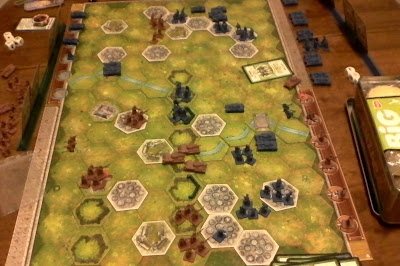 |
What happened to the light quality (a bit of a puzzle)? Soviet armour has recaptured
part of the ridge line, but a quick thrust down the south bank of the river near Kaluga
captures the river bridge (a major objective), and takes out a 2-tank unit
that was about to attack the Germans occupying that end of the ridge. |
I was curious as to losses in this game. A count determined that the Russians lost 19 infantry figures, 3 tank and 2 artillery. The Germans lost 16 panzers (wow!) and 9 infantry. Part of the reason for this investigation was a notion that occurred to me, inspired by the 'Medics and Mechanics' order Jacko played in the middle of the game. His five dice yielded not one recovered vehicle for the selected depleted panzer unit. Bad luck, but it didn't affect the overall outcome.
But suppose the battle were part of a campaign? We would want to recover some of our losses. What would happen if, after the battle, a die were rolled for each unit lost? Suppose we allowed the return of the appropriate figure were a soldier or tank to appear, with the player's choice for each star (to recover lost artillery, say). So I tried it out.
The Germans recovered 8 panzers and 9 infantry for a net loss of 8 panzers - a serious dent, in campaign terms, to their amour inventory (but bear in mind: Moscow has fallen!). The Russians recover all 3 tanks lost, 10 infantry and both artillery figures for a net loss of 9 infantry. Note that one may not recover more units of a particular type than one began. Well, it's an idea...
My thanks to Jacko for an enjoyable evening, even though we are now living under the yoke of global Nazism...