Showing posts with label Unfinished Projects. Show all posts

Saturday, December 30, 2023

A Reminder for Me...

A recent Bob Cordery posting concerning the use to be made of a spare piece of pasting board reminded me of something I've been walking on for well over a year, now.  

I have an interesting piece of carpet I picked up off the street a few years ago. Somebody has dumped it.  But the thing seemed to be in reasonable condition, so I did the civic-minded carpetatarian thing, and rescued it.  You know: before it rained. Or something.

What made it interesting...?

Salvaged carpet for war games?


Coloured a sort of  'sea green', the thing got trimmed off to 28"x70" (72cm x 180cm). It's lying on my bedroom floor (goes fairly well with the walls) as the most convenient (least inconvenient) storage location.

I've been thinking of cutting the thing in half to make, when reoriented, a 35" x 56" (90cm x 144cm) game surface. Conveniently,  I have some off cuts from this carpet, plus others of a rather lighter hue, that can form elevated ground. 

Off cuts for elevated ground.  The paler items I have had
 much longer, from some other source.

Were the playing surface divided into 6cm squares - the exactly right size for my Chromatic Wars armies - that would make a field of 15 x 24 squares.  The question is, though: do I really need yet another playing surface?  I seem to have plenty as it is...

An old hotel quilt thingy - great for deserts or possibly 
winterish - square grid. Salvaged from an earthquake site 
(over a year after the earthquake that wreck the hotel).

PW3x3 


Memoir '44 game board - great for my mediaevals
and for Sengoku battles as well


An alternate Sengoku board... Made from ceiling tile
(I think). The grid cells are a whisker smaller than 
the Memoir '44.


10x10 square grid, used for the First Blacklands War.
Plywood surface that was intended for earthquake repairs.


A quilt I bought in 1976.  In 47 years it has 
faded some... Ungridded

Ungridded blanket I picket up somewhere about 40 years ago,
 specifically for its colour, to be used for War Gaming...


Artificial lawn - ungridded.  Good size for One Hour Wargames.

Probably my favorite: my hex board...
Another, larger, piece of plywood. Very versatile.

I didn't fully realise before I began this inventory just how many war games surfaces I have available. All this probably explains why, after two or three years, I never got around to doing anything with this piece of carpet.


Friday, September 10, 2021

Tinkering...

 Although in the last few weeks a deal of my time has been devoted to playing and writing up - especially writing up - my Waterloo battle, I have been tinkering around with several other projects.  A generously disposed mind might suppose I've been multitasking, but really tinkering - or even pottering - is mush closer the mark.


First off, my reading of Tim Gow's war games projects have persuaded me that maybe I should adopt something similar for my Army Men (a.k.a. Jono's World) forces. Such is the 38th Regiment, the Army of the Republic of Kiivar.  These armies still use battle flags.


Artillery is always useful to have, and if you can't buy them, make them. This project was done years ago, but the sailorman gun/howitzer crews have only in the last year or so been painted. I have three of these heavy pieces, forming a battalion or regiment.
The items below are more recent acquisitions.  The gun is a very fine piece, the towing vehicle a misshapen thing that has a useful tow bar.
The following are my 'Panzergrenadiers' in the service of Ra'esharn.  The beauty of this system is that each stand might represent a section/ squad, or it might represent a whole company - possibly a battalion - depending upon the scale of action I'm looking for.
So this array might be a company of 4 platoons, or, probably more likely given the directions I've been headed lately, two regiments, each two battalions.  Add 4 or 6 tanks, we have the sharp end of a Panzer Division.  


Next on the list are my mounted Samurai, additions to the foot figures used in the Shogun board game for fighting Sengoku campaigns.  The regular reader of this blog will have seen Clan Red, and some of Clan Blue in action.  Here are the others.

Sengoku Wars:

Clan Green:


Clan Orange:

I painted these yellow, rather than orange, for two reasons.  One was that I thought I didn't have a good orange paint, but I did have yellow.  The other was that I had a source for a yellow flag design and none for orange.  The design I've used is only approximate - a simplification - but it does give this clan a certain battlefield 'presence'.

Clan Purple:

I really didn't have a purple paint, but I was quite happy with the appearance of this outfit.  The red sun on the flags looks pretty sharp.

We'll finish this bit with some group pictures...


The Blue and Purple Clans are sufficiently contrasting...


Chromatic Chronicles

Having a bunch of HaT Napoleonic cossacks kicking around doing nothing, methought they would be a suitable addition to my Izumrud-Zeleniya (GREEN) army.  I figured that between 1815 and 1880, the general appearance of cossacks would not have changed much...


The figure leaning over to stick his point in somebody's liver is a particularly annoying one. He looks as though he's trying to trip over the guy next to him...

Imagi-Nations ...

There is one other project that has engaged something of my attention, having to do with my imaginary 18th Century forces. A new army has come into being, based around figures that were homeless and seemingly surplus to requirements. I thought of it as the Army of the Herzogtum of Rechburg - in memory of the late Barry Taylor, author of the Lyndhurst Chronicles of several years back.  Unfortunately Barry passed away with his campaign narrative not yet fairly begun.


However, Paul 'Jacko' Jackson, a closer friend of Barry's, has embarked upon building his own Rechburg Army. Mine will become a bordering country to its north. A small army, it will have one feature unique from all my 18th century armies. The network of spies the Emperor Violoncello established throughout the whole of Europeia, maintained by his successor, the Empress Harmonica, and whose reports are regularly received by Archduke Piccolo, has observed that Nordmark's infantry battalions now include battalion guns...


More on this project another time.


Tuesday, April 7, 2020

Under lockdown...

Irregular Turcowaz Sipahi face Ruberian Lancers.
Much to my surprise, not a lot is happening chez moi on the war games front. Ideas occur for campaigns and battles (of which more anon) and for a new 'cartoon' navy, which is probably not a very good idea, however fun it might be. This posting follows on from the previous three to begin with - a project that began from small, modest beginnings, into something pretty near global.
Recently on my cutting board.  Spare Airfix Foreign Legion
figures as artillery.  The leaning back guy looks to be
tugging the firing lanyard.

Having last year fought a couple of battles - more or less historically based, though disguised into a period 40 years previous, upon General Townshend's disastrous 1915-6 operations in Mesopotamia - it seemed to me that the BLUE OPFOR, the Turcowaz, ought to have an army of its own, rather than  Azurian (BLUE) ring-ins. The Turkish Army of the Russo-Turkish War of 1877 seemed to me designed for the task. Turns out that though Strelets-R make the figures, they aren't that easy to get hold of.   Only the foot Bashi-Bazouks seemed to be available.

Well, that's a start. Paul threw in a half dozen of Turkish sipahi from a couple of centuries earlier - great for irregulars, and colourful withal. Between them they could make for all kinds of Turkic or Arabic tribes people dwelling in the more obscure parts of the world. Eventually we found some regular foot in the Strelets-R 'Thin Red Line' Pack.  

Irregular Turcowaz sipahi.
Now they have all been painted up, the TURQUOISE Army presently constituted as shown in the following pictures.
Turcowaz Army.

Turcowaz Army

1 Army Command stand
3 Regular Infantry Units with
     1 command stand, 3 rifle stands
4 Irregular Infantry Units with
     1 command stand, 3 warrior(?) stands
1 Irregular Cavalry Unit with
     2 sipahi stands

To be added when the opportunity provides;
1 Regular Cavalry Unit with
     1 command stand, 3 cavalry stands.
2-3 Artillery Units with
     1 gun, 2 or more crew.

At the moment a spare regular command stand can substitute for 1 gun crew, and a Krupp type of gun perhaps scratch-built. This army is certainly 'fightable' as it presently stands. The 'Units' might represent anything from companies to Divisions, though they will probably be seen more often as battalions or brigades.
 
Turcowaz army, yet to be supplied with more modern artillery.
And so it will - sometime soon. I hope.

The circumstance is that Major-General Scarlett's Ruberian expedition into the Medifluvia has been stopped by the Turcowaz Army, and retreated to the scene of their first victory at Hak Al Kumara. There he has permitted himself to become besieged, giving vent to strident appeals to higher command to effect his rescue. Rather than leave the stranded army to stew in General Scarlett's juice, that higher command cobbled together a second expedition, under Major-General Ezekiel Rust to attempt the relief.
Even in its unfinished state, this army is ready for action.

This circumstance brings me to the serendipitous inclusion of the following unit into the Ruberian (RED) Army. The 'Thin Red Line' box contained a couple of sprues of Highlanders. A dozen of the figures being sufficient for my purposes - I wanted no more than 1 unit, 'Jacko' (who had put the order in on my behalf) got the other dozen or so. It so happened that the 7th Division relief column of 1916 included a couple of Highland battalions.  I had been thinking of making them into something vaguely Hellenic, but changed my mind.

In painting the 'tartan' on the kilts, I again used my 'sample' technique that I used for my Napoleonic highlanders, which, I think, turns out surprisingly tartan-like. To my eye, anyhow. Pictured is the Dearg Highland Infantry. The flag is, of course, the Cross of St Andrew, with the Cross of St George in canton.

Dearg Highland Infantry in the service of Ruberia.

And now, folks, for an abrupt change of subject. 

Lately I have been thinking more and more about where I'm going with my WW2 armies. So I have begun a wholesale reconciliation of my Russian army, with the view of building as many 6-stand units of the 'Not Quite Mechanised' type as I can with what I have available, supplementing them with 2-stand SMG, and possibly other, subunits. The 6-stand units will be battalions, regiments, brigades or Divisions, depending upon the scale of action. In their Divisional role, though, I'm thinking of adding a 76.2mm field piece or 122mm howitzer. 
My Soviet Infantry - most of what I can find, anyhow...
Below is most of my Soviet artillery to date: 3 76.2mm anti-tank/ field pieces; 2 122mm howitzers (one is semi-scratchbuilt, the other a metal model), and 4 152mm howitzers. 
Most of my Soviet artillery.  I'll probably be building a couple
more of my scratch-built field guns.

The nearest is an older type with the 'shark-fin' muzzle brake that I made a week or so ago. It is based on a spare Airfix British 5.5-inch howitzer, with the gun barrel trimmed back and replaced with one from a Plastic Soldier kit. The gun shield and elevating (?) wheel were added on. The shield is wrong, but looks right to my mind - a very acceptable piece. A bit of weathering and highlighting/ shading should finish it off nicely.
Latest inclusion to my heavier Soviet ordnance: an older pattern
(M1937) 152mm gun/howitzer.  A quick kit bash with a
cardboard gun shield.

What I have in mind is Operation Dolgorouky, some time in mid 1944, pitting a couple of Soviet Armies - one Rifle, one Shock - against a single Panzer Corps. Dare I rope in Bob Cordery's 66th Army - a facsimile thereof, slightly reorganised - as the Rifle army? The 6th Shock Army will be the one with most of the teeth.  I'm tempted to call the pair collectively the rather small 'South Pripyat Front'...

On the German side, XLIX Panzer Corps will comprise 1 Panzer Division,  1 Regular Infantry Division, and 1 'Grenadier' Division - a formation a trifle weaker than the regulars. Their front line position will be dug in, wired and mined.  

It's all in my head at the moment, wanting for me to begin by sorting out the Russians, then the Germans, and putting pencil to paper... 

Saturday, March 28, 2020

Explosive Project (3 - incl The New Zealand Wars)


It was whilst writing up the last couple of postings, and thinking about this one, that the thought occurred to me to draw up a rough schematic of where the original RED vs BLUE 'Little Wars' eventually led. Not all of what is shown here is contemporaneous with the third quarter of the 19th century, when the conflicts between Azuria and Ruberia are meant to take place.


The affairs of Harad and Tchagai happen a century later, as does the bickering among the Latin States on the other side of the Hypermetric Ocean. Gatonegro fights for its independence from Reina de Oro in the first half of the 19th Century, and the wars between Austereia and Severeia two centuries before even that. But it's the same world, even though not all of it has been realised in armies built and campaigns fought. Not all the projects are mine, although I am or have been one way or another associated with them. I have ... sort of ... expropriated the famous Madasahatta island, renamed Madasagascar.

Oronegro is the brainchild of Gowan Ditchburn, one of his blogs being devoted to it (see here). The Harad (linked here)  project was created by 'Evil Uncle Brian', to which Tchagai was added when I finally succumbed to Brian's invitation (bordering on wheedling) to join it. Tchagai has been the scene of my recent (and as yet unfinished) 'Long Live the Revolution' campaign set in the mid-to-late 1940s. The narrative so far may be seen from here...(link).  The core idea for the 'Benighted Continent (Aithiops)' campaign belongs to 'Jacko' of 'Painting Little Soldiers'.

I was going to add a little more, here, about these campaign projects, but...

...I received by way of response to the first of these 'Exploding Project' postings some very interesting remarks by one 'Roughneck', a fellow Kiwi who expressed interest in developing a project based upon the New Zealand wars. It's a good thing I check out the 'for moderation' archive from time to time, else I would have missed it. Now, we both agreed that a rather high proportion of the battles involved attacks, usually unsuccessful, against fortified places. Here's what he had to say.

Hi Archduke
Long time follower of your blog. As a fellow Kiwi I also have a particular interest in our own New Zealand Wars but like Steve have yet to find a ruleset that really suits the conflict. As Ive gotten older I have found myself drawn to less complex games and have become quite a fan of The Portable Wargame rules. Given the varied nature of the New Zealand Wars I actually think TPW might just do the trick. I feel that to really capture the flavour of the whole conflict it probably needs to be played as a series of campaigns rather than just one off battles. Using TPW as a starting point The Flagstaff War could be played as a point to point campaign culminating in Ruapekepeka, the Waikato and Tauranga campaigns could be simple ladder campaigns as could Titokowarus War. The spread of Pai Mairie could be treated as an area control campaign whilst the hunt for Te Kooti could be a set of linked skirmishes dependent upon supply and hidden movement. As for the actual rules themselves obviously some tweaking would be required but nothing too onerus. I agree that attacking a pa might make for an uninteresting game but placed within the broader context of a campaign with variable victory conditions for each side I think it has the makings of something more enjoyable. After reading Soldiers Scouts and Spies I also see an element of military intelligence being incorporated into the game perhaps in the game set up or deployment phase with the Btitish player having variable limited knowledge of the enemy based on local intel and the Maori player having certain intel advantages to begin with e.g. hidden units or units on blinds perhaps. I'd be interested in your thoughts. regards Roger

What Roger had to say was pretty much on the money, I thought, in his view that the New Zealand wars would be better fought as a series of campaigns. There were battles, sure, but those that did not involve attacks upon fortified places were most often a matter of ambushes, subterfuges, and downright sneakiness. At that Maori proved far more adept than the Imperial military, or the colony's leadership. Given larger numbers and advantages in equipment, no doubt the colonial government figured to make up in brute force what they lacked in subtlety.

Suppose one were to campaign the war in South Taranaki, beginning mid-1868.
The genesis of the war had to do with settlers' encroachment upon Maori land recently 'confiscated' by the Colonial authorities, that threatened the livelihoods of the Maori themselves. Maori efforts, led by Titokowaru, to reach an acceptable compromise came to diddly-squat, whereat that leader reversed his pacific policy. Raid and counter-raid involving tens of soldiery and warriors, led to the encounter battle of Te Ngutu o Te Manu (The Beak of the Bird (?); it might mean 'the Mouth of the Holy Man'). This led to a defeat of the colonial forces so decisive that people began to doubt the permanence of European (pakeha) settlement in this part of the world.

What were the sizes of the forces involved? The European expedition comprised some 350 people,  mostly on foot, organised into 3 company-sized 'Divisions'. Maori had at the outset maybe 60 warriors, though it seemed that during the course of the battle, several more, attracted by the ruckus, joined in. The Europeans were chased several miles. Among their 50 casualties was the famous and popular Major Gustavus von Tempsky (or, as Maori are said to have called him, Manurau, which might be translated as 'one hundred birds', or 'many birds' ), killed during the fighting, close by the pa palisade. 

These are the sort of numbers one might expect in New Zealand's battles, tens, maybe a few hundreds. Although there might be thousands of imperial or colonial soldiers available in a given campaign (The Waikato, 1863), not all will be involved in a given battle.

For such a campaign I'd probably be inclined towards 'armies' of individual figures at 1:1. If using one figure to represent more than one, I would suggest 1:8 as the maximum. Of course, a 600-strong force would be represented by 75 figures at that scale, but we're talking there of an unusually large action by New Zealand standards. At the time Titokowaru was building the Tauranga-ika pa, he had maybe 400 warrior followers. Col. Whitmore went after him with perhaps 800 armed constabulary and 200 kupapa - Maori allies - along with a couple of Armstrong rifled cannon and as many Coehorn mortars. Pretty big forces by New Zealand War standards.  


It is probably just as well Titokowaru's campaign petered out in the full tide of (apparent) success, as Col. Whitmore (rightly, in my view) regarded as the fortifications beyond carrying by his force, even at 5 to 2 odds. Historian James Belich is inclined to portray what he calls the 'modern pa system' as something perhaps beyond the ken of European military expertise. Even if my comment overstates his thesis, methinks he at least equally overplays his argument. The star fort at Tauranga-ika, and its external and internal features, would have been instantly recognisable to a student of Vauban, I believe. 
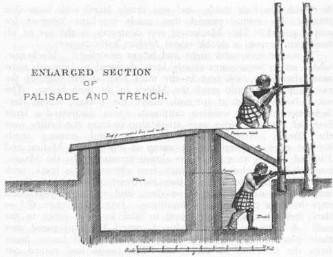

Yet that to my mind goes much further to the credit of Maori ingenuity and adaptability in the face of overwhelming numbers. Similar situations yield similar solutions. The tutelage Maori got was not from mythical renegade Prussians (Belich is right about that), but from their opponents' approach to warfare, the accident of traditional pa design (buildings and dwellings half sunk into the ground), and their own ingenuity in adapting to the circumstances of firearms and cannon.

So a 'linear campaign' of Titokowaru's war might involve
1.  Surprise raid on a small redoubt (Turuturu-Mokai).  Maybe 60 Maori vs 25 Pakeha.
2.  Colonist's counter-raid on a Maori village.
3.  Attack on Nga Ruahine stronghold (Te Ngutu o te Manu)
4.  Motoroa - Titokowaru's  'strategic offensive/ tactical defensive' campaign - first episode.
     Maori build a pa in a threatening position - a common Maori practice - to invite Colonists to               attack.
5.  Tauranga-ika - second episode (A 'what if' action.  This was no mere star fort, having within it             internal defensive features, that would somehow have to be incorporated in the action).
6.  (What if) Attack on Wanganui (Whanganui) settlement. Possibly could include a Waikato Kingite       contingent on the side of Titokowaru.
7.  If Maori forced to retreat, a bush rearguard action (Waitotara River).

At Tauranga-ika, you could probably play out the action (which never happened) with, say, 100 European Constabulary figures reinforced by 25 Whanganui kupapa allies, against, say, 50 Ngati Ruahine warrior figures defending the fort. The Europeans would be backed with a rifled cannon and a siege mortar.

Why the Maori campaign in South Taranaki was so suddenly abandoned is something of a mystery. The usual explanation is that Titokowaru himself - a tohunga holy man - lost his mana tapu through an affair with another chief's wife. No one would follow one who had debased himself in such a way, or had abused a trust.

I would have liked to have been able to read more of Bob Cordery's campaign design for colonial wars from his forthcoming book. But from what I've seen so far, it seems it would be just the thing for the New Zealand's wars, especially, as Roger indicated, the pursuit of Te Kooti ('Teh Kawtee', for a reasonable approximation of how his name should be pronounced).


Incidentally, I am inclined to think that for Maori, the 'European wars' were really a resumption of the 'Musket Wars', which had been, practically speaking, entirely a Maori affair during the 1820s through to the 1840s. In almost every one of the conflicts between Maori and Pakeha,  the latter had Maori allies and supporters. When Colonel Whitmore interrupted his hunt for Te Kooti to face the threat of Titokowaru, a column of Maori opposed to Te Kooti carried on the pursuit.  Note that there was not even a hint of cooperation between Te Kooti and Titokowaru; theirs were entirely separate campaigns. At that, although the former began earlier and lasted longer, it is clear that Titokowaru was seen at the time as the greater threat to colonial security.

For all the anti-colonialism you hear these days, Maori at the time had no objection to European settlement as such, even welcomed it. I rather think Maori took to European ways.  In 1860, even before the conflict over the Waitara Purchase, one enterprising Maori entrepreneur was running a ferry service across the North Taranaki Bight between New Plymouth and Kawhia on the Waikato coast. Another had built and was operating a water mill some miles outside the New Plymouth town precincts.

But Maori got rather more than they bargained for from Pakeha settlement. Even before 1860 the overall European population in New Zealand exceeded the Maori, though most were in the South Island. By 1870 the major conflicts were over. Only Te Kooti remained at large, effectively a fugitive, the pursuit being carried out mostly by Maori.  

Friday, March 6, 2020

An Explosive Project (2)


The transition from Very Little Wars with 16-figure companies to the Horse, Foot, Guns was easy to contemplate, megalomaniac as I am. Imagine: a stand of 4 figures represents an infantry Brigade of some 2000 officers and men. Three of those, plus maybe a command element, you have a Division; three Divisions, with a bigger command stand, perhaps, and you have an Army Corps.  You might be looking at 45 infantry figures, here. Add a Brigade of Horse (3 figures) and a park of artillery (1-3 guns each with a couple of gunners), and you just scrape past 50 figures.  Fifty figures for an Army Corps!  I'll have a piece of that!

Turcowaz regular infantry.  The army now has 21 infantry
elements, 12 of which are irregulars...
An attractive idea. But I wanted armies of about 1875, roughly Britannic and roughly Gallic. What I wanted to see was an army list for either, as a guide line for organisation, but never saw one. What with one thing and another, the project sputtered on for a few more years with nothing much happening. Becoming disenchanted with the whole DBx rule systems - through no real fault of them - it was not easy to conjure up much enthusiasm for carrying on with it.  
Royal Dearg Highlanders in the service of Ruberia.
It was the Portable War Games systems that revived the interest. The whole gig looked simple, a few try-outs indicated very quick, very playable games, and the thing has progressed much more rapidly in the last three years. It has expanded considerably as well. The original intention was a war - or series of wars - between the Kingdom of Ruberia (RED) and la République of  Azuria, upon or near their home territories, with perhaps a side-order of colonial rivalry in, say, Africa or South Asia. But when the notion of something less 'symmetric' came to mind, the Azurian Army suddenly got co-opted into an 'alternative BLUE', namely TURQUOISE, or Turcowaz. 
The latest Bashi-Bazouk recruits.  Actually they are the
Strelets-R 'bonus' Russian Streltsi figures.  Near
enough, says I.
Having fought at least 4 actions, it was clear that the Turcowaz ought to have its own army. For these I chose the Turkish armies of the 1877 war against Russia. Unfortunately these aren't so easy to get hold of.  Strelets-R makes them, but they aren't so easily available. I scored a box of foot Bashi-Bazouks (through Paul 'Jacko's' on-line contact with a distributor), and that was about it. Still, they got painted up. Then a Crimean War box came available, with Turkish foot, Russian Foot and Horse, and some Highlanders. The Turks were pretty much the same as the 1877 lot; they'd do. Unsure what to do with the highlanders, eventually I shared them with Paul and made a formation of 3 stands and a command from what I kept.
The Royal Dearg Highlanders again.  Under the PW system
this lot could be a company, a battalion, a Brigade,
or a Division.
And the Russians? Well, I did have a 'hidden character' nation that was called Porphyria that was to be a Tsardom, but as these fellows favoured green, they became Zelyoniya.  Its army won't be huge; 8 infantry elements and maybe 4 Horse, plus a gun or two.  Enough, perhaps to prove a menace to the northern borders of the Settee Empire of Turcowaz.

Just by the way, I really like the chunky presence of the Strelets-R figures, especially the later sculpts.  They probably require a deal more attention to painting than some other plastic figures of similar scales, but the end result is worth it.  
Flank rear view of Turcowaz regulars.
Meanwhile, the aforementioned 'Jacko' had himself caught the 19th Century colonial warfare bug, and was developing his own armies and nations. His green-uniformed guys become the Imperial forces of Azeitona - vaguely Portuguese (should we call them Azeitonese or Azeitonians?).  Resisting their encroachments are the m'Butu tribesmen (BLACK) and the vaguely Arabic (WHITE?) pirates/ raiders/ really annoying people. Though they are his project, there are - or will be - points of contact between his and my projects, especially in the Dark Benighted Continent of Africa Aithiops.  
Turcowaz regulat foot.
The most promising beginning seems to be upon the east coast of Aithiops. 'Jacko' scored a fine campaign map of the WW1 campaign of German East Africa. The recent battle of the Limpopo Trail was intended as a species of prologue to the conflicts that will develop in that region of the world. The Ruberians will almost certainly take an interest - and it would scarcely be surprising if the Settee Empire of Turcowaz sought some kind of confrontation with the Abyad (?*) corsairs, raiders and suchlike riff-raff...
Turcowaz irregular cavalry.  Actually Stretets-R 17th
Century Ottoman Turks, but OK for my purposes.
The Ruberian Imperial troops of Rajistan will still be mounting operations against the fringes of the Settee Empire, such as the Medifluvia region and perhaps expanding into the area of Tchagai, which itself became the scene of a revolt some 7 decades later...
The beauty of the PW system is that it could lend itself to a wide range of scales. An Infantry stand might represent anything from a platoon to a Brigade; a group of three or four might be a company or a Division, depending on the overall scale of operation or campaign being undertaken. A single cavalry stand might be a troop or a Brigade. I don't imagine any higher cavalry formations larger than a Division.  And a gun might be a troop or a regiment.  The recent action along the Limpopo Trail was a small affair of maybe regimental or brigade sized forces.  The setback to Azeitona is not one to compromise the colony's existence...
Turcowaz army, so far...  Could do with some regular cavalry
and 'modern' artillery.
 I do like flexibility and versatility.
Elements of Ruberian Army: foot, artillery, and the dreaded
Gatling guns.
Now, recent perusals of the Madasahatta Campaign (Eric Knowles and Bob Cordery) has led to the realisation that, distant as the colonial emprises are from their homelands, they require a certain naval presence, if only to protect the imports of vital supplies and equipments, and the colonies themselves from raid, robbery, etc.  Something ... ocean going; not too flashy, something with a shallow draught, moderate speed, and bally great big guns. Say hello to the Queen of the East Aithiopsian waters, HMS Blunderer, coastal battleship, 9000 tons, carrying four 12-inch rifled guns. A gunboat of the 'Fly' class, perhaps HMS Botfly (a sister vessel, HMS Shoofly, operates in Medifluvian waters) might be suitable for riverine work. Perhaps one or two former American Civil War naval units might find their way into the rival navies. I feel fairly sure that Azeitona will welcome the ironclad ram Lafayette, bought from the United States of Anaconda in 1866. No match for the Blunderer, of course, but ... with a certain presence of its own.  Perhaps the twin-turreted monitor Kickapoo, recently sold (in 1874) by the USA to an undisclosed buyer, might yet find its way to the area.  Who knows? 

HMS Blunderer - newly commissioned, still wanting
its lifeboats...
Plenty of scope for small scale inshore and riverine naval and combined operations...

To be concluded...

Abyad*  - My tentative name for the Islamic Arabs, Mahdists and what have you, engaged in raid, robbery, and all-round rambunctiousness... well that's what the Ruberians are saying, anyhow. Probably Jacko already has his own name for them.