We left the narrative last time with the Grand Armee having largely fallen back across the Vachva stream. Only the 17th Division of V Corps, facing the Bianchi Austrian Divsion, and the 3rd Cavalry Division Cuirassiers up against Frimont's heavies, remained in action.
.
Fact was that after several hours' action, it was getting late, and Paul needed to return to his family. So far the French had been getting rather the worse of the action overall. They had several successes to celebrate, breaking both Russian cavalry units, and bombarding the Golynets garrison out of the place; but both IX Corps infantry Divisions were spent forces, and French cavalry had been twice defeated by Austria's semi-regular formation of freikorps and landwehr before the latter were overrun by the cuirassiers of 3rd Cavalry Division.
I very nearly called the battle at this point - an indecisive action and quite unsatisfactory from the French point of view. But this seemed to sell the emperor short. Surely he wouldn't leave the thing there, with little to show but the heavier losses?
He didn't. I reckoned the Grande Armee retained within its heart one more supreme effort. Despite the discomfiture of 17th Infantry and not recking the outcome of the clash of cuirassiers, Napoleon ordered a general assault, all along the line. I played the remainder of the action out solo.
In the following narrative I will deal in succession, rather than in parallel, with the actions to the north of Golynets, then to south. At some half-way point the threads will be gathered together, then the story continue in the same manner until the end. I think this will be the easier for me to write and the reader to follow. The battle diagram is a very rough representation of events as planned.
Preliminary to the assault on both wings, the Imperial guard artillery - 80 cannon - finally drove the Division sized garrison from Golynets village, when they retreated all the way back to Bruski beyond the main north-south road.
As the III Corps light horse retired behind the Vachva stream, the III and IX Corps artillery kept up an effective fire upon the Prussian and Russian infantry on and about the Haliniez heights. The three III Corps infantry Divisions set their faces towards the heights themselves, and the IX Corps light cavalry passed though their battered foot comrades, with the rather shaky line of Russian grenadiers in their sights.
In the teeth of shot, shell and canister, 10th Infantry stormed up the hill and overran the Prussian guns before the Silesian line infantry could intervene. The latter's response was otherwise prompt, and a protracted close combat and melee swarmed over the southern end of the heights.
At the same time the IX Corps light horse redeemed the honour of Marshal Victor's army corps with a signal victory over the Russian grenadiers. Already weakened by musketry and gunfire, and failing to form square betimes - no easy matter under fire from 64 cannon - the Russians were simply overwhelmed.
(Aside (there will be a few of these): The dice tell the story. In my rule system in all combats the standard is one die per figure in contact (supporting ranks halved), sixes required to hit. Circumstances may modify the dice allocation upwards - 3 dice per 2 figures, or 2 for 1; or downwards: 2 for three or 1 for 2. The grenadiers are an elite unit and get 3 for 2; the lancers also got 3 for 2 fighting infantry in line. Since both count 'advantage', these are cancelled. Both sides, got 1 dice per figure in contact, one for two for supporting ranks. The grenadiers could count only a very limited overlap. The Lancers got 7 dice, and I think the grenadiers the same. The light horse scored 4 hits (!!); the grenadiers diddly squat. A big victory for the former! I do use a 'normalising' system for modifying hits scored (I HATE saving rolls), which might have reduced the hits to three or possibly even two figures lost, but there was no saving the grenadiers from a withdrawal)

At the north end of the heights, the Brandenburg Landwehr having been driven off the feature, 25th Division found themselves faced by the return of a rather battered heavy cavalry formation. Rolling musketry from the front rank was enough to throw the Prussian horse off the heights, never to return.
So far, the left wing of Grande Armee was doing very well, having carried the north end of Holiniez heights and overrun the Prussian corps artillery, and driven in the Russian line besides. But the key to the battle lay upon the south side of Golynets.

Two Divisions of the Imperial Guard - Middle and Young Guard - and two from V Corps, joined and supported by the Old Guard and the Guard cavalry, rolled forward across the stream. Seventeenth Division was already in contact with Bianchi's Austrians - and getting the worse of it - and the Russians had three and the Austrians one more Division facing the oncoming French. The Allies had in addition the support of artillery from both contingents.
Though at least two of the Russian Divisions had already been in action, on the French side, the Young Guard was somewhat depleted, and 16th Division in scarcely better shape.
As the decisive clash of infantry seemed imminent, the cuirassiers of 3rd Cavalry Division found themselves facing oncoming Austrian armoured horsemen, bent on vengeance and eager to try their metal. Having at last defeated the landwehr and freikorps formation, the French formation had perhaps too little time to rally and reform. The Austrians got the better of the encounter, sent the French horse to the rightabout and back across the Vachva stream. This left the French right flank momentarily bereft of protection.
At the same time, the Bianchi Division made its first contact in the big infantry battle. Getting the better (
3 to 2 on the dice rolls), they drove back the Polish foot. This drew the attention of the Imperial Guard heavy cavalry. Getting slightly the worse of this new encounter, the Austrian foot drew off in good order, still facing the enemy.
So far, in this part of the battlefield, matters seemed to be continuing in the Allies' favour much as they had so far all day. In an effort to keep the Austrian cuirassiers clear of the right flank of the infantry columns, General Grouchy threw in 6th Cavalry's dragoons. This was to take a gamble - something of a desperate one. This formation had already taken some heavy knocks from the Austrian semi-regular foot. It was fortunate, perhaps, that they still have one charge left in them.
The first hint that the Grande Armee's fortunes were about to take a turn occurred close by Golynets. The devastating musketry of the Middle Guard at reduced the Division facing them into a cloud of disordered Russians retiring far to the rear. They almost reached Bruski before they could be brought to order. By then it was too late for them to redeem their failure.
Such was the situation, then, as the late afternoon sun began to approach the horizon. The Allied right was under intense pressure from Marshal Ney's Corps, supported by the IX corps light horse and artillery. Only one Prussian Division - the Silesians - remained in more or less full strength to oppose the French tide. Every other formation was more or less battered or depleted.
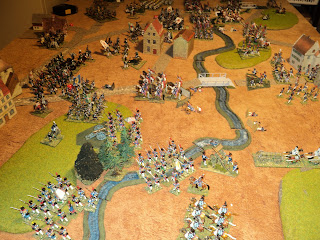
The first clash between that sole Prussian Division and the French 10th ran honours even, and these Silesians proved stubborn defenders. At the end of the day they were still holding the southern end of the Heights. The depleted Division of Elbe Landwehr's attempted assistance was thrown back by the IX Corps cavalry, and the Brandenburgers also made one last effort to retake the north end of the heights.
Behind the leading French formations, were the fresh 11th Division, and the III Corps light horse, somewhat depleted, but now rallied and in good order. For the Allies, prospects on this wing were not encouraging.
Although the Silesians were giving as good as they were getting , the landwehr on either flank were enjoying less success. The lancers of the IX Corps cavalry soon put the Elbe Division to flight, and the 25th division edged the Brandenburgers once more and for all off the Heights.
(Aside: The observant reader will note perhaps that I've reversed the green and red/blue dice results. That was absent-mindedness. The French actually got more dice in the roll (slightly greater numbers), and I happened to pick up the green ones for them. I didn't notice until I looked at the pictures afterwards).
So matters stood as the sun began to dip beyond the western horizon. But the decision was to be made on the other wing.


The Middle Guard having thrown back their opponents, the Young Guard and 16th Division, after a brief and indecisive firefight closed with the two Russian divisions facing them. The result was a disaster for the Russians. That 16th Division got considerably the better of its battle (3 hits to 1), was celebratory enough, but the already depleted soldiers of the Young Guard performed miracles (4 hits to none!). Both Russian formations staggered back from the encounter a deal faster than they had advanced.
Eighteenth Division served out the Siegenthal Division in equally brusque manner, inflicting five times the knocks as they received. In a trice, the whitecoats were to be seen disappearing eastwards in a confused mass. The one Allied success along the whole front was the cuirassiers' defeat of the 3rd Dragoon Division - hardly to be wondered at given the latter's battered and depleted condition.
With scarcely a pause, then, the whole French front between the Golynets village and the woods to the south rolled on, with hardly a formed unit, apart from the Allied artillery, to oppose them. The Austrian cuirassiers were discouraged from assailing the French flank by the rallied, though damaged, 17th Division and III Cavalry Corps. Itself having halted its retrograde movement, Bianchi's Division stood fast at least to halt part of the French line.
It was really a hopeless gesture. The battle was already effectively over. The Prussian and Russian corps were badly mauled, the latter being chivvied eastwards before they could halt and rally. For the moment, barely small Division remained in good order and proper command. Only the Austrians still had most of its formations in hand, but they could scarcely take on the Grand Armee alone.
The Emperor of the French could be satisfied. Costly as the battle was (
losses in figures for both sides were very nearly equal at over 100 each, the two-figure difference being in the Allied favour), the Allies had received a severe check. The
Grande Armee could resume, more or less unmolested, its retreat into Poland.
A fortnight later, the bulk of the army safely brought to a brief halt at Vilna, Napoleon handed the command over to the king of Naples, Marshal Murat, and set off for Paris in his private coach, there to resume control of the the Imperial government. The army itself, after a brief rest and recuperation, and scarcely discommoded by Cossack raids, resumed its march back into the Grand Duchy of Warsaw, there to await the summer campaign of 1813.
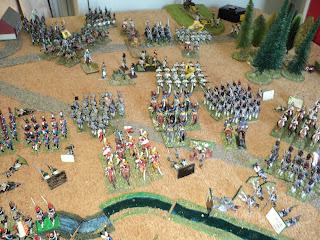
The Allied army broke up after that. The Prussian corps returned to East Prussia, where it was to form possible cadre for an expanded Prussian national army. The Austrians returned to their home empire, leaving a small army corps in Galicia, on the Grand Duchy's border, under the command of Archduke Ferdinand d'Este. The Russian main army, so badly bruised at Golynets, called in the flanking formations of General Wittgenstein from the north and Admiral Tchitchigov from the south. Halting to reorganise, they required well over a week before the lead contingents began to follow up the long gone Grande Armee.
The scene was set for the coming campaign: the War of the Nations.
(The War of the Nations is to be the major war of which this series of articles, The Retreat from Smolensk, was intended as a prequel, or maybe prologue.)