Showing posts with label Vive l'Empereur. Show all posts

Friday, November 11, 2022

Harking Back: Forcing a Defile.


Having just read a posting from Battlefields and Warriors: Wargaming in Small Spaces on scenario generation, I was reminded of a long past action from a campaign set in the Peninsular War.  This particular situation cropped up when the Duke of Abrantes (General Andoche Junot), marching towards Badajoz from the north, found himself having to cross a river crossable only by a stone bridge.  Waiting for him on the other side, was a force of Spaniards in none too compliant a mood.

Having been reminded, I thought I'd look up my own account of the action.  It was not to be found in this blogspot! Fortunately, I recalled the possibility I might have posted elsewhere, and I discover that, though inactive for some years, that blog spot is still extant.  In a fit of nostalgia, I thought I'd post the account here.  Paul Jackson, by the way, commanded the Spanish. 


Thursday, December 23, 2010

Action at the Guardiana Bridge.

This, the first action of the Armee du Nord in the current Peninsular War Campaign going on in Christchurch, was no light ordeal by fire for the men of General Junot's Corps. For the six weeks since the campaign opened in March 1810, le Duc d'Abrantes has been gathering in his troops for an advance into the desolate badlands of Estremadura - central Spain.

It had been a lonely march. Just once did the French glimpse the enemy, a troop of light horse, far to the south, on the far bank of the Guardiana River. In the second week of April, the main body of Junot's troops, now at the end of a slender line of communication, were approaching the stone bridge that represented the sole crossing along this road of that broad stream. Awaiting them upon the far bank lay a Spanish Brigade reinforced by a battery of light guns.

001


The veterans of 3rd Hussars led off in line to cover the deployment of the rest of the army. As they swept over the ridge to the west, the column of II/15th Line were greeted by a deadly salvo from half the Spanish battery firing at long range.

Discreetly, the battalion withdrew behind the crest to await developments. In the meantime, the laborious process of bringing up and deploying into line the big guns of 3rd Company went on.

With the disappearance of the infantry, the Spanish guns turned their attention to the hussars fronting the bridge. On this day the Iberian artillerists were plying their pieces with a will and with skill. Within too short a space of time, the Hussars were reduced to half their original numbers, and betook themselves to the rear.

More in hope than expectation, Junot ordered his Cavalry commander, General Curto, to take the guns. Joining the King Joseph Guard, he flung the dragoons across the river, straight into the teeth of the deadly canister fire. The gunners stood with the aplomb of veterans against the sight of several hundred horsemen thundering down upon them.

Having lost 40% of their strength by the time the reached the gun line, the troopers were already wavering, but retained sufficient resolve to cut down several gunners. The latter responded with trailspike and rammer eking out their few pistols.

At last, the troopers fell back exhausted. Shaken by the losses thay had taken (60%), they fell back to the riverbank under the shelter of their own artillery on the north bank.
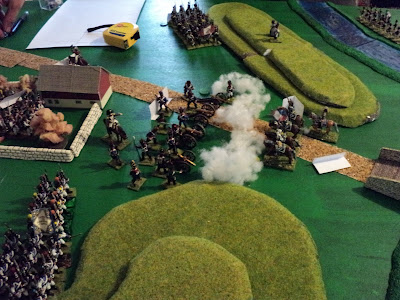
At least they had silenced a section of the guns, and put the rest of the battery out of action for a space, but the job was yet to do. It was up to the infantry.
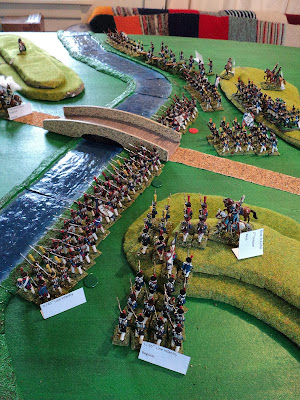
As the infantry lined the river bank, Junot had already been directing columns to ready themselves to attempt the crossing. The battalion immediately available turned out to be the 500 conscripts of II Battalion, 86th Line Infantry - not Junot's ideal tool for the task in hand. Nevertheless, any rearrangement would likely do more harm than good: across the bridge they went. Reaching the other side, they began to trundle forward towards the guns.

But the Spanish commander had seen it all coming - as who could not? - and had brought up a 700-strong column of Volunteers de Laen to intercept the attack. In a costly and tough close-quarter fight, Spanish numbers told, and although losing heavily themselves flung the enemy unceremoniously back whence they came.

All would have been well and satisfactory so far as the Spanish commander was concerned had not the Volunteers de Jaen allowed the excitement of their victory overcome their fear of the enemy. Though easily distanced by the scampering Frenchmen, the Volunteers reached the middle of the bridge where they were met by a devastating volley of canister, and II/65th coming the other way.

Under cover of the cavalry and infantry assaults, Junot had brought his guns much closer to the bridge, ready to crush the lighter Spanish ordnance beneath the weight of his counterbattery fire. There they were, in good time to provide for the Volunteers de Jaen a lively exposition of French gunnery at short range.

The lesson was well taught. Mowed down in windrows by canister, the disordered survivors were crushed by the French infantry onslaught as well. The scant survivors, 100 out of the original 700, fled the field.
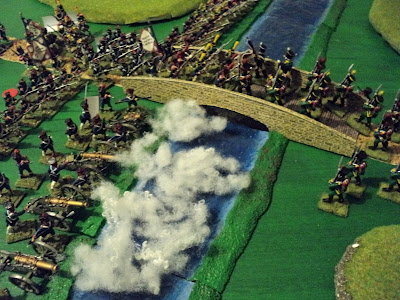
There was little now to stop the French crossing. The artillery had drawn back a piece, and their shelling, though galling enough, was insufficient alone to slow the French down much. No infantry counterattack materialised, though Junot would probably have welcomed one.

Instead, declining further action, the Spanish drew off. They had drawn blood, and had no wish to augment the French vengeance by further acts of rashness.

So Junot had his bridge, but at considerable cost. Early estimates put Spanish losses at somewhat short of 700; the French very close to 1000. But the crossing was secure, and Junot had not yet revealed his entire hand...

Sunday, October 9, 2011

Battle of Guarda - Part Three


Continuing the narrative of the Prince of Essling, the Marshal Massena to his Emperor, le Tondu in Paris, concerning the French victory over the Army of Portugal at Guarda.

Having determined the location of all our enemies, we were able, Sire, to put into immediate effect our overall plan of enveloping the southern flank. In the meantime, the holding action of Mermet's Division continued to pin the defenders of Guarda itself and the mountain upon which the town stood. By midday, the place was almost surrounded already, and the Portuguese line infantry keeping open the road northwest out of the town was taking heavy losses and barely hanging on. A battalion of 6eme Legere had already infiltrated behind the town and cut the west road.

Meanwhile, it transpired that a battalion of 38th South Staffordshire was waiting behind the northwoods to take in flank any push by our people along the north face of Guarda Hill....
Had 4th division been able to push the Portuguese out of the North Woods, the position of 38th Sth Staffs would certainly have been compromised, but the enemy refused to budge, even after II/25th Legere enveloped their right flank whilst a battalion of Labassee's 8th Brigade engaged them in front.

As the action around the town proceded thus indecisively, events were taking their planned course aloung the stream that flowed westward from the southwest corner of the village. As the Allied infantry hastily scrambled back across to their own side of the stream, General Loison's light infantry were swiftly following up, supported by the battalion columns of line infantry.


Bent in a right-angle as the Allied line had become, naturally a weak point had developed at the point of the angle. Already the Duc d'Elchingen was striking at and through that point. Despite their valiant resistance in that sector, the defending English artillery and infantry (9th Devonshire) were overrun, many of the guns destroyed if not captured, and the English colours taken by 6eme Regiment de Legere. But even before then, as mentioned earlier, elements of our light infantry were established firmly upon the western slopes behind the town.
Fixed as they were along the river line and defending the village and its environs, the allies foung it difficult, despite the presence of large reserves to contain the irruption of French troops into the angle of their position. Brigade General Simon's chasseurs and voltigeurs were bringing the disordered Allied infantry under fire already...
...and soon masses of our troops - Simon's 9th and Marcognet's 6th Brigades were pinning down and wreaking heavy execution among the defenders.
A general view of the battlefield. General Loison (Geoff) and Marshal Beresford (Ross) contemplate their next moves...


Not content simply with holding his position behind the town, Ney ordered Bardet's 7th Brigade to exploit on through the woods at the foot of the far slopes of Guarda Hill. There they dropped into fire action behind an Allied company of Light artillery before either was aware of the other (Fact was, Ross - General Beresford - his attention fixed on the riverside action, hadn't taken enough notice of events in that part of the world, which meant the infantry of 6th Light got into the woods without coming under fire from the guns). Although the Allied guns hastily turned upon the backs of the French skirmishers, their fate was soon sealed when they were overrun by another French unit following up.


As the day drew on with the Allies found themselves under unremitting pressure, the English Marshal suddenly ordered a general withdrawal. The Guarda garrison managed to break out by the last road available out of the town, and the enemy made off after incurring heavy loss.
At a cost of perhaps 1300 casualties on our side, we inflicted, we estimate, three times that number upon the enemy, and took some 450 prisoners (100 of them English). The trophies of the day included 14 guns and two stand of colours (one of them from 9th Devonshire Infantry).
Guarda remains in our hands, and we believe our position between the Allied wings will afford us certain advantages in the coming campaign.

I remain, etc etc
Andre Massena, Prince d'Essling, Duc de Rivoli, commanding L'Armee du Nord.

Tuesday, October 4, 2011

Battle of Guarda - Part 2


From: Marshal, Prince d'Essling, Duc de Rivoli,Andre Massene, commanding 'lArmee du Nord' in Portugal and Spain;
To: Napoleon, Emperor of the French, King of Italy etc etc

Sire -
I have the honour and pleasure to beg to report upon the recent victory by French arms over the forces and allies of the Perfidious Albion. After much manoeuvring, marches and countermarches, the larger portion of the Corps of the Duc d'Elchingen, Marshal Ney, brought to bay at the town of Guarda in north central Portugal that part of the Allies known as the Army of Portugal, under command of a Marshal Beresford of England. Owing to the difficulties of the terrain, the Duc d'Elchingen was instructed to take 3rd and 5th Divisions - the latter in brigade strength only - preceded by Lorges's Dragoons in a sweep into the right rear of the Guarda town, whilst 4th Division and P.Soult's light cavalry conducted a holding action in front. The latter was to become an all out assault if the opportunity presented itself.

The early attacks upon Guarda rapidly spread to both flanks. Soult uncovered a pair of Portuguese battalions in the North Woods; Guarda itself was strongly garrisoned, though a preliminary bombardment by the 12pr guns of the Reserve artillery somewhat reduced the strength of the buildings as strongpoints; the lead elements of 3rd Division ran into an English battalion and a battery flanking the south side of the town. There they discovered elements of another Brigade extending the enemy line into the South Woods.

With the action becoming general along the line, most of 6th Brigade of Marchand's Division, and all of Loison's and Lorges's commands were free to carry on their march deep into the enemy's southern flank. When it became apparent that 26eme Legere (9th Bde, 5th Div.) had swung north prematurely to engage the south face of the woods on their right, I felt it necessary to send to remind their commander of his instructions, which indeed he carried out much to my satisfaction thereafter.
Progress upon Guarda hill and the woods to the north was necessarily slow, given the difficulties of the ground even to light infantry. I and III battalions, 25th Legere (7th Bde) attacked the town itself...

...whilst their companion battalion (II/25eme legere) engaged the Portuguese Brigade to their right,...
...and II and III/6eme Legere attacked along the southern slopes of Guarda Hill.

With parts of 5th and 6th Brigades gradually driving back the enemy, and the rough going on the enemy flank found to be clear of the enemy, Marshal Ney could be seen resolutely striking out with his troops for the distant ridge.

Our earlier appreciation having determined there must be at least as many more enemy foot troops hidden as had already been disclosed, plus his horse and much of his artillery yet to be developed, we had some reason to apprehend what might lie upon the further side of that long and lofty eminence guarding the Anglo-Portuguese right rear...
When at last the lead elements of Ornano's Brigade (15eme Regiment de Dragons)crested the heights, the sight that greeted them was such as to afford considerable relief from the tension of not knowing what lay on the far side of the hill.
A whole brigade was found on the near bank of a stream, hastily forming square. Some distance to the Dragoons' left front, and on the far bank, a redoubt had been built that contained a battery of guns, sited, fortunately for us, facing due south, and so unable to quite to bring the dragoons under fire. Also upon the far side of the stream, could be seen the mass of General Grant's Division of Dragoons, more infantry at least another brigade, and a gun battery that caused some damage to our 15th Dragoon regiment before it could retire behind the crest.


Altogether, what had been disclosed gave us confidence that this action would end favourably to us...


To be continued...

Sunday, October 2, 2011

Battle of Guarda - May 1810


Marshal Massena's first battle as Commander in Chief of l'Armee du Nord, has taken three campaign months of strenuous marching and countermarching to bring about. The Vive l'Empereur Peninsular Wargame campaign has been going on for over a year, now, interrupted from time to time by earthquakes and heavy snowfalls, with very little action in Portugal to show.

In the South, Marshal Soult and his subordinates (Generals Suchet and Sebastiani de la Porta, and I think Marshal Mortier) have been beating the Spanish time and again, though the Iberians seem still to be popping up here and there to create nuisances of themselves. The only involvement of the L'Armee du Nord occurred when Junot's VIII Corps march upon Badajoz was briefly interrupted by a Spanish force defending the sole river crossing of the Guardiana River. Junot's operations in the western parts of Estremadura had to be rethought when the pitifully small garrison in Madrid was driven out by a popular uprising.

Meanwhile, it was looking as though Massena was being forced out of Portugal without a major action. Having fortified Guarda - an important road nexus - Massena reluctantly evacuated the place and fell back upon Almeida, just barely inside the Portuguese frontier with Spain. But then, certain intelligences brought by his aggressively handled cavalry operations suggested there might be at Guarda an Anglo-Portuguese force of a size worth attacking, but not so large as to make the undertaking too hazardous.


The Marshal Prince of Essling at once seized his chance. Wishing to report to Paris that if he had to abandon Portugal it would not have been without a fight, he was prepared to take a chance on the enemy proving even somewhat stronger than his own. The estimates were that numbers in all arms were roughly equal. As it happened, Massena slightly misinterpreted the information, thinking the enemy infantry to be numerically somewhat stronger. As it transpired his overestimation of the enemy foot was matched by his underestimate of the enemy artillery.

Arriving east of the town the Marshal was faced with a formidable position: the place itself crowning a lofty, very difficult, ravine-scarred eminence flanked by woods that presented an almost insuperable obstacle to his cavalry. His initial idea of a sweep around the north he ruled out of court after a close reconnaissance of the terrain. It had to be a left hook - and that didn't look very appetising, neither.

Fortunately, in Marshal Ney (Andrew Taylor, who had under his own hand 9 battalions and the 8pr company of Marchand's Division), and his Divisional commanders (Geoff had Loison's single [9th] Brigade [4 bns], Lorges' sole [2nd] Dragoon Brigade [3 regiments] and an 8pr company), the Prince had subordinates of the same mind. It was a simple matter to draw up the battle plan, based upon the line he expected the enemy to occupy. I (Massena) doubled up by taking the roles of General Mermet (7 battalions of 4th Division), the 12 pr guns of the Reserve artillery, and General Soult (2 light cavalry regiments). That seemed to me a fair division of roles among the three of us.


Directing the Marshal Duke of Elchingen to lead the left hook by Marchand's and Loison's Divisions, preceded by Lorges's dragoons, 'Massena' adopted an overseeing role, content for the most part to let his subordinates to get on with it (What this meant was, the 'Marshal Massena' figure stayed close by 'Marshal Ney' whilst I also took command and spent most of my time as 'General Mermet' of 4th Division and 'General P.Soult's' brigade of chasseurs-a-cheval. Occasionally I would check out how things were going and take pictures. Once I did 'send a message' to 'General Loison' (Geoff) when I thought his troops were swinging north prematurely, but that was much later in the day).

The French general advance shortly before 9:00 a.m. Already the general plan of attack is taking shape. In the foreground, Soult's Chasseurs have discovered two Portuguese battalions lining the woods north of Guarda; and the leading elements of Bardet's 7th Brigade are beginning the climb towards the town itself. Meanwhile the rest of Ney's VI Corps are marching into the Alied left flank and rear...
The first contacts upon Guarda Hill itself, and in the thickish woods (classed as 'medium' in Colin's rule set) to the south. The sole unit of light infantry in the Allied army - a corps of tiradores - were lucky to survive being attacked front and rear by French light troops. They flung back their assailants and managed to extricate themselves behind a unit of Portuguese line infantry (classed as militia in this campaign).

In the Comments to a previous article, I was asked about the little blocks of wood with the two nails sticking out. The rule set we are using have been authored by Colin Foster, the Duke of Wellington in this campaign, and at whose place we fought this action (and as fine a wargaming venue as you could wish).

To the blocks can be pasted labels identifying units and commanders, and the nails hold beads that log information. The black beads (which for some reason we call 'pips') tell us whether and to what extent the unit may act. Each bead signifies an action and is removed when the action is carried out (shooting, moving, changing formation). A unit can continue acting until it runs out of 'pips'. 'Pips' can be carried over into an opponent's bound, which allows it to react to opponent's action. They aren't carried forward any further, but are renewed at the beginning of the player's own bound. In effect you top up unused 'pips' to the unit's maximum allowanc). This allowance, the number they receive, depends upon the unit's quality (raw, experienced, veteran) and whether it in under command (i.e. within the command radius of its brigade commander). Additional 'pips; may be allocated by higher command when certain conditions are met (which is why 'Massena' (the figure) remained close to the main action throughout the day).

The other nail holds beads of other colours, and shows the unit's morale state - from extremely enthusiatic to completely routed. A given unit's 'ground' state is 'beadless'. When a unit takes a hit, it receives a white bead (in addition to any beads signifying atate of morale). A second hit means an element (roughly 100 infantry, 75 cavalry in scale terms) gets removed, along with the bead. The bead signifies a 'helf-element' loss.

I find the system quite simple to use, quickly informative and visually not unappealing. It reminds me somewhat of John Sandars's log-pin system for his Sandskrieg game. Mind you, threading the beads on the nails when one eye doesn't function properly can be a bit... awkward...

To be continued...

Friday, December 3, 2010

Peninsular War Campaign...

For the last few weeks, a bunch of Christchurch wargamers, sinking their identities into various well-known personages of the Peninsular war, have been engaged in a struggle for power over the Iberian Peninsula. The last three posts have described some of the action in that campaign.

Here's the cast of characters:
Marshal Massena, Prince of Essling: Ion (Me)
Marshal Soult, Duke of Dalmatia: Andrew Taylor
General the Duke of Wellington: Colin Foster
Marshal Beresford (Commanding the Portuguese): Ross Fraser
Anybody and everybody Spanish not friendly to France: Paul Jackson
God of War (Mars) - or maybe Goddess of Battles (Bellona): Barry Taylor

Of course, each character has a number of other non-players (NPCs) under command. Messena commands the Armee du Nord, broadly speaking active in Old Castile, Estremadura, the area around Madrid, and Portugal. Under Massena's command are Marshal Ney (VI Corps), General Reille (II Corps - soon to be taken over by Marshal Bessieres) and Genl Junot (VIII Corps). One has the sense of being spread rather thin!

This is partly due to the scaling down of the armies. Any any given time the French Empire had committed something like 250,000 to 300,000 to this theatre. We are making do with forces representing maybe a fifth or a quarter of those numbers. Clearly the whole Peninsula has been scaled down, as has the time scale (though each Campaign move is called a week).

Much of the early action has taken place in Marshal Soult's extended bailiwick: Zaragoza surrendered; Genl Suchet successfully stormed Barcelona; the confused and scrambling combat at Castalla was followed up by the pursuing French successfully forcing a river crossing at Xativa.

There has been little fighting in the northwest, though that seems likely shortly to change. Gathering under VI Corps command as large a force as he dared - in view of the vulnerability of his lines of communication and the need for garrisons to hold down the countryside - Massena undertook to carry out the orders that had been issued direct from Paris: take Portugal. Marching by way of Almeida, Guarda and Covilha, Massena penetrated as far as Abrantes, whereat his scouts reported the presence of large Anglo-Portuguese forces - perhaps 15,000 troops, more than half of whom were British - upon the hills on the far bank of the Tevo River.

With a force little more than what the enemy seemed able to assemble, Massena declined to attack, but offered battle where he stood. The Iron Duke mysteriously drew off most of his force south to Santarem, but Messena refused to be drawn. A quick strike by Marshal Ney towards Fatima yielded no results; and at the end of March Massena began gradually to pull back northwards.

There were two reasons for this. Faced by a strong enemy force whilst isolated at the end of an exiguous line of communication was not a situation that Messena felt could be long endured (yes, I know: Massena did indeed endure such a situation during the winter of 1810-11, but I wasn't going to have with that!). Somehow a better opportunity needed to be sought. But equally compelling was news of an Anglo-Iberian landing somewhere near Gijon, on the Biscay coast. The reported numbers of Allied troops involved suggested this was no mere raid, but a serious effort to (re)conquer Old Castile. Could II Corps meet this threat? A worrying situation to be sure, yet those that knew him began to discern a faint gleam in the Marshal's eye. Dispatch riders with heavy escorts rode off in numbers with orders to the various commanders throughout Northern Spain. The game was afoot!

Meanwhile, General Junot has been conducting an offensive of his own in barren Estremadura. It has been a lonely journey - hardly a Spaniard has been encountered in the entire province, though there was rumour of enemy light cavalry moves south of the Rio Guardiana. At last, approaching Badajoz, VIII Corps has run into a small brigade strength Spanish corps that seems ready to defend a river crossing - a single bridge with nary a ford by which to bypass the defile. A small action seems imminent in that remote part of the world.

Action looks likely in northern Portugal as well. Forced to abandon Viseu, Massena is planning a strike in that direction in the hope of bringing on an action. It seems fairly clear to him that he can not much longer retain a foothold in Portugal, but, perhaps to avert Imperial wrath in Paris, he wishes at least to cross swords before moving back into Spain. Besides which, the Guarda crossroads is a fine point upon which to strike out at foes coming from different directions, whilst at the same time not an easy place to get past if the Allies want to carry the war into Spain. The strategic value of such a point is not lightly to be given up!

On the other hand, there remain those enemy troops in Old Castile that require attention...

Friday, November 19, 2010

Barcelona Falls!

Such were the headlines that blazoned the Moniteur at the beginning of April, 1810. Zaragoza had surrendered at discretion, but the determined garrison of Barcelona, despite two breaches being torn out of the crumbling city walls, were determined to defend the city to the last...
003

A view of Barcelona in more peaceful times...

The map shows the city of Barcelona, flanked by the Citadel to the east, and Fort Joie hard by the town to the southwest. Heavy siege batteries in both places were still active. Though those at Fort Jouy was largely masked by the city walls against an attacker coming from the north, the Citadel guns could reach two-thirds to three-quarters across the north face. That left a fairly narrow corridor through which the assaulting columns could advance, safe from the heavy ordnance in the outlying works.

However, as these were served solely by artillery, the French commander, General Suchet, decided to take the city by storm, leaving the more heavily fortified fortifications to 'wither on the vine'. He had available some 5000 infantry, a single battery of 8pr guns, and 1200 light horse. Besides the single battery company in the Citadel and in Fort Jouy, General Giron, commanding the garrison, had just 2200 poorly trained volunteers and militia, and a company of 8 light guns.

Storming the town
006
General Suchet opened the ball with a powerful attack in depth upon a narrow front. Supposing (rightly) that the breaches had been mined, he elected to storm the wall beside the major breach near the North-West tower, ignoring completely the minor breach in the centre of the north face as too hazardous to approach under the flanking fire from the Citadel.

Gen. Giron declined to defend the walls, instead placing a garrison in each of the Western, Central and Eastern Districts. A fourth small volunteer battalion he kept in reserve hard by the Eastern District, behind the light guns placed to enfilade any attacker who crossed the walls. The maze of streets in Western District, just behind the major breach, proved to be extremely tough to attack, and although the first to come under assault, it's defenders held out for a very long time.
Fall of the Central District
007
A battalion sized attack cleared the Central District surprisingly quickly, though only after a stiff fight. This left the flanking Districts isolated from each other. Rearranging his forces, Giron flung his Eastern District garrison in a spirited counterattack that, to everyone's surprise, recovered the lost ground.
Spanish counterattack recovers the Central District (briefly)
010
Before this unexpected success be consolidated, a renewed French attack flung the Spanish out again. With the scattering of this battalion, Giron was forced to deploy his last battalion in defence of the Eastern District.
It was shortly after that that the Westen district finally succumbed.
With two-thirds of the city in his grip, Suchet prepared with care his attack on the District remaining in Spanish hands. Left with a single small battalion of volunteer militia (400 men - 4 stands), Giron determined to fight to the last. The other three battalions had scattered among the streets and alleys of Barcelona; his guns had been overrun. It was a brave 400 that stood to meet the final assault.
The final assault
011

It was a fitting climax to the day's action. Four battalion columns stormed into the Eastern District, and were met by a withering storm of musketry. Losses mounted sharply on both sides; nearly half the Spanish defenders fell, but took an even heavier toll upon their assailants. Appalled, the French fell back to regroup.

Before they could renew the attack, however, a ragged Spanish militia officer approached with a flag of surrender. General Giron had been severely wounded, and, for their bravery, the scant remnants of the defenders had had enough.

The French were jubilant. Barcelona was theirs.