Showing posts with label 17th Century Wargames. Show all posts

Wednesday, March 27, 2024

30YW Work In Progress

 I've been spending a good deal of the last fortnight 'finishing off' my long neglected 30 Years' War project - begun maybe 30 years ago.  It kinda went into limbo when I made the monumental blunder of converting the thing from my own system (down to my own rule set) into DBR format.  That might have been OK had DBR been properly 'finished' (in my view), and had that game system retained its following at the club. It wasn't, and it didn't. 

But I have always intended at some time to revive the project, and the publication of the Portable Pike and Shot Wargame rather inclined me to do something about it. But, there as the small matter of the unexpected Sengoku rule set... 

At any rate, I can point to considerable progress on the 30YW front.  The Swedish have some cavalry now, and many of the unconverted troops have been rebased and the bases flocked. 


A few Swedish cuirassiers and pistoleers. The cuirassiers
I suspect are more in the way of allies.

The Swedish pistoleer cavalry units will comprise 4 stands (elements) of 3 figures each - 12 figures. There are six such units.  For battlefield purposes, they may be spit into 2-stand tactical units. The Cuirassier units each comprise 2 stands of 3 figures.  I have 2 such units done, but they may get 2 more. The Swedes will also have a unit of harquebusiers - probably allies, such as Saxons.

The bulk of the Swedish charging cavalry. I've 
not worried over the correctness of the flags -
so long as they belonged (more or less) to the right army.

Imperialist horse: cuirassiers.
At the moment the Imperialist cuirassiers are in 3-stand (9-figure) units. The original idea was that the Imperialists would favour the deep columns that formed Graf zu Pappenheim's method of cavalry warfare. However I'm thinking of their being reduced to 2-stand tactical units, they being split from 4-stand regiments.
Imperialist harquebusiers and, behind them,
'commanded' musketeers
The Imperialist harquebusiers - pistol bearing horse, are to be 9-figure (3-stand) units, appearing as 3 ranks of 3.  These represent the deep pistoleer columns fighting by caracole. In my original set of rules, my Imperialist horse were to form 2 shooting ranks of 6 figures each; the Swedish just one rank, but of 8 figures. Shooting was by single rank, but it would take a whole move to reload. Howver, the existence of a second rank permitted the unit to shoot every move. Given the chance the Swedish cavalry would move into contact with the sword without shooting, and counting the two extra front rank figures as overlaps.

How the Portable Wargames version will play out may be something like what happened in this action, but it requires further examination, I think.
Artillery limbers. 
At the moment, my Imperialist foot are made up of several 6-stand 'battalia' comprising 8 pikemen and 12 musketeer figures. At the moment I have 8 such units. In addition are 12 elements of 'commanded shot', forming 6 2-stand units.
Imperialist foot: units of 4 musketeer stands (12 figs) 
and 2 pike stands (8 figs) each

Below: Swedish foot - 7 battalia of 20 figures (6 stands) each, plus 4 commanded shot units of 6 figures (2 stands) each.

Swedish battalia - 6 stands, 20 figures -
same as the Imperialists

More Swedish battalia

Swedish 'commanded shot' - 4 of 8 stands in 
2-stand units


In front of the Green Regiment, 2 more 2-stand 
units of 'commanded shot'.

Both armies may field a couple of stands of dragoons. For these I used the kneeling figures firing light muskets/ carbines (?) plus a command figure, of which Revell has given a lavish supply. Unfortunately, some time in the intervening 30 years, one of these fellows has gone walkabout, vanished, completely disparoo. So one of the Imperialist stands has just the two shooting figures. If there happens to be - if a scenario calls for - some qualitative difference between the two stands, guess which will be the poorer.

Imperialist dragoons
The dragoon stands are much deeper than the other foot stands in order to include the horsed figures that identify the stands as dragoons.
Swedish dragoons
There follow some command stands. These have only a 4cm (instead of 6cm) frontage, and they can be attached to other units. At the moment they are still 'works in progress'. The stands with the flags are to be the Army commanders' stands. 

A couple of Imperialist command stands

A couple of Swedish command stands

I plan on adding a couple of stands each of commanders on foot.  If I can find the spare mounted command stands, both armies will receive one more of them.
Foot figures as yet unassigned. I imagine some will
form for each army a 'forlorn hope'.

Mounted figures and artillery - still to be sorted out.

Finally, there remains a fair number of figures to be sorted. One more 9-figure unit of Imperialist pistoleers has been determined, and there are more cuirassiers to be assigned an army (probably Imperialist).  Artillery, too, are a long way short of 'finished'. Finally, those officer figures in the foreground will most likely end up as 'generals of foot'.


Saturday, January 25, 2020

More on 'Other People's Imaginations'


I've just been re-reading my previous posting, and the comments that followed. Some remarks by Neil Patterson reminded me of a half-forgotten still-born project from 45 years ago. To this day, I think about it from time to time with a certain wistfulness. Like one of Neil's concepts, this was set in the Balkans - or at least, a Balkanish sort of region. But the period setting was Late Mediaeval/ Early Renaissance.
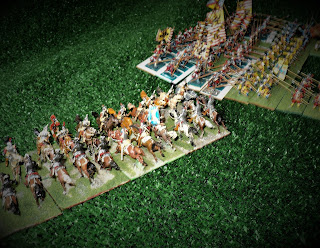
Battle of Jazzynitza Lug - as recalled - between the City State
of Dubius and Monteblanco.  The original battle used
Airfix 'Sheriff of Nottingham' and 'Robin Hood' figures.


Somewhere upon the Eastern Adriatic littoral...


Being 'Balkanish', the region - its name lost to antiquity - was split up into several rival States, of varying size and military strength. Each state had its own specialist troop type - one large state of rolling grass plains was famed for its horses, hence for its cavalry; another, a heavily forested alpine province, favoured the pike; the City State (somewhere upon the Adriatic(?) coast) was renowned for its arquebusiers. I think knights, archers and crossbow men also were to feature. Probably everyone might field ordinary humble spearmen.


The whole thing was envisaged as a multi-player game. As a result of the military specialisation among the States, it could be imagined that a certain amount of arms dealing was intended to occur, to supply deficiencies in each other's armed forces.  So this called for a certain amount of cooperation among the States.  Of course, having acquired a consignment of pikes from 'Pikeland', didn't prevent one from using them against 'Pikeland' subsequently - unless you 'bought' the men that went with them. I don't recall whether the campaign involved mercenaries - or how.

I have a feeling this market in arms was predominantly to take the form of trade - of barter - rather than monetary deals. Don't recall exactly. Economic factors were generally pretty fudged out of consideration, but there must have been production and financial constraints upon the manner in which States could develop their military.


For each State, the objective was to become the hegemon overall - very like the Diplomacy board game in that regard. It was impossible, however, for even for the most powerful State to 'go it alone', so alliances and non-aggression deals were de rigueur for even mere survival. In such situations, there was always the possibility of States 'ganging up' against a single State, or perhaps unfair trade sanctions being imposed. To keep the 'States' honest the Game Director had what I called the 'Umpire's Sanction'. 

It was called the Nordic Horde. 

Now, the figures in use for this whole project were Airfix: 'Sheriff of Nottingham' and 'Robin Hood' figures. Quite a lot of the Nottingham spearmen lost their spears and received in return sturdy wire pikes - at least 72 such figures, as I recall from one of the 'test' battles fought. I don't recall where the arquebusiers came from - some adaptation of the plastics, I'm sure. 

So, whence came the Nordic Horde?  Airfix Ancient Britons. Hordes of 'em. That is why this Horde was Nordic rather than Asiatic, I suspect. When the Nordic Horde was feeling restless (at the 'Umpire's' discretion), the 'Balkan States' pretty much had to drop everything and fend them off.  So powerful was 'The Horde', that if just two States stood aloof from the threat, the likelihood was that the whole region would be overrun, and sink into a Nordic Dark Age. End of Game. 

Battle play test.  The City State
horse (right) broke their opponents,
 to 
win the battle.
I recall that Philip - the inventor of this 'project' - and I played a couple of small games to test his very simple game rules (derived from Young and Lawford's Charge!). In one of these he had a force of perhaps 12 or 20 cavalry, and 4 12-figure pike blocks each arranged in 4 ranks of 3 figures. I had as many horse, 2 pike blocks and a 12-figure unit of arquebusiers. Having fewer than 60 or 70 figures a side, the thing was fought on a desk top. As the infantry fight gradually developed in Philip's favour, the even cavalry fight went, by sheer luck, quickly and decisively my way. 
The next battlefield featured a lot of hedged enclosures, with one gateway, which sole defile might be negotiated by cavalry in single file.  That pretty much neutralised my cavalry out of the action. A canny operator, was Philip!  But it rather defeated the purpose of the play test, methinks.


It was a pity that time, marching on as it usually does in step with 'real life events' (one of which was my leaving Auckland to take up work in Wellington), didn't lead to the project getting any further off the ground.  I've always thought it a promising concept - provided, of course, you got together at least a half dozen like-minded war gamers ready to give it a serious go.  I have occasionally toyed with reviving it, but have been forced to conclude that the practical difficulties would be beyond my capacity to overcome them.

Unless I played it solo.


Mabutuland.


That brings me to a project behind which lies the motivating force of my war games buddy, Paul, a.k.a. 'Jacko' of the occasional blog spot, paintinglittlesoldiers.  I would like to see more happening with that blog, but there also happens to be another that has seen no action for several years: The Empire of Jaxonia.  This one, though, I hope will see something happening, and this blogspot revivified.  

Think: East Africa, c.1880, not so far from the offshore island of Madasahatta, with ambitious colonial powers, Arab raiders, Turkish traffickers in ivory, gold and persons, and the  fearsome indigenous tribes wishing everyone else would go away, and leave them in peace to fight among themselves.   

I believe the framework is similar in overall concept to Space 1888, which might be played as a war game, or as a role-playing game.  The RPG aspect offers local sub-plots within a much broader narrative.  The inspiration for this comes from Ubonga: A Solo Campaign from Darkest Africa.  Having some 100 'spare' Zulu Wars British figures, I have offered to create a company-sized force garrisoning some up-river fortified outpost, though I admit that the logistical backup would probably be wanting.  I have suggested that one of the main rivers be called the 'great grey-green greasy Limpopo River, which is as deep as the sea, and bordered with fever trees', just because I like saying 'the great grey-green... etc'.

Schematic of HMS Thunderer that will form the basis
of the construction of HMS Blunderer


On the strength of it, though, I have begun building a coastal battleship based on the old HMS Thunderer (to be called, I think, HMS Blunderer), forming a small flotilla together with a Fly Class gunboat, and an assortment of paddlesteamers and tenders. Other nations might get some ex-American Civil War riverine craft, sold them by a canny US government with an eye for a buck.

All this so far is pretty vague, very much in its early stages.  But 'Jacko' has done quite a lot of work on developing the factions and forces. Not only that, but he's got hold of the map for the S&T Magazine game: Sideshow - German East Africa, 1914-18. Possibly my own Ruberians, Azurians and Turkowazians will have a role to play in what is, in certain respects, really quite a vast undertaking. I hope to have more to write on this topic later on.  
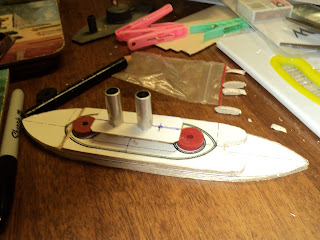


HMS Blunderer, early construction.  The faucet washers will
be the turret 'guides' rather than the gun turrets themselves.
The overall scale length has been shortened slightly
to fit 2 hex-grid widths.  Hence the shortened distance
between the funnels.


Monday, August 7, 2017

Yet More Thoughts on Grid War Games

...
Multi-element units on a chessboard.  Swedish foot and Imperialist
Horse.  Or Severeian vs Austereian if you prefer.

Some of the recent response to my earlier comments and posting on this topic led me to look into the practicalities of:

1.  Units that occupy more than one grid cell
2.  How one might approach diagonal movement and placement.

This was very experimental - not a play test, withal, merely to inquire into the 'look of the thing.'  In the accompanying pictures, I was focusing more on the infantry than the horse.   Unfortunately the 6cm width elements are slightly too wide for the 5.7cm squares on the chessboard.

 Black Regiment in line.
A Swedish (or Severeian when I'm feeling whimsical) regiment (battalion) of foot, comprising a pike block (8 figures) with 2 arqubusier/musketeer wing elements (6 figures each).  The unit occupies 3 spaces - grid cells.  In play, each element would have conferred upon them their own strength points.
Red Regiment in left echelon, facing north.
In this formation, the unit can switch front to due west
and then form line in a single move.
Lined up orthogonally, the unit presents a nicely ordered, solid line, but suppose they found their enemy somewhere off to their left flank front?  One possibility is to begin by throwing forward the right flank to form left echelon as in the above picture.  In my view this would work quite well in the kind of 'orthogonal-only' systems we have been discussing, as the unit would be flexibly enough placed immediately to form the solid line East-West or North-South as required.
Red Regimentin line facing diagonally 45-degrees.  The gaps
 do rather detract from the notion of contiguity, one feels.
Suppose we allowed diagonal moves and shooting according to the system proposed in my previous posting (counting a diagonal step as one-and-a-half steps, and rounding the fractions down for completed moves).  With a two-square movement rate, it would be possible, provided the left-flank element pivoted in place, to wheel the whole  3-element line 45-degrees as in the diagram (except they ought in the picture to be lined up on the light-coloured squares).
If the cavalry advance into the adjacent light squares, a
close combat would ensue.  But what about the
corner-t0-corner adjacent green squares? Ought the
cavalry be permitted to concentrate their attack
upon the right flank musketeers, say?

Then of course you run into the elements splitting up to centre upon their grid cells  Is this good?  Do I like this? Not sure. This diagram has alerted me to another fishhook with this system. Suppose the Imperialist (Austereian)  Horse were to try charge the Severeian line. Does an element placed upon a diagonally adjacent square count as being in close combat? If so, you could bring seven (7!) elements into close combat with the diagonally oriented unit.  Against an orthogonally oriented unit, only five. In the pictured situation, the cavalry might try concentrating upon the right flank musket element, say. That does not sound at all like a Good Thing!  
I perceive, then, that there is a whole lot more to this whole question than meets the eye. I'd probably be inclined to allow close combat between orthogonally adjacent grid-cells, and allow only shooting between diagonally adjacent cells. This would equalise to 8 the 'contactable' cells around the unit, though in one case there would be 3 frontal, 2 flank and 3 rear; the other 4 frontal and 4 rear.   It would also solve a little problem I noticed last time with javelins shooting diagonally.
Food for thought, but I am beginning to think that maybe trying to sort out the diagonal moves, orientations and effects aren't worth the candle.  It seems more than likely that my 30YW armies are better suited to an ungridded battlefield after all.   If I wanted to persist with this, I would have to construct a grid field with 6cm squares.  Starting from scratch, 6cm hexes might be a better option.  
These last couple of pictures are a bit of self indulgence. I rather regret my neglect of these armies, especially as there isn't all that much to do (Swedish Horse and some artillery) to finish these off. But other projects are clamouring more for attention... 


Monday, April 12, 2010

Nga Tupuna - Ancestors

The following strip was my contribution to a book of cartoons and strips celebrating 1000 years of history of Maori and Pakeha (specifically English) ancestors of New Zealanders. Of course, something like 800 years of the latter take place in England. The strip is based very loosely on a real incident in the English Civil war, shortly before, I think, Marston Moor.

This has been reproduced from my copy of the resulting book - not the crispest, but readable. Click on the picture to enlarge - click again to supersize.

Wednesday, February 17, 2010

Thirty Years War figures...

Having over my 30YW stuff yesterday, taking those photos and posting them has led me to thinking about what Imagi-Nation belligerents might be called into existence for some sort of campaign? Probably King and Emperor or something similar.

How about the Imperium of Austeria and the Kingdom of Severia?

Of course, I won't be restricting the numbers to mere 400AP DBR - I reckon for 30YW, 500AP gives better balanced armies anyway, particularly for the Swedish whilst still using the Brigade system.

The fact was, I bought my 30YW armies with an entirely different view, with the army sized pre-determined. It works out at around 900AP of Imperialists and 750AP of Swedes according the the DBR accounting system.

Why the difference? My own rules rather favoured the Swedes - especially their horse - whose units were smaller, but rode in a single rank, and charged. Unless the 12-figure Imperialist horse shot very well, the 9-figure Swedish units more often than not would send their opponents flying. The Imperialist numbers made up for this and led to some very interesting battles.

I still have the battle maps of a series of actions fought under my rules (wish I still had that rule set), including the Battle of Coutras as a 'disguised scenario', and Nordlingen. Although these were played long ago, I wonder if there would be enough interest in a narrative with maps and pictures...?