Showing posts with label General remarks. Show all posts

Wednesday, May 13, 2026

What happened?!

Early this year I posted a run-down on armies and navies finished off during the course of 2025. Although I have added a few little items since - e.g. the Settee Empire (Turcowaz) got a small ironclad gun ship, and the chubby merchant fleet got an extra vessel about a week ago - really my forces are pretty much complete as they now stand, with no further additions required. Rather, I find myself with a few loose ends - orphaned figures in trivial numbers I'm not sure what to do with.

That would, one might suppose, offer more time for (a) war gaming and (b) the writing up thereof. That isn't happening... and I don't know why. OK, it's the blahs. Sort of.  I have such a backlog of postings to post; the second chapter of Waterloo 2.0 is in draft (and that has taken a good 6 weeks to get started, even); the first two land battles of the Little Great War have been fought and pictured: and I haven't yet put together a proper war narrative for the Little Great War...

Little Great War: Battle of Azaen, 11 June, 1884


Little Great War: Battle of Azmezidon, 15 June 1884

What happened to my version of the Battle of Aspern-Essling?! That was played out last August! This really is reprehensible.

Aspern-Essling, Morning, 21 May 1809


Aspern-Essling, about midday, 22 May

This morning I was glancing through an old Wargames Illustrated magazine and lit on an article about the 30YW Battle of Breitenfeld. I had clean forgotten that I played out a 'Breitenfeld' on my hex table back in December. Had I posted it? Nope. No idea where the notes went, but methinks the Waterloo campaign narrative will have to wait upon a brief write-up of the 30YW action. This will be less a battle narrative than a write-up of the army organisation, adaptations of the Portable P&S rule set, and the limitations of my small table (or of overlarge armies!).

Midway through the 'Battle of Breitenfeld'. I don't recall 
what was the final result!

I wonder if it is because I have so many projects pretty much completed in terms of established armies. Could it be that I have reached a 'Buridan's Ass' impasse, unable at any given time satisfactorily to decide which project to focus on? Un embarras de richesses it is. Perhaps certain global events are distracting me - I certainly have been following the major conflicts with a great deal of interest, trying to pierce the fog of mal-information this country is receiving and passing off as 'News'. That has had some effect upon my war gaming, and has more than once led to my wondering why I war game at all, or even whether I ought.

Time methinks to wake up, and level off the backlog mountain...

Saturday, May 2, 2026

Army Accommodations


A recent posting on Bob Cordery's blogspot, Wargames Miscellany reminded me of something I've been meaning to do for a long time: tell of the accommodations of my war games armies. His own accommodations look to me convenient and handy - especially the 'army in a box' concept - something I have striven for but never quite achieved to my satisfaction. We begin with these 'tray towers'.

The coloured ones house most of my Napoleonic inventory. We might call this an 'army corps in a tray', in accordance with my Big Battles 4 Small Tables game system. Some 'double up', such as the two French Cavalry Corps in the picture below. I Cav Corps comprises 3x12-figure brigades of dragoons and a park of 1 gun with 3 crew figures; II Corps comprises 3x12-figure brigades of 12 cuirassiers. Also present in this tray are Marshal Murat with his aide-de-camp, and Generals Milhaud and Lasalle. Some sort of horse grenadier staff officer seems to have accommodated himself there as well.


In the following picture, a single French Amry Corps takes up only about half the room. One of the Divisions (the 5th) has been taken out for some work that needs doing on them. This Army Corps (II) comprises 3x24-figure Infantry Divisions, a light horse brigade and a park of 2 guns each with 3 crew figures. Those triangular and trapezoidal profiles you see are bases for the artillery in action. I prefer (for the moment) not to fasten the guns to these bases.
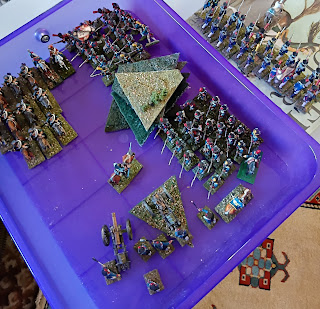


Below are a couple of Austrian Army Corps in their trays. Top tray, looks like I Corps: 3 Line Divisions, 1 Jager Division (rather larger formation than historica1!), and a unit of Uhlans. Again we have a 2-gun artillery park, but with 4 crew figures each. The artillery scale is determined by the number of crew figures, at 1 figure representing 8 guns, and 200 artillerymen. So this formation's artillery park represents 64 guns and 1600 gunners.


The bottom tray shows part of the Reserve Corps of Austrian grenadiers and cuirassiers.


The next two trays hold my British army: foot in the top, artillery and horse in the bottom. The Royal Scots Greys were an indulgence. Now, these trays measure 26cm x 34cm. The plastic being rather soft, the heavy metal figures tend to sag the floor of the trays. This was a real problem with the next tray tower, whose trays measure 33cm x 37cm. That extra width was enough to cause a sag that would compromise the safety of the figures in the tray below. 
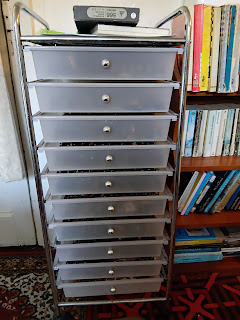

Stack of trays. the whole unit can be wheeled around
or the separate drawers removed. I damaged this 
somewhat several years ago when I tripped over an 
impediment I might as well have placed in order 
to do so, slammed into the thing, and took a hefty gouge out of my 
knee. The bottom tray still sticks a bit... and I still
bear the scar.

This I solved by transferring all the metal figures to the less roomy coloured towers. The armies here are all - very nearly all - plastics. The top 5 hold my 30YW armies. The picture didn't come out so I am not showing any. The next two hold my War of the Spanish Succession Imperialists.
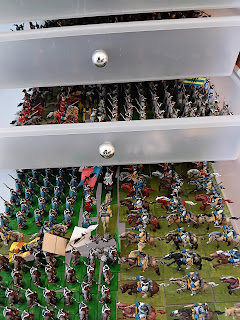
WSS Imperialists: 36-figure foot and 
24-figure horse units. I rather wish I had adopted
a different plan...

... and the next two my Prussian Army, inherited when their previous owner was about to deep six the lot. The Paul 'Jacko' Jackson added to the infantry, Italieri plastics, enough to build the army from 7 to 9 units; and I bought some Italieri cavalry. So 'antispiring' (outspiring?) were the figures that it took me an age to get them painted.  And then, just because I liked the look, and had forgotten what Prussian horse I had, I added a couple of metal (Minifigs). The whole army comprises 3 Army corps, each with 3x24-figure Divisions, an park of 2 guns and 4 gunners, and two or three cavalry formations. This army, like my French, has far too much cavalry! At any rate, the whole lot goes into just two of these trays.

Prussian Army

***

A very useful ... thing ... that I could use more of!

Now, the sort of thing pictured above would have been very handy: hardish plastic, deep enough to accommodate flags and uhlans. This is where my Napoleonic Russian uhlans live, together with Aeryth Chromatica Turcowaz cavalry. Not all the drawers have much in them at the moment.
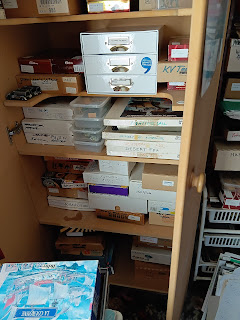

WW2, some board games I've hardly ever looked 
at (including SPI's Fighting Sail), and 
logistics elements at the bottom.

But that brings me to something I discovered several years ago: these 3-drawer cardboard archive tray thingies. There is a word for them, I'm sure. The white box at the upper centre of the picture holds most of the army of Altmark-Uberheim - one of my 'War of the Imperialist Succession' armies.

My rather inefficiently stacked WW2 and such 
cupboard. The white box with the blue apostrophe 
is what is intended to engage the interest here.


Just lingering in this tall cupboard for the moment, all the other random boxes here contain WW2 items: tanks, vehicles, guns. I really must go through and sort it all out.
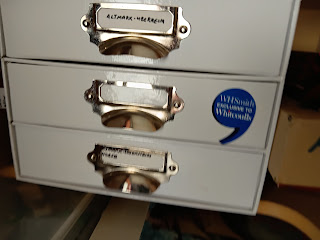
Altmark-Uberheim army box.


Altmark-Uberheim foot and horse.

Now this set was deeper than wide, unlike all the other cardboard storage that I picked up over the years. Pity, as for several reasons this was the better design.

Not Quite Seven Years War army barracks.


Here we have it. Everything in those 5 boxes belongs to my War of the Imperialist Succession/ Not Quite 7YW armies. Atop the left of the pile as you see it two flat boxes hold the Imperialist Infantry, and I do believe one Archduke Piccolo might be found there. Four of my five Sengoku armies are in boxes to the right, and that little black box contains my 'Jono's World' aircraft stands. The labels on most of those boxes will have to be redone...

The main drawback of these otherwise splendid units, is that they are not very robust. I might yet end up replacing them once they start to disintegrate. Mind you some of these are twenty and more years since their purchase.
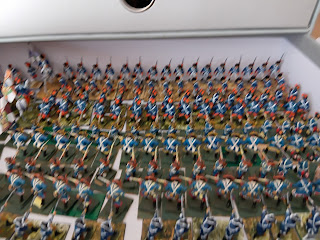
Infantry of Hessen-Rohr 5 regiments of 36 figures in all 
4 companies of 8 plus HQ of 4.

What the boxes contain: 5 x 36-figure infantry and 4x19-figure cavalry. 
Imperialist horse: 3 dragoon and 1 hussar regiment.
I have a notion that the green dragoons are below establishment 
at 15 figures.

RED and BLUE armies, and my really tiny
navies overall

Then there are these two. The contain my Chromatic Wars armies Ruberia and Azuria - and badly in need of relabelling. The armies of Turcowaz and Izumrud-Zeleniya have slightly different accommodation that I forgot to photograph: same idea, but metal-bound plastic. Very large drawers on that one. 

Here's where my ACW armies live. Mostly photographic paper boxes, with the occasional chocolate box thrown in. The whole arrangement is sufficient to hold something like 1500 figures. Not ideal, though. Mainly one box will contain a brigade or possibly two of infantry, the artillery have very shallow chocolate boxes of their own (except for my South Carolina Brigade, which has a 2-gun battery in the same box.  The cavalry have separate accommodations.
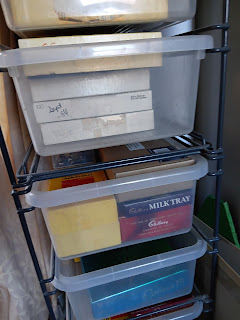
ACW boxes.

My Chromatic Wars navies live in a chest of drawers, two of which accommodate the 'whole worlds' navies'. Top drawer: 20 vessels of Ruberian Royal Navy; the 6 torpedo boats of Chervenia; some landing barges; the 8 Hellenic and 9 Turcowaz vessels.

Third drawer: 7 merchant ships (2 armed); 19 Azurian vessels (including the two overscale 'flatiron gunboats'), the light cruiser and 3 torpedo boats of the minute Rhumbarbarian Navy; and the 8-ship navy of Izumrud-Zeleniya. Separating the Zeleniyans from the others, are two riverine boats: a sternwheeler steamship, and a Ruberian  'Fly' class gunboat.


The above is what separates the naval accommodations: my Roman Fort. This featured as the fortified wall of the riverine market town of Kachinga in the 'Darkest Aithops' campaign run by 'Jacko' and myself that was kiboshed by COVID19 2.0. 5 years ago. I don't think it will ever be revived, worse luck. It promised to be very interesting. The colonial army was about to be ambushed at Getmai Drift by what remained of the m'Butu tribal forces, though it was very doubtful that the colonial tide would have been stemmed. 

In another chest of drawers one might locate my 'Byzantiad' armies - and my ACW vessels, which, again, I forgot to photograph

Some 'Byzantiad' stuff. Those galley hulls are from a project begun 
decades ago. Still don't know what to do with them.

Other bits and pieces have their own storage spaces - this unit of bins contains several HO-OO scale buildings, some cardboard railway buildings, some Usborne mediaeval, a few plastic, and a number home made. These days I find myself using more often several underscale buildings that I have stashed elsewhere.
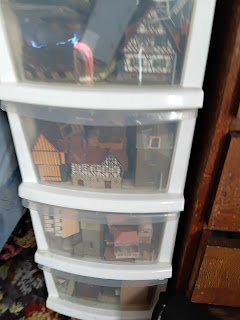
Assorted buildings


Below, counters, dice, little magnetic chessboard, and my hearing aid stuff. 
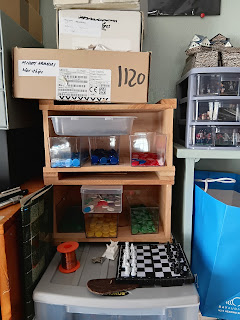
That folded thing divided into green squares
and tucked in between furniture was one of those
  'could be useful' buys. Still not sure what to do with it

And finally, I have found a place for my 1:600 'Jono's World' expeditionary forces. One change I will probably make. I combined the AA and logistic elements, which seemed to make sense, and perhaps those elements will remain so. But I think some separate AA elements are called for...
'Jono's World' Armies. The aircraft stands are 
for my 'Mighty Armada's' game system that needs 
a fair bit of work to complete...


Well ... that isn't everything, but it is most of it. At some future time I might say something about my folders of notes, sketches, maps, ORBATS etc. I had a look at my ACW folder, and discovered that over the years I had accumulated a fairly useful resource. More of that sort of thing another time...


Tuesday, November 16, 2021

Wot I bawt at the Bring-n-buy.

Every year, the War Games section arranges a bring and buy weekend at the Woolston Club.  This year it was limited to one day, and delayed a couple of months on account of the Alert Level 2 still in force in this town (Christchurch, New Zealand).  Every year I manage to spend some money - as a rule, not very much.  This year perhaps a little above average, especially if I add in the enormous lunch...

I went in with a couple of 'will-buy-if-I-see- 'em' notions, but, not seeing 'em, I didn't buy 'em. Pity.  Never mind.  What follows were some serendipitous finds.

So, here's the damage:


Here, some playing pieces for Memoir '44.  I can't think why I bought the Panthers, except forgetting that the Panther was the standard German playing piece.  For the rest: Tigers (for an elite unit), and StuGs (for a pair of mobile anti-tank units).  

Seeing these brought me to mind my Blackland Wars and Chromatic Wars projects.  These struck me as vaguely suitable as mountain or light field pieces in the service of one or more of my armies.  As there are 4 guns to the box, but 32 artillery crew figures in the other box, I opted from the Austrian crew figures, but they won't end up as Austrian, but as other things.  It so happens that some of the figures are horse teams or limber riders.  That is no bad thing, so some of my 'spare' limbers will now get actual riders.
A couple of Deport guns assembled.  Although both types, Deports (French) and Skoda (Austrian Emire) came into service in World War One, they have to my mind the look plausibly of earlier provenance.
Now, a couple of books with a naval theme.


Richard Woodman's The Battle of the River Plate, published 2008, turns out to be an account of the whole voyage of the panzerschiff, Admiral Graf Spee, and the hunt to end her commerce raiding.  Apart from the overall narrative, there are biographical snippets of the main characters (including the three British cruisers) and quite nice sketches of the merchant vessels involved in the story, most of which were taken and sunk by the raider. The battle itself occupies just 32 pages of the 150-odd page account, and the only map of the battle is of the Graf Spee's late afternoon run for Montevideo and the pursuit by HMS Ajax and HMNZS Achilles.  It's an engaging read, though it seems to me unclear what is (or was) the 'grand delusion'.  On the other hand there's a good deal in the story that I had never before heard of.  

It is my belief that Kapitan zur See Langsdorff knew very well before the battle was over that his ship would never make it back to Germany. Graf Spee had the better of the morning's battle, effectively halving the firepower ranged against it. But the ammo stocks for his main battery had been more than halved, and, apart from the battle damage taken, some of Graf Spee's machinery was compromised even before the battle. Langsdorff might have fought it out with the two light cruisers once HMS Exeter, reduced to little more than a smoking wreck, crawled out of the battle, but perhaps he was indeed as humanitarian as his reputation suggested - and declined in the event to put his young crew, and the prisoners he was carrying, to any further hazard. Further, had he sunk the the other cruisers, he might have incurred greater hostility on along the South American coast than he in the end did. It's possible - even to my mind plausible - that figuring that honour had been served, he thought it time to call quits.  

The other volume, quite slender, is a Time-Life publication dating from 1979. The Dreadnoughts, part of a Seafarers series, I gather, is a brief account of the dreadnoughts leading up to and including an account of the Battle of Jutland. It really is a nice book, with a handsome hardcover binding. At five bucks, a bargain.  I've added a photo of the front end papers, and one of the artist impressions of the Jutland action.  This one shows the fate of HMS Warrior, which, attempting to find its way home during the night, blundered into the German High Seas Fleet battle line.


Finally, one last pass around the room unearthed these five items, in a small box, going for $5 the lot.  Done!  They go straight into my Army Men project.  They are 3D prints, the Centurion being in one piece, the others two or more.  I think maybe there is a piece missing from one of the APCs but I'm not complaining.  Although my Army Men gig supposes a technology of c.1943, a few slight anachronisms aren't going to worry me.  It's an imaginary world anyhow.  I'm not sure why these were going so cheaply - maybe the vendor was dissatisfied with their quality, though they looked fine to me.  


The Patton tank is very nearly the same size of the two toy tanks I already have. A whisker larger, maybe, but quite unnoticeable. On the other hand, as I suspected it would be, the Centurion is a deal bigger than my others of the same type. But among the four the scales weren't consistent anyhow. So these will form a small, composite battalion of Cougar tanks, ranging from Mark I (light medium armour, medium anti-tank) through to the Mark VI (extra heavy armour and anti-tank)

Altogether, a satisfactory morning of hunting and gathering...

Friday, September 1, 2017

Hey, Big Spender!

Today was this year's Bring and Buy sale down at the club.  I am usually circumspect and frugal on such occasions, but today, for the first time ever, I spent more than $100.  For me, that is splashing it about.  Here's the score:
This morning's purchases.  The big item. of course, was the
Memoir 44 board game.


The big item was the boxed set Memoir 44, which I have, with considerable interest, read about on several blogs.  That was nearly half my expenses, but I was extremely pleased with my other purchases:


  • Quick Build Box: T26 Tanks
  • Quick Build Box: A13 Tanks - with a surprise!


One of those delightful occasions when 1+1=3.  I found this
only after I had brought the swag home.


  • 'Blast' markers (12);
  • Plastic trees (12) - one can never have too many trees;
  • 27 small dark blue dice (which will very likely serve as Strength Point markers);
  • Small packet of foliage/ground cover material
  • Copy of Joseph Campbell's The Hero With a Thousand Faces. I have read much of the book before, but never owned a copy...

Altogether, a very satisfactory morning for $110, including entree through the door. In the manner of the Five who went mad in Dorset: "Hoo-Rah!"

Tuesday, May 2, 2017

Travel Battle Campaign Map

Looking at Bob Cordery's Travel battle Napoleonic campaign maps, I was quickly struck by the rotational symmetries of the 4-piece quadrants in both maps.  I wondered if there was an easy way of eliminating, or at least reducing those symmetries.

To save a bit of time, I copied one of Bob's printed campaign maps onto a picture file, and, using Microsoft Paint (it might be primitive by industry standards, but it has the features I want and use often) made certain modifications.

1.  Selected the leftmost column of four, and transplanted it on the right hand  side.
2.  Observing that the top and bottom centre blocks of four were rotationally symmetrical, rotated one only piece in each, left 90 degrees..

Here is the map thus produced:


I agree, many would like symmetry as offering a fair and even playing field, as in chess.  But others will prefer asymmetry as posing problems of its own.

The above map offers useful  4 entry points on three sides; 3 on the north side if you discount the farm driveway at the top left.

North-south there are two distinct through-routes, but east-west there is but one.

Note that the above 4x4 array contains 24 gameboard pairs. The gameboard pairs offer 16 permutations.  So of the pairs above, at least 8 must be identical, however oriented (e.g. top left vertical and top right vertical; bottom left and right vertical, and I can see one other pair that appears four times.  

Interesting, this sort of thing...

Monday, March 6, 2017

Portable Wargames and Drawing Hexes...

A One-Hour Wargames scenario '#15:Fortified Defence', using
my vaguely late 19th century Imaginations armies.  Because I |
wanted to use one of my Gatling guns, I went for the 'Machine Age' rule set.

After many vicissitudes, my hardback copy of Bob Cordery's Portable Wargames finally landed on my porch - on my birthday too!  I wonder how they arranged that!  Could not have been timed better. You'd think I would have tried out at least one of the games by now - but we'll come to that in another posting.  At any rate, I have been busy buffing up my armies of Ruberia (RED) and Azuria (BLUE), though the latter may well supply the soldiery for another nation - the Settee Empire of Turkowaz (TURQUOISE).  Ruberia at least now has its guns and gatlings painted and based...  Of these, more another time.
Ruberian infantry advance to the attack against heavily
fortified Turkowaz troops.
Discussing grid systems just lately, Mr Cordery has been puzzling over why a field of offset squares 'did not feel right' as a compromise between a field if hexagons (hexes) and a field of squares. Here's link to the article on Wargames Miscellany.

This led to my exercising my own mind about this. I recalled that, way back in 1991, in preparation for a 'Bathtub' 1941 campaign based on Operation 'Crusader', I wanted to make a campaign map. A field of hexes being 'too hard' to make (a chore I had tried once before) I came up with the 'offset square' idea. The project never did get off the ground, though I had made the map and drawn up the ORBAT lists. The thing has lain more than half forgotten somewhere among all my war games jottings ever since.

But one thing I had forgotten and recalled to mind just this morning. I did not 'invent' the field of squares.  Mine was a field of rectangles, with an 'aspect ratio' of about 10:8.66 (or, if you prefer, 11.55:10, or 30:26). There was a reason for this.  I wanted this field to approximate as closely as possible a hex field, such that the physical (as distinct from the notional) distance between the centres of the cells were the same along the 'horizontal line' as along the angled 'lines'.  

I have a feeling that the slight distortion of distances in a field of squares might be the source of Bob's unease. Maybe.

All through last week I was also off and on thinking that the field of offset squares could be transformed into a field of hexes. Well, actually, no. But is took a while for me to figure this out, and the why. It was not until I recalled to mind my oblongs that I worked out how it could be dome. I wish I had figured this out 30 years ago. No doubt there will be readers who know this method of creating hex fields...

 1.  Draw up your field of oblong cells. For the purposes of this article I have made them 50mm by 43mm.
If you are making 100mm wide cells, then the other dimension should also be 'doubled' to 87mm.

I have done this solely with a ball pen and an ancient, badly battered, wooden foot rule. No other tools are required. I also allowed an 7mm margin at the top of the page. The reason for this will be apparent in the next paragraph.
The 'offset rectangles' field.  The red triangle shows how
I wanted this field to work. On a field of squares, the
'angled'  lines would be close to 170mm to the 'horizontal
line's 150mm.
2.  Draw in additional horizontal lines above and below those already laid down at a distance of 7mm either side.  The side of a hexagon that is 50mm between the faces is 29mm to the nearest mm. Subtracting 7mm from the top and from the bottom of 43mm gives us our 29mm hex-side.
The additional horizontal lines drawn in.  You can see now,
possibly, why the top 7mm margin has been left!
I could have drawn in the hexes at once,
but hallucinated a need to mark
intermediate points that I was never
going to use.
 3.  Now you can start drawing in the hexagons as shown in the diagrams below. You will see here that I added in at this point some additional markings. This was simply to confuse myself: they were entirely redundant, unnecessary and a waste of time. Through this cause I managed to get mixed up a couple of times...


4, Having drawn up the hexagons, they can then be inked in. Being lazy, I inked then in freehand, following the lines. Normally, one would have drawn the oblong field and additional lines in pencil that could be erased. But you can see from these pictures there is scarcely any distortion, even on this pretty roughly drawn field.

I took the last two pictures to show how little distortion there is, even viewing the 'angled' lines of hexes.  Something over thirty years ago, for a naval war games project ,I build up a hex field using triangles.  What a chore that was!  I filled two sheets with hexes (you will see them here), and then tossed in the sponge.  A few weeks ago, inspired by the idea of Portable Wargames naval, I finished of 5 further sheets using the 'pin' method of reproducing the hex field.
 But I wish 30 years ago I had figured out the method I have described here!

I'm sorry the ACW 'Stonewall in the Valley' Campaign has stalled.  Too many distractions.  It has not been forgotten, and will resume soon.