Doug: I actually want to expand this beyond the Realm Eternal and offer you the chance to expound on all of Thor's supporting cast (like the Recorder, for example). The denizens of the Nine Realms await!
Showing posts with label Asgard. Show all posts
Showing posts with label Asgard. Show all posts
Friday, July 24, 2015
Monday, March 30, 2015
Guest Post - Thor: The Truth of History Review
Doug: Edo Bosnar is back today with another Bronze-feeling gem from the 21st century. Join him as he walks us through an Alan Davis/Mark Farmer Thor romp. And yes -- for those scoring at home this is our third Thor post of the last four days!
Edo Bosnar: Once,
when Karen and Doug reviewed Avengers 1.5,
the post had the title “Finding Silver Well Past Bronze.” Well, I think this
book kind of fits that category, although the story has more of a Bronze Age
feel.
Thor:
The Truth of History (2008)
Alan Davis-Davis/Mark
Farmer
Well,
the scene then shifts to the distant past, and we see Thor, Sif, Balder, and
the Warriors Three storming a fortress inside Asgard held by Storm Giants. There’s a mystical gateway in the fortress that the Storm Giant queen wants to
use to access Midgard, which is apparently a no-no due to an agreement reached
between all of the pantheons, as Thor explains to the queen. Volstagg, enjoying
the heat emanating from the portal, gets closer to warm his posterior, and – of
course – ends up falling through it.
Thor
then spies a city in the distance (Giza as it turns out), and they figure that
may be where Volstagg ended up. They hope that he’s had a better welcome. And
sure enough, Volstagg seems to be having the time of his life – and not really
questioning why everyone is content to ply him with food and drink.
This
is a fun little story, and the art is simply a joy to look at. I think it’s
still really easy to find this cheaply, and it’s included in a TPB called
Marvel Tales that also collects a few annuals done by Davis.
Monday, April 28, 2014
Avengers Firsts: Hercules
Today's post is #1500 by the Bronze Age Babies - thanks for reading!
Journey Into Mystery Annual #1 (1965)(cover by Jack Kirby and Vince Colletta)
"When Titans Clash!"
Stan Lee-Jack Kirby/Vince Colletta
Doug: Stuck in the '60s we are! But it's been fun so far, hasn't it? Today's fare should be a blast, too, as we look in on a beloved series -- the Mighty Thor under the creative direction of Stan Lee, Jack Kirby, and Vinnie Colletta. 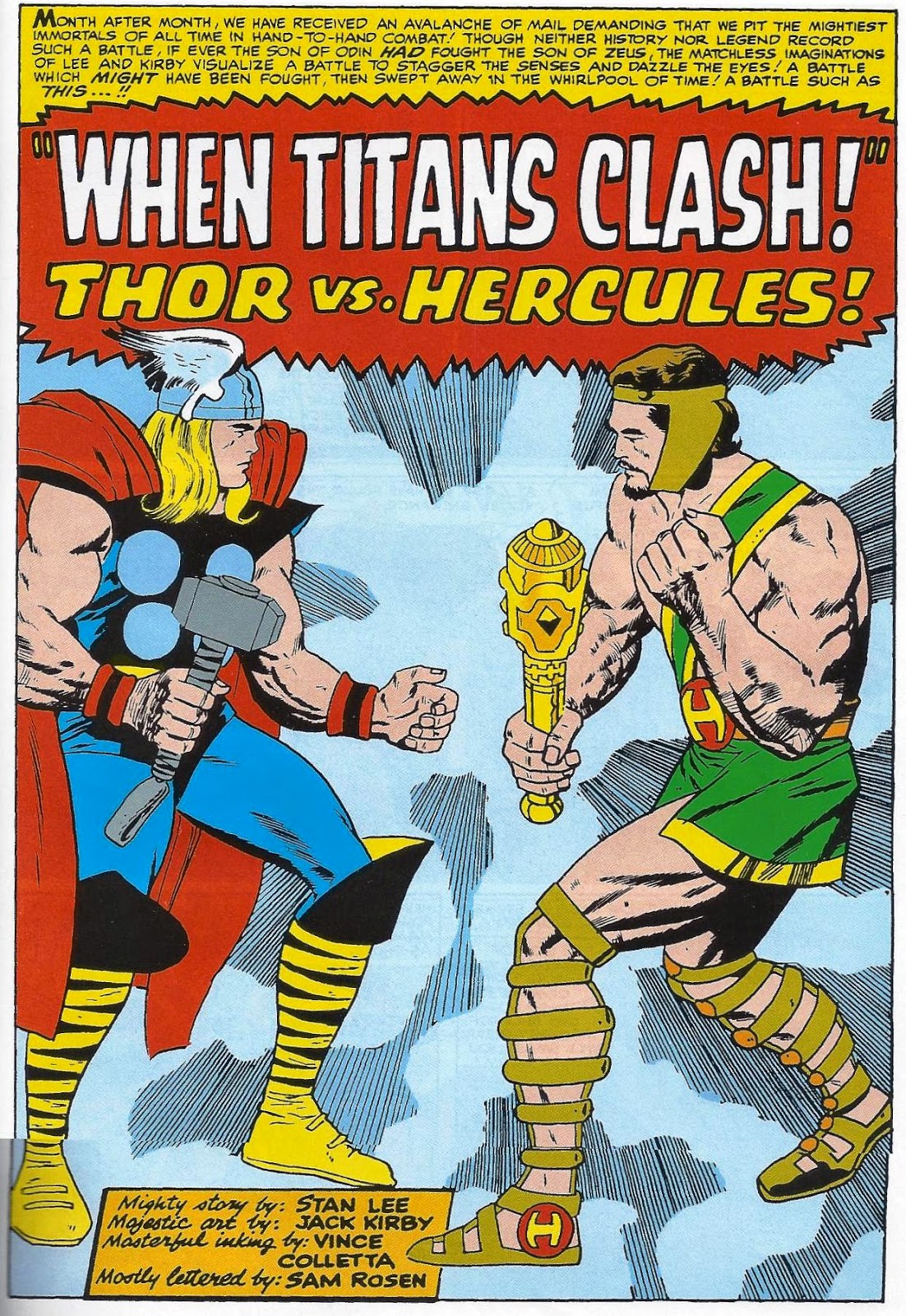 God of Thunder vs. Lion of Olympus? Shoot -- why wait?!
Doug: We open with a nice splash page, perhaps an image that could have taken place a mere moment ahead of the shot on this issue's cover. Even in a stand-off, Kirby's figures exude dynamic power. So we get it rolling on page 2 with Thor and Loki riding their steeds amongst some craggy rocks. Thor has convinced skeptical Loki to ride with him in search of adventure in Jotunheim -- the land of the Storm Giants! Thor knows the legends, that the Storm Giants have been searching for a lost passage to fabled Olympus. But wanting a little action, and glory to report to the All-Father, Thor has come here really to create some mischief. He spies two giants moving heavy rocks and attacks them without provocation. Loki melts away while Thor takes it to these two bozos with all the fury we saw on display in the battle scene that began Thor: The Dark World. This action is fast, powerful, and over pretty quickly. But of course Thor's brazenness could be his worst enemy, and indeed in his lust for a quick and lasting triumph he creates a massive landslide.
Karen: It's interesting that the caption on the splash page finds the creative team sort of hedging their bets, saying that "if ever the son of Odin had fought the son of Zeus" it might have been like this!
Doug: I love these stories that have the flavor of a "Tales of Asgard" yarn, because Thor always seems to be even a bit wilder and more impetuous. In the Earthbound stories his godliness seemed a bit more to the fore.Doug: Thor falls with the rockslide, down, down, down... until he lands upright in a chamber made of stone. He figures that the giants must have been right in their guess as to the placement of the gateway to Olympus, for surely he must be in it. He ventures outside, attempting to remain in the shadows. He marvels at some of the odd creatures he sees, yet thinks that perhaps Olympus is not so different from Asgard. But he knows that he must find a way back to the Realm Eternal, so sets off in bold fashion toward a bridge. But -- you guessed it -- as fate would have it another wants to use the narrow construct first. And that someone happens to be named Hercules. What a great way to introduce the conflict between these two: who can be the first to walk across a bridge.
Karen: Lee must have felt the need to tie the realms of Asgard/Jotunheim and Olympus together, but the idea that the giants originated in Olympus is an odd one. I can't recall reading of giants in Greek myths -other than the Titans or Cyclops. Kirby gives Olympus a distinctly different look and feel than Asgard. We see typical Greek mythological characters like satyrs and centaurs, as well as the marble columns and temples that typify ancient Greek civilization.
Doug: Even though I read this in the Essentials, I could still get a sense for the brightness and airiness (is that a word?) of Kirby's Olympus. While Asgard was generally depicted as magnificent, I think the notion that it floated as an island in space always transmitted to me a darker setting.
Doug: I truly don't know which I enjoy more in this era of Thor -- Kirby's visuals or Lee's dialogue. Both are just wonderful. Hercules and Thor begin to spar verbally as well as physically, and it's just a hoot.
Karen: This younger Thor is much more like Hercules in personality than his later, more somber, self. That does make it a lot more fun to watch them go at it! Hercules' look was definitely inspired by the Steve Reeves' Hercules films, although where the little "H"'s on his heels and belt came from, I have no idea (the same place as Galactus' "G" I guess).
Doug: Hercules uproots a large totem and bends it into a shape that he declares he will use to bind Thor and make him Herc's prisoner. Dumb old Thor plunges headlong into the twisted arrangement, and Hercules does indeed ensnare him. But Thor strains against his bonds and bursts free, to Herc's incredulity. They again resume fisticuffs, with Hercules pledging to strike Thor again and again in the same spot until Thor falls. Well, Thor does indeed fall, only to bust out a trick that only fans of the Silver Age could appreciate -- the Son of Odin digs his fingers into the turf and rips up the entire landscape like it was a roll of carpet! Hercules is thrown off-balance. As Thor leaps upon his adversary, Hercules grasps two large stones, which he crashes together in Thor's face, the powder blinding the Asgardian.
Karen: Well, we got the pulling-on-the-ground trick.
Doug: With no vision, Thor knows he must swing wildly in order to stay upright until his eyes are clear of the dust. Each immortal uses his strongest punches to try to vanquish the other. But suddenly the Earth shakes as light cracks the sky. Zeus appears, and orders an end to the battle. Fittingly, he's been watching from afar and thinks the whole thing was just great. In a page out of any parental handbook, Zeus compliments both of the spoiled brats, declares them equals, and makes them shake hands and declare friendship for one another! Thor offers that Zeus has the same lordly qualities as his own father and even kneels to the All-Father of Olympus. But then Thor says he must take his leave of Olympus to return to affairs in Asgard. With some Kirby rays emitting from the royal scepter, Thor is lifted back across the divide to Jotunheim, where his adventure began. Loki awaits, and Thor accuses him of fleeing during the fight with the giants. Loki asked where Thor had gone, but the prince says that his memory is failing him. Suddenly huge boulders begin to erupt from the chasm -- Loki claims it must be the work of the Storm Giants, but Thor knows better. He smiles to himself as he watches Zeus's barrier complete itself, but muses that someday he shall again learn of Olympus and see Hercules.
Doug: This one was short at only 15 pages. We remarked to each other when we chose this Annual for our little Avengers series that it seemed somewhat out of place, disconnected from Giant-Size July. But when we paged through it and found how short it was it was sort of nice. It's a simple story -- the only motivation in telling it is to pit Thor against Hercules. I suppose it's more satisfying than the Thor-Hulk tussle in Journey Into Mystery #112, although like that there's no real winner here. But it must have been a thrill ride for youngsters who'd have come to this in the year before I was born! And as I remarked above, today's story hails from that time when Stan, Jack, and Vinnie were cranking out top-notch adventures each and every month.
Sunday, November 10, 2013
BAB Classic: Doug's and Karen's Favorites -- Thor Annual 5
NOTE: This post was originally published on July 25 2011.
Thor Annual #5 (Summer 1976)
"The War of the Gods!"
Steve Englehart-John Buscema/Tony DeZuniga
Doug: Man, how do you put your finger on that favorite Annual? The usually-summertime release of these treasures makes them so memorable! I'll declare right now that this is my favorite, and that's saying something.
Doug: Scribe Steve Englehart gives us the "Tales of Asgard" treatment over the first 7-8 pages, and it's a nice rendition with John Buscema providing the visuals.
Karen: I find it really interesting that Steve Englehart wrote this story. As far as I know, Englehart never had any kind of run on Thor. The only time he worked with the character was in Avengers. I'd love to know why he was given this assignment. But whatever the reason, I thought he handled this mythic narrative very well. Of course, Buscema's art is magnificent, even if DeZuniga is not my favorite inker for him.
Doug: As Chapter 1 begins, following the lengthy but able prologue, we meet the mighty Thor, prince of Asgard. Thor's personality is laid out for us: brash, loyal, a fighter. We're told of his affinity for Midgard, and that he is wont to pay heed to the prayers of mortals that are directed toward him. We also see the forging of Mjolnir, and here is the reason why I've always thought the mallet to be made of stone -- it's right here! Of course, every other source tells us it's made of a metal known as Uru, but here Englehart clearly states that it's stone. And no argument from me -- in my eyes, it had always been portrayed as if it were stone. As Englehart's background information segues into today's story, Thor appears near the Arctic circle to join a battle on the side of his beloved Vikings. These men are engaged by warriors not known to Thor, but nonetheless Thor brings death to them. We cut away briefly to the headquarters of the invaders and find that they are Greeks, who now pray to their champion -- Hercules, son of Zeus!
Karen: This reminded me a bit of that sequence in the Thor movie where we see the Vikings and then the Asgardians vs. the Giants.
Doug: So what do you think of this yarn so far? I recall as a kid just hanging on every word and picture. I was really into mythology at this point in my young reading life, so for these tales to spring to life was astounding. I don't think I'd fully fleshed out my opinions on various comic book artists, but I knew that Big John was something special. I knew nothing of Steve Englehart (though I'd been loving his run on The Avengers), but his manner was easy. I probably didn't know him from Roy Thomas, but I'd say now that Roy would have worded this up even more in order to include limitless literary references.
Doug: Well, back to the battle royal at hand. Big John really cuts loose in this scene -- I don't think I'm exaggerating if I say that it's quite possible to hear the battle while looking at the beautiful tableau in hand. After several pages of awesomeness, however, Thor decides that the brutalities between he and Hercules can only end in a draw.
Karen: It's interesting that at this point in time, Thor and Herc have very similar personalities -brash, immature. Back when Hercules first appeared in Thor in the '60s, he was always shown in this manner, while Thor was portrayed as more somber and reasonable. It's fun to see a younger Thor here, with a little more fire -even if he was a dunderhead.
Doug: On the mount, Herc is meeting the same fate that Thor was faced with. It's a bit worse, though, as aside from bloodthirsty Ares (why, oh why, did Bendis ever think Ares was an Avenger??) no other among the pantheon of Greek gods will side with Hercules. I want to add that there's plenty of great characterization here -- Englehart gets the voice and personality of each of these gods and goddesses. But remember Loki... Suddenly "Thor" materializes in the midst of the Olympians and strikes Hercules while hurling insults at one and all. It doesn't take Zeus long to come over to Herc's point of view -- it shall be WAR!
Karen: Englehart knows his mythology too, as he has Hera show her disdain for Hercules, "the unfortunate result of earlier escapades"!
Doug: Yep -- caught that. And if she knew ol' Zeus was going and disguising himself as all manner of beast... What a war it is! Buscema again is really allowed to cut loose. There's a lot of pageantry in this battle, as it oozes "epic" right off the printed page. There's a nice little vignette involving Balder battling Ares and again, Englehart nails it. But in the end, it is the Asgardians who triumph.
Karen: The artwork is spectacular. I can only imagine that Buscema had a blast drawing ancient warriors, horses, weapons, etc. This was like Conan but on a larger scale.
Doug: Chapter 3 opens in Odin's throne room, as Loki is in custody and Thor stands before his lord. Thor, dull one that he is, wonders how Odin knew it was Loki who orchestrated the battle. Odin has a couple of great lines in this scene, as does Thor.
Karen: Odin is very well handled in this story. He comes off as regal and masterful, not petty as he often seemed in the Lee-Kirby era.
Doug: But in Olympus, Thor and the others are not recognized. In fact, they are insulted. Thor, ever the hothead, decides to bring the thunder to the Greeks. But as he raises Mjolnir, naught transpires! Disgusted and dismayed, the Asgardians immediately return to the North. Storming (no pun intended) into Odin's quarters, Thor seeks answers. As father and son battle to be heard, it is the All-Father's voice that wins out. When Odin speaks, he informs Thor of his machinations behind the scenes and with his counterpart Zeus. The Olympians, you see, believe that they won. And then Odin imparts wisdom in a morality play that ends our tale: the Asgardians exist because the Vikings believe in and worship them; likewise for the Olympians and their Greeks. It's a symbiotic relationship, Odin explains, and one Thor doesn't quite grasp. Why, then, would he have power in Olympus? They believe in him not. Departing abruptly, Thor wanders, feeling like he's been played. Venturing near the quarters of Karnilla the Norn Queen, he allows her to prophesy to him -- of coming champions with which he will ally himself: the Avengers. And our young thunder god knows one thing: that he doesn't yet know everything.
Karen: I liked that idea, that the faith of men strengthened the gods. Of course, it doesn't hold up when you think about Thor's battles in outer space with aliens who haven't a clue who he is, but it's still a neat idea. Buscema portrays Thor's frustration very subtly. The quick flash of the Avengers was nice, as was the final page showing the thunder god in his glory.
Doug: This story was recently reprinted in a trade paperback, Thor vs. Hercules. I'd say -- get your hands on it! I'll stop with the praises -- you should have gotten my message by now. What a great way to have spent 30-35 minutes as a 10-year old!
Subscribe to:
Posts (Atom)